VIDEO: Time to Face the Facts about Caribbean Corruption – 26 May 2013

This is the interview on Caribbean Corruption for ‘Time to Face the Facts‘ which was broadcast out of Barbados-based Caribbean Media Corporation on Sunday 26th May 2013.

The audience was regional via cable and global via their Facebook page. The interviewer is Jerry George and the format was a live call-in. Video courtesy Jerry George

Part 1:


Part 2:

Part 3:

Charting our losses: ‘A picture is worth a thousand words’

The last four articles in this series have focused on what I call ‘two sides of the same coin’ – the coin being the large-scale and improper use of Public Money.

I examined the THA/BOLT office project called MILSHIRV being undertaken with the Rahael group and the Calcutta Settlement land scheme in which the HDC acquired developed lands at several times the proper price the State could have paid.

Throughout this type of critique one has to strive for effective balance and fundamental integrity.  The extent of the waste and/or theft is never easy to pinpoint when one is working from outside and relying solely on published documents, but my best efforts to establish those facts is what is presented.  Of course it is impossible to say for sure that any amount of money was stolen in a particular project, hence the phrase ‘wasted or stolen’.

Objectively, it does not matter whether the money is wasted or stolen, if it is ultimately unavailable for the benefit of the Public.  Once spent, that Public Money is gone forever, which is why Value for Money is of such importance in any proper Public Procurement system.

Subjectively, however, the errors of inexperience or poor process must be differentiated from an active conspiracy to defraud.  Although the objective measure of loss might be identical in terms of the dollar-amount, there are different long-term consequences.  Innocent errors and miscalculations can be rectified over time by ongoing review processes.  Deliberate conspiracies to defraud require concerted and well-grounded attacks in order to be eliminated.  What is worse about the deliberate conspiracies is that they affect the very atmosphere in which public business is conducted.

We end up with a situation where it pays to pay a bribe and the decision not to pay is to suffer delay.

That is why we are where we are today.  Simple so.

One of the important lessons emerging from the Wall St disaster is that the variety of financial regulators with their varying rules and experiences allowed financial players to engage in ‘Regulatory Arbitrage’. That was  the scenario in which financial players shopped for pliable or suitable regulators within which to channel their products, resulting in the unprecedented financial disaster we are all living through.

Here in T&T we have seen a similar pattern in our financial markets, but the point being made here is that it has also emerged in the Public Procurement arena, with TIDCO paving roads; the rising profile of State-owned entities which were deliberately excluded from the formal procurement controls; those same companies breaking their own rules and so on. That is the emergence of a toxic kind of ‘Procurement Arbitrage’, which is the reason why we must have over-arching regulations to control all transactions in Public Money.

So, there are two types of losses being charted here –

  1. Firstly, inexperienced officials or poor processes can approve wasteful uses of Public Money through sheer ignorance.
  2. Secondly, there is deliberate conspiracy to defraud the Treasury of our precious Public Money.

Only a Court can establish whether the lost Public Money was wasted or stolen, so I have ventured no opinion as to which is which. Readers can reach their own conclusions.

These charts illustrate the extent of the waste or theft of Public Money in the THA/BOLT and Calcutta Settlement projects.

A good example is worth a thousand words

THA/BOLT – MILSHIRV Project

Rental Rates THA- BOLT chart
Occupancy Excess THA-BOLT
Rental increase chart with table THA-BOLT


Click on the charts above to see full size version


Calcutta Settlement Land sale – Eden Gardens

stamp duty Eden gardens Chart 1 20130405-1
Acquisition options HDC chart 2 20130405


Click on the charts above to see full size version

Calcutta Settlement review

The simple, inescapable fact is that the State could have lawfully acquired the ‘Eden Gardens’ property for less than $40M.  The HDC paid $175M in November 2012 to Point Lisas Park Ltd (PLP) for that property, which is the reason I am calling this an improper use of Public Money.

Despite having available the advice of the Commissioner of State Lands, the Commissioner of Valuations and various attorneys at HDC and so on, the Cabinet approved this transaction.  This Cabinet, with two Senior Counsel at its head and several other seasoned legal advisers, appears to have been unaware of, or intentionally ignoring, the legal safeguards.

Some readers may be surprised at those assertions, so here are my reasons for making such.

The last two articles examined the steps leading to the HDC’s purchase of land at ‘Eden Gardens’ in Calcutta Settlement.  In my opinion that transaction, as well as the one which preceded it, are both highly improper and very probably unlawful.  The HDC purchase must be reversed and the responsible parties investigated/prosecuted as required by our laws.

This ‘Eden Gardens’ episode is an object lesson in what can go wrong when elementary policy is set aside for stated reasons of expediency.  Apart from the lack of any Needs Assessment, the unclear role of the Commissioner of State Lands is a source of serious concern.  That Commissioner’s role is to advise the State on the strategic implications of its land policies and transactions, so this is a straight example of a case which required a solid input from that critical State Officer.

So, what should have happened?  How would a proposal like the ‘Eden Gardens’ one have been handled if the various parts of the system were functioning properly?

When parties are in commercial negotiations, there is always a Plan ‘B’, to be adopted in case the main plan goes awry.  Each side has a different Plan ‘B’, since they have different interests.

What was Point Lisas Park’s Plan ‘B’ in case their negotiations with the State were unsuccessful?  While we can never know for sure, PLP being a private company, the fact that those lots were widely offered at $400,000 can allow us to form a view as to the benchmark they were likely using.

The State’s Plan ‘B’ is far simpler to establish, since there exists the legal power to compulsorily acquire private property for a public purpose.  That was the third unique facility enjoyed by the State as set out in the previous article.

In the case of a landowner making unreasonable demands, the State has the lawful option of compulsorily acquiring the property.

The Land Acquisition Act 1994 (LAA) establishes the right of the State to compulsorily acquire private property for a public purpose.  At S.12, the LAA specifies the rules of assessment used to arrive at the sum offered to the owners of private property interests being acquired.

S.12 (4) states –

…(4) In making an assessment under this section, the Judge is entitled to be furnished with and to consider all returns and assessments of capital value for taxation made or acquiesced in by the claimant and such other returns and assessments as he may require…

The point in this case being that, having registered a purchase at $5M in February 2010, PLP would have been unable to legally resist a compulsory purchase which adopted that price as its basis.  Even if the State, in recognition of the roughly $29M spent by PLP on building the infrastructure for ‘Eden Gardens’, were to add that sum, the final offer would only be about $34M.

Those provisions at S.12 (4) of the LAA are a critical safeguard against persons who might seek to under-declare their properties to evade taxes, then seek to make exorbitant claims if the State seeks to acquire compulsorily.  S.12 (4) prevents the State from falling victim to any such games, it is a critical safety-valve to protect our Treasury from those who seek to pay as little as possible when taxes are due, but boldly make huge claims from the Treasury when seeking to sell.

That is why I am calling for this matter to be swiftly investigated and the responsible parties prosecuted to the full extent of the law.

This was in reality a potent dilemma for PLP, in that if they were served with a proper compulsory purchase notice, they would have either had to stick with the $5M figure as a 2010 baseline, or reject that deed and incur the strong penalties at S.84 of the Conveyancing and Law of Property Act.

One of the three deeds executed on Wednesday 3 February 2010 recorded the purchase of ‘Eden Gardens’ for $5M, which is a massive understatement of consideration.  The true market value of that undeveloped property at that date would have been of the order of $50M, so the loss of Stamp Duty to the Board of Inland Revenue would have been in excess of $3.0M.  The underpayment of Stamp Duty is tantamount to a defect in title of a property.  Are we witness to the State making a massive over-payment for marginal lands with defective title?

Did the Cabinet and the HDC receive the proper advice from the Commissioner of State Lands and the Commissioner of Valuations, as well as the other legal advisers?  If yes, that advice was plainly not followed, so in that case the question would have to be ‘What caused the Cabinet and the HDC to abandon that sound advice?

If the true situation is that the proper advice was not provided, we need to know why.  If the advice was not sought, then we need to know why.  If the advice was sought, but not provided, those advisers need to be rusticated so that our processes are protected from more of this nonsense.

The State has an overriding duty to comply with the law and be exemplary in its conduct.  That is not negotiable, if we are to build a society which is orderly, progressive and just.

Episodes such as the ‘Eden Gardens’ sale and the THA/BOLT deal continue the erosion of Public Trust and the loss of that intangible, almost-forgotten, source of ‘soft power’, the Benefit of the Doubt.

This Prime Minister has made repeated statements that any evidence of wrongdoing will be investigated, so that the offenders can be prosecuted according to law.  These three articles have detailed the evidence and breaches of sound public policy, so it is now over to the authorities.

The ‘Eden Gardens’ transaction is a prime example of a large-scale economic crime against the State and the interests of its citizens.

Again, I ask – ‘Who were the beneficiaries?

The final point here is that the parties to the PLP purchase and improvement of ‘Eden Gardens’ are now in litigation, with the contractors – SIS Ltd. – suing Point Lisas Park Limited for various monies and demanding an account of the $175M.  Case CV 2012 – 5068, so we have interesting times ahead.

Calcutta Settlement again

163940In light of the many questions raised by readers after the last article on the HDC’s purchase of land at ‘Eden Gardens‘ in Calcutta Settlement, I am continuing there.

The previous article discussed the Calcutta Settlement scheme and its relation to implementation of national housing policy.  There is little, if any, connection between the provision of affordable housing and the acquisition of those ‘Eden Gardens‘ lands, at what is surely the highest price in Central Trinidad.  How we create and implement a progressive housing policy is a critical part of this discourse, but there is more.

Another important aspect of this episode is the fact that sound land administration policy appears to have been abandoned for expediency.  Expediency should never eclipse proper policy, especially when neither the process nor end-result advance the ultimate objective of serving our citizens.

The sidelining of sound land administration policy was essential in order to get the Calcutta Settlement scheme approved.  National Land Administration policy is important so that we can be strategic in using the country’s property assets for proper national development, as opposed to the enrichment of a select few.

The State is a unique player in our country’s land arena, so we need to place this Calcutta Settlement episode into proper context from a land administration viewpoint.

This is the framework –

  • Size – The State is by far the largest land-owner in the country, which means that there are only limited situations in which it will require private lands;
  • Wealth – The State is the wealthiest entity in the country, which means that it alone can bid at certain levels for the best properties.  Applied to this case, a reasonable question would be ‘Who would have purchased ‘Eden Gardens’ and at what price, if the State had not proceeded?‘;
  • Compulsion – The State is the sole entity in the country able to lawfully acquire land for a public purpose against its owner’s wishes, which means that if an owner of private property takes an unreasonable position during negotiations, the State can compulsorily acquire it;
  • Planning Authority – The State is the national planning authority, which means it has the power to approve its own designs and proposals;
  • Statutory undertaker – The State has ownership and control of the principal utilities, electricity and water/sewerage;

So, if the State intended to construct affordable housing in Central Trinidad, it could have chosen from the abundant State-owned property in the area, granted planning permission for its own proposed development and provided services.  The State could only have bought the ‘Eden Gardens‘ land by ignoring sound land administration principles.  Elementary policy was ignored in favour of sheer expediency, or worse, the enrichment of carpetbaggers at the expense of the Public Interest.

What was the advice of the Commissioner of State Lands on this transaction?  Was his advice sought?  Bizarre and expensive precedents are being set in situations of zero benefit to the Public Good.  This deal is detrimental to the Public Interest.

At a level of State policy, there was a collapse into expedience and a continuing silence as to the role of ‘Eden Gardens’ in the national housing policy.  But when I delved into the documents in my possession, there were even more causes for concern.

The Registrar General’s records show that there were three transactions executed on the same day for this property – It was Wednesday 3 February 2010 –

  1. Deed # DE2010 004276 02D001 rescinded the 2004 Sale Agreement (the one for $17M, registered in 2007), with the deposit returned and no claims made;
  2. Deed # DE2010 007816 95D001, Point Lisas Park Ltd (PLP) purchased the property from the owner, Sookdeo Deousaran, for $5M, paying Stamp Duty of $350,000;
  3. Deed # DE2010 003449 63D001, PLP mortgaged the property to said Sookdeo Deousaran for $18.5M at 8%, to be repaid on the last day of January 2012.

These purchasers were prepared to pay $17M for this undeveloped property in mid-2004, but ended up paying only $5M for it in early 2010.  On the same day, they mortgage it for $18.5M.  By happy coincidence, or otherwise, the property with infrastructure added was offered to the HDC at $200M in late January 2012, two years later.  Literally unbelievable.

What is more, the fact that the second and third of those deeds were executed on the same day is deeply perturbing as to the operation of the Stamp Duty section of the Board of Inland Revenue.  The second deed transfers the property for $5M and Stamp Duty is paid on that, yet the third deed shows a mortgage granted the same day on the same property for $18.5M.  Normal practice in the finance world is for a mortgage to be taken on a property at some fraction of its current market value.  Both those deeds were registered at the San Fernando office of the Registrar General’s Dept.

If there were a reasonable gap between the first sale to PLP and the new owners mortgaging the property, it might be possible to claim some increase in value due to its physical development or obtaining permission to develop.  But since both transactions took place on the same day, there is no way anyone can claim a genuine difference in value.

The 8% interest rate on the two-year mortgage is instructive, in that the actual rate at which finance was offered at that time for similar projects was in the 10.5-12.0% range.  The reasonable conclusion being that both sides had a high degree of comfort with each other, indicative of close collaborators.

S.84 of The Conveyancing and Law of Property Act (1939), states that the penalty for falsely stating the consideration in a deed is a modest fixed fine and a further penalty payment of 5 times the amount of the understatement.  Those penalties apply to both the buyer and seller, perhaps to discourage these dishonest practices.  The Act goes further to offer the penalty payment as a reward to the person making the report of the understatement.

S.86 of that Act also specifies a small fixed penalty for an attorney found guilty of “…knowingly and willfully…” recording a false consideration and mandates that the said attorney “…shall…” be disbarred.  Of course an attorney who had prepared only one of those deeds could reasonably claim to be genuinely unaware of the entire transaction, so we will see.

Sad to say this ‘Eden Gardens’ scheme is reminding me of the CL Financial antics. I am thinking about the the affidavit of the Inspector of Financial Institutions  stating that Clico Investment Bank did not file its Corporate Tax returns for 2007, 2008 and 2009 and the fact that, despite those lapses, they were able to obtain a bailout on ‘sweetheart terms‘.  The Eden Gardens chiefs were able to understate the property value to avoid the true level of Stamp Duty, but were also able to get Cabinet to agree to effectively bail them out, also on ‘sweetheart terms‘.

Always remember that the land at ‘Eden Gardens‘ cost $663,000 per lot as agreed by the Cabinet, seemingly unaware that the developers were offering lots there for sale at $400,000 only months before.

The HDC purchase was completed on 9 November 2012 and recorded in DE 2012 026026 11D001.  The para before the $175M sale price is the one which specifies the 2010 deed for $5M, just so.

I approved of the diligence of our AG in challenging the legality of the THA’s BOLT project.  This ‘Eden Gardens‘ scheme is also in need of urgent investigation, so we will see.

My final point is that all the information cited in this article is available on the internet, so where is the basic due diligence?  These sorts of schemes should not even get past the first gatekeeper, far less into the Cabinet for consideration.

From THA/BOLT to Calcutta – tangled webs: Part 1

tha-bolt1
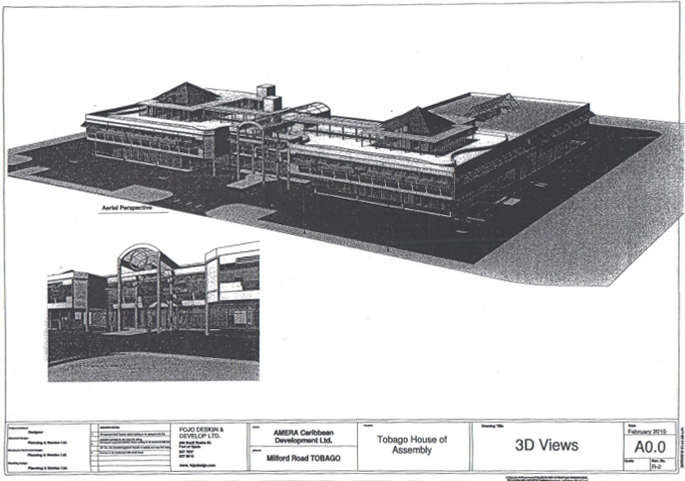
Artist Impression of THA Admin building courtesy Amera Caribbean Development Ltd.

With the THA elections having become a kind of national contest, the issues of governance and integrity loom large.  The two relevant controversial issues, both of which emerged late last year, were the THA/BOLT office project and the HDC’s proposed purchase of land at Calcutta No. 2 Settlement.

Both those projects have given me serious cause for concern in terms of proper public procurement practice, so much so that I see them as being two sides of the same coin.  Both these cases are models of inadvisable dealings in Public Money of a type which no prudent or reputable company would undertake.  I am choosing my words carefully since recent reports are that litigation has already started on both projects.

I do not at all agree with the widespread myth that corruption is a minor thing which adds maybe 10% or 15% to the cost of projects.  That misinformation is nothing but public mischief which has blinded us to the scale of the theft of Public Money, so it must be completely demolished.  In the case of the 1970s to 1980s ‘Government to Government Arrangements’ the then PM, George Chambers, told the nation that two out of every three ‘Petro-dollars’ was wasted or stolen.  In the ongoing imbroglio over the $1.6Bn Piarco Airport project, we learned from the DPP’s S.34 statement that $1.0Bn of Public Money had been located in offshore bank accounts.

The DPP’s S.34 Statement on Wednesday September 12, 2012

…These cases involve allegations of a conspiracy to defraud the Republic of Trinidad and Tobago of over TT$1 billion by the fraudulent use of bonds and the rigging of the contracts for the various Construction packages for the Piarco Airport Project…

The DPP’s full statement is here.

Also, from “Cops target MP in $1Bn airport scam” in Trinidad Guardian of Friday 5 March, 2004 –

…TV6 News reported last night that Lindquist and Interpol officers had discovered more than $1billion stashed away in off-shore accounts, arising out of corruption in the airport project…

This article deals with the THA/BOLT project, which is a Public Private Partnership. The PPP is a procurement model now being pursued by this government, according to the strategy outlined in the 2013 budget.

Build Own Lease Transfer (BOLT) is a subset of the PPP procurement method.  Under a BOLT arrangement a client has a facility built by the private sector at their expense – the client makes agreed rental payments so that the developer can cover the cost of building the project and a reasonable profit.  At the end of the agreed lease period, the facility is transferred to the client.

There has been effective use of PPP to produce Public Goods like the Brian Lara Promenade.  BOLT has also been used to procure prominent POS buildings such as NALIS, UTC HQ and Ministry of Works HQ (via Republic Bank) and the AG’s office at Cabildo Chambers (via NIPDEC).

The PPP can be a feasible method of procuring public goods, offices or other facilities in situations where the State is unable to commit to the capital expenditure and there is a pressing need.  The strong selling-point of the PPP is that the private sector takes the risks and is allowed to make a reasonable profit while the public sector can add to its stock of capital goods without the risks of project execution.

These PPP arrangements are now being intensely criticized in developed jurisdictions as having served the public interest very poorly.  The focal point of much of the criticism has been the fact that, despite the rubric, the private sector has seldom taken any genuine risk.

Turning to the actual THA/BOLT deal, I have to say that the decision to publish a large number of the important documents in relation to this arrangement is to the credit of the THA.

The bundle of documents are here.

Orville London, THA Chief Secretary

In response to the request from the Minister of Finance, THA leader Orville London said:

…that under the laws and the T&T Constitution the Finance Minister has no authority to instruct him to provide information to him within any timeframe.

However, London said, in the interest of public disclosure and considering that this particular transaction has generated so much discussion he believed that he had a responsibility to make the information available to the public and the Minister…

This is a bold and in my view admirable initiative by a leading Public Official and I have to say that it has tempered my scepticism over this project.  I only wish that Cabinet Ministers took a similar view of their responsibilities.

The THA ‘bundle’ details the ongoing financial shortfall in allocations from Central govt, the main point of which is the fact that the THA is definitely resource-starved in relation to the arrangements with Central govt.  When one considers the financial state of the THA alongside the national economic outlook – we are in our fourth year of deficit financing in relation to the national budget – it is a sobering background to this discourse.

I have spoken with all the main parties to this arrangement and this is a summary of the THA/BOLT deal.  The THA purchased a 3-acre parcel of land at the corner of the Claude Noel Highway and the Shirvan Road from private landowners for $12M and immediately leased it back to them for a 199-year lease at a nominal rent.  The private developers have agreed to erect an 83,000sf office building at a cost of $143M and the THA has agreed to lease it for 20 years at a fixed rent of $15.61psf – an annual rent of about $15.55M, totalling some $311M over the term of the 20-year lease – with the property reverting to the THA at the end of the lease.  Those offices are to be built for the THA’s Division of Agriculture, Marine Affairs, Marketing and the Environment.

There have been recent reports of the AG’s lawsuit to test the legality of the THA/BOLT arrangement, so this is not an attempt to pre-empt the Court in ruling on those submissions.

My concerns arise at the level of the Needs Assessment, which must be the first stage of any proper procurement process, public or private.  The purpose of the Needs Assessment is to determine the rationale for and scope of the project so that preliminary consideration can be given to the key elements before any high costs are incurred.  In this case, we are told that the developer approached the THA, which is unusual to the extent that best practice requires that extra care be taken with unsolicited proposals.

The main points concerning me are that once again we are seeing large-scale expenditure of Public Money without a proper business case having been made.  The opinion of Hamel-Smith & Co as to the legality of the transaction is of no comfort to me, this is a matter of making a sound investment decision.  A legal opinion is necessary but not sufficient.

Senate president, Timothy Hamel-Smith

That 6-page legal opinion,dated 3 January 2011,by Timothy Hamel-Smith (who was appointed Senate President on 18 June 2010) is at page 168 of the ‘bundle’.

  • Quantity of space – at pages 68 and 69 of the THA ‘bundle’ there is a ‘Note for Executive Council’ which summarises that the offices occupied by that Division – a total of 22,500sf is detailed, while a further 6,000sf can be reasonably surmised for the last Department.  The average rent being paid by the THA for this Division is $8.17psf, also please note that a total of 28,500sf is now occupied by the Division for which the THA is procuring an 83,000sf office building.
  • Quality of space – The cost of $143M for that space equates to $1,723 per square foot and I am reliably informed that the contract calls for a fully fitted and finished office building.  That figure is at the absolute upper end of the range of costs for office buildings.
  • Rent levels – According to the THA’s adviser on this project, Peter Forde, at the THA Press Conference on 10 September 2012 – see

    …the monthly payment of $15.61 per square foot per month was not an unreasonable rate because there were properties in Scarborough where tenants were paying as much as $10.00 per square foot. He stressed that even if there was inflation the rate will remain the same…

    The first issue I have with that is the attempt to use the $10psf comparable to justify the $15.61psf rent.  That is an unreasonable ‘stretch’ by my standards as a professional valuer.  Did the THA seek the opinion of the Commissioner of Valuations?  Secondly, the fact that the rent cannot be increased in the event of inflation is a distraction, since the likely effect of this new, huge THA office building is that the rental market in Tobago will become saturated with the offices they vacate.  The result of that is the decline in office rental values, so in the absence of any provisions for rent adjustments, the burning question has to be ‘What real risk is this developer taking?’.  Risk Allocation remains a real issue.

So, in summary, we have a semi-autonomous Public Authority contracting, at a time of tremendous financial strain, to build first-class facilities three times larger than the second-class ones it currently occupies.  Finally, please note that according to the ‘Note’ I cited earlier, the current monthly rent bill of the THA Division is $231,788, while the new monthly rent under this arrangement will be $1.295M – over five times more.

At the start of this article, I gave examples of the ratio at which Public Money was wasted or stolen, so just compare this project to those figures.

My next article will delve into the Calcutta Settlement land deal and its own peculiarities.

VIDEO: Early Morning Interview – 4 May 2012

JCC President Afra Raymond appeared on Early Morning with Hema Ramkissoon to discuss ‘Government fails to deliver?’; a question on the minds of the construction industry. 04 May 2012. Video courtesy CNC3

  • Programme Air Date: 4 May 2012
  • Programme Length: 0:16:18

VIDEO: JCC Press Conference – 02 May 2012

The JCC hosted a Press Conference recently to discuss issues in the country in the construction industry. Afra Raymond’s contribution to the press conference is here. 02 May 2012. Video courtesy JCC

  • Programme Air Date: 2 May 2012
  • Programme Length: 0:13:33

Property Matters – Only a matter of time

whooshThe way the Ministry of Planning & the Economy (MPE) is persisting in their course of action on the Invader’s Bay development is perturbing in terms of the long term consequences of short-term decision-making.
At Section 2.0 of the Request for Proposals (RFP) for Invader’s Bay we read

…For Trinidad and Tobago this is a “major waterfront transformation” along the line of other signature waterfront developments such as Darling Habour (sic) in Sydney, Baltimore Inner Habour (sic), the Habour-front (sic) in Toronto, London Docklands and Teleport City in Tokyo. Although the genesis of the projects may vary, the result has generally been bold and dramatic. With the change in the manner in which ports operate and cargo is transported, waterfront property is now more valuable for its residential, retail and recreational function than simply for port activity with heavy industry, docks and fenced off warehouses, as is the case currently in Port of Spain…

We are being asked to consider the Invader’s Bay initiative ‘along the line’ of other leading international examples, which in itself is a good place to proceed from.  The reality is that those developments cited by the MPE all took decades to conceive and what is more, the authors of the RFP know that.  Yet we are also being asked to believe that a workable concept/s could be devised for Invader’s Bay in an RFP which is silent on the current strategic plans for the capital and only gives proposers 6 weeks to prepare.

Of course the lack of consultation will severely limit the participation of many important developers, not to mention the public.

The point is that in all those cities cited by the RFP, there is a serious commitment to consultation, which means that those large-scale transformations took considerable time to conceptualise.

In the city of New York, for example, there has been a long-standing commitment to community-based development.  Check this 6 October webcast from The New School – the introduction is instructive –

For decades, deliberations over land use in New York City have included developers, community boards, elected officials, the Department of City Planning and other city agencies. Do the people who live and work in city neighborhoods have a sufficient voice? Do residents improve the process, or impede progress? Who is best positioned to determine a neighborhood’s needs, and what are the best structures for public participation? New York has long been a leader in community-based development but as the city recovers from the Great Recession, what does the future hold?

And that is just one reference, readers can ‘Google’ to find the many other supportive examples.  In the very RFP, as well as in the recent budget, there is a clear commitment to consultation in national development.  Except in this case.

But there is more.

As I wrote in the opening of ‘Reflections on Republic Day’, on the Raymond & Pierre website on 27 September 2007 –

The best example I can think of for the kind of broad commitment to consultation is, of course, the site of the World Trade Centre in Lower Manhattan: Ground Zero. This is a very interesting example since the site is privately owned and the City of New York is controlled by the Democrats while the Republicans control the national government of the USA. Against this background of different players we have the fact that the destruction of the WTC was a most severe blow to US prestige and power. The entire defense apparatus was rendered useless by that attack. Arguably, there could be no site in the world with a more urgent claim to large-scale redevelopment.

Yet, the fact is that a sort of compact has been arrived at between the parties to the effect that no redevelopment will take place unless and until everyone has had their say. For example, there was a recently concluded international competition for the design of the 911 Memorial. There were over 5,000 entries from more than 60 countries and a winner was just selected.

As expected, the consultations have been controversial and emotional but the fact is that an environment existed in which such an understanding could work. Whatever one’s view of the American imperium, there is a potency to the existence of that huge crater at the heart of their main city while the necessary conversations go on. Time for us to think again.

At that time I was protesting the haste and waste of the then PNM regime, a consequence of their pattern of proceeding with huge developments without any consultation.

At Section 3.1 of the RFP –

TENURE ARRANGEMENT

The proposed Developer will be chosen via this RFP process and shall then enter into a Memorandum of Understanding (MOU) with the Government of Trinidad and Tobago (Ministry of Planning and the Economy) for an agreed lease rate. It is expected that this activity would be finalized within one (1) month of the submission of the said RFP.

Which means that we can expect the choice of the proposed Developer will be made and the lease agreements completed in one month from the closing date. Yes, Friday 4 November.

Sad to say, there is even more.  The RFP also specifies –

“…If financing has to be sourced from an external source, the Developer MUST submit a letter of guarantee from the financier as well as a profile of the financier. Failure to comply with this requirement will result in disqualification…”

When we raised the point that this is an impossible condition for new bidders to satisfy, given the sheer scale of the proposed development, both Ministers – Tewarie and Cadiz – attempted to indicate that this mandatory condition was flexible. Unbelievable, but true.

As leaders, whether in government or non-governmental organisations, we have an obligation to learn from the past. This is an effort to document the events in this episode, so that there will be a record, when the Invader’s Bay matter comes to be critically examined in the future.

The clear inconsistency of the position taken in the budget on urban planning was highlighted in last week’s column. With respect to this project, we noted the attempt to cast this development in the same light as other examples which all involved long-term consultation, the silence on the existing plans, the impossibly-short timetable to elicit fresh proposals, the even-shorter timetable for selection and agreement of lease terms, the wobbling on the financial requirements and incredibly, that the scoring criteria were to be finalized after the proposals were submitted.

It is literally impossible to determine which of these is worse than the others and it is beyond the imagination of any fiction writer I know to take a plot this far. But this is what is happening in our country today.

In my mind, all of these, taken together, show that the publication of the RFP is a form of sham dialogue and openness. If this is the genuine attempt by the MPE, to properly seek the public interest, then I am giving them an ‘F’ for effort.

What we are seeing here is a recipe for disaster, we already have all the ingredients of corruption, so what is next?

It really does make me wonder who runs this country and when, if ever, can we achieve consistent and equitable government. Who is the real power?

Property Matters – The Needs Assessment

The Ministry of Planning & the Economy (MPE) announced last week that 10 proposals had been received in response to its RFP for Invader’s Bay.

Given that MPE has not carried out a Needs Assessment for this prime property, for whatever reason, I will continue to outline the relevant elements for the Invader’s Bay property.  This is not intended to be complete, just a list of what I consider to be the critical items a proper Needs Assessment would include –

  • Investment – This is a parcel of land estimated to be worth at least $1.0Bn, so any attempt to describe this process as ‘not being an investment’ would be completely wrong.  In the literal sense, it might not involve any expenditure of State money, but, in every other sense, the disposal of this $1.0Bn asset would constitute a major State investment in Invader’s Bay.
  • The National Interest – At this moment the imperative is to diversify our economy so as to find sustainable replacements for our declining energy revenues, so this is an apt point.  Following on last week’s column, it seems reckless that such an attractive State-owned property would be developed without consideration of the strategic issue.  Even on the conventional basis of announcements of construction jobs and permanent jobs etc., it is difficult on purely financial grounds to justify most types of development on that site, especially given the generally depressed market.  The decisive factor, given the level of interest such a unique offering is likely to attract, would be to have as an identified ‘Need’ that only projects which were net earners of foreign exchange would be considered.  Such a condition would eliminate any offices, apartments, foreign franchise restaurants or shopping malls and set the stage for a different development discussion.  A necessary discussion at this point in our country.  Please note that the RFP does state that the project should generate foreign exchange, but that is only expressed as an ‘expectation’, which is far too flexible, given the influence of the traditional property developers.  If the intention is genuinely to break with the past and set off in a new direction, the conditions need to be strong enough to break the grip of the past.
  • Balanced Development and Lagging areas – The RFP speaks to these concerns as follows – “The Government recognizes the value of long term planning as well as problems created when long term planning is ignored. In order to ensure balanced development and restore lagging areas, care must be taken in the development of new areas…”  Those are real concerns, but they seem at odds with the intention of the RFP, since the execution of that plan gives us yet another major development in our capital.  We should consider if this is an area we want to develop at this time – bearing in mind that scarce private-sector resources may be required in other part of the country – for instance, the San Fernando Waterfront and other areas – so that development can be balanced instead of continuing the last administration’s emphasis on POS.  The sidebar contains a comparison of three large-scale ‘urban development’ districts which formed part of the budget.

There is always the question of who controls the terms of these public debates.  The intention from this side is to have that flawed RFP withdrawn.  To proceed as things stand is to continue on a path which lacks the necessary transparency and public participation.  The quantities of money involved and the absence of those critical elements means that we would be proceeding with all the ingredients for corruption.

This RFP amounts to an invitation to tender, so the bogus idea that this is just a discussion or consideration of proposals must be discredited.  It is nothing of the sort.   This RFP is a tender process to put these valuable public lands into private hands, which is quite different from a consultation.  We have to stop any attempt to mix-up the two processes.

The State and its agencies have an over-riding obligation to be exemplary in their conduct.

SIDEBAR – A budget comparison

The 2012 budget sets out three urban development projects, at pages 31 and 32 –

  • Invader’s Bay – “…significant interest has been expressed in the transformation of the waterfront along Invader’s Bay. This development has great potential for promoting commercial activities in the services sector and will benefit the country significantly. Such projects are meant to be private sector initiatives utilizing green building technologies and will assist in making Trinidad and Tobago an attractive destination for new investments…”
  • Sustainable City Project – East Port of Spain – “…This initiative, is part of a wider “Emerging and Sustainable Cities Initiative” supported by the Inter-American Development Bank of which Port of Spain has been chosen as one of the five pilot cities from170 eligible cities in the hemisphere…This project is being developed in partnership with the East Port of Spain Council of Community Organizations, the Caribbean Network for Urban and Land Management at UWI, the East Port of Spain Development Company, and other key stakeholders. This exercise has also engaged the Making Life Important Initiative of the Ministry of National Security…”
  • Chaguaramas – “…the Chaguaramus Development Authority is spearheading development in the North-Western region and a master plan detailing land use proposals for that region will soon be subject to public discussion…”

Of course those three proposals are favouring Trinidad’s north-west peninsula, which returns to the theme of balanced development, but a further description of their relative merits is beyond the scope of this article.  I am inviting readers to consider the varying approaches to an important long-term large-scale issue such as urban development.

In the cases of east POS and Chaguaramas, the commitment to widespread consultation is manifest, yet there is no such commitment evident in the case of Invader’s Bay, which seems to me to be ‘the jewel in the crown’.  The three current strategic plans for POS, all paid for by Public Money, are being ignored by the very Ministry responsible for Planning.

Good Public Administration requires actions which foster the confidence and trust of the public, that is indisputable.  Those policies and actions must be transparent, reasonable and, above all, consistent, if the public is to place real trust in the hands of the administration.

For all those reasons, it is unwise for any administration to operate in an inconsistent fashion.

In the case of Invader’s Bay, with the stakes so very high, it would be reckless to continue in this manner.

Property Matters – Proper Procurement Practice

My last column addressed the imperative of controlling State expenditure as an element in the national budgeting process. I made the point that a new Public Procurement system needs to come into effect to give us the tools to control these huge expenditures.

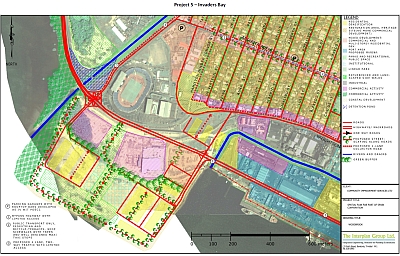
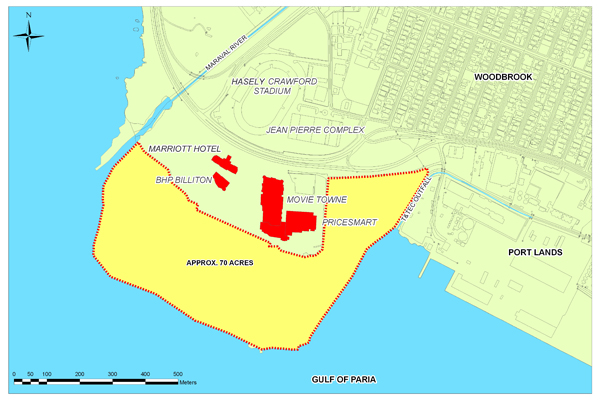
The Ministry of Planning & the Economy (MPE) published a Request for Proposals (RFP) at the end of August for the development of Invader’s Bay, a 70-acre parcel of State-owned reclaimed land – shown in this plan  below: invadersbay-sml

The Invader’s Bay lands are absolutely prime property – flat, waterfront land with easy access to highways and all the urban infrastructure of water, electricity and sewers. These are valuable public lands, with an estimated value of at least $1.0Bn.

That RFP invited proposals with a closing-date of 4 October, which is an entirely inadequate 6 weeks. The Joint Consultative Council for the Construction Industry (JCC) has taken a strong position against that RFP process, including writing the MPE and meeting with the Minister, Sen. Dr. Bhoendradatt  Tewarie and Minister of Trade and Industry Stephen Cadiz, MP.

The JCC wants work for its members, but that must be after a proper process, it is not our intention to stop any particular project

The JCC wants a proper participatory process.

The first “official” response to our publicity was an article in the Newsday of Monday 3 October – ‘Cadiz: JCC jumped the gun‘, the leading point being that the government was trying to open-up the procurement process so as to invite suitable proposals.

Cadiz is reported to have said

…What the Government has done is asked interested parties for proposals for concepts,” he said. “I don’t see that there is any issue at all. There were proposals made and the Government felt that this is public land and we should open it up and we gave people six weeks, we feel that is enough time…

Public Procurement can be described as the process which results in the spending or earning of ‘Public Money’.  Public Money is money which is due to or payable by the State, or any debts for which the State is ultimately liable.  Therefore Public Money must include the contracts entered into by the State as well as the disposal, by sale or otherwise, of State assets.  The Invader’s Bay RFP is the start of a large-scale Public Procurement process, since its stated intention is to lease land to developers who make ‘suitable proposals’.

The publication of the RFP and those statements all give the impression that a proper procurement process is underway at Invader’s Bay.

Nothing could be further from the truth.  Let me explain.

The first step in the Procurement cycle is the ‘Needs Identification’.  The two main questions in the case of Invader’s Bay would be –

  1. What do we want to do with this property?  That must also include ones assumptions as to what uses are not desirable there.
  2. Why do we want to do these things?

For example, the answer to the ‘What’ question could be that the property would be used for recreation or parkland.  The answer to the ‘Why’ question could be either for private profit or to create new recreational facilities as a ‘public good’, those being free facilities which increase the amenity of a district or city.  The Brian Lara Promenade and the San Fernando Hill facility are two examples of that.

Without a Needs Assessment it is impossible to objectively assess what is a ‘suitable project’.  To carry out a Needs Assessment, it would have been necessary for the MPE to have consulted widely with the public and stakeholders.  The Invader’s Bay lands are in our capital and are about one-third the size of the Queen’s Park Savannah.  My point being that any proper Needs Assessment must involve substantial public and stakeholder consultation.

There has been no consultation whatsoever.  None.

What is even more unacceptable is that the RFP, which was published by the Ministry of Planning & the Economy, is silent as to the 3 existing strategic plans for the Port-of-Spain area.  The 3 plans are:

  1. Final Draft Development Plan: A Strategic Planning Framework for Metropolitan Port of Spain (Volume 2 Implementation Plan – The Port of Spain City Corporation) [Main Link] [Alternate Link]
  2. A Strategy for the Economic, Social and Physical Transformation of East Port of Spain: East Port of Spain Strategic Development Plan – September 2007
  3. Port of Spain Waterfront Project Strategic Development Plan for lands from Sea Lots to the Mucurapo Foreshore, still unpublished.

All of those plans paid for with Public Money.  A straight case of – ‘nearer to Church, further from God’.

So, how are the proposals to be assessed?  How will the decisions be made?

At para 3.5 of the RFP, at ‘Project Assessment’, we read –

Proposals will be scored using the “Invader’s Bay Development Matrix and Criteria Description”.

We asked for that document when we met with the Ministers, but were told that it would be completed after the closing-date.

In the absence of these rules, how can developers know the ingredients of a winning proposal?  Given that the evaluation rules are due to be completed after the closing-date, how can we be sure that this is a transparent process?

This could be an opportunity to demonstrate best-practice for public procurement, as promised by the People’s Partnership.

What is happening here is a recipe for accusations, blunders and confusion, just like in the previous decades of ‘old politics’.  All the ingredients for corruption are present and that is why the JCC has made this call for the immediate withdrawal of this deeply-flawed RFP and its revision, after wide consultation.

We need to move away from the pattern of the biggest projects being set-up in secret , so that by the time the public gets to hear about it, all the vital details are fixed.

Expediency taking precedence over proper process has long been a costly constant in the governance of our society.

We must do better and it is not too late to do the right thing.

Expenditure of Public money – Accountability – Transparency = CORRUPTION

SIDEBAR: Criticisms by Cadiz

stephencadiz
Minister of Trade and Industry, Stephen Cadiz, MP

It is instructive to consider the criticisms of the JCC which were reportedly made by Cadiz.The headline accused the JCC of ‘jumping the gun’, implying undue haste and thoughtless speed.  Cadiz is quoted as saying, “…I think the JCC jumped the gun,” he said. “If you cannot do it by six week then how long? Six months?”.

At another point in the same article, Cadiz is quoted as saying, “We need to get these things going,” he said. “The JCC only made representation of their disappointment four weeks into the RFP…”  The implication being that the JCC were tardy and should have acted more swiftly.

If this Invader’s Bay situation were not so serious, it would be comical. The question in my mind is ‘Which of those explanations does Minister Cadiz believe?

What seems clear is the hostility with which the Minister views the intervention of the JCC.