Afra Raymond is the featured speaker at the lunchtime talk to the Rotary Club of Port Of Spain on ‘Public Procurement shifts’.
- Programme Length: 00:19:05
- Programme Date: Tuesday 20 October 2026
Afra Raymond is the featured speaker at the lunchtime talk to the Rotary Club of Port Of Spain on ‘Public Procurement shifts’.

Afra Raymond was interviewed by Wendell Stephen and Sir Charles of NETT Radio on the proposed amendments to the Public Procurement law initiated by the Government. The Bill, The Public Procurement and Disposal of Public Property (Amendment) Bill 2026, was already passed in the Lower House.

Afra Raymond was interviewed this morning, Wednesday 23 September 2026, by Dale Enoch and Tony Lee on The Morning Show on i95.5FM to discuss the proposed amendments to the Public Procurement & Disposal of Public Property Act. On this day, the government will be debating the amendments in the Trinidad and Tobago Parliament. Audio courtesy i95.5 FM
26 Sept 2025
The Editor,
The appointment of Dave Tancoo as Finance Minister following the UNC’s electoral victory on April 28th, 2025, represents an opportunity for fresh perspectives in Trinidad and Tobago’s fiscal leadership. As Minister Tancoo prepares his inaugural budget presentation, the following strategic approaches merit consideration for strengthening the nation’s economic foundation.
Given the importance of this transition period and the complex challenges facing our economy, these three policy frameworks are offered as constructive contributions to the national dialogue on fiscal strategy and economic development priorities –
If UNC wishes to do better than the previous PNM administration, they must act differently.
Afra Raymond
afraraymond.net
Fri, 12 Sept 2025
The Editor,
The second Procurement Compliance Plus (PC+) Lab on 10 September 2025 was focused on Procurement Governance, so it was a strong addition to this excellent training series for this important new legal arena. Although Procurement and Purchasing are long-established essential processes for any business, this is a novel field due to the significant changes arising from the Public Procurement & Disposal of Public Property Act (PPDPPA) 2015. The PPDPPA established effective new rules to oversee transactions in Public Money, with heavily punitive provisions, its most important feature being that oversight and penalties are now applicable to both named Public Sector Officials and Private Sector Suppliers and Contractors.
The interactive sessions were hosted by a cadre of outstanding professionals, led by the estimable Dr Margaret Rose, a long-time campaigner and educator in this field. I was a panellist, but it was also an opportunity for me to learn from and engage with a range of practitioners in this multi-faceted professional field.
Continue reading “Letter to the Editor – Public Procurement Progress?”Sunday, 31st August 2025
The Editor,
The April 2025 election of the UNC govt has triggered convulsions within State-controlled entities, with the replacement of Boards and Management being the main issues, most recently in the case of First Citizens’ Bank (FCB) in which the State is the majority shareholder.
The Finance Ministry is entirely within its legal rights to change the Boards of State-controlled entities, subject of course to compliance with the Central Bank’s ‘Fit & Proper’ rules and the requirements for an Extraordinary General Meeting.
That said, there are a few additional perspectives to consider, flowing from the PM’s outright, repeated declarations that the State is the majority shareholder in both FCB and Republic Bank Ltd –
Finally, I was concerned to note that the new appointee as incoming FCB Chairman is Mr Shankar Bidaisee, who was also recently appointed Chairman of UDECOTT. This is not in any way an attack on Mr Bidaisee’s competence, but the era of the ‘super-Chairman’ or ‘Czar’ should be placed firmly in the history books. Former PM, the late Patrick Manning, found such favour with Calder Hart that he was appointed to Chair the Boards of five State-controlled entities. Yes, five. We all should reflect on how that particular ‘concentration of power’ ended-up1. But that was in the ‘bad-old-days’, and we ought to have learned from those bitter experiences. There are enough high-quality, willing candidates to serve in those positions, even given the heavy demands of public office. That concentration of power is never a good thing, so it needs to be avoided.
Afra Raymond
afraraymond.net
15th August 2025
The Editor,
Since the UNC’s election victory on 28 April 2025, we have had several official statements on allegedly excessive legal fees paid by the State during the previous PNM administration from 2015 to 2025.
Some details of those legal fees paid have now been published, which is good, since transparency on the expenditure of Public Money is essential if we are to have an informed engagement with these issues.
The ongoing ‘CEPEP case’ is also a serious concern, as the parties appear to be battling over the existence and content of various Cabinet Notes and Board Resolutions, not to mention who said what to who and WhatsApp messages and so on. At issue is the legitimacy/legality of the April 2025 renewal/award of various CEPEP contracts said to total $1.4 Billion in Public Money. Having read those articles, I am staggered that the reported defence of the ex-CEPEP Chiefs does not seem to be citing their compliance with the Public Procurement and Disposal of Public Property Act (The Act). What is more, the plaintiffs, as reported in the press, also seems to be silent on such compliance, which is what is required by The Act since April 2023. As interesting as those reported details are, the decisive point in this matter is CEPEP’s compliance with the Act in awarding those contracts.
In the ‘bad-old-days’ of the previous PNM administration we saw the then-AG, Faris Al Rawi, making a meal of the serious allegations of massive legal fees fraud against former PP AG Anand Ramlogan SC and newly-appointed NGC Chairman, Gerald Ramdeen – the sum allegedly mis-appropriated was in the $1.0 Billion region. Yet, at the very same time, the then-Finance Minister, Colm Imbert, was exempting expenditure on legal fees from the oversight of the Office of Procurement Regulation (OPR). Incredible, but that is what really happened in this country.
I am referring to the fact that on Friday 4 December 2020 our Parliament passed the third set of amendments to the Act. Those exemptions were a serious blow to the long-term campaign for proper control over transactions in Public Money and are extremely detrimental to the public interest.
The removal of legal, accounting/auditing, medical fees, and financial services, as well as Government to Government Agreements and ‘such other services as the Minister may, by Order, determine’ from OPR oversight was risible when one considers the strong and repeated statements as to concerns over the alleged legal fees and other scandals. The over-stated concerns as to speed and efficiency could have been addressed by approval limits for ‘Procuring Entities’ and an obligation to make quarterly reports to the OPR. At that time, it was remarkable that the Opposition UNC, as it then was, seemed unable (or was it merely unwilling?) to make those points or advance any counterproposals.
We now have a freshly elected government, with its AG making loud claims about excessive legal fees paid by the previous PNM administration, with a troubling silence on the UNC position on those damaging 2020 exemptions from the Act. I am not at all inspired by the disclosure of this or that legal fee, since what we need is a clear position from the UNC on the repeal of those damaging exemptions from the Act. Those detrimental exemptions must now be repealed so that the public interest could be well-served by comprehensive and independent oversight by the OPR, as intended when the People’s Partnership (PP), of which the current ruling UNC was the leading element, passed the parent legislation – Act No 1 of 2015.
We must avoid the errors of the past if we are to do better. If the newly-elected UNC govt wishes to do better, it must act differently from the previous PNM govt. It would be a serious blow to our Republic if the OPR were to become yet another toothless/ineffective oversight body, like the Integrity Commission or the Auditor General.
Afra Raymond
afraraymond.net
Friday 4th April 2025
To the Editor,
Following Dr. Rowley’s statement on 15 March 2025, we now know from our newly-selected Prime Minister, Stuart Young SC, that Adam Stewart, Executive Chairman of Sandals, is scheduled to visit Tobago on Monday 7th April 2025 to resume discussions on the Tobago Sandals project.
According to PM Young, “We need to learn from the mistakes of the past, and not allow a few misguided naysayers to stop the potential development of the economy of Tobago. This is for Tobago.”
In response to Dr Rowley, THA Chief Secretary Farley Augustine remarked, ‘‘…Tobagonians rejected the Sandals project because it was undemocratic and did not make proper economic sense, that MoU that was signed by the current MP for Tobago West (Shamfa Cudjoe-Lewis) and it did not meet the environmental best practices or standards that we wanted…” (The emphasis is mine, as I entirely agree with those comments.)
Continue reading “Letter to the Editor on proposed restart of Tobago Sandals talks”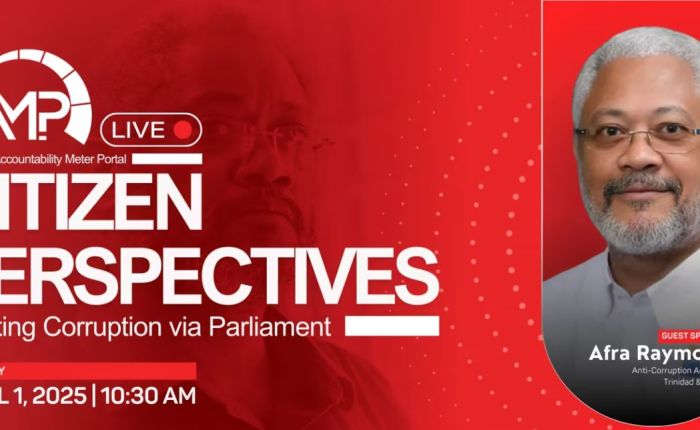

JAMP (Jamaica Accountability Meter Portal) presented the findings of its citizen survey on parliamentary accountability in the fight against corruption. Afra Raymond was invited to be a guest speaker at this webinar hosted by Jeanette Calder, Executive Director, JAMP, to give a Trinidad and Tobago perspective on accountability and transparency. Video courtesy JAMP
The T&T Guardian newspaper interviewed Afra Raymond on the issue of the renewed engagement of the Sandals hotel group to develop a resort in Tobago. The following article, written by Andrea Perez-Sobers and published on Friday, April 4, 2025, is presented below. Click here to read the complete article on the Trinidad and Tobago Guardian website.

If the State is to revisit and fund the Sandals mega-project in Tobago, the hotel must pay proper rates of tax and rates of pay to its staff.
There ought to be no tax holidays or concessions if the entire complex is to be funded by public money and on publicly owned land.
That’s according to former head of the Joint Consultative Council (JCC) Afra Raymond, responding to former prime minister Dr Keith Rowley’s statements on March 15 that he has personally reached out to the Sandals’ owner with a plea to take another look at the island.
“I didn’t give up after all that (first failed attempt). Recently, I spoke to the leadership at Sandals, and I asked them to come look at this again, and if I was the problem, I wouldn’t be there moving forward,” Rowley said, at the commissioning of Tobago’s new terminal of the ANR Robinson International Airport..
Continue reading “No tax holiday for Sandals – Trinidad and Tobago Guardian”
