Property Matters – Procuring State Housing – Part 1

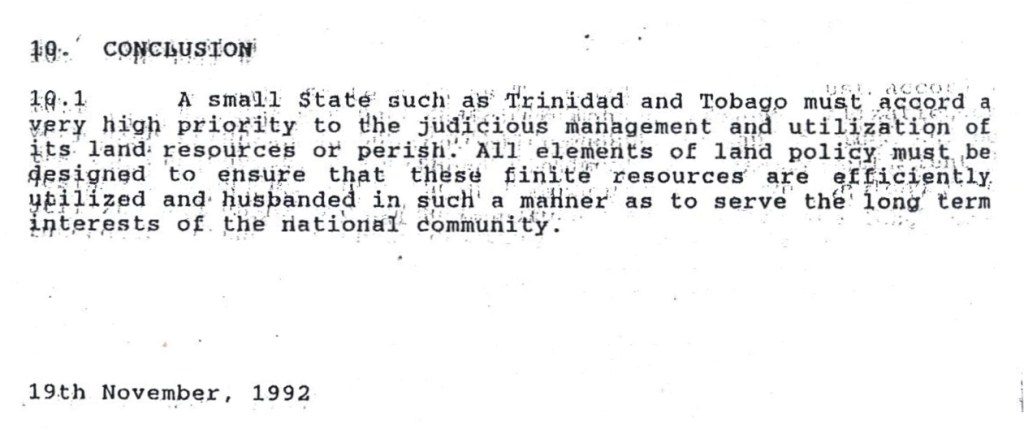
Conclusion of National Land Policy 1992

This is the first part of my two-part analysis of some fundamental and large-scale issues of the State’s Land and Housing Policies and Programs. This first part deals with the background, while the second part will deal with the unfolding issues on the Trinidad and Tobago Housing Development Corporation (HDC) and LandMarkTT Properties programs. This analysis is based on the relevant policies, laws, official statistics, and published statements.

Showing Trinidad and Tobago A New Way Home

Our country actually has a National Land Policy (1992) and a National Housing Policy (2002), both of which have been effectively erased by successive political administrations. So that is why none of the officials busily commenting on land and housing ever refer to our existing national policies. If one were to try searching official websites for those policies, it would be fruitless, far less to actually request those policies from one of the responsible State Ministries or Agencies. Our public officials make bold public statements, while we are witness to huge public investments in this critical arena, all without regard to the approved national policies. That is the framing for the collective fix that we are in, and this has been the case for over 20 years now, since the official policies became inconvenient.

I will demonstrate how the official land and housing programs have unfolded in an increasingly contrary manner when compared to the objectives of the official policies. Policy Review is a normal procedure to ensure proper alignment between objectives and outcomes. The problem in this instance is that a policy review would have required a full statement of the facts in terms of both spending and performance, together with public consultations. Those practices are serially avoided by successive political administrations, so the solution was to simply ‘erase’ those national policies from view and carry on regardless. This is the detrimental sly erasure which has ensured that those beneficial policies are effectively concealed from the public it is intended to serve. That is the background to the ongoing silence on our National Land and Housing Policies. I have kept those Policies, hence my continuing series of challenges.

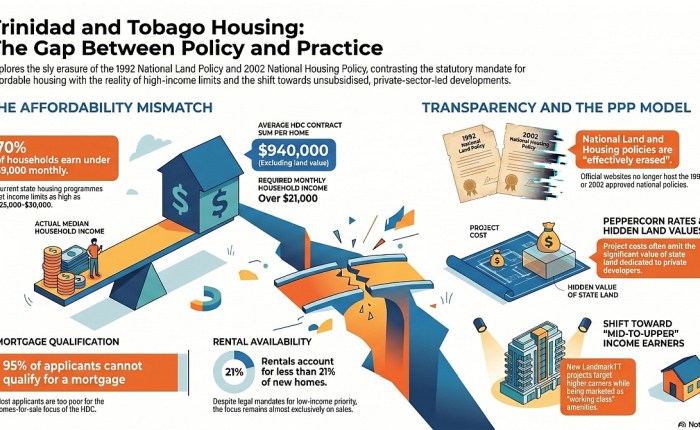
The Land for the Landless program, which is handled by the Land Settlement Agency (LSA), needs a significant adjustment to its rules, since although that program was intended for those applicants outside HDC criteria, its monthly income limit is $30,000, while the HDC’s monthly income limit is $25,000. (Click here for Frequently Asked Questions on HDC website). Quite frankly, apart from the re-establishment of an LSA limit which is lower than the HDC limit, both those monthly income limits need to be greatly reduced to reflect reality. We often hear of fact-based decision-making as a desirable approach to complex problems, so the qualification criteria for these State land and housing programs must be reconsidered in light of the most recent CSO research (2011 census) showing that 70% of our households have a monthly income of less than $9,000. That means that the monthly income limits for these programs are far too high if the intention is to address the dire situation of the neediest households.

The actual household income levels in our country are so low that over 95% of the applicants on the HDC’s waiting list cannot ever qualify for a mortgage, simply because they are too poor. We set these unrealistic maximum income levels for applicants, and the result is plain to see. Most applicants cannot afford to buy, and yet we have a state housing program supposedly intended to assist the neediest families, which almost exclusively focuses on homes for sale. The HDC is a Statutory Agency, established by Act No. 24 of 2005. It is a creature of Statute and therefore bound to follow that law. Section 13 (1) (a) of the HDC Act requires it to provide “affordable shelter and associated community facilities for low and middle income persons”. That sequence is no accident; the very HDC Act gives precedence to the low income persons, it’s in the law. The income profile amongst applicants and the text of the originating Act gives priority to HDC building homes for rent in preference to homes for sale. Yes, that is the law, so what is the actual result? My detailed research into the current 2002 Housing Policy shows that HDC has never built more than 21% of its new homes for rent. Those findings are from 2003 to now, so the lack of focus and sheer misallocation of vast sums of Public Money spans several political administrations. In this one thing at least, there is some kind of unusual consensus between supposed political rivals.

Saddam Hosein, MP, Minister of Land and Legal Affairs

Public Private Partnership (PPP) approaches to housing provision are now in vogue, but we need to consider the extent to which that model can deliver the decent housing so desperately needed by our poorest citizens. In addition, while we note the Minister of Land and Legal Affairs, Saddam Hosein’s declaration that no State monies are to be spent on these projects, two issues arise. Firstly, there is a long-term and detrimental blind spot in how projects are discussed in our country in that we never, ever mention the value of the lands being dedicated to these projects so that the only figure mentioned is the contract sum for the construction. That needs to change – the State needs to explicitly declare the value of the lands being dedicated to these projects if we are to have a clear picture of the total cost of these developments. Secondly, the PPP agreements I have seen all have provisions that effectively inoculate the private sector party from any losses if there should be a shortfall in the projected sales. In such cases, the State is in fact guaranteeing the return of the private sector by removing those risks, so one is entitled to wonder just what risk the private sector is bearing. If the answer is that the private sector is bearing no risks, that means that we have been pursuing a detrimental PPP model, thus far.

Minister Hosein’s statements that the State has not contracted to make any payments within those arrangements needs to be carefully scrutinised. Firstly, as I stated earlier, we need to include the value of the land in our consideration of these projects, it is not possible to appreciate the full scope of these projects if we continue to omit the land value. That is also ironic given that the ‘Land and Legal Affairs Minister’ is going to be playing a leading role in these arrangements going forward. Secondly, apart from disclosing those previously concealed land costs, we also need to acknowledge that these contracts commonly allow private developers to get paid by the State if the projected commercial outcomes are not met. Quite simply, I do not at all accept the notion that no Public Money is at risk in these projects. It all comes down to the difference between the cash and accrual approaches to accounting and that can be a challenging matter for some people.

VIDEO: PC+ Tobago Public Procurement Laboratory – Afra Raymond, 27 NOV 2025

This is the recording of my session at the PC+ Tobago Public Procurement Laboratory, which was at the Magdalena Grand Beach & Golf Resort (MGBR) on Thursday, 27, and Friday, 28 November 2025. I presented on the first day on ‘PUBLIC PRIVATE PARTNERSHIPS: THE TOBAGO STORY’, in which I analysed the very venue (MGBR), the MILSHIRV project, and the aborted Tobago Sandals proposals.

  • Programme Length: 00:56:42
  • Programme Date: 27 November 2025

Letter to the Editor – Open Letter to our Finance Minister

26 Sept 2025

The Editor,

The appointment of Dave Tancoo as Finance Minister following the UNC’s electoral victory on April 28th, 2025, represents an opportunity for fresh perspectives in Trinidad and Tobago’s fiscal leadership. As Minister Tancoo prepares his inaugural budget presentation, the following strategic approaches merit consideration for strengthening the nation’s economic foundation.

Given the importance of this transition period and the complex challenges facing our economy, these three policy frameworks are offered as constructive contributions to the national dialogue on fiscal strategy and economic development priorities –

  1. Revenue Generation – At this time of decreased national earnings and steep declines in the availability of $USD, it is important to appreciate the crucial role of the Energy sector to our national prosperity. In 1974, the Permanent Petroleum Pricing Committee (PPPC) was established to combat the pernicious practice of Transfer Pricing in the Energy Industry. For reasons which remain unclear, the PPPC was effectively dismantled in the 2000/2001 period, so yet another ‘Legacy Policy’ was silently wrecked to our collective detriment, since that shift could only have benefitted the Energy Companies.  As explained over the past two decades by my peerless colleague and Energy Adviser, Anthony Paul, the fiscal losses to T&T have been tremendous. Ian Narine also highlighted this important issue in ‘Foreign Exchange and Economic Fantasies’ in the Business Guardian of 25th September 2025. It is therefore essential that the Finance Minister urgently re-instate the Permanent Petroleum Pricing Committee (PPPC) to safeguard our nation’s share of those earnings.

    In that connection, difficult as it may be for the UNC to contemplate, there must also be a sober re-assessment of its decision to repeal the Property Tax, as that was the most feasible window into significant untaxed earnings from Investment Property.
  2. Overseeing Transactions in Public Money – The Public Procurement & Disposal of Public Property Act (PPDPPA) was passed in 2015 during the People’s Partnership government, within which the UNC was emphatically the leading element. The previous PNM Finance Minister, Colm Imbert, removed legal, accounting/auditing, medical fees, and financial services, as well as Government-to-Government Agreements and “such other services as the Minister may, by Order, determine” from OPR oversight. Those exclusions kept huge transactions in Public Money from Independent oversight, which could only be to our collective detriment. I am calling on the Finance Minister to take bold and restorative action to ensure the urgent repeal of those damaging exemptions from the PPDPPA.
  3. Firm action against White-Collar criminals – I smiled while reading about Finance Minister Tancoo’s clarity on the recent Financial Action Task Force (FATF) bill –
    “…Tancoo highlighted measures criminalising bribery in public procurement and embezzlement of public resources […] ‘T&T must never again find itself in the position we were in over the last few years, when the Office of the Procurement Regulator, the Auditor General, and others sounded the alarm,’ he said. ‘Billions of taxpayers’ dollars were spent illegally on projects no one could verify.’ He added that the bills establish a robust legislative framework to address crime, cross-border activities, and white-collar offences that have already cost the nation billions and affected thousands of lives. ‘We promised the people we’d tackle these issues. With these bills, that promise is kept…’

    So far so good, in relation to those international obligations, but we also need to see an equal determination to seek the Public Interest with local contractors, advisers, and suppliers. Given its position on FATF, the Finance Minister needs to ensure stern and prompt prosecution of White-Collar Crime up to and including those accused from within the UNC ranks. No more backsliding or late filing, case not ready or any of that, let these accused face the Courts and ‘tell it to the Judge’.

If UNC wishes to do better than the previous PNM administration, they must act differently.

Afra Raymond
afraraymond.net

Letter to the Editor – After one time is two times?

19 Sept 2025

The Editor,

When it comes to White-Collar Crime in our Republic, we are once again being forced to ask if Justice is truly blind and, more to the point, whether we are ever going to see that concept in effect.

During the PP government 2010 to 2015, we saw then-AG, Anand Ramlogan, investigating and launching lawsuits against the former Board members of UTT, e-Teck and Petrotrin for various breaches of Directors’ legal duties. While those were deeply political actions, taken by a politician, to the best of my knowledge those were pioneering cases testing the limits of Directors’ responsibilities under S99 of the Companies Act.   The targets were obviously the Chairmen of those State-owned Enterprises, Professor Ken Julien and the late Malcolm Jones, both of whom could be regarded as prime PNM operatives. Despite his political motivations, I respected then-AG Ramlogan’s actions as setting a new high-water mark in our public sector governance and accountability.  

The UTT case collapsed when the main State witness changed his testimony in July 2015. In September 2015, PNM returned to office for a decade, after which the Petrotrin case on the failed Gas to Liquids project was discontinued on the advice of the now-discredited Vincent Nelson, which then-AG Faris Al Rawi acceptedThe e-Teck case on ‘Bamboo Networks Ltd’ never really got started since the former Board claimed that the legal action was started outside the four-year limitation period, but that defence was defeated by the State, at High Court, Appeal Court and the Privy Council, using the novel argument that the limitation period could only really have started running with a change of government. Despite the Privy Council’s 2018 ruling in favour of e-Teck, the case against those former Board Members was never pursued by the PNM administration; it simply slid into obscurity.

Those were truly deplorable episodes, both the alleged dereliction of Directors’ duties and the resulting high costs to the public. But the really reprehensible aspect is that the PNM administration effectively abandoned those cases against their political allies once they were returned to office after the 2015 elections. So what is the position now?

Steve Ferguson, a former UNC heavyweight and one of the Piarco Airport accused, just lost his case in the Appeal Court in Miami and was ordered to pay $131M USD, plus costs and interest. Ferguson reportedly plans to file a further appeal, so can we really expect the State to actively pursue this matter, now that a UNC government is back in power?

SIS reportedly just lost in its Arbitration with NGC over the Beetham Water Recycling Plant, so once again the question is whether NGC will press a UNC financier (Krishna Lalla of SIS) to pay that Award?

We have also seen recent reports of Justice Frank Seepersad resisting EMBD’s attempts to again delay the litigation in that huge 2017 case against the UNC’s political allies. Those include current UNC Energy Minister Dr Roodal Moonilal, so I am watching this one with tremendous interest.  Could it be that the newly-appointed EMBD Board is trying to derail the case against its political allies without actually ‘filing’ to discontinue the action?

Of course there are so many more of these political prosecutions, including the SportTT Board and Eden Gardens cases, all caught-up in the turbid post-election flux. 

We must break this pattern of the political class constantly looking after their own, with the Public Interest being only a remote concern. Two wrongs could never make a right. If the UNC wishes to do better than the previous PNM administration, they must act differently and be seen to do so.

‘What ain’t meet you ain’t pass you‘ is a real long-time saying which greatly amused us when we were young, but look where we reach.

Afra Raymond
afraraymond.net

Letter to the Editor – Public Procurement Progress?

Fri, 12 Sept 2025

The Editor,

The second Procurement Compliance Plus (PC+) Lab on 10th September 2025 was focused on Procurement Governance, so it was a strong addition to this excellent training series for this important new legal arena. Although Procurement and Purchasing are long-established essential processes for any business, this is a novel field due to the significant changes arising from the Public Procurement & Disposal of Public Property Act (PPDPPA) 2015. The PPDPPA established effective new rules to oversee transactions in Public Money, with heavily punitive provisions, its most important feature being that oversight and penalties are now applicable to both named Public Sector Officials and Private Sector Suppliers and Contractors.

The interactive sessions were hosted by a cadre of outstanding professionals, led by the estimable Dr Margaret Rose, a long-time campaigner and educator in this field. I was a panellist, but it was also an opportunity for me to learn from and engage with a range of practitioners in this multi-faceted professional field.

The PPDPPA established the Office of Procurement Regulation (OPR) as the Statutory Oversight Agency with responsibility to ensure that these transactions are conducted in accordance with that law. Public Bodies and their Private Sector counterparts will continue to contract with each other, but in this new arrangement all of those decisions are under the oversight of the OPR.

Given the importance to our Public Interest of maximising the value obtained for every dollar of Public Money, the complexity of the PPDPPA with its various intersections with other laws, the heavy penalties and the high political stakes, there is every good reason for the professionals engaged in this arena to support this outstanding series of educational conferences.

I am also told that the OPR was invited to deliver the keynote speech at the inaugural PC+ event on 2nd May 2025, so I am very disappointed that the OPR has not attended either of these pivotal conferences. I am reliably informed that the OPR declined that invitation due to a stated fear of being accused of conflict of interest, given that it is that office which would have to rule on any complaints, challenges or other disputes. I will not stand aside while the OPR becomes yet another of our ineffective Oversight Bodies, like the Auditor General or the Integrity Commission. There is simply too much at stake here.

Apart from the over-arching point that the OPR could participate in such events without any loss of its neutrality, impartiality or fairness and more importantly, would certainly gain tremendous understanding of the challenges facing practitioners. All in all, the further bonus from OPR participation in these events would be a far greater general understanding of the issues and their context. The OPR must urgently reconsider its reluctance to attend these PC+ events, especially since its reasons appear quite rickety when one considers that  the Chief Justice gave the keynote at the inaugural event and there were three Appeal Court judges in attendance at the entire second event.

Justice and its Officers should not be so cloistered and in this new dispensation that must now include Procurement Regulators.

Afra Raymond
afraraymond.net

Letter to the Editor – Freedom of Information?

Fri, 5 Sept 2025

The Editor,

The Freedom of Information Act 1999 (FoIA) is part of what I call the “RLM Suite” of Legacy Policy – reforms championed during the tenure of then-AG Ramesh Lawrence Maharaj. That suite included the FoIA, the Judicial Review law, the activation of the Integrity Commission, the Prevention of Corruption Act and the Proceeds of Crime Act. Together they represented a deliberate attempt to empower citizens and hold public institutions accountable.

I chose the phrase ‘Legacy Policy’ to denote a particular type of law which it is all but impossible to reverse, due to its manifest good sense and popularity. So, although our Courts have widely recognised the transformative concepts at the heart of the FoIA, with leading rulings now cited internationally, with approval, as examples of progressive jurisprudence, there is still a deep dis-ease with the very Freedom of Information, at the political level.

The Act requires that Annual Reports on the operation of the FoIA be laid in Parliament, so that there could be some proper record of how this important facet of our Republic was operating. Yet, notwithstanding its parentage, just after the 2010 elections, the Freedom of Information Unit was moved to the Office of the Prime Minister, then onto Foreign Affairs (?) then the Communications Ministry. So those Annual Reports were last published in 2009, and this switch took place during the PP government, within which the UNC was the leading element.

But PNM was not to be left behind in these tactics of delay and obstruction to the fundamental democratic rights of Freedom of Information, since in 2019 there was a short-lived attempt under then-AG Faris Al Rawi to dilute the Act by extending response times to six months and so on. A short sharp campaign was mounted to confront this threat, so those proposals were quietly withdrawn.

Equally damaging are the quieter, ongoing tactics of delay and obstruction. Ministries and state agencies routinely frustrate and delay requests. In terms of my own ongoing research, since February 2025 I have been dealing with an ever-retreating timeline from NGC for information on legal fees and technical/commercial details for the Beetham Water Recycling Plant (BWRP). Partners at expensive law firms are engaged to explain the delays and promise the requested details, but those were to have been delivered over 3 months ago. While deploying the delaying tactics, NGC published details of those BWRP legal fees with this astonishing quote from NGC Chairman, Gerald Ramdeen –  “There will be no secrecy under this board,” he added. “Any request for information will be met and information disclosed.” Well I tell you eh.

It is precisely at this stage that the FoIA ought to be revised and strengthened. The law must be modernised to ensure compliance, curb abuse, and enforce real-time accountability. But revision must avoid the errors of the past. If a newly elected UNC government wishes to do better, it must act differently from the PNM before it.

The promise of the “RLM Suite” was never meant to gather dust. It was meant to anchor transparency in our democratic life. Whether we advance or abandon that legacy is now the question before us.

Afra Raymond
afraraymond.net

Letter to the Editor – The State-owned and controlled entities

Sunday, 31st August 2025

The Editor,

The April 2025 election of the UNC govt has triggered convulsions within State-controlled entities, with the replacement of Boards and Management being the main issues, most recently in the case of First Citizens’ Bank (FCB) in which the State is the majority shareholder.

The Finance Ministry is entirely within its legal rights to change the Boards of State-controlled entities, subject of course to compliance with the Central Bank’s ‘Fit & Proper’ rules and the requirements for an Extraordinary General Meeting. 

That said, there are a few additional perspectives to consider, flowing from the PM’s outright, repeated declarations that the State is the majority shareholder in both FCB and Republic Bank Ltd – 

  • Republic Bank’s Board – We are witness to the sudden replacement of FCB’s CEO and its entire Board, so are we now therefore to expect that the Republic Financial Holdings’ CEO and Board is to be similarly, summarily replaced? If not, why not? This question was also posed by my erstwhile colleague and Business Guardian Editor, Anthony Wilson, on 28th August 2025 in ‘Is Republic Bank next?
  • The Integrity Commission – Will all Officers and Directors of both those companies now be required to file declarations to the Integrity Commission?
  • Changing/Replacing the Board – I agree with Mariano Browne’s recent comments that it is inadvisable and extremely rare for the entire board of a financial institution to be changed all at once, since that means complete loss of institutional memory.

Finally, I was concerned to note that the new appointee as incoming FCB Chairman is Mr Shankar Bidaisee, who was also recently appointed Chairman of UDECOTT. This is not in any way an attack on Mr Bidaisee’s competence, but the era of the ‘super-Chairman’ or ‘Czar’ should be placed firmly in the history books. Former PM, the late Patrick Manning, found such favour with Calder Hart that he was appointed to Chair the Boards of five State-controlled  entities. Yes, five. We all should reflect on how that particular ‘concentration of power’ ended-up1. But that was in the ‘bad-old-days’, and we ought to have learned from those bitter experiences. There are enough high-quality, willing candidates to serve in those positions, even given the heavy demands of public office. That concentration of power is never a good thing, so it needs to be avoided.

Afra Raymond
afraraymond.net

  1. The impact of that benighted period was deep and adverse, climaxing in the Uff Enquiry which effectively unmasked Calder Hart such that he departed just before publication of that Report, never to return – two decisive extracts from Hart’s cross-examination are here for readers who want to see the pitiful depths to which racism and colonialism took us in the first decade of the new millennium, under a PNM administration. ↩︎

Letter to the Editor – The HDC’s program paradox

22nd August 2025

The Editor,

The State’s provision of affordable housing to low and middle-income applicants has been delivered primarily by the Housing Development Corporation (HDC) and, to a lesser extent, the Land Settlement Agency (LSA).

The current Housing Policy—”Showing Trinidad & Tobago a New Way Home“—was established in 2002 with the ambitious target of producing 100,000 new homes within a decade. Before the HDC was established in 2005, that role was fulfilled by the National Housing Authority (NHA), which was established in 1962. Despite allocations of public money and private sector borrowings exceeding $20 billion since 2002, the NHA/HDC completed less than 25,000 new homes.

Beyond the gross totals and their serious implications lies a more insidious issue: the actual effectiveness of this large-scale public housing program when we consider the human element. The HDC Act stipulates that its purpose as a statutory agency is to facilitate affordable housing for low and middle-income applicants. Yet over 90% of applicants on the HDC waiting list cannot qualify for a mortgage because they are simply too poor, while only 21% of new HDC homes are available for rent. Given the amounts of public money invested in this program and the desperate housing needs of our poorest citizens, this represents a tremendous misallocation of scarce resources.

The HDC’s low output compared to original targets, combined with its failure to serve the majority of applicants for affordable housing, constitutes a serious indictment of its performance.

Since 2003, NHA/HDC has not had audited Financial Statements, so there are substantial financial accountability issues in addition to those noted earlier. HDC stated that the financial statements for 2003 to 2009 were audited, but those financial statements were accompanied by Independent Auditors Reports, issued by KPMG Chartered Accountants, every one of which was subject to a Disclaimer of Opinion. The Disclaimer of Opinion is many times worse than a mere qualified audit since it means that the auditor has so little confidence in the records that it is impossible to form a responsible professional opinion.

During the recently concluded election campaign, I was astonished by Jearlean John’s promise to deliver 500 new homes per week and “…we are looking to build at least 10,000 houses per year…” if the UNC were elected. Ms. John served as HDC’s Managing Director from November 2009 to March 2016 and provided serious assistance to my public housing research during that period. There is no doubt that she is well-informed on these matters.

The Housing Ministry now has a Minister and two Ministers of State—a considerable commitment of political capital to this important public policy area.

We must avoid the errors of the past if we are to do better. If the newly elected UNC Administration wishes to succeed where others have failed, it must act fundamentally differently from the previous PNM government.

Afra Raymond
afraraymond.net

Letter to the Editor – Repeal all Exclusions/Exemptions to the Public Procurement & Disposal of Public Property Act NOW

15th August 2025

The Editor,

Since the UNC’s election victory on 28 April 2025, we have had several official statements on allegedly excessive legal fees paid by the State during the previous PNM administration from 2015 to 2025.

Some details of those legal fees paid have now been published, which is good, since transparency on the expenditure of Public Money is essential if we are to have an informed engagement with these issues.

The ongoing ‘CEPEP case’ is also a serious concern, as the parties appear to be battling over the existence and content of various Cabinet Notes and Board Resolutions, not to mention who said what to who and WhatsApp messages and so on. At issue is the legitimacy/legality of the April 2025 renewal/award of various CEPEP contracts said to total $1.4 Billion in Public Money. Having read those articles, I am staggered that the reported defence of the ex-CEPEP Chiefs does not seem to be citing their compliance with the Public Procurement and Disposal of Public Property Act (The Act). What is more, the plaintiffs, as reported in the press, also seems to be silent on such compliance, which is what is required by The Act since April 2023. As interesting as those reported details are, the decisive point in this matter is CEPEP’s compliance with the Act in awarding those contracts.

In the ‘bad-old-days’ of the previous PNM administration we saw the then-AG, Faris Al Rawi, making a meal of the serious allegations of massive legal fees fraud against former PP AG Anand Ramlogan SC and newly-appointed NGC Chairman, Gerald Ramdeen – the sum allegedly mis-appropriated was in the $1.0 Billion region. Yet, at the very same time, the then-Finance Minister, Colm Imbert, was exempting expenditure on legal fees from the oversight of the Office of Procurement Regulation (OPR). Incredible, but that is what really happened in this country.

I am referring to the fact that on Friday 4 December 2020 our Parliament passed the third set of amendments to the Act. Those exemptions were a serious blow to the long-term campaign for proper control over transactions in Public Money and are extremely detrimental to the public interest.

The removal of legal, accounting/auditing, medical fees, and financial services, as well as Government to Government Agreements and ‘such other services as the Minister may, by Order, determine’ from OPR oversight was risible when one considers the strong and repeated statements as to concerns over the alleged legal fees and other scandals. The over-stated concerns as to speed and efficiency could have been addressed by approval limits for ‘Procuring Entities’ and an obligation to make quarterly reports to the OPR. At that time, it was remarkable that the Opposition UNC, as it then was, seemed unable (or was it merely unwilling?) to make those points or advance any counterproposals.

We now have a freshly elected government, with its AG making loud claims about excessive legal fees paid by the previous PNM administration, with a troubling silence on the UNC position on those damaging 2020 exemptions from the Act. I am not at all inspired by the disclosure of this or that legal fee, since what we need is a clear position from the UNC on the repeal of those damaging exemptions from the Act. Those detrimental exemptions must now be repealed so that the public interest could be well-served by comprehensive and independent oversight by the OPR, as intended when the People’s Partnership (PP), of which the current ruling UNC was the leading element, passed the parent legislation – Act No 1 of 2015.

We must avoid the errors of the past if we are to do better. If the newly-elected UNC govt wishes to do better, it must act differently from the previous PNM govt. It would be a serious blow to our Republic if the OPR were to become yet another toothless/ineffective oversight body, like the Integrity Commission or the Auditor General.

Afra Raymond
afraraymond.net

Letter to the Editor – Publish details of State Office Rentals NOW!

The Editor,

In the early 2000s, the then-PNM administration, under the late Patrick Manning, made ambitious urban development proposals intended to reduce the State’s historic dependence on private-sector landlords. 

That program was executed by UDECOTT, under the hand of Calder Hart, with 2.3M square feet of offices constructed by the State in POS. The iconic, elliptical, blue-glass office tower on Independence Square is Nicholas Towers, which contains 100,000 sf of offices – so our Public Money funded the construction of new offices 23 times the size of Nicholas Towers. 

Apart from the staggering UDECOTT corruption confirmed at the 2009 Uff Enquiry, I have always had nagging doubts as to whether that massive office construction program actually achieved its objectives. Despite my efforts, it was never clear if our monthly rental bill for State offices had in fact been significantly reduced as a result of that UDECOTT program. There certainly have been no official declarations of that achievement, which one would expect if indeed that had been the case, given our political culture.

In October 2023, I exchanged points with then Public Administration Minister, Ms Allison West, on the conflicting and incomplete details of the State’s leasing of the former RBC HQ building at Park St in POS for the Office of the DPP. At that time, then-Minister West attempted a rebuttal of my claims of massive corruption, but that was rendered nugatory by both her failure to provide any substantiation for the details of the Public Monies spent on that failed project and her claims that all the details of State leases were available on the ‘Property & Real Estate portal’ at https://pmis.gov.tt/. That link remains a dead one, so the information is as yet inaccessible to the public. At that time, I asked the question – 

‘Why not make the entire database readily accessible to the public, just like the EBC list?’.

There was no reply, so no details were provided.

I was therefore pleased to hear the statement by Prime Minister Kamla Persad-Bissessar SC to the 22nd May 2025 post-Cabinet Press Briefing in which the issue of secrecy/confidentiality of State office rentals was specifically addressed – 

“…We will release the existing list to the Public, in the interest of Transparency…this is your Money, this is Taxpayers’ Money, and you have a right to know where your Money is being spent…So Minister has been given the authority to release that list of the rentals, for you to see what has been happening, in secret and, in some cases, illegally…if public members don’t want people to know that we are renting your building, Government is renting your building, with Taxpayers’ Money, then too bad for you, don’t rent-out your building, do not rent-out your building if you don’t want people to know that you are renting your building to the Government…simple as that, so don’t come and cry and plead ‘privacy’, there is no privacy when we are spending Taxpayers’ Dollars…there can be no defence of ‘Privacy’, or you don’t want your name out there…” 

The PM’s statement can be found between 13:22 and 14:48 in the YouTube recording of that 22nd May 2025 post-Cabinet Press Briefing.

I entirely agree with those emphatic statements from our PM, Kamla Persad-Bissessar SC, so I am calling for all the details of the State’s office leases to be published as a searchable database showing Addresses: Owners’ identities: Square footage: Carparking: Rental paid: Lease terms (i.e. start and finish dates): Repairing/Maintenance obligations.

Sunlight is the best Disinfectant.

Afra Raymond
afraraymond.net