On 17th June 2026, the Housing Development Corporation (HDC) reportedly issued its formal Notice to halt the intended award of 11 contracts totalling $3.4 Billion to build 3,700 new homes for sale, on public interest grounds.
That announcement has triggered official statements on the HDC’s intention to get the process right and to deliver these badly needed new homes for sale. All sides are going to great lengths to satisfy the Office of Procurement Regulation’s (OPR’s) requirements, so that aspect certainly represents real progress. But those statements can only offer comfort if one ignores the reality of the HDC’s extensive waiting-list, in which over 90% of the applicants can only afford to rent.
“…Whereas the People of Trinidad and Tobago—…(b) respect the principles of social justice and therefore believe that the operation of the economic system should result in the material resources of the community being so distributed as to subserve the common good…”
From the preamble of our Republic’s current Constitution (1976)
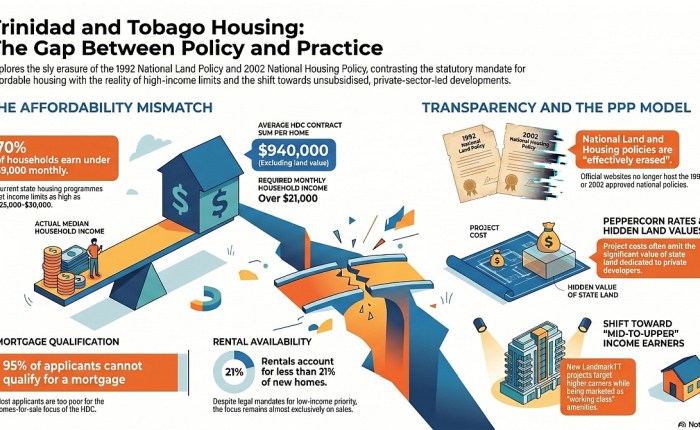
The simple truth is that the overwhelming majority of HDC’s applicants can only afford to rent, but nothing is being built for rent. That is the challenge we face in terms of realising the objectives of our Housing Policy.
I thought this would be a two-part analysis, but the final conclusions required a fuller treatment, hence this closing article to place those issues in a public policy context. My analysis led me to the conclusion that the HDC’s projects could not in any way have satisfied a proper needs assessment, as required by the Public Procurement and Disposal of Public Property Act (PPDPPA). As such, this is a call for the OPR to engage these public policy issues with the required seriousness.
Some concerns have emerged on the concentration of a large number of land agencies and, of course, the newcomer, LandMarkTT Properties Ltd, into the portfolio of Land and Legal Affairs Minister Saddam Hosein. While it is true that there are now a large number of state agencies under this Minister’s control, I balance that against two perspectives.
Firstly, Trinidad and Tobago has always had severely oversized Cabinets, given our modest size, so as a point of principle, a large number of agencies under one Minister is not in itself offensive to good order. That would really depend, in my view, on the quality of the various Boards and Officials of those agencies.
Secondly, the OPR has a statutory role in ensuring compliance with the Public Procurement & Disposal of Public Property Act, which Minister Hosein expressly affirmed when explaining how these agencies will work together. See Govt clarifies Landmark TT housing model amid criticism – Trinidad Guardian.
This is the first part of my two-part analysis of some fundamental and large-scale issues of the State’s Land and Housing Policies and Programs. This first part deals with the background, while the second part will deal with the unfolding issues on the Trinidad and Tobago Housing Development Corporation (HDC) and LandMarkTT Properties programs. This analysis is based on the relevant policies, laws, official statistics, and published statements.
This is the recording of my session at the PC+ Tobago Public Procurement Laboratory, which was at the Magdalena Grand Beach & Golf Resort (MGBR) on Thursday, 27, and Friday, 28 November 2025. I presented on the first day on ‘PUBLIC PRIVATE PARTNERSHIPS: THE TOBAGO STORY’, in which I analysed the very venue (MGBR), the MILSHIRV project, and the aborted Tobago Sandals proposals.
The State’s provision of affordable housing to low and middle-income applicants has been delivered primarily by the Housing Development Corporation (HDC) and, to a lesser extent, the Land Settlement Agency (LSA).
The current Housing Policy—”Showing Trinidad & Tobago a New Way Home“—was established in 2002 with the ambitious target of producing 100,000 new homes within a decade. Before the HDC was established in 2005, that role was fulfilled by the National Housing Authority (NHA), which was established in 1962. Despite allocations of public money and private sector borrowings exceeding $20 billion since 2002, the NHA/HDC completed less than 25,000 new homes.
Beyond the gross totals and their serious implications lies a more insidious issue: the actual effectiveness of this large-scale public housing program when we consider the human element. The HDC Act stipulates that its purpose as a statutory agency is to facilitate affordable housing for low and middle-income applicants. Yet over 90% of applicants on the HDC waiting list cannot qualify for a mortgage because they are simply too poor, while only 21% of new HDC homes are available for rent. Given the amounts of public money invested in this program and the desperate housing needs of our poorest citizens, this represents a tremendous misallocation of scarce resources.
The HDC’s low output compared to original targets, combined with its failure to serve the majority of applicants for affordable housing, constitutes a serious indictment of its performance.
Since 2003, NHA/HDC has not had audited Financial Statements, so there are substantial financial accountability issues in addition to those noted earlier. HDC stated that the financial statements for 2003 to 2009 were audited, but those financial statements were accompanied by Independent Auditors Reports, issued by KPMG Chartered Accountants, every one of which was subject to a Disclaimer of Opinion. The Disclaimer of Opinion is many times worse than a mere qualified audit since it means that the auditor has so little confidence in the records that it is impossible to form a responsible professional opinion.
During the recently concluded election campaign, I was astonished by Jearlean John’s promise to deliver 500 new homes per week and “…we are looking to build at least 10,000 houses per year…” if the UNC were elected. Ms. John served as HDC’s Managing Director from November 2009 to March 2016 and provided serious assistance to my public housing research during that period. There is no doubt that she is well-informed on these matters.
The Housing Ministry now has a Minister and two Ministers of State—a considerable commitment of political capital to this important public policy area.
We must avoid the errors of the past if we are to do better. If the newly elected UNC Administration wishes to succeed where others have failed, it must act fundamentally differently from the previous PNM government.
In the early 2000s, the then-PNM administration, under the late Patrick Manning, made ambitious urban development proposals intended to reduce the State’s historic dependence on private-sector landlords.
That program was executed by UDECOTT, under the hand of Calder Hart, with 2.3M square feet of offices constructed by the State in POS. The iconic, elliptical, blue-glass office tower on Independence Square is Nicholas Towers, which contains 100,000 sf of offices – so our Public Money funded the construction of new offices 23 times the size of Nicholas Towers.
Apart from the staggering UDECOTT corruption confirmed at the 2009 Uff Enquiry, I have always had nagging doubts as to whether that massive office construction program actually achieved its objectives. Despite my efforts, it was never clear if our monthly rental bill for State offices had in fact been significantly reduced as a result of that UDECOTT program. There certainly have been no official declarations of that achievement, which one would expect if indeed that had been the case, given our political culture.
In October 2023, I exchanged points with then Public Administration Minister, Ms Allison West, on the conflicting and incomplete details of the State’s leasing of the former RBC HQ building at Park St in POS for the Office of the DPP. At that time, then-Minister West attempted a rebuttal of my claims of massive corruption, but that was rendered nugatory by both her failure to provide any substantiation for the details of the Public Monies spent on that failed project and her claims that all the details of State leases were available on the ‘Property & Real Estate portal’ at https://pmis.gov.tt/. That link remains a dead one, so the information is as yet inaccessible to the public. At that time, I asked the question –
‘Why not make the entire database readily accessible to the public, just like the EBC list?’.
There was no reply, so no details were provided.
I was therefore pleased to hear the statement by Prime Minister Kamla Persad-Bissessar SC to the 22nd May 2025 post-Cabinet Press Briefing in which the issue of secrecy/confidentiality of State office rentals was specifically addressed –
“…We will release the existing list to the Public, in the interest of Transparency…this is your Money, this is Taxpayers’ Money, and you have a right to know where your Money is being spent…So Minister has been given the authority to release that list of the rentals, for you to see what has been happening, in secret and, in some cases, illegally…if public members don’t want people to know that we are renting your building, Government is renting your building, with Taxpayers’ Money, then too bad for you, don’t rent-out your building, do not rent-out your building if you don’t want people to know that you are renting your building to the Government…simple as that, so don’t come and cry and plead ‘privacy’, there is no privacy when we are spending Taxpayers’ Dollars…there can be no defence of ‘Privacy’, or you don’t want your name out there…”
I entirely agree with those emphatic statements from our PM, Kamla Persad-Bissessar SC, so I am calling for all the details of the State’s office leases to be published as a searchable database showing Addresses: Owners’ identities: Square footage: Carparking: Rental paid: Lease terms (i.e. start and finish dates): Repairing/Maintenance obligations.
The implementation of the controversial Property Tax is now underway in Trinidad and Tobago, marked by a series of official announcements and the issuance of revised Notices of Valuation to an estimated 400,000 residential taxpayers. While these revisions are necessary, there is a critical flaw in the system that must be addressed: the restricted access to the Valuation Roll database. This column explores the implications of this restricted access, argues for the necessity of transparency, and identifies who stands to gain from maintaining the status quo.
The new Property Tax system in T&T aims to deliver equitable taxes through a crowd-sourcing approach, which promises transparency and low operational costs. Property owners were asked to submit detailed returns – about 60,000 of which were sent – which were then analyzed by the Valuation Division of the Finance Ministry. Selected properties were inspected and measured, leading to provisional tax assessments. Taxpayers have the right to object to these assessments, which would be refined through this iterative process of public feedback, ensuring fairness and accuracy.
Afra Raymond, Managing Director of property advisory company, Raymond & Pierre, speaks at the company’s 50th anniversary celebration, a mini-Conference on Land and Property in Trinidad and Tobago, hosted at the Centre of Excellence on Tuesday 13th December 2022. His first topic there was ‘Public Procurement law through the lens of professional responsibility‘. His second topic there was ‘Land & Housing Policy in post-Independence Trinidad and Tobago‘ that sees to the needs of poor people.
Programme Date: 13 December 2022
Programme Length: 00:16:02 and 00:12:38
Playlist contains 2 videos. Select in top right corner.
The Ministry of Trade and Industry (MTI) responded on Sunday, 18 June 2023 to my letter of Friday, 16 June 2023, which pointed-out that the Minister’s reported statement that Trinidad Hilton “had not been renovated for over 20 years” was entirely untrue.
The MTI’s second paragraph confirmed my statements that Trinidad Hilton had been extensively renovated in a program which commenced in 2008. The rest of the MTI’s letter set out some details of the works which are now proposed for that property, but while it is good that we now have that greater level of detail, some serious questions now arise.
My analysis of the Trinidad Hilton, given the estimated profits, as derived from the reported payments of Corporation Tax, shows that the payments of Rent to eTecK would be –
Year
Net Profit (after tax, consistent with AGOP)
Rent @76% of Net Profit
Return on Investment ($634M)
2015
$3.099M
$2.355M
0.37%
2016
$6.233M
$4.737M
0.75%
2017
$2.533M
$1.925M
0.31%
2018
$1.987M
$1.510M
0.24%
These estimates indicate extremely low rates of Return on Investment, which no private sector investor would tolerate, especially given the ongoing requirement for expensive periodic capital works.
The concerns all relate to the investment decision, given that the State owns the three largest hotels in T&T – Trinidad Hilton, Hyatt Regency and Magdalena Grand in Tobago.
Since the MTI has engaged in this much-needed disclosure, it would be in the public interest if these details could be now provided –
Comparison – without details of the parts renovated in the 2008 program and the out-turn costs, it is impossible to discern the rationale for these new works. I am requesting that MTI provide those details to permit the comparison to justify the new investment;
The impact of Hyatt Regency – Hyatt Regency caused a virtual collapse in the POS Hotel market since its opening in Jan 2008, with severe impacts on other hotels in our capital city, as a result of the Government diverting most of its functions/conferences to that new venue. The affected hotels include Ambassador; Crowne Plaza; Kapok; Cascadia; Carlton Savannah and most of all the Trinidad Hilton which decisively lost its pre-eminence in the POS market. Did the 2008 program of works have the effect of improving Trinidad Hilton’s fortunes? What has been its occupancy rate in the past 15 years? I recently saw elaborate proposals for the redevelopment of the Salvatori Building site in downtown POS as a Public Private Partnership, to include a 319-room hotel – how does this affect the investment decision?;
Financial performance of the State-owned hotels – this area has been a virtual Black Hole, with very little, if any, reliable information made available. Our Public Officials observe a serious, detrimental commitment to silence on the performance of these massive investments. No audited accounts have ever been made available for these State-owned hotels, although we know that the foreign companies with Management Agreements (Hyatt, Hilton and Hospitality Solutions International for Magdalena Grand in Tobago) would have regular and proper accounts showing real returns to justify their continued operations. Once again, I am requesting MTI to make these figures available to the public, who are paying for all of this.
The Department of Management Studies at the Faculty of Social Sciences at UWI St Augustine offers post-graduate studies on Tourism and Management, so it would be interesting to have their input on these large-scale investment decisions.