Integrity threat from the Appeal Court

ictt-vs-tsttOn 27th June 2013 the Appeal Court ruled that –

  • TSTT is not a State Enterprise. The members of its Board are not subject to the Integrity Provisions.
  • It is only the members of the Boards of those Statutory Bodies which exercise public functions that are subject to the jurisdiction of the (Integrity) Commission.

Telecommunications Company of Trinidad & Tobago (TSTT) is a company established between the T&T State and the British-based multinational, Cable & Wireless. C&W holds 49% of the shares in TSTT, while the State holds about 42% of the shares together with the right to nominate 5 of its 9 Directors.

That unanimous ruling has serious consequences for the viability of our nation’s integrity framework.

The intended purpose of that framework is to ensure a satisfactory level of transparency and accountability in the way Public Money is transacted and Public Functions are discharged.  There is still a strong case for this Integrity Framework as a necessary ingredient in the Good Governance of our nation. The Integrity Framework includes the Auditor General; the Integrity Commission; the Investments Division of the Ministry of Finance and the two Parliamentary Accounts Enterprises Committees.  Ours is the most vibrant Caribbean economy and the State is clearly the largest player, so the proper management of that sector is critical. Given the continuing rise in the waste and theft of Public Money, there will always be a need for an improved, more effective Integrity Framework to oversee these huge, controversial operations.
Continue reading “Integrity threat from the Appeal Court”

The Treasury Scandal

I wonder if is Bobol?
What dey doing with Taxpayer’s Money at all!?
I wonder if is Bobol?
What dey doing with Taxpayer’s Money at all!?
—Opening stanza of ‘The Treasury Scandal’ by Atilla the Hun (1937)

I took this title from the late 1930’s kaiso by the great Atilla the Hun (Raymond Quevado) on the scandal of some $200,000 missing from T&T’s Treasury.  His outrage was rooted in the fact that the story came-out in bits and pieces and of course, none of the ‘Big-Boys’ was ever jailed, or even charged for that theft.  That was a massive amount of money in the 1930s – at that time a good Woodbrook house cost about $6,000 – so that could give you an idea. Atilla was lamenting the lack of accountability and transparency in how Public Money was being managed.  The ‘Treasury Scandal’ was a true episode from the bad-old-colonial-days of the 1930s, but of course we have progressed a great deal since then, having achieved Independence, Republican status and universal education.

dookeran-portrait
Winston Dookeran, MP

The problem is that despite the obvious movement forward, we are witness to yet another ‘Treasury Scandal’. I am referring to the CL Financial bailout, announced in January 2009 and still ongoing at an anticipated cost of $24Bn – according to paras 21 and 22 of the 3 April 2012 affidavit of then Finance Minister, Winston Dookeran.

It is vital to look back before we go forward.  In 2008 and 2009, the Indo-Trinbago Equality Council (ITEC) campaigned strongly on the issue of the Secret Scholarship Scandal’. The suspicion was that there was a secret scholarship fund operated by the State without any transparency and ITEC used its Parliamentary representatives and the Freedom of Information Act to force the Patrick Manning-led PNM administration to publish the details they had been trying to conceal.

The published details included the names of those who benefited from the funds as well as the amounts, dates of payments and details of the courses of study to be pursued.  Some of the more controversial issues to emerge from the publication of those scholarship details were –
devant-anand

  • From the names given, it seemed that less than 10% of the recipients were citizens of East Indian descent;
  • The PNM administration was never able to demonstrate how those scholarships had been advertised, or for that matter, any objective process used to choose from the applicants;
  • Unlike other Scholarship arrangements, there was no requirement for these scholarship winners to do any kind of national service;
  • A number of people who were reported to have received money, went public to say they had never even applied for, far less received, scholarships. The question arising was ‘Where did that money really go?’;

A total of $46M of Public Money was paid during the 5 year period under examination.  The President of ITEC at that time was Devant Maharaj and its leading attorney was Anand Ramlogan, both of whom now serve in the Cabinet.

I fully supported ITEC in that use of the Freedom of Information Act to force publication of important information on the use of Public Money, which is the property of every citizen.

In my view the failure and or refusal to account for the colossal and unprecedented expense of the CL Financial bailout is indicative of a ‘Quiet Coup‘ against our Republic.  I am deliberately borrowing Simon Johnson’s potent phrase, used to describe the coup of Financial Capital against the USA published in a fascinating and essential article from The Atlantic.  The fact that two successive administrations have remained bound to these arrangements and the low priority given to transparency and accountability in this matter all speak to the potency of the plotters.

“Emerging-market governments and their private-sector allies commonly form a tight-knit—and, most of the time, genteel—oligarchy, running the country rather like a profit-seeking company in which they are the controlling shareholders… As masters of their mini-universe, these people make some investments that clearly benefit the broader economy, but they also start making bigger and riskier bets. They reckon—correctly, in most cases—that their political connections will allow them to push onto the government any substantial problems that arise.”
—Simon Johnson. “The Quiet Coup” in The Atlantic. 2009.

The CL Financial group was able to use its considerable political clout and financial footprint to achieve a binding agreement that our Treasury would be used to pay its debts.  Absolutely unprecedented and all negotiated in less than three weeks, we are told.  That is the official version of this astonishing story.

Given the likely existence of a ‘Code of Silence’ in this tangled affair, I have been making use of the Freedom of Information Act in my campaign for transparency and accountability in the CL Financial bailout.

If we are ever to start to untangle this web of deceit and betrayal, we must get details of who got their money out, how much, on what terms and when.  On 8 May 2012, I applied to the Ministry of Finance via the FoIA – from which the Central Bank is exempt – to request this information –

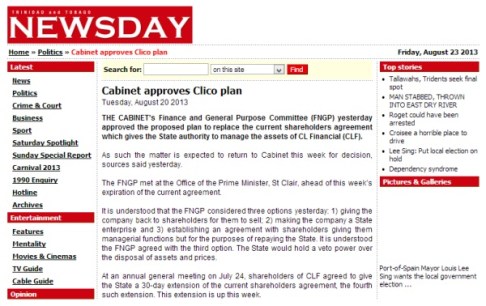
SIDEBAR: “Cabinet approves Clico plan” courtesy Newsday

newsday-clip

Read the Newsday’s laconic report on this matter here.

  • Accounts – The audited accounts for the CLF group or whatever figures the Minister is relying on;
  • The briefing given to the Independent Senators in September 2011 before debate of the two supplementary bailout Bills;
  • Details of the creditors, especially EFPA holders, to see who got what money;
  • Whether the Minister required CLF’s Directors to comply with the Integrity in Public Life Act.

The Ministry replied on 14 August to say that the information requested is likely to be exempt and I am now challenging them in Court.

If it is right and proper to use the FoIA to force publication of the details of a Secret Scholarship Scheme of some $46M over 5 years, why is it acceptable to conceal the details of some $24Bn in Public Money? That is over 521 times more Public Money being spent in secret…yes, $24Bn is over 521 times more money than $46M.

For all we know, some of the people on the Ministry’s list of persons who have been paid could be the same ones protesting via the various Policyholders’ Groups.

To quote Cabinet Minister Devant Maharaj in October 2011, as part of the ongoing campaign on the Secret Scholarship Scandal:

Maharaj said yesterday that he rejected Williams’ claim thatthen prime minister Patrick Manning’s handwritten note on one of the applications for the matter to be handled quietly was ministry protocol, as was claimed by Yuille-Williams. “It seems as if this was the overriding motto for the disbursement of these funds,” Maharaj added. “This was a blatant attempt to hide the facts from the glare of public scrutiny.”

Russell Martineau, SC

At this time the Ministry of Finance is publicising the end of the CL Financial bailout so that all the Public Money spent on this can be repaid and there are various official reports of how this is to be achieved.  At the very same moment, the said Finance Ministry has engaged a high-powered and expensive legal team, headed by Russell Martineau SC, to oppose my attempts to have the basic information published.

That is today’s Treasury Scandal.

Ministry of Finance Dance

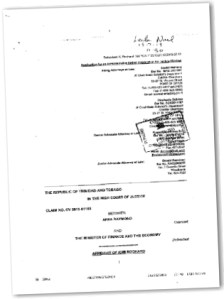
minFaffidavitThis is the 12th July affidavit filed by the Ministry of Finance in reply to my claim under the Freedom of Information Act (FoIA) filed against them in this matter.

This is a most interesting document for several reasons –

  • Attorneys – The legal team is led by Russell Martineau SC, former AG and former President of the Law Association. Martineau was lead attorney for CL Financial’s auditors, PricewaterhouseCoopers, during the recently-concluded Colman Commission and he strongly opposed my submissions as you can see in this revealing clip. His Junior in this case is Gerald Ramdeen, who was Junior Counsel to the said Colman Commission.
  • My recent supplemental application – On 18th March, I made a further application under the FoIA for the details of the creditors of CL Financial, particularly the EFPA holders, in relation to the amounts repaid and claimed. It is interesting that the Ministry of Finance chose to treat with this in their affidavit.
  • The objection – Despite several readings of this 5-page affidavit, I am not clearly able to see just what is the Ministry’s real reason for objecting to the release of the requested info.
  • State-controlled Enterprises – The recent Appeal Court ruling in #30 of 2008 on the meaning of State-controlled Enterprises is a real threat to the public interest in relation to the governance arrangements in situations like this. The final sentence of para #14 is “In any event, CL Financial Ltd. is a private company and is not a public authority under the provisions of the Freedom of Information Act.” Well I tell you.
  • The fundamental position – At the Court hearing on 23rd May, the lead attorney for Finance, Russell Martineau SC, was emphatic in stating to Justice Ronnie Boodoosingh that there was no intention of compromising or considering the release of even some of the requested information. It is going to be a fight for every item of information.
  • Public Secret – We are now being told that the bailout process for CL Financial is nearing its end with a procedure having been agreed for the recovery of the Public Money which has been spent. Serious and justified concerns are being voiced at this time since there is no way to be sure how much money has been spent or the terms of the final settlement. I will be writing more on this shortly. We are being told that the agreed terms of the settlement are solid in protecting the public interest, yet this very Ministry, Finance, is using a highly-paid legal team to oppose the publication of fundamental information.

The burning question remains…

What is the big secret?

VIDEO: Time to Face the Facts about Caribbean Corruption – 26 May 2013

This is the interview on Caribbean Corruption for ‘Time to Face the Facts‘ which was broadcast out of Barbados-based Caribbean Media Corporation on Sunday 26th May 2013.

The audience was regional via cable and global via their Facebook page. The interviewer is Jerry George and the format was a live call-in. Video courtesy Jerry George

Part 1:


Part 2:

Part 3:

‘Time to Face the Facts’

Afra Raymond is on ‘Time to Face the Facts‘ to discuss Corruption with host Jerry George…

Time to Face the Facts Show

This is a live telecast on Sunday 26th May 2013 – today being the 50th anniversary of the establishment of Africa Liberation Day, for those of us who still remember…- from 7pm to 9pm on Cable TV as CaribVision or streaming on the internet via their FaceBook page –https://www.facebook.com/timetofacethefactsshow?fref=ts

Please spread the word and be sure to tune-in…

Silence is the Enemy of Progress!

Best Wishes


Afra

Charting our losses: ‘A picture is worth a thousand words’

The last four articles in this series have focused on what I call ‘two sides of the same coin’ – the coin being the large-scale and improper use of Public Money.

I examined the THA/BOLT office project called MILSHIRV being undertaken with the Rahael group and the Calcutta Settlement land scheme in which the HDC acquired developed lands at several times the proper price the State could have paid.

Throughout this type of critique one has to strive for effective balance and fundamental integrity.  The extent of the waste and/or theft is never easy to pinpoint when one is working from outside and relying solely on published documents, but my best efforts to establish those facts is what is presented.  Of course it is impossible to say for sure that any amount of money was stolen in a particular project, hence the phrase ‘wasted or stolen’.

Objectively, it does not matter whether the money is wasted or stolen, if it is ultimately unavailable for the benefit of the Public.  Once spent, that Public Money is gone forever, which is why Value for Money is of such importance in any proper Public Procurement system.

Subjectively, however, the errors of inexperience or poor process must be differentiated from an active conspiracy to defraud.  Although the objective measure of loss might be identical in terms of the dollar-amount, there are different long-term consequences.  Innocent errors and miscalculations can be rectified over time by ongoing review processes.  Deliberate conspiracies to defraud require concerted and well-grounded attacks in order to be eliminated.  What is worse about the deliberate conspiracies is that they affect the very atmosphere in which public business is conducted.

We end up with a situation where it pays to pay a bribe and the decision not to pay is to suffer delay.

That is why we are where we are today.  Simple so.

One of the important lessons emerging from the Wall St disaster is that the variety of financial regulators with their varying rules and experiences allowed financial players to engage in ‘Regulatory Arbitrage’. That was  the scenario in which financial players shopped for pliable or suitable regulators within which to channel their products, resulting in the unprecedented financial disaster we are all living through.

Here in T&T we have seen a similar pattern in our financial markets, but the point being made here is that it has also emerged in the Public Procurement arena, with TIDCO paving roads; the rising profile of State-owned entities which were deliberately excluded from the formal procurement controls; those same companies breaking their own rules and so on. That is the emergence of a toxic kind of ‘Procurement Arbitrage’, which is the reason why we must have over-arching regulations to control all transactions in Public Money.

So, there are two types of losses being charted here –

  1. Firstly, inexperienced officials or poor processes can approve wasteful uses of Public Money through sheer ignorance.
  2. Secondly, there is deliberate conspiracy to defraud the Treasury of our precious Public Money.

Only a Court can establish whether the lost Public Money was wasted or stolen, so I have ventured no opinion as to which is which. Readers can reach their own conclusions.

These charts illustrate the extent of the waste or theft of Public Money in the THA/BOLT and Calcutta Settlement projects.

A good example is worth a thousand words

THA/BOLT – MILSHIRV Project

Rental Rates THA- BOLT chart
Occupancy Excess THA-BOLT
Rental increase chart with table THA-BOLT


Click on the charts above to see full size version


Calcutta Settlement Land sale – Eden Gardens

stamp duty Eden gardens Chart 1 20130405-1
Acquisition options HDC chart 2 20130405


Click on the charts above to see full size version

Calcutta Settlement review

The simple, inescapable fact is that the State could have lawfully acquired the ‘Eden Gardens’ property for less than $40M.  The HDC paid $175M in November 2012 to Point Lisas Park Ltd (PLP) for that property, which is the reason I am calling this an improper use of Public Money.

Despite having available the advice of the Commissioner of State Lands, the Commissioner of Valuations and various attorneys at HDC and so on, the Cabinet approved this transaction.  This Cabinet, with two Senior Counsel at its head and several other seasoned legal advisers, appears to have been unaware of, or intentionally ignoring, the legal safeguards.

Some readers may be surprised at those assertions, so here are my reasons for making such.

The last two articles examined the steps leading to the HDC’s purchase of land at ‘Eden Gardens’ in Calcutta Settlement.  In my opinion that transaction, as well as the one which preceded it, are both highly improper and very probably unlawful.  The HDC purchase must be reversed and the responsible parties investigated/prosecuted as required by our laws.

This ‘Eden Gardens’ episode is an object lesson in what can go wrong when elementary policy is set aside for stated reasons of expediency.  Apart from the lack of any Needs Assessment, the unclear role of the Commissioner of State Lands is a source of serious concern.  That Commissioner’s role is to advise the State on the strategic implications of its land policies and transactions, so this is a straight example of a case which required a solid input from that critical State Officer.

So, what should have happened?  How would a proposal like the ‘Eden Gardens’ one have been handled if the various parts of the system were functioning properly?

When parties are in commercial negotiations, there is always a Plan ‘B’, to be adopted in case the main plan goes awry.  Each side has a different Plan ‘B’, since they have different interests.

What was Point Lisas Park’s Plan ‘B’ in case their negotiations with the State were unsuccessful?  While we can never know for sure, PLP being a private company, the fact that those lots were widely offered at $400,000 can allow us to form a view as to the benchmark they were likely using.

The State’s Plan ‘B’ is far simpler to establish, since there exists the legal power to compulsorily acquire private property for a public purpose.  That was the third unique facility enjoyed by the State as set out in the previous article.

In the case of a landowner making unreasonable demands, the State has the lawful option of compulsorily acquiring the property.

The Land Acquisition Act 1994 (LAA) establishes the right of the State to compulsorily acquire private property for a public purpose.  At S.12, the LAA specifies the rules of assessment used to arrive at the sum offered to the owners of private property interests being acquired.

S.12 (4) states –

…(4) In making an assessment under this section, the Judge is entitled to be furnished with and to consider all returns and assessments of capital value for taxation made or acquiesced in by the claimant and such other returns and assessments as he may require…

The point in this case being that, having registered a purchase at $5M in February 2010, PLP would have been unable to legally resist a compulsory purchase which adopted that price as its basis.  Even if the State, in recognition of the roughly $29M spent by PLP on building the infrastructure for ‘Eden Gardens’, were to add that sum, the final offer would only be about $34M.

Those provisions at S.12 (4) of the LAA are a critical safeguard against persons who might seek to under-declare their properties to evade taxes, then seek to make exorbitant claims if the State seeks to acquire compulsorily.  S.12 (4) prevents the State from falling victim to any such games, it is a critical safety-valve to protect our Treasury from those who seek to pay as little as possible when taxes are due, but boldly make huge claims from the Treasury when seeking to sell.

That is why I am calling for this matter to be swiftly investigated and the responsible parties prosecuted to the full extent of the law.

This was in reality a potent dilemma for PLP, in that if they were served with a proper compulsory purchase notice, they would have either had to stick with the $5M figure as a 2010 baseline, or reject that deed and incur the strong penalties at S.84 of the Conveyancing and Law of Property Act.

One of the three deeds executed on Wednesday 3 February 2010 recorded the purchase of ‘Eden Gardens’ for $5M, which is a massive understatement of consideration.  The true market value of that undeveloped property at that date would have been of the order of $50M, so the loss of Stamp Duty to the Board of Inland Revenue would have been in excess of $3.0M.  The underpayment of Stamp Duty is tantamount to a defect in title of a property.  Are we witness to the State making a massive over-payment for marginal lands with defective title?

Did the Cabinet and the HDC receive the proper advice from the Commissioner of State Lands and the Commissioner of Valuations, as well as the other legal advisers?  If yes, that advice was plainly not followed, so in that case the question would have to be ‘What caused the Cabinet and the HDC to abandon that sound advice?

If the true situation is that the proper advice was not provided, we need to know why.  If the advice was not sought, then we need to know why.  If the advice was sought, but not provided, those advisers need to be rusticated so that our processes are protected from more of this nonsense.

The State has an overriding duty to comply with the law and be exemplary in its conduct.  That is not negotiable, if we are to build a society which is orderly, progressive and just.

Episodes such as the ‘Eden Gardens’ sale and the THA/BOLT deal continue the erosion of Public Trust and the loss of that intangible, almost-forgotten, source of ‘soft power’, the Benefit of the Doubt.

This Prime Minister has made repeated statements that any evidence of wrongdoing will be investigated, so that the offenders can be prosecuted according to law.  These three articles have detailed the evidence and breaches of sound public policy, so it is now over to the authorities.

The ‘Eden Gardens’ transaction is a prime example of a large-scale economic crime against the State and the interests of its citizens.

Again, I ask – ‘Who were the beneficiaries?

The final point here is that the parties to the PLP purchase and improvement of ‘Eden Gardens’ are now in litigation, with the contractors – SIS Ltd. – suing Point Lisas Park Limited for various monies and demanding an account of the $175M.  Case CV 2012 – 5068, so we have interesting times ahead.

Pre-Action Protocol letter to Ministry of Finance pursuant to FoI Application of 11 May 2012

preactionWhat is being pursued here is our right as citizens of a modern republic to the details of these huge expenditures of Public Money – the CL Financial bailout is costing some $24Bn, about $3.5Bn USD! – and the background to how critical legislative support is obtained.  It is my view that S.34 was not the first time and that the spectre of ‘regulatory capture’, which underlines much of the discourse around the Great Depression 2, is in fact founded on a sinister degree of ‘legislative capture’.

Having had a series of ‘cat and mouse’ exchanges with the Ministry of Finance since my Freedom of Information Act application made on 11 May 2012, this is my pre-action protocol letter sent to them by my attorney on Thursday 7 March, seeking their proper reply in 7 days…that time expires at midnight today, Wednesday 13 March, so stay tuned, because we are going to the High Court after that…

Calcutta Settlement again

163940In light of the many questions raised by readers after the last article on the HDC’s purchase of land at ‘Eden Gardens‘ in Calcutta Settlement, I am continuing there.

The previous article discussed the Calcutta Settlement scheme and its relation to implementation of national housing policy.  There is little, if any, connection between the provision of affordable housing and the acquisition of those ‘Eden Gardens‘ lands, at what is surely the highest price in Central Trinidad.  How we create and implement a progressive housing policy is a critical part of this discourse, but there is more.

Another important aspect of this episode is the fact that sound land administration policy appears to have been abandoned for expediency.  Expediency should never eclipse proper policy, especially when neither the process nor end-result advance the ultimate objective of serving our citizens.

The sidelining of sound land administration policy was essential in order to get the Calcutta Settlement scheme approved.  National Land Administration policy is important so that we can be strategic in using the country’s property assets for proper national development, as opposed to the enrichment of a select few.

The State is a unique player in our country’s land arena, so we need to place this Calcutta Settlement episode into proper context from a land administration viewpoint.

This is the framework –

  • Size – The State is by far the largest land-owner in the country, which means that there are only limited situations in which it will require private lands;
  • Wealth – The State is the wealthiest entity in the country, which means that it alone can bid at certain levels for the best properties.  Applied to this case, a reasonable question would be ‘Who would have purchased ‘Eden Gardens’ and at what price, if the State had not proceeded?‘;
  • Compulsion – The State is the sole entity in the country able to lawfully acquire land for a public purpose against its owner’s wishes, which means that if an owner of private property takes an unreasonable position during negotiations, the State can compulsorily acquire it;
  • Planning Authority – The State is the national planning authority, which means it has the power to approve its own designs and proposals;
  • Statutory undertaker – The State has ownership and control of the principal utilities, electricity and water/sewerage;

So, if the State intended to construct affordable housing in Central Trinidad, it could have chosen from the abundant State-owned property in the area, granted planning permission for its own proposed development and provided services.  The State could only have bought the ‘Eden Gardens‘ land by ignoring sound land administration principles.  Elementary policy was ignored in favour of sheer expediency, or worse, the enrichment of carpetbaggers at the expense of the Public Interest.

What was the advice of the Commissioner of State Lands on this transaction?  Was his advice sought?  Bizarre and expensive precedents are being set in situations of zero benefit to the Public Good.  This deal is detrimental to the Public Interest.

At a level of State policy, there was a collapse into expedience and a continuing silence as to the role of ‘Eden Gardens’ in the national housing policy.  But when I delved into the documents in my possession, there were even more causes for concern.

The Registrar General’s records show that there were three transactions executed on the same day for this property – It was Wednesday 3 February 2010 –

  1. Deed # DE2010 004276 02D001 rescinded the 2004 Sale Agreement (the one for $17M, registered in 2007), with the deposit returned and no claims made;
  2. Deed # DE2010 007816 95D001, Point Lisas Park Ltd (PLP) purchased the property from the owner, Sookdeo Deousaran, for $5M, paying Stamp Duty of $350,000;
  3. Deed # DE2010 003449 63D001, PLP mortgaged the property to said Sookdeo Deousaran for $18.5M at 8%, to be repaid on the last day of January 2012.

These purchasers were prepared to pay $17M for this undeveloped property in mid-2004, but ended up paying only $5M for it in early 2010.  On the same day, they mortgage it for $18.5M.  By happy coincidence, or otherwise, the property with infrastructure added was offered to the HDC at $200M in late January 2012, two years later.  Literally unbelievable.

What is more, the fact that the second and third of those deeds were executed on the same day is deeply perturbing as to the operation of the Stamp Duty section of the Board of Inland Revenue.  The second deed transfers the property for $5M and Stamp Duty is paid on that, yet the third deed shows a mortgage granted the same day on the same property for $18.5M.  Normal practice in the finance world is for a mortgage to be taken on a property at some fraction of its current market value.  Both those deeds were registered at the San Fernando office of the Registrar General’s Dept.

If there were a reasonable gap between the first sale to PLP and the new owners mortgaging the property, it might be possible to claim some increase in value due to its physical development or obtaining permission to develop.  But since both transactions took place on the same day, there is no way anyone can claim a genuine difference in value.

The 8% interest rate on the two-year mortgage is instructive, in that the actual rate at which finance was offered at that time for similar projects was in the 10.5-12.0% range.  The reasonable conclusion being that both sides had a high degree of comfort with each other, indicative of close collaborators.

S.84 of The Conveyancing and Law of Property Act (1939), states that the penalty for falsely stating the consideration in a deed is a modest fixed fine and a further penalty payment of 5 times the amount of the understatement.  Those penalties apply to both the buyer and seller, perhaps to discourage these dishonest practices.  The Act goes further to offer the penalty payment as a reward to the person making the report of the understatement.

S.86 of that Act also specifies a small fixed penalty for an attorney found guilty of “…knowingly and willfully…” recording a false consideration and mandates that the said attorney “…shall…” be disbarred.  Of course an attorney who had prepared only one of those deeds could reasonably claim to be genuinely unaware of the entire transaction, so we will see.

Sad to say this ‘Eden Gardens’ scheme is reminding me of the CL Financial antics. I am thinking about the the affidavit of the Inspector of Financial Institutions  stating that Clico Investment Bank did not file its Corporate Tax returns for 2007, 2008 and 2009 and the fact that, despite those lapses, they were able to obtain a bailout on ‘sweetheart terms‘.  The Eden Gardens chiefs were able to understate the property value to avoid the true level of Stamp Duty, but were also able to get Cabinet to agree to effectively bail them out, also on ‘sweetheart terms‘.

Always remember that the land at ‘Eden Gardens‘ cost $663,000 per lot as agreed by the Cabinet, seemingly unaware that the developers were offering lots there for sale at $400,000 only months before.

The HDC purchase was completed on 9 November 2012 and recorded in DE 2012 026026 11D001.  The para before the $175M sale price is the one which specifies the 2010 deed for $5M, just so.

I approved of the diligence of our AG in challenging the legality of the THA’s BOLT project.  This ‘Eden Gardens‘ scheme is also in need of urgent investigation, so we will see.

My final point is that all the information cited in this article is available on the internet, so where is the basic due diligence?  These sorts of schemes should not even get past the first gatekeeper, far less into the Cabinet for consideration.