This is a most interesting document for several reasons –
Attorneys – The legal team is led by Russell Martineau SC, former AG and former President of the Law Association. Martineau was lead attorney for CL Financial’s auditors, PricewaterhouseCoopers, during the recently-concluded Colman Commission and he strongly opposed my submissions as you can see in this revealing clip. His Junior in this case is Gerald Ramdeen, who was Junior Counsel to the said Colman Commission.
My recent supplemental application – On 18th March, I made a further application under the FoIA for the details of the creditors of CL Financial, particularly the EFPA holders, in relation to the amounts repaid and claimed. It is interesting that the Ministry of Finance chose to treat with this in their affidavit.
The objection – Despite several readings of this 5-page affidavit, I am not clearly able to see just what is the Ministry’s real reason for objecting to the release of the requested info.
State-controlled Enterprises – The recent Appeal Court ruling in #30 of 2008 on the meaning of State-controlled Enterprises is a real threat to the public interest in relation to the governance arrangements in situations like this. The final sentence of para #14 is “In any event, CL Financial Ltd. is a private company and is not a public authority under the provisions of the Freedom of Information Act.” Well I tell you.
The fundamental position – At the Court hearing on 23rd May, the lead attorney for Finance, Russell Martineau SC, was emphatic in stating to Justice Ronnie Boodoosingh that there was no intention of compromising or considering the release of even some of the requested information. It is going to be a fight for every item of information.
Public Secret – We are now being told that the bailout process for CL Financial is nearing its end with a procedure having been agreed for the recovery of the Public Money which has been spent. Serious and justified concerns are being voiced at this time since there is no way to be sure how much money has been spent or the terms of the final settlement. I will be writing more on this shortly. We are being told that the agreed terms of the settlement are solid in protecting the public interest, yet this very Ministry, Finance, is using a highly-paid legal team to oppose the publication of fundamental information.
Afra Raymond is on ‘Time to Face the Facts‘ to discuss Corruption with host Jerry George…
This is a live telecast on Sunday 26th May 2013 – today being the 50th anniversary of the establishment of Africa Liberation Day, for those of us who still remember…- from 7pm to 9pm on Cable TV as CaribVision or streaming on the internet via their FaceBook page –https://www.facebook.com/timetofacethefactsshow?fref=ts
The case is a critical challenge to the detrimental notion that $24Bn of Public Money can be spent without Accountability or Transparency. That notion does violence to any healthy conception of the Public Interest, so I expect this contest to be a sharp one.
“Power concedes nothing without a demand…” Frederick Douglass…Freedom Fighter and esteemed ancestor…
“Sunlight is the best disinfectant!” Former US Supreme Court Justice Louis Brandeis…
In light of the many questions raised by readers after the last article on the HDC’s purchase of land at ‘Eden Gardens‘ in Calcutta Settlement, I am continuing there.
The previous article discussed the Calcutta Settlement scheme and its relation to implementation of national housing policy. There is little, if any, connection between the provision of affordable housing and the acquisition of those ‘Eden Gardens‘ lands, at what is surely the highest price in Central Trinidad. How we create and implement a progressive housing policy is a critical part of this discourse, but there is more.
Another important aspect of this episode is the fact that sound land administration policy appears to have been abandoned for expediency. Expediency should never eclipse proper policy, especially when neither the process nor end-result advance the ultimate objective of serving our citizens.
The sidelining of sound land administration policy was essential in order to get the Calcutta Settlement scheme approved. National Land Administration policy is important so that we can be strategic in using the country’s property assets for proper national development, as opposed to the enrichment of a select few.
The State is a unique player in our country’s land arena, so we need to place this Calcutta Settlement episode into proper context from a land administration viewpoint.
This is the framework –
Size – The State is by far the largest land-owner in the country, which means that there are only limited situations in which it will require private lands;
Wealth – The State is the wealthiest entity in the country, which means that it alone can bid at certain levels for the best properties. Applied to this case, a reasonable question would be ‘Who would have purchased ‘Eden Gardens’ and at what price, if the State had not proceeded?‘;
Compulsion – The State is the sole entity in the country able to lawfully acquire land for a public purpose against its owner’s wishes, which means that if an owner of private property takes an unreasonable position during negotiations, the State can compulsorily acquire it;
Planning Authority – The State is the national planning authority, which means it has the power to approve its own designs and proposals;
Statutory undertaker – The State has ownership and control of the principal utilities, electricity and water/sewerage;
So, if the State intended to construct affordable housing in Central Trinidad, it could have chosen from the abundant State-owned property in the area, granted planning permission for its own proposed development and provided services. The State could only have bought the ‘Eden Gardens‘ land by ignoring sound land administration principles. Elementary policy was ignored in favour of sheer expediency, or worse, the enrichment of carpetbaggers at the expense of the Public Interest.
What was the advice of the Commissioner of State Lands on this transaction? Was his advice sought? Bizarre and expensive precedents are being set in situations of zero benefit to the Public Good. This deal is detrimental to the Public Interest.
At a level of State policy, there was a collapse into expedience and a continuing silence as to the role of ‘Eden Gardens’ in the national housing policy. But when I delved into the documents in my possession, there were even more causes for concern.
The Registrar General’s records show that there were three transactions executed on the same day for this property – It was Wednesday 3 February 2010 –
Deed # DE2010 004276 02D001 rescinded the 2004 Sale Agreement (the one for $17M, registered in 2007), with the deposit returned and no claims made;
Deed # DE2010 007816 95D001, Point Lisas Park Ltd (PLP) purchased the property from the owner, Sookdeo Deousaran, for $5M, paying Stamp Duty of $350,000;
Deed # DE2010 003449 63D001, PLP mortgaged the property to said Sookdeo Deousaran for $18.5M at 8%, to be repaid on the last day of January 2012.
These purchasers were prepared to pay $17M for this undeveloped property in mid-2004, but ended up paying only $5M for it in early 2010. On the same day, they mortgage it for $18.5M. By happy coincidence, or otherwise, the property with infrastructure added was offered to the HDC at $200M in late January 2012, two years later. Literally unbelievable.
What is more, the fact that the second and third of those deeds were executed on the same day is deeply perturbing as to the operation of the Stamp Duty section of the Board of Inland Revenue. The second deed transfers the property for $5M and Stamp Duty is paid on that, yet the third deed shows a mortgage granted the same day on the same property for $18.5M. Normal practice in the finance world is for a mortgage to be taken on a property at some fraction of its current market value. Both those deeds were registered at the San Fernando office of the Registrar General’s Dept.
If there were a reasonable gap between the first sale to PLP and the new owners mortgaging the property, it might be possible to claim some increase in value due to its physical development or obtaining permission to develop. But since both transactions took place on the same day, there is no way anyone can claim a genuine difference in value.
The 8% interest rate on the two-year mortgage is instructive, in that the actual rate at which finance was offered at that time for similar projects was in the 10.5-12.0% range. The reasonable conclusion being that both sides had a high degree of comfort with each other, indicative of close collaborators.
S.84 of The Conveyancing and Law of Property Act (1939), states that the penalty for falsely stating the consideration in a deed is a modest fixed fine and a further penalty payment of 5 times the amount of the understatement. Those penalties apply to both the buyer and seller, perhaps to discourage these dishonest practices. The Act goes further to offer the penalty payment as a reward to the person making the report of the understatement.
S.86 of that Act also specifies a small fixed penalty for an attorney found guilty of “…knowingly and willfully…” recording a false consideration and mandates that the said attorney “…shall…” be disbarred. Of course an attorney who had prepared only one of those deeds could reasonably claim to be genuinely unaware of the entire transaction, so we will see.
Sad to say this ‘Eden Gardens’ scheme is reminding me of the CL Financial antics. I am thinking about the the affidavit of the Inspector of Financial Institutions stating that Clico Investment Bank did not file its Corporate Tax returns for 2007, 2008 and 2009 and the fact that, despite those lapses, they were able to obtain a bailout on ‘sweetheart terms‘. The Eden Gardens chiefs were able to understate the property value to avoid the true level of Stamp Duty, but were also able to get Cabinet to agree to effectively bail them out, also on ‘sweetheart terms‘.
Always remember that the land at ‘Eden Gardens‘ cost $663,000 per lot as agreed by the Cabinet, seemingly unaware that the developers were offering lots there for sale at $400,000 only months before.
The HDC purchase was completed on 9 November 2012 and recorded in DE 2012 026026 11D001. The para before the $175M sale price is the one which specifies the 2010 deed for $5M, just so.
My final point is that all the information cited in this article is available on the internet, so where is the basic due diligence? These sorts of schemes should not even get past the first gatekeeper, far less into the Cabinet for consideration.
Afra Raymond chats with Fazeer Mohammed on the Morning Edition show giving a year end wrap up of issues including the Colman Commission and The CL Financial bailout. Video courtesy TV6
We are entering the endgame of the Colman Commission, so we need to maintain full vigilance. We must bear witness in a sober manner.
The PNM element
Former PNM Ministers Danny Montano, Conrad Enill and Mariano Browne were recently named by Commission Chairman Sir Anthony Colman as having declined to testify.
“It is noticeable that there has been a remarkable lack of cooperation from others, who were responsible for political decision-taking — to mention a few names: Mr. Enill, Mr. Browne and Mr. Montano in particular — have not offered to come and give evidence,” Sir Anthony said at Winsure Building, Richmond Street, Port-of-Spain.
“It is surprising perhaps that those who were the political representatives of the people of Trinidad and Tobago have not been able to provide assistance to the Commission in circumstances where it might have been expected of them,” he added.
Colman then named three former Cabinet ministers who had been previously named in testimony at the enquiry in relation to the HCU.
“To mention but a few names Mr (Conrad) Enill, Mr (Mariano) Browne and Mr (Danny) Montano in particular have not co-operated to come and give evidence,” Colman said.
That refusal to appear before a Commission of Enquiry amounts to a kind of contempt of court, since it is wilful disrespect for a lawful enquiry. These are PNM Seniors, whose testimonies would have been invaluable in unraveling this series of financial collapses.
Here is why those missing testimonies are so important –
Mariano Browne is a Chartered Accountant who left a successful career as a Banker – including a significant part of that career spent at CLF, Browne was the first head of Clico Investment Bank and CLF’s Barbados Banking arm – to become Minister of Trade and Minister in the Ministry of Finance after the 2007 general elections. In addition, he is PNM Treasurer, so he could have given a rare insight into the linkages between these collapses and the large-scale donations made by both the CL Financial Group and the Hindu Credit Union (HCU).
Conrad Enill comes from a Credit Union background, was also Minister in the Ministry of Finance up to the 2007 general elections and served as PNM Chairman up to their 2010 election loss. Enill called for an investigation into the finances of HCU as far back as mid-2002, but swiftly withdrew from that course of action after reportedly being pressured by then PM Manning.
Danny Montano is also a Chartered Accountant, who was Minister of Labour at the time of the HCU collapse (that Ministry has supervisory responsibility for Credit Unions).
“…THE Hindu Credit Union (HCU) financed Karen Nunez-Tesheira’s successful campaign to become the Member of Parliament for D’Abadie/O’Meara in the 2007 general election.
However, Nunez-Tesheira was not the only People’s National Movement (PNM) candidate who secured campaign financing from the HCU during that election.
This was revealed yesterday as the commission of enquiry into the collapse of CL Financial and the HCU resumed at the Winsure Building on Richmond Street in Port of Spain.…”
“….THE Hindu Credit Union (HCU) financed the campaigns of the country’s two major political parties—the People’s National Movement (PNM) and the United National Congress (UNC)—in the 2007 general election, former HCU president Harry Harnarine said yesterday….”
It is clear that the testimony of these three former PNM Cabinet Ministers would have been crucial to the Colman Commission unravelling this financial fiasco. I am convinced that the matter of what Cabinet knew at the time it took the bailout decision is crucial. For one thing, was Cabinet told that the beleaguered CL Financial group had paid a dividend on 16 January 2009, three days after they had written to the Central Bank for the bailout? If the Cabinet knew of the illegal dividend payout, why were no provisions made in the MoU of 30 January 2009 for the recovery of those monies? If the Cabinet were not told, then we are contemplating what might be a prior case of a senior Minister misleading colleagues to get the required result. A kind of pre-S.34 situation.
Both Browne & Montano are Chartered Accountants, so this reported refusal to give evidence seems to be a case of ‘conduct unbecoming a professional’.
The PNM is now making serious efforts to market itself as a party which stands for good values in terms of Accountability, Transparency and Good Governance. Given the PNM’s track record that is a great challenge. These reported refusals are doing great damage to those efforts.
Ironically enough, at this moment Dr. Bhoe Tewarie and Karen Nunez-Teshiera, are both looking better than these three former Ministers, given that they have appeared before the Commission. Just imagine that.
Sir Anthony Colman was reported to have issued subpoenas for certain missing witnesses in the HCU matter and held them in contempt of court when they failed to appear. I am waiting to hear whether the same treatment will apply to these PNM Seniors.
“…THREE witnesses have been held in contempt of court for not responding to subpoenas issued by the Commission of Enquiry into the collapse of CL Financial and the Hindu Credit Union.
A commission of enquiry has the same status as that of a High Court.
Those deemed to be in contempt of court yesterday by commissioner Sir Anthony Colman are former chief executive officer of HCU Communications, Gawtam Ramnanan, former HCU financial consultant Jameel Ali and Dave Jagpat…“
It seems like this is yet another episode of inconsistent behaviour which serves to reinforce my belief in this potent ‘Code of Silence’. Let me explain with these facts set out above. One group of witnesses have offered weak excuses of the familiar kind – questionable medical certificates and so on – they were served with orders compelling their attendance (those are called subpoenas) and when they failed to respond, Colman made a ruling that they were in contempt of court. That group was HCU witnesses.
Another group of witnesses took a different approach….they actually have decided not to testify and communicated that to the Colman Commission as described above. Why has Colman not issued subpoenas or made any adverse rulings against these reluctant witnesses?
They are former member of the PNM cabinet, so I have to ask myself if there is a tacit agreement as to areas which will not be ventilated in this Enquiry.
Those areas which are seemingly off-limits now seem to include serious questions as to whether the Cabinet was misled. This is a sobering example of the channels of power. We have to bear witness.
Roger Gaspard, SC, DPP“…I am particularly concerned that an otherwise credible prosecution might be stopped by the court on the grounds that a defendant’s right to a fair trial had been fatally compromised by the publicity attendant upon your enquiry. As such, I shall be issuing a press release warning the media against the publication of any material which may jeopardise the police investigation and any potential criminal proceedings…”
We also read that “…Gaspard also issued a stern warning to media houses last night to cease publication of “anything which might jeopardise, hinder or otherwise prejudice the investigation or any possible proceedings which might result from it…“.
The Colman Commission has maintained the modern standard of Public Enquiries in that the public can choose from attendance in person, live TV, streaming webcasts, online transcripts and online witness statements. It seemed to me that the position being taken by the DPP could jeopardise the public interest in having this information broadcast in the widest possible terms.
On 10 November, my mind churned as I read this – “…Meantime, the Commission of Enquiry is set to restart on December 3 with former Central Bank Governor Ewart Williams and Inspector of Financial Institutions Carl Hiralal expected to take the witness stand…”
At this stage we are expecting to hear the testimony of the Chiefs in this series of disasters – Lawrence Duprey, Ewart Williams, Carl Hiralal, Robert Mayers, Ram Ramesh, Faris Al-Rawi, Amjad Ali, Anthony Rahael, Andre Monteil. I am very concerned that we are now seeing what appears to be a detrimental development in terms of complete transparency.
“I remain mindful of competing public interest factors including the fair trial rights of potential defendants, the freedom of the press and the requirement of open justice.”
This is definitely an aspect which needs our most intense scrutiny.
The former CLICO CEO
Gene Dziadyk
Finally, we come to the matter of former CLICO CEO, Gene Dziadyk, with whom I have been in correspondence, writing and offering to tell the inside scoopon what went wrong inside CLICO.
I have read his material and he takes a completely opposite view to me as to what has happened here.
My own view is that the CL Financial group was able to use its track-record of huge political donations and other links to obtain full State support on favourable turns when the inevitable crisis emerged. The CLF group was able to use its links to take advantage of the State. Dziadyk’s view is that the State used the crisis to take advantage of the CLF group in general and the CLICO policyholders in particular.
I cannot see any way that we could both be right. The critical point is that only the publication of the audited, consolidated accounts and other details I have been pursuing will allow us to see the truth of this matter.
But the fact that Dziadyk is a trained actuary, who was at the centre of the scene for so long, makes his testimony invaluable for the insights it will allow the Colman Commission. I was therefore very surprised to read that he is not going to be called as a witness.
Readers who are interested in having the testimony of Gene Dziadyk form part of the Colman Commission to state their support for that to happen – the Secretary to the Enquiry is Judith Gonzales and her email address is comsecclfhcu@gmail.com.
These kinds of issues are exactly the ones on which the public input of Seenath Jairam, SC is sorely missed. Having decided to take the Ministry of Finance brief and later deciding to return it, any of Jairam’s subsequent public utterances will be coloured by those decisions.
That is the point I was making in the previous column on the sacrifices which leadership demands.
“Blind man’s buff [or Blind man’s bluff] is played in a spacious area, such as outdoors or in a large room, in which one player, designated as “It”, is blindfolded and gropes around attempting to touch the other players without being able to see them, while the other players scatter and try to avoid the person who is “it”, hiding in plain sight and sometimes teasing them to make them change direction.”
The entire ‘section 34 fiasco’ is churning in my mind, so I am calling it the Plot to Pervert Parliament.
The way in which the country, its significant institutions and its legislature have been misled for the benefit of political financiers has given me pause. The entire episode is truly revolting, even for those of us who have little faith in our political rulers.
Having listened to the PM’s address on this S.34 fiasco there are now more questions than answers. The silence by the PM and other leading MPs on these documented facts during the Parliamentary debate on the repeal seems to amount to a calculated decision to withhold information.
The main questions for the PM are along two limbs –
Firstly, how does the AG’s absence overseas for a few days exonerate him? We need to stay with this line, given that it is the principal one advanced by the PM after her research into the issue.
Secondly, there is the burning question of what is Volney’s true role in all this? Did the PM ask him why he misled his Cabinet colleagues and the Parliament? If so, what did Volney say? If the PM did not ask Volney for his reasons, one has to be deeply skeptical about the idea that this single Minister outwitted the entire Cabinet.
The fact that this episode centred on the actual 50th Jubilee weekend was a powerful wake-up call to us all. History is rich in irony.
For my part, there is no way we are lightly ‘moving on’ from this tragic place…this is the occasion to resolve a lot of this nonsense and put us on the road to a much improved system of governance. It is going to be a hard campaign, but we must have a realistic appreciation of our situation if we are to have any chance at prevailing.
After the PP’s election victory, the Steve-Ish issue presented a conundrum since the USA wanted them and the public wanted to see them face justice. The Extradition request was refused so that they can be tried here. That ruling was not appealed by the AG, who stated that the reason is to allow them to be tried here.
The result of the sudden reversal in the face of mounting protest, is that the Piarco Accused can now say to the Court that Parliament exercised its powers to repeal legislation upon which they were relying to seek freedom. Parliament acted to reduce the rights of two individuals and the Court may be asked to rule that those actions of the Parliament have oppressed these men. The recent repeal of this section seems to have fortified the case of the Piarco Accused in seeking freedom.
Sidebar – Was S.34 the first time?
I am now recalling that the CLF bailout and shareholders agreement were never debated, they were both declared as fait accompli. What is more, as I wrote in this space recently, the Ministry of Finance is claiming that the contents of the presentation to Members of Parliament on the new bailout laws is secret. The S.34 fiasco involved an alleged stealing of $1Bn in Public Money and we are all now seeing the extent to which these white-collar criminals and their servants will go to cover their tracks. It is truly revolting. So, the question is ‘‘Given what we now know and the fact that the CLF bailout involves many billions of dollars in Public Money, is it reasonable to assume in good faith that our Parliamentarians and Public Officials will be responsible and honest in their dealings?’ I will be returning to this, it is turning in my mind.
Proper Priorities of our Parliament
Our Parliament has been on holiday since 11 July, but it has been reconvened twice in that period. The first occasion was in mid-August to satisfy an upcoming evaluation by the Financial Action Task Force of our Financial Intelligence Unit. All members voted in support of that Bill. The second occasion was for the repeal of the controversial s.34 and that raised a question for me. Why did the government agree to reconvene to repeal? Was it because of our objections and criticisms, or was it the stated concerns of the USA? In our 50th year of Independence, did the concerns of the USA outweigh our strong concerns? A sobering reflection.
The Title of this article is a kinda medley, when you study that, in Whe Whe, #34 is ‘Blind Man‘, we have been outwitted. One of my favourite moves, in those well-plotted spy thrillers, is the ‘Double-Bluff‘…This S.34 episode is a real cynical game of Blind Man’s Bluff….you see?
The CL Financial bailout continues to be a major failure on any scale, both in the causes of the fiasco and especially the manner in which it has been handled.
This is my update on what has been the progress in this campaign.
The equation for our reality check is –
Expenditure of Public MoneyMinus Transparency
MinusAccountabilityEqualsCORRUPTION
In May 2009, I wrote that the Directors and Officers of the CL Financial group should be required to file declarations under the provisions of the Integrity in Public Life Act (IPLA).
According to the IPLA, the Schedule detailing those persons is at page 31 – one of the classes of person required to file declarations to the Integrity Commission is –
“Members of the Boards of all Statutory Bodies and State Enterprises including those bodies in which the State has a controlling interest.”
I have put the last part of the sentence in italics to emphasize the deliberate choice of language by the legislators. The drafting of legislation is a painstaking exercise of strategy, debate and sometimes compromise…my point being that the inclusion of that last phrase must mean that the legislators intended to go beyond merely saying ‘Statutory Bodies and State Enterprises’, which would be the obvious, to specify that the IPLA must also apply in situations where the State has a controlling interest.
The CL Financial Shareholders Agreement (the Agreement), of 12 June 2009, which I obtained by using the Freedom of Information Act, specifies at clause 3.1 that the Board of Directors of CLF shall consist of seven Directors, four of which shall be nominated by the Government. The government has been exercising its rights under this clause, so it is clear that the State’s controlling interest in the CL Financial group is effective.
Quite apart from the four companies named in the bailout Memorandum of Understanding of 30 January 2009 and the Agreement – i.e. CL Financial, CLICO, British American Insurance and Caribbean Money Market Brokers – it is also clear that CL Financial controls the other companies in the group. This effective State control therefore extends to include enterprises which are majority-owned by CL Financial, such as Home Construction Limited, Angostura Holdings Limited, Republic Bank Limited and Methanol Holdings Trinidad Limited.
This very issue of the meaning of the IPLA in relation to state-controlled companies was ruled upon by the High Court in HCA1735 of 2005, in which one of the two issues being determined was –
“…(2) What is the meaning of the expression “Members of the Boards of all Statutory Bodies and State Enterprises including those bodies in which the State has a controlling interest” in paragraph 9 of the Schedule to the Integrity in Public Life Act as amended?…”
The written judgment of Justice Judith Jones states in its conclusion –
“…Conclusion
248. In my opinion therefore the words “Members of the Boards of all Statutory Bodies and State Enterprises including those bodies in which the State has a controlling interest” as found in the Act must be taken to mean:
‘the members of the management or decision making body of:
all organisations or bodies established by Statute;
all businesses or companies controlled by or on behalf of the State’.
249. Further for the purpose of determining control by or on behalf of the State a business or company shall be taken to be controlled by the State if the State exercises or is entitled to exercise control directly or indirectly over its affairs; if the State is entitled to appoint a majority of the directors of the Board of Directors or holds at least fifty percent of the capital of that body.
250. This interpretation to my mind is in accord with the purpose and intention of the legislation as expressed by the Constitution and the Act, that is, to preserve and promote the integrity of persons exercising executive or legislative functions on behalf of the State…”
I am advised that TSTT appealed that High Court decision and that judgment is awaited since mid-2010.
I confirmed that key CL Financial Directors have not been filing declarations under the IPLA. On Monday 10 September, I consulted in person with Integrity Commission staff who confirmed to me that none of these people have filed declarations or been required to file such for 2009, 2010 or 2011 –
Gerald Yet Ming (CLF’s current Chairman)
Hayden Charles (CLICO Director)
Ronald Harford (Republic Bank’s Chairman)
Dr Euric Bobb (former CLF Chairman)
Rampersad Motilal (Managing Director of Methanol Holdings Limited)
According to the 3 April 2012 affidavit of then Minister of Finance, Winston Dookeran, the public money committed to this colossal bailout is –
Para 21         (a)      $5.0Bn already provided to CLICO;
                (b)      $7.0Bn paid to holders of the EFPA and
Para 22                  $12.0Bn estimated as further funding to be advanced.
That is a total of $24Bn in public money being paid to satisfy the creditors of the CLF group.
I wrote on Monday 10 September to both the Integrity Commission and the Minister of Finance & the Economy to report my serious concerns on this unacceptable state of affairs. It simply cannot be right that the Directors of this huge state-controlled group are allowed to escape the provisions of the IPLA. There must be proper transparency in matters of this kind, if good order is to be preserved in our society.
CL Financial accounts and if those are not available, the figures on which the Minister of Finance has been relying – The reply is to ask me to provide further information as to what I mean. The Minister of Finance is making analyses and justifying his positions in public, including proposing legislation to Parliament – he must therefore be relying on some figures or estimates to proceed in this way. When I ask for those details, the Finance Ministry is mystified and needs me to explain what I really mean. Just imagine that!
The presentation made to Members of Parliament in September 2011 to brief them prior to the debate on the Central Bank (Amendment) Bill and the Purchase of Certain Rights and Validation Bill 2011– The reply is to claim that the presentation is an exempt document which the Ministry is therefore unable to provide. The official presentation made to our Members of Parliament in this matter is deemed secret, which seems incompatible with the notion of a free, democratic society, so it will not rest there.
The recent revelations about the Plot to Pervert Parliament in relation to the S.34 debacle and the way in which the country, its significant institutions and its legislature have been misled for the benefit of political financiers have given me pause. I am now reflecting that the bailout and shareholders agreement were never debated, they were both declared as fait accompli. What is more, the new 2011 laws I am writing about here have a similar flavour of Abuse of Office in that we are being told that the contents of that presentation to Members of Parliament are secret. The S.34 fiasco involved an alleged stealing of $1Bn in Public Money and we are all now seeing the extent to which these white-collar criminals and their servants will go to cover their tracks. It is truly revolting. So, the question is ‘‘Given what we now know and the fact that the CLF bailout involves many billions of dollars in Public Money, is it reasonable to assume that our Parliamentarians and Public Officials will be responsible and honest in their dealings?’ I will be returning to this, it is turning in my mind.
Details on the composition of the creditors of the CL Financial group, in particular EFPA holders. I was asking who was owed money and who got paid. That is at the centre of this issue – The reply states that the information requested is likely to be exempt from the Freedom of Information Act. That is another aspect of this to be challenged.
Declarations filed by Directors and Officers of the CL Financial group under the IPLA – The reply points out that those declarations are secret, which is correct, but also goes on to state that this is not to be construed as an admission or denial that the IPLA applies to those Directors and Officers. Well I tell you.
The region’s largest privately-held group of companies is now under State control, in a situation of huge insolvency, with no proper accounts and no declarations being filed by the Directors.
It is as if the sheer size and power of this CL Financial event is warping all the usual rules – like a black hole or anti-matter – to the extent that it seems like the Freedom of Information Act is now being used for the Incarceration of Information!
This development is a serious peril to our Treasury. It must be a matter of the gravest possible concern to all right-thinking people that our fundamental Integrity safeguards appear to have been circumvented or ignored in a matter of this size and consequence.
These are my emails to formally raise the issue of the applicability of our Integrity in Public Life Act—which requires Public Officials to file declarations of their interests and assets as an Integrity safeguard—to the Directors of CL Financial.
This is an issue I first wrote on in May 2009 and the questions remained unanswered, so the questions have now been put directly to the relevant officials.
To – Mr. Martin Farrell, Registrar of the Integrity Commission
Dear Sir,
The Integrity in Public Life Act requires that “Members of the Boards of all Statutory Bodies and State Enterprises including those bodies in which the State has a controlling interest” are required to file returns and declare interests with the Integrity Commission.
Clause 3.1. of the CL Financial Shareholders’ Agreement of 12th June 2009 – see https://afraraymond.net/wp-content/uploads/2010/03/mou21.pdf – specifies that the Board of Directors of CLF shall consist of seven Directors, four of which shall be nominated by the Government. The GORTT has a controlling interest and it is public knowledge that the GORTT has exercised those rights, amounting to strong influence evidencing control.
It seems clear that the directors of CL Financial Ltd are therefore persons who should file declarations, and therefore also the directors of subsidiaries under their influence and control, but having visited your offices earlier today to examine the Register of Interests it seems that these Directors have not been filing returns with you.
For your information, your staff confirmed to me today that none of these people have filed declarations or been required to file such for 2009, 2010 or 2011 –
Gerald Yet Ming (CLF’s current Chairman)
Hayden Charles (CLICO Director)
Ronald Harford (Republic Bank’s Chairman)
Dr Euric Bobb (former CLF Chairman)
Rampersad Motilal (Managing Director of Methanol Holdings Limited)
I am therefore requesting, in the public interest, your confirmation that Directors of CL Financial and the companies within its control are required to file declarations or your confirmation that those Directors are not required to file or such other informative response that will satisfy this complaint of apparent non-compliance.
From: Afra Raymond <afraraymond@gmail.com>
Date: Mon, Sep 10, 2012 at 10:13 PM
Subject: Compliance of CL Financial Directors with the Integrity in Public Life Act
To: [email hidden by author]
To – Senator Larry Howai, Minister of Finance & the Economy
Honourable Minister,
The Integrity in Public Life Act requires that “Members of the Boards of all Statutory Bodies and State Enterprises including those bodies in which the State has a controlling interest” are required to file returns and declare interests with the Integrity Commission.
Clause 3.1. of the CL Financial Shareholders’ Agreement of 12th June 2009 – see https://afraraymond.net/wp-content/uploads/2010/03/mou21.pdf – specifies that the Board of Directors of CLF shall consist of seven Directors, four of which shall be nominated by the Government. The GORTT has a controlling interest and it is public knowledge that the GORTT has exercised those rights, amounting to strong influence evidencing control.
In addition, the CL Financial bailout has consumed large amounts of public money, in which connection I would invite your attention to the 3rd April 2012 affidavit of then Minister of Finance, Winston Dookeran, in which the public money committed to this bailout is detailed as –
Para 21    (a)     $5.0Bn already provided to CLICO
           (b)     $7.0Bn paid to holders of the EFPA and

Para 22           $12.0Bn estimated as further funding to be advanced.
That amounts to an estimated $24Bn of public money to be expended in bailout exercise and it is my contention that our country’s Integrity safeguards must be firmly in place to reduce any potential for improper behaviour or the suspicion of such.
It seems clear that the directors of CL Financial Ltd are therefore persons who should file declarations, and therefore also the directors of subsidiaries under their influence and control, but having visited the Integrity Commission offices earlier today to examine the Register of Interests it seems that these Directors have not been filing returns.
For your information, Integrity Commission staff confirmed to me today that none of these people have filed declarations or been required to file such for 2009, 2010 or 2011 –
Gerald Yet Ming (CLF’s current Chairman)
Hayden Charles (CLICO Director)
Ronald Harford (Republic Bank’s Chairman)
Dr Euric Bobb (former CLF Chairman)
Rampersad Motilal (Managing Director of Methanol Holdings Limited)
I am therefore requesting, in the public interest, your confirmation that Directors of CL Financial and the companies within its control are required to file declarations or your confirmation that those Directors are not being required to file or such other informative response that will satisfy this complaint of apparent non-compliance.
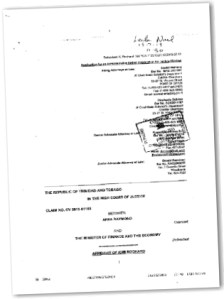 This is the 12th July affidavit filed by the Ministry of Finance in reply to my claim under the Freedom of Information Act (FoIA) filed against them in this matter.


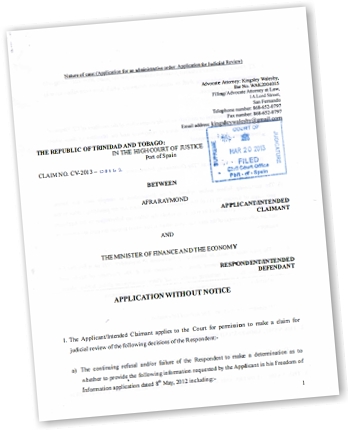



 The CL Financial bailout continues to be a major failure on any scale, both in the causes of the fiasco and especially the manner in which it has been handled.
 AfraRaymond.net