Property Matters: In-Dependence? Part 4

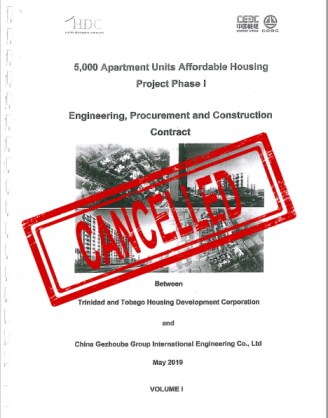
cancelled-hdc-contract

Sad to say, but this bitter, bizarre HDC/CGGC contract and its reported cancellation requires that my Season of Reflection closes with further, more blatant, counterfactuals.  Last week I quipped about the amazing scenes we were witnessing in this episode, but the more recent statements denote a sharp descent.

This recent barrage was an epic of Carefully Crafted Confusion.

For example, the important issue of whether the Attorney General advised on the contract has been serially evaded.

Here are Acting PM Imbert’s replies to Parliament on Friday 13th September 2019

“...Mr. Indarsingh: Thank you, Mr. Deputy Speaker. Can the Acting Prime Minister state whether this contract for over half a billion dollars was vetted by the Attorney General of Trinidad and Tobago?

Mr. Deputy Speaker: I will not entertain that question at this time, Member…”

(pg 10)

“…Mr. Rodney Charles (Naparima): Thank you, Mr. Deputy Speaker. Can the Acting Prime Minister state whether any due diligence by the Office of the Attorney General was undertaken prior to the signing of the Framework Agreement between the China Gezhouba Group International Engineering Company and the Housing Development Corporation on July 13, 2018?

The Acting Prime Minister and Minister of Finance (Hon. Colm Imbert): Mr. Deputy Speaker, I am advised that the framework agreement did not require the Attorney General to give an opinion on the contract.

Mr. Charles: Thank you, Mr. Deputy Speaker. Is it the norm for state enterprises to enter into contracts in the order of this magnitude without reference to oversight by either Cabinet or the Attorney General?…

Hon. C. Imbert: Mr. Deputy Speaker, firstly, the Housing Development Corporation is a statutory authority, it is not a state enterprise. It has its own rules according to statute, and the Housing Development Corporation does have the authority to determine its own contractual affairs…”

(pg 15)

In the first case, the Deputy Speaker refused the question and in the second, the Acting PM simply said that the AG’s advice was not required.  As yet, we have no idea if that advice was sought and provided.  Did the AG advise?  Yes or no?

Another aspect of this is that, as a Statutory Corporation, HDC is governed by its Act, which states at clause 12  –

“…12. The Minister may give to the Board directions in writing of a specific or general nature to be followed in the performance of its functions or the exercise of its powers under this Act, with which the Board shall comply…”

Clearly, HDC is legally bound to comply with any lawful instructions from its line Minister, so any statement to imply its independence is simply false and misleading.

Then PM Rowley’s statements on Monday 16th September 2019 were intended to shield HDC Chairman, Newman George.

…We didn’t put Newman George to run the HDC…” is a perfect counterfactual, since the HDC Board is appointed by Cabinet, of which the PM is Chairman.

On 3 December 2015, the government news service advised that ‘Housing Minister appoints new HDC Board’, inclusive of its Chairman, Newman George.

I was intrigued by these parts of Dr Rowley’s statement –

“…The PM said Cabinet was unhappy with some aspects of the contract, including a conflict between the plan to sell apartments (which people may not be able to afford) and Cabinet’s desire to build rental units. He also lamented the old deal would have required the HDC to get help from several ministries and may have been too accommodating to a foreign entity…”

Could it be that we will see a move towards affordability and rental units?

Dispute Resolution

At pg 17, clause 1.4 states that –

…The contract shall be governed by Law of Republic of Trinidad and Tobago…

Apart from the awkward phrasing, that is sound.

At pg 34, sub-clause 20.6 states that –

“…Any dispute, controversy or claim arising out of or relating to this contract…shall be referred to and finally resolved by Arbitration under the rules of Arbitration of the International Chamber of Commerce…the arbitration award shall be final and binding upon both Parties…the place of Arbitration shall be London, England…the arbitration shall be conducted in British English…”

So far so good, but there is more.

The contract contained two payment guarantees.  The first, in which the HDC guaranteed the full sum due to CGGC, and in the second of which HDC guarantees the retention held in respect of defects etc.  Both those guarantees specify –

“…This guarantee shall be governed by the laws of the People’s Republic of China and shall be subject to the Uniform Rules for Demand Guarantees, published as No 758 by the International Chamber of Commerce…”

Given that our Public Money was to fund this huge project and support these guarantees, it is  unacceptable that the governing law was not our own. Quite apart from the issue of the governing law, it is striking that these solid guarantees are seldom, if ever, enjoyed by local contractors.

ADDENDUM: Who signed what?

The Framework Agreement of 13 July 2018 was signed by HDC’s Managing Director, Brent Lyons (pg 11).
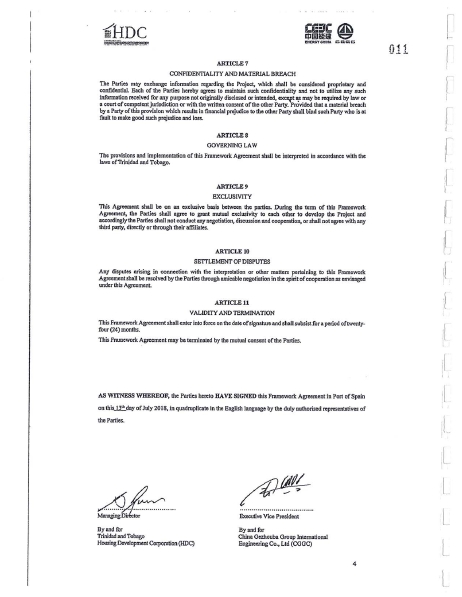
brent lyons sign

The Contract Agreement of 17 May 2019 was signed by HDC’s Chairman, Newman George (pg 6).
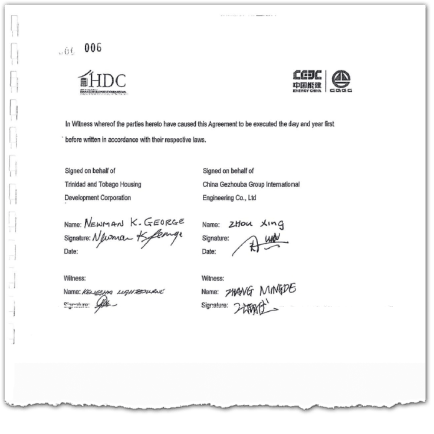
newman-george-sign

Property Matters – In-Dependence? Part three

cancelled-hdc-contractThe previous article opened with news of the unexpected and welcome cancellation of the huge HDC/CGGC contract to design and build 5,000 new apartments.

The barrage of stories on this issue in the last week has left one phrase ringing in my mind, VS Naipaul’s sardonic wit in his ‘independence novel’, A House for Mr Biswas – “…amazing scenes were witnessed when…”.

Two essential elements of the Season of Reflection are shown in the addenda –

  1. the affordability question, as well as
  2. the role of local professionals and contractors.

Continue reading “Property Matters – In-Dependence? Part three”

Property Matters – In-Dependence? Part two

On Thursday, 5 September 2019, the PM announced at the post-Cabinet media briefing that the large-scale HDC contract with China Gezhouba Group Company (CGGC) for 5,000 new apartments was now ‘cancelled’-

…That contract was reviewed extensively by the Cabinet and it has been stopped. HDC has been instructed to go back out to tender because there were some parts of that contract that did not meet Cabinet’s acceptance and approval, both structurally and legalistically. That contract has been stopped.

So, Cabinet has reviewed this contract (after its execution!) and has now cancelled it so as to re-tender and proceed in accordance with proper standards.  Sad to say, a straight reading does not count for much in these matters.  This is where we are, that is all.

The previous article explained the several serious aspects which were wrong with that HDC contract.  In my view the entire contract was wrong, even if no laws were broken and all the necessary protocols were observed.  ‘rong like a Crix Biscuit and this article will explain exactly how. Continue reading “Property Matters – In-Dependence? Part two”

Property Matters – In-Dependence?


“Local contractors and consultants who compete with foreign companies should be provided with the same or equivalent benefits as enjoyed by those foreign companies and should be protected from unfair competition through matters such as soft loans.”
—The Uff Report‘s 43rd recommendation, on the benefits awarded to foreign contractors.


This slideshow requires JavaScript.

This article will delve into the large-scale program for 5,000 new apartments to be built for HDC by China Gezhouba Group International Engineering Co Ltd (CGGC). I am writing this on the night before our 57th anniversary of Independence and my reflections are bittersweet, dwelling on those old discussions about how, for many countries in the Global South, Independence was only symbolised as a spectacle. We used to call it Flag and Anthem Independence, all form with little substance.

As the fight for transparency in our Public Business is waged against those officials who are hostile to the truth, my mind runs on the widespread recent discussion on the proper performance of the National Anthem; the re-emergence of the colonial offense of Sedition; the bizarre, backward, dress-codes to enter public facilities (no sleeveless, no shorts, no cap or hat, no this and none of that) and so much else in the same vein. At the same time as the endless discussions on these issues, we have a cultivated, enforced silence on the huge deals and arrangements within which our Public Assets are bargained. Continue reading “Property Matters – In-Dependence?”

Property Matters – Affordability and Legality part two

hdc actThe previous article continued my Season of Reflection by exposing yet another counterfactual, the myth that the Trinidad and Tobago Housing Development Corporation (HDC) builds affordable housing as required by our Housing Policy (2002) and the HDC Act (2005).

Any basic examination of the facts reveals that the majority of the HDC’s output of new homes are not affordable. I estimated that un-affordable majority as being virtually 80% of the new homes produced for HDC.

The official silence is eloquent and damning. Except that officials are not always silent, so let me share a short social encounter last week with a high-ranking housing official. That official took the astonishing step of telling me that I did not know what I was writing about and that even the information I was relying on was incorrect. When I pointed out that my work is all based on the HDC’s data, checked and supplied by its authorised officers, the conversation took an even more bizarre turn, well beyond the scope of this article. Continue reading “Property Matters – Affordability and Legality part two”

Property Matters – Affordability and Legality

The previous three articles, I, II and III exposed counterfactuals, those being baseless claims, hypotheses or beliefs. In those cases, I dealt with large-scale toxic untruths, shamelessly promoted by those who know better. All that is in it.

Showing Trinidad and Tobago A New Way HomeThis week I continue my Season of Reflection, turning to T&T’s Housing Policy and Program. The Housing Policy (2002) was implemented via the National Housing Authority (NHA), which was succeeded in 2005 by the Housing Development Corporation – established by the HDC Act. This week’s counterfactual is that our housing policy and the HDC are dedicated to producing affordable housing.


This article will establish just how small is the HDC output of affordable homes and go on to locate these operations within the legal obligations governing that Public Institution. Continue reading “Property Matters – Affordability and Legality”

Property Matters – the Cost of the Candle

The previous articles, here and here, delved into the meaning of counterfactuals, those being baseless claims, hypotheses or beliefs. In those cases, I dismantled the dishonest discourse of some of our thought leaders, who should certainly know better. The prior examples were rooted in the sobering racist beliefs expressed by too many educated and responsible people, that is my view.

This week I continue my Season of Reflection by delving into the almost-forgotten Tobago Sandals MoU litigation which forced publication of that important document. This article will be dealing with the issues relating to the legal fees paid in that matter, so it does not repeat the points in the MoU or anything like that.

Legal-fees-1

Continue reading “Property Matters – the Cost of the Candle”

CL Financial bailout – restating the Case, part two

The previous article delved into the meaning of counterfactual, that being a ‘baseless claim, hypothesis or belief’. I started my Season of Reflection by confronting the false narratives of certain thought leaders who are seemingly oblivious to the irrefutable and considerable achievements of the CL Financial group.

The size and scope of the CLF group make it impossible to really discuss business, investment, finance or real estate at a national or regional level without that group being a significant element in that discussion. To discuss those important topics at a national or regional level and be silent on CLICO and the CLF group is to literally ignore the Elephant in the Room. You see?

Considering that the CLF group was established, managed and owned by an African-descended group, it is mind-boggling to hear these repeated claims of Black non-achievement from people who ought to know better.

About a year ago, one of these eminent people published an article making those points about the decline of Black business in T&T and so on. When I wrote to remind him of the existence of CLICO and CLF as a fact, irrespective of what one thought of that company, his response proposed that there were many truths and so on. Postmodernism is a broad field of philosophy, but even that one was way beyond the boundary.

This week, I will examine the second counterfactual in this series – that is the ‘baseless claim, hypothesis or belief‘ that East Indian people are especially corrupt, especially those who are Hindus. We have all heard it, the love of money and the love of land and so on and so forth. Up to a few nights ago my ears twitched as a well-regarded Minister in the current administration confided those views to me, I am not sure if he recognised the sheer disbelief on my features, but he was called away before my response could be delivered.

The case I am making in this article is that the CL Financial bailout is the single largest and most corrupt act in our country’s history, if not the entire region’s history.

clf-bailoutThe CLF bailout is the hugest loan ever of perpetually-scarce Public Money to the wealthiest people in the Caribbean on the most generous terms. Sweetheart Deal does not even begin to describe this level of access to our Treasury, our Cabinet and our very Future.
That agreement is recorded in the 30 January 2009 Memorandum of Understanding and the 12 June 2009 CLF Shareholders’ Agreement, both of which are publicly available.

Consider these points about the CLF bailout –

  1. Amount

    No limit or ceiling was ever set, so the State effectively agreed to write a blank cheque to the CLF shareholders. As we are now told, the total cost is in excess of $25 Billion. By way of comparison, the Wall Street bailout in 2008 was estimated in December 2010 by the USA Treasury Secretary, Timothy Geithner, to cost about 1% of GDP. The CLF bailout cost more than 10% of our GDP, according to the Ministry of Finance in the 2011 Budget Statement.

  2. No repayment period

    Neither of the two agreements contain any provisions to cover repayment period. In the event, the shareholders’ agreement was extended seventeen times.

  3. Interest

    Neither agreement contains any provisions as to the interest to be paid on this huge loan of Public Money. As it unfolded the first $4.9 Billion, which was paid to CLICO was done via issuing a 4.5% preference share. On the basis of a weighted average cost of capital analysis, the interest payable for that loan of over $25 Billion in Public Money is less than 1%. Yes, that is the real interest rate. In comparison, companies bailed-out on Wall Street paid over three times the prevailing base-rate to get Federal funds.

    One of the questions I was examining in getting the details of this bailout is the cost of interest and financing to the State. You see, the State had to borrow heavily to lend the CLF shareholders. That sum is $4,830,506,986.33, as at 30th June 2018. By my analysis, the monthly cost of interest and financing escalated from $30,640,697.82 per month between 30 January 2009 and 30 April 2016 to $85,895,308.99 per month between 30 April 2016 to 30 June 2018. You see?

    On this single aspect of interest, the loss of Public Money has been huge.

  4. Rationale for the bailout was what, really?

    The public was sold the CLF bailout by appeals to the plight of pensioners and the stability of the economy and so on.

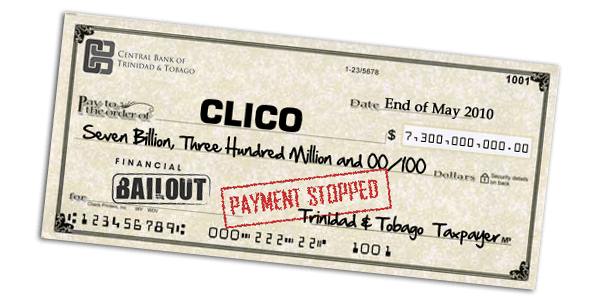
    bailoutcheque1The first estimates of cost were about $5.0 Billion, but when the PP won the May 2010 election it was reported that some $7.3 Billion had been spent. The proposal made by then Finance Minister Winston Dookeran in his inaugural budget was to offer 20-year bonds to ease the burden on the Treasury. The protests and rapid organisation which followed that announcement were epic, with various Policyholders and Depositors groups being formed. When then PM, Kamla Persad-Bissessar, addressed the Parliament on 1 October 2010, her question was pregnant –

    …Because if it is today after the $7.3 Billion, all these EFPA people, the policy group and so on, they are out there, where is their money? Where is their money? Did you have a priority listing of who should be paid? Why did you go—and you are now crying crocodile tears about trade unions, credit unions, the poor man and the small man—why did you not pay them first? Why did you not pay them first? Where did that $7 Billion go?…

In closing, ask yourself who were the Chiefs in negotiating and agreeing to this epic toxic deal? How many of them were East Indian, or Hindu, for that matter? It’s a straight case of ‘Nearer to Church, further from God‘, as the old people used to say.