Paying the Price

On Wednesday 11 June 2014, the Senate unanimously approved the Public Procurement & Disposal of Public Property Bill 2014 and that Bill is soon to go to the House of Representatives for their deliberation. I was present to witness the collective efforts made by Senators on Tuesday 10 June and it was a really thought-provoking experience for me.  I started to wonder just how much we could achieve if the banal point-scoring and ritual picong was to become a thing of the past.  The basis of decision-making on public issues would have to shift to a fact-based one, which would be a huge, healthy step away from the sad formula of ‘might is right’.

What a day that would be for us all, just imagine.

But we have to exist in this place, as it is, with all its imperfections.  Which leads me to discuss the constant questions put by people who want to know if ‘this law we are fighting for‘ could prevent this-or-that corrupt practice.  So the two projects which I would use to give worked examples are –

  1. the THA/BOLT office project on which the High Court recently ruled;
  2. Calcutta Settlement/Eden Gardens land purchase by HDC.

THA/BOLT
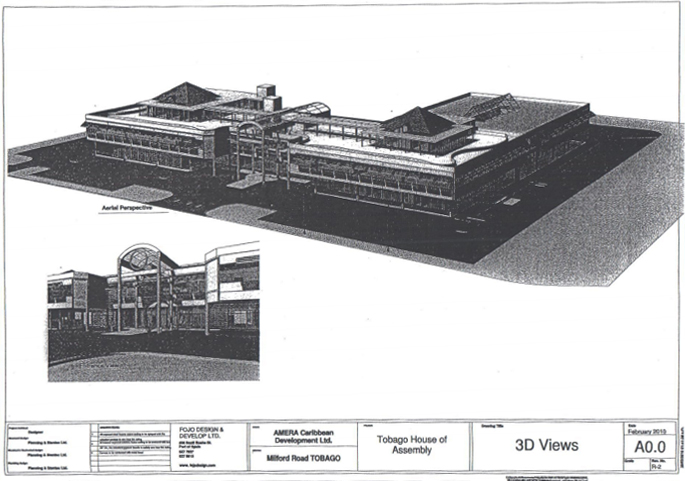
tha-bolt1This project was analysed in a previous article, which set out certain questionable aspects of those arrangements.  In my opinion, the greatest areas of concern were  –

  • Size – THA stated that the Divisions for which this building was being leased now occupy 28,500sf, yet the completed project is to comprise 83,000sf – almost three times more space.
  • Quality – The new building is projected to cost $143M, which equates to $1,723 per sq ft and that is at the upper end of office costs, even when we consider that the contract was reported to be for a fully fitted building.
  • Rent – The current rent paid by the THA for the Divisions to be located in the new facility is an average of $8.17 per sq ft.  The rent for the new facility was agreed at $15.61 per sq ft, which is almost twice the rate now paid.  It was telling that the THA relied on the statements of a Civil Engineer, Peter Forde, who sought to justify that rent by reference to the fact that $10 per sq ft was being paid for some offices in Scarborough.  Mr. Forde is an esteemed engineer with whom I have worked well in the past, but that is like relying on my advice, as a Chartered Valuation Surveyor, as to the correct steel to use in some complex structure.
  • Total Costs – The total monthly rent now paid by THA for those Divisions is $231,788, while the new project is set to cost a monthly rent of $1.295M – more than five times more.

All of these arrangements being made by a public authority which makes a compelling case that the Central Government has starved them of financial resources over a considerable period.  The THA, starved of money, is justifying a deal which will hugely increase their monthly rent bill, for an office building three times larger than required at a higher quality than any other in Tobago.  That is the sense of this deal.

The recent litigation over this project was altered after it started, to two questions of ‘construction’, being ruled by the Court to be issues of public interest –

  • Finance Ministry approval – Is THA required to obtain approval from the Ministry of Finance before entering a BOLT arrangement?
  • Tendering procedure – Is THA required to follow the procedures of the Central Tenders Board Act (CTB Act) in entering a BOLT arrangement?

The High Court ruling on 30 April 2014 was claimed by THA to be an endorsement of their course of action, but this is what it actually meant.

ISSUES High Court Ruling Proposed Public Procurement Law
Preliminary considerations No ruling by the Court. A Needs Assessment would be required to take account of a life-cycle costing, which includes both initial and cost-in-use aspects.
Ministry of Finance approval At para 33, the Court ruled that THA is not required to obtain approval of the Minister of Finance.  In that respect, one can understand THA’s claim to have been vindicated.At para 29, the Court makes the inescapable point that since this is a 20-year recurrent commitment which would have to be paid for by financing from the Central Government, it would be prudent for the THA to consult with the Finance Ministry before entering such arrangements. This is a transaction in ‘Public Money’ via a ‘Public Private Partnership’ which is included in the remit of the proposed law.
Tendering Procedure At paras 48 through 51, the Court was emphatic that the THA was required to follow the provisions of the CTB Act. The proposed law abolishes and replaces the CTB Act and would include this kind of project under the oversight of the Office of Procurement Regulation.

In this case, the THA’s claims of victory appear unrealistic, but the good news is that the proposed arrangements will act to prevent a recurrence of this wasteful type of project.

EDEN GARDENS

163940This 2012 purchase of 50.5 acres (comprising 264 residential lots with ancillary uses) by the Housing Development Corporation (HDC) was also the subject of a series of articles in this space, which highlighted these questionable aspects –

  • Private sales as individual lots – Eden Gardens lots were being offered for sale in 2011 at $400,000.
  • HDC Valuations or Offers? – HDC obtained a private valuation of the property at $52M in November 2011.  In January 2012 Eden Gardens is offered to the HDC at $200M.  So why did HDC order a valuation in November 2011?  Was there an attempt to offer the site to HDC before November 2011 and at what price?
  • The State valuer exceeds the opinion of a private valuer? – Of course that is virtually unknown, but the fact is that the Commissioner of Valuations issued an opinion of value in April 2012 placing the property at $180M.
  • HDC Purchase – The HDC buys the property in November 2012 at $175M, which equates to $663,000 per lot.   Given that those lots were available in 2011 at $400,000, that is a 66% increase in the value of those lands within one year, which can make no sense.  It makes even less sense when one considers that HDC was buying the all that land at once, so a discount would be the rational and expected commercial practice.  So what was the basis on which this price was settled?
  • Plan ‘B’ – The State had the power to compulsorily acquire the land if it was required for a public purpose, which housing is.  The point being that the State could have lawfully acquired Eden Gardens for no more than $35M, if they had chosen to use their powers of compulsory acquisition.  So, why did they choose to go the Private Treaty route?
  • The ‘Ultimate Beneficial Owner’ – The basic business practice required of bankers and other finance professionals is to ‘Know Your Customer’ as a fundamental part of ‘Anti Money Laundering’ (AML) laws now in force in this country.  Those laws and professional practices have now extended to cover the activities of real estate agents, so anyone selling land would be required to conform.  The vendor of Eden Gardens was Point Lisas Park Limited, but from my research at the Registrar General’s Dept, it seems that PLP Ltd. has never issued shares.  Which means that we can only speculate as to who was the ‘Ultimate Beneficial Owner’ of Eden Gardens and indeed, who received $175M for that property.

The proposed new laws do not contain any provisions to govern the State in ‘acquiring public property’, which was the case in Eden Gardens, since the State was buying land.

This is one of the outstanding serious concerns as to the proposed new law, which would not act to prevent this type of corrupt practice.  Our Parliamentarians need to consider these aspects in finalising this law.

The Elephant in the Room – part 2

Port of Spain
Port of Spain

The recent announcements as to the upcoming completion of the ‘Government Campus Plaza’ offices in POS and the relocation of significant State agencies to central Trinidad are charged with meaning for the office sector. The previous article on this topic examined the huge quantity of State-owned incomplete office buildings in greater Port-of-Spain, the impact of that on the incomplete private office projects and the role of the ongoing process of decentralisation.  For the purposes of this discussion, greater POS is the area bounded by the sea to the South, the WestShore Clinic to the West, the Queen’s Park Savannah to the North and the Lady Young Road to the East. This is going to be a closer look at those aspects, so that we might discern how this issue is going to be settled. There are interlocking issues which have created the Elephant in the Room –

  1. the incomplete State offices, which will impact on the private office rental market as they are completed;
  2. the existing offices leased by the State, which need to be re-examined;
  3. the trend towards decentralisation, with its own profound implications.

To understand the issue requires the reconciliation of these large, seemingly-conflicting, elements.  The first is of course, the ‘sunk capital’ in terms of the State-owned, incomplete office buildings in POS.  The second is the existing leases the State holds from landlords of office space in POS.  The third element is the ongoing programme to relocate significant Ministries and State Agencies out of POS, generally to Central Trinidad.   I am also of the view that we need to enquire into the progress of the ongoing decentralisation process.  The details we need are – Which Ministries/State Agencies are to be relocated from POS?  What are the preferred locations for these offices?  What progress has been made on those relocations?   Has land been purchased/leased?  Has State land been allocated? Has a building been identified?  If a new building is to be constructed, what progress has been made in terms of project scoping, design, tendering and construction?  When are these new non-POS State offices anticipated to be occupied? The key enquiries in this matter would be –

  • State Leases

    We need to know exactly what offices the State is leasing and that info would include – the Ministry or State Agency in occupation; the addresses of the buildings; the size of the office space and its facilities; the number of carparking spaces; the rent paid; the service charge paid; the parties; the extent of the lease/tenancy agreement (when did the lease start and for how long was it agreed).  Apart from the info being presented in that type of detail for each rental, the overall picture will be instructive, as it will show the amount of space occupied  and at what cost. That information will in turn disclose the average (mean) rent per square foot paid.  Without details on the present arrangements for State offices, we cannot properly judge the alternatives.

  • Empty Buildings

    Alexandra PlaceAn additional enquiry has to be raised on the particular instances where the State is paying a rent for property which remains unoccupied.  The same details listed above need to be sought in those cases, but in addition, we need to be told why those properties are still unused.  A great concern was raised recently on #One Alexandra, which concern was mostly justified in my opinion, but the fact is that it is not the only one.  The public needs to be told the full extent to which the State pays rent for unoccupied offices.
  • Re-location progress

    On 2 April 2014, Minister of Planning & Sustainable Development, Dr. Bhoe Tewarie, gave some details in the Senate on these relocations –

    • Ministry of Tertiary Education and Skills Training and some of its portfolio agencies are to be relocated to an ‘integrated administrative complex‘ 15-acre site north of the Divali Nagar on the eastern side of the Uriah Butler Highway. No size was given for the complex and construction was noted to have started in April 2014.
    • Ministry of Community Development is to be relocated to new offices at a 10-acre site near the Divali Nagar on the eastern side of the Uriah Butler Highway. No size or start-date was given for these offices.
    • Ministry of Food Production is considering relocating out of its long-established offices at St. Clair Circle, at the northern end of the Magnificent Seven strip, to either Chaguanas or Farm Road in Curepe.  That decision is pending.

    COSTATT2-595x340

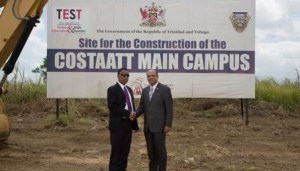
    In the last week we have been told that the headquarters of COSTAATT, which is a part of UTT, is to be relocated from Melville Lane in POS to a location near the new Chaguanas Administrative Complex.   The main building occupied by COSTAATT is said to comprise 86,000sf, which is rented for $13.00psf – the total annual rent is $13.473M.  We were also told that COSTAATT’s POS operations require further rental space to the annual amount of $1.64M.  The new building is costing $168M inclusive of VAT, but no details were given as to its size or proposed completion date.  There are other relevant questions as to the convenience of the new location for students and faculty, but the fact that Chaguanas remains the fastest-expanding town in the country for the past 20 years is a part of that issue.

  • UDECOTT’s rollout

    governmentcampus
    Government Campus

    As per the previous article in this series, the State has built, but not completed, a total of 1,329,000sf of offices in POS.  According to Minister of Finance & the Economy, Larry Howai, on 5 May 2014 –  “Cabinet has approved a sum of approximately $1.5 billion to complete the Government Campus buildings in downtown Port-of-Spain,” said Howai. Once this is completed in the next 12 months I expect that the OSH problems being complained of at the BIR will be a thing of the past.”

    That Cabinet approval equates to $1,129 per sq ft, which seems high unless one considers that a significant part of that money is stated to be for remedial works and not strictly for fittings and finishes. The impending completion of those offices will be a sea-change in the fortunes of POS, since their occupation will force the landlords who were renting to the State to seek other tenants. In my estimation at least half the rented offices in the capital are occupied by the State, so that office market is largely driven by the public sector.

    I have heard many colleagues attempting to rationalise the coming change by reference to OSHA requirements which require more office space allocated to each worker and therefore those requirements would ease the impact of the impending new offices.  Another rationalisation I have heard is the one about how some landlords would be leaving their places locked-up so they will not actually be offering those on the market, so there will be no real effect and so on.

All of those are coping mechanisms for dealing with the reality of change on an epic scale.  This is the Manning Plan, in full effect.  To quote the CEO of leading private sector office developer, RGM, Gerard Darcy, in a May 2013 interview  – “…The Government Campus is still the 800-pound gorilla in the room because it is too large to ignore…”.  I expect a significant adjustment in office rent levels in POS in the medium term. The financial sector, especially those who have expanded their loan portfolios on the basis of the property boom, will need to take careful stock of the extent to which these rapidly-approaching changes imply severely impaired assets.

The Uff Bluff

Jearlean John. Photo courtesy Trinidad Guardian
Jearlean John, Chairman UDeCOTT

On December 11, I wrote ‘Invader’s Bay Review‘ in this space, calling for an immediate public review of that improper large-scale development being proposed on reclaimed State lands in west POS.  I also took the opportunity to make the point that there had been no consultation on that proposed development and that UDECOTT’s repeated public statements that its operations are now compliant with the Uff Report recommendations are false.

UDECOTT’s response was to place full-page advertisements in the three daily newspapers, on Saturday 14 and Sunday 15 December, in an expensive attempt to refute my criticisms.  My letter to the editor, carried in this newspaper on the Sunday, put UDECOTT’s misleading advertisement in context and reaffirmed the continuing falsehood of their claimed compliance with the Uff Report.  The episode is recounted here.

There are several lessons one can draw from this exchange – the sheer hostility to the truth which is now becoming a disturbing ‘new normal‘ in our society; the invisible hand of the bureaucracy in devising large-scale developments, stated to be for the benefit of citizens, without citizen inputs; the inescapable reality that these obstructive forces operate across and within all our political administrations.

Sunity Maharaj wrote a fine overview of these burning issues in ‘Amandla!  Now listen to the people‘ in the 15 December Sunday Express.  In that article, Sunity detailed the development of a perverse consultation industry “Its specialty is in designing events that look like consultation, sound like consultation but do not actually involve consultation…”.

There is a serious challenge facing us here, since there is no will to implement the beneficial recommendations contained in the Uff Report, despite the repeated false promises.  The failure to implement those proposals is deeply detrimental to our society as it entrenches the colonial idea that development is not something which really concerns the people of this country.  Worse, the deceptive policy of politicians claiming to intend to do the right thing, while doing the underhanded thing, is imposing a neo-colonial reality.  The State has a duty to be exemplary in its conduct and for the State to fail to do so and to act deceptively in that failure, is to increase cynicism and instability in our society.

In addition to failing to implement the Uff Report recommendations, there was also another significant setback.   The Enquiry website – www.constructionenquiry.gov.tt – which held all of the proceedings and evidence, became inaccessible at the end of 2010, about 6 months after the Peoples Partnership electoral victory.

moore-volneyThe JCC has been pressing for the implementation of the Uff Report recommendations and the restoration of the Enquiry website.  Those efforts have ranged from the Attorney General, who directed us to the Minister of Justice, to the then Minister Volney who ignored our three letters on the matter – see http://www.jcc.org.tt/uff.htm.  When we pressed-on with Volney’s successor, Christlyn Moore, the exchanges were sobering.

The two previous Ministers of Justice – Volney and Moore – both claimed that the Uff Report recommendations were to be implemented by the impending Public Procurement legislation.  Quite apart from the inordinate delay in bringing these critical new laws into being, that claim is entirely false, since only one of the recommendations, the 56th, relates to new Public Procurement laws.  90 of the 91 recommendations could have been implemented by now with no need to get any new laws passed or any use of valuable Parliamentary time.  The JCC’s repeated offers to assist and advise in any working party for that purpose have also been ignored.  The implementation of those 90 recommendations would have greatly reduced the criminal theft and waste of Public Money with which we are now beset.  The failure to implement those recommendations is probably the largest single ingredient in the continuing decline in our ‘morality in public affairs‘.

Even worse is the steadfast refusal to reinstate the Uff Enquiry website.   There is no way to tell if the website was deliberately removed or if there was a mundane technical reason for its disappearance.  What we do know for sure is that there is solid official resistance to even offer a sensible explanation for the continuing refusal to reinstate.

It is critical for us to learn from our errors if we are to avoid a repetition and it is therefore important that we excavate those lessons so that they can be considered.  To fail to do that is to thwart the entire move to a ‘developed nation status’.  Our nation’s primary information needs to be properly documented and published so that anyone who wants to learn the lessons can do so.

The evidence in the Uff Enquiry offers a deep, unprecedented insight into the state of affairs in our country and the conduct of our substantial business dealings.  That information is first-class primary source material for research and teaching in critical fields such as Government, Finance, Engineering, Surveying, Planning, Economics, Sciences, Law and Management.  We cannot become a ‘learning society‘ if first-class primary information is suppressed.  It does not matter how many universities we build or how many pupils we certificate, the ignorance of our own primary information will frustrate the drive to a higher level of education.

On 26 March 2013, then Minister Moore replied to the JCC –

“…It is inappropriate to make available the evidence revealed in the Uff Enquiry at this time as they may ground future criminal enquiry…”

On 23 May, we invited the Minister to reconsider her position, pointing out that –

“…To quote from the final remarks of the Enquiry Chairman, Professor John Uff QC Ph.D. – “…Finally we would like to thank the Press for their continued and expert coverage of the Enquiry; and the public for their unflagging interest in the proceedings. There are few countries in the world where an Enquiry into the construction industry could fill a prime time television slot for over a year. For me it has been a unique experience and I am personally honoured to have had the opportunity, as I hope, to serve the interests of the construction industry and the people of Trinidad & Tobago…” There can therefore be no doubt that the entire proceedings of the Uff Enquiry were published widely…”

This is the Minister of Justice, claiming that our request to reinstate this invaluable website, would amount to ‘making the evidence available‘.  Evidence which had been widely televised, all day long and rebroadcast at night. I tell you.

The Minister promised to revert to us by the end of June 2013, but that reply never came.

So now UDECOTT’s stance is clearer, given the overarching policy of the State on these critical matters of public concern. I maintain that UDECOTT did not conform to the 17th Uff recommendation in its involvement in the Couva Children’s Hospital.  That recommendation is –

“User groups and other interest groups should be properly consulted on decisions regarding public building projects, to ensure that relevant views can be expressed at the appropriate time and taken into account before decisions are made.”  (emphasis mine)

Procurement_NoticBut the current concern goes beyond the ongoing Couva Children’s Hospital, since UDECOTT is playing a leading role in the Invader’s Bay development. In December 2013, UDECOTT published full-page Requests for Proposals in the newspapers for Designers for Infrastructure Development of Invader’s Bay.  UDECOTT is seeking to hire a designer for the infrastructure element of this large-scale development which means that the selected designers would have to conform to the client’s instructions in preparing their plans.  The client’s instructions would have to be based on some kind of concept, proposal or outline.  That raises the obvious questions of when were these concepts, proposals or outlines conceived and by whom?  Most importantly, who approved these?  We know for sure that there has been no consultation with the public, user groups or other interest groups.

So, we are witness to yet another episode of large-scale development being undertaken, in this case by UDECOTT, with none of the promised consultation.

Hence my title – The Uff Bluff.

Letter to the Editor – UDECOTT’s failure to consult response

udecott-complaintIn response to a full page UDECOTT advert (embedded below) in response to my article “Invader’s Bay Review” (excerpted above), also published in the Business Express.

From: Afra Raymond <afraraymond@gmail.com>
Date: Sat, Dec 14, 2013 at 9:30 AM
Subject: Letter to the Editor – UDECOTT’s failure to consult
To: Editors of daily newspapers. Email addresses withheld

The 17th recommendation of the Uff Report is –

User groups and other interest groups should be properly consulted on decisions regarding public building projects, to ensure that relevant views can be expressed at the appropriate time and taken into account before decisions are made.

The decisive part is ‘before decisions are made.

The Peoples Partnership has not implemented the Uff Report’s 90 recommendations as promised and there has never been an explanation of that failure or refusal to carry out those critical measures. The sod was turned for the Couva Children’s Hospital on 2nd March 2012, at which time the project type, location, size, budget and procurement arrangements were all announced for the first time. Plainly, no consultation took place before those decisions were made, which was the point made in my 11th December article ‘Invader’s Bay Review’.

UDECOTT has now issued full-page newspaper advertisements to attempt to label my irrefutable observation as ‘reckless and damaging’ and so on. Yet another waste of public money, given that UDECOTT provided no examples of consultation before the key decisions were made on this huge project.

That pattern of secret development is inimical to our country’s progress. We must be properly consulted before decisions are made. We strongly criticised the last administration for that pattern of development and we will continue to make the same point. We must become a learning society.

Afra Raymond
POS

Invaders’ Bay Review

There now needs to be a complete and open review of the Invaders’ Bay matter. That is imperative if the public interest is to be safeguarded.

The catalogue of irregular dealings and improper procurement practice at Invaders’ Bay has now grown so that we are facing an important moment of decision. At this point there has been no announcement as to an award of contract or grant of any lease, so the threshold of binding legal agreement has not been crossed. In investment language, we are at the ‘inflection point’, which is where the prudent investor has to make a decision to continue or abandon a course of action.

This is the exact moment we should be calling for an open review of this major public project, before any binding commitments are made.

The Commission of Enquiry is an often-used device to probe into matters of serious public concern. In relation to construction and property development, we have had recent CoEs into the Piarco Airport Project, UDECOTT, Land-Date and the Biche School Project, to name a few.

The public has a sceptical attitude to these Commissions, since they never seem to bring the desired results in terms of arrests of prominent public officials or disgorgement of stolen monies. Many people dismiss CoEs as ‘talk shops’ set up to enrich lawyers, but I do not dismiss them as effective ways to serve the public interest. Despite the imperfections of the Enquiry process, including the fact that key witnesses can refuse to appear without incurring any serious penalties, there are real benefits. The main one, in my view, is that a CoE allows us in the public to learn about major matters of public concern which would likely have remained hidden.

That is the reason we need to retain this process so that the wrongdoing of the past can be exposed, so that we can have the possibility of avoiding those in the future. The weak point of the process is that it always takes place after the crimes have been committed, so during the Bernard Enquiry we were learning about the already-constructed Piarco Airport Terminal. Too late to prevent the massive theft and waste of Public Money.

That is why we need to consider a shift in our approach to the question of enquiries into questionable public projects, since the process is a reactive one, completely unable to stem wrongdoing.

At the ‘inflection point’ now occupied by the Invaders’ Bay project, we have an opportunity to examine this large-scale development before any significant expenditure of Public Money so that we can detect and deter wrongdoing. I am not yet settled in my mind as to exactly what type of review is best here, but whatever happens, it must be independent and committed to publication of its findings.

Some of the main issues which such an Enquiry or Review should examine are –

  • Consultation – The complete lack of consultation in this large-scale development proposal for our capital city would be addressed by the process. The land is vested in UDECOTT via a lease and that organisation has repeatedly claimed to have implemented the recommendations of the Uff Report. The 17th of those recommendations states “User groups and other interest groups should be properly consulted on decisions regarding public building projects, to ensure that relevant views can be expressed at the appropriate time and taken into account before decisions are made”. Given the swiftness with which the Couva Children’s Hospital – which is being executed via UDECOTT – emerged in March 2012, we know for sure that those recommendations are not being observed by UDECOTT. Even looking beyond UDECOTT and its conflicting ‘versions’, we can see the contradictory actions of the Ministry of Planning & Sustainable Development supporting a public consultation process at King’s Wharf in San Fernando, yet refusing to hold public consultations on Invaders’ Bay in Port-of-Spain.
  • Environmental Concerns – The Invaders’ Bay lands are extensive waterfront holdings in State property. The proper development of those lands must take full account of drainage issues and the impact on the environment, including the marine-life issues arising in any waterfront project. I have before me the EMA’s letter of 14 November, which confirms that there have been no requests or Certificate of Environmental Clearance (CEC) applications for the Invader’s Bay lands. In addition, the EMA records provided to me show that the most recent application for a CEC at Invader’s Bay was in January 2007. It is not possible to obtain planning permission without EMA approval, so there are other implications of the lack of these approvals.;
  • There is no link between the RFP and the other three strategic plans for the POS area. That violates the fundamental notion of strategic planning in that existing plans are ignored for no given reason. Piecemeal planning and development is detrimental to the Public Interest. So, who was the author of that RFP and who in the Ministry of Planning approved such a document?;
  • The Request for Proposals (RFP) published by the Ministry of Planning in August 2011 seeking Design-Build proposals for the development of these lands specified an entirely inadequate 6 weeks for submissions. Whose recommendation was it to truncate the development process in this fashion?;
  • The evaluation rules were only published after the closing-date for the tenders, so how did the proposers know what criteria to meet? That late publication is in breach of proper tender procedure, so the entire process is voidable and therefore illegal.
  • Legal Instructions and advice – Also critical to any review process would be the details of the legal advice sought and obtained at various stages of this process. The Ministry is adopting a bizarre, secretive stance in which the advice is claimed to vindicate their actions ‘thus far’, yet that legal advice is being suppressed. The JCC has taken legal action to challenge that unacceptable secrecy in this most public matter.;
  • Infrastructure – The 2014 Budget discloses a $50M allocation for infrastructure at Invader’s Bay, which of course is only a small part of this substantial cost. In the absence of environmental or planning approvals, it is difficult to establish the cost for proposals of this nature, since a design cannot be completed.
  • Allegations of squatting – Finally, we turn to one of the most vexed phrases in our lexicon where land is concerned. The issue of squatting, which is the unauthorised occupation of land not in your ownership. From the sequence of images shown below, we can trace some elementary conclusions:
    1. the first (left) is a map/plan, which uses a dotted line to illustrate the boundary between the Invaders’ Bay property and adjoining Port Authority lands to the north…the physical boundary is occupied by a watercourse/ravine and those ‘Port’ lands are occupied by MovieTowne/PriceSmart, a green play park and the Marriott/BHP-Billiton building
    2. the second (middle image) is an aerial photo which shows the Invader’s Bay land bare of vegetation
    3. the third (image at the base) is an aerial photo which shows the Invaders’ Bay land re-vegetated with mangrove and what appears to be a bare excision, immediately south of MovieTowne’s western carpark…that is a gravel-paved area, which is south of the watercourse I mentioned earlier…it is accessed via a basic bridge from the said MovieTowne carpark.

    (Click on images to expand)

    I am asking whether MovieTowne has a lease, licence or tenancy agreement to occupy those lands. Does MovieTowne pay any rent, licence fee or charge of any sort for the use and occupation of those lands? What action is UDECOTT taking on this? What action is the Commissioner of State Lands taking on this? It would be unacceptable for an entity in breach of State policy to benefit from the decisions of the State. I hope that is not what we are seeing here.

We need a full, independent and open review of this Invader’s Bay matter. Do you agree?

Invader’s Bay part 2: All the Ingredients for Bobol…

Since my previous article on this controversial proposal, we have seen that certain legal advice reportedly considered by the government has been featured in another newspaper.  If that is the advice the State is relying upon in advancing their Invader’s Bay proposals, we are seeing a large-scale act of intentional illegality and a worrying return to the ‘bad-old-days.

My main concerns are –

CONSULTATION?

Compare the lack of consultation at Invader’s Bay with what happens elsewhere.  In particular, the large waterfront lands near the city centre of San Fernando at  King’s Wharf, which has been the subject of ongoing public consultations over the years.  The press reports that various design and redevelopment concepts were presented to and discussed with a widely-based audience.

Whatever the criticisms one might make of the King’s Wharf proposals, it is undeniable that views have been sought from the public/stakeholders and various proposals have been made for consideration.

The JCC and its Kindred Associations in Civil Society met with Ministers Tewarie and Cadiz on 26 September 2011 to express our serious concerns.  Yet, when Minister Tewarie was challenged by the JCC and others as to the complete failure to consult with the public, the only example of consultation he could cite was the very meeting we had insisted on, which took place after publication of the Ministry’s Request for Proposals (RFP) and just about one week before the closing-date for proposals.

This Minister obviously does not consider public consultation to be a serious element in real development, notwithstanding the lyrics about innovation, planning and, of course, Sustainability and the Cultural Sector.  Just consider the way in which East Port-of-Spain is being discussed within that same Ministry.  The prospects for sustainable economic development of East POS must be linked with the Invader’s Bay lands, there is no doubt about that.  What is more, to carry-on as though the two parts of the capital can enjoy prosperity in isolation from each other is to trade in dangerous nonsense.  When criticising the large-scale physical development plans of the last administration, ‘dangerous nonsense’ is exactly what I had accused them of dealing in.

Public Administration must be consistent, reasonable and transparent if the public is to be properly-served.  To do otherwise is to encourage disorder and a growing sense that merit is of little value.  The decisive thing has become ‘Who know you’. 

We need to be informed now what planning permissions or environmental approvals have been granted on Invader’s Bay and on what terms.

The Legal advice

I have seen the two legal documents reported on in another newspaper and have to say that those are remarkable documents.

A critical undisputed point, is that the evaluation rules – the “Invader’s Bay Development Matrix and Criteria Description” – were only published after the closing-date.  The JCC made that allegation in its letter of 14 December 2011 and that was confirmed by Minister Tewarie in his Senate contribution on 28 February 2012.  That is a fatal concession which makes the entire process voidable and therefore illegal, since the proposers would have been unfairly treated.

Note carefully that in writing to seek legal advice in response to that challenge of December 2011, the fact that the tender rules were published ex post facto does not seem to have been the subject of a query as to its legal effect.

In one of the legal documents I saw, the penultimate para is chilling in its directness –

…A simple answer to Dr Armstrong’s question on whether the RFP conforms to the (Central) Tenders Board Act is that it does. In reality, the entire tender process was not brought under the CTB Act and the matrix and criteria were forwarded to the tenderers AFTER they submitted their initial proposals to the MoPE…

The ‘simple answer‘, which is what Senator Armstrong got from Minister Tewarie, is that the Central Tenders’ Board Act had been conformed with.  The next sentence is where we enter the other place…let us deconstruct it –

Phrase

Meaning of the phrase

In reality The prior sentence is the official version we are going to tell Senator Armstrong, but here is what really happened.
“…the entire tender process…” Minister Tewarie has consistently held that there was no tender process, this is the State’s senior legal adviser calling that process by its correct title, two weeks before his statement in the Senate.
…“the entire tender process was not brought under the CTB Act…” The tender process was required to be brought under the CTB Act, since it was being done via a Ministry…but that did not happen.
“…the matrix and criteria were forwarded to the tenderers AFTER they submitted their initial proposals to the MoPE…” The State’s senior legal adviser is confirming here that the elementary good practice rules of tendering have been violated, rendering the entire process voidable.

There are two clear findings of illegality in that single paragraph by the State’s senior legal adviser.  Yet a ‘simple answer‘, which was ultimately deceptive, was suggested for Senator Armstrong.

The advice which featured in the press was from Sir Fenton Ramsahoye SC, seemingly obtained after the initial opinion just discussed.

The Ramsahoye opinion was reported to have ‘given Bhoe a green light‘ and so on, but I have serious doubts on that.

  1. Firstly, if there had been clear-cut, solid advice which would have exonerated its actions, the government would have published that so as to silence its critics.
  2. Secondly, having read it myself, their game is a lot clearer.

Ramsahoye’s mind seems to have been directed to the prospect of UDECOTT being granted a head-lease of the entire Invader’s Bay property and then granting sub-leases to the developers selected by the Ministry of Planning.  Those developers would then carry out the proposed development/s.

If that is the way this is proceeding, then there are two serious issues arising on UDeCoTT’s involvement –

  1. The Switch – While it is true that UDeCOTT can lawfully grant the subleases and operate outside the CTB Act, the burning question has to be when was this decision taken to give UDeCoTT that role?  Minister Tewarie has been adamant, since November 2011, that Cabinet took a decision that the Invader’s Bay project be removed from UDeCoTT’s portfolio to be placed within his Ministry.  When did that purported switch back to UDeCoTT take place?  Has Cabinet actually approved such a move?  The first advice looked at the development as it had proceeded and made the conclusions which I criticised above.  The second advice, contemplated a procedure which had been vigorously resisted by the responsible Minister.
  2.  The role of the Board – One of the most vexatious issues to be probed in the Uff Enquiry is the question of to what extent can Cabinet instruct a State Board.  That issue of undue Cabinet influence was also a large contention during the Bernard Enquiry into the Piarco Airport scandal.  Uff concluded, at para 8, that the scope of Ministers’ power to give instructions ought to be clarified.  There are several significant challenges if one accepts the formulation put onto the Invader’s Bay process in Ramsahoye’s opinion. Cabinet would have to instruct that UDeCoTT implement decisions taken by the Ministry of Planning etc.  As we have seen and as the legal advice has clarified, those decisions emerged from unlawful processes.  Is UDeCoTT obliged to follow unlawful instructions?  In the event of litigation, which is increasingly likely, will the members of UDeCoTT’s Board be indemnified by the State for their unlawful acts?   If that were the case, it would be repugnant, with deep echoes of the two earlier large-scale episodes of wrongdoing at Piarco Airport and UDeCoTT projects as cited above.

I stated earlier that this Invader’s Bay matter had all the ingredients for corruption.  I stand by those views.

Property Tax Facts

Property Tax is back and the controversy has naturally returned since the ‘Axe the Tax‘ movement was a signal moment of unity in the anti-PNM campaigns of 2009/2010.

In my opinion, the anti-Property Tax movement was an important measure of the extent to which our national discourse is now irrational and baseless.  The disenchantment with the Manning administration and the thirst to have them removed seemed to occupy more time than any substantial discussion as to the merits of the proposed Property Tax.

Now, as then, I hold the view that our nation’s Property Tax regime is long-overdue for reform and updating.  I support the proposals to do so and we will have to wait for more detail to analyse these proposals further.

Here are a few of the basic facts on Property Tax.

The size of the Property Tax Take – Proportionally

The Estimates of Revenue disclose that in 1995 property tax was 2% of tax revenue and in 2009 it was expected to be a mere .18%.  Property tax, when last collected, contributed a small fraction of the amount it did 15 years ago.  The official projections for the Property Taxes proposed by the PNM were for that revenue to increase to $325M in 2010 – even at that level, the contribution would have barely exceeded 1% of the national tax revenue.

The Draft Estimates of Revenue (2014) published in the recently-approved budget are unclear and I have requested an official clarification before making any detailed comments on those.  As an example the Total Tax Revenue 2014 is estimated (at p. vii) to be $46.8Bn, with ‘Taxes on Property’ comprising $3.914M, which is a tiny proportion of the total, about 100,000th of 1%.  The accompanying chart, on that very page, shows Property Tax at 1% of the total.  There is more to say, but I am awaiting the requested information, hopefully before next week’s deadline.

The key point here is that property is a vibrant engine of wealth in our country and has been so for many decades, every successful person knows that.  Given that fundamental, it is obvious that property has to be properly taxed if any kind of economic justice is to emerge. The historically paltry percentage of revenues raised via Property Taxes is solid justification for a comprehensive mapping of who owns what and the where.  This is a flourishing sector of the economy, so proper taxes are long-overdue.

The size of the Property Tax Take – Absolutely

property-tax_93-09
Total Property Tax 1993-2009. Click image to see expanded version. category_expand

*The PNM’s 2009 proposal was to abolish both the L&B Taxes and the House Rates, with the replacement Property Tax anticipated to earn $325M in the year 2010 – from Ministry of Finance, Estimates of Revenue 2010 (at pg v )

The figures tell a story, since they depict an unexplained decline in Property Tax revenue from $132.16M in 1994 to $83.44M in 1995 and modest increases to $95.08M in 2001, before restoration to $129.65M in 2002.  L&B Taxes were payable outside of Municipalities, while House Rates were payable within the 5 Municipalities – POS, San Fernando, Arima, Point Fortin and Chaguanas.

According to the official records, the real decline in Property Tax income in that period occurred in non-Municipal areas, with L&B Taxes falling from $109.38M in 1994 to $60.38M in 1995, never rising above $64M, before restoration in 2002 to $94.08M.  In clear contrast, House Rates in the corresponding period rose steadily from $22.78M to $35.97M.

I am an outsider examining these aspects of the Property Tax challenge from the published record and one wonders just who is responsible for this level of sheer recklessness.  After all, 45% of the revenue from L&B Taxes vanished in a mere 12 months and in any properly-managed organisation that would send alarm bells ringing.  Over the seven fiscal years 1995-2001, an annual average of $50M in Land & Building Taxes went unpaid – which makes a total of about $350M in missing revenue, at a minimum. What was the reaction within the Board of Inland Revenue?  What steps did they take to identify and eliminate this leakage?  Was there any tax evasion?  Was anyone charged for that criminal offence?

These are essential questions to be resolved if we are to master the challenge of the proposed Property Tax  system.

The Local Government element

mc-funding-chart_2009
2009 Municipal Corporations funding. Click image to see expanded version. category_expand

Both PNM and Peoples Partnership proposed to send the Property Taxes direct to the Consolidated Fund.  The effect of that would be to reduce Municipalities to having just over 2% of their funding free from Central Government controls.  That critical element must form part of any discussion on Local Government reform.

Next week, I delve into the question of income tax on rental income and the likely levels of tax on your property.

Charting our losses: ‘A picture is worth a thousand words’

The last four articles in this series have focused on what I call ‘two sides of the same coin’ – the coin being the large-scale and improper use of Public Money.

I examined the THA/BOLT office project called MILSHIRV being undertaken with the Rahael group and the Calcutta Settlement land scheme in which the HDC acquired developed lands at several times the proper price the State could have paid.

Throughout this type of critique one has to strive for effective balance and fundamental integrity.  The extent of the waste and/or theft is never easy to pinpoint when one is working from outside and relying solely on published documents, but my best efforts to establish those facts is what is presented.  Of course it is impossible to say for sure that any amount of money was stolen in a particular project, hence the phrase ‘wasted or stolen’.

Objectively, it does not matter whether the money is wasted or stolen, if it is ultimately unavailable for the benefit of the Public.  Once spent, that Public Money is gone forever, which is why Value for Money is of such importance in any proper Public Procurement system.

Subjectively, however, the errors of inexperience or poor process must be differentiated from an active conspiracy to defraud.  Although the objective measure of loss might be identical in terms of the dollar-amount, there are different long-term consequences.  Innocent errors and miscalculations can be rectified over time by ongoing review processes.  Deliberate conspiracies to defraud require concerted and well-grounded attacks in order to be eliminated.  What is worse about the deliberate conspiracies is that they affect the very atmosphere in which public business is conducted.

We end up with a situation where it pays to pay a bribe and the decision not to pay is to suffer delay.

That is why we are where we are today.  Simple so.

One of the important lessons emerging from the Wall St disaster is that the variety of financial regulators with their varying rules and experiences allowed financial players to engage in ‘Regulatory Arbitrage’. That was  the scenario in which financial players shopped for pliable or suitable regulators within which to channel their products, resulting in the unprecedented financial disaster we are all living through.

Here in T&T we have seen a similar pattern in our financial markets, but the point being made here is that it has also emerged in the Public Procurement arena, with TIDCO paving roads; the rising profile of State-owned entities which were deliberately excluded from the formal procurement controls; those same companies breaking their own rules and so on. That is the emergence of a toxic kind of ‘Procurement Arbitrage’, which is the reason why we must have over-arching regulations to control all transactions in Public Money.

So, there are two types of losses being charted here –

  1. Firstly, inexperienced officials or poor processes can approve wasteful uses of Public Money through sheer ignorance.
  2. Secondly, there is deliberate conspiracy to defraud the Treasury of our precious Public Money.

Only a Court can establish whether the lost Public Money was wasted or stolen, so I have ventured no opinion as to which is which. Readers can reach their own conclusions.

These charts illustrate the extent of the waste or theft of Public Money in the THA/BOLT and Calcutta Settlement projects.

A good example is worth a thousand words

THA/BOLT – MILSHIRV Project

Rental Rates THA- BOLT chart
Occupancy Excess THA-BOLT
Rental increase chart with table THA-BOLT


Click on the charts above to see full size version


Calcutta Settlement Land sale – Eden Gardens

stamp duty Eden gardens Chart 1 20130405-1
Acquisition options HDC chart 2 20130405


Click on the charts above to see full size version

Calcutta Settlement review

The simple, inescapable fact is that the State could have lawfully acquired the ‘Eden Gardens’ property for less than $40M.  The HDC paid $175M in November 2012 to Point Lisas Park Ltd (PLP) for that property, which is the reason I am calling this an improper use of Public Money.

Despite having available the advice of the Commissioner of State Lands, the Commissioner of Valuations and various attorneys at HDC and so on, the Cabinet approved this transaction.  This Cabinet, with two Senior Counsel at its head and several other seasoned legal advisers, appears to have been unaware of, or intentionally ignoring, the legal safeguards.

Some readers may be surprised at those assertions, so here are my reasons for making such.

The last two articles examined the steps leading to the HDC’s purchase of land at ‘Eden Gardens’ in Calcutta Settlement.  In my opinion that transaction, as well as the one which preceded it, are both highly improper and very probably unlawful.  The HDC purchase must be reversed and the responsible parties investigated/prosecuted as required by our laws.

This ‘Eden Gardens’ episode is an object lesson in what can go wrong when elementary policy is set aside for stated reasons of expediency.  Apart from the lack of any Needs Assessment, the unclear role of the Commissioner of State Lands is a source of serious concern.  That Commissioner’s role is to advise the State on the strategic implications of its land policies and transactions, so this is a straight example of a case which required a solid input from that critical State Officer.

So, what should have happened?  How would a proposal like the ‘Eden Gardens’ one have been handled if the various parts of the system were functioning properly?

When parties are in commercial negotiations, there is always a Plan ‘B’, to be adopted in case the main plan goes awry.  Each side has a different Plan ‘B’, since they have different interests.

What was Point Lisas Park’s Plan ‘B’ in case their negotiations with the State were unsuccessful?  While we can never know for sure, PLP being a private company, the fact that those lots were widely offered at $400,000 can allow us to form a view as to the benchmark they were likely using.

The State’s Plan ‘B’ is far simpler to establish, since there exists the legal power to compulsorily acquire private property for a public purpose.  That was the third unique facility enjoyed by the State as set out in the previous article.

In the case of a landowner making unreasonable demands, the State has the lawful option of compulsorily acquiring the property.

The Land Acquisition Act 1994 (LAA) establishes the right of the State to compulsorily acquire private property for a public purpose.  At S.12, the LAA specifies the rules of assessment used to arrive at the sum offered to the owners of private property interests being acquired.

S.12 (4) states –

…(4) In making an assessment under this section, the Judge is entitled to be furnished with and to consider all returns and assessments of capital value for taxation made or acquiesced in by the claimant and such other returns and assessments as he may require…

The point in this case being that, having registered a purchase at $5M in February 2010, PLP would have been unable to legally resist a compulsory purchase which adopted that price as its basis.  Even if the State, in recognition of the roughly $29M spent by PLP on building the infrastructure for ‘Eden Gardens’, were to add that sum, the final offer would only be about $34M.

Those provisions at S.12 (4) of the LAA are a critical safeguard against persons who might seek to under-declare their properties to evade taxes, then seek to make exorbitant claims if the State seeks to acquire compulsorily.  S.12 (4) prevents the State from falling victim to any such games, it is a critical safety-valve to protect our Treasury from those who seek to pay as little as possible when taxes are due, but boldly make huge claims from the Treasury when seeking to sell.

That is why I am calling for this matter to be swiftly investigated and the responsible parties prosecuted to the full extent of the law.

This was in reality a potent dilemma for PLP, in that if they were served with a proper compulsory purchase notice, they would have either had to stick with the $5M figure as a 2010 baseline, or reject that deed and incur the strong penalties at S.84 of the Conveyancing and Law of Property Act.

One of the three deeds executed on Wednesday 3 February 2010 recorded the purchase of ‘Eden Gardens’ for $5M, which is a massive understatement of consideration.  The true market value of that undeveloped property at that date would have been of the order of $50M, so the loss of Stamp Duty to the Board of Inland Revenue would have been in excess of $3.0M.  The underpayment of Stamp Duty is tantamount to a defect in title of a property.  Are we witness to the State making a massive over-payment for marginal lands with defective title?

Did the Cabinet and the HDC receive the proper advice from the Commissioner of State Lands and the Commissioner of Valuations, as well as the other legal advisers?  If yes, that advice was plainly not followed, so in that case the question would have to be ‘What caused the Cabinet and the HDC to abandon that sound advice?

If the true situation is that the proper advice was not provided, we need to know why.  If the advice was not sought, then we need to know why.  If the advice was sought, but not provided, those advisers need to be rusticated so that our processes are protected from more of this nonsense.

The State has an overriding duty to comply with the law and be exemplary in its conduct.  That is not negotiable, if we are to build a society which is orderly, progressive and just.

Episodes such as the ‘Eden Gardens’ sale and the THA/BOLT deal continue the erosion of Public Trust and the loss of that intangible, almost-forgotten, source of ‘soft power’, the Benefit of the Doubt.

This Prime Minister has made repeated statements that any evidence of wrongdoing will be investigated, so that the offenders can be prosecuted according to law.  These three articles have detailed the evidence and breaches of sound public policy, so it is now over to the authorities.

The ‘Eden Gardens’ transaction is a prime example of a large-scale economic crime against the State and the interests of its citizens.

Again, I ask – ‘Who were the beneficiaries?

The final point here is that the parties to the PLP purchase and improvement of ‘Eden Gardens’ are now in litigation, with the contractors – SIS Ltd. – suing Point Lisas Park Limited for various monies and demanding an account of the $175M.  Case CV 2012 – 5068, so we have interesting times ahead.

Calcutta Settlement again

163940In light of the many questions raised by readers after the last article on the HDC’s purchase of land at ‘Eden Gardens‘ in Calcutta Settlement, I am continuing there.

The previous article discussed the Calcutta Settlement scheme and its relation to implementation of national housing policy.  There is little, if any, connection between the provision of affordable housing and the acquisition of those ‘Eden Gardens‘ lands, at what is surely the highest price in Central Trinidad.  How we create and implement a progressive housing policy is a critical part of this discourse, but there is more.

Another important aspect of this episode is the fact that sound land administration policy appears to have been abandoned for expediency.  Expediency should never eclipse proper policy, especially when neither the process nor end-result advance the ultimate objective of serving our citizens.

The sidelining of sound land administration policy was essential in order to get the Calcutta Settlement scheme approved.  National Land Administration policy is important so that we can be strategic in using the country’s property assets for proper national development, as opposed to the enrichment of a select few.

The State is a unique player in our country’s land arena, so we need to place this Calcutta Settlement episode into proper context from a land administration viewpoint.

This is the framework –

  • Size – The State is by far the largest land-owner in the country, which means that there are only limited situations in which it will require private lands;
  • Wealth – The State is the wealthiest entity in the country, which means that it alone can bid at certain levels for the best properties.  Applied to this case, a reasonable question would be ‘Who would have purchased ‘Eden Gardens’ and at what price, if the State had not proceeded?‘;
  • Compulsion – The State is the sole entity in the country able to lawfully acquire land for a public purpose against its owner’s wishes, which means that if an owner of private property takes an unreasonable position during negotiations, the State can compulsorily acquire it;
  • Planning Authority – The State is the national planning authority, which means it has the power to approve its own designs and proposals;
  • Statutory undertaker – The State has ownership and control of the principal utilities, electricity and water/sewerage;

So, if the State intended to construct affordable housing in Central Trinidad, it could have chosen from the abundant State-owned property in the area, granted planning permission for its own proposed development and provided services.  The State could only have bought the ‘Eden Gardens‘ land by ignoring sound land administration principles.  Elementary policy was ignored in favour of sheer expediency, or worse, the enrichment of carpetbaggers at the expense of the Public Interest.

What was the advice of the Commissioner of State Lands on this transaction?  Was his advice sought?  Bizarre and expensive precedents are being set in situations of zero benefit to the Public Good.  This deal is detrimental to the Public Interest.

At a level of State policy, there was a collapse into expedience and a continuing silence as to the role of ‘Eden Gardens’ in the national housing policy.  But when I delved into the documents in my possession, there were even more causes for concern.

The Registrar General’s records show that there were three transactions executed on the same day for this property – It was Wednesday 3 February 2010 –

  1. Deed # DE2010 004276 02D001 rescinded the 2004 Sale Agreement (the one for $17M, registered in 2007), with the deposit returned and no claims made;
  2. Deed # DE2010 007816 95D001, Point Lisas Park Ltd (PLP) purchased the property from the owner, Sookdeo Deousaran, for $5M, paying Stamp Duty of $350,000;
  3. Deed # DE2010 003449 63D001, PLP mortgaged the property to said Sookdeo Deousaran for $18.5M at 8%, to be repaid on the last day of January 2012.

These purchasers were prepared to pay $17M for this undeveloped property in mid-2004, but ended up paying only $5M for it in early 2010.  On the same day, they mortgage it for $18.5M.  By happy coincidence, or otherwise, the property with infrastructure added was offered to the HDC at $200M in late January 2012, two years later.  Literally unbelievable.

What is more, the fact that the second and third of those deeds were executed on the same day is deeply perturbing as to the operation of the Stamp Duty section of the Board of Inland Revenue.  The second deed transfers the property for $5M and Stamp Duty is paid on that, yet the third deed shows a mortgage granted the same day on the same property for $18.5M.  Normal practice in the finance world is for a mortgage to be taken on a property at some fraction of its current market value.  Both those deeds were registered at the San Fernando office of the Registrar General’s Dept.

If there were a reasonable gap between the first sale to PLP and the new owners mortgaging the property, it might be possible to claim some increase in value due to its physical development or obtaining permission to develop.  But since both transactions took place on the same day, there is no way anyone can claim a genuine difference in value.

The 8% interest rate on the two-year mortgage is instructive, in that the actual rate at which finance was offered at that time for similar projects was in the 10.5-12.0% range.  The reasonable conclusion being that both sides had a high degree of comfort with each other, indicative of close collaborators.

S.84 of The Conveyancing and Law of Property Act (1939), states that the penalty for falsely stating the consideration in a deed is a modest fixed fine and a further penalty payment of 5 times the amount of the understatement.  Those penalties apply to both the buyer and seller, perhaps to discourage these dishonest practices.  The Act goes further to offer the penalty payment as a reward to the person making the report of the understatement.

S.86 of that Act also specifies a small fixed penalty for an attorney found guilty of “…knowingly and willfully…” recording a false consideration and mandates that the said attorney “…shall…” be disbarred.  Of course an attorney who had prepared only one of those deeds could reasonably claim to be genuinely unaware of the entire transaction, so we will see.

Sad to say this ‘Eden Gardens’ scheme is reminding me of the CL Financial antics. I am thinking about the the affidavit of the Inspector of Financial Institutions  stating that Clico Investment Bank did not file its Corporate Tax returns for 2007, 2008 and 2009 and the fact that, despite those lapses, they were able to obtain a bailout on ‘sweetheart terms‘.  The Eden Gardens chiefs were able to understate the property value to avoid the true level of Stamp Duty, but were also able to get Cabinet to agree to effectively bail them out, also on ‘sweetheart terms‘.

Always remember that the land at ‘Eden Gardens‘ cost $663,000 per lot as agreed by the Cabinet, seemingly unaware that the developers were offering lots there for sale at $400,000 only months before.

The HDC purchase was completed on 9 November 2012 and recorded in DE 2012 026026 11D001.  The para before the $175M sale price is the one which specifies the 2010 deed for $5M, just so.

I approved of the diligence of our AG in challenging the legality of the THA’s BOLT project.  This ‘Eden Gardens‘ scheme is also in need of urgent investigation, so we will see.

My final point is that all the information cited in this article is available on the internet, so where is the basic due diligence?  These sorts of schemes should not even get past the first gatekeeper, far less into the Cabinet for consideration.