For a Few Dollars More

Sen. Larry Howai, Minister of Finance

Next Monday, 8 September 2014, is carded for the Finance Minister to deliver his 2015 Budget Statement to the country and of course speculation is great as to whether this will be an ‘election budget‘ or if a more restrained approach might be taken.

In preparing to write this column, I took a look at our budgets since 2005 and it was really striking that many of the key issues identified a full decade ago are still at the fore of the more recent budgets. Some of those issues were the imperative to reduce our dependence on the energy sector; the constant push to upgrade our infrastructure; the demand for more resources dedicated to national security and of course, the repeated statements about this or that program to reduce white-collar crime.

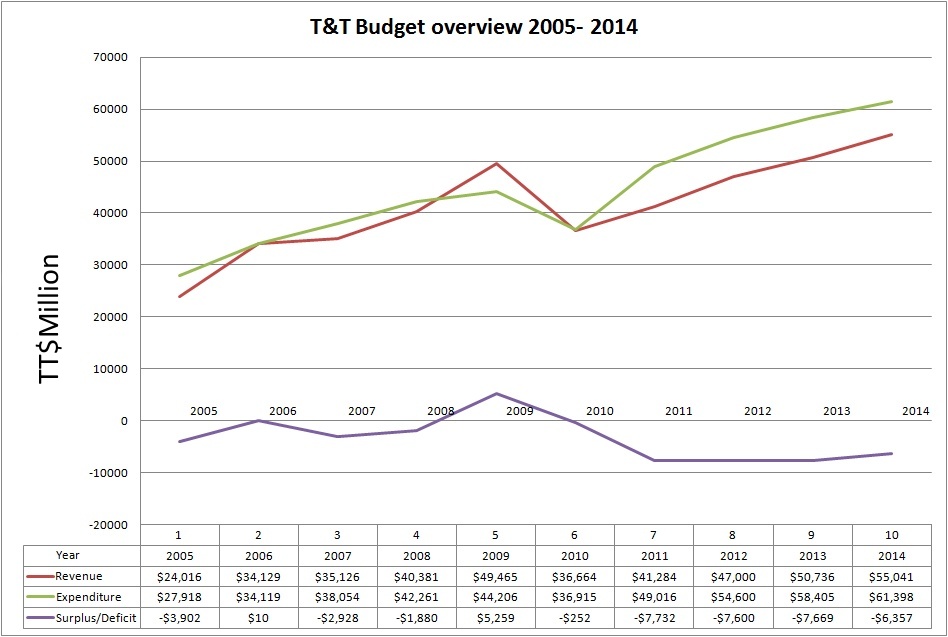
These expenditure and revenue figures were drawn from the Budget Statements, so no account has been taken of either actual outcomes or supplemental appropriations – this is the process used by the Government to obtain authorisation from the Parliament to exceed the approved spending limits in the national budget.


fistrful of dollars

Clearly, we are seeing a trend as to the constant increases in expenditure, with only one decline, in 2010. Given that background, it also appears that surpluses are rare, occurring only twice, in 2006 and 2009.

The reality that we are on the verge of a national election which is sure to be strongly-contested, leaves me in little doubt that the 2015 budget is also likely to be a deficit budget, with the State spending more than it earns.

The recent scandals at LifeSport, Eden Gardens, THA/BOLT, CAL, CL Financial and of course, the Beetham Water Recycling Project, all show the extent to which the Treasury is being targeted by well-connected parties.

There is a constant stream of allegations of ‘Grand Corruption’, which is little surprise in our society in which an unsupported allegation is so often used to discredit an opponent. There is no comfort to be had in that observation, since the other reality is that thorough investigations and prosecutions are only done against ones political enemies, inside or outside the ruling party. That is the sobering reality in our Republic, in which we should all enjoy equal rights and be held to common standards. Different strokes for different folks, just like back in the ‘bad-old-days‘.

It seems to me that the defining question, in terms of whether the various financial crimes are taken seriously, is whether the accused persons are ‘members in good standing‘, so to speak.

The extent to which our Treasury is protected from being plundered by criminal elements is a serious question which should concern every citizen, given that the Public Money in the Treasury belongs to us as citizens and taxpayers. The frequency with which these financial crimes are overlooked is nothing less than scandalous, as any of the Auditor General’s Reports in the previous decade would attest. Permanent Secretaries approving payments in breach of financial regulations; payments made with no documents (leases, contracts or agreements) on file; failure or refusal to produce documents as required by law upon the Auditor General’s request and so many other types of lawbreaking. The same types of conduct is also rife in State Enterprises, which is why so many of the larger ones are unable to produce accounts as required by the very Ministry of Finance which sets those rules and continues to fund them.

The wicked part is that these Public Officials are virtually never charged with breaking the law or made to face any other serious consequences for their misbehaviour in Public Office. We need a new beginning in terms of how we handle the reality of our country’s wealth and its intentionally-degraded laws for controlling how our Public Money is used. A big part of that would be a political dispensation in which full investigations and prosecutions were the norm, especially when key members of the ruling party are the target of allegations.

Our budgeting process now shows all the signs that our system of Public Financial Management is ineffective in dealing with the seasoned criminals who are hard at work helping themselves to our money, whatever the political party in power. At that level, at least, there is little evidence of discrimination.

The growing complexity of the budget is of no comfort. For example, the 2014 documents totalled some 2,997 pages, yet the Billion-Dollar-Plus Beetham Water Recycling Project (BWRP) was omitted. Despite questions as to what did he know and when did he know it, the Minister of Finance continues to ignore the fundamental requirement to provide for this huge project within our national accounts. There has been no attempt to give the public the necessary explanation as to how the BWRP is to be paid for, since the underlying commercial arrangements which are driving this project remain obscured. The BWRP also shows a strong theme as to the privatisation of our nation’s water supplies, which is a growing area of concern globally. Not the first one, it is true, since we had DESALCOTT before, but this second, huge project implies a trend, in my mind.

The inescapable question is ‘To what extent can we rely on our national accounts, if huge projects like BWRP are omitted?

All of which brings us to the continuing and unexplained delay in passing the Public Procurement & Disposal of Public Property Bill. That new law would play an important part in greatly reducing the scope for waste and theft of Public Money. The JCC and its Kindred Associations in the Private Sector Civil Society group continue to call for this law to be passed without any further delay.

Of course all of this is driven by the political parties’ imperative to raise money from various financiers to fund election campaigns, so Political Party Financing laws are essential to control those influences. The Parliament recently unanimously approved a Private Members’ Motion laid by Independent Senator, Helen Drayton, to appoint a Joint Select Committee (JSC) to start the long-overdue process of agreeing just what are the new laws we need to deal with this influence, described by President Carmona, in his inaugural address as a ‘veritable juggernaut‘. The JCC continues to call for the JSC to be appointed so that this critical work can be started to control Political Party Financing.

Having observed the two-week spectacle of prolonged debate in the Parliament on the recently-approved Constitutional Amendment Bill, one can only wonder as to the priorities which are being displayed.

Hence my title – ‘For a Few Dollars More‘.
Money is the Problem

One of the big unanswered questions arising out of the recent ‘grand corruption’ cases in relation to the Public Sector remains – ‘How can we lawfully punish those wrongdoers who are looting our country?

Most discussions proceed along the lines of what I call the ‘bag of money‘ idea, in which we are looking for the actual stolen money.  The belief being that the stolen loot can actually be located and linked to the thieves, who will then face a harsh penalty.  My preferred solution is for full disgorgement of all the stolen monies as a starting-point, even if that is a remote goal.

In re-examining the issue practically, one has to ask “Why do we persist in these ‘pipe-dreams’, while ignoring the ‘low-hanging fruit’ all around us?”  So I am considering a new strategy for action on these critical issues.

‘Public Money’ is the term used to describe money due to or payable by the State, including those sums for which the State would be ultimately liable in the event of a default.  Public Money is sometimes called Taxpayers’ Money, it is our Money. Continue reading “Money is the Problem”

Everything but the Truth

On 1st June 2014, my former colleague and Business Guardian Editor, Anthony Wilson,  made a call for a ‘national debate’ on the proposed disposal of CLICO’s traditional portfolio of insurance business.  This is the first of my responses.

We are now entering the chaotic endgame of this epic CL Financial bailout fiasco. Some of the recent official statements are –

  • CL Financial’s other assets, including majority shareholdings in Republic Bank Limited and Methanol Holdings to be sold;
  • Full repayment of Public Money advanced in this bailout is expected.
  • CLICO’s traditional insurance policy portfolio is being professionally valued prior to its intended disposal;
  • Atrius Ltd., set up in 2013 as an alternative vehicle for CLICO’s continuing business, is to be effectively abandoned;
  • All of CLICO’s sales agents are to be terminated by the end of this month, June 2014;

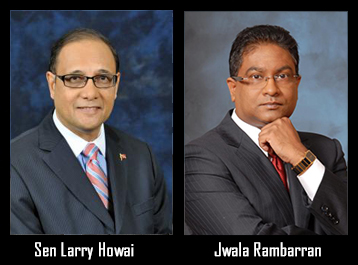
jwala-howaiThe recent statements of both the Minister of Finance, Larry Howai, and the Governor of the Central Bank, Jwala Rambarran, could give the public an impression that this financial disaster has now been mostly resolved and we are on some kind of smooth track to a complete solution.
I remain sceptical as to the extent to which these problems have been resolved. The complete lack of detailed information, despite many requests by myself and others, leaves one to wonder just what is the basis for these serious decisions.

So, why am I saying this?

The money being used in the CL Financial bailout is ‘Public Money’, which we sometimes call tax-payers’ dollars. The leading learning from which we have to draw serious lessons is Lord Sharman’s 2001 Report to the British Parliament ‘Holding to Account‘, which was a thorough examination of the definition, role and need for control of ‘Public Money’. In the Public Procurement campaign we expanded on Sharman’s definition of ‘Public Money’ so as to capture the full range of possibilities, but we have accepted his key finding as to the requirement that ‘Public Money’ is to be managed to a higher standard of Accountability and transparency than Private Money – see 2.23 on pg 15.

The contemporary, best-practice position in respect of the management of and accountability for Public Money being that the private sector rules are the bare minimum.

CL Financial Ltd. is a holding company for the Duprey empire, comprising major companies such as Republic Bank Ltd.; the Angostura Group; Methanol Holdings Trinidad Ltd; Home Construction Group of Companies; British-American Insurance Company Ltd; Lascelles-Mercado Ltd. (the Jamaican owners of Appleton and Wray & Nephew rums).

The last audited accounts for the CL Financial group were published on 18 November 2008, for the financial year ending 31 December 2007. The function of consolidated audited accounts is to give investors and management the necessary information with which to make decisions as to the future of the company.

Since 2009 I have been making requests under the Freedom of Information Act for these items of information –

  • Audited Accounts for the CL Financial group, or the basis of the various statements by successive Ministers of Finance;
  • Senate Briefing – details of the high-level briefing given to Independent Senators in September 2011 prior to the vote on the two new laws – one to allow the State to borrow an additional $10.7 Billion to settle the bailout and the Act to shield the Central Bank from the supervision of the Courts;
  • Payments – details of the payments to the various claimants under the terms of the bailout, in particular EFPA-holders;
  • Integrity Commission – confirmation of whether the Minister of Finance was requiring the CL Financial Directors to file declarations as required by law.

I have effectively withdrawn the last of those requests and am now in litigation against the Minister of Finance & the Economy for the first three items. The State has resisted those claims and the litigation continues. I have continued my quest on the compliance of CL Financial’s Directors with the Integrity in Public Life Act with the Integrity Commission, despite the serial delays and unresponsiveness which have beset those requests.

The question before us now is, “How can the State and our government be making these serious, long-term decisions in the absence of the basic information?” Put another way, “How can we continue to allow these serious decisions to be made in our name on our behalf and supposedly, for our benefit, while the State continues to withhold the basic information?

We have now entered the unimaginable territory of unexamined State power being exercised on an unprecedented scale in the pursuit of an unknown agenda.

This is the big picture and it is an ugly one.

Try to imagine the Board of a major, privately-owned, holding company proposing to its Shareholders that its major assets be disposed-of without the basic information, such as audited accounts or details of meetings with major stakeholders. Such an action would be seen as a gross violation of elementary norms of corporate governance and quite likely be rejected with swift, high-level dismissals. Yet, here we have our government (the Board of Directors) proposing these actions while refusing the reasonable requests of shareholders (citizens such as myself and others) for the rationale for and basic information underlying this process.

The fundamental, best-practice principle that Public Money is to be managed to and accounted for to a higher standard than Private Money has seemingly been rejected. Rejected by the Minister of Finance & the Economy and the Governor of the Central Bank.

That is the scale of this ‘thing without a name’. I tell you.

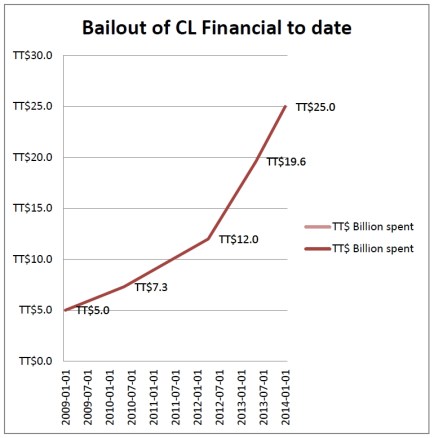
We, the citizens and taxpayers of this Republic, are being told that this unprecedented expenditure of Public Money of $25 Billion is to be resolved by a questionable process. The long-time saying is buzzing through my head – ‘What eh meet yuh, eh pass yuh‘.

Some points to remember in thinking about this issue –

  • CL Financial Shareholders’ Agreement expires at the end of June 2014;
  • Asset Sales have continued with the unadvertised sales of Valpark and Atlantic Plazas;
  • No Interest was charged on the huge sums of Public Money spent to settle the indebtedness of the CL Financial group. The Board of Inland Revenue is a Division of the Ministry of Finance & the Economy and annual interest of 20% is charged to taxpayers who are late in their payments.
  • ‘Fit & Proper’ regulations have never been applied to this CL Financial collapse, as mandated by Central Bank’s regulations, despite my continuing calls. One has to wonder if the stage is being set for a return of Lawrence Duprey & his cohorts to our country’s high-level corporate lifestyle.

On 28 May 2014, the Business Express ‘Opinion‘ was entitled ‘Bringing closure to the CLICO debacle‘ and one of the statements in that editorial was stunning –

“…Thus far, Rambarran and Finance Minister Larry Howai have been forthcoming in their handling of the CLICO issue…”

I could not agree less. The taxpayers and citizens of Trinidad & Tobago are being abused in this entire process.

CL Financial bailout – Paying the Devil

paying the devilToday is the 30th of January 2014: five years since the State bailout of CL Financial was announced to a shocked nation and region. It is necessary to mark this moment in time with solid facts and stern meditation.
The Carnival season is upon us, so J’ouvert is near the front of my thoughts. J’ouvert is simple, yet tremendous, because of the experience of passing from night into daylight and of course those around you becoming clearer as the light overcomes the darkness. For me, the defining feature of Jouvert is the terrifying portrayals of ‘Devil mas‘ in its various forms – ugly and dirty, covered with mud, oil or paint; real noisy, beating pitch-oil tins and such; forceful, in demanding payment from you before you could pass. You have to pay the Devil to go away. Pay the Devil, so he could leave without dirtying you up.

The vast amount of detail which has emerged in the last five years, means that I can only focus on one key aspect of the CL Financial bailout scandal.

My main theme is that vast amounts of Public Money have been committed to repay the debts of CL Financial, while the chiefs who directed and controlled that conglomerate seem free to come and go as they please. Or, in the case of Duprey, who refused to testify at the Colman Commission, to go and refuse to come. Once again, Trinis in the running for some awards for innovation and so on, with Duprey being the world’s first ‘Penniless Philanthropist‘.

How much Public Money has been spent on this exercise? How much of that Public Money will the State recover? That is my focus.

When the Memorandum of Understanding was signed on 30th January 2009, it was on the basis that CL Financial assets would be sold to recover the Public Money being advanced, which was estimated to be about $5Bn.

Winston Dookeran’s first budget speech on 8th September 2010 was a critical turning-point, as it appeared to me that he was attempting to stem the flow of Public Money out of the Treasury. Dookeran made a case which was based on the huge and unprecedented liabilities facing the State at pg 9 –

“…The total funding provided as at May 2010 by the Government and the Central Bank, excluding indemnities and guarantees to First Citizens Bank amounted to approximately $7.3 billion. As of June 2010, CLICO and British American combined total liabilities were approximately $23.8 billion but total assets were $16.6 billion…” .

Immediately, in protest at Dookeran’s attempt to limit the cost to our Treasury, there were several ‘Policyholders’ and Depositors’ groups‘ formed. The word ‘Depositors’ was soon omitted when it was realised that it would not suit their purposes.

With Dookeran isolated and the government under mounting pressure from these new protest groups, there were new laws drafted to stifle the protestors’ legal options. At this point, we had the historic address to Parliament by the PM on 1st October 2010 – historic because even with the required majority of votes to pass the intended new laws, the PM chose to explain and persuade the public. The bailout was extended to Hindu Credit Union and the Commission of Enquiry was announced to find the causes of the collapse of the CL Financial group and HCU.

Most notable was the PM’s outrage at the mystery of the bailout – at pgs 25-26

“…The $5 Billion has been spent—we are advised—to repay matured  EFPA policies in an ad hoc and unstructured manner where payment arrangements were entered into based on levels of funds invested. What criteria did you use to repay investors? Whom did you choose to pay? How were they chosen? These questions need to be answered. Because if it is today after the $7.3 Billion, all these EFPA people, the policy group and so on, they are out there, where is their money? Where is their money? Did you have a priority listing of who should be paid? Why did you go—and you are now crying crocodile tears about trade unions, credit unions, the poor man and the small man—why did you not pay them first? Why did you not pay them first? Where did that $7 Billion go? We need those answers, Mr. Speaker. We deserve those answers. The taxpayers need to know. Because when a parent  has to buy school books and bags to send his/her children to school but they have to pay tax out of the little money, they need to know where that money has gone…Where, how and why; we need to know…”

In September 2011 Parliament approved a new law authorising the State to borrow an additional $10.7 Billion to fund the bailout.

Winston Dookeran’s affidavit of 3rd April 2012 specifies that $24 Billion of Public Money is committed to the bailout, at paras 21 & 22…

Para 21         (a)      $5.0Bn already provided to CLICO;
                (b)      $7.0Bn paid to holders of the EFPA and
Para 22                  $12.0Bn estimated as further funding to be advanced.

Recent estimates have now risen to ‘$25b and counting‘ according to the Sunday Express report of 4th May 2013. Given the shock with which the estimated bailout cost of $5 Billion was received a mere five years ago, it is sobering that $25 Billion can now be bandied-about by Public Officials in this fashion.

Will our money ever be repaid? If so, how and when?

Now and again, official statements are made to assure the public that the matter is being resolved and the CL Financial Shareholders Agreement is extended for this reason or that. There is an appearance of diligence and purpose, but there are also other statements which we must consider.

Finance Minister Howai is recorded in Hansard of 30th January 2013, speaking about the CL Financial bailout – at pgs 16-17

“…Mr. President, we shall never recover all the funds that have been put into the group, but our focus is to try and maximize what we can and to reduce the borrowing that we need to do…”.

Even more concerning is that there has been secretive disposal of assets of the CL Financial group – to cite one example, Valpark Shopping Plaza was recently sold to Courts, without any public advertisement.

All the while, the State is mounting strong resistance to my lawsuit to force publication of the details of this bailout. The secrecy is inimical to the wider public interest, which is being sacrificed for the comfort and benefit of the ruthless few.

Every single established mechanism for oversight, transparency and accountability in public affairs has been sidelined in this sordid CL Financial scandal. Integrity in Public Life Act – nothing. Audited Accounts – not available. Freedom of Information Act – legally disputed. Briefing to Parliament – exempted.

Ask yourself – “Would you trust a public official with $1M to spend if there were no requirement for them to account properly?” If not, why should we trust any public official or institution with the authority to spend 24,000 million dollars with no oversight or accounting.

Hence my title – we really Paying the Devil.

cl-bailout-timeline

CL Financial bailout – Really learning from the past

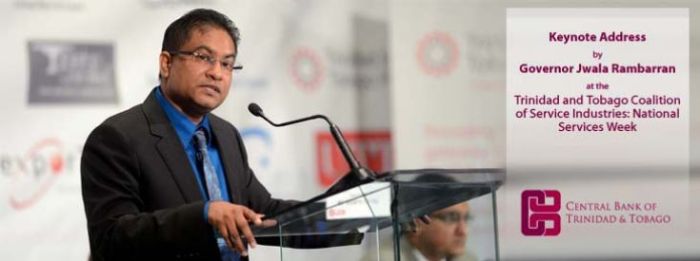
CB-gov - TTCSII am responding to the points made by Central Bank Governor, Jwala Rambarran, in his 6 November speech to the T&T Coalition of Service Industries.

This speech attempted to both re-affirm the Central Bank’s important role in our economy –

…as the country‟s prime financial regulator, the Central Bank has an almost fifty year record of maintaining the safety and soundness of the financial system…

and to distinguish Rambarran’s tenure as Governor since July 2012 –

…These are just a few of the initiatives the Central Bank has been working on over the last fifteen months to rebuild confidence, strengthen financial stability and to help create our future financial system…

Rambarran’s focus was “…First, “How did it all happen?” and, second…“What is being done to prevent a similar event from happening again?…” Continue reading “CL Financial bailout – Really learning from the past”

AUDIO: “Forward Thinkers” on More 104.7FM – 24 October 2013

Radio More FM 104.7 Afra Raymond chats on the show ’Forward Thinkers‘ with David Walker on 104.7FM, dealing with the CL Financial bailout and my lawsuit against the Minister of Finance to get at the detailed information as to how the $24B in Public Money was spent. 24 October 2013. Audio courtesy More 104.7 FM
  • Programme Date: Thursday 24th October 2013
  • Programme Length: 0:45:41

CL Financial bailout – Lawsuit against Minister of Finance

This is my reply to the Ministry’s affidavit of 12 July which seemed to rely on the fact that CL Financial is a private company to refuse publication of the requested information.

Of course that line of reasoning is yet another emerging threat to our country’s Integrity Framework, so our reply challenges the validity of this assertion.

At our hearing on 1 October, Justice Boodoosingh ordered me to formally notify CL Financial and we have done that, so at our hearing earlier today, CL Financial were represented by a team led by Stephen Singh and various dates were set, with our next hearing on 27 February 2014.  Of course that is the very Carnival week, so stay tuned. I expect there will be significant other developments well before that.

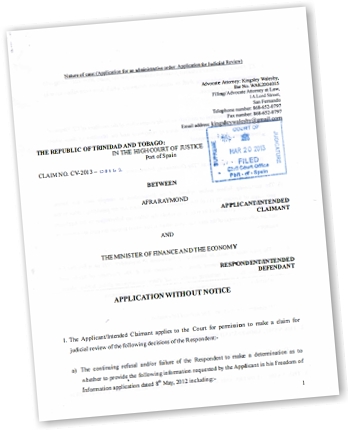
Application for judicial review in Afra Raymond vs Ministry of Finance and the Economy

appl-tiltThis is my filing for the Judicial Review of the continuing refusal of the Ministry of Finance to reply to my Freedom of Information request of 11 May 2012 along with my sworn affidavit.

The case is a critical challenge to the detrimental notion that $24Bn of Public Money can be spent without Accountability or Transparency.  That notion does violence to any healthy conception of the Public Interest, so I expect this contest to be a sharp one.

“Power concedes nothing without a demand…”

Frederick Douglass…Freedom Fighter and esteemed ancestor…

“Sunlight is the best disinfectant!”

Former US Supreme Court Justice Louis Brandeis…