Property Matters: Some comments on the property and construction proposals of Budget 2011

Winston Dookeran, MP and Min. of Finance reading Budget 2010. Original photo courtesy Trinidad GuardianThis was the inaugural budget for both the newly-elected People’s Partnership and its Finance Minister, Winston Dookeran.

The burning question for me in preparing these comments was the big one – “Is the Honeymoon over?”

In my view, the honeymoon for this new government will last about 6 months, given the sheer scale of the mess they have inherited.

There were real expectations aroused in the recent election campaign and the reduced revenues available to the State would have made the budget into a balancing-act, particularly when one considers the repeated promises of ‘No New Taxes’.

The main items on the property and construction aspects were –

  1. PROPERTY TAX
    The Property Tax was ‘Axed’ as promised – “…The Property Tax will be replaced by the old Lands and Building Taxes regime at the old rates and old values. There will be a waiver of lands and buildings tax for the year 2010…”There has been a misleading rebuttal on this from the Opposition Leader, Dr. Keith Rowley, in that the 2011 Estimates of Revenue tell us that the Land & Building  Taxes are expected to increase from $71.4M to $173.8M.  Rowley’s statement would lead one to think that the property tax take would be of the order of $300M, due to the omission of the municipalities. In fact, that is not the case, since the revenue of the five municipalities (POS, San Fernando, Arima, Chaguanas and Point Fortin) are found in the Estimates of Revenue for Statutory Boards and Similar Bodies etc.  Due to the fact that one of the effects of the controversial property tax was to relieve these municipalities of their powers to tax property, the 2011 estimates of revenue need to be properly interpreted.  The municipalities are estimated to raise revenue of nil in 2011, since all their revenue – as well as that of the regional corporations – is collected by the Counties and transmitted to the Central Government.The true picture is that $142.52M was the estimate of revenue from property taxes in 2009 – that is the combined figure for House Rates, paid in municipalities, and Land & Building taxes paid elsewhere.  We are therefore anticipating an increase in revenue from this source of the order of 18%.

    No rationale was given for the waiver of property taxes for 2010, which was an astonishing decision, given the background against which the budget was drawn up.

    Before I leave the property tax topic, it is interesting to consider that rental income is also subject to income tax.  Not many people who own rental property actually pay income tax on that rental income – if you don’t believe me, just ask a few friends or relatives who own rental property.  This seems to me to be an area in which the Finance Minister can easily collect the data and increase the State’s revenue by staying within the ‘No New Taxes’ promise and implementing the laws which are already on the books.  But more on that in a later article.

  2. HOUSING
    The Minister of Finance made strong statements in support of home ownership, he also outlined what appears to be a merger between several State-controlled mortgage companies.  No target numbers of new homes to be built were given. The Housing and Environment Minister, Dr. Roodal Moonilal, recently announced that the Housing Development Corporation’s (HDC) new output target is 6,000 new homes in 2011. The Housing and Environment Ministry have zero allocation of capital funding according to the 2011 Estimates of Expenditure.  There is an allocation of $845M to the Hosuing and Settlements programme shown in the Public Sector Investment Program (PSIP).  Those estimates should cross-reference with each other and the fact that they do not is cause for concern, to say the least. This is the pattern of State spending on new homes, derived from the capital allocations only –

    Year Housing Ministry Capital Allocation ($M)
    2008 $718.70
    2009 $1,342.40
    2010 $860.40
    2011 $845.00

    There was also the revival of an annual tax credit of $18,000 per household for first-time owners for the first five years.  That measure is expected to cost $20M, which implies that just over 1,100 households will benefit from this provision.  To quote – “…This measure will generate significant investment in the private sector housing industry….”  Given the quantity of unsold, privately-built homes and the volume of HDC units soon to be released onto the market, it seems quite unrealistic to expect that this measure could yield ‘significant investment‘.

    What is of greater concern to me is the question of whether we are at the limits of possibility as to home-ownership levels.  76% of our households now own their homes, the comparative figure for the USA is 69% and for the UK it is 68%.  How realisitic is it to keep pushing for increasing home-ownership?

    The HDC’s low-cost ‘Accelerated Housing Program’ stalled, with over 10,000 empty homes as proof, due to a shortage of applicants who could qualify for a mortgage.

    The Minister of Finance spoke of the neglect with which our organisational and institutional infrastructure had been treated and I could not agree more.  On this count, there needs to be proper consideration given to the resucitation of the Rent Control Boards.  Also, the HDC needs to start giving some of those empty homes to people who just want to rent.

  3. Special Purpose Entities (SPEs) – What is their future in this new dispensation

    Mr. Speaker, no coherent, co-ordinated planning or strategy for state enterprises exists. As a result we have begun to rationalize the state enterprises, including the special purpose companies, which will incorporate a new accountability system that goes beyond the presently operating company ordinances. It is these loopholes in public accountability that resulted in the UDeCOTT scandal. This must never again happen in Trinidad and Tobago.

    Now that this just not so since there is a Performance Monitoring Guide of State Enterprises, published by the Investments Division of the Ministry of Finance in 2008. (see – http://www.finance.gov.tt/content/pub0DCE11.pdf)

    This issue, as always in our country, is one of implementation.  The provisions  of that guide are not being followed and the wrongdoers are not being called to order.

    The issue for us is to prevent the recurrence of that pattern of mismanagement and disorder in public affairs.  That can only happen if we enforce the present guidelines and systems.

In the next column, I will discuss the attempt to map out a new philosophy in this budget and the CL Financial/HCU bailout.
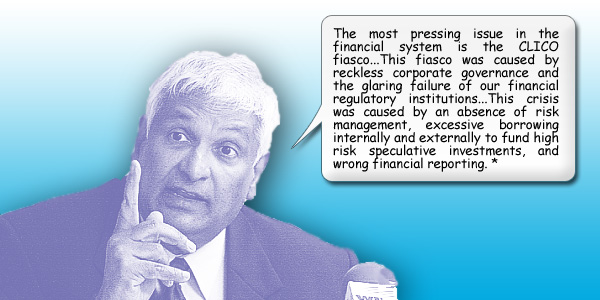
CL Financial bailout – The House on the Corner 2

Winston Dookeran sounds off on CLICO

—* Finance Minister Winston Dookeran, speaking on the CL Financial bailout, during his inaugural Budget Speech on 8th September 2010

More insights into CIB

The examination of CLICO Investment Bank (CIB) continues, based on the affidavits in the Central Bank’s winding-up action.

Firstly, as an overview, I consider the various versions of the accounts and their implications –

  • CIB’s 2007 audit – Was performed by PricewaterhouseCoopers (PwC) as at 31 December 2007, with the Balance Sheet showing Total Assets of $12.587Bn and Total Liabilities of $11.699Bn. Please note that those accounts were unqualified – PwC gave a ‘clean’ audit to CIB at the end of 2007. (See – https://afraraymond.net/wp-content/uploads/2010/09/cib_2007_accounts.pdf)
  • CIB’s Management Accounts – As at 31st January 2009, showed Total Assets of $12.264Bn and Total Liabilities of $10.692Bn. Those figures are broadly in line with the audit figures 13 months earlier, at the end of 2007. (See – https://afraraymond.net/wp-content/uploads/2010/09/cib_mngt_acc.pdf)
  • Ernst & Young’s Statement of Affairs – As at 31 January 2009, that showed Total Assets of $6.387Bn and Total Liabilities of $11.080Bn. Virtually $5.9Bn of assets seem to have vanished in a mere 13 months – a weekly rate of ‘withdrawal’ close to $105M – leading inevitably to the estimated insolvency of $4.693Bn. (See – https://afraraymond.net/wp-content/uploads/2010/09/cib_stmnt-of-aff.pdf)
  • The size of the CIB insolvency – Apart from its size as a proportion of the entire CIB Balance Sheet, this gap can give one an idea of the composition of the missing $76.1Bn from the CL Financial Balance Sheet – see ‘Finding the Assets‘ published in the Business Guardian on 19th November 2009.
  • The Return on Assets – This is a benchmark of company performance, being the net income as a proportion of the total assets. In the case of CIB, according to the PwC 2007 audit, the RoA is less than 1%.  That is an exceedingly poor rate of return which would normally denote weak management, but it seems that CIB functioned well as an operation to raise cheap finance for the CL Financial group.
  • Statutory Deposit – Note 4, at page 45, of CIB’s 2007 financials states a legal requirement for CIB to maintain a non-interest bearing Reserve Account with the Central Bank equivalent to 9% of its deposits and other specified liabilities. Given that the 2007 Balance Sheet discloses Customer Deposits and accrued interest of $5.509Bn, the Reserve Account ought to have been holding about $495M, as a buffer against just this sort of situation. Was that Reserve Account credited in accordance with the stated requirements? Were those funds expended first in the crisis, or has the Treasury taken the full cost of CIB’s failure?

That is an overview of the CIB position, which leaves the burning question – ‘Where did all this money go?‘  For $5.9Bn in assets to vanish in 13 months is an incredible failure of corporate governance and state oversight.  Given paras 5 and 6 of Hiralal’s affidavits – which effectively seek to claim that the events of the 15 January 2009 were unexpected – it seems that neither the auditors nor the regulators performed properly in this case.  But more on that later…

Devilish Details

Here are some details of where the money went and how it was handled.  This is taken from para 7 of the affidavit of Ernst & Young Director, Maria Daniel

  • Financial Records

    …The financial record keeping in CIB was weak.  The financial accounting system was not appropriately designed and implemented…

  • Bank Records

    …Bank reconciliations were not properly prepared.  CIB’s reconciliations contained numerous errors that were not corrected on a timely basis …

  • Loan Portfolio

    …In general the loan portfolio comprised a significant percentage of high risk real estate projects…and the rest of the portfolio was of poor credit quality.  Additionally, there was a lack of supporting documentation and/or appropriate security for many of the files inspected.  There was little evidence to suggest that the loan portfolio was being properly administered by management, and generally, recovery efforts on delinquent loans were inadequate…

  • Loan Arrears

    …The arrears report as prepared and presented by CIB’s management as at 31 January 2009 showed only $111M in arrears, which is approximately 5% of the loan portfolio…

    That 5% bad-loan proportion would be considered acceptable by banking norms and would raise few alarms.  Given that CIB was in crisis, it seems unbelievable that this crucial indicator was at 5%, but the very next sentence reads –

    …However, upon further examination Ernst & Young identified at least $1Bn in loans that should have been classified as non-performing or on a watch-list…

    From those figures it seems that the true level of delinquency in the loan portfolio was of the order of 45% and one can only wonder what CIB’s management were trying with the 5% arrears story.

  • Investment Portfolio

    …The profile of the investment portfolio was not commensurate with the liquidity requirements on the funding side of CIB’s balance sheet, with less than 1% of the portfolio invested in government securities and money market instruments…In addition, 88% of their investment portfolio, including the investment in Republic Bank shares, represented investments into other CLF Group companies…

I said ‘some details’ and the full affidavit can be viewed at https://afraraymond.net/wp-content/uploads/2010/09/cibey1.pdf.

Well, William?

Well, William?William Lucie-Smith, the erstwhile Managing Partner of PwC until his retirement in June 2004, commenting on the CL Financial bailout, recently stated “…Indeed I dont (sic) know why anyone assumes the books were wer (sic) wrong at any time and did not reflect accurately what was happening…

Mr. Lucie-Smith, the people questioning the accuracy of those CL Financial books now includes Ernst & Young and our Finance Minister, not just this Chartered Surveyor.  Given the quantity and quality of the information presented here, I am wondering if you are going to stick with that opinion.  Will Lucie-Smith resile from those views?  That kind of reversal would require real character and integrity.
** See http://www.trinidadexpress.com/commentaries/CL_Financial_A_new_strategy_required_.html.

Where does the Truth Lie?

If PwC’s audits were properly done, based on true accounts received from CIB and the relevant accounting standards, then the Inspector of Financial Institutions has been at fault to allow this failed institution to retain its licence.  If, as an alternative, the Inspector relied on misleading accounts, then one could hardly lay the full blame onto them.  In the latter case, either CIB’s in-house accountants, or the auditing firm PwC bears a heavy responsibility for this entire crisis.  EYvsPwCCompare and contrast the different results of the PwC 31 December 2007 audited Balance Sheet and the E&Y 31st January 2009 Statement of Affairs.  The discrepancies between the CIB Management Accounts and E&Y’s Statement of Affairs of 31 January 2009 are astonishing.



One can be escapist and say ‘on the one hand this, but on the other hand that‘ for only so long before reality sets in.  The fact is the group collapsed because it ran out of money.  Exactly how it ran out of money is a huge story of our age, supposedly an enlightened and more educated one.  That is the $57,000 question.

But the allocation of responsibility would also have to go beyond the role of the auditors to include the failure of the Inspector to detect the fact that CIB had filed no Corporation Tax returns for 2007.  Or was it that the Inspector’s office did note that and simply took no action?

Auditing the Accountants

What is the role of ICATT in all this confusion?  I tried with an open letter on 19th October 2009 and several dialogues with various of their Board of Directors.  Is ICATT investigating any aspect of this fiasco?  Does ICATT have any concerns over the MoU/Shareholders’ Agreement and its terms?  Does ICATT exist solely to advance and protect the professional interests of its membership?  Is it unreasonable for the general public to expect ICATT to have spoken out on these burning issues?  With all respect to the people concerned, ICATT’s silence is resembling a cover-up.

What is the meaning of ‘Fit and Proper’?

Our laws sets the penalty for murder as hanging, so, even if one does not agree, it is clear that the penalty is final to both indicate society’s intolerance of taking another human life and to prevent a recurrence.

The ‘Fit and Proper’ regulations are meant to regulate the behaviour of the Directors and Officers of Financial Institutions, since they are the people to whom we entrust our monies.  Any recklessness or dishonesty on their part can lead to severe loss of capital and ‘Fit and Proper’ ensures that those acts are punishable by loss of your privilege to serve in those high-powered positions.  The Companies Act even makes it illegal for Company Directors to ‘mismanage’ the affairs of a company.

Look at the case of the failed insurer, Goodwill Insurance, the Central Bank took a winding-up action which ended in two of its Directors – Johann Lambkin and Lennard Woodley – being fined $20M and banned from serving as Directors or Managers in any company incorporated in here for 5 years – see http://webopac.ttlawcourts.org/LibraryJud/Judgments/HC/rajkumar/2009/CV_06_02529DD30July2009.pdf.

Why is the Central Bank not proceeding against the CL Financial Directors?

The Timing Thing

So far I have been writing about this CL Financial collapse as if it took place in January 2009 and that is a position in need of a re-think.

When a marriage ends, the first ‘official notice’ of that is when one of the parties files for divorce, but there is often a stage before that when one of them moves out or moves on, and a stage before that one at which they stop having sweet times together.

I think the CL Financial ‘official notice’ was when they wrote for help on 13th January 2009, at some point before that, key people moved out or moved on and at some point before that, the group was failing.

When did the CLF group actually collapse?

CL Financial bailout – The House on the Corner

Some insights into CIB

CIB head office - The House on the Corner

I am starting to look at the CLICO Investment Bank (CIB) and its operations, as revealed by the ongoing bailout.

CIB is a very interesting part of the saga, because even prior to the collapse of the CL Financial group there was a widely-held view that CLICO and CIB were parts of the group which were responsible for raising finance for their ambitious plans.  Even though the interest rates offered by CLICO and CIB were incredibly high – about twice the average offered by others – it would have been much more expensive for the CLF group to borrow those funds via loans.  The view was that the CLF group had a legitimate method of harvesting funds on terms advantageous to them.

In April this year the Central Bank applied to the High Court to have CIB ‘wound-up’, due to its insolvency, estimated in that submission to be of the order of $4.7Bn.  (See https://afraraymond.net/wp-content/uploads/2010/09/cibcbtt2.pdf) That application to wind-up is being opposed by the NGC and the National Insurance Board (NIB).  Those matters are still before the Courts, which I only mention because the documents filed there give a disturbing insight into the CIB mystery.

We were also being fed some lyrics that the CL Financial group in general and CIB in particular were all healthy/strong companies with good assets, fallen victim of the global financial crisis.  Despite the natural doubts on that one, I had some trust in those people who were speaking to me.  The mystery remained – Was CL Financial and CIB an audacious, well-run operation which had become a victim of a declining market or, even worse, a sinister conspiracy?  Or was it a much less glamorous story of the Caribbean’s largest-ever business conglomerate actually being some kind of Naipaullian ‘Thing without a name‘?

I have read some of the affidavits in this case and the contents will be severely disturbing to any right-thinking reader, even you are not a financial expert.  This week I am looking at two affidavits of the Inspector of Financial Institutions, Carl Hiralal. The affidavits are available to read at https://afraraymond.net/wp-content/uploads/2010/09/cibey1.pdf and https://afraraymond.net/wp-content/uploads/2010/09/cibcbtt1.pdf.

Carl Hiralal
Carl Hiralal, Inspector of Financial Institutions

There is a way that the entire reading is surreal, since the very person who was supposed to safeguard us from extensive wrongdoing and risk-taking, now has to swear to the Court that the institution has failed so badly it needs to be wound-up.

The main points were –

  • The initial meeting – At para 5 he states “…On January 15th 2009 as part of its normal regulatory process, the Central Bank held a meeting with officials from the Petitioner…” (CIB).  Now that is literally an unbelievable sentence.  Hiralal is swearing that this was a routine meeting.  We are being asked to forget that the then Minister of Finance told the Parliament on 4th February 2009 that

    “…I would like to read into the record of Hansard, a letter from Clico Investment Bank addressed to the Central Bank. That letter is dated January 13, 2009. It is on the letterhead of CL Financial, addressed to Mr. Ewart Williams, the Governor and signed by Lawrence A. Duprey, Group Executive Chairman…

    see page 628 of http://www.ttparliament.org/hansards/hh20090204.pdf.  I am forming the impression that Hiralal does not want to have the ‘bailout letter’ cited in this Court matter at all, for whatever reason.  You see, if it were cited, the Central Bank would have been forced to file a true copy, which anyone would have been able to access.  Neither of my Freedom of Information applications for that ‘bailout letter’ – to Nunez-Tesheira or Dookeran – have been fruitful.  So we have this incredible statement for starters.  We are being asked to believe that Lawrence Duprey’s letter requesting urgent, massive financial assistance and the meeting two days later were unconnected.

  • Reasons for winding-up – At paras 9 c. and 10 g. he states “…the Petitioner (CIB) was not maintaining high standards of financial probity and sound business practices…”  Stunning, and in a sworn affidavit from the chief regulator.  This is the high official responsible for maintaining good order of the players in the financial system.  Those Directors, Auditors and Officers of CIB, the ones who presided over this situation, do you still consider them to be ‘fit and proper’, Mr. Hiralal?  Yes or no?  If Yes’, how come?  If ‘No’, what are you going to do about it?  And when?  But there is more.
  • Board of Inland Revenue – At para 23 he states “…With respect to the Creditors of the Petitioner, the Petitioner has met the statutory obligations for the Board of Inland Revenue (except for Corporation Tax Returns for 2007, 2008 and 2009 which are being prepared and remain outstanding)…”  I spoke with a very experienced accountant and a corporate attorney before writing this and the common view is that the meaning of that statement is that the Corporation Tax owed by CIB is unpaid for 2007-2009.  If they owe those taxes we dealing with people who do not pay their taxes, yet expect the taxpayer to assist them in times of need.  Even if the taxes are paid-up in full, there is still the elementary and inescapable governance question of how and why CIB failed to file a tax return?  Did PwC report on this in either their audit or management letter?  Was Hiralal aware of CIB’s failure to file before he was forced by the procedural requirements of the winding-up petition to declare his hand?  Did the Board of Directors know?  Have penalties been applied?
  • Statement of Affairs – This is at para 12 and appears to contradict the prior statement in that it does not show any amount for either ‘Taxation Recoverable’ or ‘Taxation Payable’.  There needs to be an explanation on this.
  • Auditors – CIB’s auditors were PricewaterhouseCoopers (PwC), who were featured last week.
  • Lucie-Smith’s view – William Lucie-Smith, former Managing Partner of PwC, responding to bloggers on his Express article ‘CL Financial: A new strategy required’ – see http://www.trinidadexpress.com/commentaries/CL_Financial_A_new_strategy_required_.html – replied on Friday 20th August, like this “…Indeed I dont (sic) know why anyone assumes the books were wer (sic) wrong at any time and did not reflect accurately what was happening…”  Just my first read of those affidavits made me question the reliability of the accounts.

Next, I will be going into some more detail on how CIB actually worked, based on sworn affidavits.

The Concentric Circles

Concentric circlesFor the purposes of this article, CIB is at the centre of the page, with its Directors and Officers being in charge of its strategy and management.  They bear primary responsibility for the company’s affairs on behalf of the shareholders and other stakeholders.



The second ring is the auditors, usually a leading firm of Chartered Accountants, who examine the accounts prepared by the company to report whether those accounts offer a true and correct picture of the company’s financial health.  The auditors use international accounting standards as a benchmark for quality and comparability of figures, if there are material divergences from those standards, the auditor’s opinion can be qualified, which is when the divergences are specified.

The third, outer ring is the financial sector regulators, whose job is to ensure that the companies within the industries comply with the law and other guidelines created by the regulators.  The regulators examine the audited accounts and other information from the companies in order to determine the extent to which the rules are being followed.

We, the saving and investing public, are outside of that series of concentric circles and once there are no alarm bells, we will place our savings with these approved financial institutions.

The reason for all that is to preserve the most fragile and vital ingredient of the capitalist system.  Yes, I am speaking about trust, which is also an important aspect of the wider society.

The society relies on the people in these three concentric circles to act in a ‘fit and proper’ fashion in the execution of their duties, with proper penalties in place for improper or illegal behaviour.  The idea being that there is a minimum standard of conduct and risk-taking which avoids nasty surprises in the course of normal savings and investment.

There are real questions as to what levels of risk-taking and innovation are healthy or desirable to maintain some balance between profit-levels and stability.  That is a fascinating aspect of the financial industry to be expanded on.

The Regulator

The chief Regulator at the Central Bank, with responsibility for both Banks and Insurance companies, is the Inspector of Financial Institutions.  That office is held by Carl Hiralal, who was appointed on 1st January 2007.  Hiralal is a well-qualified, highly-experienced professional and that only makes the contents of his affidavits all the more disturbing.

For more details, see – http://www.ttaifa.com/downloads/2009CarlHiralalBio.pdf

The CIB Directors

At the time of the collapse, the Board of Directors of CLICO Investment Bank comprised –

Mervyn Assam (Chairman)
Amjad Ali
Anthony Rahael
Maria Thorne
Michael Callender
Faris Al Rawi

Housing Policy Imperatives – part 6

I am bringing this analysis to a close by asking the question as to which individuals are ultimately responsible for this scandalous situation.  The age-old questions persist – Are we mere creatures of circumstance?  What influence can one individual have on transforming a situation?  Do modern outlooks over-emphasise the power of the individual?

We need to close the circle to understand the role of the high-powered individuals in charge of this policy.

The Author of the Policy

Calder Hart
Former HMB and UDeCOTT CEO, Calder Hart

Calder Hart, then CEO of Home Mortgage Bank and well-known to be a protégé of Andre Monteil’s, claimed to have authored our National Housing Policy – ‘Showing Trinidad & Tobago a new way home

In October 2002, Hart told me that in his office and he made a point of seeking my views of the new policy.

I questioned the originality, relevance and feasibility of the proposed policies and a frank discussion ensued.  It seemed clear, from Hart’s reaction and subsequent behaviour, that he had indeed taken authorship of that misguided policy.

That policy can be viewed at here.  Given their non-involvement in the later stages, it is interesting that the cover-page of the housing policy highlights UdeCOTT as a main state agency in its implementation.

The Minister of Housing

Keith Rowley
Former Min. of Housing, Dr. Keith Rowley, M.P.

The Minister of Housing with longest tenure through this period was Dr. Keith Rowley, M.P., currently leader of the Opposition PNM – he was in that office from  November 2003 to November 2007 – see http://www.ttparliament.org/members.php?mid=26&pid=5&id=KRO01.

The HDC was launched on 1st October 2005 to replace the National Housing Authority.  The Trinidad and Tobago Guardian newspaper reported Dr. Rowley’s remarks at that time – see http://legacy.guardian.co.tt/archives/2005-10-15/news7.html

Earlier, Rowley said the NHA was restructured because it lacked accountability.

There are a lot of things that did not go right in the NHA and one of those things had to do with accountability…The HDC is not going to function like that. We are required by law to have the accounts ready in a certain period of time.  The CEO will be held accountable and the Cabinet will hold the minister accountable and the Parliament will hold the Cabinet accountable. That is what the HDC means.

“…the HDC never published any accounts in the 5 years of its existence. It goes even further, since the NHA’s accounts for the period 2002 to 2004 have only recently been prepared.”

Continue reading “Housing Policy Imperatives – part 6”

CL Financial bailout – Examining the Horns

Once again, I am returning to the need for us to grow a culture of responsible behaviour as a vital part of national development.

Responsible Reasoning

William Lucie-Smith
William Lucie-Smith

The idea that the CL Financial bailout is just like the one in the USA is a durable one, which has been very useful to those people who are seeking satisfaction.  Nothing could be further from the truth.  That is a false view and what is more, extremely misleading to the public, who rely on informed members of society to share that information conscientiously.  Rightfully or wrongfully, many people here look upon the USA and the doings of its government with a sense of approval, to the point that if Uncle Sam does it that way, there must be some good sense in that.  That idea that our bailout is ‘just like the one in America‘ must be challenged, defeated and put out of its misery.

On Wednesday August 18th, William Lucie-Smith, the Express columnist wrote on this very topic, his sub-title being ‘A new strategy required’.  That column can be found at http://www.trinidadexpress.com/commentaries/CL_Financial_A_new_strategy_required_.html
Lucie-Smith is a chartered accountant, former Managing Partner of PricewaterhouseCoopers and currently is a Director of both Republic Bank and Sagicor – he is described in his byline as ‘specialising in corporate finance’.

That article started with the claim that the CL Financial bailout was in some way similar to the US government’s bailout of its financial sector.

…The original plan was to guarantee policyholder funds and make loans available to Clico, so that confidence would be restored and the group businesses turned around. This is what happened in the United States with the vast majority of TARP funds being repaid in full with interest…

Given the huge stakes in this matter, the promotion of such misleading views is nothing less than public mischief.

Here are some of the main points of the CL Financial bailout which are, in every respect, completely different from the USA situation –

  • No Public Explanation – Apart from Duprey’s single, brief speech at the press conference to announce the bailout on 30th January 2009, there has been no proper forum at which the CL Financial chiefs have been made to give an account of this catastrophic collapse.  Neither has there been an attempt to set one up.  That is in direct contrast to the highly-publicised and televised Congressional hearings at which the chiefs of these failed financial institutions have been questioned as to their actions and the serious consequences.  We have all seen those TV shows.  Even the new CL Financial management is little better, compared with the USA where the Treasury must make a monthly report to Congress on the bailout.
  • No limit on quantum – No limits have ever been set on the CL Financial bailout.  Every firm in the USA bailout had its borrowing limits specified at the outset.  As an example, see Citigroup’s terms at http://www.financialstability.gov/latest/hp1287.html.  Or the wider bailout, at http://www.financialstability.gov/latest/tg13.html.
  • No interest – Neither of the Agreements specifying the terms of the CL Financial bailout even mention interest.  As Lucie-Smith himself stated, the recipients of the US bailout had to repay taxpayers’ monies with interest.
  • No pre-payment of creditors – An interesting feature of the US bailout was that the failing financial institutions were made to stand the first tranche of losses before any taxpayers’ monies were injected.  In other words, they had to sell some of their assets first before tapping into Uncle Sam’s Treasury.  In contrast, CL Financial has been able to tap right into Treasury funds without any significant asset disposals – yet another point that Lucie-Smith himself makes.
  • No time-limit for repayment – Neither of the Agreements specifying the terms of the CL Financial bailout give any stated payback period.  The US bailout set out repayment periods for all recipients of taxpayers’ funds.
  • No security taken – No significant CL Financial assets have been disposed of, as per the agreements – yet another point that Lucie-Smith himself makes.  In addition, the Governor of the Central Bank has himself confirmed that all of the CL Financial group assets are encumbered – see http://guardian.co.tt/business/business/2009/04/08/govt-left-empty-handed-cl-financial-bailout.
  • No dilution of equity position of CL Financial shareholders – Despite the massive extent of the CL Financial bailout – it is effectively an open-ended commitment – there is no dilution of the shareholders’ equity.  In the US bailout, the troubled  companies were forced to give equity to the Federal Government.  In order to receive taxpayers’ money in the USA, Fannie Mae (the huge mortgage company) gave 79.9% of its equity; while AIG (at that time the world’s largest insurer) gave over 85% of its equity; 36% of Citibank belonged to the US government in February 2009 – pages 229, 401-2 and 530 of Andrew Ross Sorkin’s ‘Too big to Fail’ refer.  CL Financial shareholders have not been made to dilute their equity.  If I, writing as an interested citizen, could know this, it seems that any specialist in corporate finance would also know these details.

The only resemblance to the US bailout is in name only.  Real Trini-ting.    Duprey and his cohorts negotiated a Blank-Cheque Bailout at zero interest, without losing any of their assets.  That deal is absolutely unique.

Our taxpayers have effectively made a huge single loan (probably the largest in the Region’s history) to the wealthiest individual in the Region at Zero interest.  Virtually every relevant professional body and Civic Society organisation has remained silent on this bold-faced attack on our Treasury.  Nothing from the Accountants, Lawyers, Bankers, Economists, Trade Unionists or Religious bodies.  The one recent exception to this has been the call by the Trinidad & Tobago Transparency Institute (TTTI) for investigations into the Angostura disaster.

The CL Financial bailout has been cloaked in the robes of benevolence and stability, resulting in a situation which has minimised the floods of lawsuits which would have been confronting some of those responsible parties – Auditors, Attorneys, Company Directors and Officers.  In reality, the common-wealth of our entire society has been pledged to rescue a fortunate few.

The CL Financial bailout is in urgent need of re-negotiation, to say the least.  “It wrong like a biscuit.

In the same way it was wrong for the last administration to use taxpayers‘ money to rescue the CL Financial chiefs from the real consequences of their decisions, it would be equally wrong for this newly-elected government to also bailout those affected by HCU’s demise.  Two wrongs could never make a right.

Cocktail of Consequences

Angostura Rums

Angostura is the Caribbean’s flagship rum and bitters company.  It was a Caribbean icon, manufacturer of Angostura Bitters, as well as classic rums like 1919, Royal Oak, 1824, VAT 19 and Old Oak – Angostura was acquired by CL Financial in 1998.

The 2008 audited accounts were finally published at the end of July 2010 and the extent of their losses are cause for grave concern, seemingly a harbinger of the state of the entire group, 18 months into the bailout.

Coming after an extended wait for the 2008 audited accounts, the Guardian headline on 4th August 2010 was stunning: ‘Angostura declares $1.28Bn loss’ – see   http://guardian.co.tt/business/business/2010/08/04/angostura-declares-128-billion-loss.

The Express headline, on the same date and story, made me smile – ‘Angostura sales rise’ – see http://www.trinidadexpress.com/business/99917894.html.

It was said to be the largest loss in the history of our stock market and it represents colossal destruction of investors’ capital and national wealth.  It seems that the source of the losses was a receivable due from its parent company, CL Financial – according to the Deputy Chairman’s report – see http://www.angostura.com/LinkClick.aspx?fileticket=JSMxolh%2bmC8%3d&tabid=144

…[the] precarious financial position of our parent company…impaired the collectability of circa $1,185M in receivables from the CL Financial group…

The Notice to Shareholders of 26th June 2009 – see https://afraraymond.net/wp-content/uploads/2009/11/26jun2009_angostura_notice_to_shareholders.pdf – stated that the receivable from the parent company was $633M.  So you have to wonder what is the reason for that receivable almost doubling.

The interests of the minority shareholders have been subordinated to those of the majority shareholder, CL Financial, which was able to acquire the leading Jamaican distiller, Lascelles Mercado, by deploying the Angostura assets.  This episode is one which raises issues of minority shareholder rights which are unlikely to disperse.  As Justice Carlton Best is reported to have said, in relation to his lawsuit against CLICO for a $57,000 fixed deposit they failed to honour upon maturity – ‘It feels like robbery without a firearm’.

Who advised the Angostura Board on this transaction?  How can we accept the declaration that those funds are now irrecoverable?  How could a parent company, said by its auditors to have assets worth in excess of $100Bn at the very same accounting date (31st December 2008) be unable to repay a mere $1.185Bn.

Yes, it is true, the same accountants – the esteemed international firm, PriceWaterhouseCoopers – are auditors for both CL Financial and Angostura.  But more on that in the sidebar.

It is almost a metaphysical query – can a responsible class always escape judgement?

SIDEBAR: Auditing the Auditors

PricewaterhouseCoopers (PwC) is the world’s largest professional services firm in the accounting and finance industry.  PwC audits the accounts for UDeCOTT, CL Financial, Angostura and at one point I can even recall the Hindu Credit Union announcing that that firm was to be their internal auditors.  Clearly, PwC is a main player in the big leagues here in Trinidad & Tobago.  Let me declare here that they are also my [Afra Raymond, not Raymond & Pierre] accountants.

On 30th June that firm issued a letter, under the hand of Colin Wharfe, its new Senior Partner, to announce four new appointments.  The letter also explained that four of the most senior Partners had all retired on 30th June, those were –

  • Graham Mitchell, former Senior Partner, after 28 years’ service;
  • Jewan Ramcharitar, after 34 years’ service;
  • Peter Inglefield, after 34 years’ service;
  • Gerald Olliverre, after 32 years’ service.

The new appointments were announced in full-page press adverts, which omitted the retirements. See letter here – https://afraraymond.net/wp-content/uploads/2010/08/pwc_resignations.pdf

A version of this commentary appeared in print on August 26, 2010, on page 17 of the Business Guardian.

Housing Policy Imperatives – part 5

This week the examination shifts to the scale of the failure of our national housing policy – see <http://www.vision2020.info.tt/pdf/Policies and Procedures/Strategic_Corporate Plans/Housing Plan.pdf>.  Three main points for consideration are –

  1. Meeting the targets
    The original target was for the HDC to construct 100,000 new homes in a decade, which figure was generated from the 1994 ‘PADCO reports’—The Review of Shelter and Land Development Policy Study (PADCO reports): The PADCO reports is a series generated by The Planning and Development Collaborative International, Inc. and Laughlin and Associates Limited (who were contracted by the Government of Trinidad and Tobago in 1993)—that study is available at the Ministry of Housing & Environment’s library.  The annual target was reduced to 8,000.  As noted in the previous article, the reduced targets should have yielded 60,000 new homes by now, but the HDC has built only 15,394 new homes.The HDC made a recent statement that the number of empty new homes was approximately 10,000.  So just about 5,000 new homes have been built and distributed since the inception of this ‘accelerated housing programme’ in September 2002.  Even if we omit 2002, that is an annual average of 667 new homes being built and distributed. Even with the most optimistic assumptions, one is looking at considerable challenges in achieving these demanding targets.  At the current rate of performance it would take over 140 years to satisfy the original target.  That is how far off-track this accelerated housing programme has gone.  Deep into the long grass.

  2. The Cost-based Pricing model
    In previous articles in this series, I have been critical of the HDC’s cost-based approach to pricing its units.  In terms of the central mission of the Ministry of Housing  – i.e. creation and distribution of housing to the needy – that pricing model is inappropriate.  That is because it does not identify either the housing subsidy allocated to successful applicants or the opportunity cost of the HDC’s policies. The value-based approach is the more appropriate model to satisfy those basic requirements.  That is because it offers greater clarity to policymakers, since it is based on the market value of the completed homes, with the housing subsidy and the opportunity cost being the difference between the value and the actual HDC selling price. On 21st March 2008, this newspaper carried a report headlined “PM’s son in line for apartment” – see http://legacy.guardian.co.tt/archives/2008-03-21/news8.html – on allegations that Brian Manning, son of the then-PM was in line to receive one of the HDC apartments at Fidelis Heights in St. Augustine.  Noel Garcia, the then-MD of the HDC, was reported to have said –

    …the Government had taken a decision not to subsidise this  particular development. It is being sold at market rates in HDC’s thrust to expand and attract an open market clientele.

    Noel Garcia, former MD of HDC. Photo courtesy Trinidad Guardian
    Noel Garcia, former MD of HDC. Photo courtesy Trinidad Guardian

    Given that the units were reportedly being sold for a maximum of $875,000 and that they were worth a minimum of $1.7M, it is clear that each new home there is sold with at least $800,000 in housing subsidy.  The only way Garcia’s incredible statements could be correct is if one were using the misleading cost-based approach.

    I entirely agree with his statement that the Fidelis Heights development “…is therefore not part of HDC’s provision of subsidised housing for low-income earners.”  It is really subsidised housing for the middle-income groups, but that could never be right when the waiting list is bulging with needy people who cannot even get an HDC unit to rent.

    Fidelis Heights was, even by its name, a monument to misleading and wrong-headed thinking.  The HDC project with probably the highest level of housing subsidy per unit was built for the least needy on their waiting list.  Only if the underlying philosophies and resulting models are appropriate, can we avoid a repetition of this blatant waste of public funds in the face of real, human need.

    Given that the HDC is unable to satisfy the needs of the people it was intended to serve – the poorest citizens who cannot afford a proper home – it is scandalous that its scarce resources should have been diverted to Fidelis Heights, or the one at Federation Park in Port-of-Spain.

    The selection of this pricing model is proof of misguided policy at the most elementary level.  The basic concept of opportunity cost appears to have eluded the responsible officials and, what is more, that misguided policy appears to have been approved at the very highest level.

    Wrong-headed thinking can only encourage corrupt behaviour.

  3. Costs
    What has the national housing programme cost this country?  That is no rhetorical question, since this fact sits at the heart of the analysis.  The Housing Development Corporation (HDC) is the State’s implementing agency for production of new housing, it was formed in 2005 by an Act of Parliament and replaced the National Housing Authority (NHA).  The HDC’s funding comes from four sources –

    1. Treasury allocations – Those are announced in the budget and can be established from the Estimates of Expenditure as Capital Allocations to the Ministry of Housing.
    2. Sale of new homes – When the HDC sells a new home, that money is also available to them.
    3. Bond Issues – The HDC has also raised money by occasional bond issues; those funds can be used to either build more homes or ‘pay down’ on more expensive loans.  The bonds issued are government-guaranteed, so they are considered as virtually risk-free ‘sovereign debt’.  Given that the government itself issues bonds at lower rates of interest, it begs the question as to why these SPE’s are allowed to borrow on these terms.  That issue was raised by in the BG View of 20th August 2009 – see http://guardian.co.tt/business/business-guardian/2009/08/20/debt-depreciation-or-discipline.
    4. Bank Financing – The HDC also borrows money from commercial banks or the IADB to fund their construction programme.

    Try as I might, it has proven impossible to determine just how much the HDC has spent on building new homes in any given year.  That is because there are no accounts at all which are available to the public.

    The HDC Act, at section 18 and 19, mandates that the Board shall keep and properly audit accounts.  Section 20 requires the Board to submit its annual report to the line Minister within 3 months of the end of the financial year.  The line Minister is in turn obliged, by section 20 (2), to lay that report in Parliament within 3 months of receipt.  See – http://mphe.gov.tt/home/images/stories/pdfs/tthdc%20act%2024%20of%202005.pdf.

    The HDC has never laid either its annual report or audited accounts into Parliament for the public.  The failure to publish accounts is one of the most serious warning-signs of companies in financial trouble.

    That failure to publish HDC or NHA accounts over such a long period (since 2002 at least) spanning several administrations, is a serious indictment of the main participants – the politicians, the Board Directors and of course, the professionals involved in the entire huge operation.

    I have been reliably informed that the HDC’s new management is attempting to rectify this situation and that must be a priority if we are to properly assess the performance of this vital social programme.

The overall picture is stark –

  • Gross under-performance in terms of the output of new homes, only about one-quarter of the reduced target has been achieved:
  • Poor financial and project controls – as revealed in the Uff Report (at para 25:30 – see http://www.raymondandpierre.com/articles/article84.htm), not one HDC project has a signed contract:
  • No accounts or annual reports, given the preceding point, that is not surprising:
  • An inequitable allocations policy, with lower priority given to those who cannot afford to buy.
  • Approximately 10,000 new homes remain empty and that is the one which tops them all.  The ongoing adverse consequences include – vandalism, the greater rate of general deterioration afflicting empty homes, the high cost of security and of course, the continued pressure on those people on the waiting list ‘holding strain’.

Given the combined effect of all this, which is probably hidden to most of today’s readers, one can only wonder at the patience of our needy citizens.

The entire situation also raises potent questions about the purpose and performance of the SPEs.

SIDEBAR: The concept and importance of opportunity cost and housing subsidy

Let’s use a typical home at Fidelis Heights as an example.

  • Unit Cost – $825,000 (and it is not clear if land and professional fees were included)
  • Selling Price – $825,000
  • Market Value – $1.7M
  • In the prevailing cost-based pricing model, this is considered a satisfactory, ‘zero-subsidy’ result, since the State has recovered all of its costs. Another phrase in the lexicon is the ‘cost-recovery’ model of pricing.

    The danger, as shown in the example in this article, is that the ‘cost-based’/’cost-recovery’ model ignores opportunity cost.

    The opportunity cost is the difference between the actual selling price of the unit and the market value. The HDC could sell each Fidelis Heights home for $1.7M, but has made the decision to sell at a reduced price of $825,000, which means that each sale is at the loss of those possible earnings. That amount of the loss incurred by the decision to sell at a lower price is called the opportunity cost. It is important that opportunity cost be identified and quantified as an element in all decision-making, both private and public sector. A decision-making process which ignores or obscures opportunity cost is negligent at the very least and can encourage corrupt practices and the dilution of capital.

    In this example, the opportunity cost is $1,700,000 – $825,000 = $875,000.
    Opportunity cost

    $875,000 is enough money to build at least three modest homes, yet this system has allocated that much money to each Fidelis Heights purchaser, each of whom qualified for a mortgage at that level.

    As a result of this questionable choice and the resultant shaky pricing model, there is an enormous ‘leakage’ of housing subsidy and opportunity cost.

    The opportunity cost can also be described as the housing subsidy since that is the difference between what a Fidelis Heights unit actually sold for and what a purchaser in the open market would have to pay for a similar unit.
    The two terms are therefore synonymous – Opportunity Cost is exactly equal to Housing Subsidy.

    http://guardian.co.tt/news/general/2009/03/25/quality-performance-must

    A version of this commentary appeared in print on August 5, 2010, on page 13 of the Business Guardian.

    Related reading:

    Housing Policy Imperatives – Part 4

    Having set out a framework for a more effective and equitable national housing policy, it is time to deepen the discussion.  In this week’s column, I will further analyse the existing housing policy so as to highlight those errors which we must avoid if we are to do better.

    My proposed framework would quantify housing subsidy and allocate that in accordance with identified housing need, with the quality of the new homes also being monitored to ensure constant improvement.

    To go further into the issues requires that we examine these aspects –

    • National Planning – It will be very difficult to achieve improved levels of housing quality if we proceed to build large numbers of new homes without reference to a national land-use plan.  1984 was the last time our Parliament approved a national land-use plan.  Over 25 years have elapsed and the position of the last government was that the national land use plan was being prepared for discussion in the next 2 years or so.  We have very limited developable land in this country – only about 9 to 10% of the total – so it is critical to plan and co-ordinate our future for best results with our limited resources.  Transportation, education, shopping, health-care, industry, housing and recreation are the main aspects which need to be fit onto those developable lands.  This ongoing housing programme has already had grievious cases of the alienation of agricultural lands for housing.  Alienation of agricultural lands is when we pave over farmland for non-agricultural development.  That land is permanently lost in terms of our food supply, but we need to preserve our agricultural lands.  That is vital in terms of maintaining our food security.
    • Intensity of development – An associated aspect that we need to reconsider is whether we can spare the land to continue HDC developments of  homes with gardens.  The HDC must publish its figures on the numbers of new homes built; the amount of land consumed; the numbers of houses versus the numbers of multiple-family homes and of course, the numbers of these various types of homes which have actually been occupied.  At this point the HDC has only built 15,394 new homes, compared to their annual target output of 8,000 new homes, which, if attained, would have been 60,000 new homes.  The HDC has only built a quarter of the intended number of new homes, which means that we still have time to adjust and improve the programme.
    • Pricing – The more I consider the dilemma in which this housing policy has been caught, the more it seems that the fundamentals were poorly-considered.  Just consider the issue of the pricing of the units – How did the pricing model evolve?  I have already, in part 2 of this series, critiqued the HDC’s cost-based model for its erroneous outputs in terms of assessing the quantities of housing subsidy being allocated.  One can go further to ask how these price points emerged.  Was any reference made to the incomes of the people on the waiting-list or were the HDC prices driven by the demands of the physical development agenda?  It seems to me that the latter was what took place, if indeed any conscious process of setting prices ever did occur.  If we are aiming for people-centred development, that entire misguided approach to pricing needs to be revised.  We need to give serious consideration to building more modest multiple-family homes for rental.
    • Quality – Another matter which has been in the news from both the last administration and now the new one, is the issue of the poor quality of some of the new homes.  We have been given various ‘horror stories’ about poor construction and the need for further works and so on.  But there is more to this story.  The fact is that the norm in the construction industry is that a contractor only has a valid claim to be paid in the case of ‘works properly executed’, so how did the HDC end up paying for all these defective buildings?  I am not seeking to exonerate the contractors from any wrongdoing, but the simple fact is that someone in HDC ought to have had the responsibility to inspect and approve the works before payment was authorized.  Either the HDC has a process for doing that or not.  If yes, what went wrong?  Who signed-off on those poorly-built homes?  If there is no such process, then the HDC system is one which exposes the Treasury and the neediest families in the land to real abuse.  These are serious questions which need to be answered, and soon.  If there are indeed civil servants and consultant advisers who have been approving defective work, they need to be dealt with.  If that were so, it seems to me that such actions would amount to grave professional misconduct, at the very least.  Such people should be banned from any State work for a period, as a minimum.  The real horror story is the official silence on the fact that someone from the HDC had to approve these very same defective works.  Lying by omission – see http://guardian.co.tt/commentary/letters/2010/06/03/don-t-blame-contractors-only-shoddy-hdc-work.  That continuing dishonesty is the real horror story.  To remind readers that this is no new issue, please see – http://guardian.co.tt/news/general/2010/04/26/capacity-firms-weak-non-existent.

    I close this week by renewing my call for Minister Moonilal to take leadership on this burning national issue.  A conference on revising Housing Policy should include participation from the leading civil society organizations such as the JCC, the National Land Tenants’ and Rate-payers’ Association, the Sou-Sou Land group, Habitat for Humanity and the Salvation Army.

    Basic facts need to be compiled and distributed to seed the discussion.  The framework and philosophy need to be clearly articulated, if we are to get it right this time around.

    The continuing presence of over 10,000 empty homes is intolerable – it is solid proof of a seriously failed policy.  Our silence has to be broken on this issue.  We cannot continue this way.

    Related reading:

    VIDEO: Morning Edition Interviews

    VIDEO: Morning Edition Interviews – March 2010

    AfraRaymond.com, at this time chooses to re-issues these interviews on Morning edition on TV6 CCN, Trinidad and Tobago, to keep readers up-to-date on issues surrounding Uff Report and UDeCOTT Affair respectively.

    1. Afra Raymond sits with senior journalist Andy Johnson to discuss the “UDeCOTT/Calder Hart Affair” on Morning Edition television show on TV6.
      • Programme Date: 10 March 2010
      • Programme Length: 0:28:16

    2. Afra Raymond sits with guest host, William Lucie-Smith on the Morning Edition television show as part of a panel with senior counsel Israel Khan, to discuss the leaked Uff Report.
      • Programme Date: 31 March 2010
      • Programme Length: 0:26:52