The Code of Silence has formed the subject of several columns in this series.
I am referring to the unwritten agreement amongst the leadership group in our society to maintain silence in matters of white-collar crime. The guiding principle of the Code being that the members of that group must never be exposed to the same scrutiny and penalties as the common criminal.
That Code of Silence is poisonous to the progressive development of our society. Unless we can bury the notion that white-collar crime pays, our society is doomed to lurch from crisis to crisis. White-collar crime will never be truly challenged until the Code of Silence is tested to destruction. I welcome anything which would dismantle the Code of Silence. Literally anything.
The Commission of Enquiry into the various financial collapses which have beset us – Clico, British-American, Clico Investment Bank, Caribbean Money Market Brokers, the CL Financial group and the Hindu Credit Union – was announced by the Prime Minister in her 1st October address to Parliament.
On 17th November, Sir Anthony Colman QC was sworn in as the new sole Commissioner – he replaced the original choice – Sir Gavin Lightman QC, who had an apparent conflict of interest. The Secretary to the Colman Commission is Judith Gonsalves, who served the Uff Commission in that role. It is reported that Colman intends to hold open hearings and that those should start sometime in this month.
So, we are seeing three powerful channels emerging –
- CIB winding-up action – ongoing litigation from National Insurance Board and National Gas Company to stop the Central Bank’s winding-up action. Those court actions have been set for hearing in April and the sum of money at stake is an estimated $1.8Bn.
- Policyholders challenges – The various policyholders’ groups have now declared their intention to take legal action to recover the monies they feel are owed to them. The sum of money at stake in that series of actions is estimated to be $12Bn.
- The Colman Enquiry – This is an overall, public investigation into the causes of the large-scale financial collapse as listed above. Given the continuing failure to produce the accounts, the total sums of money involved are unknown.
So, what is the likely effect of these lawsuits and the oncoming Colman Commission of Enquiry on the entrenched Code of Silence in our society?
To begin with, I expect a series of legal challenges to the very hearings of the Commission, with the likely grounds being the long-established principle that no person should suffer ‘double jeopardy’, in terms of two sets of charges to be answered. It will be an attempt to completely derail the entire Commission of Enquiry.
I would not be very surprised if certain state agencies also sought to shut the enquiry down. That would be a repeat of the unprecedented recent situation in which UDeCOTT went to court to challenge the Uff Commission.
The beneficiaries of the Code of Silence will make great efforts to avoid any deep examination of its members and the public needs to be alert to this point. There is absolutely no shame in that group and we should also prepare ourselves mentally for the ‘memory loss’ defence of the kind we saw from Hafeez Karamath in the recent Uff Commission.
After generations of operating unexamined, the very bowels of the society’s leaders are about to be opened up to a disgusted and skeptical public. The motivations, links and payoffs between these leaders are to be exposed to view. The exposure is going to be critical. Given the speed with which our legal system operates, the exposure is likely to be lengthy. Given the range of active media in our society, the details are going to be all over the place.
So, what is at stake here? What else can we expect, apart from legal challenges?
To begin with, I believe that the sums of money involved are several times more than in the Uff Commission. In addition, the slowing economy and the pattern of behaviour have set the public into a very critical mood.
In my view, these are some of the people we would see publicly cross-examined in the Commission of Enquiry and various lawsuits –
-

Lawrence Duprey Most important of all, the Chief of Chiefs, Lawrence Duprey – Will he or won’t he show up for the many hearings? What can we expect to hear? Can Duprey offer an explanation for the shocking discrepancy between the $100BN+ asset valuation as at the end of 2007 and the $23.9Bn asset value he specified in his letter of 13th January 2009 to Ewart Williams? A mere 56 days separate the publication of those 2007 accounts – on 18th November 2008 – from Duprey’s letter, which has been hidden from view, despite my two Freedom of Information applications. The only reason we have some idea of this discrepancy – no…that is the wrong word, maybe staggering decline is better – is the anxiety of the then Minister of Finance to clear her name from allegations of Insider Dealing. That anxiety led the Minister to read this letter into Hansard on 4th February 2009.
-
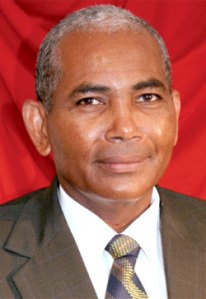
Andre Monteil Second most important of all, the Chair of Chairs, Andre Monteil – Monteil is now in retirement as a farmer and his testimony is surely one of the most awaited in recent times. As former PNM Treasurer, CL Financial Group Finance Director, Chairman of Education Facilities Company, National Housing Authority, then Housing Development Corporation and Clico Investment Bank, it is difficult to imagine a player who was more central. It is almost like a spy movie called ‘The Man who knew Too Much’.
-
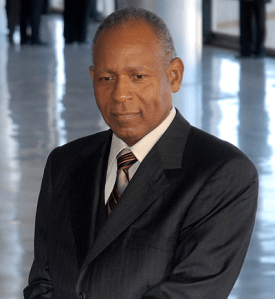
Patrick Manning Patrick Manning – When one considers the huge donations reportedly made by CL Financial to the PNM and the tangled web of this entire affair, it is difficult to see how Manning can escape serious, hard questions on many aspects. For instance, his 2002 decision to stop enquiries into HCU by then Minister in the Ministry of Finance, Conrad Enill, will surely be open to question. Manning’s recent bizarre behaviour might well be the beginnings of a defence. We will see.
-

Karen Nunez- Tesheira Karen Nunez-Teshiera – The Minister of Finance who had to go to Parliament twice to attempt to clear her name in this matter. Firstly, from allegations that she withdrew her money from CIB early, having had inside information. Secondly, from allegations that as a CL Financial shareholder, she was biased in her dealings with the bailout, having failed to recuse herself from the discussions. Not one person I know, even blindly-loyal PNM-ites, is willing to openly defend the behaviour of Nunez-Teshiera. Not one. Imagine that. I think the phrase is “…A jury of one’s peers…” I wonder whether her Cabinet colleagues knew that the Minister was a shareholder? We won’t have to wait long.
-

Carl Hiralal The Regulators – from both the Supervisor of Insurance, and the Inspector of Financial Institutions, Carl Hiralal. Just imagine the Supervisor explaining how Clico kept its licence all those years its statutory fund in serious shortfall. Or the Inspector justifying how CIB can fail to file its tax return and yet keep its licence. Mr. Hiralal must be considering his position most carefully at this point.
-

Ewart Williams Central Bank Governor – Imagine Ewart Williams reconciling his several statements on Clico being a problem case since 2004, with his having two fixed deposits at CIB. Williams must also be having a few reflective moments.
- The Directors – What is to be the position of the Directors of these failed companies? According to an affidavits filed in the Central Bank’s winding-up action, CIB made an undocumented loan with no interest rate or repayment period agreed. That loan was in the sum of $162M USD – yes, about $1.03Bn of depositors’ funds were lent to Angostura (a related party) with no documentation. It would be interesting to hear the Directors explain the degree to which that sort of advance is compatible with their fiduciary duty. It is important to note that the phrase fiduciary duty in this case refers to the obligation of those CIB Directors to act with the depositors’ interest as their first priority. But remember that CIB was wholly-owned by CL Financial. So, can one properly reconcile the fiduciary duties owed to depositors with those owed to the sole shareholder? It is a veritable conflict to be loaning depositors’ monies to the main shareholder, but that is why the loan agreements and credit committees exist. So as to provide safeguards against incautious loans, which can jeopardise depositors’ funds, so as to ultimately destabilize the bank itself, as in this case. There was no agreement. None at all. For a loan exceeding one billion dollars. All of the safeguards to balance the several duties of the prudent Director seem to have been ignored in this situation. Just imagine the Chairman who presided over the meeting of CIB’s Board which approved that loan, answering a series of critical questions, explaining just what they were doing dispensing with depositors’ funds in that loose fashion. I can scarcely wait.
 The Auditors – The various PWC professionals who prepared and signed those audits. Will we see the release of the hidden accounts? How much longer can they remain concealed? There must be some quiet desperation creeping into Balisier House and PWC, just edging forward, along Victoria Avenue.
-

Robert Mayers Robert Mayers – When he retired on 7th December 2008, did he or did he not know that Caribbean Money Market Brokers (CMMB) was heading for a financial collapse? Of course, we now know from the official statements that CMMB collapsed a mere 7 weeks after Mayers left office as its Managing Director. So, which is it to be? Is it that the collapse came like a bolt of lightening from a clear blue sky? Were there any warning signs? Do CMMB’s accounts give any clues?
-

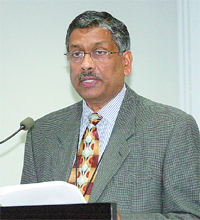
Dr. Bhoendradatt Tewarie Dr. Bhoendradatt Tewarie – He is former principal of UWI’s St. Augustine campus and now heads UWI’s Institute for Critical Thinking. Dr. Tewarie was a Board Director of the parent company, CL Financial, at the time of the collapse. Was he aware of Duprey’s letter to the Central Bank Governor, a mere 3 days before that Board authorized payment of a dividend to CL Financial’s shareholders?
- The same characters and many of the same questions are in the HCU part of the story.
The members of that Code of Silence are probably considering how best to escape the consequences of their actions and inactions. It will be a truly unique Christmas season for some of them. There are probably not enough lawyers in the country to handle this tidal-wave of legal actions.
The stakes are huge and the burning question for me is – Can this be the first time that prominent people go to jail? Serious sentencing? Will any stolen monies be recovered?
Can the Code of Silence survive this challenge?
The Code of Silence must be destroyed if we are to progress.
SIDEBAR: Who is Anthony Colman?

Take a read at his comprehensive website including his CV. http://www.siranthonycolman.com/
 The new situation is charged with peril and one is reminded of Naipaul’s father, the intrepid journalist from A House for Mr. Biswas whose favourite tagline was “…amazing scenes were witnessed…”
 The recent series of changes at CNMG have sparked a series of evolving discussions. I was one of the three people ‘let go’ from CNMG and that
  TV call-ins soon followed and of course, the internet/email broke onto the scene in the mid-1990s. The final stage in this progression is the growth of new-wave social media – such as Facebook, YouTube, Twitter etc. – to the point where they have now eclipsed the older formats like web-pages.
 More to the point, we have a situation where we have embraced the new situation and its possibilities, while our leaders and organisations lag far behind. Just as an example, the website for the Prime Minister is
  It is easy to criticise the politicians and their mistakes, but this silence by Newsday is just another level of irresponsibility which would make any right-thinking person pause. Newsday have their own patchy track-record in that they forced-out Kevin Baldeosingh over his challenge to Fr. Henry Charles for plagiarism. The parliament discussions on Friday 12th and the news releases from both the Media Association of Trinidad & Tobago (MATT) and the Congress of the People (CoP) formed the basis of articles on the issue from Thursday 11th. Given that behaviour it is interesting to watch them, as The People’s Newspaper, minimizing a matter of such great concern to so many people. A matter concerning an apparent threat to freedom of the press.
 This is the letter CNMG sent

 The Bankers Association of Trinidad & Tobago (BATT) and the Association of Trinidad & Tobago Insurance Companies (ATTIC) are also part of the situation.
 As it is, we already have been bound to a rotten bailout of the wealthiest individual in the Caribbean by our Treasury at
 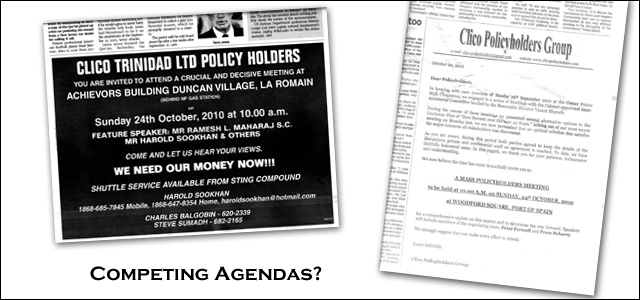 There was an EFPA group and a CLICO Policyholders group formed just after the budget on 8th September, but they soon merged under the latter name. I am now seeing what appears to be a substantial split with 2 competing meetings being organised for 10am today – one in Port-of-Spain and the other in San Fernando.
 The Mottley Report – There was a team of three advisers – Wendell Mottley, Colin Soo Ping Chow and Steve Bideshi – appointed to examine the CL Financial group and we need to know what were the findings of this group.

 Throughout this series of articles on the CL Financial bailout I have touched on the existence and effect of a Code of Silence amongst our ruling elite.
 This is one of the leading Professional Bodies and their silence has been deafening. The President of the Law Association is former Independent Senator, Sunday Express columnist and eminent Senior Counsel, Martin Daly. Daly is widely regarded as a fearless and irreproachable voice on many matters.
 The entire collapse is shot through with a failure of accountants at several levels and yet this professional body has been silent on all this. After ignoring my open letter and other attempts to start some dialogue on this, Anthony Pierre, ICATT’s President, agreed to appear on a TV interview with me on CNMG. That interview was broadcast on Sunday 26th September 2010 – it can be viewed at
  There has been very limited engagement from UWI on this matter, which is a pity when one considers that the areas of study there include economics, finance, law, business management and accounting.

 Yes, the TTTI did make a strong statement calling for improved accountability in the bailout process. That is a Civic Society body doing its job.
 Robert Mayers was the former Managing Director of CMMB, who retired on 8th December 2008 – see
 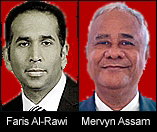 CIB was chaired by Mervyn Assam, recently appointed as a Special Ambassador with responsibility for Trade and Industry. Faris Al-Rawi, attorney-at-law, was a Director on that Board and he is now a PNM Senator.
 Ian Narine, writing in the Business Guardian on Thursday 14th October –
 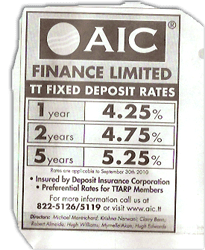 In the last part of September, AIC Finance has been advertising surprisingly high rates of interest in daily newspaper adverts which also offer ‘Preferential rates to Trinidad & Tobago Association of Responsible Persons (TTARP) members’.
 A version of this commentary appeared in print on October 17, 2010, on page A31 of the Sunday Guardian.
 Amidst the raging debate on the rights of the disappointed depositors versus those of the anxious taxpayer, I am continuing to examine some more of the fundamental issues. Yes, I accept that there are depositors amongst the taxpayers, but those interests are not in alignment, hence the discussion.
 That is the burning question at this time and a large part of the blame for the CL Financial collapse must lay with the regulators. In this case it seems that the Governor of the Central Bank and Inspector of Financial Institutions both have serious questions to answer. The situation is really too much to even imagine, but a few examples –
