Afra Raymond’s first submission to the Commission of Enquiry into the failure of CL Financial Limited, Colonial Life Insurance Company (Trinidad) Limited, Clico Investment Bank Limited, Caribbean Money Market Brokers Limited, and The Hindu Credit Union Credit Union Co-operative Society Limited.
My name is Afra Martin Raymond and I am a Chartered Surveyor, being a Fellow of the Royal Institution of Chartered Surveyors. I am Managing Director of Raymond & Pierre Limited – Chartered Valuation Surveyors, Real Estate Agents and Property Consultants. I am also the President of the Joint Consultative Council for the Construction Industry (JCC), an umbrella organisation which represents the interests of Engineers, Surveyors, Architects, Town Planners and Contractors in this Republic.
This submission is being made in my personal capacity and does not represent the position of either Raymond & Pierre Limited or the JCC.
My work on this vital issue has all been based on the public record and can be seen at my blog www.afraraymond.com.
I am willing to give oral evidence before the Commission.
The TV/Radio Shows – I have done seven TV interviews on the CL Financial bailout and those are available at the ‘Multimedia’ page of my blog.
Up Next! TV interview with Brian Branker, former Executive Chairman of British American Insurance Company Ltd (BAICO) – This is the first time, to my knowledge, that one of the CL Financial chiefs has gone onto the record to speak about these events. The interview is available at http://vimeo.com/15145888.
The 12th June 2009 CL Financial Shareholders’ Agreement – this is the subsequent agreement, erroneously described by the Ministry of Finance as ‘giving substance to’ the original MoU, but later found to have enshrined a decided shift in favour of the shareholders – https://afraraymond.net/wp-content/uploads/2010/03/mou21.pdf.
I do believe all the items in this submission to be true and correct, save and except for the Up Next! Interview, which comprises the views and observations of Brian Branker.
I have been preparing my submissions for the Colman Commission and took some time-out to start reading the Report into the USA’s financial crisis. Of course I am referring to the Financial Crisis Inquiry Report, which was published at the end of last month, about a year after its first hearings.
Even though I have barely scratched the surface of this 662-page work, it has already been a deeply fascinating read, filled with cautionary insights. The first conclusion of that Report is worth citing –
“We conclude this financial crisis was avoidable.
The crisis was the result of human action and inaction, not of Mother Nature or computer models gone haywire. The captains of finance and the public stewards of our financial system ignored warnings and failed to question, understand, and manage evolving risks within a system essential to the well-being of the American public. Theirs was a big miss, not a stumble. While the business cycle cannot be repealed, a crisis of this magnitude need not have occurred. To paraphrase Shakespeare, the fault lies not in the stars, but in us.
Despite the expressed view of many on Wall Street and in Washington that the crisis could not have been foreseen or avoided, there were warning signs. The tragedy was that they were ignored or discounted…”
It is an epic failure in that the world’s strongest and most diversified financial system was brought, literally, to its knees by a tidal wave of greed. Some of the main features were –
Slack regulators, who had looser and looser control of market activity, yet did little or nothing to propose the need for better controls.
Corrupt politicians, who accepted huge political donations from the financial institutions – yes, both parties – so that there was an absence of real debate on major policy shifts and consequences
A sheer overdose of hubris in an atmosphere in which it seemed, against all good sense, that tangible risk had been abolished. The catchphrase among market players was ‘IBGYBG – I be gone, you be gone’ – denoting a total abandonment of the notion of customer service. In many cases the salespersons knew what they were selling was of such poor quality that their own firms were betting against it.
If any of this sounds familiar, yes, you are right; it is almost the same as our own crisis. The old aphorism ‘When Uncle Sam catch a cold, the Caribbean get pneumonia’ comes to mind.
I have to say that the reading is a sobering experience as one starts to reflect that the deep and broad USA economy has been crippled by these ‘smartmen’ and their political minions. So what hope do we have of resisting those elements? That is the question we need to grapple with in this rounds.
But for all the parallels, there are two important differences –
Firstly, the guilty actors are not going to own-up. This is one pie they won’t want a piece of. They may try to seek exoneration in a version of the truth which locates blame somewhere on Wall Street. Those assertions need to be strongly challenged; they represent a piece of pure mischief.
Secondly, the US crisis is far smaller, proportionally, than our own. The Minister of Finance stated in the 2011 Budget (pg. 8) that the CL Financial bailout was costing our country more than 10% of its Gross Domestic Product (GDP). In comparison, the US bailout was estimated, in December 2010, by their Treasury Secretary to be costing about 1% of that country’s GDP. These facts show the double-mischief of these bold-faced people trying to tell us that this is just like in America.
According to those sources, this crisis is costing us 10 times more than the Wall Street one we keep on about. The relevant Ministry of Finance Press Release of 17th January 2011 states, “…With the Government’s planned bailout of CLFG (CL Financial Group), Standard and Poor’s expect net general government debt will rise to 28% of GDP in fiscal 2011 from 15% in fiscal 2010, though it will remain below the 36% median for ‘A’ rated sovereigns…” That is a difference of 13%. Yes, that is 13 times more than the USA…
This crisis will require us to properly compare and contrast those situations.
It has been two years, but at last the Commission of Enquiry into the T&T financial collapse is about to start its hearings. For the first time and against all their schemes and plans, the main agents of the Code of Silence are going to be forced into the direct sunlight to face questions and of course I mean the several court cases and the Colman Commission as discussed in ‘Testing the Code of Silence‘.
Sir Anthony Colman
The final date for submissions to the Colman Commission is Monday 14th February, which means that all written evidence must be filed by then. I am not sure if electronic evidence, like the 55-minute interview Brian Branker (former Executive Chairman of British American Insurance Co.) gave on Up Next! in September 2010 is allowable, but it seems worth it to try. So this is my call for the producer of that show, Jerry George, to please do submit it. If you are interested, it is at http://vimeo.com/15145888.
I expect that by now the main actors in this Code of Silence are all rehearsing their lines and agreeing who will speak on which piece and in fact which parts to be silent on. In my opinion we can expect nothing but self-serving and defensive statements, if not outright lies, from the main actors in this mess – the CL Financial chiefs, the wayward Regulators and of course, the auditors. The burning question is therefore how is the public interest going to be defended and advanced? By whom? On what terms?
To make the obvious comparison with the Uff Enquiry, we are looking at the same kind of procedure. The decisive difference is that, in this case, the balance of forces is entirely different.
You see, in the Uff Enquiry there were the forces of the State and its agents all lined up to defend their way of operating – that included UDeCOTT, Calder Hart, National Insurance Property Development Company (NIPDEC), Housing Development Corporation (HDC) and of course the State itself was in the Enquiry in the person of the Attorney General. On the other side there were the Joint Consultative Council and Dr. Keith Rowley, MP. All those parties were strongly represented. There were also independent forces at the Enquiry – the Trinidad & Tobago Transparency Institute (TTTI), Carl Khan and myself – the only two witnesses whose testimony stood without hostile cross-examination.
Due to the balance of forces in that forum, the Uff Enquiry was satisfactory in that all versions were strongly contested under cross-examination and also by conflicting testimonies – the Enquiry was forced to decide on the veracity and relevance of evidence…there was no easy middle road or settling for a version because no one had spoken against it.
Here, in the Colman Commission, we face an entirely different order of challenge. Let me explain –
Firstly, the quantities of money involved are several times larger – at least ten times more, in my estimation.
Secondly, the entire establishment seems to have capitulated to the ‘Duprey Dream’. That is a state in which no serious questioning of the actions of the CL Financial chiefs is undertaken. In the USA experience, this phenomenon is described as Regulatory Capture. It is one in which regulators are actually ‘occupied’ by forces who are the people they are supposed to police. That is not unfamiliar to us here in Trinidad & Tobago, but that is why we must fight against it. It is a true nadir of absolute corruption. A roaring silence of the formal and informal regulators.
Finally, based on that record, the Colman Commission will be dominated by these people, the ones who caused the entire mess. If that is the case, there is a real danger that the truth could be compromised or even sacrificed. That peril is what we have to work against.
Some of us have insisted on this Enquiry as a necessary step in preventing a repetition and further looting of the society. The facts and the versions of the facts are about to be tested in the crucible of the Colman Commission.
The only way we can avoid the US fate, and possibly worse, is by doing our very best to learn from the bitter experience. Those of us, who have insisted on this crisis being a real turning-point, must make the most of this moment. In my opinion, that can take place on two levels –
The publicity level, with lobbying to ensure that the process receives the maximum possible exposure, generally, and spot-lobbying to ensure that the key players in the mess are spotlighted when it is their turn to testify. The sole Commissioner was reported to have said that the hearings will be televised. How can we check on and ensure that takes place? Also, we should be insisting on a similar arrangement to Uff with the transcripts being on-line.
The evidential level, at which we need to make submissions to contend with the rotten and dishonest discourse from the utterly unresponsible parties who are ultimately responsible. We not only have to contend with and destroy the ‘Anansi-stories‘, we also have to advance our own arguments into the spaces and places they do not want us to go into.
Trevor Sudama, former MP
The key person from whom I would like to see a submission is the respected former MP and economist Trevor Sudama, who was the first person to put onto the public record these serious concerns over the health of the CL Financial group. That was in the 2001 Budget debate and of course we all know that Sudama and his colleagues – Ramesh Lawrence Maharaj and Ralph Maraj – were strongly attacked, ostracized and ultimately forced from the political Head Table. All by their own party colleagues.
Mr. Sudama, we need your input in this vital matter. The background for your intervention in this matter, your debate on it and the political attack must form part of the record in this Enquiry.
Some of the key commentators who should put in written submissions are Camini Marajh of the Express, Andre Bagoo of Newsday and Anthony Wilson, the Ag Editor-in-Chief of this newspaper.
Our professional Institutions have been pointedly silent and I would hope to see submissions from –
Association of Trinidad & Tobago Insurance Companies,
Our institutions of higher education should join in with their perspectives –
Arthur Lok Jack School of Business, part of UWI
School of Business and Computer Studies
School of Accounting and Management
Caribbean Centre for Monetary Studies, also a part of UWI
UWI’s Economics Department
UWI’s Government Faculty
I am going to close by sketching just one parallel.
To go back to the main points of the Wall Street experience as outlined above, we hear of these complex debt swap instruments and their toxic consequences. The fatal flaw of these instruments, according to the reports I have read, seems to be that they seemed to be a good way to invest with high returns and little or no risk. The truth turned out to be just the opposite.
It all seems remote from our own situation, but that is not the only way to look at it. The most controversial single item in this entire situation here has been the EFPA, an annuity duly approved by the Supervisor of Insurance. When we consider the promotional literature for that product, it is nothing less than scandalous that a leading company should have been allowed to advertise an investment product with exceptional rates of return and the repeated phrase ‘guaranteed investment’. There is absolutely no such thing as a guaranteed investment. It is a complete contradiction in terms, but yet it went out to tens of thousands of people, who suspended their disbelief and went along for the ride. That is the Trini parallel with those complex debt swap instruments.
This my Freedom of Information application made on 22nd December 2010 to the Minister of Finance for the ‘Duprey’ letter of 13th January 2009 and the 31st December 2008 accounts of the CL Financial Group.
Readers who are not familiar with the ‘Duprey’ letter and its implications, should read – ‘Finding the Assets.’
This is the third application I am making for these documents. The first was to the previous Minister of Finance, Karen Nunez-Tesheira, who delayed a long time, then ended-up telling me to go to the Central Bank, since they were the original addressees. Of course that was a transparent ploy to frustrate my application, as we know that the Central Bank is immune from the Freedom of Information Act (FoIA).
My next application was on 28th June 2010 to the present Minister of Finance, Winston Dookeran, who never acknowledged the application, despite several reminders.
Readers, please remember that the FoIA requires that the public authority reply to applications in 30 days. There are no penalties for breaching that requirement, so we have to contend with these tactics.
It is now occurring to me, as I write this, on Thursday 20th January 2011, that by Monday 24th we will have reached yet another deadline, but this time we will go further than just letter-writing.
When you combine the failure to reply by both PNM and PP Ministers of Finance with the bizarre affidavited evidence of our Inspector of Financial Institutions, Carl Hiralal on the background to the Central Bank’s application to wind-up CLICO Investment Bank, it is clear to me that the decision has been taken to suppress that letter. For whatever reason, as we say in these parts.
There has been a recent, refreshing discussion on the shape and necessity of our welfare state. The Welfare State is used to refer to the various administrative arrangements which redistribute the nation’s wealth to assist the more needy citizens in our midst.
The discussion was initiated in the T&T Review of January 3 in Gregory McGuire’s thoughtful and solidly-based review of the welfare spending trends and their wider consequences. The responses ranged from a two-part article (Part I & Part II) in the Express from Professor John Spence, with an attempted rebuttal from Dr. Errol Mathura in the same newspaper. From the Guardian, there has been a serious commentary on Sunday 16 by Dr. L Trevor Grant – ‘Curb escalating poverty in rich T&T’ – and the editorial of Monday 17, dealing with the fate of the empty HDC houses.
That Guardian editorial – ‘Housing Shame’ – was based on the reports of an investigation into the situation at several of the HDC virtually-completed, but unoccupied housing projects.
Sunday’s Guardian headlined with ‘Scandalous’ on an abandoned $156M HDC project and that is my point of discussion on this Welfare State matter. The empty homes built by the HDC are symbolic of a serious need to re-examine our housing policy.
Above and beyond the case of the vandalized HDC homes, the fundamental public housing situation is scandalous. Scandalous is my word to describe a policy of allocating of scarce resources to build homes, without satisfying the needs of the poorest applicants. That is a blatant misallocation of public resources.
As I wrote in the Trinidad Guardian newspaper in 2007, our housing market is divided into 5 layers, moving from the neediest to the wealthiest –
Homeless – People who have nowhere to live or rely on charity for shelter.
Permanent Renters – People who can never afford to buy.
Transitional Renters – People who are renting now, but will end up as home-owners.
Home Owners – People who own their homes.
Multiple Home-owners – People who are wealthy enough to own more than one home – these people are also the ones who rent property to the others.
According to the latest figures released by the Housing Development Corporation in March 2010, there are over 10,000 empty homes in their stock of newly built units. In addition, there is a waiting-list of hopeful applicants believed to be in excess of 100,000 people. How can we reconcile those figures?
Dr. L Trevor Grant is the only author, to my knowledge, to have written on the plight of the homeless in our society and his column in Sunday’s Guardian gave telling details on the level of need in those communities.
We have constructed a national housing policy which pays only lip-service to the housing needs of the poorest applicants. The clear preference – PNM or PP – is for the applicants who qualify to buy a home from HDC. That is the only explanation for the reality of 10,000 empty new homes and 100,000 waiting applicants.
There have been some recent handovers of new HDC homes to applicants featured in the press and those have all detailed the incredible length of time these applicants waited for their new homes. Waiting periods in excess of 20 years have been mentioned.
There is a severe disconnect between these expensive policies to provide subsidized housing and the reality of being a poor applicant on HDC’s waiting-list.
At this point, an estimated 76% of our people live in owner-occupied property. That is comfortably above the comparative figures for the USA or the UK, where the numbers are in the 68-69% range. It seems clear that we are approaching the limits to which we can realistically grow home-ownership in our country. In some ways we may already have exceeded those limits.
Another point I detailed in my 2010 series ‘Housing Policy Imperatives’, was the nature of the housing subsidy being offered by the HDC. For example, if the HDC sells a home with a market value of $500,000 to an applicant for a price of $325,000, the difference between those two figures is the housing subsidy. Yes, in this example there is a $175,000 housing subsidy to each of those people who buy those homes from HDC.
The big question is – if the HDC can afford to provide these benefits to applicants in the layer of ‘transitional renters’, what are the levels of subsidy and number of new homes being provided to those in the poorer layers?
If that relationship does not improve to favour those who cannot ever afford to buy, we will be stuck in an increasingly frustrating housing fix.
The housing fix is notable for the inequity with which the country’s scarce resources are allocated and the hopelessness of the poorer applicants.
There are also secondary problems which run very deep and those include the issues highlighted in the Guardian’s story on the abandoned HDC estate.
What is the cost of securing all these virtually complete, but vacant homes? I am reliably informed that the annual cost of security is of the order of $50M, yet there are still significant episodes of vandalism and squatting.
Additionally, we have to factor in the cost of maintaining and repairing the unoccupied homes. Empty properties deteriorate at a faster rate and that is a cost to the HDC which could be avoided by putting people to live in these empty homes.
The estimated annual sum of $50M to secure these homes is staggering. That sum of money could build over 200 badly-needed low-income homes every year.
HDC Board
There is a newly-appointed HDC Board and the time is now opportune for a review of this important Welfare State policy.
A critical factor in all this is the role of rent controls, since the long-established rent control boards were allowed to wither on the vine by the last administration.
Rent controls and the planning regime need to form a part of the Housing Policy Review.
The audited accounts for CMMB for 2006, 2007, 2008 and 2009 were obtained from the SEC. They allow a view of CMMB’s financial affairs for the 5-year period 2005 to 2009. I have included some selected ratios drawn from those accounts.
There has been a challenge to my assertion that CMMB failed, reaching to the stage of my having been requested to provide the Business Guardian with an indemnity against possible legal costs and damages. I was unable to persuade the Editor to accept my conclusions and agreed alterations to my prior column on this matter. Regular readers will know that my concern was triggered by reports in the pages of the Business Guardian that some of the key people in CMMB have now opened a new investment house, KSBM.
Since 22nd October 2010 I have been trying to obtain the official Terms of Reference for the Colman Inquiry into this financial fiasco, but those several enquiries were fruitless until the Secretary to the Inquiry faxed me the requested document on the first working day of the New Year. Thank you. The Terms of Reference were published in the Trinidad and Tobago Gazette of 17th November 2010 – No. 144 in Volume 49. Here is the first sentence in the second paragraph, for any of those who still have doubts –
…And whereas the President on the advice of the Cabinet has deemed it advisable and for the public welfare that a Commissioner be appointed to enquire into the failure of CL Financial Limited, Colonial Life Insurance Company (Trinidad) Limited, CLICO Investment Bank Limited, British American Insurance Company (Trinidad) Limited, Caribbean Money Market Brokers Limited and the Hindu Credit Union Cooperative Society Limited with a view to ascertaining why such events occurred…
So there we have it – the President on the advice of the Cabinet – but there is more, if anybody needs more signs of a failure. The Central Bank issued a Press Release on the day of the Bailout – 30th January 2009. The first objective stated in that document is –
To stem the increasingly serious liquidity pressures being faced by the financial services companies within the Group – i.e. CLICO Insurance Company Limited (CLICO), CLICO Investment Bank (CIB), British American Insurance Company Limited (BAICO) and Caribbean Money Market Brokers Limited (CMMB)…
I am not going to spend any more time stating the obvious, but it would be interesting for the other side to give a public opinion on all this. Can anyone seriously claim that CMMB did not fail? Well, I guess we will have to wait and see. The sheer boldfaced attitude of certain people knows no bounds and with the Carnival Season starting-up, anything could play.
In my view, there are substantive issues beyond the obvious failure and those would include –
CMMB’s role in the CL Financial group. In the 5 years I examined, there was a very low rate of profit earned by CMMB.
Year
2005
2006
2007
2008
2009
Return on Assets
1.22%
0.97%
0.0015%
0.0043%
0.0094%
Given the very low profits earned during CMMB’s operations, there are two inescapable questions arising – What is the real reason for the CL Financial group to hold onto this company? and What was in it for them?
It was certainly useful for the parent company to be able to secure advances of $1.8Bn from CMMB on what were no doubt good terms. So CMMB was a useful subsidiary for CL Financial to be able to draw on when there was the need.
The JMMB (Jamaica Money Market Brokers) element. But then also we need to consider the sidebar item on the acquisition by CL Financial of the JMMB block of shares in October 2008. What could have been the rationale for CL Financial to spend $262M on securing its ownership of a company that was about to fail? No doubt that would have been a period of considerable cash-flow pressure within CL Financial itself, so it does seem to be a bizarre decision. Given all of those elements, why would CLF pay such high multiples to buy the remaining shares in a failing subsidiary? This is one of those intrigues which makes me wonder whether there was more in the mortar than the pestle, so to speak. Given that the purchase of the JMMB shareholding was only 3 months before Duprey wrote that fateful letter requesting financial assistance,what was CLF’s rationale? Could there have been a prior agreement as to the price to be paid for those shares? Was a valuation of those shares ever done? If so, by whom, on what assumptions and with what result?It seems that a huge sum of money (over $260M, by my calculations) was drawn out of the collapsing parent company, on what was virtually the brink of the meltdown, to buy the remaining shares in yet another collapsing company. It is staggering to conceive of a situation in which a financial company could spend over $260M without such elementary due diligence, which is why this aspect is an important one. At the very least, the quality of judgment of the CL Financial chiefs seems suspect. Could it be that the reporting systems of the group were so poor as to be unable to foresee the impending collapse at either the group or CMMB level?
The First Citizens’ Bank purchase. The FCB price of $1.00 shows the evaporation of CMMB’s shareholders’ capital. The apparent request by FCB’s auditors for a specific confirmation of the State guarantee is important since it is reasonable to assume that PwC, also CL Financial’s auditor, would have been aware of the fragility of the imputed security for those massive advances.
Ramcharan Kalicharan
Kalicharan’s explanation. The former CMMB Managing Director, Ramcharan Kalicharan gave a version of events in these pages on 16th December 2010? He was trying to contend that the liquidity pressure on CMMB developed as a result of the bailout of the parent company. Of course the fact that they were both in trouble at the same time – hence their being mentioned repeatedly at the time of the bailout – lends the lie to that one.
Leveraging. One of the features of the failed firms elsewhere has been the extent to which they were over-leveraged i.e. the amount of capital they had borrowed greatly outweighed the amount the firm’s owners had invested from their own money. The conventional thinking is that an over-leveraged firm would be likely to act in a more risky fashion if a smaller proportion of the partners’ own money is likely to be lost. Some of the findings of the ongoing global meltdown are causing those formerly settled principles to be re-examined. In the case of the Wall Street firms which were bailed out in the US crisis, the leverage ratios were in the 35 to 40 times range. That means that those firms had borrowed 35 to 40 times more than the capital they had committed out of the shareholders’ funds.
Year
2005
2006
2007
2008
2009
Leverage (Gearing ratio)
28.7
20.1
36.4
34.5
240.8
So, the CMMB gearing ratio exceeded the 20-times range since 2005, with that startling 240-times as at the date of collapse. It seems that CMMB was run far over the ‘redline’ for a substantial period and what is worse, that this steep level of risk was disclosed in their filed audited accounts. Which leads right into the second point, which is, of course, the role of the regulators in all this. To return to the issue I raised in writing about AIC a few months ago, this speaks to the question of the proper role of the regulators of our financial system. Are they to fulfill a virtually clerical function, to ensure that statements and accounts are filed on time and in the correct fashion? Or do they have a more pro-active and forward-looking role and responsibility in identifying firms which may have all their filings in order but, by virtue of their actual behaviour in the market, may be posing serious risks to the entire system?
The medium-term implications for FCB. Finally, when I consider the levels of volatility and the cost of ‘fixing-up’ CMMB for FCB to take it, this,together with FCB’s exposure to Home Construction Limited (as evidenced in FCB’s 2009 Annual Report in which they disclosed that 9% of their entire loan portfolio (an amount in excess of $1.0BN) had been advanced in a single instrument at favourable rates to Home Construction Limited) would have the combined effect of the FCB group itself now being significantly exposed, seemingly more so than other banks, to an element of CL Financial risk.
SIDEBAR: Jamaica Money Market Brokers (JMMB)
JMMB and CL Financial established CMMB in 1999. In October 2008, CL Financial purchased JMMB’s 45% share in CMMB at a price of $41.37M USD ($262.7M TTD). That equates to a value for the entire enterprise in the range of $580M and given that CMMB’s Total Profit in 2008 was $35M, that is an earnings multiplier in excess of 16-times. See – http://jamaica-gleaner.com/gleaner/20081015/business/business1.html
This is the time to reflect on the changes we have witnessed in the last year and the several challenges arising from those. This column will attempt to combine the ‘Property Matters’ concerns with the ongoing examination of the CL Financial fiasco.
The Uff Report
Professor John Uff
For me, the largest single event this year was the completion of the work of the Uff Commission of Enquiry into the Public Sector Construction Industry, with particular reference to UDeCOTT and the HDC. The controversial Commission of Enquiry was at the centre of widespread public concerns as to the level of corruption in the State construction sector. To his credit, the Enquiry Chairman, Professor John Uff QC, PhD, insisted that the proceedings be televised and the results of each day’s hearings were also posted to its website.
The Uff Report made history in this country, since it is the first time that a government has published the Report of a Commission of Enquiry. That is no small accomplishment and despite the fact that these massive wrongdoings took place under the last PNM administration, the act of publication has to be welcomed.
But there are still challenges, because, for whatever reason, the Uff Commission’s website, www.constructionenquiry.gov.tt has now been shut down, which is a real pity, since it contains the important testimony of many witnesses on the issues in this area. That website needs to be re-opened and I am calling on the Attorney General, under whose Ministry the Enquiry was operated, to ensure that takes place. It is no large expense to have these important documents made available to the public. In light of their educative content, I would suggest that the actual documents be housed at UWI, as they have a direct bearing on the deliberations of the Engineering and Social Sciences Faculties.
Of course we had the sight of a fleeing Calder Hart and a defeated Patrick Manning, his PNM cohorts drinking bitter tea for his fever, all attributable in my view to the groundbreaking Uff Commission.
Looking forward, we have the fact that the 91 recommendations of the Uff Report were adopted by the Peoples Partnership in the run-up to the 24th May General Election. We have now been promised that those are to be implemented by Minister of Justice, Herbert Volney. We await Volney’s early report as to the implementation.
In that connection and taking from the PNM example, I am, once again, calling for the publication of the report of the Commission of Enquiry into the Piarco Airport project. The Bernard Report must be published now.
CL Financial bailout The other huge event of the year was the budget speech on 8th September 2010, in which Finance Minister, Winston Dookeran, disclosed publicly that he was revising the terms of the CL Financial bailout. That bailout was a hugely suspect act, the largest financial commitment ever undertaken in this country, without proper due diligence or even any proper ventilation in the Parliament. Our Republic had never been so financially violated and in broad daylight. It was encouraging to see the Finance Minister take the point to its logical conclusion and of course that brought about the large-scale organisation of various aggrieved groups to put their point.
That series of organisations, committed to the doubtful mantra of the guaranteed investment – whatever that is – took on a series of bizarre and increasingly combative stances. The signature theme being that ‘We are not responsible for our decision’. We were being treated to a spectacle worthy of any of the ‘Ole Mas’ presentations of yore, in which successful investors – on average at least $700,000 was invested by each of these ‘protestors’ – having benefited from the operation of the capitalist system were seeking 100% redemption from the State.
The entry of the Prime Minister into this debate on 1st October was in my view a turning-point in our development. For the first time in my memory a politician, who had the majority, to achieve the significant changes which had been tabled, stepped back from that act of sheer power to attempt an act of persuasion. It was a signal lesson in the reality of possibility in our lifetime. Even if one is amongst the Clico Policyholders’ Group (CPG) and feeling aggrieved, the calm audacity of the Prime Minister’s decision must be respected.
Most importantly, we now have a one-man Commission of Enquiry established with the eminent UK jurist, Sir John Colman QC sworn in. That Commission is to examine the causes of the CL Financial and Hindu Credit Union collapses. The Colman Commission is expected to start sittings in January 2011 and the Attorney General has directed that its report be delivered in 6 months’ time.
The Manning Factor
Patrick Manning
The most comical event of the year is the bold-faced attempt by the former Prime Minister, Patrick Manning, to shift attention away from the PP’s revelations as to the illegal spying activities of various State agencies. Manning, the original PM, attempted to show-up the Prime Minister, Kamla Persad-Bissessar, with a series of allegations on the status of a house being built with private funds on private lands for a private purpose. The Prime Minister effectively dismissed Manning’s concocted concerns with the telling observation that all the refutations she quoted were available from the public record, if the accuser had ever been interested in examining that open source.
Having stirred to life and found his voice, it is important to note the several matters on which Manning maintains a stony silence –
Calder Hart – Where is Calder Hart? The nation was told solemnly by Manning that he knewCalder Hart’s whereabouts and further, that Hart was not a fugitive. We are now told that Calder Hart cannot be located and Manning needs to speak on this. Is it true that Hart gave Manning his location? Has Hart changed locations? Or is it that Manning has not shared that information with the correct authorities?
Election rationale – What, if any, was his rationale for calling the general election at mid-term? I am not sure that anyone knows the answer to this one, but it is surely of continuing interest.
Guanapo Church – What is the truth behind the ill-fated Guanapo Church? It is not my habit to wax scriptural, but that was a ‘house built on sand’ if ever we saw one. The reason for the State Grant of this land and the rapid grant of full planning permission – a record of only one month between the date of application and the grant – remains unexplained. As for the architect’s plans for this huge church in the grounds of the PM’s residence, the mind boggles. Where is Pastor Pena? We need to insist that Manning tells us more about this miraculous church.
Cleaver Heights – Another area is the wild allegation Manning made, at the close of the 2008 budget debate, as to a ‘missing’ $10M at an HDC project at Cleaver Heights in Arima. Or was it $20M? After inserting that case into the ongoing Uff Commission and having the embarrassment of having the allegation evaporate under cross-examination, Manning needs to tell us just how he came to learn of this allegedly missing money.
CL Financial bailout – Manning’s conduct in this matter has been the crowning-point of his administration, in my view. The then Minister of Finance, Karen Nunez-Teshiera, was accused of using ‘inside information’ to make early withdrawals of her own funds from the CL Financial Group and to compound the mischief, being a shareholder of the CL Financial group in the sum of over $10M. Manning’s steadfast defense of his beleaguered Minister of Finance was a display of loyalty which is seldom seen in higher political circles. We need to know if the Minister told her colleagues that she was indeed a shareholder of the troubled group. Did she or did she not recuse herself from the Cabinet’s deliberations? My reading of the events, as told by the very Minister, is that she did not.
For Manning to fail to come clean on these questions, he would run the risk of damaging his hard-won reputation for upstanding values and leadership.
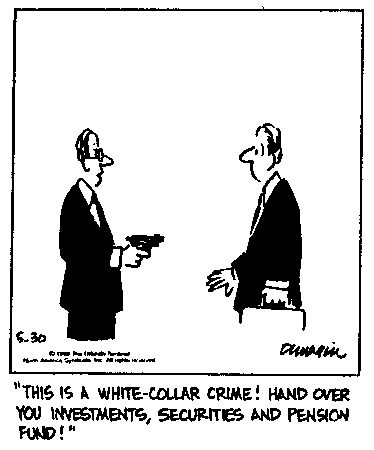
White Collar Crime The obvious connection between these various events is the fact that White Collar Crime – which is sometimes, mistakenly, called victim-less crime – is afflicting our country in a big way.
The year ahead holds significant challenges as we try to go forward in this morass, to escape the conspiracy which I have titled The Code of Silence.
The only way political rulers can carry on as they do, wasting the country’s money for the benefit of their friends and family, is because they are sure of each other’s silence. The people in the private sector who were responsible for the financial collapse are no different. The financial collapse is not, as some have falsely claimed, in any way connected with the Wall Street crisis. That is only a handy coincidence. If our regulators and politicians were doing their jobs we would not be in this position.
Please remember that the alarm bells on CL Financial were sounded by Trevor Sudama, since the 1999 budget debate. More to the point, many of the people who still inhabit the Parliament were there at the time. Again, I give this administration credit for appointing a Commission of Enquiry into this sordid affair.
Also, please remember that both UDeCOTT and the HDC failed to file accounts for years, in breach of the law and State guidelines. That failure was not remarked upon by members of the then Opposition. More to the point, we have now had a change in administration, with no word on the UDeCOTT accounts. I do acknowledge that certain HDC accounts have now been published and that is to be the subject of upcoming commentary.
The Code of Silence must be broken if we are to progress.
KSBM directors, Brent Salvary, Ramcharan Kalicharan, Robert Balgobin and Robert Mayers
The headline was an arresting one – ‘Investment pros set up new business‘ at page 10 of the Business Guardian of 9th December. It was reported that a new investment house, KSBM, was launched and it seemed that they were profiling.
Given that all four of KSBM’s Executive Directors are ex-CMMB chiefs, there is an inescapable question… ‘Did CMMB collapse, or did they not?‘
Our society’s level of development will be limited by our capacity to reason and learn from that reasoning. The Code of Silence must be destroyed if we are to progress. It is necessary to probe this question most soberly and this is my attempt.
As is my practice, I am proceeding from the published record –
If we refer to the MoU signed on 30th January 2009 there are only two references to CMMB, in which, at clauses 1 c) and 6 b), the CL Financial group agrees to sell its shares in CMMB, along with a list of other assets.
…Today, the Government, the Central Bank of Trinidad and Tobago, and First Citizens Bank (FCB) became part of a bail-out package for CLICO Investment Bank, CLICO and British American Insurance and Caribbean Money Market Brokers (CMMB)…
The Governor’s statement made that day goes a little further, by referring to the transfer of third-party assets and liabilities of CIB and CMMB to First Citizens’ Bank.
…This is the first in a series of media conferences that the Central Bank intends to schedule to update the national community about progress with respect to resolving the financial difficulties in CLICO, CIB and CMMB…
It is reasonable to ask why it became necessary to transfer CMMB’s third-party assets and liabilities (which would have included depositors) to another financial institution. More to the point, it would seem from the events that only a State-owned financial institution was willing to partake. In my view, if CMMB were healthy and whole, it would never have been even mentioned in all of this.
But, wait, there were conditions –
The fourth reference of course was the revelation that the previous administration had created a $1.8Bn guarantee to cover CMMB’s advances to its parent company, CL Financial. First Citizen’s Bank had made that guarantee a condition of its acquiring CMMB.
On 1st October, 2010, which was the fateful Friday on which our Prime Minister discussed the CL Financial matter at length in Parliament, First Citizen’s Bank wrote to the Minister of Finance to get confirmation that that guarantee was properly in place.
…First Citizens Bank CEO Larry Howai yesterday confirmed the bank’s request and revealed that it was made in relation to the bank’s acquisition of Caribbean Money Market Brokers (CMMB) under the terms of a supplemental agreement drawn up subsequent to the Memorandum of Understanding (MOU) of January 30, 2009. CMMB had racked up a substantial debt due to loans to parent company CL Financial.
“What happened is when we acquired CMMB, CMMB was owed money by the CL Financial Group,” Howai said. “We had told the government at the time that we would only acquire CMMB if they guaranteed the debts…
It seems to me that the guarantee First Citizen’s Bank was confirming had been made in conditions of great privacy, for it was the first time I was reading about it. A Supplemental Agreement to the published MoU – one can only wonder when that is to be published.
…The terms of reference of the Commission of Enquiry include looking into the causes, reasons, and circumstances leading to the deterioration of the financial conditions at CLICO, CLICO Investment Bank Ltd, British American Insurance Company (Trinidad) Ltd and Caribbean Money Market Brokers and HCU which threatened the interest of depositors, investors, policyholders, creditors and shareholders and the circumstances, factors, causes and reasons leading to the January 2009 intervention by the Government for the rehabilitation of the companies…
Some other views have been put to me, most notably by the editor of a leading newspaper, to challenge my assertions on CMMB, so one needs to go further.
Yes, it is now time to consider First Citizens’ Bank’s (FCB) 2009 Annual Report.
As to the post-bailout events, I am considering page 77 of FCB’s 2009 annual report and Note 1 to the accounts ‘General Information’ is giving me pause – the relevant paras are cited –
…The CMMB Group comprises CMMB Limited, CMMB Trincity and CMMB Barbados…Effective 2 February, 2009, the Bank assumed control of CMMB Securities and Asset Management Limited (CSAM)…
The meaning of that series of statements is unclear to me…FCB assumed control of the CMMB Group (which we are told has 3 parts) on 2nd February 2009. Ditto for CMMB Securities and Asset Management (CSAM)…is that part of the CMMB group or not? I am not at all clear on what, if any, is the difference in these companies.
But, apart from that note, the real meat of the matter is found at Note 39 on page 131 – ‘Business Combination’ – the opening para of which, in reference to CMMB, reads –
…The acquired business contributed revenues of $369.9 million and net profit of $91.9 million to the group for the period from 2 February 2009 to 30 September 2009…
The acquired business is obviously CMMB and that profit rate, at just about 25% of turnover, is below FCB’s overall 45.5% profit rate disclosed at page 73, in the Consolidated Income Statement.
The CSAM performance, disclosed on the next page of the same note, is less impressive –
…The acquired business contributed revenues of $3 million and net loss of $0.16 million to the group…
But the body of that Note is contained in its details of Net Asset Values, to quote –
…The details of the fair value of the assets acquired and arising from the acquisition are as follows…
The Fair Value of Net Assets for the two acquisitions is disclosed as being:
CMMB Fair Value
CMMB Carrying Value
CSAM Fair Value
CSAM Carrying Value
($187,444,000)
$74,949,000
$14,219,000
($14,218,000)
I abbreviated the table to show its headings and totals only.
Fair Value is the estimated market value of the assets and liabilities, with an adjustment for any ‘special purchaser’ advantages or disadvantages.
Carrying Value is what used to be called ‘Book Value’ – i.e. acquisition cost less any depreciation.
The largest negative entry in that accounting is Other Funding Instruments, disclosed at $5.464Bn. What were these?
Point being, that, even if we ‘net-off’ the two companies, these figures disclose a negative Net Asset Value of about $173M.
More to the point – which was CMMB’s state at the date of the bailout – the table in Note 39 also discloses CMMB’s cash and cash equivalents to be NIL at the time of the bailout. CSAM’s are disclosed to have been about $7.3M.
….The Group’s total assets were $27.8 billion as at the end of September, 2009 up $11.9 billion or 75%. This increase was mainly as a result of the acquisition of CMMB which accounted for just over $7.6 billion of the Group’s total assets…
I am unable to reconcile the contents of Note 39, which specify a negative Net Asset Value of at least $173M, with this statement as to the additional $7.6Bn in total assets.
The conflict in the narrative is evident even in the very CEO’s statement –
At page 13, we read –
…During the year, the most significant event for the Group was the acquisition of Caribbean Money Market Brokers (CMMB), the largest brokerage house in Trinidad and Tobago. The acquisition contributed to growth in assets, profits and funding…
Then, at page 14…
…we were called upon by the Central Bank to assist with the payments to depositors of CLICO Investment Bank (CIB) and to acquire CMMB, both of whose customers were seriously affected by the necessary interventions made by the authorities to stabilize the system…
How were the CMMB customers ‘seriously affected by the necessary interventions’?
Nothing in FCB’s 2009 Annual Report leads me to doubt my original conclusion as to CMMB’s collapse. I am sure more details will emerge during the Colman Commission, the Terms of Reference for which were again requested from the AG’s office this week.
But in fact more details emerge in the Business Guardian column of 16th December ‘First Citizens profits from Duprey’s CMMB‘. Two quotes from the First Citizens CEO will suffice –
“As far as First Citizens chief executive officer, Larry Howai, is concerned, the bank and the government together saved CMMB – ‘They would not have been able to continue in business much longer’”
“CMMB had serious impairment of between $1.6 and $1.8billion which would have had to to have been written off or provided for in some other way”
It would really be refreshing to have one of those CMMB chiefs (Ram Ramesh or Robert Mayers, maybe?) assist us in gaining a clearer picture of the events.
In summary, we have CMMB
reportedly with NIL cash balances as at the bailout
reportedly with a negative Net Asset Value
with its customers stated to be ‘seriously affected’
acquired by the State-owned bank
The terms of which acquisition include a secret guarantee for $1.8BN of presumably irrecoverable advances to its parent company
The subject of the oncoming Colman Commission
The big question for me is how come the chiefs of CMMB, a financial institution which is known to have failed on this scale, can be permitted to open another one? We are acting as if we have no capacity to learn from our errors. Just carrying on as though nothing happened. What is the role of the SEC and the Central Bank in all this? Have we learned nothing?
I certainly hope that my colleagues in the press are going to be as insistent and detailed on this matter as the circumstances demand.
Afra Raymond sits with hosts, Fazeer Mohammed and Felipe Nogueira on the Morning Edition television show to discuss the code of silence surrounding the CLICO bailout. Video courtesy TV6
At this point in time, the nation’s budget is running at a deficit for the third successive year and the Minister of Finance is tasked with developing new sources of revenue. I think it is time to return to the question of property tax.
According to a recent statement by the Minister, if all the taxes due were paid, we would not have any budget deficit. The ‘tax gap’ is the difference between the total taxes owed and the actual taxes collected. While the notion of total compliance by taxpayers would be somewhat unrealistic, the goal of closing the ‘tax gap‘ is certainly one worth pursuing.
As I wrote on 19th September in this space –
…consider that rental income is also subject to income tax. Not many people who own rental property actually pay income tax on that rental income – if you don’t believe me, just ask a few friends or relatives who own rental property. This seems to me to be an area in which the Finance Minister can easily collect the data and increase the State’s revenue by staying within the ‘No New Taxes’ promise and implementing the laws which are already on the books…”
I am returning to the subject in this article.
When one considers how wealth accrues in our society, it is obvious that property forms a significant part of the nation’s assets. A great portion of the wealth of our successful citizens flows from rentals, buying blocks of land to sub-divide and sell-off lots, development or just flipping (buy low, sell high). There is no doubting that property dealings are a significant wealth-creating engine in our society.
The property sector is lightly taxed, with no real capital gains taxes, very little income tax collected on rentals and very low rates paid for Lands & Buildings Taxes/House Rates. Only in the case of Stamp Duty is there a somewhat modern system in place, but even that has been effectively neutralized by the real traders.
The widespread and varied protests against the PNM’s Property Tax proposals seemed to me to be divided into two types.
Firstly, the general mood of protest against paying any further monies to a wasteful and corrupt government.
Secondly, we were fed the notion of inequity, with many examples about pensioners and the less well-off families being heavily promoted.
In saying so, it is striking to me that the position of the serious property dealers remained concealed in that campaign, which was effective in seeking after sympathy-support. Almost reminds me of the Clico Policyholders Group.
The first class of objection is practically dead, given the strong mandate given to the PP in the General Election. That said, it would be literally playing with fire for them, having achieved office by campaigning against the PNM proposals, to bring forward a new property tax in a similar mode.
The second class of objection is interesting in that it could be instantly invoked to play on our natural sympathy for the ‘underdog’.
I am proposing that the Minister of Finance consider targeting rental income for taxation.
So, what are the merits of this proposal?
Firstly, the information could be easily gathered in the upcoming national census, for which enumerators have already been trained. All that is required is three simple questions –
Do you rent your home/business? – Yes or No? If the answer is no, the other questions are omitted. If the answer is yes, the next two questions apply.
Who is your landlord?/To whom do you pay rent?
How much rent do you pay?
Given the natural tension between landlords and tenants, it is difficult to imagine many tenants concealing or distorting facts for the benefit of their landlords. The simple fact is that there is plenty of information just waiting to be collected.
Secondly, the legislation is already in place, so there is no need to get any law changed or go to Parliament for any discussion. I am proposing purely administrative measures, in which our existing laws would be properly enforced, something the public is continually calling out for.
Thirdly, owner-occupiers will be lightly taxed under the present arrangements, while only the landlords will pay income tax on their rental income. That will negate the sympathy-objection, as outlined above.
In terms of actual implementation, it would be advisable to get a high rate of participation by offering a tax amnesty to those who filed corrected tax returns within say 3 months. The waiver of penalties and interest charges on the 6-year tail of liability would be an attractive incentive to sensible investors.
Just to be clear, the payment of income tax on rental income does not set-off or reduce a property owners’ liability to pay property tax, as in the case of Land & Buildings Taxes or House Rates.
There is a substantial pool of untaxed income, together with an inescapable means of gathering the necessary information.
The only question is ‘What are we waiting for?’
SIDEBAR –Property Tax Act 2009 – an update
The closing act of the last PNM regime was the vastly-unpopular property tax, which was assented-to by our President on 29th December 2009, after bruising months of public protest and many, many uninformed statements. The Property Tax Act 2009 was to be the basis of a complete revision of our country’s property tax system, insofar as the old Land & Building Taxes and House Rates were concerned.
The nationwide protest against the Property Tax proposals was a key factor in coalescing the opposition to the PNM and seemed to me to have paved the way to the electoral victory of the People’s Partnership government in May 2010. One of the PP’s most distinctive and popular manifesto promises was the repeal of that Property Tax Act.
I was in support of the proposed changes to the Property Tax system as being long-overdue.
As things stand, no Property Taxes have been paid for 2010 and the Minister of Finance has given property-owners a waiver for this year. That waiver amounted to over $140M and it remains unexplained.
There have recently been advertisements seeking details from property owners to update the database for Lands & Buildings Taxes, so it seems that some further revisions are to take place.
For me, the key point at which we lost our way in the UDeCOTT/HDC/NIDCO bobol, was the crossroads of the Investment Decision.
That Investment Decision is an indispensable part of any rational process of development, for families, businesses and countries alike. The national level is my concern and there must be broader considerations in making those decisions.
It is clear from the depth of the failure, that the last administration lost its way completely, insofar as elementary concepts such as opportunity cost, payback periods, cost-benefit analysis and so on. We have only now begun to scratch the surface in terms of understanding the extent of the losses and corruption – readers, please be reminded that as yet, we have no accounts for UDeCOTT or HDC for several years. In normal business thinking, the failure to publish accounts without even an attempt at an explanation is tantamount to an admission of the most serious problems. Only State-owned organisations can get away with that kind of irregular conduct, which is maybe why they do it.
My concern in this article, is that apart from the Investment Decision in the case of specific projects, the State has an obligation to consider the wider picture in terms of fine-tuning, timing and phasing those projects. Our last land-use plan in our country was approved by the Parliament in 1984 and we have had several fruitless attempts to revise that plan.
The focus here is on the need for a proper practice of integrated planning, in particular long-term land-use and town-planning. By integrated planning I am speaking to an approach which takes account of varying principalities, such as land-use, financial constraints and national targets. In addition, the approach allows a balance to be struck between the competing demands within various time-horizons, such as immediate demands, medium term demands (say, 10 to 20 years) and longer-term considerations.
Lack of an updated national Land-use plan
As I wrote in the Business Guardian of 9th October 2008 –
Dr. Emily Gaynor Dick-Forde, former Minister of Planning, 2007-2010
“The Minister of Planning, Housing and the Environment spoke at a breakfast meeting of the Couva/Point Lisas Chamber of Commerce on September 10, and some of her reported comments deserve our close attention.
The minister told her audience that the National Physical Development Plan was passed in 1984 and had been continually updated, but that “that plan has somehow never reached to Parliament.” Somehow. The mind boggles.
One report said, “Dick-Forde said the external and internal committees on national development were working towards the completion of the National Development Plan, which will be taken to Parliament in the next two years.”
Given the last Minister’s stated timetable, we ought now to be having a draft plan published for consideration. Where is this, Minister King? When do the consultations start?
Transportation planning
Austin 'Jack' Warner, MP, Minister of Works & Transport
This is a vital, related area and Minister of Works & Transport, Jack Warner, told us that the PNM government paid $21M for an incomplete Comprehensive National Transportation Study (CNTS) – see http://guardian.co.tt/news/general/2010/10/09/warner-pnm-paid-21m-non-study – and I agree. That fact only makes the situation more doubtful, since we seem to be making major transportation system decisions in the absence of a strategic plan.
…We all know how difficult it is to access Maracas Bay through the North Coast Road.
Currently, it takes approximately 45 minutes to get from Santa Cruz to Maracas Bay. Furthermore, landslips on the North Coast road are a major deterrent to persons wishing to access this scenic route for pleasure or business. As a result we will do a business plan for a new: ‘Connective Development Project’. This project would create an underground tunnel from Maracas Valley to Maracas Bay, to enable quicker access to the North Coast…
The expansion of the Highway Network
We are now aware that the National Infrastructure Development Company (NIDCO) is proceeding with ambitious Highways packages from San Fernando to Point Fortin, with the San Fernando to Mayaro route under active discussion – see http://www.newsday.co.tt/politics/0,124988.html.
Coastal Water Taxis
It seems that the government has changed its mind, three times, on this part of our public transportation system. Firstly, we were disposing of two of the four new water-taxis as being superfluous. Secondly, there was an about-face, in which it was decided to keep the new water-taxis. Most recently, I have seen advertisements for the provision of brokerage services for the disposal of these vessels. Again, what is the basis?
Sewer Treatment plants and the threat of cholera
We recently had shocking stories about the leaking of significant amounts of untreated sewage into the Maraval reservoir – see http://guardian.co.tt/news/general/2010/11/19/wasa-boss-moka-residents-must-pay-repair-sewerage-plant. That is no surprise, given the widespread practice of property developers walking away with their profits in hand upon completing the sales of their properties, but with no proper plan for the maintenance of the sewer treatment plants.
Once again, this is an area which urgently needs to be addressed in terms of town planning, local health, WASA regulations and adequate financial mechanisms for ongoing maintenance of these facilities.
The Housing Development Corporation (HDC) The HDC’s new target for 2011 is 6,500 new homes and that is still a huge number. Given our limited land resources and the absence of a national planning framework, how is this to proceed?
There remains the unanswered question as to what is the basis for these decisions?
The Limits of our financial resources
The Minister of Finance recently called for Ministries to not implement any new large projects, due to the financial limits constraining state expenditure – see http://www.newsday.co.tt/news/0,129148.html. That is a valid call, which shows that the time is ripe for us to plan our major strategies and projects so that they can conform to some sort of national context.
That context would have to include elements such as land-use, transportation implications, financial limits and the question of the capacity of the economy to meet the targets being set.
SIDEBAR: Fuel subsidies in national planning
The question of fuel subsidies is an important part of this integrated planning discussion, since, at approximately $2.8Bn, they are a large part of our national expenditure. More to the point, the effect they have on our behaviour is largely unremarked, which is paradoxical – the gas price being so low that we do not really consider it in our daily choices.
It is a classic example of the sort of ‘policy silos’ which the integrated planning approach seeks to overcome.
The Minister of Works & Transport speaks out strongly against the heavy subsidies necessary for the operation of the Coastal Water Taxis – no statement from Warner on the larger sums spent on the fuel subsidy. The Minister of Energy, in the run-up to the budget, says that these fuel subsidies may need to be reduced. The Minister of Finance, in his budget address, said –
“…The largest Subsidy is on petroleum products, particularly gasoline which usually represents one to two percent of GDP per annum. All of our citizens benefit from this subsidy. It is often difficult to determine whether resources are being used wisely to achieve the intended objectives of subsidies. We are currently reviewing whether alternate options are more efficient…”
We need to develop a holistic view of the various subsidies being paid in our economy and transportation subsidies, including fuel, are important considerations.
The goal of promoting the wider use of public transportation has to be adopted with some vigour and creativity. The fuel subsidies enjoyed by small vehicles – say, less than 12 passengers – should be gradually reduced with a shift of those subsidies to larger-capacity vehicles. They make more efficient use of our limited roadways and would reduce the adverse effects of traffic and pollution.
The three Ministries concerned should join with the Ministry of Planning in mapping out these strategies and policies.
The strategic goal should be to decrease the convenience of individual car-journeys and increase the convenience of the mass-transit approach.
It is no easy shift to go from today’s congested reality to the medium-term goal of a much-improved transportation system with travelers having several choices. That journey would involve a virtual culture-shock for most of us, but it is one we should start, sooner than later, for our common good.
That is one of the examples of how an integrated planning approach can offer fresh solutions to serious problems.
 I have been preparing my submissions for the Colman Commission and took some time-out to start reading the Report into the USA’s financial crisis. Of course I am referring to the


 The audited accounts for CMMB for
  The JMMB (Jamaica Money Market Brokers) element. But then also we need to consider the sidebar item on the acquisition by CL Financial of the JMMB block of shares in October 2008. What could have been the rationale for CL Financial to spend $262M on securing its ownership of a company that was about to fail? No doubt that would have been a period of considerable cash-flow pressure within CL Financial itself, so it does seem to be a bizarre decision. Given all of those elements, why would CLF pay such high multiples to buy the remaining shares in a failing subsidiary? This is one of those intrigues which makes me wonder whether there was more in the mortar than the pestle, so to speak. Given that the purchase of the JMMB shareholding was only 3 months before Duprey wrote that fateful letter requesting financial assistance,what was CLF’s rationale? Could there have been a prior agreement as to the price to be paid for those shares? Was a valuation of those shares ever done? If so, by whom, on what assumptions and with what result?It seems that a huge sum of money (over $260M, by my calculations) was drawn out of the collapsing parent company, on what was virtually the brink of the meltdown, to buy the remaining shares in yet another collapsing company. It is staggering to conceive of a situation in which a financial company could spend over $260M without such elementary due diligence, which is why this aspect is an important one. At the very least, the quality of judgment of the CL Financial chiefs seems suspect. Could it be that the reporting systems of the group were so poor as to be unable to foresee the impending collapse at either the group or CMMB level?

 The other huge event of the year was the budget speech on 8th September 2010, in which Finance Minister, Winston Dookeran, disclosed publicly that he was revising the terms of the CL Financial bailout. That bailout was a hugely suspect act, the largest financial commitment ever undertaken in this country, without proper due diligence or even any proper ventilation in the Parliament. Our Republic had never been so financially violated and in broad daylight. It was encouraging to see the Finance Minister take the point to its logical conclusion and of course that brought about the large-scale organisation of various aggrieved groups to put their point.
 The obvious connection between these various events is the fact that White Collar Crime – which is sometimes, mistakenly, called victim-less crime – is afflicting our country in a big way.

 …The CMMB Group comprises CMMB Limited, CMMB Trincity and CMMB Barbados…Effective 2 February, 2009, the Bank assumed control of CMMB Securities and Asset Management Limited (CSAM)…
 For me, the key point at which we lost our way in the UDeCOTT/HDC/NIDCO bobol, was the crossroads of the Investment Decision.

 The HDC’s new target for 2011 is 6,500 new homes and that is still a huge number. Given our limited land resources and the absence of a national planning framework, how is this to proceed?
