Afra Raymond sits with Fazir Mohammed and Jessie May Ventour to speak on Transportation Logistics, Challenges and Implementation in Trinidad and Tobago.
- Programme Date: 23 August, 2010
- Programme Length: 42:40
Afra Raymond sits with Fazir Mohammed and Jessie May Ventour to speak on Transportation Logistics, Challenges and Implementation in Trinidad and Tobago.
Once again, I am returning to the need for us to grow a culture of responsible behaviour as a vital part of national development.

The idea that the CL Financial bailout is just like the one in the USA is a durable one, which has been very useful to those people who are seeking satisfaction. Nothing could be further from the truth. That is a false view and what is more, extremely misleading to the public, who rely on informed members of society to share that information conscientiously. Rightfully or wrongfully, many people here look upon the USA and the doings of its government with a sense of approval, to the point that if Uncle Sam does it that way, there must be some good sense in that. That idea that our bailout is ‘just like the one in America‘ must be challenged, defeated and put out of its misery.
On Wednesday August 18th, William Lucie-Smith, the Express columnist wrote on this very topic, his sub-title being ‘A new strategy required’. That column can be found at http://www.trinidadexpress.com/commentaries/CL_Financial_A_new_strategy_required_.html
Lucie-Smith is a chartered accountant, former Managing Partner of PricewaterhouseCoopers and currently is a Director of both Republic Bank and Sagicor – he is described in his byline as ‘specialising in corporate finance’.
That article started with the claim that the CL Financial bailout was in some way similar to the US government’s bailout of its financial sector.
…The original plan was to guarantee policyholder funds and make loans available to Clico, so that confidence would be restored and the group businesses turned around. This is what happened in the United States with the vast majority of TARP funds being repaid in full with interest…
Given the huge stakes in this matter, the promotion of such misleading views is nothing less than public mischief.
Here are some of the main points of the CL Financial bailout which are, in every respect, completely different from the USA situation –
The only resemblance to the US bailout is in name only. Real Trini-ting. Duprey and his cohorts negotiated a Blank-Cheque Bailout at zero interest, without losing any of their assets. That deal is absolutely unique.
Our taxpayers have effectively made a huge single loan (probably the largest in the Region’s history) to the wealthiest individual in the Region at Zero interest. Virtually every relevant professional body and Civic Society organisation has remained silent on this bold-faced attack on our Treasury. Nothing from the Accountants, Lawyers, Bankers, Economists, Trade Unionists or Religious bodies. The one recent exception to this has been the call by the Trinidad & Tobago Transparency Institute (TTTI) for investigations into the Angostura disaster.
The CL Financial bailout has been cloaked in the robes of benevolence and stability, resulting in a situation which has minimised the floods of lawsuits which would have been confronting some of those responsible parties – Auditors, Attorneys, Company Directors and Officers. In reality, the common-wealth of our entire society has been pledged to rescue a fortunate few.
The CL Financial bailout is in urgent need of re-negotiation, to say the least. “It wrong like a biscuit.”
In the same way it was wrong for the last administration to use taxpayers‘ money to rescue the CL Financial chiefs from the real consequences of their decisions, it would be equally wrong for this newly-elected government to also bailout those affected by HCU’s demise. Two wrongs could never make a right.

Angostura is the Caribbean’s flagship rum and bitters company. It was a Caribbean icon, manufacturer of Angostura Bitters, as well as classic rums like 1919, Royal Oak, 1824, VAT 19 and Old Oak – Angostura was acquired by CL Financial in 1998.
The 2008 audited accounts were finally published at the end of July 2010 and the extent of their losses are cause for grave concern, seemingly a harbinger of the state of the entire group, 18 months into the bailout.
Coming after an extended wait for the 2008 audited accounts, the Guardian headline on 4th August 2010 was stunning: ‘Angostura declares $1.28Bn loss’ – see http://guardian.co.tt/business/business/2010/08/04/angostura-declares-128-billion-loss.
The Express headline, on the same date and story, made me smile – ‘Angostura sales rise’ – see http://www.trinidadexpress.com/business/99917894.html.
It was said to be the largest loss in the history of our stock market and it represents colossal destruction of investors’ capital and national wealth. It seems that the source of the losses was a receivable due from its parent company, CL Financial – according to the Deputy Chairman’s report – see http://www.angostura.com/LinkClick.aspx?fileticket=JSMxolh%2bmC8%3d&tabid=144 –
…[the] precarious financial position of our parent company…impaired the collectability of circa $1,185M in receivables from the CL Financial group…
The Notice to Shareholders of 26th June 2009 – see https://afraraymond.net/wp-content/uploads/2009/11/26jun2009_angostura_notice_to_shareholders.pdf – stated that the receivable from the parent company was $633M. So you have to wonder what is the reason for that receivable almost doubling.
The interests of the minority shareholders have been subordinated to those of the majority shareholder, CL Financial, which was able to acquire the leading Jamaican distiller, Lascelles Mercado, by deploying the Angostura assets. This episode is one which raises issues of minority shareholder rights which are unlikely to disperse. As Justice Carlton Best is reported to have said, in relation to his lawsuit against CLICO for a $57,000 fixed deposit they failed to honour upon maturity – ‘It feels like robbery without a firearm’.
Who advised the Angostura Board on this transaction? How can we accept the declaration that those funds are now irrecoverable? How could a parent company, said by its auditors to have assets worth in excess of $100Bn at the very same accounting date (31st December 2008) be unable to repay a mere $1.185Bn.
Yes, it is true, the same accountants – the esteemed international firm, PriceWaterhouseCoopers – are auditors for both CL Financial and Angostura. But more on that in the sidebar.
It is almost a metaphysical query – can a responsible class always escape judgement?
 PricewaterhouseCoopers (PwC) is the world’s largest professional services firm in the accounting and finance industry. PwC audits the accounts for UDeCOTT, CL Financial, Angostura and at one point I can even recall the Hindu Credit Union announcing that that firm was to be their internal auditors. Clearly, PwC is a main player in the big leagues here in Trinidad & Tobago. Let me declare here that they are also my [Afra Raymond, not Raymond & Pierre] accountants.
On 30th June that firm issued a letter, under the hand of Colin Wharfe, its new Senior Partner, to announce four new appointments. The letter also explained that four of the most senior Partners had all retired on 30th June, those were –
The new appointments were announced in full-page press adverts, which omitted the retirements. See letter here – https://afraraymond.net/wp-content/uploads/2010/08/pwc_resignations.pdf
This week the examination shifts to the scale of the failure of our national housing policy – see <http://www.vision2020.info.tt/pdf/Policies and Procedures/Strategic_Corporate Plans/Housing Plan.pdf>. Three main points for consideration are –
 The original target was for the HDC to construct 100,000 new homes in a decade, which figure was generated from the 1994 ‘PADCO reports’—The Review of Shelter and Land Development Policy Study (PADCO reports): The PADCO reports is a series generated by The Planning and Development Collaborative International, Inc. and Laughlin and Associates Limited (who were contracted by the Government of Trinidad and Tobago in 1993)—that study is available at the Ministry of Housing & Environment’s library. The annual target was reduced to 8,000. As noted in the previous article, the reduced targets should have yielded 60,000 new homes by now, but the HDC has built only 15,394 new homes.The HDC made a recent statement that the number of empty new homes was approximately 10,000. So just about 5,000 new homes have been built and distributed since the inception of this ‘accelerated housing programme’ in September 2002. Even if we omit 2002, that is an annual average of 667 new homes being built and distributed. Even with the most optimistic assumptions, one is looking at considerable challenges in achieving these demanding targets. At the current rate of performance it would take over 140 years to satisfy the original target. That is how far off-track this accelerated housing programme has gone. Deep into the long grass.
…the Government had taken a decision not to subsidise this particular development. It is being sold at market rates in HDC’s thrust to expand and attract an open market clientele.

Given that the units were reportedly being sold for a maximum of $875,000 and that they were worth a minimum of $1.7M, it is clear that each new home there is sold with at least $800,000 in housing subsidy. The only way Garcia’s incredible statements could be correct is if one were using the misleading cost-based approach.
I entirely agree with his statement that the Fidelis Heights development “…is therefore not part of HDC’s provision of subsidised housing for low-income earners.” It is really subsidised housing for the middle-income groups, but that could never be right when the waiting list is bulging with needy people who cannot even get an HDC unit to rent.
Fidelis Heights was, even by its name, a monument to misleading and wrong-headed thinking. The HDC project with probably the highest level of housing subsidy per unit was built for the least needy on their waiting list. Only if the underlying philosophies and resulting models are appropriate, can we avoid a repetition of this blatant waste of public funds in the face of real, human need.
Given that the HDC is unable to satisfy the needs of the people it was intended to serve – the poorest citizens who cannot afford a proper home – it is scandalous that its scarce resources should have been diverted to Fidelis Heights, or the one at Federation Park in Port-of-Spain.
The selection of this pricing model is proof of misguided policy at the most elementary level. The basic concept of opportunity cost appears to have eluded the responsible officials and, what is more, that misguided policy appears to have been approved at the very highest level.
Wrong-headed thinking can only encourage corrupt behaviour.
Try as I might, it has proven impossible to determine just how much the HDC has spent on building new homes in any given year. That is because there are no accounts at all which are available to the public.
The HDC Act, at section 18 and 19, mandates that the Board shall keep and properly audit accounts. Section 20 requires the Board to submit its annual report to the line Minister within 3 months of the end of the financial year. The line Minister is in turn obliged, by section 20 (2), to lay that report in Parliament within 3 months of receipt. See – http://mphe.gov.tt/home/images/stories/pdfs/tthdc%20act%2024%20of%202005.pdf.
The HDC has never laid either its annual report or audited accounts into Parliament for the public. The failure to publish accounts is one of the most serious warning-signs of companies in financial trouble.
That failure to publish HDC or NHA accounts over such a long period (since 2002 at least) spanning several administrations, is a serious indictment of the main participants – the politicians, the Board Directors and of course, the professionals involved in the entire huge operation.
I have been reliably informed that the HDC’s new management is attempting to rectify this situation and that must be a priority if we are to properly assess the performance of this vital social programme.
The overall picture is stark –
Given the combined effect of all this, which is probably hidden to most of today’s readers, one can only wonder at the patience of our needy citizens.
The entire situation also raises potent questions about the purpose and performance of the SPEs.
Let’s use a typical home at Fidelis Heights as an example.
In the prevailing cost-based pricing model, this is considered a satisfactory, ‘zero-subsidy’ result, since the State has recovered all of its costs. Another phrase in the lexicon is the ‘cost-recovery’ model of pricing.
The danger, as shown in the example in this article, is that the ‘cost-based’/’cost-recovery’ model ignores opportunity cost.
The opportunity cost is the difference between the actual selling price of the unit and the market value. The HDC could sell each Fidelis Heights home for $1.7M, but has made the decision to sell at a reduced price of $825,000, which means that each sale is at the loss of those possible earnings. That amount of the loss incurred by the decision to sell at a lower price is called the opportunity cost. It is important that opportunity cost be identified and quantified as an element in all decision-making, both private and public sector. A decision-making process which ignores or obscures opportunity cost is negligent at the very least and can encourage corrupt practices and the dilution of capital.
In this example, the opportunity cost is $1,700,000 – $825,000 = $875,000.

$875,000 is enough money to build at least three modest homes, yet this system has allocated that much money to each Fidelis Heights purchaser, each of whom qualified for a mortgage at that level.
As a result of this questionable choice and the resultant shaky pricing model, there is an enormous ‘leakage’ of housing subsidy and opportunity cost.
The opportunity cost can also be described as the housing subsidy since that is the difference between what a Fidelis Heights unit actually sold for and what a purchaser in the open market would have to pay for a similar unit.
The two terms are therefore synonymous – Opportunity Cost is exactly equal to Housing Subsidy.
http://guardian.co.tt/news/general/2009/03/25/quality-performance-must
Related reading:
Having set out a framework for a more effective and equitable national housing policy, it is time to deepen the discussion. In this week’s column, I will further analyse the existing housing policy so as to highlight those errors which we must avoid if we are to do better.
My proposed framework would quantify housing subsidy and allocate that in accordance with identified housing need, with the quality of the new homes also being monitored to ensure constant improvement.
To go further into the issues requires that we examine these aspects –
I close this week by renewing my call for Minister Moonilal to take leadership on this burning national issue. A conference on revising Housing Policy should include participation from the leading civil society organizations such as the JCC, the National Land Tenants’ and Rate-payers’ Association, the Sou-Sou Land group, Habitat for Humanity and the Salvation Army.
Basic facts need to be compiled and distributed to seed the discussion. The framework and philosophy need to be clearly articulated, if we are to get it right this time around.
The continuing presence of over 10,000 empty homes is intolerable – it is solid proof of a seriously failed policy. Our silence has to be broken on this issue. We cannot continue this way.
Related reading:
 VIDEO: Morning Edition Interviews – March 2010
AfraRaymond.com, at this time chooses to re-issues these interviews on Morning edition on TV6 CCN, Trinidad and Tobago, to keep readers up-to-date on issues surrounding Uff Report and UDeCOTT Affair respectively.
VIDEO: First Up Interview – 8 July 2010Afra Raymond sits down with Jessie May Ventour and Fazir Mohammed for a discussion on the new initiative by the new Government to the ongoing CL Financial bailout.
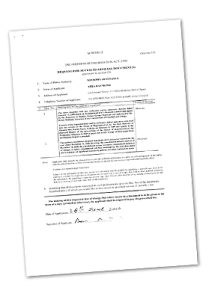
This is a second attempt to get at the Duprey letter – the first application was eventually deflected by the Ministry, who asked us to refer to the Central Bank. I believe that was a barefaced attempt to stifle our request with the fact that the Central Bank is exempt from the FoI Act.
My request for the 2008 audited accounts is based on the terms of the 12th June CL Financial Shareholders’ Agreement – Section 4 of the SA sets out the procedure for a proper system of accounts, culminating at 4.4.5 – “…shall ensure that an annual report of CLF is prepared and dispatched…in manner consistent with standard corporate practice…” The accepted interpretation of this language informs us that the word ‘shall’ denotes an obligatory, non-voluntary duty. If that is the case, when can we expect publication of the 2008 annual report, accompanied by audited accounts, as per ‘standard corporate practice’?
 Last week’s column delved into the vital issue of housing subsidy and its mis-allocation. This week, I will set out some suggestions as to how this wrong-headed allocation of public subsidy might be re-oriented to better serve our needy citizens.
The existing system is fundamentally flawed and in urgent need of reform, if we are to better apply the limited quantities of housing subsidy to the nation’s real housing needs.
In order to create a more effective and transparent equation for the allocation of housing subsidy we need to establish three things. Those are the quantity of housing subsidy which is available for the State to dispense; the housing need of those on the HDC’s waiting list and the housing quality of the new units produced by the HDC, since those ought to be raising the general standard of housing accommodation.
The key point here is that there is only limited housing subsidy available and a clear choice has to be made as to its allocation. That choice has been made under the existing policy, which in my view is inequitable and counter-productive. If we accept that the proper measure of a successful housing policy is needy families moving into new HDC homes which improve their living conditions, we also need to accept that a policy which can generate over 10,000 empty homes is a failure.
A supplementary point is that if we are spending vast sums to build new homes, we also need to obtain a measurable improvement in the nation’s housing standards.
The main points could be outlined in this way –
We need to allocate the limited housing subsidy to those in the greatest need. That is the only reasonable policy for this critical area of national development. That can only proceed properly on the basis of understanding the parts of the puzzle. Anything other than a comprehensive review of these wrong-headed policies is a recipe for more waste and empty homes.
Which brings me to an issue raised in last week’s column; the incidence of ‘policy silos’. That phrase – ‘policy silos’ – refers to a condition in which the activities of various State agencies impinge on the same issues and yet, incredibly, there seems to be scant, if any, co-ordination between those agencies. The aspects addressed last week can be summarized as –
Those are exactly the ‘policy silos’ we need to dismantle if we are to make any real progress on these vital issues.
Minister Moonilal should take the lead on this issue by convening a symposium or conference to debate these issues and establish some kind of policy consensus. We cannot continue this way.
We need to go beyond the numbers game of billions spent, jobs created and new homes built. We need to move to a new, clear space where our national housing policy is declared as existing to improve the living conditions of our neediest citizens. We need to move beyond the narrow perspectives which glorify home-ownership as the only correct answer. There are many productive and honest families, in advanced countries, who never own a home. They are no less worthwhile than those of us who are home-owners.
Most of all, Minister Moonilal should take urgent steps to distribute the ‘…approximately 10,000…’ homes to the most needy.
There ought to be a programme for those people who have HDC homes and no longer need them. That program would offer a cash payment to those HDC tenants who vacated their units. That would have the practical effect of releasing additional housing units to the HDC without the expense and delay of having to construct new ones.
Related reading:

We need to be mindful of the relationship between morals, ethics, law and of course, that scarce commodity, good sense. Obviously, law is the paramount authority, because we live in a republic ruled by laws, not men. No one should break the law and there are penalties for doing that. But we also know that in life we make many important decisions without referring to any laws. Those are sound decisions, which form norms, eventually described as custom-and-practice or culture. There are many acts, which are at one and the same time both deeply offensive to right-thinking people (and I think that most people are right-thinking) and in breach of no particular law. Many acts, with no need for examples, since this is a newspaper any child could pick up and read. There might even be laws against me describing such acts in print. Who knows?
The reality being that, as important as law is, the proper development of our society depends on far more than just law. Law is a necessary, but not sufficient ingredient for proper development. So, what do I mean by proper development? One of the key signs that we are moving forward would be an increased sense of consequence and the capacity to learn from our errors. Some examples of our failures in those respects were set out in the prior article in this series.
Some of the main points here were –
…If Dr Rowley is so concerned about the Parliamentary Code of Ethics, I want to ask him some questions this afternoon. “Why was he so silent when Mr. Manning appointed his wife, not once, not twice, but three times as a minister? “I want to ask him why he was silent when a Minister of Health had his son open pharmacies all over the country to sell CDAP drugs? Wasn’t that code of ethics broken then? “I want to ask him also why he was silent when another Minister of Health had his wife take all the insurance of the Government of Trinidad and Tobago to a company she owned? Why was he silent then?
See – http://guardian.co.tt/news/politics/2010/06/16/warner-i-have-broken-no-law
Strange as it might seem, a mere 3 weeks into the honeymoon, we were witnessing a premeditated statement by a senior Minister to the effect that ‘two wrongs make a right’. Mr. Warner was trying to silence Dr. Rowley, by reference to his condonation. That is a sad and rickety foundation from which to proceed, but even more telling is Warner’s implicit acceptance that his own position was wrong.
Warner’s attempt to diminish Rowley’s victory was also interesting –
Not contented that he removed Patrick Manning from office—he got the easiest political ride in history—he had the temerity to accuse me of breaking some law, or transgressing some code of ethics…
It has to make you wonder, if that is Jack Warner’s view of Rowley’s victory, what is his view of the PP’s triumph?
…Beloff said he was unaware of any precedent in any common law jurisdiction for a person holding at one and the same time, ministerial office and another post outside of the Government. “I have little doubt that a main reason is that the demands of ministerial office would usually preclude such dual appointment and the minister could be exposed to criticism for not devoting himself full-time to his government duties…
I say again that the State has a duty to be exemplary in its conduct. We have a right to reasonable, consistent and transparent decision-making by government. Another aspect of this is that this lawyer-driven decision seems, to me at least, to limit the PM’s power in Cabinet to control her team.
Apart from law, most of the people who supported Jack Warner on this issue seemed to proceed from either the ‘two wrongs’ principle or from the notion that Mr. Warner is a superior performer. It seems that, in this case, Jack Warner will have to ‘take win’ and all we can do is measure his reputation against his actual performance.
One of the fascinating aspects of this affair is the way in which power has been defined, and re-defined, in the unfolding. My favourite definition of power was always ‘the ability to set the agenda’. It has always been the case that the setting of the public agenda was a prerogative of the PM, leaving Leaders of the Opposition lagging one beat behind. As a result of that pattern, a lot of sound and fury became the norm of Opposition. In his opening statement on 4th June, Dr. Keith Rowley, as the new Leader of the Opposition, set out his objections to Jack Warner’s multiple appointments. We had comments from every sector of the society on this issue and many group exchanges on radio call-ins and the social media. Whatever one thinks of the actual objections raised by Dr. Rowley, it is clear that those objections shaped the public agenda. That is no bad thing. In this rounds, it seems that the change we voted for could be coming from unexpected places and with odd timing.
Last week’s column set out my principal queries as to our nation’s housing policy – see http://www.vision2020.info.tt/pdf/Policies and Procedures/Strategic_Corporate Plans/Housing Plan.pdf – and the intervening events have only put those into better focus.
Key points –
‘Cheaper Govt Houses’ in the Sunday Guardian of 27th June featured an interview with Dr. Roodal Moonilal, Minister of Housing and the Environment. The Minister touched on some of the key issues and confirmed that
…Some people simply cannot afford the market value of the homes. As a result, Government is looking to provide a further subsidy to assist with the purchasing of homes. I intend to take a proposal to Cabinet to consider the price reduction of the housing units…
– see http://guardian.co.tt/news/politics/2010/06/27/cheaper-govt-houses-pg-6 .
There was no mention of rented housing in that article, so it seems that the new Minister has adopted the existing policy of preferring to sell the new homes built by the Housing Development Corporation (HDC). In addition, he is proposing to increase the housing subsidy. An important correction is that HDC houses are not sold at ‘market value‘ as the Minister implied. Market value is the amount the new home could sell for on the open market and the HDC offers the new homes to applicants at a lower price.
What is Housing Subsidy?
This is an important aspect of the housing policy discussion and these are the basic points –
[Minister of Science, Technology and Tertiary Education (MSTTE) Fazal] Karim said while the university has established mechanisms to register landlords “there exist no mechanisms to monitor prices, ensure quality accommodation, minimise security anxiety or seek the interests of the landlords and students.” In the near future, Karim said, the MSTTE and the Health Ministry will establish a committee that will make recommendations to establish mechanisms for the provision of subsidies “on rents to all students residing in the region and who are registered at tertiary institutions in the area.”
It seems from his statements that the MSTTE is proposing a rental subsidy to all tertiary students, whatever their means. In a situation of scarce resources, that type of policy can have inequitable consequences, since some of these students are not needy at all.
The Minister of Legal Affairs, Prakash Ramadhar, attending as MP for the area, said –
…what adds to the problem is the lapsing by the Rent Assessment Board. “We nationally had to debate the issue if this country would go into a free market in terms of rent or rent restriction.”
Ramadhar said he would like to see free market forces determine rents.

So here we have the paradox deepening, with the Minister responsible for the rent control system seeming to say that he is against those controls.
The outlook for the state’s intervention into the housing arena is confusing, to say the least. Confusion is the ideal atmosphere to breed under-performance and corruption.
Our needy citizens deserve better. This entire debate should be to create reasonable, redistributive and sustainable housing policies for our nation.
The allocation of scarce housing subsidy must be reported and improved, so that the most needy receive the most subsidy.
Next week, we expand to include questions as to how many of the HDC houses are occupied by the legitimate tenants? Are steps being taken to deal with those who have broken the terms of their tenancy? Also, some discussion on the use of re-purchase schemes as another way to create extra units of housing.
Last week’s column asked Dr. Moonilal to specify how many new homes were empty at this time and it was very disappointing to read that “…approximately 10,000 homes, including defective units, are unoccupied…”. The new administration has to strive to do better than the one they just replaced and it is just not acceptable that the HDC cannot (or will not?) report on an elementary matter like this.
Related reading:


