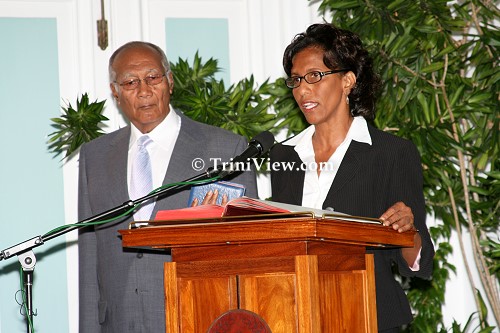
On Tuesday 24 April 2012, JCC President Afra Raymond addressed the POS Rotary Club at their luncheon on ‘The Imperative of Public Procurement – The Government to Government Arrangements‘ – the Power Point presentation is shown here.
JCC President Afra Raymond speaks on Procurement revelations in the Parliamentary debate on No-Confidence in the Prime Minister on First Up with Paul Richards and Jessie-May Ventour.
A timeline of events within the People’s partnership period…
4 November 2010
Afra Raymond’s Agreement for Freelance Services with CNMG was discontinued. My agreement with CNMG was as a Commentator with a one-hour current affairs program to be aired alternative Sundays and weekly editorial slots on Friday mornings as part of the ‘First Up’ program.
TnT Mirror and I95.5FM are reportedly the subjects of an embargo in respect of State advertisement – both these outlets have been identified as being strongly critical of the present Peoples Partnership government. MATT issues a statement condemning “advertising boycott.” Minister of Foreign Affairs and Communications denies the existence of the advertising embargo in January 2012.
O’Brien Haynes resigns as CEO of Radio Vision Limited (which includes Power 102.1FM)
29 December 2011
Ian Alleyne is the subject of Police Search on TV6/CCN/Express offices. Ian is the controversial host of ‘CrimeWatch’, the country’s most popular TV show, a hard-hitting and interactive outlet for the #1 public concern – the relentless rise of violent crime. ‘CrimeWatch’ is deeply critical of certain elements in the Police Service. MATT issued a statement on the “TV6 raid”
Afra Raymond’s column on Karen Nunez-Tesheira sent to her by Trinidad and Tobago Guardian’s Ag Editor-in-Chief. My Business Guardian columns had been a critical analysis of a range of issues from ‘Property Matters’ to the ongoing scandal of the ‘CL Financial bailout’. I resigned as a columnist at the Guardian on 4 January 2012
David Mohammed suspended indefinitely from 102.1FM. David was the originator of ‘The Black Agenda’ programme, which rose to become T&T’s most popular radio program. ‘The Black Agenda’ programme can be followed on Twitter, on Youtube or on Facebook. The only report I have seen in the print media on David’s virtual dismissal was in the T&T Mirror. Also, there were statements of support from the National Workers’ Union, and the OWTU.
CCN Directors are requested to present themselves for Police interview, which seems to have arisen out of the same episode with Ian Alleyne and the broadcast of the so-called ‘rape tape’.
The Newsday office and reporter Andre Bagoo’s home is the subject of Police search. Andre is the lead investigative reporter for the Newsday, with emphasis on politics and corruption in public administration.
This is a sinister pattern, which we need to recognise now.
To seed this discussion, I have three threads…
The use of Police resources to target journalists is questionable in light of the apparent, unexplained delays in dealing with the CL Financial chiefs, the UDECOTT chiefs and of course, the HCU chiefs. The Police anti-media operations were apparently executed in exemplary fashion with warrants being obtained and searches done using the element of surprise – no reasonable person could find fault with the execution of those operations. The burning question for me, given the apparent delays in prosecuting or even searching the ‘White Collar robbers’ – even during the recent SoE – is ‘What are the priorities of our Police Service? Are our limited Police resources being effectively allocated in the fight against ‘White Collar crime’?
The second issue is the agenda of the Media practitioners. Despite the strong and clear statements from the Media Association of T&T (MATT) on these issues – the embargo of State advertising for the Mirror and I95.5FM, the Police search of TV6/CCN on the Ian Alleyne issue and the Police search of Newsday and Andre Bagoo – there is still no MATT comment on the Power 102.1FM dismissals and the issue of the Guardian’s Acting Editor-in-Chief sending my column on Karen Nunez-Tesheira to her for comment. We need to be mindful of self-censorship in a world in which most of the media is in private ownership. Which shifts into my next point…
Lastly, there are the issues emerging from the world we live in now. It is a truly New World, with the commonly-held conviction that ours is a ‘free society’. Our Constitution guarantees freedom of speech, freedom of expression and freedom of association. It also guarantees the rights of property owners and that takes me straight to the vexatious juxtaposition of those rights. You see, if we do live in a society with all those rights, the question arises ‘What is wrong with the owner of a media outlet deciding to let-go/fire/suspend indefinitely/re-assign a particular commentator?’ Even more to the point – “Are we saying that the privately-owned media can pick-and-choose their commentators, but the State-owned outlets have a different set of rules to follow?” Despite the provisions of T&T’s international anti-corruption and media treaty obligations in favour of whistle-blowers, there are still those who want to know what is wrong with the government deciding how to place its advertisements.
I am closing this off now; to let the discussion flow…the battle-lines are clear to me…our sentiments on the free nature of our society come into conflict with the impulse for self-protection once we achieve Public Office. In this rounds, given the boundless nature of the new technology, we are going to see a sharper, more wily, battle to reduce the strength and clarity of our media. I greet it.
As always, the struggle is against the enemy without and the enemy within…
Please view my iPad oPinion video Podcast on this topic here
This is the video of the segment from the show Making A Difference with Felipe Noguera called Caribbean Economic Forum. Appearing with guest Afra Raymond was David Walker, another prominent analyst on the CLICO debacle. Video courtesy Making a Difference
12:52 pm – 1,425 word column submitted. Article was intended for publication in Business Guardian of Thursday 5 January, 2012.
2:59 pm – Wilson emails “…Afra this column is not up to your usual standard…” with notes for my review.
7:24 pm – Copy submitted to my webmaster and Barbados Free Press for their publication.
Saturday December 31, 2011
12:11 pm – Final text agreed with Wilson.
4:18 pm – Wilson emails me to say that he has had legal advice that my column is defamatory. I reply that the attorney ought to have been told that all of Wilson’s queries had been satisfied.
Sunday January 1, 2012
12:02 pm – Wilson replies to say that the attorney had suggested that Nunez-Tesheira be given sight of my column (that was later contradicted by Wilson’s post of Thursday 5 January at 4:41 pm on Judy Raymond’s Facebook Wall – “…the subject of the article has not been asked to comment on the allegations. I think at the very least in order to fall within Reynolds, a comment should be procured…” That advice could never be the same thing as sending my entire column for comment.) Wilson sent my column to Nunez-Tesheira and emails me to say that she had found “…that the piece was defamatory of her, that it lacked balance and that it contained several errors of fact and critical omissions…”
3:17 pm – I reply that “…KNT’s claim that the column is defamatory comes as no surprise, so I frankly attach no weight to it. What is surprising to me is that you shared this column with the person who was its subject. That seems to be taking this into unprecedented territory.
I answered all the queries you directed to me, Tony. Your concerns on the question of defamation were directed to your attorneys and I do think that it would have been important to brief the attorney that your factual concerns were satisfied.
This CL Financial matter continues to cast a long shadow…”
4:17 pm – Wilson replies, opening his email with the statement that “…It is by no means unprecedented territory…”.
Tuesday January 3, 2012
1:25 pm – I follow-up, by emailing “…Given that you showed my column to Karen Nunez-Tesheira, without my prior knowledge or consent, I am interested in whether you would be prepared to share her comments with me…the actual text of those, please, not a condensed or edited version…as you know, Primary Sources are most important.
I am also curious as to when it was sent to KNT and also the contents of the legal advice on which you are relying…I am taking my own advice at this time…”
2:53 pm – My attorney emails his advice that, apart from one phrase – which I removed – ‘…the Article does not contain defamatory material…”.
3:59 pm – Wilson emails to say that Nunez-Tesheira did not give written comments.
4:43 pm – I email my legal advice toWilson, with a request to see the advice on which he is relying.
8:00 pm – Wilson & I speak on the ‘phone, during which I tell him that the article is already on BFP, which he did not know before.
Wednesday January 4, 2012
3:18pm – I email my resignation to Wilson.
4:32pm – Wilson emails the legal advice on which he was relying.
6:13pm – AfraRaymond.com publishes the article ‘Swearing an Oath’ in conformity with our legal advice.
For those who are only now joining the story, this is a summary of what I feel are the vital issues here. My commentary column on the former Minister of Finance, Karen Nunez-Tesheira, was sent to her for comment by the Guardian’s Acting Editor-in-Chief, Anthony Wilson. That is a completely improper action, which is a breach of basic media ethics. When I challenged that action as being surprising and unprecedented, Wilson responded that “…It is by no means unprecedented territory…”. At which point I resigned as a Guardian columnist and this broad discussion started.
…In response to Mr Raymond’s comment, let me say that I have NEVER before sent any commentary to any politician or anyone else, apart from our attorneys, for pre-publication vetting. I say that without fear of contradiction and also state that that is NOT the newspaper’s policy or practice. (For Mr Raymond to pursue this point after this denial would simply be compounding the defamation.)…
Quite apart from the unnecessary legal threats, since it was never my intention to defame anyone, we are being told that this was a one-off decision to send my entire column for vetting.
Two questions arise –
Firstly, why did Wilson seek to tell me, in relation to his decision, that “…It is by no means unprecedented territory…”?
Secondly, if we accept that his reversal is now the true state of things, there is another issue. Why was this exceptional consideration shown to the former Minister of Finance?
That is the ‘sole and only issue’.
The three alibis that Wilson has been using on the internet need to be set aside at once –
The attorney told me to do it – According to Wilson’s post of Thursday 5 January 2012 at 4:41 pm on Judy Raymond’s Facebook Wall, the Guardian’s attorney’s advice on this question was – “…the subject of the article has not been asked to comment on the allegations. I think at the very least in order to fall within Reynolds, a comment should be procured…” That advice could never be the same thing as sending my entire column.
The article was published before by Barbados Free Press (BFP) – My article was published by BFP on Friday 30 December 2011, but the first point is that when we spoke on the evening of 3 January 2012, Wilson told me that he did not know it had been published. Also, even if Karen Nunez-Tesheira saw the BFP posting as soon as it was published, how does that explain Wilson’s decision to send it to her for comment before making his own decision?
I thought it was entirely defamatory so I showed it to the subject – Wilson, from his post on Judy Raymond’s Facebook Wall at about 1:00 pm on Friday 6 January 2012– “…I sent the entire commentary to Ms Tesheira because I formed the view that the entire commentary, from its proposed headline to the last sentence, was defamatory…” So, if Wilson had already decided it was defamatory, why did Karen Nunez-Tesheira need to see the column? Why did Wilson send it to her?
Please note that at no point has Wilson admitted to doing anything wrong or breaking any principles or proper editorial policy. He started-off by trying to tell me that his decision is nothing unusual, then that course of action went sour when BFP put the only logical meaning to the Guardian’s position. So his first post to BFP (January 5, 2012 at 3:16 pm) was to threaten action for defamation, problem being that the BFP article was based on his words, so that was a dead-end. Next move, Wilson reverses his position by stating that this was a one-off decision and threatening legal action for defamation, again, if I continue.
Wilson has reversed his course with no admission of error or wrong-doing or anything being out-of-order at all.
Sad to say, it is reminding me of CJ Archie and Justice Kangaloo returning their ‘Silks’ to the President, while being careful to point-out that they are not guilty of any error or wrongdoing, going further to confirm that their actions are not intended to be critical of either the Administration or the President. To my eye, the parallels are powerful.
In addition to finding out why Wilson took that decision to send my column to Karen Nunez-Tesheira, there is another question. Given that Wilson is its Acting Editor-in-Chief and he has not accepted that he did anything out-of-order, I feel entitled to ask what is the position in going forward? Has the integrity of the Guardian been compromised by this unusual accommodation offered to a politician? After all, their Acting Editor-in-Chief does not appear to see that decision as being anything improper.
Well yes, I never imagined that the occasion would arise for me to quote Karl Hudson-Phillips with approval, but here goes…new times bring new issues, which demand new responses. I tell you.
From the leading story of the Express of Saturday 6 January 2012 about the CJ & Justice Kangaloo returning their silks – Hudson-Phillips is criticising the CJ for his first Press Release on the issue:
…an alarming lack of understanding of what is thought to be a very important institution in Trinidad and Tobago under his purview. His release can be considered a perverse avoidance of a serious issue. The sole and only issue is that sitting judges should not apply for and accept silk…
In my view that powerful statement is relevant to this discussion on the decision by the Guardian acting Editor-in-Chief, Anthony Wilson, to send my entire column on Karen Nunez-Tesheira to her for comment. Here is my version, paraphrasing Hudson-Phillips –
…Wilson shows an alarming lack of understanding of what is thought to be a very important institution in Trinidad and Tobago under his purview (the T&T Guardian). His postings on the internet in relation to this issue can be considered a perverse avoidance of a serious issue. The sole and only issue is that Editors should not send entire columns to the subjects for their comment…
An additional level of perversity intrudes here when one considers the fine Guardian editorial of Thursday 5 January 2012 on the broad matter of quality in our society and its implications for the ‘Silk controversy’.
Given the history of this aspect of the media, my view is that we need to be vigilant in this matter, since it is reminding me of the earlier situations involving Aldwyn Chow, Jones P Madeira et al in February-May 1996 with the media having to face-down over-ambitious politicians and public figures. We need to guard against the perils of self-censorship.
As I said, in the closing part of my resignation email –
“As far as I am concerned, this is a vital issue, hence my spending this amount of my limited time and energy on it. An independent, high-quality, courageous and honest media is essential to the advancement of our country. That conviction has been at the centre of my work with The Guardian and I am thankful for the opportunity to have had my views published in those pages.
The enduring questions are how do we speak truth to power and more to the point, how can we be honest with ourselves.”
Endnotes
Under the terms of my contract as a Commentator with Guardian Media Limited, the copyright of the work is mine.
Franka Philip’s post on Judy Raymond’s Facebook Wall, and subsequent commentary is the source of many quotes in this article. The link for Facebook members/friends is https://www.facebook.com/heyjudes/posts/304560422918876. Included in the other commentators were editors, former editors and journalists from the Guardian and Trinidad Express newspapers–Maxie Cuffy, Judy Raymond, Franka Philip, Atillah Springer, Kevan Gibbs, Rhoda Bharath–who lend a sense of probity and specific knowledge that I, as a columnist, have not acquired as yet.
An interesting thesis required for a MA in Mass Commission was discovered online by a friend researching the earlier incident with the Guardian and its editors Alwin Chow, Jones P Madeira, et al. Entitled “TRYING TO GO IT ALONE AND FAILING IN AN AUTHORITARIAN DEVELOPING STATE: A CASE STUDY OF THE INDEPENDENT IN TRINIDAD” by Cassandra D. Cruickshank (December 2005). It studies the fate of an independent newspaper in a “pseudo-democratic state” and the lessons learnt from that experience that can be applied by today’s media houses. http://etd.fcla.edu/UF/UFE0012001/cruickshank_c.pdf
The former Minister of Finance, Karen Nunez-Tesheira, is once again in the news, due to her dispute with the Integrity Commission as well as her expected testimony at the next session of the Colman Commission.
The former Minister has had to defend against allegations of insider information1 related to her early withdrawals from CLICO Investment Bank (CIB). [Hansard report of February 4, 2009 calls it “PERSONAL EXPLANATION Allegations of Insider Trading.”] There was a lengthy address to the Parliament on Wednesday 4 February 2009. The 7 March 2009 revelation in the Trinidad and Tobago Guardian Newspaper, that Nunez-Tesheira was a CL Financial shareholder was also the cause of further defensive statements to Parliament on 27 March 2009. In the first wave of defence, there was silence as to the fact of Nunez-Tesheira’s shareholdings in CLF. In November 2011, her attorney attempted to challenge my position on this at the Colman Commission, but I maintained that ‘If the genuine attempt was to address the perception of corruption in a forthright fashion, all the information should have been given’. In the second wave of defence, there was no mention of the fact that the insolvent CL Financial group paid a dividend to its shareholders after writing that fateful letter to the Central Bank for financial assistance. Again, through the unfolding scandal we are witness to responsible officials who chose to be selective in making the required full and frank disclosure. All to the detriment of the tax payer.
Those attempts to defend against the allegations were only partially successful, since there is little doubt that Nunez-Tesheira’s reputation has been damaged by the entire episode.
Nunez-Tesheira is now alleging that the Integrity Commission failed to properly notify her of exactly what possible charges have been notified to the Director of Public Prosecutions. I understand that the charges relate to an allegation that the CLF shareholding held by Nunez-Tesheira amounts to a conflict of interest in relation to the discharge of her duties as Minister of Finance at the time of the bailout.
If the former Minister’s concerns are true, that may negate the fundamental investigation, which would be a real pity in terms of settling the elementary accounts of that turbid period.
I have my own serious concerns, derived from the same set of facts, about the lessons to be learned from the decisions of that individual, Karen Nunez-Tesheira.
Form of Oath (affirmation) for A Minister or Parliamentary Secretary
I, A.B.. do swear by………… (solemnly affirm) that I will bear true faith and allegiance to Trinidad and Tobago and will uphold the Constitution and the law, that I will conscientiously, impartially and to the best of my ability discharge my duties as ………… and do right to all manner of people without fear or favour, affection or ill will.
To my mind, the only reasonable reading of the phrase ‘conscientiously, impartially‘ is that personal, family, friends or other commercial interests must never be present or considered when discharging public duties. The closing phrase specifies without fear or favour, affection or ill will, the plain meaning of which only reinforces the previous point.
I keep returning to the National Gas Corporation (NGC) Press Release of 4 February 2009 in response to widespread rumours that its heavy withdrawals had prompted the collapse of the CL Financial group. That Press Release rebutted those allegations, but was interesting in that it also spoke of CIB’s failure to return significant deposits in November and December 2008. This citation from the Press Release –
That official NGC statement establishes that the CL Financial group was known to have been in very serious financial difficulties as far back as November 2008 – after all, over a three-month period CIB was unable to repay in excess of $250M in matured deposits. Given the high degree of trust between the CL Financial group and the government of the day, that breach must have been known at the very highest level.
Then I move to consider the extensive interview Nunez-Tesheira gave on 4 February 2009 to the Trinidad Express on the broken deposits, the headline being truly priceless ‘Everybody knew CIB was in trouble’. That interview formed part of my submission at the Colman Commission, with neither its inclusion, nor my inferences from it, being challenged by Nunez-Tesheira’s attorney during his cross-examination on 10 November.
…She then said: “On December 31, 2008, I withdrew an account which had matured on December 31, 2008”. Since then, Express investigations have discovered that Nunez-Tesheira had (not one) but two accounts with CIB, which matured (not on December 31) but was due to mature in April and August 2009 respectively. And she applied on December 30 to break these two deposits.
In an interview with the Express on February 4, Nunez-Tesheira also confirmed that her sister made an application on December 30 to break the $2.1 million deposit held in her late mother’s name, Una Nunez. In that interview Nunez-Tesheira said: “Everybody knew CIB was in trouble.” But she stressed that she only received the formal brief on the issue of CL Financial troubles on January 14.
In an interview on the same day with this newspaper, she stated: “The information about CIB and the concerns about CIB, were out there in the public domain for a long time, and my sister being a banker, would have been one of the persons who would have heard the concerns about CIB.”
Asked if in hindsight she should have declared her investments in CIB and CMMB before making any statements in the Parliament on the issue, Nunez-Tesheira said she had no need to do so. “In answering that question, it would imply that there was something that somehow was untoward,” she said, adding that there was not(hing untoward)…
In her statements to the Parliament Nunez-Tesheira was emphatic on these important points – from page 629 of Hansard of 4 February 2009 –
...Prior to January 14 of this year, I can truthfully state that I had no personal, formal or informal information about the extent of the liquidity difficulties the Clico Investment Bank has found itself in, other than the information known and available to any other citizen of Trinidad and Tobago and those on the other side, for that matter. Like any other citizen of this country, I also have to attend to my personal affairs and I did so until December 30, 2008 with respect to my personal transactions with Clico Investment Bank…
The emphasis is mine.
The emphasis on extent, as distinct from the existence of the liquidity difficulties, is crucial. The way that statement to Parliament is crafted, it is possible to have been aware of the existence of the liquidity problems and still claim to have been ignorant of the extent of those problems. In my view, Nunez-Tesheira’s choice of words is artful, since she is already on the record as to her motivations in ensuring that her family monies were withdrawn from CIB when she learned of the financial problems there.
The then Minister of Finance was also clear that she took official action only at the point when she was officially informed.
In my view, this sequence of facts represents a real, clear example of breach of public duty and breach of the ministerial oath of office. By her very own words Nunez-Tesheira was informed and believed that the group had problems, as a result of which, she took the necessary steps to protect her own family’s financial position. Following that, the then Minister was officially advised that the CL Financial difficulties were now going to be requiring a State bailout at which stage she took official steps to deal with the crisis.
In my opinion, the Oath of Office does not permit that course of action. Under the terms of that Oath, officeholders are required to properly discharge their duties at all times. A holder of ministerial office ought not to allow family interests to come into conflict with his/her duty to protect national/public interests. It seems clear to me that the actual course of decisions by Nunez-Tesheira in this episode is contrary to both the spirit and intent of the Oath of Office.
So, firstly, we have Nunez-Tesheira’s apparent decision that the information as to CIB’s financial crisis – wherever it came from – was solid enough to take immediate steps to protect personal interests. Apparently, the public, proper duties of that office awaited an official letter. I tell you.
Next, we have the payment of the final dividend by CLF and the burning question of whether her Cabinet colleagues were informed by Nunez-Tesheira that she was not only a shareholder, but also in receipt of dividends from the very group that was seeking a State bailout. Those are the questions which can only be answered by lifting the conventional veil of Cabinet secrecy.
If you are not outraged, you haven’t been paying attention…
This is the recording of my actual testimony on my Witness Statement and the amended Power Point presentation.
I was led in evidence by Counsel to the Colman Commission, Peter Carter QC, with questions at the close from these parties –
Gita Sakal, former CL Financial Corporate Secretary – represented by Justin Phelps, who had a few questions on the post-Shareholders’ Agreeement Directorships.
Karen Nunez-Tesheira, former Minister of Finance – represented by Frederick Gilkes, who questioned my assertions on the Minister’s undeclared shareholding.
This shows the attempts by various parties to object to my showing the PowerPoint presentation…some of those parties and their attorneys include –
Central Bank – represented by London-based Bankim Thanki QC
Lawrence Duprey – represented by London-based Andrew Mitchell QC
PriceWaterhouseCoopers – represented by Russell Martineau SC, former Attorney General and former President of the Law Association
Andre Monteil – represented by Martin Daly SC, Sunday Express columnist and former President of the Law Association
It is really instructive to consider the various arguments put forward by these parties in an attempt to limit my testimony and ultimately to deny it the benefit of clear illustration via PowerPoint.
There is going to be a real struggle to show the information on this series of financial and economic crimes. That information needs to be shown in as digestible a form as possible, which was the point of my presentation.
Between the strong opposition of the parties who were at the centre of the crisis and the refusal of the government to fund multi-media facilities, we have a fight on our hands to get at the facts.
 On Tuesday 24 April 2012, JCC President Afra Raymond addressed the POS Rotary Club at their luncheon on ‘The Imperative of Public Procurement – The Government to Government Arrangements‘ – the Power Point presentation is shown here.



 Fazeer Mohammed re-assigned at CNMG. Fazeer was the popular co-Host of the leading breakfast TV show ‘First Up’. He subsequently resigns.
 Marcia Henville suspended from 102.1FM. Marcia was the outspoken livewire who led a highly-popular drivetime talk-show examining current affairs

 Ian Alleyne is the subject of Police Search on TV6/CCN/Express offices. Ian is the controversial host of ‘CrimeWatch’, the country’s most popular TV show, a hard-hitting and interactive outlet for the #1 public concern – the relentless rise of violent crime. ‘CrimeWatch’ is deeply critical of certain elements in the Police Service. MATT issued a statement on the “TV6 raid”
 David Mohammed suspended indefinitely from 102.1FM. David was the originator of ‘The Black Agenda’ programme, which rose to become T&T’s most popular radio program. ‘The Black Agenda’ programme can be followed on
  The Newsday office and reporter Andre Bagoo’s home is the subject of Police search. Andre is the lead investigative reporter for the Newsday, with emphasis on politics and corruption in public administration.