Afra Raymond sits with guests Martin Daly, SC; Conrad Enill, former Minister in the Min. of Finance; and Richard Joseph of Trinidad and Tobago Transparency Institute to discuss the topic, “State-Owned Entities: Taking Stock”. Video courtesy CNMG
We are now entering a bizarre endgame in this rounds of musical chairs. The children’s game has returned for us adults, but with a vengeance.
As I wrote on 10th September in this space, the real question is ‘When exactly did the CL Financial group collapse?’.
To understand this huge matter we need to put things in the correct order –
Firstly, the CL Financial chiefs left others holding the risks. Some dates and names, to support the theory –
L.A. Monteil – retired at the end of March 2008
M.A. Fifi – retired in August 2008
Robert Mayers – retired in December 2008.
What did they know and when did they know it?
Secondly, there was a series of large-scale, rapid withdrawals of funds which preceded the start of the bailout. That pattern of activity would have speeded-up the collapse. It would be very interesting to see details of who broke their deposits and failed to ‘roll-over’ in that crucial final stage.
Thirdly, post-January 2009, we have the massive payout of State funds, as detailed in the Guardian editorial of 25th October. Who was the recipient of those funds? Who benefited? On 1st October, the Prime Minister promised to publish that list and we await with interest.
Now, with the PP government taking the decision to review the bailout process, we have entered a truly bizarre stage of this matter. This is the part where all those trusting people who were told to wait and have faith, are realizing that the people in the know have already withdrawn and secured themselves. Some of those people in the know were the same ones who were telling the faithful to keep on waiting. What a thing.
There now appear to be at least four groups representing these investors –
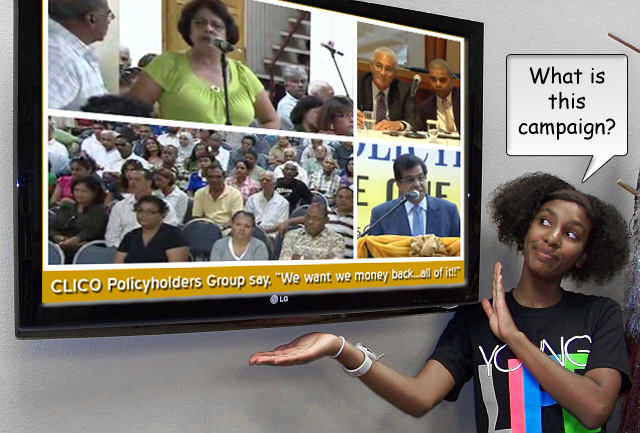
The Clico Policyholders’ Group (CPG) – which is the most visible one with Peter Permell, Manny Lawrence and Norris Gomez etc.
The Clico Policyholders’ Protection Association (CPPA), which is the one with Harold Sookhan and Ramesh Lawrence Maharaj.
South Action Group – with Solomon Hem Lee
Denbow Group – a small number of Clico investors who are being represented by Dr. Claude Denbow SC.
Some of the positions being taken by the various groups are indicative of the degree of desperation of the parties, hence the title of this article. The general view emerging from these groups seems to be that the CL Financial group is basically healthy and profitable, so there should be no issue about returning their investment.
I do not know what those views are based on and it is impractical to continue basing our discussions on the series of rumours and draft reports and suchlike. We need good quality information to make a quality decision and that is not negotiable. We need to insist on that as a minimum.
After the first round of organizing and attorneys’ letters, followed by the Prime Minister’s important address on 1st October, we are now into what appears to be an even stranger place.
Two of the stranger proposals emerging from the CPG’s Port-of-Spain meeting on 24th October were –
Prem Beharry of the CPG was reported in the Trinidad Guardian to have said – “…Ryan ALM are saying they would take US$600 million and would convert it to the best debt instrument in the world which is US Treasury Bills,” Beharry said. “The Ryan ALM group is saying, within three months if they are engaged, they would be able to sell those bonds and get in cash of US$1.8 billion which is equal to the debt of TT$10.5 billion—that money would be used to pay all the policyholders…” That is literally too good to be true. It is the same approach that created this mess in the first place – both at the CL Financial group and Hindu Credit Union. It seemed to me that the CPG was recommending that the government put $600M USD of our taxpayers’ money into this scheme. Yes, I said scheme. Maybe if it was really so good they should have just accepted the discounted rates being offered in the budget and invested those funds with Ryan ALM. After one time is really two times, yes. I recently read that one Prem Beharry was appointed to the National Gas Company Board.
Another proposal, this one reportedly stated by Peter Permell, the CPG’s most prominent spokesperson was for the state to pay 40% immediately with the balance being payable in 5 to 7 years. The persons waiting for delayed payments would earn interest of 4-4.5% on those unpaid balances and also be entitled to a 51% share of any uplift in the value of sold assets. No, there was no proposal for those CPG members to share in any losses if assets had declined in value.
It may all just be a series of negotiating positions, but it seems pretty clear that no one from these various investors’ groups intends to take a discount or ‘haircut’ on the monies owed to them. The unstated assumption is that if someone has to stand the bounce or take a haircut, that someone must be the taxpayer. That could never be the correct position. So, we need the facts.
The most startling development is the Central Bank’s full page adverts on Thursday 28th October, repudiating the claims that it had offered any guarantees in this situation. The reaction was immediate, with the CPPA publishing large adverts in opposition the next day and a new anti-bailout group emerging for the first time – at last! The CPG’s response was a nadir in their campaign, with the Trinidad Guardian reporting that – “…Permell went on to say that they do not care where the Central Bank gets the money from once they guarantee the policyholders’ contracts…” – I could scarcely believe what was on the page before me. Even the most militant Trade Unionists use more reasonable language.
Which brings us right to the meat of the matter, the order of things. What is the reason that the investors’ groups are now at the front of the line for assistance from this government? I could be wrong, but it is easy to get that impression when one hears of Cabinet discussing the matter twice in one week, certain groups giving threatening timetables and so on. I do not know if our Cabinet – PNM, UNC or PP – has ever given such a total priority to any matter in the past.
There are other claims on the limited monies available to the State. All of those claims existed before these investors groups. All.
Many people have poor water supply. Outstanding payments to contractors and suppliers are in excess of $7.0Bn, according to Central Bank estimates. Insufficient money for OPVs – the estimated cost of $3.0Bn is too much for the country to bear, so national security is falling behind. More guns and drugs entering our homeland. Public Servants claims are about $3Bn and that is also a strain on the Treasury. Not enough police cars. Sad situation in the public hospitals.
The CPG issued a 2 page advert in the Guardian on Thursday 4th November and it deserves careful reading. It was good to see their call for the publication of the correct financial information before making a decision. They set out their proposals for the relief of CPG members – those are the latter of the two above, with the added condition that they be given two seats on the boards of CL Financial and Clico.
The CPG claims that its proposals place no additional burden on the taxpayers, which is a good thing, if that is truly so. The CPG’s proposals are silent as to how the monies already spent are to be recovered.
The real test will be if the accounts and asset valuations reveal the group to be insolvent. Will the various investors’ groups accept that or are we in for a long, bitter fight?
SIDEBAR: The Commission of Enquiry
The Attorney General recently announced that he had withdrawn Sir Gavin Lightman QC as the sole Commissioner, due to an apparent conflict of interest. Lightman had appeared for Clico in a 1991 court case and the PNM did well to have stopped this before it went too far.
Two important further points, though –
Firstly, this is the second such occasion. In the first case, the Commission of Enquiry into 1990 was announced with retired Appeal Court Judge Mustapha Ibrahim as its chair, until he pointed out that he too had a conflict of interest. There needs to be some more care taken on this count.
Secondly, the terms of reference need to be qualified, since the AG was reported to have said that “…The COI, he said, covers CL Financial, Colonial Life Insurance Company (Clico), Clico Investment Bank, British American Insurance Company and the HCU…” Having been frustrated in my efforts for the past fortnight to get confirmation of the Terms of Reference from the AG’s Ministry, I am forced to rely on press reports. Question being, why is CMMB being omitted?
Last week I wrote about the Code of Silence observed by our ruling class. I gave examples to support my idea, but there was not enough space to mention everyone.
The Bankers Association of Trinidad & Tobago (BATT) and the Association of Trinidad & Tobago Insurance Companies (ATTIC) are also part of the situation.
We have a long history of our rulers making huge, stupid, destructive decisions without any commitment to transparency or accountability. That lack of transparency is what allows corrupt to flourish. We can never eliminate corruption, but if we are serious about reducing it, we need to proceed differently.
Maybe, just maybe, this is the kind of colossal event which could force some of us to drastically change our ways, despite the positions we now assume. This is a moment of national peril and the continued observance of the Code of Silence is going to cost our country plenty money.
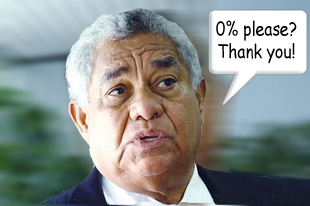
As it is, we already have been bound to a rotten bailout of the wealthiest individual in the Caribbean by our Treasury at ZERO interest. Anybody looking to set up a small business has to face the bank and pay interest. None of that for Lawrence Duprey and the CL Financial chiefs. They have been able to enrich themselves and when the entire thing went wrong, they were able to negotiate a handsome handshake for themselves and then leave the mess for our government to clean-up.
That is the plain meaning of the bailout. Is not policyholders we bailing-out, is the richest, smartest characters in the country. The bailout script is unfolding so well that almost the entire discussion is now about the fairness/unfairness of the government’s position with respect to retired policyholders etc.
Real Anansi antics.
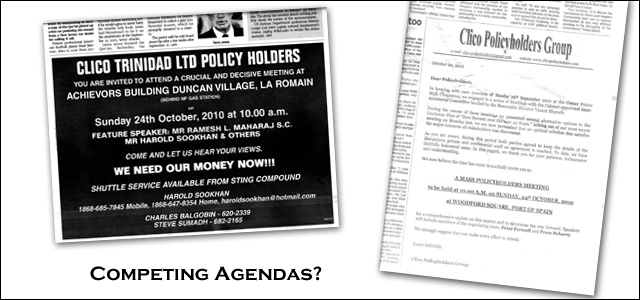
The CLICO Policyholders Group (CPG) There was an EFPA group and a CLICO Policyholders group formed just after the budget on 8th September, but they soon merged under the latter name. I am now seeing what appears to be a substantial split with 2 competing meetings being organised for 10am today – one in Port-of-Spain and the other in San Fernando.
The CPG group has been very successful at getting their views known and making the media circuit, with the eventual meetings with the advisory group set up by the PM.
The main concern being advanced by the CPG is for the recovery of the funds deposited with CLICO and there has been no reply whatsoever to the point that, despite its labelling, the EFPA was largely sold and understood as a deposit. The accounting rule of thumb as to ‘substance over form‘ in interpretation is an irrefutable part of the debate on this, but CPG have been silent on this point.
Almost all the many people with whom I have discussed this issue, have been very plain in their language – ‘I had my money deposit with CLICO‘ and so on. But the word Policyholder is more likely to attract sympathy, so the games continue.
We already spent $7.3Bn in cash since the bailout was announced. Please note that nobody is even talking about how the State is going to recover that loan. The only talk is about how are they, the depositors, going to recover their monies.
There is a real principle of financial equity being shredded to pieces in the conduct of this bailout and it was disappointing that Mr. Dookeran, as an Educator in the field, did not take the opportunity to expand on this.
The intent is plainly to deprive the Treasury of its limited funds so that the assets of 15,000 people can be preserved.
So, What about those negotiations?
Sen. Vasant Bharath
When the Prime Minister spoke on 1st October, she created an advisory group (headed by Minister of Food Production, Vasant Bharath) to meet with the policyholders to seek other options.
The Prime Minister was to meet with concerned persons and activists on Wednesday 7th October in Chaguanas, but that meeting was cancelled at short notice, with no alternative dates given.
What we are left with is lengthy, secret meetings to discuss the review of the bailout terms, with no concrete information emerging. That secrecy is totally unsatisfactory. It smacks of secret deal-making and does nothing to inspire the confidence which is supposedly the very purpose of this exercise.
The last regime, with all of their noble intentions and devout Ministers, lost their way in a morass of muddled purposes, secret deals, mixed-up with misleading and false public statements from the highest office in the land. We all know how that ended. The question is whether we have learned anything from that bitter experience. The Peoples’ Partnership were the main beneficiaries of those PNM errors, have they learned from that?
Our money is being spent on this massive exercise and it is not good enough to emerge from these closed meetings with agreed phrases like ‘constructive or meaningful’. This emerging pattern speaks of disrespect for the acumen of our people.
To re-state my equation:
Expenditure of Public Money – Accountability and Transparency = CORRUPTION
Imagine these bold-faced people declaring that when they are done and settled, the terms will be announced to us who paying for the whole thing. The first sign of a bad marriage is when the husband is the last to know – some say, the wife. But the main point is that the public cannot be the last to know.
The simple and painful fact is that public confidence in our leaders is at an all-time low. The time-honoured notion that a leader is someone wiser, more mature, less reckless and of overall higher ideals has been tested to destruction by events. In this particular case, it is easy to understand the charged atmosphere, hence the need for extra ventilation and transparency.
I was recently emailed by a well-meaning group asking that I start setting out some ideas of how CLICO might be rescued and I had to remind them that without basic information, all we can do is argue emptily with each other. All to the amusement of the masterminds of this, the greatest economic crime in our nation’s history.
I was even ‘phoned, while writing this, by an acquaintance who is a leading member of the CPG to join him and an un-named UK guest in a TV studio on Monday morning to discuss all this. Yes, I dismissed the request – too much secret-thing for my taste – and challenged the caller to name the person, supposedly a top UK expert.
What would be ‘constructive and meaningful’ would be to publish these long-outstanding reports so that we in the public can inform ourselves on the vital issues –
The original Duprey letter of 13th January 2009.
The audited accounts of the CL Financial group for the years ending 31st December 2008 and 2009 – Have PwC completed that? When are they to be published?
The Mottley Report – There was a team of three advisers – Wendell Mottley, Colin Soo Ping Chow and Steve Bideshi – appointed to examine the CL Financial group and we need to know what were the findings of this group.
Given that we are being asked to bailout and clean-up Mr. Duprey’s crisis, I feel we need to be told the names and details of those who benefitted from the $7.3Bn paid out so far, as well as those details for the borrowers of the $1.0Bn of ‘non-performing loans’ in CIB’s portfolio.
Finally, we also need to have the position of the CLICO Policyholders’ Group published. What exactly are they claiming?
We have seen reports in the press about the very long Cabinet meeting on Thursday 21st at which the CLICO issue was said to be part of that agenda.
It would be totally unacceptable for a deal to be sealed without properly informing us, the taxpaying public, as to the true background.
The People’s Partnership has already distinguished itself, positively, by announcing Commissions of Enquiry into the attempted coup in 1990 and the Financial collapse (CL Financial and HCU). This is no time to get diverted into back-room deals.
I am working for betterment and from you, our elected rulers, I expect better.
Code of Silence was an article in two parts – the first dealing with the agents and effects of that Code and the second dealing with the unfolding case of AIC.
As usual, I sent the article to my main blogging-collaborator Barbados Free Press (BFP) who split it apart into those halves. Maybe they felt that the bond default by AIC Barbados in the second half deserved a separate focus for their readers – who knows?
Amidst the raging debate on the rights of the disappointed depositors versus those of the anxious taxpayer, I am continuing to examine some more of the fundamental issues. Yes, I accept that there are depositors amongst the taxpayers, but those interests are not in alignment, hence the discussion.
By making a legislative proposal to frustrate the CLICO Policyholders Group (CPG) litigation, the government seemed to have conceded the merit of the protestors’ case. Those proposals have now been withdrawn and on Friday 1st October, the Prime Minister gave an extensive reply to the CPG. The strategic decision seems to have been to retreat from the narrow corridors of legality and strive for the broad perspectives of the entire nation. The apparent decision is to favour an act of persuasion over one of sheer power. Given our norms of governance in these parts, that is no small shift and it is a welcome sign, quite apart from my agreeing with the stance taken.
Most importantly, the Prime Minister announced a Commission of Enquiry into the collapse of both CL Financial and Hindu Credit Union (HCU).
Once again, I am going to refrain from discussing the legal issues, despite the tempting developments in this aspect of the matter. I am going to keep deepening this discourse so that we can have a better quality of discussion
What was the EFPA?
Firstly, it is necessary to spend a little time on the true nature of the Executive Flexible Premium Annuity (EFPA), since that product is what the majority of this dispute is about. The product was approved for marketing by the Supervisor of Insurance in 1990.
An annuity is an investment product for an individual, to save for a specified future expense by means of periodic payments. CLICO had an approval for a Flexible Premium Annuities, which was attractive to those people who had fluctuating incomes, but soon led to the sale of Single Premium Annuities. Those are investments in which the investor pays a single premium and receives the benefits after CLICO had held the funds for a short term.
So the single premium can be viewed as a deposit, which is what many of the agents called it. While the annuity, traditionally a long-term investment product, then assumed a norm in which most EFPAs were held for 5 years or less.
In saying so, it is interesting to consider the question of just how an organisation can purchase an annuity, which is an investment product for an individual. The fact that so many organisations did so, does damage to the notion that this EFPA was sold in conformity with its true nature.
So, in summary we have an approved annuity, which is mainly sold as a single-premium, short-term, high-interest investment product to anyone who wants one, including Credit Unions, private companies – several CLICO agents tried, repeatedly, to get deposits from our firm – and State-owned corporations. At some point that annuity morphed, by this series of changes, which seem, to me at least, to have fundamentally altered the character of the approved instrument
All of which returns to the basic accounting principle that when one is trying to interpret a situation such as this, the correct procedure is to be guided by the substance rather than the form of the transaction. That is the background to my assertion that the correct interpretation of the EFPA is as a deposit.
When you consider the very high interest rates offered and the unique way that CLICO altered the EFPA, one has to wonder how the regulator viewed these activities. But more on the regulators later.
What did CLICO become?
Even beyond the changes which the EFPA underwent in the hands of CLICO, the reverse was also to take place. That happened because CLICO changed the EFPA to suit the strategy of its parent company, CL Financial, but the parent group (and ultimately CLICO) in the end were irreversibly changed and then destroyed by the EFPA’s success. Let me explain –
In our system, there are 3 species of financial institution –
Banks and other Financial Institutions (approved as Deposit-taking Institutions by the Deposit Insurance Corporation);
Insurance Companies and
Credit Unions.
CLICO’s liabilities, as stated by the Finance Minister, were $6Bn to traditional insurance policyholders and $12Bn to depositors. The question being, given that two-thirds of their liabilities are non-insurance, how could it be legitimate to consider CLICO an insurance company? More to the point and looking forward, where does a company like CLICO fit into our regulatory framework? That is an important aspect for us to consider for the future of our financial services market.
What were the Regulators doing?
That is the burning question at this time and a large part of the blame for the CL Financial collapse must lay with the regulators. In this case it seems that the Governor of the Central Bank and Inspector of Financial Institutions both have serious questions to answer. The situation is really too much to even imagine, but a few examples –
The Governor repeatedly stated his doubts on the stability of the CL Financial group, yet admitted later, in a written statement – see http://www.central-bank.org.tt/news/releases/2009/mr090204.pdf – that he had deposited money at CLICO Investment Bank (CIB).
The Governor stating his strong disapproval the conduct of the CL Financial chiefs – The Governor spoke on 23rd April 2009 – “If you ask me whether CL Financial did everything that was honourable and beyond reproach, the answer is no! The answer is no!” see – http://guardian.co.tt/business/business/2009/04/24/cl-financial-bailout-cost-5-billion-over-two-years . Yet he has not invoked ‘fit and proper’ regulations to disqualify those offending people from holding office in any financial institution, which is within his ambit.
Carl Hiralal, Inspector of Financial Institutions, swears an affidavit in the CIB winding-up action in which, at para 23, he confirms that CIB had filed no Corporation Tax Returns in 2007, 2008 or 2009. The plain meaning of which is that they did not pay their taxes, yet were able to keep their banking licence and when it all went wrong, were also able to get a bailout.
The Statutory Fund – We have heard many statements since this collapse that the CLICO Statutory Fund was not paid-up in full and yet they too were able to retain their licences.
When, if ever, did the CLICO sales force stop selling? Answer is they never did, and have continued to remain open for business despite their self-confessed insolvency. Is it true that CIB was seeking deposits up to the last?
Mismatch of funding tenor and risk – It was clear that CL Financial, in addition to morphing an approved product beyond recognition, then ballooning those receipts up to over-balance the entire company, operated with a fundamental ill at the heart of the thing. Having coaxed many investors to place their eggs in one basket, the very company they had trusted with their savings turned around and broke yet another fundamental financing rule. CL Financial used short-term/high-interest funds to finance long-term investments, which was evident from its accounts. Did the regulators have a risk ranking or some other tool to allow closer monitoring of these activities?
The Nature of the thing – Finally, we have the issue raised above – i.e. the EFPA that became something else and the insurance company that also became something else. Like some bizarre horror or science fiction movie, but is our country. My question being that there must be some point at which an approved product stops resembling the original one, to the extent that the regulator needs to have the clarity and integrity to stop those sales. In consequence of the prior failure, CLICO stop resembling CLICO and also became something else.
What is to become of these self-confessed, slack regulators? The state has already saddled a considerable burden in assisting these depositors, but are we to have a continuation of this disastrous performance?
I ask the question because the CLICO pattern is not over, not at all. There are still other doubtful financial institutions offering incredible rates of interest, with special incentives for the vulnerable. Yes, it is still going on – see the sidebar. Do we have the will to do differently? Can we do better?
As a matter of urgency, we need to have published the full details of those who gained from the $7.3Bn already spent in this scandalous bailout. We need names, addresses, amounts of capital and interest and date of payments as a minimum. Those monies are public monies and if it was correct to insist on disclosure in the shocking case of the ‘Secret Scholarship Scandal‘ last year, it is equally right in this disgusting case.
‘What is good for the Goose is Good for the Gander’.
Expenditure of Public Money – Accountability and Transparency = CORRUPTION
We also need to have published the full details of the $1.0Bn of ‘non-performing’ loans on CIB’s books.
The Impossible Claim – denied?
The size of the outstanding claims is a total of about $18Bn, which is colossal when compared to the largest pool of money available to the state – i.e. the Heritage and Stabilisation Fund, which itself holds about $18Bn. The state cannot bankrupt itself
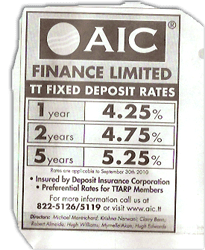
In the last fortnight or so, the same company has been advertising surprisingly high rates of interest in daily newspaper adverts which also offer ‘Preferential rates to Trinidad & Tobago Association of Responsible Persons (TTARP) members’. Those interest rates range from three to four times the rates being offered by the commercial banks. If CL Financial could not sustain this strategy, how can AIC continue to offer these rates in today’s market?
That is the question.
SIDEBAR: Two points in the PM’s speech need emphasizing
The First, is in the positive, democratic interpretation of the revised bailout being offered to the estimated 250,000 people affected as policyholders and depositors. All 225,000 policyholders – those with life, pension and health insurance policies – will have their claims honoured by the State. 10,000 of the 25,000 depositors are owed amounts less than $75,000 and those claims can be settled now. Which leaves 15,000 depositors to choose between litigation or accepting the present offer of a discount on their monies.
In summary, 235,000 of the 250,000 claimants are being fully settled and that is 94%.
The Second, is in relation to the erroneous portrayal of the impact of discounting on the claimants who accept the government’s offer. There seems to be an error in the calculations upon which the PM relied in making her statement –
“…We are going to give some help. These installment instruments I am saying can be cashed in early at financial institutions. Yes, they will be cashed in at a discount. But I have been informed by the hon. Minister of Finance, Mr. Winston Dookeran, that based on discussions with local financial institutions, that if the first five years of installment notes were cashed in, the discount could be as high as or as low as—when we look at it the glass is half-full or half-empty, depending on how you look at it—5 to 10 per cent. What this means is for every dollar, you could get between 90 to 95 cents per dollars if you decide to discount. I am so advised…”
Apart from my not understanding the selection of the first five years of investment notes as a point for discussion, the calculations are misleading, since the actual discount at those rates (with which I concur) will have a far greater impact – see http://wp.me/pBrZN-qh for a detailed explanation.
We are witness to a second wave of assault on our Treasury. Let us be sure, those of us who are not in line to benefit directly from the bailout, that the picture is complicated and it contains perils for the entire country.
The original bailout was an unjustifiable and colossal facility granted to the CL Financial Chiefs and the shareholders of that failed, privately-owned, group. I say facility because the taxpayers’ money in our Treasury was pledged to repay the debts of the CL Financial group. The deal was hatched in secret and fact is, upon reflection, its terms were never formally debated in our Parliament. What was debated was a series of amendments to the laws governing distressed Banks and Insurance companies. A lot was said about the issue and many notable contributions were made to the debate in Parliament, but the agenda item for debate was not the terms of the bailout.
The 30th January 2009 Memorandum of Understanding had already been signed and was on its way to implementation when our Parliament debated and agreed to amend the legislation. The nation had witnessed a ‘Quiet Coup’ to draw from the title of Professor Simon Johnson’s seminal article (in the May 2009 edition of The Atlantic) on this process in the USA – see http://www.theatlantic.com/magazine/archive/2009/05/the-quiet-coup/7364/.
I have no intention of arguing the legal merits of the case being advanced by the CLICO Policyholders’ Group (CPG), leave that to the learned. I just note that we are yet to hear the voice of the traditional policyholder in the declarations of this Policyholders’ Group.
The bare facts need to be laid out for consideration, it would be far better to conduct this discussion in a more informed manner, with some of the missing details requested at the close of last week’s column. But is best to start from where we are. So, the bare facts –
CIB’s insolvency is estimated, according to the winding-up petition being heard in the High Court, to be of the order of $4.7Bn
According to the Finance Minister in his budget speech, the combined insolvency of British American and CLICO is of the order of $7.2Bn. It is not possible to tell from that speech if those estimated figures included the monies already drawn from the Treasury in pursuance of this bailout.
The amount said to be spent on the bailout, up to May 2010, was $7.3Bn.
The amount being owed to the 225,000 policyholders is estimated to be $6Bn. That covers traditional insurance products such as pensions, health plans and life insurance – it works out at an average of $26,666 owed to each person.
The amount being owed to the 25,000 depositors is estimated to be $12Bn, which works out at an average of $480,000 owed to each person. But there is another way to look at that information and that is in the sidebar.
The Governor of the Central Bank, the very official the CPG is seeking to have affirmed as the proper decision-maker in this matter, in April last year made public statements that all the assets of the group are encumbered.
In the absence of the accounts and operating with the available information, it seems reasonable to believe that the CL Financial group is insolvent and further that our Treasury has swallowed an impossible series of obligations. Furthermore, there is no obligation on the borrowers – the CL Financial shareholders – to pay one cent of interest. Even worse, Para ‘A’ of the 12th June 2009 CL Financial Shareholders’ Agreement actually obliges the State to protect the interest of the shareholders – see http://wp.me/pBrZN-bP.
Of course this leads to yet another ‘$57,000 question’ – ‘If the CL Financial group is insolvent, then how are we paying for all this?’ Yes, that is the big one.
It seems that the CPG is intent on advancing its sectoral interest and while we know that is how things work, it is even more important to be watchful of our nation’s wealth. We are actually being asked to put out an additional $12Bn to rescue the 15,000 CPG members, with no reasonable hope of recovering those monies.
For the record, no one from the previous government or the Central Bank, for that matter, has ever even attempted to justify the rotten terms of this bailout. Not even an attempt to explain the interest-free, unlimited, unsecured loan to that lucky group of 325 CL Financial shareholders.
Even now, with the new terms being hotly debated, please note carefully that no new terms are being announced for the ultimate borrowers, the CL Financial shareholders.
Selwyn Ryan
Professor Selwyn Ryan of UWI, who was, last year, a strong critic of the bailout process and its glaring conflicts of interest, now appears to have become a leading party in the CPG, calling for that suspect deal to be honoured. A deep contradiction in terms, I tell you. How do you honour a rotten deal? Politics does make strange bedfellows and yes, history is truly rich in irony.
Emmanuel "Manny" Lawrence
Even stranger still, is the presence in the CPG of Emmanuel ‘Manny’ Lawrence, former Sales Director of CLICO and now head of one of its sales agencies. In the three years before the CL Financial group collapsed, all the CLICO agents I knew made intense efforts to get deposits from me. Not once did these agents even attempt to sell me a life insurance plan or health plan. These agents consciously and deliberately coaxed many of those people who are now protesting to place all or most their investments in this one instrument. That is the kind of irresponsible behaviour which led many people to be in breach of the basic investment guideline against over-concentration of risk – to avoid putting all ones eggs in one basket. That is the kind of biased and unsound advice which no proper professional would render to a client. It is a decisive factor in this entire scenario.
The ingredients included the requirement for cash by an expanding industrial/commercial group, the resulting lucrative commissions being paid, the trust of the investors and the poor level of general financial literacy. Those factors all contributed to this appalling picture. To be fair, despite the titles adopted by some of these salesmen, they were not true Investment Advisers, since they were selling CLICO products.
Also, as to the discussion about the sophistication of the investors, the fact is that even an organisation as large as the National Gas Company, could be seen to have placed undue reliance on the high-interest/high-risk products being offered by the CL Financial group. At one point, according to its 4th February 2009 Press Release, over 45% of NGC’s funds were in CL Financial – see http://wp.me/pBrZN-ec .
SIDEBAR: The depositors re-examined
I just made the point that the 225,000 ‘traditional, long term policyholders’ are owed an average of $26,666 per policyholder.
Also, that the 25,000 depositors are owed an average of $480,000 per depositor. It is interesting that if you subtract the maximum of $75,000 which would be due to each of the 10,000 ‘small-scale’ depositors, the total owed to the remaining 15,000 depositors is reduced to $11,250,000,000. That adjustment carries the average amount due to the real protestors in this CPG to no less than $750,000 per depositor. Yes, that is twenty-eight times the amount due to the traditional policyholders.
Ironically enough, the voice of the traditional policyholders, who outnumber the depositors nine-to-one, is virtually silent in all this. I am yet to hear anything from the CPG on behalf of those traditional policyholders. But then again, it is clear that by far the larger amount is owed to the depositors and further, that they appear, on average at least, to be owed about 18 times more than the typical policyholder. Yes, as Growling Tiger did sing “Yuh know very well that Money is King’’.
This was the inaugural budget for both the newly-elected People’s Partnership and its Finance Minister, Winston Dookeran.
The burning question for me in preparing these comments was the big one – “Is the Honeymoon over?”
In my view, the honeymoon for this new government will last about 6 months, given the sheer scale of the mess they have inherited.
There were real expectations aroused in the recent election campaign and the reduced revenues available to the State would have made the budget into a balancing-act, particularly when one considers the repeated promises of ‘No New Taxes’.
The main items on the property and construction aspects were –
PROPERTY TAX
The Property Tax was ‘Axed’ as promised – “…The Property Tax will be replaced by the old Lands and Building Taxes regime at the old rates and old values. There will be a waiver of lands and buildings tax for the year 2010…”There has been a misleading rebuttal on this from the Opposition Leader, Dr. Keith Rowley, in that the 2011 Estimates of Revenue tell us that the Land & Building Taxes are expected to increase from $71.4M to $173.8M. Rowley’s statement would lead one to think that the property tax take would be of the order of $300M, due to the omission of the municipalities. In fact, that is not the case, since the revenue of the five municipalities (POS, San Fernando, Arima, Chaguanas and Point Fortin) are found in the Estimates of Revenue for Statutory Boards and Similar Bodies etc. Due to the fact that one of the effects of the controversial property tax was to relieve these municipalities of their powers to tax property, the 2011 estimates of revenue need to be properly interpreted. The municipalities are estimated to raise revenue of nil in 2011, since all their revenue – as well as that of the regional corporations – is collected by the Counties and transmitted to the Central Government.The true picture is that $142.52M was the estimate of revenue from property taxes in 2009 – that is the combined figure for House Rates, paid in municipalities, and Land & Building taxes paid elsewhere. We are therefore anticipating an increase in revenue from this source of the order of 18%.
No rationale was given for the waiver of property taxes for 2010, which was an astonishing decision, given the background against which the budget was drawn up.
Before I leave the property tax topic, it is interesting to consider that rental income is also subject to income tax. Not many people who own rental property actually pay income tax on that rental income – if you don’t believe me, just ask a few friends or relatives who own rental property. This seems to me to be an area in which the Finance Minister can easily collect the data and increase the State’s revenue by staying within the ‘No New Taxes’ promise and implementing the laws which are already on the books. But more on that in a later article.
HOUSING
The Minister of Finance made strong statements in support of home ownership, he also outlined what appears to be a merger between several State-controlled mortgage companies. No target numbers of new homes to be built were given. The Housing and Environment Minister, Dr. Roodal Moonilal, recently announced that the Housing Development Corporation’s (HDC) new output target is 6,000 new homes in 2011. The Housing and Environment Ministry have zero allocation of capital funding according to the 2011 Estimates of Expenditure. There is an allocation of $845M to the Hosuing and Settlements programme shown in the Public Sector Investment Program (PSIP). Those estimates should cross-reference with each other and the fact that they do not is cause for concern, to say the least. This is the pattern of State spending on new homes, derived from the capital allocations only –
Year
Housing Ministry Capital Allocation ($M)
2008
$718.70
2009
$1,342.40
2010
$860.40
2011
$845.00
There was also the revival of an annual tax credit of $18,000 per household for first-time owners for the first five years. That measure is expected to cost $20M, which implies that just over 1,100 households will benefit from this provision. To quote – “…This measure will generate significant investment in the private sector housing industry….” Given the quantity of unsold, privately-built homes and the volume of HDC units soon to be released onto the market, it seems quite unrealistic to expect that this measure could yield ‘significant investment‘.
What is of greater concern to me is the question of whether we are at the limits of possibility as to home-ownership levels. 76% of our households now own their homes, the comparative figure for the USA is 69% and for the UK it is 68%. How realisitic is it to keep pushing for increasing home-ownership?
The HDC’s low-cost ‘Accelerated Housing Program’ stalled, with over 10,000 empty homes as proof, due to a shortage of applicants who could qualify for a mortgage.
The Minister of Finance spoke of the neglect with which our organisational and institutional infrastructure had been treated and I could not agree more. On this count, there needs to be proper consideration given to the resucitation of the Rent Control Boards. Also, the HDC needs to start giving some of those empty homes to people who just want to rent.
Special Purpose Entities (SPEs) – What is their future in this new dispensation
Mr. Speaker, no coherent, co-ordinated planning or strategy for state enterprises exists. As a result we have begun to rationalize the state enterprises, including the special purpose companies, which will incorporate a new accountability system that goes beyond the presently operating company ordinances. It is these loopholes in public accountability that resulted in the UDeCOTT scandal. This must never again happen in Trinidad and Tobago.
This issue, as always in our country, is one of implementation. The provisions of that guide are not being followed and the wrongdoers are not being called to order.
The issue for us is to prevent the recurrence of that pattern of mismanagement and disorder in public affairs. That can only happen if we enforce the present guidelines and systems.
In the next column, I will discuss the attempt to map out a new philosophy in this budget and the CL Financial/HCU bailout.
I am starting to look at the CLICO Investment Bank (CIB) and its operations, as revealed by the ongoing bailout.
CIB is a very interesting part of the saga, because even prior to the collapse of the CL Financial group there was a widely-held view that CLICO and CIB were parts of the group which were responsible for raising finance for their ambitious plans. Even though the interest rates offered by CLICO and CIB were incredibly high – about twice the average offered by others – it would have been much more expensive for the CLF group to borrow those funds via loans. The view was that the CLF group had a legitimate method of harvesting funds on terms advantageous to them.
We were also being fed some lyrics that the CL Financial group in general and CIB in particular were all healthy/strong companies with good assets, fallen victim of the global financial crisis. Despite the natural doubts on that one, I had some trust in those people who were speaking to me. The mystery remained – Was CL Financial and CIB an audacious, well-run operation which had become a victim of a declining market or, even worse, a sinister conspiracy? Or was it a much less glamorous story of the Caribbean’s largest-ever business conglomerate actually being some kind of Naipaullian ‘Thing without a name‘?
There is a way that the entire reading is surreal, since the very person who was supposed to safeguard us from extensive wrongdoing and risk-taking, now has to swear to the Court that the institution has failed so badly it needs to be wound-up.
The main points were –
The initial meeting – At para 5 he states “…On January 15th 2009 as part of its normal regulatory process, the Central Bank held a meeting with officials from the Petitioner…” (CIB). Now that is literally an unbelievable sentence. Hiralal is swearing that this was a routine meeting. We are being asked to forget that the then Minister of Finance told the Parliament on 4th February 2009 that
“…I would like to read into the record of Hansard, a letter from Clico Investment Bank addressed to the Central Bank. That letter is dated January 13, 2009. It is on the letterhead of CL Financial, addressed to Mr. Ewart Williams, the Governor and signed by Lawrence A. Duprey, Group Executive Chairman…”
see page 628 of http://www.ttparliament.org/hansards/hh20090204.pdf. I am forming the impression that Hiralal does not want to have the ‘bailout letter’ cited in this Court matter at all, for whatever reason. You see, if it were cited, the Central Bank would have been forced to file a true copy, which anyone would have been able to access. Neither of my Freedom of Information applications for that ‘bailout letter’ – to Nunez-Tesheira or Dookeran – have been fruitful. So we have this incredible statement for starters. We are being asked to believe that Lawrence Duprey’s letter requesting urgent, massive financial assistance and the meeting two days later were unconnected.
Reasons for winding-up – At paras 9 c. and 10 g. he states “…the Petitioner (CIB) was not maintaining high standards of financial probity and sound business practices…” Stunning, and in a sworn affidavit from the chief regulator. This is the high official responsible for maintaining good order of the players in the financial system. Those Directors, Auditors and Officers of CIB, the ones who presided over this situation, do you still consider them to be ‘fit and proper’, Mr. Hiralal? Yes or no? If Yes’, how come? If ‘No’, what are you going to do about it? And when? But there is more.
Board of Inland Revenue – At para 23 he states “…With respect to the Creditors of the Petitioner, the Petitioner has met the statutory obligations for the Board of Inland Revenue (except for Corporation Tax Returns for 2007, 2008 and 2009 which are being prepared and remain outstanding)…” I spoke with a very experienced accountant and a corporate attorney before writing this and the common view is that the meaning of that statement is that the Corporation Tax owed by CIB is unpaid for 2007-2009. If they owe those taxes we dealing with people who do not pay their taxes, yet expect the taxpayer to assist them in times of need. Even if the taxes are paid-up in full, there is still the elementary and inescapable governance question of how and why CIB failed to file a tax return? Did PwC report on this in either their audit or management letter? Was Hiralal aware of CIB’s failure to file before he was forced by the procedural requirements of the winding-up petition to declare his hand? Did the Board of Directors know? Have penalties been applied?
Statement of Affairs – This is at para 12 and appears to contradict the prior statement in that it does not show any amount for either ‘Taxation Recoverable’ or ‘Taxation Payable’. There needs to be an explanation on this.
Auditors – CIB’s auditors were PricewaterhouseCoopers (PwC), who were featured last week.
Lucie-Smith’s view – William Lucie-Smith, former Managing Partner of PwC, responding to bloggers on his Express article ‘CL Financial: A new strategy required’ – see http://www.trinidadexpress.com/commentaries/CL_Financial_A_new_strategy_required_.html – replied on Friday 20th August, like this “…Indeed I dont (sic) know why anyone assumes the books were wer (sic) wrong at any time and did not reflect accurately what was happening…” Just my first read of those affidavits made me question the reliability of the accounts.
Next, I will be going into some more detail on how CIB actually worked, based on sworn affidavits.
The Concentric Circles
For the purposes of this article, CIB is at the centre of the page, with its Directors and Officers being in charge of its strategy and management. They bear primary responsibility for the company’s affairs on behalf of the shareholders and other stakeholders.
The second ring is the auditors, usually a leading firm of Chartered Accountants, who examine the accounts prepared by the company to report whether those accounts offer a true and correct picture of the company’s financial health. The auditors use international accounting standards as a benchmark for quality and comparability of figures, if there are material divergences from those standards, the auditor’s opinion can be qualified, which is when the divergences are specified.
The third, outer ring is the financial sector regulators, whose job is to ensure that the companies within the industries comply with the law and other guidelines created by the regulators. The regulators examine the audited accounts and other information from the companies in order to determine the extent to which the rules are being followed.
We, the saving and investing public, are outside of that series of concentric circles and once there are no alarm bells, we will place our savings with these approved financial institutions.
The reason for all that is to preserve the most fragile and vital ingredient of the capitalist system. Yes, I am speaking about trust, which is also an important aspect of the wider society.
The society relies on the people in these three concentric circles to act in a ‘fit and proper’ fashion in the execution of their duties, with proper penalties in place for improper or illegal behaviour. The idea being that there is a minimum standard of conduct and risk-taking which avoids nasty surprises in the course of normal savings and investment.
There are real questions as to what levels of risk-taking and innovation are healthy or desirable to maintain some balance between profit-levels and stability. That is a fascinating aspect of the financial industry to be expanded on.
The Regulator
The chief Regulator at the Central Bank, with responsibility for both Banks and Insurance companies, is the Inspector of Financial Institutions. That office is held by Carl Hiralal, who was appointed on 1st January 2007. Hiralal is a well-qualified, highly-experienced professional and that only makes the contents of his affidavits all the more disturbing.
I am bringing this analysis to a close by asking the question as to which individuals are ultimately responsible for this scandalous situation. The age-old questions persist – Are we mere creatures of circumstance? What influence can one individual have on transforming a situation? Do modern outlooks over-emphasise the power of the individual?
We need to close the circle to understand the role of the high-powered individuals in charge of this policy.
The Author of the Policy
Former HMB and UDeCOTT CEO, Calder Hart
Calder Hart, then CEO of Home Mortgage Bank and well-known to be a protégé of Andre Monteil’s, claimed to have authored our National Housing Policy – ‘Showing Trinidad & Tobago a new way home‘
In October 2002, Hart told me that in his office and he made a point of seeking my views of the new policy.
I questioned the originality, relevance and feasibility of the proposed policies and a frank discussion ensued. It seemed clear, from Hart’s reaction and subsequent behaviour, that he had indeed taken authorship of that misguided policy.
That policy can be viewed at here. Given their non-involvement in the later stages, it is interesting that the cover-page of the housing policy highlights UdeCOTT as a main state agency in its implementation.
The Minister of Housing
Former Min. of Housing, Dr. Keith Rowley, M.P.
The Minister of Housing with longest tenure through this period was Dr. Keith Rowley, M.P., currently leader of the Opposition PNM – he was in that office from November 2003 to November 2007 – see http://www.ttparliament.org/members.php?mid=26&pid=5&id=KRO01.
Earlier, Rowley said the NHA was restructured because it lacked accountability.
There are a lot of things that did not go right in the NHA and one of those things had to do with accountability…The HDC is not going to function like that. We are required by law to have the accounts ready in a certain period of time. The CEO will be held accountable and the Cabinet will hold the minister accountable and the Parliament will hold the Cabinet accountable. That is what the HDC means.
“…the HDC never published any accounts in the 5 years of its existence. It goes even further, since the NHA’s accounts for the period 2002 to 2004 have only recently been prepared.”
Meeting the targets The original target was for the HDC to construct 100,000 new homes in a decade, which figure was generated from the 1994 ‘PADCO reports’—The Review of Shelter and Land Development Policy Study (PADCO reports): The PADCO reports is a series generated by The Planning and Development Collaborative International, Inc. and Laughlin and Associates Limited (who were contracted by the Government of Trinidad and Tobago in 1993)—that study is available at the Ministry of Housing & Environment’s library. The annual target was reduced to 8,000. As noted in the previous article, the reduced targets should have yielded 60,000 new homes by now, but the HDC has built only 15,394 new homes.The HDC made a recent statement that the number of empty new homes was approximately 10,000. So just about 5,000 new homes have been built and distributed since the inception of this ‘accelerated housing programme’ in September 2002. Even if we omit 2002, that is an annual average of 667 new homes being built and distributed. Even with the most optimistic assumptions, one is looking at considerable challenges in achieving these demanding targets. At the current rate of performance it would take over 140 years to satisfy the original target. That is how far off-track this accelerated housing programme has gone. Deep into the long grass.
The Cost-based Pricing model
In previous articles in this series, I have been critical of the HDC’s cost-based approach to pricing its units. In terms of the central mission of the Ministry of Housing – i.e. creation and distribution of housing to the needy – that pricing model is inappropriate. That is because it does not identify either the housing subsidy allocated to successful applicants or the opportunity cost of the HDC’s policies. The value-based approach is the more appropriate model to satisfy those basic requirements. That is because it offers greater clarity to policymakers, since it is based on the market value of the completed homes, with the housing subsidy and the opportunity cost being the difference between the value and the actual HDC selling price. On 21st March 2008, this newspaper carried a report headlined “PM’s son in line for apartment” – see http://legacy.guardian.co.tt/archives/2008-03-21/news8.html – on allegations that Brian Manning, son of the then-PM was in line to receive one of the HDC apartments at Fidelis Heights in St. Augustine. Noel Garcia, the then-MD of the HDC, was reported to have said –
…the Government had taken a decision not to subsidise this particular development. It is being sold at market rates in HDC’s thrust to expand and attract an open market clientele.
Noel Garcia, former MD of HDC. Photo courtesy Trinidad Guardian
Given that the units were reportedly being sold for a maximum of $875,000 and that they were worth a minimum of $1.7M, it is clear that each new home there is sold with at least $800,000 in housing subsidy. The only way Garcia’s incredible statements could be correct is if one were using the misleading cost-based approach.
I entirely agree with his statement that the Fidelis Heights development “…is therefore not part of HDC’s provision of subsidised housing for low-income earners.” It is really subsidised housing for the middle-income groups, but that could never be right when the waiting list is bulging with needy people who cannot even get an HDC unit to rent.
Fidelis Heights was, even by its name, a monument to misleading and wrong-headed thinking. The HDC project with probably the highest level of housing subsidy per unit was built for the least needy on their waiting list. Only if the underlying philosophies and resulting models are appropriate, can we avoid a repetition of this blatant waste of public funds in the face of real, human need.
Given that the HDC is unable to satisfy the needs of the people it was intended to serve – the poorest citizens who cannot afford a proper home – it is scandalous that its scarce resources should have been diverted to Fidelis Heights, or the one at Federation Park in Port-of-Spain.
The selection of this pricing model is proof of misguided policy at the most elementary level. The basic concept of opportunity cost appears to have eluded the responsible officials and, what is more, that misguided policy appears to have been approved at the very highest level.
Wrong-headed thinking can only encourage corrupt behaviour.
Costs
What has the national housing programme cost this country? That is no rhetorical question, since this fact sits at the heart of the analysis. The Housing Development Corporation (HDC) is the State’s implementing agency for production of new housing, it was formed in 2005 by an Act of Parliament and replaced the National Housing Authority (NHA). The HDC’s funding comes from four sources –
Treasury allocations – Those are announced in the budget and can be established from the Estimates of Expenditure as Capital Allocations to the Ministry of Housing.
Sale of new homes – When the HDC sells a new home, that money is also available to them.
Bond Issues – The HDC has also raised money by occasional bond issues; those funds can be used to either build more homes or ‘pay down’ on more expensive loans. The bonds issued are government-guaranteed, so they are considered as virtually risk-free ‘sovereign debt’. Given that the government itself issues bonds at lower rates of interest, it begs the question as to why these SPE’s are allowed to borrow on these terms. That issue was raised by in the BG View of 20th August 2009 – see http://guardian.co.tt/business/business-guardian/2009/08/20/debt-depreciation-or-discipline.
Bank Financing – The HDC also borrows money from commercial banks or the IADB to fund their construction programme.
Try as I might, it has proven impossible to determine just how much the HDC has spent on building new homes in any given year. That is because there are no accounts at all which are available to the public.
The HDC Act, at section 18 and 19, mandates that the Board shall keep and properly audit accounts. Section 20 requires the Board to submit its annual report to the line Minister within 3 months of the end of the financial year. The line Minister is in turn obliged, by section 20 (2), to lay that report in Parliament within 3 months of receipt. See – http://mphe.gov.tt/home/images/stories/pdfs/tthdc%20act%2024%20of%202005.pdf.
The HDC has never laid either its annual report or audited accounts into Parliament for the public. The failure to publish accounts is one of the most serious warning-signs of companies in financial trouble.
That failure to publish HDC or NHA accounts over such a long period (since 2002 at least) spanning several administrations, is a serious indictment of the main participants – the politicians, the Board Directors and of course, the professionals involved in the entire huge operation.
I have been reliably informed that the HDC’s new management is attempting to rectify this situation and that must be a priority if we are to properly assess the performance of this vital social programme.
The overall picture is stark –
Gross under-performance in terms of the output of new homes, only about one-quarter of the reduced target has been achieved:
No accounts or annual reports, given the preceding point, that is not surprising:
An inequitable allocations policy, with lower priority given to those who cannot afford to buy.
Approximately 10,000 new homes remain empty and that is the one which tops them all. The ongoing adverse consequences include – vandalism, the greater rate of general deterioration afflicting empty homes, the high cost of security and of course, the continued pressure on those people on the waiting list ‘holding strain’.
Given the combined effect of all this, which is probably hidden to most of today’s readers, one can only wonder at the patience of our needy citizens.
The entire situation also raises potent questions about the purpose and performance of the SPEs.
SIDEBAR: The concept and importance of opportunity cost and housing subsidy
Let’s use a typical home at Fidelis Heights as an example.
Unit Cost – $825,000 (and it is not clear if land and professional fees were included)
Selling Price – $825,000
Market Value – $1.7M
In the prevailing cost-based pricing model, this is considered a satisfactory, ‘zero-subsidy’ result, since the State has recovered all of its costs. Another phrase in the lexicon is the ‘cost-recovery’ model of pricing.
The danger, as shown in the example in this article, is that the ‘cost-based’/’cost-recovery’ model ignores opportunity cost.
The opportunity cost is the difference between the actual selling price of the unit and the market value. The HDC could sell each Fidelis Heights home for $1.7M, but has made the decision to sell at a reduced price of $825,000, which means that each sale is at the loss of those possible earnings. That amount of the loss incurred by the decision to sell at a lower price is called the opportunity cost. It is important that opportunity cost be identified and quantified as an element in all decision-making, both private and public sector. A decision-making process which ignores or obscures opportunity cost is negligent at the very least and can encourage corrupt practices and the dilution of capital.
In this example, the opportunity cost is $1,700,000 – $825,000 = $875,000.
$875,000 is enough money to build at least three modest homes, yet this system has allocated that much money to each Fidelis Heights purchaser, each of whom qualified for a mortgage at that level.
As a result of this questionable choice and the resultant shaky pricing model, there is an enormous ‘leakage’ of housing subsidy and opportunity cost.
The opportunity cost can also be described as the housing subsidy since that is the difference between what a Fidelis Heights unit actually sold for and what a purchaser in the open market would have to pay for a similar unit.
The two terms are therefore synonymous – Opportunity Cost is exactly equal to Housing Subsidy.

 The Bankers Association of Trinidad & Tobago (BATT) and the Association of Trinidad & Tobago Insurance Companies (ATTIC) are also part of the situation.
 As it is, we already have been bound to a rotten bailout of the wealthiest individual in the Caribbean by our Treasury at
  There was an EFPA group and a CLICO Policyholders group formed just after the budget on 8th September, but they soon merged under the latter name. I am now seeing what appears to be a substantial split with 2 competing meetings being organised for 10am today – one in Port-of-Spain and the other in San Fernando.
 The Mottley Report – There was a team of three advisers – Wendell Mottley, Colin Soo Ping Chow and Steve Bideshi – appointed to examine the CL Financial group and we need to know what were the findings of this group.

 Amidst the raging debate on the rights of the disappointed depositors versus those of the anxious taxpayer, I am continuing to examine some more of the fundamental issues. Yes, I accept that there are depositors amongst the taxpayers, but those interests are not in alignment, hence the discussion.
 That is the burning question at this time and a large part of the blame for the CL Financial collapse must lay with the regulators. In this case it seems that the Governor of the Central Bank and Inspector of Financial Institutions both have serious questions to answer. The situation is really too much to even imagine, but a few examples –
 In the last fortnight or so, the same company has been advertising surprisingly high rates of interest in daily newspaper adverts which also offer ‘Preferential rates to Trinidad & Tobago Association of Responsible Persons (TTARP) members’. Those interest rates range from three to four times the rates being offered by the commercial banks. If CL Financial could not sustain this strategy, how can AIC continue to offer these rates in today’s market?
 We are witness to a second wave of assault on our Treasury. Let us be sure, those of us who are not in line to benefit directly from the bailout, that the picture is complicated and it contains perils for the entire country.
 This was the inaugural budget for both the newly-elected People’s Partnership and its Finance Minister, Winston Dookeran.

 For the purposes of this article, CIB is at the centre of the page, with its Directors and Officers being in charge of its strategy and management. They bear primary responsibility for the company’s affairs on behalf of the shareholders and other stakeholders.

 The original target was for the HDC to construct 100,000 new homes in a decade, which figure was generated from the 1994 ‘PADCO reports’—The Review of Shelter and Land Development Policy Study (PADCO reports): The PADCO reports is a series generated by The Planning and Development Collaborative International, Inc. and Laughlin and Associates Limited (who were contracted by the Government of Trinidad and Tobago in 1993)—that study is available at the Ministry of Housing & Environment’s library. The annual target was reduced to 8,000. As noted in the previous article, the reduced targets should have yielded 60,000 new homes by now, but the HDC has built only 15,394 new homes.The HDC made a recent statement that the number of empty new homes was approximately 10,000. So just about 5,000 new homes have been built and distributed since the inception of this ‘accelerated housing programme’ in September 2002. Even if we omit 2002, that is an annual average of 667 new homes being built and distributed. Even with the most optimistic assumptions, one is looking at considerable challenges in achieving these demanding targets. At the current rate of performance it would take over 140 years to satisfy the original target. That is how far off-track this accelerated housing programme has gone. Deep into the long grass.


 AfraRaymond.net