The previous article outlined the size of the Caroni lands and some of the intended uses to which that land would be put. I contrasted the positions taken by UWI in 2003 and my own from 2004, with the current situation.
UWI’s July 2003 Position Paper – ‘A Framework for National Development: Caroni Transformation Process‘ – was developed by diverse contributions, mostly made at a special seminar on 27 April 2003. At that time there were strong rumours that the then PNM government, headed by Patrick Manning, intended to close Caroni (1975) Ltd. The expressed fears at the time were that PNM supporters, friends, family and financiers would all benefit from a ‘land grab’. Caroni was a State Enterprise which had made heavy losses in the virtually 30 years since it had been purchased from its British owners, sugar giant Tate & Lyle.
The UWI Seminar was most timely since their Position Paper was issued in July 2003 and presented to the then Minister of Agriculture, Land & Marine Resources, John Rahael, in September 2003. Caroni (1975) Ltd was closed on Emancipation Day 2003.
The UWI study took a long-range view of the Caroni issues and as such it is an important document which set a framework for these Caroni lands. The land area was determined, at Appendix 1, to be 74,780 acres. At page 30, ‘Consultation’ is specified as the first requirement for the development of these lands.
The UWI Position Paper sets out its Recommendations at Chapter Eight on pages 71 & 72 –
Govt to prepare & publish a comprehensive plan for Caroni.
Govt to convene an urgent National consultation on the Caroni resources and the published plan.
Any departure from the National Physical Development Plan be done through the legally- stipulated process which includes bringing those proposals to Parliament.
That all terms and conditions for the leasing and tenure of the Caroni lands be detailed to the public in a public document, to meet the requirements of transparency.
That Govt establish a skills bank so that the Caroni workers would have choices as to how they would be integrated in future planned enterprises.
That the State establish an independent Screening Committee to stringently screen potential investors who seek Caroni lands as their location of business.
That the Ministry of Agriculture Land and Marine Resources establish an independent authority charged with the implementation of plans for agriculture and agriculture-related industries.
That Govt establish a comprehensive system of water control on the Caroni lands, in order to facilitate irrigation, as an essential pre-condition for the establishment of agricultural enterprise on the Caroni lands.
The the Govt establish a Lease Income Funding Enterprise System and embark upon a comprehensive joint funding venture with companies in the heavy industrial sector, in order to fund national platforms for development, such as the following ones proposed by this Position Paper:
A Botanical Plan
A Technological & Vocational Institute
A Buffalo Reconstruction program
A Model Program for Untenured Residents
A Food Park Plan
A Research and Development Mandate, for the University of the West Indies and other research institutes in order to support Agro-Industrial Development.
As far as I am aware, none of those sensible recommendations have been implemented.
Dr. the Honourable Roodal Moonilal, Minister of Housing and Environment
“…We want to challenge the Government yet again, as we did with the Member for Port of Spain North/St. Ann’s West to come to the House and bring the plan for Caroni (1975) Limited to the House. Let us debate their plan for Caroni (1975) Limited…” (pg 601)
Chandresh Sharma MP, speaking in the same debate (pg 637)
Chandresh Sharma MP
“…Mr. Speaker, I was talking about UWI ’s recommendations based on the Caroni (1975) Limited lands that say there should be no land grabbing. These qualified minds thought of the process and they have looked at what obtains in the Government. Some of the best agricultural lands in this country were taken by the PNM —Aranguez and Trincity—and some of the best sugar came from there, and also cocoa in the earlier days. They built houses to secure PNM votes. They must not forget that the East-West Corridor—stretching from Chaguanas to Arima—has 14 seats, which the PNM hopes to control all the time. The seats that they do not control are the ones involved in agriculture like Barataria/San Juan, St. Augustine, St. Joseph, and Tunapuna would return to us soon. So they took the best agricultural lands and built houses on them. The thinkers saw the PNM at work…”
Also –
“…I have just identified some of the thinking from the University Position Paper which is A Framework for National Development Caroni Transformation Process produced by UWI in July 2003. It is instructive to note that to date the Government has not responded to any of the proposals obtained in this document. This is another clear demonstration of how they intend to treat with agriculture and those who are involved in agriculture…” (pg 638)
So, the UNC’s key speakers were insisting, in 2004, that the UWI plan must be considered.
It is striking to consider the identity of some of the Contributors listed at page i of the UWI Position Paper –
Winston Dookeran (then an MP, now Minister of Foreign Affairs, after serving as Minister of Finance)
Dr Roodal Moonilal (then an MP, now Minister of Housing and Urban Development)
Rudranath Indarsingh (then President of the All Trinidad General Workers’ Trade Union Union, now Minister in the Ministry of Finance)
Professor Clement Sankat (then at the Engineering Faculty, but now UWI Principal)
Dr Asad Mohammed (then a UWI academic, now Chairman of the National Planning Task Force)
It seems clear to me that the Caroni lands were identified as critical national resources which needed an urgent, strategic intervention from our leading thinkers to preserve the Public Interest. That UWI Position Paper is extremely important for our long-term collective interests. Sad to say, but it seems to have been sidelined and forgotten, just like the 1992 Land Policy.
What is more, we do not have any clear account as to what happened to those Caroni lands in either the period between 2003 and the PP’s election victory in May 2010, or the period between May 2010 and now.
After one time, is really two times.
UWI must, as a matter of urgency, reconvene a seminar to examine what has happened to the Caroni lands. That is imperative.
Next, I will consider the role of EMBD and the LSA in developing our lands, particularly the Caroni area.
SIDEBAR : The SIS episode
Hon. Jairam Seemungal, MP. Minister of Land and Marine Resources
One of the controversial episodes arising recently in relation to Caroni land is the occupation of 35 acres of land at Couva by SIS Ltd, the contractor company linked to many controversial State projects. There were claims by farmers who had been in occupation of the land that SIS had put them off the site before fencing it, with further statements by the Commissioner of State Lands (who has responsibility for management of State Lands) that SIS did not have a tenancy for that land and were in illegal occupation. To add to the brew, the Minister of Land & Marine Resources, Jairam Seemungal, was reported in the Trinidad Express newspaper on 12 March 2015 as denying that there was no agreement for SIS to occupy that land. When asked what were the terms of that lease or tenancy, the Minister is reported to have said –
“…When you enter into an agreement the arrangement in the agreement itself is private, the State land is State land but when you enter into an agreement when the Commissioner enters into an agreement or anybody enters into an agreement with any person whatsoever then the process itself whatever documentation all these things inside of the agreement those become a private matter unless it is registered in the Ministry of Legal Affairs where one can go and do a search…”
A private agreement for Public Lands. I tell you.
To crown-off the entire episode, the Prime Minister told Parliament, on Friday 13 March 2015 –
“…I have spoken to the hon. Minister of Land and Marine Resources. He has indicated that at no time did he state that lease or other agreements with regard to state lands entered into between SIS and the Government is a private matter and therefore should not be disclosed…”
Complete denial. What is clear is that there is a serious hostility to the truth on display here. Simply appalling.
Caroni (1975) Ltd, the loss-making sugar conglomerate which was also a State Enterprise, was closed on 1 August 2003. The Caroni estate has to be located within the wider context of our national Land Policy, if we are to make sense of what is happening.
“The now-defunct Caroni (1975) Limited includes lands the size of Tobago whose value has been under-stated and which now could fall prey to a land grab……The current Caroni Transformation Process is about converting national assets into private assets. In the main it is serving the interest of those who wish to generate private capital from public wealth stocks; for this reason the current process is exploitative and fraught with inequity.
“The historical model is being excruciatingly exacted on Caroni lands. The current transformation clones the historical model.” The Report criticised areas of the current restructuring process which echoed those of the exploitative historical model. It said: “The enterprise is conceived to control land space. To control land space especially prime property near the port is to control the socio-economic agenda. Land is leased on gratuitous terms, 99 years for example, without publication of the terms of the lease or tenure. This leaves the process open to political and economic opportunism and speculation…”
These extracts are from UWI’s Position Paper – ‘A Framework for National Development: Caroni Transformation Process’ dated July 2003 as reported in the Trinidad and Tobago Newsday.
At that time, my academic colleagues at UWI were placing on record their serious concerns at the implications of the procedures being adopted by the Manning government in relation to the Caroni lands.
How many of those concerns are justified today, with the Peoples Partnership government in office since May 2010?
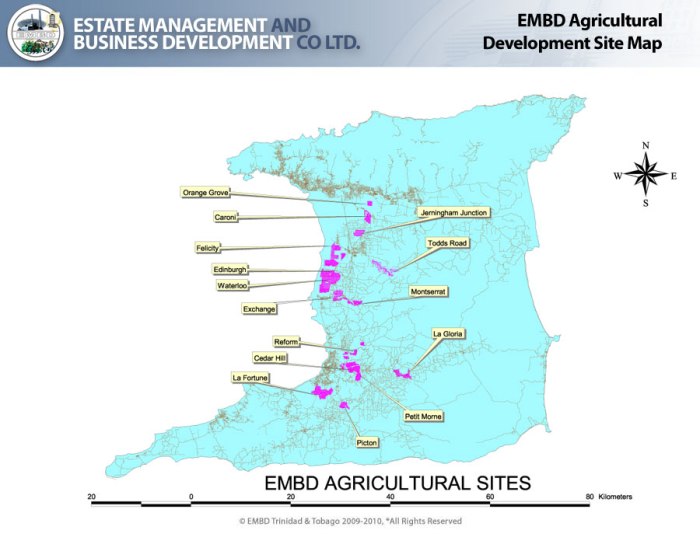
The best estimates of the land area of the Caroni Estate at 2003 were in the 76,000 to 77,000 acre range, which would equate to about 6% of our country’s entire land area. The Caroni lands stretch from Orange Grove in the north – just south of Trincity – to the outskirts of Princes Town in south Trinidad. The lands belonging to Caroni (1975) Ltd also included property at Mayaro and ‘Down-the-Islands’.
EMDB Residential Sites
The EMBD website states that it is responsible for the development of the former Caroni lands – some 7,500 residential lots are being prepared for ex-Caroni workers as part of their retrenchment package, with a further 8,400 agricultural leases of 2-acre parcels reportedly being processed. By my estimation, that means about 940 acres are to be used for the residential lots, with at least 16,800 additional acres to be used for the agricultural plots. The total land area to be used in these programs would therefore be of the order of 17,740 acres, which is just under a quarter (about 23%) of the estimated area of the Caroni lands.
There are significant struggles becoming evident in relation to the EMBD land distribution exercise, with these lands being allocated free to former Caroni workers as part of their retrenchment compensation.
The Trinidad Express reported that the Minister of Finance & the Economy, Larry Howai, announced a significant change in the original policy in the 2015 budget, in that the ex-workers receiving agricultural leases were now free to sell these lands. This announcement in September 2014 sparked a sharp response from Shiraz Khan, President of the Trinidad United Farmers’ Association, who labelled the new policy as ‘nonsensical‘ and ‘destructive to the agricultural sector.‘ One has to wonder if this important shift in land policy was discussed with the Farmers’ Association.
The split in positions became glaring with the swift response of Lily Herai, an ex-Caroni worker who is President of the Couva/Point Lisas Chamber of Commerce, who is reported to have “welcomed the move because it will add to the business development of the area.” Ms. Herai was also quoted as saying – “…We are in the Couva/Point Lisas area. There are a lot of service type business that have emerged recently and it keeps growing. It gives the leaseholders an opportunity to sell their lands…”
To my mind, the most startling statements on the EMBD lands came from Minister in the Ministry of Finance & the Economy, Rudranath Indarsingh, former President of the All Trinidad General Workers’ Trade Union (ATGWTU). His comments are reported in the Trinidad Express on 12 December 2014:
“…Despite being given permission to sell their lands on the open market, ex-Caroni (1975) workers were urged yesterday not to sell by Minister in the Ministry of Finance Rudranath Indarsingh.
Indarsingh, a former president of the All Trinidad General Workers’ Trade Union (ATGWTU), said the union worked hard to get the lands for the workers, and land value can only increase.
He was speaking yesterday at a ceremony in Couva to distribute more land leases to the ex-employees.
Speaking to the Express afterwards, Indarsingh said there were rumours Government ministers were preying upon the recipients, encouraging them to sell their recently received land…”
(The emphasis is mine.)
I tell you.
The State Agencies responsible for land
This is a listing of the key Ministries and the relevant State Agencies which manage our country’s lands. The sheer number of bodies with overlapping responsibilities makes understanding the land question a major challenge.
Ministry of Land and Marine Resources Minister: Jairam Seemungal MP Agencies
Lands & Surveys Division
Commissioner of State Lands
Land Settlement Agency (LSA)
Ministry of Housing and Urban Development Minister: Dr Roodal Moonilal, MP Agencies
Estate Management & Development Company Ltd (EMBD)
Housing Development Corporation (HDC)
Urban Development Corporation of T&T (UDECOTT)
Sugar Industry Labour Welfare Committee (SILWC)
Ministry of Planning & Sustainable Development Minister: Senator Dr Bhoendradatt Tewarie Agencies
Town & Country Planning Division (TCPD)
Chaguaramas Development Authority (CDA)
East Port-of-Spain Development Company Ltd.
Ministry of Food Production Minister: Senator Devant Maharaj Agencies
Agricultural Development Bank
Agricultural Society of T&T
Cocoa & Coffee Industry Board of T&T
Livestock & Livestock Products Board
National Agricultural Marketing and Development Company (NAMDEVCO)
Sugarcane Feeds Centre
Ministry of the Environment & Water Resources Minister: Senator Ganga Singh Agencies
Environmental Management Authority (EMA)
Apart from this battle on the EMBD projects, we have to consider the ‘Land for the Landless’ program which is intended to provide some 3,000 to 4,000 residential lots each year. That is the strain being put onto the limited lands available in our country, as we fight for clarity on what is happening to our country’s lands.
The lack of the database proposed in the 1992 Land Policy means that we are operating in an information vacuum which appears to be deliberate.
Every public official is accustomed to the world of today, with the instantaneous access to detailed information on an astounding range of issues, worldwide. We all know that the banks and insurance companies have all the relevant details of many millions of accounts and transactions available at our virtual fingertips. We all know that, so why are we continuing to permit this rapid disposal of our country’s land without some public system to provide the details for our consideration?
“…Our nation’s interest demands that we recognise that the Caroni lands are too big, too important and too valuable to be the preserve of any single group or political party…”
At that time, I was criticising the short-sighted policy of the Manning government in relation to the Caroni lands.
After one time, is two times.
Next, I will delve further into the EMBD situation and the features of the land/property information system we so urgently need.
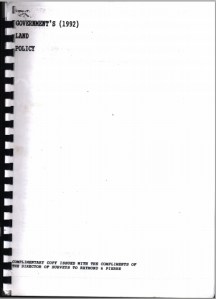
The Trinidad & Tobago Land Policy of 1992 has not been reviewed, withdrawn or superceded. Those are the facts. The responses of various public officials when queried, and the routine conduct of public bodies in relation to public land, are both in conflict with the existing policy. This article will explore the gap between the official policy and official conduct.
The 1992 Policy contains elements which are substantially beneficial to our nation.
Land is very important, especially because the quantity is very limited, so we need future-looking and properly-enforced Land Policy if we are to have a sustainable future in our country. I am specifically using ‘we’, since the important role of land requires us all to have a stake in these progressive outcomes. I am also specifically using ‘in our country‘, to emphasise the fact that most of us will have to live here.
This week’s column will set out some of the key elements in the 1992 Land Policy, so that we can begin to understand just why it has been effectively dismissed from official consideration.
State ownership
Hon. Jairam Seemungal, MP. Minister of Land and Marine Resources
An important consideration is the high proportion of public land in our country, at para 1.2 on page 2 of the Land Policy we learn that an estimated 52% of the whole is State land. We also recently heard Land & Marine Resources Minister, Jairam Seemungal, state that the proportion of land belonging to the State is of the order of 58% of the whole. Because so much of the country’s land belongs to the State, it is therefore critical to ensure we have a robust policy in respect of State land.
An estimated 47% of State land is forested and therefore subject to certain controls. The non-forested State lands are about 133,000 hectares, which is about 329,000 acres.
The estimated land area designated as suitable for cultivation is about 35% of the whole, comprising about 179,000 hectares or 442,000 acres.
Agricultural Land
According to the 1992 policy, there is a significant decline in the proportion of suitable land actually under cultivation, from 74% in 1963 to about 60% in 1982.
We need to consider food security as an important part of our country’s security. Our taste for foreign food and drinks; the uncertainty of our foreign exchange supply and the continuing loss of agricultural land, all mean that it is critical for land use policy to support our country’s food security policies.
History shows that once land is removed from agricultural use for other types of development, it is almost always lost for future agricultural use. That is described as ‘land alienation’ to signify a complete loss.
We have already lost some of our most fertile lands to contemporary development – eg three major areas completely lost are Valsayn as well as the River and Diamond Estates in Diego Martin. The very fertile Aranjuez lands are being rapidly developed with housing and commercial uses.
In fact, the lands at Tucker Valley in Chaguaramas are some of the last remaining first-class agricultural land in the country. To my mind this means that extra attention must be paid to any proposals for the use or development of those lands. Most importantly, those proposals must be ventilated and considered within the context of the land policy.
So, what does our official land policy state on this critical issue?
At page 9 –
4. LAND USE POLICY
Land Zoning
4.1 During the period of the oil boom (1974-1982) there was great incentive to shift land out of agricultural into other uses such as housing developments and industrial/commercial activity. In the process much good agricultural land was irretrievably misallocated. This is confirmed by the 1982 Agricultural Census.
4.2 The New Land Policy proposes:
(a) that the existing system of land use zoning be strengthened to ensure that prime agricultural land is not mis-managed or converted to non-agricultural uses except on the basis of a significant spatial or economic development rationale…
The expanded program is to provide between 3,000 to 4,000 lots each year, at an estimated annual cost of $1.0 Billion. The Minister also proposed an increase of the income limits for applicants from the previous figure to a new joint monthly income of $30,000.
This ‘Land for the Landless‘ program will require our sternest scrutiny, given its key features. For one thing, the annual target of 3,000 to 4,000 lots means that about 200 hectares (or 500 acres) of land would be distributed each year. How can we ensure that this program does not cause more loss of our limited agricultural land? Where is all this land going to come from? Given the fact that most officials seem unaware of our country’s existing land policy, this is a serious issue. Indeed, the very Land Settlement Agency stated that they were unaware of any State land policy when we contacted them before starting this series. So that is the problem, the officials who should know, don’t know and what is more, they don’t know that they don’t know. I tell you.
But the situation becomes even less acceptable when we consider the increased income levels in the expanded program. The intention of this program, as I understand it, is to provide subsidised housing lots to poorer people who are unable to afford land and intend to build their own homes. A family with a combined monthly income of $30,000 would comfortably qualify for private mortgage financing to buy a home in the $1.5M+ price range. To expand a program intended to serve the poorer groups of hopeful homeowners in this way is a wanton diversion of limited State resources – both land and finance – for some other purpose.
HDC allocation policy sets a monthly household income limit at $25,000 and LSA is now racing ahead to offer subsidised land to families earning up to $30,000 a month. I tell you.
It seems like this program is really ‘Land for Everybody’.
…With this, Mr. Speaker, you would find that you have lands all over the place, they have thousands and thousands and thousands of acres. Just under the Caroni (1975) Limited alone, they had over 70,000 acres of land, and now I am finding it is closer to 90,000 aces to 100,000 acres of land they had, and we can only know that, Mr. Speaker, by using a scientific approach…
So, there is official uncertainty as to the true land area of the Caroni estate.
The most important finding, thus far, is the extent to which the basic policy and information is unknown, which would be a very bad situation, or it is known and is being purposely ignored. The former case would be a very sorry story in terms of how our country has been run for too long, but the latter case would be far, far worse. So, which is it?
What we need as a starting-point in this process of managing the critical asset of land, is an open, searchable database with details of all the country’s property, public and private. The 2009 Property Tax proposals made by the Manning administration would have required such a database if the new system was to have worked. There was considerable merit in those proposals, but the strong opposition killed the idea and the Peoples Partnership shelved the Property Tax after winning elections in May 2010.
There are substantial landowners and land-grabbers who would have had their holdings and operations exposed to critical scrutiny if such a database had been established. Those people have benefitted from the continued opaque arrangements.
So, what does the Land Policy say on this?
(page 6)
“…Establishment of National Land Information System
3.4 …Lack of timely information results in loss of revenues, loss of investment opportunities and inefficiencies in land management…
3.5 The New Land Policy proposes establishment of an integrated graphic and non-graphic national land information system as a matter of priority. This system will be computer-based…”
Of course, back in 1992, the internet was in its infancy, so the proposal was not for online access.
There have been some steps to complete the required database, but given the amount of money which has flowed through our Treasury and the enlightened policy being established in 1992, we are still without the required detailed, public information.
The question is ‘Which interests are served by operating in the shadows?‘
Conclusion
Our country has severe limits on the available land, so we need a proper system to ensure that those lands are used in a sustainable and equitable manner. Despite its beneficial aspects, it is clear to me that the 1992 Land Policy is in need of revision. In the interim, that policy must be observed. The concerned members of the public need to inform themselves to defend our patrimony.
The Trinidad & Tobago Land Policy of 1992 has not been reviewed, withdrawn or superseded. Those are the facts.
The responses of various public officials when queried, and the routine conduct of public bodies in relation to public land, are both in conflict with the existing policy. This article will explore the gap between the official policy and official conduct.
The 1992 Policy contains elements which are substantially beneficial to our nation.
Land is very important, especially because the quantity is very limited, so we need future-looking and properly-enforced Land Policy if we are to have a sustainable future in our country. I am specifically using ‘we‘, since the important role of land requires us all to have a stake in these progressive outcomes. I am also specifically using ‘in our country‘, to emphasise the fact that most of us will have to live here.
This week’s column will set out some of the key elements in the 1992 Land Policy, so that we can begin to understand just why it has been effectively dismissed from official consideration.
State ownership
Hon Jairam Seemungal, MP, Minister of Land & Marine Resources
An important consideration is the high proportion of public land in our country, at para 1.2 on page 2 of the Land Policy we learn that an estimated 52% of the whole is State land. We also recently heard Land & Marine Resources Minister, Jairam Seemungal, state that the proportion of land belonging to the State is of the order of 58% of the whole. Because so much of the country’s land belongs to the State, it is therefore critical to ensure we have a robust policy in respect of State land.
An estimated 47% of State land is forested and therefore subject to certain controls. The non-forested State lands are about 133,000 hectares, which is about 329,000 acres.
The estimated land area designated as suitable for cultivation is about 35% of the whole, comprising about 179,000 hectares or 442,000 acres.
Agricultural Land
According to the 1992 policy, there is a significant decline in the proportion of suitable land actually under cultivation, from 74% in 1963 to about 60% in 1982.
We need to consider food security as an important part of our country’s security. Our taste for foreign food and drinks; the uncertainty of our foreign exchange supply and the continuing loss of agricultural land, all mean that it is critical for land use policy to support our country’s food security policies.
History shows that once land is removed from agricultural use for other types of development, it is almost always lost for future agricultural use. That is described as ‘land alienation’ to signify a complete loss.
We have already lost some of our most fertile lands to contemporary development – e.g. three major areas completely lost are Valsayn as well as the River and Diamond Estates in Diego Martin. The very fertile Aranjuez lands are being rapidly developed with housing and commercial uses.
In fact, the lands at Tucker Valley in Chaguaramas are some of the last remaining first-class agricultural land in the country. To my mind this means that extra attention must be paid to any proposals for the use or development of those lands. Most importantly, those proposals must be ventilated and considered within the context of the land policy.
So, what does our official land policy state on this critical issue? At page 9 –
“4. LAND USE POLICY
Land Zoning
4.1 During the period of the oil boom (1974-1982) there was great incentive to shift land out of agricultural into other uses such as housing developments and industrial/commercial activity. In the process much good agricultural land was irretrievably misallocated. This is confirmed by the 1982 Agricultural Census.
4.2 The New Land Policy proposes:
(a) that the existing system of land use zoning be strengthened to ensure that prime agricultural land is not mis-managed or converted to non-agricultural uses except on the basis of a significant spatial or economic development rationale…”
The expanded programme is to provide between 3,000 to 4,000 lots each year, at an estimated annual cost of $1.0 Billion. The Minister also proposed an increase of the income limits for applicants from the previous figure to a new joint monthly income of $30,000.
This ‘Land for the Landless‘ programme will require our sternest scrutiny, given its key features. For one thing, the annual target of 3,000 to 4,000 lots means that about 200 hectares (or 500 acres) of land would be distributed each year. How can we ensure that this program does not cause more loss of our limited agricultural land?Where is all this land going to come from? Given the fact that most officials seem unaware of our country’s existing land policy, this is a serious issue. Indeed, the very Land Settlement Agency stated that they were unaware of any State land policy when we contacted them before starting this series. So that is the problem, the officials who should know, don’t know and what is more, they don’t know that they don’t know. I tell you.
But the situation becomes even less acceptable when we consider the increased income levels in the expanded program. The intention of this program, as I understand it, is to provide subsidised housing lots to poorer people who are unable to afford land and intend to build their own homes. A family with a combined monthly income of $30,000 would comfortably qualify for private mortgage financing to buy a home in the $1.5M+ price range. To expand a program intended to serve the poorer groups of hopeful homeowners in this way is a wanton diversion of limited State resources – both land and finance – for some other purpose.
HDC allocation policy sets a monthly household income limit at $25,000 and LSA is now racing ahead to offer subsidised land to families earning up to $30,000 a month. I tell you.
It seems like this program is really ‘Land for Everybody‘.
“…With this, Mr. Speaker, you would find that you have lands all over the place, they have thousands and thousands and thousands of acres. Just under the Caroni (1975) Limited alone, they had over 70,000 acres of land, and now I am finding it is closer to 90,000 aces to 100,000 acres of land they had, and we can only know that, Mr. Speaker, by using a scientific approach…”
So, there is official uncertainty as to the true land area of the Caroni estate.
The most important finding, thus far, is the extent to which the basic policy and information is unknown, which would be a very bad situation, or it is known and is being purposely ignored. The former case would be a very sorry story in terms of how our country has been run for too long, but the latter case would be far, far worse. So, which is it?
What we need as a starting-point in this process of managing the critical asset of land, is an open, searchable database with details of all the country’s property, public and private. The 2009 Property Tax proposals made by the Manning administration would have required such a database if the new system was to have worked. There was considerable merit in those proposals, but the strong opposition killed the idea and the Peoples Partnership shelved the Property Tax after winning elections in May 2010.
There are substantial landowners and land-grabbers who would have had their holdings and operations exposed to critical scrutiny if such a database had been established. Those people have benefitted from the continued opaque arrangements.
So, what does the Land Policy say on this?
(page 6)
“…Establishment of National Land Information System
3.4 …Lack of timely information results in loss of revenues, loss of investment opportunities and inefficiencies in land management…
3.5 The New Land Policy proposes establishment of an integrated graphic and non-graphic national land information system as a matter of priority. This system will be computer-based…”
Of course, back in 1992, the internet was in its infancy, so the proposal was not for online access.
There have been some steps to complete the required database, but given the amount of money which has flowed through our Treasury and the enlightened policy being established in 1992, we are still without the required detailed, public information.
The question is ‘Which interest are served by operating in the shadows?‘.
Conclusion
Our country has severe limits on the available land, so we need a proper system to ensure that those lands are used in a sustainable and equitable manner. Despite its beneficial aspects, it is clear to me that the 1992 Land Policy is in need of revision. In the interim, that policy must be observed. The concerned members of the public need to inform themselves to defend our patrimony.
10.1 A small State such as Trinidad & Tobago must accord a very high priority to the judicious management and utilization of its land resources or perish. All elements of land policy must be designed to ensure that these finite resources are efficiently utilized and husbanded in such a manner as to serve the long term interests of the national community.
—Conclusion of “A New Administration and Policy for Land” (19 November, 1992)
Long-standing public concerns over land allocation have been increased by a number of recent events. Most notably there have been reports of leases of waterfront land at ‘Chagville’ for a waterpark and the Chaguaramas Convention Centre for a hotel project. The other episode to have attracted interest is the alleged occupation of 35 acres of Caroni land by SIS in Couva in contested circumstances.
When one considers the recently-announced projections for distribution of 100 new homes per week by the Housing Development Corporation (HDC) and the huge ‘Land for the Landless‘ proposals, it is clear that land is a hot topic. It is tempting to dismiss these proposals as being mere electioneering, but that would be a grave error, in view of the importance of land in our society. Justifiably so.
This article will set out some of the inescapable facts about our country’s land and housing situation. It is not possible to cover these vast, complicated and interlocking issues in a single column, so this is the start of an important series. History demands nothing less.
Proceeding from the general to the particular will mean deferring discussion of the specific controversies arising at this time so that the fundamental and serious issues can be properly framed.
The main points are –
The Land
Landsat image map of Trinidad. Click image for linked article. See p 156 of linked article.
The land area of Trinidad & Tobago is 5,128 sq. kilometres (1,980 sq miles), but apart from the raw quantity of land, we have to take proper account of the quality of our land. By which I mean to say that a majority of our land area is swamp, forest and mountainous terrain which is not suited for easy development – in my estimation, at least 60% of our land is in those zones.
The existence of those development-free zones is essential for the sustainability of the other zones, the developed ones. Some of the elements in that sustainability equation would include green cover on high ground to reduce run-off from heavy rainfall; aquifers which can replenish with clean water; swamps/mangrove coastal areas to buffer high-tides and form a vital link in the food-chain; forests to act as living repositories of our bio-diversity and so on.
The balance between the two types of zones is in constant tension, given the high level of national wealth; the tendency of wealthy persons to land-hoard; the tendency of poor people to take up unauthorised occupation of land and our growing environmental awareness. Those rising tensions as to land use can only be properly addressed by balancing of the needs of the human population against those of the other living elements; the present generation against those of the unborn and not least, the appetites of the wealthy against the needs of the poor.
Idealists would suggest that those elements are not in actual conflict with each other, but realism and the facts before us speak of a grim kind of contest. The systems for environmental study, public consultation and urban & regional planning are all intended to set norms for the resolution of those conflicting demands.
Population density
Population distribution map. Courtesy CSO. Click to enlarge.
Since the land area of our country is static (at 5,128 sq kilometres) apart from marginal gains and losses due to reclamation and erosion, the actual population is an important measure of the pressure that our lands are under.
The population density of T&T as at 2011 is 262 persons per sq kilometre, which places us 31st in terms of world population density, out of 194 countries measured at the Index Mundi website. Of course that figure is a serious underestimate, given the fact that our ‘official’ population has been recorded as virtually static at about 1.3M for quite some time now. The underestimate in terms of population is clear when one considers the electoral list of over-18s, which is just under 1,060,000 as at 2011. The situation is even starker when considered with the relevant figures for owner-occupation and the huge numbers shown in the HDC’s waiting-list.
It seems clear that our actual population is significantly higher than the official figure, which means that the population density is much higher than stated by Index Mundi.
Land Policy
For the reasons outlined earlier, there has been a steady stream of criticism of the systems in place for environmental management, public consultation and planning in relation to our nation’s physical development.
There is almost no discussion as to our land policy. The fact is that the national land policy was established in 1992 and has not been revised, superceded or withdrawn. As a practitioner in the field, I am aware of the policy and consider its contents to be substantially beneficial to our collective interests.
The problem is that the official land policy is seldom observed, so much so that I often wonder how widely-known is its existence or contents.
To test my suspicions, I decided to try an experiment by asking some surveyor colleagues at a recent conference and was astonished at the number of people who had no idea if there was a land policy. Some colleagues went beyond uncertainty to flatly deny its existence.
But that is not all, not at all.
I then caused queries to be raised with the relevant official bodies as to the existence of a national land policy. The replies need to be carefully noted, so that we can understand the turmoil and confusion which exists at the official level.
Here is what we were told –
Ministry of Housing & Urban Development – Did not confirm or deny, but referred us to the Land Settlement Agency, which is a Division of that Ministry.
Land Settlement Agency – Stated that they were unaware of any official land policy in existence and suggested that we contact the Ministry of Planning & Sustainable Development.
Ministry of Planning & Sustainable Development – Did not confirm or deny, but referred us to the Ministry of Land & Marine Resources. Another query to MPSD yielded the suggestion to contact the Town & Country Planning Division of that Ministry, but the TCPD then stated that “a policy was in process but nothing had been finalised.”
Ministry of Land & Marine Resources – Did not confirm or deny, but referred us to the Commissioner of State Lands, which office is yet to answer our repeated calls. Further queries to other departments within MLMR only yielded repeated statements that no such policy exists.
This official level of confusion and ignorance is unacceptable, given the critical importance of land in “satisfying the long-term interests of the national community.”
Quite frankly, the fact that only one of the many officials we spoke with was willing to give a name, which was actually someone else’s, speaks volumes to the pitiful position of official ignorance or obfuscation on this critical national resource. The responsible officials behaving irresponsibly in matters of the first importance. What is this?
We are either witness to woeful ignorance or a species of wilful blindness which can never serve our collective interests. The worst type of ignorance being displayed by those who do not know that they do not know. I tell you.
Given what is happening with State land in our country, this matter deserves our sternest scrutiny, so next week I will delve deeper.
The escalating episode of the apparent conflict between the oversight of Parliament and the Courts in this matter is a real learning experience for us all. I am clear that the Speaker spoke on Friday 23 January 2015 with the intention to convey that the High Court had sent him an official Notice which was decisive in the conduct of the business of Parliament.
Here is the contentious sentence of Speaker Wade Mark’s statement –
…I received only a few hours ago a notice from the High Court of the Republic of Trinidad and Tobago dated January 16, 2015, a matter involving Larry Howai and Azad Ali of the Sunshine Publishing Company Limited…
It seems very clear to me what the Speaker intended to say. Of course we now know that the statement was baseless and misleading. Misleading in the extreme.
“…While there appears to be some misunderstanding which we expect the Honourable Speaker of the House to clarify, the Judiciary can confirm that no Notice, letter or any other communication on the matter was forwarded by the Court or any of its officers to the Speaker or any officers of the Parliament…”
How many people believe that the Speaker would have attempted to clarify, for that is all it was, if the Judiciary had said nothing?
Sidebar: TIMELINE
24 December 2014 – Larry Howai’s attorneys issue a pre-action protocol letter against the Sunshine Newspaper for the article “$470 MILLION LOAN TO LOK JACK and Others”
26 December 2014 – Sunshine Newspaper publishes “$470 MILLION LOAN TO LOK JACK and Others”
30 December 2014 – Jack Warner MP files no confidence motion against Minister of Finance & the Economy, Senator Larry Howai.
5 January 2015 – Warner’s motion is approved by the Speaker, Wade Mark.
16 January 2015 – Larry Howai’s attorneys file suit against Sunshine Newspapers for libel.
22 January 2015 – Larry Howai wrote to the Speaker.
23 January 2015 – Warner’s motion is on the agenda for Private Members Day in Parliament. After the Speaker’s statements, the motion was abandoned.
26 January 2015 – The Speaker issues a statement apologises to the Judiciary and admitting, for the first time, that the letter came from Senator Larry Howai.
30 January 2015 – The Speaker issues a new statement which apologised again to the Judiciary and claimed that he had not tried to censure the debate.
Sidebar: EMBA story
In November 2013, Wade Mark threatened to sue the Trinidad Expess over its articles on the controversy surrounding the award of an Executive Masters in Business Administration (EMBA) to him by the Arthur Lok Jack Graduate School of Business (ALJ-GSB). I have heard nothing more about that lawsuit.
That episode was one with very serious allegations of improper conduct of examination processes at the ALJ-GSB, which allegedly culminated in the award of the EMBA to the Speaker of Parliament, Wade Mark.
I was very concerned over that series of allegations, given the potential impact on the reputation of the UWI, the ALJ-GSB and ultimately, the very reputation of our Parliament, if they were proven to be factual. Most unacceptable was the silence coming from the Speaker on the central issues – Was it true that the Speaker had scored 91% in the Management Accounts exam? Had the Speaker been allowed more chances than usually permitted in those exams? Had the Speaker really written to the ALJGSB on his official letterhead? If so, why?
I confronted Mark directly the next time we met, which was on the grounds of the Parliament on Tuesday 3 February 2014. After a heated exchange, during which he told me that his performance in mathematics had always been weak, Mark declined my urging to clear the air on those serious concerns and took the position that his degree had been awarded by the ALJ-GSB.
It would really be useful if the ALJ-GSB could publish the range of marks for that MBA-level Management Accounts final exam, so that we could assess the frequency with which marks over 70% are achieved.
Sen Larry Howai
When Parliament sat on 23 January, the first item on the Agenda of the Private Members’ Day was the no-confidence motion against Larry Howai filed by Jack Warner. The Speaker gave everyone the impression that the High Court had sent an official Notice to Parliament and never mentioned that in fact he had received those documents as part of a correspondence from Senator Larry Howai, Minister of Finance & the Economy. That Notice was said to relate to the litigation between the Minister and the Sunshine Newspaper on the financing by State-owned FCB (which had been headed by the Minister during that period) of the Carlton Savannah Hotel in Cascade. That presentation was very misleading and raised the genuine issue as to whether Members facing potentially embarrassing questions in the House had discovered a novel way to seek the protection of the Courts.
Before inviting Members to speak, the Speaker issued a clear caution –
…And in those circumstances, unless the Member who is about to speak can tell this House that what he is about to say is not going to be in any way, adverse, to what is before the High Court of Trinidad and Tobago, I would have to deny this Motion although it has been approved…
Ultimately, Warner relented and effectively withdrew his motion.
The Timeline in the Sidebar sets out the sequence of events and it is a stark example of how the Parliament and the Courts have become entwined in this latest rounds of the Silly Season.
The worse part is the third statement, made on 30 January 2015, which did little to restore confidence. It seemed that the Speaker’s was attempting to reverse his earlier clear caution to the House, claiming that –
…I wish in closing to ask Honourable Members to note that after I brought to the attention of the House the existence of the said legal proceedings, in exercise of my discretion as the Presiding Officer, I permitted debate on the motion to commence. I did not deny or shut down debate on the motion. It was the mover of the motion who, of his own volition, after he commenced his contribution, decided not to proceed…
It is true that Mark did not directly rule that the debate had to be halted, but his caution effectively shut-down the debate. That caution was based on a false statement and omitted the critical fact that the party to the debate was in fact invoking the Sub Judice principle.
At this point, I am still unclear. If Speaker Mark is in fact saying that he had no objections to the motion being debated, then that debate should be reconvened at the earliest possible sitting. The stream of letters which are beneath this disturbing sequence of events must be published, the sooner the better.
The position of Senator Howai is also inexplicable. Howai and Leader of Government Business in the House, Dr. Roodal Moonilal MP both claim to have been ready to debate the motion. So why send the letter to the Speaker?
This is real mind-games with the peoples’ business, I hold no brief for Warner or any of the other Members, they are all capable of seeking their own interest. The issues of the Carlton Savannah Hotel financing seem to be serious ones and we need to insist that the debate is started at the earliest opportunity. Some points on that issue are in the Sidebar.
I am not calling on the Speaker, or anyone for that matter, to resign. The Speaker can start to restore this situation by publishing those letters and convening an early debate on Warner’s motion.
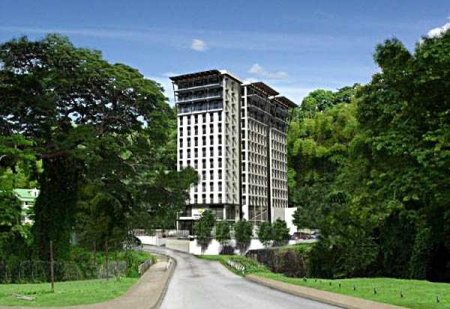
Sidebar: Carlton Savannah Hotel
It has been reported that FCB is owed over $400M borrowed for the construction of this elegant hotel on the outskirts of the Queen’s Park Savannah. That hotel is now up for sale via the receivers, Deloitte, at an asking price in the region of $120M.
The key issue evident here is the huge impact of the Hyatt Hotel on its POS rivals since its opening in early 2009. A combination of its virtual monopoly of State functions and the imperatives imposed by how it was funded have made Hyatt a unique hybrid, being at once the most elegant and most economic. Carlton Savannah seems to have been eclipsed by Hyatt and it is not the only one.
Some of the key questions would be how was the project appraised? Was sufficient security taken for this loan? What accounts for the tremendous decline in the value of this asset?
This article is to engage the issues of falling national revenues due to price declines for fossil fuels, the ongoing commentary and the PM’s 8 January 2015 statement with its attendant criticisms. I am going to focus on the role of the real estate and construction sectors in this unfolding series of serious challenges.
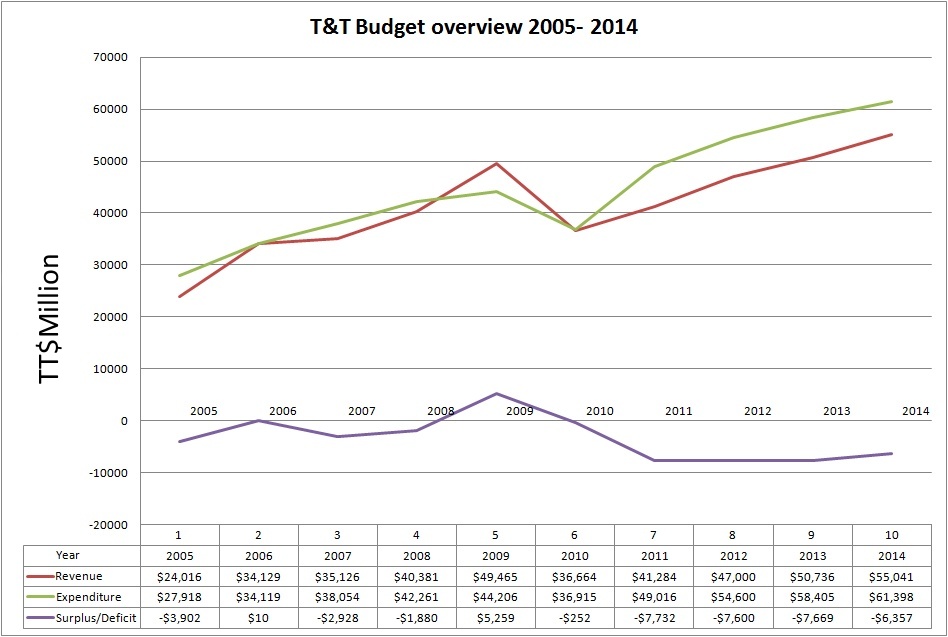
This is the graph and table from my previous budget commentary ‘A Fistful of Dollars‘ to illustrate the trend in terms of how successive governments have attempted to balance revenues and expenditure.
The Minister of Finance has just met cynical expectations by announcing Trinidad & Tobago’s largest-ever budget for 2015, with estimated revenue of $60.351 Billion in support of estimated expenditure of $64.664 Billion. This expenditure is $4.313 Billion more than the expected revenue, with 2015 being the sixth consecutive year of deficit budgets with a nominal total of just under $34 Billion in excess expenditure in that period.
Year
2005
2006
2007
2008
2009
2010
2011
2012
2013
2014
2015
Revenue
$24,016
$34,129
$35,126
$40,381
$49,465
$36,664
$41,284
$47,000
$50,736
$55,041
$60,351
Expenditure
$27,918
$34,119
$38,054
$42,261
$44,206
$36,915
$49,016
$54,600
$58,405
$61,398
$64,664
Surplus/Deficit
-$3,902
$10
-$2,928
-$1,880
$5,259
-$252
-$7,732
-$7,600
-$7,669
-$6,357
-$4,313
With national elections due within the next 12 months, a deficit budget was no surprise, but there are still significant items of concern for discussion –
Public Procurement
Once again the long-delayed Public Procurement and Disposal of Public Property law was mentioned (at pg 65) –
…We are expediting the process of preparing the regulations to make this legislation effective once it is approved by this Honourable House…
This critical new law is essential for there to be effective and modern controls on transactions in Public Money, which is the very lifeblood of virtually the entire economy. The new laws were promised within one year of the election if the Peoples Partnership won and it is now over four years since that. The Senate approved this Bill unanimously on 11 June 2014, but the progress of this critical new law has been delayed for virtually 3 months with no explanation.
The silence of the Minister of Finance as to the date on which this new law will be approved by Parliament is enough to give one pause as to the seemingly-deliberate delays which have beset the passage of this Bill.
The JCC continues its calls for this essential new law to be passed without further delay. Effective Public Procurement & Disposal of Public Property law is needed now to reduce the waste and theft of Public Money.
Beetham Water Recycling Project (BWRP)
Having omitted the Billion-Dollar-Plus BWRP from the 2014 Budget Statement and entirely ignored the various calls for its inclusion in the national accounts, the Minister of Finance & the Economy went ‘one better’ at pg 38 of the 2015 Budget Statement –
…With the completion of the Beetham Waste Water Project, the Industrial Estate at Point Lisas will benefit from a reliable and high quality water supply, thereby diverting 10 million gallons per day of good-quality potable water to the national community…
Howai seems to have had no regard to the fundamental outstanding issues on the rationale for or the underlying commercial arrangements which are driving the entire process.
To ignore these concerns is exactly the kind of poor governance and lack of accountability which the very same Minister Howai cited as reasons for the dismissal of the Caribbean Airlines Board members in May 2013. In the sobering words of the old saying ‘Is a straight case of Nearer to Church, further from God‘. If Howai wishes to continue to enjoy the respect and esteem in which he was widely held before his entry into politics, he needs to reconsider his silence on the BWRP.
State Housing
The several aspects of this important part of the Welfare State were set out at pgs 52-55, with two salient points being the waiting-list which was said to exceed 160,000 and the baffling statement on output –
…3,000 new housing units are being built with resources from the public sector investment programme and local borrowing; more than 1,000 have already been completed at Egypt Village, Princes Town, Union Hall and Victoria Keys… (pg 53)
All very ambiguous, as it seems the Minister was unable to state plainly just how many new homes are to be built in the fiscal year 2015. That ambiguity as to the target output is not acceptable in a program of this importance.
The other aspect which is unstated and even more unacceptable is the fact a large proportion of the roughly-17,000 new homes built in our country’s present Housing Policy remain empty with no rationale. My information is that the true proportion of empty new homes built by the Housing Development Corporation (HDC) is likely in excess of 40% of the entire amount built. Those empty homes should be occupied by the most needy applicants at the earliest opportunity, which will occupy the homes, reduce the high expense of security and create income (either from rentals or sales) to re-invest in the HDC’s operations.
Given that the original target of the 2002 policy – ‘Showing Trinidad & Tobago a new way home’ – was to build 100,000 new homes in a decade, the achievements and lessons-learned of this policy do need to be carefully examined. The time is ripe for a thorough non-partisan review of this important national policy.
Campaign Finance
At pg 66, Minister Howai raised the long-outstanding issue of Campaign Finance reform –
…A Joint Select Committee on Campaign Finance Reform has also been established…
The work of that JSC would be fundamental in inviting submissions and putting forward proposals as to how the influence of the party political financier can be disclosed and therefore controlled. That work must proceed without delay or secrecy, so citizens need to be very vigilant on this issue. The JCC restates its call for the work of this JSC to now proceed without delay.
The Elephant in the Room
The section devoted to ‘Office Accommodation’ at pg 43 was most useful in providing some clarity as to the anticipated completion date of the much-delayed offices in Port-of-Spain –
October 2014, next month, the Customs and Excise Division of the Ministry of Finance and the Economy;
March 2015 the Immigration Division of the Ministry of National Security;
August 2015 the Board of Inland Revenue Division of the Ministry of Finance and the Economy;
September 2015 the Ministry of Legal Affairs; and
September 2015 the Ministry of Education.
Mr. Speaker, the Government is collaborating with the Urban Development Corporation of Trinidad and Tobago with a view to outfitting all remaining buildings for occupation in 2016.
In conclusion, my lasting impression, upon re-reading, is of a high-stakes election budget. The budget debate will provide greater insight on these aspects, once the participants maintain a good standard of discussion.
Next Monday, 8 September 2014, is carded for the Finance Minister to deliver his 2015 Budget Statement to the country and of course speculation is great as to whether this will be an ‘election budget‘ or if a more restrained approach might be taken.
In preparing to write this column, I took a look at our budgets since 2005 and it was really striking that many of the key issues identified a full decade ago are still at the fore of the more recent budgets. Some of those issues were the imperative to reduce our dependence on the energy sector; the constant push to upgrade our infrastructure; the demand for more resources dedicated to national security and of course, the repeated statements about this or that program to reduce white-collar crime.
These expenditure and revenue figures were drawn from the Budget Statements, so no account has been taken of either actual outcomes or supplemental appropriations – this is the process used by the Government to obtain authorisation from the Parliament to exceed the approved spending limits in the national budget.
Clearly, we are seeing a trend as to the constant increases in expenditure, with only one decline, in 2010. Given that background, it also appears that surpluses are rare, occurring only twice, in 2006 and 2009.
The reality that we are on the verge of a national election which is sure to be strongly-contested, leaves me in little doubt that the 2015 budget is also likely to be a deficit budget, with the State spending more than it earns.
There is a constant stream of allegations of ‘Grand Corruption’, which is little surprise in our society in which an unsupported allegation is so often used to discredit an opponent. There is no comfort to be had in that observation, since the other reality is that thorough investigations and prosecutions are only done against ones political enemies, inside or outside the ruling party. That is the sobering reality in our Republic, in which we should all enjoy equal rights and be held to common standards. Different strokes for different folks, just like back in the ‘bad-old-days‘.
It seems to me that the defining question, in terms of whether the various financial crimes are taken seriously, is whether the accused persons are ‘members in good standing‘, so to speak.
The extent to which our Treasury is protected from being plundered by criminal elements is a serious question which should concern every citizen, given that the Public Money in the Treasury belongs to us as citizens and taxpayers. The frequency with which these financial crimes are overlooked is nothing less than scandalous, as any of the Auditor General’s Reports in the previous decade would attest. Permanent Secretaries approving payments in breach of financial regulations; payments made with no documents (leases, contracts or agreements) on file; failure or refusal to produce documents as required by law upon the Auditor General’s request and so many other types of lawbreaking. The same types of conduct is also rife in State Enterprises, which is why so many of the larger ones are unable to produce accounts as required by the very Ministry of Finance which sets those rules and continues to fund them.
The wicked part is that these Public Officials are virtually never charged with breaking the law or made to face any other serious consequences for their misbehaviour in Public Office. We need a new beginning in terms of how we handle the reality of our country’s wealth and its intentionally-degraded laws for controlling how our Public Money is used. A big part of that would be a political dispensation in which full investigations and prosecutions were the norm, especially when key members of the ruling party are the target of allegations.
Our budgeting process now shows all the signs that our system of Public Financial Management is ineffective in dealing with the seasoned criminals who are hard at work helping themselves to our money, whatever the political party in power. At that level, at least, there is little evidence of discrimination.
The growing complexity of the budget is of no comfort. For example, the 2014 documents totalled some 2,997 pages, yet the Billion-Dollar-Plus Beetham Water Recycling Project (BWRP) was omitted. Despite questions as to what did he know and when did he know it, the Minister of Finance continues to ignore the fundamental requirement to provide for this huge project within our national accounts. There has been no attempt to give the public the necessary explanation as to how the BWRP is to be paid for, since the underlying commercial arrangements which are driving this project remain obscured. The BWRP also shows a strong theme as to the privatisation of our nation’s water supplies, which is a growing area of concern globally. Not the first one, it is true, since we had DESALCOTT before, but this second, huge project implies a trend, in my mind.
The inescapable question is ‘To what extent can we rely on our national accounts, if huge projects like BWRP are omitted?‘
All of which brings us to the continuing and unexplained delay in passing the Public Procurement & Disposal of Public Property Bill. That new law would play an important part in greatly reducing the scope for waste and theft of Public Money. The JCC and its Kindred Associations in the Private Sector Civil Society group continue to call for this law to be passed without any further delay.
Of course all of this is driven by the political parties’ imperative to raise money from various financiers to fund election campaigns, so Political Party Financing laws are essential to control those influences. The Parliament recently unanimously approved a Private Members’ Motion laid by Independent Senator, Helen Drayton, to appoint a Joint Select Committee (JSC) to start the long-overdue process of agreeing just what are the new laws we need to deal with this influence, described by President Carmona, in his inaugural address as a ‘veritable juggernaut‘. The JCC continues to call for the JSC to be appointed so that this critical work can be started to control Political Party Financing.
Having observed the two-week spectacle of prolonged debate in the Parliament on the recently-approved Constitutional Amendment Bill, one can only wonder as to the priorities which are being displayed.
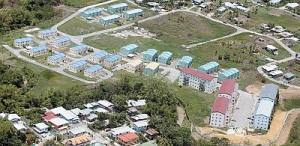
HDC housing in central Trinidad. Chaguanas is the fastest growing town in T&T.
The Trinidad and Tobago Guardian published part 2 of its interview with Afra Raymond in the 1 September 2014 edition of the newspaper.
Recent reports that the HDC housing waiting list has reached 200,000 have thrown up questions about strategies for land usage, housing design and urban planning in T&T. In our series on housing, JOSHUA SURTEES speaks to architects, planners and surveyors to find out if there is enough land available, whether everybody on the list can get a place to live and what kind of accommodation makes best use of space while providing comfortable, functional living that complements people’s lifestyles. Part four features AFRA RAYMOND, president of the Joint Consultative Council, MD of Raymond & Pierre Ltd chartered surveyors and an expert on land usage issues, procurement and housing.
How many ultra-rich, multiple homeowners are there?
How many, I don’t know. But as a practitioner I can tell you it’s a significant part of what takes place. It informs how, when parcels of land become available, what are the forces that compete for it, and this is where the boundaries between public and private become very elastic. If the forces on one side have the capacity to go after that piece of land and get it before the government, that has an effect on what options are available to the government to build affordable housing…




 Ministry of Land and Marine Resources
 Ministry of Housing and Urban Development
 Ministry of Planning & Sustainable Development
 Ministry of Food Production
 Ministry of the Environment & Water Resources


 When one considers the recently-announced projections for distribution of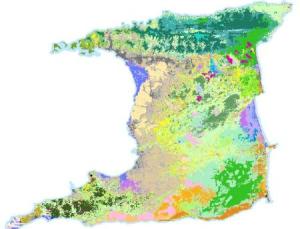

 Land Settlement Agency – Stated that they were unaware of any official land policy in existence and suggested that we contact the Ministry of Planning & Sustainable Development.
 Ministry of Land & Marine Resources – Did not confirm or deny, but referred us to the Commissioner of State Lands, which office is yet to answer our repeated calls. Further queries to other departments within MLMR only yielded repeated statements that no such policy exists.
 It has been reported that FCB is owed over $400M borrowed for the construction of this elegant hotel on the outskirts of the Queen’s Park Savannah. That hotel is now up for sale via the receivers, Deloitte, at an asking price in the region of $120M.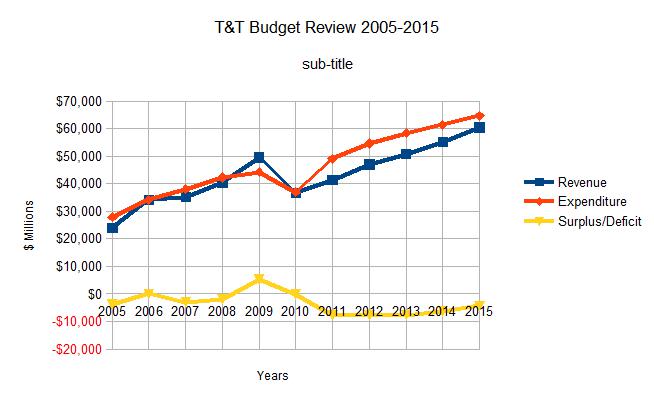
 The several aspects of this important part of the Welfare State were set out at pgs 52-55, with two salient points being the waiting-list which was said to exceed 160,000 and the baffling statement on output –
 At pg 66, Minister Howai raised the long-outstanding issue of Campaign Finance reform –