Property Matters – The EFCL Query

Continuing the series of examinations into the purpose and performance of our State Enterprises, this week I am looking at an important issue which seems to be emerging at the Education Facilities Company Ltd. (EFCL).

EFCL is a state-owned company involved in the building and maintenance of schools.  It consumes public money in the execution of its functions and that is why it is important to put these points now.

efcl excerpt 3

One of the biggest public concerns is the high level of white-collar crime, which means bribery, corruption, fraud, over-billing, ‘back-fitting’, tax-evasion, asset-stripping and so on.  White Collar crime is a growth industry, since the rewards are very high, while the risk of being caught or punished is extremely remote.

Due to the size of the State, a great deal of that white collar crime can be found in State Institutions.  Once Public Money is being spent, we must demand a high standard of accountability and transparency.

In terms of principles, there needs to be an appropriate balance between the long-established ‘Right of privacy‘ in commercial transactions and the growing ‘Right to know‘ which is part of the emerging social order.  There will be different views as to where the correct balance exists and furthermore, the consensus position will shift as time passes.

It seems to me that the default position should be that, in doubtful cases, the right of the public to information should prevail, since we are the ones paying the costs.  Indeed, that position forms part of the Freedom of Information Act, so that is substantial support.

In early 2009 we witnessed an attempt by the then PNM government to amend the Integrity in Public Life Act (IPLA) so that people reporting breaches of that Act would have been forced to give their names and addresses.  That arrangement would have given even greater protection to corrupt officials, since virtually no-one would want to make a report.  Of course people are strongly encouraged to report ‘normal’ crime like rape, robbery, murder and so on – further encouragement is offered by allowing them to make anonymous reports via 800-TIPS, for example.  Those proposals to amend the IPLA would have encouraged corrupt behaviour by reducing the reports.

That Bill was piloted by then Attorney-General, Bridget Annissette-George.  The proposals were strongly opposed in the Parliament and in the wider society, eventually being withdrawn.  One of the strongest protestors in the Parliamentary debate was Dr. Tim Gopeesingh, who was reported to have accused the government of trying to intimidate people into not making reports. [Hansard, 1 May 2009 p.441] On that occasion, the Standing Orders were used by Colm Imbert, to curtail Gopeesingh’s presentation. [Hansard, 1 May 2009 p.455]

The normal good governance provisions for annual accounts, Board Meetings, minutes and so on are very important.  But those provisions must be supplemented by an atmosphere and a series of institutional arrangements which facilitate Whistle-Blowers.  There must be clear channels and protection for Whistle-Blowers if we are to have any chance of reducing corruption in our country.

Without the assistance of Whistle-Blowers, we would not have known of the Piarco Airport or UDeCoTT fiascos and we know for sure that somebody leaked the file on the Heights of Guanapo Church just prior to last year’s election.  We need encouragement for Whistle-Blowers – in some countries they are even given big cash rewards.  The JCC has been active with its partners – TTMA, the Chamber of Commerce and the Transparency Institute – in making Public Procurement proposals to the Joint Select Committee.  An important element of those proposals is the creation of proper channels for Whistle-Blowers.

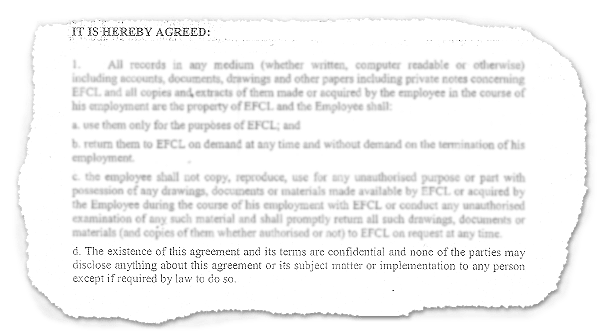
I recently received a copy of some EFCL documents, which were stated to be their new Confidentiality Policy Statement and a Staff Confidentiality Agreement for the signature of employees.  I was also told, separately, that EFCL staff are being required to sign that Agreement, under threat of dismissal.  What is more, the Agreement contains a specific clause which forbids revelation of either the existence or the terms of the agreement.

efcl excerpt 2

If those documents are genuine, there are serious grounds for concern, so I made a written query via email on Friday 1st July to the EFCL’s CEO, Paul Taylor, and its Chairman, Ronald Phillip.  I outlined what had been reported to me and asked these questions –

From: Afra Raymond <afraraymond@gmail.com>
Date: Fri, Jul 1, 2011 at 1:13 PM
Subject: EFCL Confidentiality Policy
To: paul.taylor@efcl.co.tt
Cc: ronald.phillip@efcl.co.tt

Hello Paul,

I am reliably informed that EFCL staff were recently directed to sign a ‘Confidentiality Agreement’, the rationale being that it is the new Company policy.

Before taking this any further, I am requesting your written response to these questions –

  1. Is there a new EFCL Confidentiality policy?  When did that come into effect?  Would you please provide a copy of that policy?

Assuming a new Confidentiality Policy is in place, these are my queries –

  1. Was that policy approved by the Board of Directors?
  2. Is the Ministry of Education aware of this new policy?

I would appreciate a timely response.

With best wishes.
Afra Raymond

That email was also copied, purely for information, to the Minister of Education.  At the time of writing, there has been no acknowledgment or reply.

efcl excerpt 1

This is a serious development for these reasons –

  1. The Super-Confidentiality provisions mean that staff are forbidden to obtain any advice, which seems to be a breach of good labour relations, at the very least.
  2. The unilateral imposition of this new document does violence to the proper meaning of the word ‘Agreement’.
  3. The ‘Guiding Principles’ at page 2 refer to ‘privileged information‘ and ‘EFCL’s right to privacy‘, both of which seem to me to be leading away from greater transparency and improved procurement procedures – which leads into the final point
  4. This administration promised, both on the campaign trail and post-election, to make new procurement legislation a priority.  The Joint Select Committee on Public Procurement was Chaired by Dr. Tim Gopeesingh, Minister of Education.   EFCL is the principal State Enterprise within the Ministry of Education, so what is Dr. Gopeesingh’s position on all this?  Is this taking place with Dr. Gopeesingh’s knowledge and/or approval?

It is clear to me that this kind of stealthy restriction on the possibility of staff becoming whistle-blowers is incompatible with the high-profile public statements of support for a new, effective public procurement system. Those statements range from the promises at page 18 of the People’s Partnership Manifesto to numerous speeches by the present Prime Minister.

The reality is inescapable –

Expenditure of Public money – Accountability – Transparency = CORRUPTION

I am closing by wondering, aloud, if this is the shape of the new Information policy for our State Enterprises.

SIDEBAR: What is a Super Injunction?

It is possible for a prominent person to obtain a Court Order called an injunction to prevent the publication of material which is likely to be damaging to their reputation.  That is a long-standing legal right and there has been a recent series of decisions in the UK in which super-sensitive, high profile people have been able to obtain ‘Super-injunctions’ from the High Court, which have the effect of prohibiting the publication and further prohibiting revealing the very existence of the injunction itself.  Of course the media have been fighting that in Court and there are two investigations underway into whether the ‘Super-Injunction’ is itself an abusive instrument.  The emerging thinking seems to be that these ‘Super-Injunctions’ are destroying the information balance I outlined earlier.
efcl excerpt 4

This EFCL Confidentiality Policy, if it is so, would seem to be a similar device, doing great violence to the information balance.

State Enterprises and Public Procurement

procurement cycleState Enterprises were created to enhance the pace and quality of Public Procurement, yet they are now the scene of the most bedeviling paradoxes in the entire system of public administration.

Some of the key procurement issues which arise in this arena flow directly from the split character of the governance model.

The basic rationale for the existence of State Enterprises is they can be more effective because they are not bound by the strict rules which control the conventional civil service.  The absence of those rules is supposed to allow more latitude in terms of hiring, borrowing and contracting.  State Enterprises can hire professional staff at market rates, enter complex commercial arrangements and borrow on commercial terms, all of which should amount to significant improvements in public services.

The typical State Enterprise is owned by the State, with the shareholding held by the Corporation Sole, an exceptional legal creature which exists within the Ministry of Finance.  Apart from its owner, the State Enterprise will sometimes have a ‘line Ministry’, which would be its sole or main client.  For example, the Ministry of Housing & the Environment is the sole client of the Housing Development Corporation (HDC) and the Ministry of Education is the sole client of the Education Facilities Company Limited (EFCL).

State Enterprises can operate within the existing Companies Act or be established by a separate Act of Parliament, as is the case with the HDC.  That legal framework ought to ensure that a satisfactory standard of corporate governance and accountability is maintained.

The fact is that many of the Directors and Officers of State Enterprises are political appointees, which puts the entire rationale onto a doubtful footing.  Because the salaries and perks are so attractive, not to mention the commercial opportunities, the State Enterprises are prize targets for political appointments and favours.

Some of the main issues which arise when one is considering this sector are –

  • the number of State Enterprises – there needs to be a reduction in the number of State Enterprises.
  • If the politicians can instruct the State Enterprise, via the Permanent Secretary, on specifics, what is the purpose of the Board?
  • Given the preceding point, do the Board members of State Enterprises have the same duties under the Companies Act as in the case of other registered companies?
  • In terms of our proposed Public Procurement legislation, what is the boundary between the fiduciary responsibility of the Directors and the contracting powers of an ‘authorised officer’ – i.e. someone identified as having the power to enter certain contracts?

Proceeding along the Procurement Cycle and using the International Waterfront Centre (IWC) as an example –

  1. Needs Identification – This is the first stage of the Procurement Cycle and it ought to be an objective assessment of needs.  In this case, the IWC was part of a huge, disastrous boom in building new offices in POS – this is all detailed at ‘Capital Concerns – New Office Buildings’ – here.  Before the boom started in 2005, there was 6.5M sq. ft. of offices in Greater POS, at the start of the boom some 3.2M sq. ft., or an additional 50% of the capital’s office supply was approved for construction.  Please remember that Nicholas Tower, which took 5 years to fill, is only 100,000 sq. ft.  Just under 2.8M sq. ft of new offices was actually built in POS in the last 5 years, with 2.3M sq. ft. of that space (82% of it) actually built by the State.  Every State project identified at the outset was executed, but in stark contrast, virtually half the private sector projects stopped before construction began.  The obvious consequence of that over-building by the State has been a collapse in the office rental levels in the capital, which is detailed in the next point.
  2. Reconcile Needs with Funds – This is the stage at which a developer ought to consider critical questions such as the cost of funds, the cost of the project and the returns from it.  That is sometimes called a feasibility test and this is where the IWC dissolves into utter confusion.  When then PM Manning addressed the Senate on 13May 2008, he emphasized that every UDeCOTT project was approved by Cabinet and had been vetted by a Finance Committee on Financial Implications.  That is the most important address if we are to see the depth of the problem with these State Enterprises – see here.  The break-even point on such projects is the rent at which the project can repay its costs of construction – at minimum, those costs would have to include for land, design, construction and finance.  On that ‘bare-bones’ basis, which makes no allowance for maintenance or periods when spaces are vacant, the break-even rent for the IWC is in the $30 per sq. ft. range.  This is the largest single office building ever built in our capital and the best rents ever achieved for space of comparable quality is about half the break-even figure.  There is no way that the IWC project could ever have satisfied any proper feasibility test.  Every new office project started in our capital only increased the supply of offices, which reduced the market rent, which, in turn, increased the gap with the break-even rent.  Under oath at the Uff Enquiry, Calder Hart tried to rationalize the confusion when he confirmed that only one of UDeCOTT’s projects had been subject to a feasibility test and that one was the IWC.  He was even so bold-faced as to estimate a break-even rent in the $20 range, but, when pressed, had to admit that he had left the cost of the land out of the calculations!  That is the extent of the deformed thinking which typified the best schemes of the leading State Enterprise.  Only one of the State’s many office development projects tested for feasibility and in that case, the cost of the land is omitted, yet that same land is included as a part of UDeCOTT’s Assets at $224M in that very financial year.  Political imperatives were allowed to pervert a process which exists to protect the public interest from this kind of empire-building.  But it is in the next part that the full confusion comes to bear.
  3. The rest of the procurement cycle – This is the stage at which tenders were invited for design-build and the winning bidder selected, the project built and the complex opened.  According to UDeCOTT’s statements, the IWC project is its flagship and an outstanding success, having been built on time and within budget.  Even if one accepts those assertions as being true, the IWC project is an example of the tragic consequences of a limited application of proper procurement processes.

As a result we have a completed project which is said to have been built on time and under budget, yet makes no economic sense and has a break-even point at some uncertain point in the future, if ever.

Some collateral damage needs to be noted, to quote one of the former PM’s notable phrases.  Contrary to his statement to the Senate which is cited here, UDeCOTT did not publish its accounts since 2006, which is a breach of both the Companies Act and the Ministry of Finance guidelines.  A total breach of the elementary norms of good corporate governance, which is the protection the private sector structure was supposed to give us taxpayers as a safeguard.  Because of the political element in the operation, we can see clearly that UDeCOTT was carrying-out the instructions of the Cabinet and those Directors have not been punished or censured in any way, apart from their public dismissal.  The consequence of those breaches being condoned at the largest State Enterprises – UDeCOTT and HDC – how does one get the smaller and less-visible State Enterprises to conform to good governance?

If the priest could play, who is we?

This is why we need a complete review of our procurement controls.

An Overview on the CIVIL SOCIETY submission to the Joint Select Committee on PUBLIC PROCUREMENT

This special publication is dedicated to the important issue of Public Procurement.  It is written by the a private sector group, headed by the Joint Consultative Council for the Construction Industry (JCC).  The JCC consists of:

  1. Association of Professional Engineers of Trinidad & Tobago (APETT)
  2. Trinidad & Tobago Institute of Architects (TTIA)
  3.  Board of Architecture of Trinidad & Tobago (BOATT) – observer status
  4. Trinidad & Tobago Society of Planners (TTSP)
  5. Trinidad & Tobago Contractors’ Association (TTCA)
  6. Institute of Surveyors of Trinidad & Tobago (ISTT) comprising Land Surveyors, Quantity Surveyors and Valuation Surveyors.

The private sector group consisted of –

  • Joint Consultative Council for the Construction Industry
  • Trinidad & Tobago Chamber of Industry & Commerce
  • Trinidad & Tobago Manufacturers’ Association
  • Trinidad & Tobago Transparency Institute.

The members of that Private Sector group were part of the Working Party on the Public Procurement White Paper, which was published in August 2005 and laid in Parliament the following month.

The Peoples’ Partnership’s manifesto, at page 18, commits to –

Procurement

  • Prioritise the passing of procurement legislation and appropriate rules and regulations
  • Establish equitable arrangements for an efficient procurement system ensuring transparency and accountability by all government departments and state enterprises…

In keeping with those campaign promises, the Minister of Finance tabled two legislative proposals in Parliament on 25 June 2010.  Those were a Bill to amend the Central Tenders’ Board Act (originally prepared in 1997, when Ramesh Lawrence Maharaj was Attorney General) and the Public Procurement Bill (originally prepared in 2006, after publication of the White paper).  A Joint Select Committee (JSC) was established on 1 October 2010 to examine those proposals, invite submissions and make recommendations.

The stated target of the PP government is to have the new Public Procurement legislation in place by the first anniversary of their electoral victory – i.e. by 25 May 2011.

Our Private Sector/Civil Society group reconvened last year and made a joint submission to the JSC in December 2010 – it is available here from the JCC‘s website.  Our Private Sector group has had several meetings with the JSC – which was chaired by Education Minister, Dr. Tim Gopeesingh – but the results of those are not featured in this publication.

This special publication is intended to inform readers of the necessity for new Public Procurement legislation in our country and to set out the objectives of our proposals.

The guiding Principles

 These are –

  • Transparency
  • Accountability
  • Value for Money

The broad picture

One of the most serious findings of both the Bernard Enquiry (Piarco Airport Project) and the Uff Report (UDeCOTT and HDC) was the extent to which the largest State projects were being executed outside of any normal system of accountability.  The very purpose of setting up these companies and procurement methods was to bypass the Central Tenders Board.  The natural consequence of that way of proceeding being that if the CTB could be sidelined as a deliberate act of public policy, then other important elements of the regulatory framework are violated as a matter of course.  In the case of both UDeCOTT and NHA/HDC, accounts were not filed for years – since 2006 for the former and 2002 for the latter – in flagrant violation of the rules and laws.

These were the largest State projects – often described as being the flagship or centre-piece of this or that government’s policy – yet they were breaking the main rules and getting away with it.  The ‘getting away with it’ is the cloudy part of the picture, because we never hear of any penalty being sought against those State Enterprise Directors who broke the governance rules.

But that is the very centre of the puzzle and we need to understand it before we can try to unlock it.  So, we are told, time and again, that the only way to really get important and urgent projects done in the correct fashion is to go outside the rules.  The stated reasons are that the old rules are too cumbersome, slow etc… and yet, we end up, time and again, in the same mess.

Some of the features of these fiascos are –

  • Huge cost over-runs on virtually every project.
  • Unfinished projects which virtually no one can make sense of – to date there is no proper rationale for the huge and loss-leading International Waterfront Project, apart from Calder Hart’s bogus explanation to the Uff Enquiry.
  • A gross burden on our Treasury going forward – The continuing delay in completing the accounts for these State Enterprises shows how difficult it is to work out exactly what the State owes and to whom.

What all that tells us is that the existing rule-book seems to be blocking progress and the attempts to bypass it have done little better, if not far worse.

The dismal picture on public procurement is not limited to construction projects and can be found in all the other areas.

A new approach is needed and that is what is at the foundation of these legislative proposals.

What is Public Money?

Central to the new proposals is that any new Public Procurement system must be in full effect whenever Public Money is spent.

Public Money’ is defined at page 5 of our proposals as money which is either due to, or ultimately payable by, the State.

Our proposals are intended to form part of a financial management reform package to include for a National Audit Office and a Financial Management and Accountability Bill.

The intended move is towards a greater transparency and duty of care in terms of how taxpayers’ money is spent.  Our citizens, particularly the unborn ones who will have to pay for some of the wasteful schemes which are littering the landscape, deserve no less.

The new equation confronting us is –

Expenditure of Public Money
minus            Accountability
minus            Transparency
equals         CORRUPTION

We must fix that.

So, what is at stake here?

Our society is beset by large-scale corruption, which sustains wrong-headed decision-making.  The wider social consequences of that toxic culture are now hatching, with a vengeance, in the naked violence and wily crimes which pre-occupy our head-space.

The killing-fields of East POS, the decimation of African urban youths, the URP and CEPEP gangs and the battle for turf are all part of this picture.

As long as our society continues to applaud and reward dishonest, corrupt behaviour, we will continue sliding downhill.

The structure of our economy is that most of the country’s foreign exchange is earned by the State in the form of oil & gas earnings.  The rest of the society relies on the State and its organs to recycle those earnings for the benefit of those of us not directly engaged in the energy sector.

For that reason, the State casts a very long shadow in our country, far more so than in other places.  Virtually every substantial business relies on the State and its organs for a significant part of its earnings.  A healthy connection with the State is essential for good profits.

But that is where the particular problem is, since the conduct of the State and its organs is often found to be lacking in the basic ingredients of fairplay, accountability and transparency.

If the State is the biggest source of funds in the place and the State is not playing straight at all, a serious question arises – How can we hope to uplift our society?

The State has an over-riding duty to behave in an exemplary fashion in its policy and operations.

Due to its tremendous footprint, the State has to behave in that exemplary fashion if we are to move out of this mess.  A positive shift in State conduct will have a salutary effect on the commercial culture and wider society, one that is long overdue.

So, who spends Public Money?

We have a vast, expensive and confusing array of organs, all of which are authorized to spend our money.  For a country of about 1.4M people, we have 26 Ministries.  Just consider that the UK, with a population of about 65 million, has 19 Ministries and the USA, with a population of about 300 million, has 16 Ministries.  For a Caribbean example, Jamaica has twice our population and 16 Ministries.

Quite apart from the number of Ministries, there are two further layers of agencies which also have the power to spend – our country has 73 Government Bodies and 58 State Enterprises.

Given the vast range of operations undertaken by these agencies, any new system would have to be flexible in order to cover all those types of transactions.

The main features of the new system

Three new independent organs will be created –

    1. The Procurement Regulator (PR), with the duty to create overall Guidelines and a common handbook to guide the public procurement process.  The Regulator is appointed by the President in his own discretion and reports only to the Parliament.  Agencies can create their own procurement handbooks, once these conform to the overall Guidelines, as approved by the Procurement Regulator.
    2. The Public Procurement Commission (PPC) will be the investigative arm of the new apparatus to which complaints will be directed.
    3. The National Procurement Advisory Council (NPAC) will be purely advisory and comprises 14 members from a broad range of named private sector/civil society organisations – the JCC, Manufacturers’ Association, Chamber of Commerce, Transparency Institute – as well as the Ministry of Finance and the Tobago House of Assembly.

All expenses are to be drawn on the Consolidated Fund, with the Procurement Regulator and Advisory Council required to report annually to Parliament.

A vital part of our proposals is that Cabinet, Government Ministers or politicians are prohibited from instructing or directing these new agencies in any way.

They are intended to be entirely independent of political influence, which conforms to the proposals in the White Paper.

That freedom from political influence was also specified in both the 1997 and 2006 draft legislation.

A Complaints Procedure

The proposed system will create clear rights to make complaints or report wrongdoing.  Those rights are an important aspect of any modern procurement system and we propose three types of complaints/investigations –

  1. Potential tenderers/suppliers can complain, in the first instance directly to the Agency with which the tendering opportunity resides, then, if that is not dealt with satisfactorily, they can complain to the Public Procurement Commission.  Ultimately, the right to seek the protection of the High Court is preserved, once the established complaints procedure has been followed.
  2. The Whistleblower – We are proposing that whistleblowers be given legislative protection and practical means to bring their complaints direct to the Public Procurement Commission.
  3. The Public Procurement Commission can also, on its own initiative, start an investigation into an area of concern.

There are strict time-limits for acknowledgement and resolution of complaints.

Our proposal is for the Public Procurement Commission to have powers to punish both frivolous complainants as well as parties found to be in breach of the new system.  Those can range from fines to embargoes, during which offending parties can be banned from tendering opportunities.  Offending public officers can be subject to both fines and/or imprisonment.

The concern over the cost of the new apparatus

One of the most frequently expressed criticisms is that as critics of the rationale and operations of significant State Enterprises, we seem to be proposing a new series of state-funded agencies.  Some people have pointed out that these offices are unlikely to be cheap, particularly the PPC, which is to be constituted as a standing Commission of Enquiry under those existing legal provisions.

Yes, there will be new agencies and yes, they will cost money.

Given the recent revelations as to the cost of the Uff Enquiry – already estimated to exceed $50M – there are genuine concerns that we could soon have three new state-funded agencies which could absorb maybe $100M a year.

The challenge here is to move beyond the obvious and factual observations so that we can consider the decisive factors.  Our proposals have the promotion of Value for Money as one of its founding principles and that is good for the public.  So, how can we measure the value for money of these proposals, at this stage?

The scale of public procurement spending

In the case of expenditures direct out of the Ministries, the 2011 Budget has an anticipated capital expenditure for the Ministries of $7.050Bn, as per para 8 at page 4 of the Public Sector Investment Program (PSIP).

Also in that Budget there is an anticipated capital expenditure for the State Enterprises of $6.725Bn, as per the Foreword at page 4 of the Supplementary Public Sector Investment Program (Supplementary PSIP).  The combined figure of $13.775Bn is only for projects, so it excludes the salaries, rents and normal running expenses.  Please note that other elements in public expenditure, beyond just capital projects, will be covered by these proposals.  The guiding principle being that those activities involve the expenditure of Public Money.

There are very limited exemptions from the proposed provisions and those can be viewed at the JCC website.

I am also sure that there are other ways in which Public Money is being expended which are not shown in the national Budget, so the amounts are surely larger than that estimate.

The potential for savings

The scale of the public transactions, involving Public Money, which will come under the control of this new system is huge, at least $14Bn in size.  Even if the new system only saves 5% of that sum every year, we can easily justify an annual running expense in the $100M range, as mentioned earlier. 5% of $14Bn is $700M.

In the next 30 days, we expect our Legislators to make the crucial decisions on this series of proposals and we all need to be vigilant to preserve the key points.

Those key points would include –

  • Heads of Independent organs to be appointed by the President
  • Separation of the Regulator from the Investigator
  • Regulations laid in Parliament for negative resolution, with no Ministerial or Cabinet approval required.
  • Independent Organs funded from the Consolidated Fund, with no requirement to seek a Ministerial approval or Budget vote.
  • Accountability is ensured by the requirement to report annually to Parliament.
  • Private Sector/Civil Society oversight via the National Procurement Advisory Council.
  • Proper provisions for complaints and Whistle-Blowers.

The ultimate question, given what we know now, is – Can we afford not to take this step?

At this unique and challenging moment in what has been a long, twisted journey, the prospects of more corruption and waste are grim.

For these proposals to succeed, the legislators will have to vote in favour of a new law which reduces their power and discretion.  To some, that might be an impossible contradiction and an unreasonable thing to expect, but there will be considerable political credit to the account of those who make this change happen.  Our citizens deserve no less.

Property Matters – The Business of Government

Once again, I am using this edition of Property Matters to consider the ever-controversial State Enterprises, against the wider question of the role of the State.  This is no small area for examination and I start by using what seems to be the favourite quote of Trade and Industry Minister, Stephen Cadiz, “Government has no business running business“.

Given the politics practiced here, it should be no surprise that all our political parties give emphasis to the important role of the private sector in the economy and society and so on.

The line of reasoning goes like this – “The State is only here to facilitate and clear the way for Private Enterprise.  The State does not intend to stand in the way of or compete with Private Enterprise” Those are not actual quotes, but they are just a paraphrasing of the sentiments expressed by various politicians over the years, whatever the party in power.

But the actual scale of the State’s involvement in the economy is in stark contrast to the political speeches.  It is my view that the State is in direct competition with the Private Sector in significant areas of the economy.  The large numbers of State Enterprises are inescapable examples of that.

We have to remember that it wasn’t always so.  A major part of the physical development in this country took place via the Ministries and without the involvement of any State Enterprises.  For instance, all the Primary Schools, Government Secondary, Junior and Senior Secondary Schools were built by the Ministry of Education.  All the Health Centres were built by the Ministry of Health and the Highways etc – up to the recently-opened extension to the Diego Martin Highway – were all built by Works & Transport.

Our State apparatus is huge, expensive and mystifying.

Growing up in the 1960s and 1970s, I can only remember a few State Enterprises – BWIA, TTEC, WASA, TELCO, Caroni, NP, NHA, PLIPDECO and maybe TRINTOC.    That sector grew hugely since that time. So today, for a country of about 1.4M people, we have 26 Ministries, 73 Government Bodies and 58 State Enterprises (according to ttconnect – The Government of Trinidad and Tobago portal).  To me, those are staggering numbers.    There is more on that in the sidebar.

Clearly the tendency is for that sector to grow, I cannot remember the last time the State disposed of any of their companies.  That seems to be given serious consideration only when there is an absolute crisis of the sort which confronted the NAR government in the late-1980s downturn.

In terms of expense, just consider that the 2011 Budget has an anticipated capital expenditure for the State Enterprises of $6.725Bn.  That figure is only for projects and so it excludes the salaries, rents and normal running expenses of those companies.

In this article, I am going to start asking about the State Enterprises which are in the Construction/Property field.  Those are, in descending order –

  • UDeCOTT – Urban Development Corporation of T&T
  • HDC – Housing Development Corporation of T&T
  • MTS – National Maintenance, Training & Security Company Limited
  • NIDCO – National Infrastructure Development Company
  • EFCL – Education Facilities Company Limited
  • RuDeCoTT – Rural Development Company of T&T
  • East POS DV Co – East POS Development Company

Some people would include National Insurance Property Development Company (NIPDEC) near the top of that list, but that is not a State-owned company, although many times one would be forgiven for thinking so.

Given the serious allegations of corruption at UDeCOTT leading to the Uff Commission and the continued public concerns on the State Enterprise sector, we are entitled to ask some searching questions.

There has been tremendous growth in the size of the State since independence.  Some doubts arise when one tries to consider why we now have so many of these State Enterprises.  Even more sobering than the purpose for their existence, are the questions of what has been the real performance of these State Enterprises.

When one considers that the State Enterprises listed are required to engage consultants and enter contracts for those construction works, the question has to be – What value do they add to the process of State procurement?

In the case of both UDeCOTT and the HDC, these State Enterprises are operating without accounts for several years and therefore in breach of the elementary rules of governance.  UDeCOTT’s last accounts were at the end of 2006 and NHA/HDC has had none since 2002 (I am informed that HDC recently filed its 2006 accounts).  In neither case have the Directors of those companies been sanctioned in any way.

Two of the hugest State Enterprises operating as rogues in a manner which is impermissible by Private Sector norms.  Even Lawrence Duprey’s CL Financial group had to publish its accounts within a year.

We have a large, subsidized State Enterprise sector, all paid for by taxing the very people against whom they are competing.  That is ‘advantage with a V’.

We need to ask how compatible is this arrangement with our National Development?

I am saying that it is hardly possible to blame this administration for the errors and excesses of the last one, but the honeymoon is running out fast.  Some say it is already done.

The point is that there is now an opportunity to engage in some reflection as to the purpose and performance of these huge State Enterprises.

In relation to the property and construction sector, there is also a recently-announced and large-scale national planning exercise taking place in two parts.  That is also a good reason to pause to review the character and pace of the State’s activity, particularly in the construction sector.

At the strategic level, there is no clarity as to the purpose of these State Enterprises.

At the level of performance, there is little evidence of value-added, far less value for money.

At the level of Corporate Governance and the transparent management of taxpayers’ dollars, there is extremely poor performance with no apparent intention to penalise the wrongdoers.

This sector of the State is in need of urgent, public and thorough examination.

SIDEBAR: What are the real numbers?

According to the Supplementary Public Sector Investment Program 2011 (p.5) – “…The State Enterprise Sector is comprised of fifty eight (58) companies of which forty seven (47) are wholly owned, six (6) majority owned and five (5) in which Government has a minority shareholding…

But the TTConnect website shows only 38 State Enterprises on a list which excludes HDC, UdeCOTT, RuDeCoTT, EFCL, VEMCOTT and East POS Development Company.  That list also includes the Securities and Exchange Commission – which had never seemed to fit the profile of an enterprise – and Trinidad & Tobago Mortgage Finance, which is only 49% owned by the State, according to their own website.

The State of the Media

The recent series of changes at CNMG have sparked a series of evolving discussions.  I was one of the three people ‘let go’ from CNMG and that was reported briefly on my blog.

I am starting to reflect on some aspects of all this recent interest, but no, this not an anti-PP column or one about how wicked politicians are and so on.

What kind of talk is that?
The first thing that occurred to me is how the media conversation has blown up in sheer size and how that has had an effect on the quality of our national conversation.

In the so-called ‘good old days’, before the shift I am about to describe, the only people who really had a voice in our society were those who were approved, such as government ministers and their spokespersons, established journalists, the ‘great and good‘ and of course the brave and imaginative ones who were our activists.  In fact, the last-named group were the voice of the voiceless, who fought to uplift our society.  Of course in that group you would have to include the leading calypsonians and ‘troublemakers’ of their era.

From its beginnings about 20 years ago, we have moved far from the post-independence period in which the voices heard on the national media of Radio and TV were very limited.  The NAR regime 1986-1991 decisively brought that to an end with the grant of more broadcast licences and the real birth of ‘talk radio’.  TV call-ins soon followed and of course, the internet/email broke onto the scene in the mid-1990s.  The final stage in this progression is the growth of new-wave social media – such as Facebook, YouTube, Twitter etc. – to the point where they have now eclipsed the older formats like web-pages.

As a result of all that, we now have many people, who never had a voice as individuals, being able to project their ideas onto a huge stage.  That is literally unprecedented.  The new conversation has opened up serious new challenges and opportunities.

One of the most detrimental of our habits is mauvais langue – just plain bad-talking people behind their back, but not showing it when you meet those same people.  As young people would say – Pure hate, just acting normal.

I hold the view that mauvais langue is the biggest cultural obstacle to our development as a nation.  I say that because it is my view that without an open exchange of ideas, the possibility of change is very limited.  In this new situation, someone can add a mischievous or irrelevant comment to the discussion, without ever identifying themselves or backing-up what they are saying.  As a result of those possibilities and its combination with our habits, we now have most of our blog commentators and callers-in choosing to remain  anonymous.

But what are we saying to each other?  The essential message of a large number of the comments on these T&T blogs boil down to ‘Shut Up…I don’t agree with you and don’t want to hear what you have to say…Go away!‘  Our new national conversation is on a huge scale and on a range of issues which is extremely fertile, but the dominant habits of that conversation are perturbing.

To be fair, there is a solid body of research to show that anonymous conversations of this type are extremely effective at finding-out the views of the public, workers or customers.  Indeed, this social media is now a very important part of how progressive states and corporations take their bearings as to where things stand.

One important difference I have seen is that the blogs for newspapers and news-sites in the advanced world have almost no anonymous content – people actually write as themselves.

opm websiteMore to the point, we have a situation where we have embraced the new situation and its possibilities, while our leaders and organisations lag far behind.  Just as an example, the website for the Prime Minister is http://www.opm.gov.tt/ – the last officeholder had no publicly-available email address and that website is now temporarily offline, being under re-construction.

There is also the secondary aspect of all this, the essence of our commitment  to a free press.  Of course, I am talking about the silence of Newsday – ‘The People’s Newspaper which offers daily news from Trinidad & Tobago’.  There was a huge response to the news on Monday 8th November, that Fazeer Mohammed was removed from CNMG’s morning line-up.  I think that article in the Express of the next day had over 825 comments – which must be some kind of local record. It is staggering to me that Newsday had nothing to say about this, until the Thursday after, even as a pure item of news. Just unbelievable.

It is easy to criticise the politicians and their mistakes, but this silence by Newsday is just another level of irresponsibility which would make any right-thinking person pause. Newsday have their own patchy track-record in that they forced-out Kevin Baldeosingh over his challenge to Fr. Henry Charles for plagiarism. The parliament discussions on Friday 12th and the news releases from both the Media Association of Trinidad & Tobago (MATT) and the Congress of the People (CoP) formed the basis of articles on the issue from Thursday 11th. Given that behaviour it is interesting to watch them, as The People’s Newspaper, minimizing a matter of such great concern to so many people. A matter concerning an apparent threat to freedom of the press.

We have to be honest and admit that a significant part of the national conversation is the impatient snarl to ‘shut-up’ the person we do not agree with.  That tendency has borne some strange fruit in the case of Newsday and Fazeer.

Yes, I think Fazeer was forced-out too – given his popularity, it all seems very wrong-headed to me. At several levels, but the pregnant question here is how come the State owns companies which are in competition with private ones.  The notion of the State Enterprise was originally one which performed some specialist task which the private sector did not provide, but the discussion is an involved one.

One of the criticisms of our State Enterprises is that in significant cases, they they are in competition with private business interests.  For example, First Citizen’s Bank, Udecott, HDC, EFCL and so on.  Of course the closest example of this is CNMG.  Ironically enough, the Special Purpose Entities/State-owned sector were the topic of my last show on CNMG and we did discuss this issue of competition.

So, exactly why does the State own CNMG?  How fair is it for the other media houses to have to compete with a State-funded entity?  In my view, CNMG had established a solid reputation as a topical and fearless current affairs and news source.  Of course, all of this is going to damage the brand, so its private sector rivals would be smiling to themselves.

Returning to one of my earlier discussions on the ‘Two Tendencies‘ – published in this space on 16th May 2010 – it seems clear that these are a big part of this story.  The first tendency is to say that our State Enterprises are too important to be run by anyone but the best people.  The second tendency says that, having won an election, all these bodies are ours to command and that is all.  The second tendency can distort good sense and professional standards to the bizarre extent we saw in the Udecott case.  This case of the Fazeer Mohammed ‘re-assignment’ is definitely one in which both tendencies have battled it out on the blogs and the airwaves.

It is unlikely to be settled anytime soon.

The big questions for me are –

  1. Which of the Two Tendencies is in control?
  2. How committed are we to a conversation with people who hold different views?

Property Matters: Some comments on the property and construction proposals of Budget 2011

Winston Dookeran, MP and Min. of Finance reading Budget 2010. Original photo courtesy Trinidad GuardianThis was the inaugural budget for both the newly-elected People’s Partnership and its Finance Minister, Winston Dookeran.


The burning question for me in preparing these comments was the big one – “Is the Honeymoon over?”

In my view, the honeymoon for this new government will last about 6 months, given the sheer scale of the mess they have inherited.

There were real expectations aroused in the recent election campaign and the reduced revenues available to the State would have made the budget into a balancing-act, particularly when one considers the repeated promises of ‘No New Taxes’.

The main items on the property and construction aspects were –

  1. PROPERTY TAX
    The Property Tax was ‘Axed’ as promised – “…The Property Tax will be replaced by the old Lands and Building Taxes regime at the old rates and old values. There will be a waiver of lands and buildings tax for the year 2010…”There has been a misleading rebuttal on this from the Opposition Leader, Dr. Keith Rowley, in that the 2011 Estimates of Revenue tell us that the Land & Building  Taxes are expected to increase from $71.4M to $173.8M.  Rowley’s statement would lead one to think that the property tax take would be of the order of $300M, due to the omission of the municipalities. In fact, that is not the case, since the revenue of the five municipalities (POS, San Fernando, Arima, Chaguanas and Point Fortin) are found in the Estimates of Revenue for Statutory Boards and Similar Bodies etc.  Due to the fact that one of the effects of the controversial property tax was to relieve these municipalities of their powers to tax property, the 2011 estimates of revenue need to be properly interpreted.  The municipalities are estimated to raise revenue of nil in 2011, since all their revenue – as well as that of the regional corporations – is collected by the Counties and transmitted to the Central Government.The true picture is that $142.52M was the estimate of revenue from property taxes in 2009 – that is the combined figure for House Rates, paid in municipalities, and Land & Building taxes paid elsewhere.  We are therefore anticipating an increase in revenue from this source of the order of 18%.

    No rationale was given for the waiver of property taxes for 2010, which was an astonishing decision, given the background against which the budget was drawn up.

    Before I leave the property tax topic, it is interesting to consider that rental income is also subject to income tax.  Not many people who own rental property actually pay income tax on that rental income – if you don’t believe me, just ask a few friends or relatives who own rental property.  This seems to me to be an area in which the Finance Minister can easily collect the data and increase the State’s revenue by staying within the ‘No New Taxes’ promise and implementing the laws which are already on the books.  But more on that in a later article.

  2. HOUSING
    The Minister of Finance made strong statements in support of home ownership, he also outlined what appears to be a merger between several State-controlled mortgage companies.  No target numbers of new homes to be built were given. The Housing and Environment Minister, Dr. Roodal Moonilal, recently announced that the Housing Development Corporation’s (HDC) new output target is 6,000 new homes in 2011. The Housing and Environment Ministry have zero allocation of capital funding according to the 2011 Estimates of Expenditure.  There is an allocation of $845M to the Hosuing and Settlements programme shown in the Public Sector Investment Program (PSIP).  Those estimates should cross-reference with each other and the fact that they do not is cause for concern, to say the least. This is the pattern of State spending on new homes, derived from the capital allocations only –

    Year Housing Ministry Capital Allocation ($M)
    2008 $718.70
    2009 $1,342.40
    2010 $860.40
    2011 $845.00

    There was also the revival of an annual tax credit of $18,000 per household for first-time owners for the first five years.  That measure is expected to cost $20M, which implies that just over 1,100 households will benefit from this provision.  To quote – “…This measure will generate significant investment in the private sector housing industry….”  Given the quantity of unsold, privately-built homes and the volume of HDC units soon to be released onto the market, it seems quite unrealistic to expect that this measure could yield ‘significant investment‘.

    What is of greater concern to me is the question of whether we are at the limits of possibility as to home-ownership levels.  76% of our households now own their homes, the comparative figure for the USA is 69% and for the UK it is 68%.  How realisitic is it to keep pushing for increasing home-ownership?

    The HDC’s low-cost ‘Accelerated Housing Program’ stalled, with over 10,000 empty homes as proof, due to a shortage of applicants who could qualify for a mortgage.

    The Minister of Finance spoke of the neglect with which our organisational and institutional infrastructure had been treated and I could not agree more.  On this count, there needs to be proper consideration given to the resucitation of the Rent Control Boards.  Also, the HDC needs to start giving some of those empty homes to people who just want to rent.

  3. Special Purpose Entities (SPEs) – What is their future in this new dispensation

    Mr. Speaker, no coherent, co-ordinated planning or strategy for state enterprises exists. As a result we have begun to rationalize the state enterprises, including the special purpose companies, which will incorporate a new accountability system that goes beyond the presently operating company ordinances. It is these loopholes in public accountability that resulted in the UDeCOTT scandal. This must never again happen in Trinidad and Tobago.

    Now that this just not so since there is a Performance Monitoring Guide of State Enterprises, published by the Investments Division of the Ministry of Finance in 2008. (see – http://www.finance.gov.tt/content/pub0DCE11.pdf)

    This issue, as always in our country, is one of implementation.  The provisions  of that guide are not being followed and the wrongdoers are not being called to order.

    The issue for us is to prevent the recurrence of that pattern of mismanagement and disorder in public affairs.  That can only happen if we enforce the present guidelines and systems.

In the next column, I will discuss the attempt to map out a new philosophy in this budget and the CL Financial/HCU bailout.

Housing Policy Imperatives – part 6

I am bringing this analysis to a close by asking the question as to which individuals are ultimately responsible for this scandalous situation.  The age-old questions persist – Are we mere creatures of circumstance?  What influence can one individual have on transforming a situation?  Do modern outlooks over-emphasise the power of the individual?

We need to close the circle to understand the role of the high-powered individuals in charge of this policy.

The Author of the Policy

Calder Hart
Former HMB and UDeCOTT CEO, Calder Hart

Calder Hart, then CEO of Home Mortgage Bank and well-known to be a protégé of Andre Monteil’s, claimed to have authored our National Housing Policy – ‘Showing Trinidad & Tobago a new way home

In October 2002, Hart told me that in his office and he made a point of seeking my views of the new policy.

I questioned the originality, relevance and feasibility of the proposed policies and a frank discussion ensued.  It seemed clear, from Hart’s reaction and subsequent behaviour, that he had indeed taken authorship of that misguided policy.

That policy can be viewed at here.  Given their non-involvement in the later stages, it is interesting that the cover-page of the housing policy highlights UdeCOTT as a main state agency in its implementation.

The Minister of Housing

Keith Rowley
Former Min. of Housing, Dr. Keith Rowley, M.P.

The Minister of Housing with longest tenure through this period was Dr. Keith Rowley, M.P., currently leader of the Opposition PNM – he was in that office from  November 2003 to November 2007 – see http://www.ttparliament.org/members.php?mid=26&pid=5&id=KRO01.

The HDC was launched on 1st October 2005 to replace the National Housing Authority.  The Trinidad and Tobago Guardian newspaper reported Dr. Rowley’s remarks at that time – see http://legacy.guardian.co.tt/archives/2005-10-15/news7.html

Earlier, Rowley said the NHA was restructured because it lacked accountability.

There are a lot of things that did not go right in the NHA and one of those things had to do with accountability…The HDC is not going to function like that. We are required by law to have the accounts ready in a certain period of time.  The CEO will be held accountable and the Cabinet will hold the minister accountable and the Parliament will hold the Cabinet accountable. That is what the HDC means.

“…the HDC never published any accounts in the 5 years of its existence. It goes even further, since the NHA’s accounts for the period 2002 to 2004 have only recently been prepared.”

Continue reading “Housing Policy Imperatives – part 6”

VIDEO: Morning Edition Interviews

VIDEO: Morning Edition Interviews – March 2010
AfraRaymond.com, at this time chooses to re-issues these interviews on Morning edition on TV6 CCN, Trinidad and Tobago, to keep readers up-to-date on issues surrounding Uff Report and UDeCOTT Affair respectively.

  1. Afra Raymond sits with senior journalist Andy Johnson to discuss the “UDeCOTT/Calder Hart Affair” on Morning Edition television show on TV6.
    • Programme Date: 10 March 2010
    • Programme Length: 0:28:16

  2. Afra Raymond sits with guest host, William Lucie-Smith on the Morning Edition television show as part of a panel with senior counsel Israel Khan, to discuss the leaked Uff Report.
    • Programme Date: 31 March 2010
    • Programme Length: 0:26:52

Change, not Exchange – Part 2

Trinidad & Tobago ministers after swearing in. Photo © Trinidad and Tobago News
Newly sworn-in TT Cabinet and other high government officials.

We are now in an interesting space, between the noise of the election campaign and the appointment of some of the most powerful government officials.  The new Cabinet was sworn in on Friday 28th May and the appointment of officials to the SPEs and Statutory Corporations is about to take place.

As noted previously, these SPEs are arguably now more powerful than the traditional civil service, in both the scale of their operations and the loose oversight regimes within which they exist.

As I noted in the first part of this article, published on 16th April, our history is that newly-elected governments will select their own candidates to fill these vacancies.  Apart from the issues of ritual dismissals which were identified then, there are further points to be made at this stage.

The People’s Partnership has won a resounding electoral victory and it seems that a significant number of voters were voting for a change from the large-scale corruption and bobol which had become commonplace.

There were some precedents set by the last PNM, which were so shocking, even by our elastic standards, that they must be highlighted, so we can ensure they are never repeated.

Even though the People’s Partnership is still in the ‘honeymoon period’, it is timely to set out these precedents for consideration –

  • The Spouse factor – Our last PM made local history when he appointed his wife, Hazel Manning, to the Cabinet in 2001.  The PM went to pains to list his wife’s qualifications to head the Education Ministry.  A few weeks later, he defended his appointment of Howard Chin Lee as Minister of National Security, saying on that occasion that no one needed particular qualifications to serve in his Cabinet.  That was bare nepotism, which paved the way for much of what was to follow.
  • Shareholdings – Almost everyone was shocked to read in these pages the revelation that the then Minister of Finance, author of a learned work on the ethics of the legal profession, was in fact a shareholder of the CL Financial group, which had been bailed out on sweetheart terms, with no punitive action against any of the main players – see http://www.trinidadandtobagonews.com/blog/?p=997.  A Blank Cheque Bailout.  What shocked almost no one was the PM’s stout defense of his colleague “I wish to re-affirm the confidence that I had in the Minister of Finance…” or his bizarre insistence that the criticisms of the Minister’s obvious conflict of interest was rooted in a desire, by those opposed to the government, to erect impediments in its way – see   http://www.newsday.co.tt/news/0,96934.html.
  • Multiple Directorships and Chairmanships – Another bad one was the fact that five (5) Chairmanships of major State-controlled companies were held by a single individual.  That has never happened before and it is impossible for any individual, however talented or hardworking, to discharge all those duties properly.  Although what I am saying is basic good sense, an entire Cabinet acceded to that level of sheer recklessness.   In simple terms of the long-time saying about all of ones eggs in one basket, that situation was a good example of collective irresponsibility on a tragic scale.
  • Overlapping of appointments and portfolios – In the case of the so-called Independent Senator, Michael Annisette, we had to endure that appointment at the same time as he held Directorships in 5 State-controlled companies. Of course Annisette’s position was completely implausible and conflicted, which became obvious when he became an outspoken defender of UdeCOTT during the recent revelations.  Simply unbelievable, but true – all at the same time.
  • Non-accountability of Special Purpose Entities – For example, UDeCOTT has had no audited accounts since the end of 2006 and yet they have enjoyed the PM’s praises, with no censure at all.  The peril this creates is that we can end up with SPEs which are totally out-of-control, with borrowings – all ultimately forming part of the State’s indebtedness – which are concealed due to the lack of accounts.  That is a truly dangerous place to be and what is worse, the people who oversaw this collapse of normal prudent values and good management principles are unlikely to suffer any penalty or loss.  That must change.
  • Parliament proper role – Parliament has to be restored as the principal place in which the people’s business is discussed and the one I am thinking about here is the Caribbean Airlines/Air Jamaica deal.  That was first announced in January and we were told that there would be no monies invested from Trinidad & Tobago.  After much talk about the limits imposed by the confidentiality clause, we learn on 1st May, in the midst of the election campaign, that the deal was signed at a cost of $50M USD – see http://www.usatoday.com/travel/flights/2010-04-30-carribbean-air-jamaica_N.htm. Parliament was never the forum for any proper discussion of this matter, with all its long-term implications yet unrevealed.  We need to restore Parliament to its proper place.
  • SPE in politics – Yet another new low was hit this election season when Kaisha Ince, CEO of the National Infrastructure Development Company Limited (NIDCO) spoke on the platform of a PNM political meeting on 19th May – see – http://www.trinidadexpress.com/index.pl/nart?id=161672510 or http://www.trinidadexpress.com/index.pl/nart?id=161672478 There have been reports that Ms. Ince has now been dismissed from NIDCO by the new government – see http://www.caribdaily.com/article/296300/pnm-affiliated-ceo-of-nidco-has-been-fired/. It is appalling that the head of a SPE could be on a political platform in the heat of the election battle.  What next, I wonder?  Will we soon see Permanent Secretaries and Department Heads joining the fray?  We need to draw a line here.
Jack Warner, MP. Photo courtesy Trinidad Guardian
Austin "Jack" Warner, MP, Minister of Works & Transport and UNC Chairman

Of course, these are all made more painful, by the fact that they are true and  also, by the strange position of Jack Warner MP, our new Minister for Works  and Transport.  As far as I am aware, once one is appointed to serve in Cabinet, which is effectively the highest office, one is obliged to demit all other offices at once.  The notions at work here being the general principle that it is impossible to serve two masters and also this instance being one in which the responsibilities are so serious that ones service must be total and dedicated.

Jack Warner has confirmed that he will be keeping his roles as a Vice-President of FIFA, President of CONCACAF and Special Adviser to the Trinidad & Tobago Football Federation.  Simply amazing.  Of course, I am subject to correction, but it seems to me that this is an absolutely unacceptable situation.  It is impossible for Warner to serve two masters and this is not a precedent which should be tolerated at all, at all.

I want change, not exchange – Question is “Can the People’s Partnership deliver that?”