
At this point in time, the nation’s budget is running at a deficit for the third successive year and the Minister of Finance is tasked with developing new sources of revenue. I think it is time to return to the question of property tax.
According to a recent statement by the Minister, if all the taxes due were paid, we would not have any budget deficit. The ‘tax gap’ is the difference between the total taxes owed and the actual taxes collected. While the notion of total compliance by taxpayers would be somewhat unrealistic, the goal of closing the ‘tax gap‘ is certainly one worth pursuing.
As I wrote on 19th September in this space –
…consider that rental income is also subject to income tax. Not many people who own rental property actually pay income tax on that rental income – if you don’t believe me, just ask a few friends or relatives who own rental property. This seems to me to be an area in which the Finance Minister can easily collect the data and increase the State’s revenue by staying within the ‘No New Taxes’ promise and implementing the laws which are already on the books…”
I am returning to the subject in this article.
When one considers how wealth accrues in our society, it is obvious that property forms a significant part of the nation’s assets. A great portion of the wealth of our successful citizens flows from rentals, buying blocks of land to sub-divide and sell-off lots, development or just flipping (buy low, sell high). There is no doubting that property dealings are a significant wealth-creating engine in our society.
The property sector is lightly taxed, with no real capital gains taxes, very little income tax collected on rentals and very low rates paid for Lands & Buildings Taxes/House Rates. Only in the case of Stamp Duty is there a somewhat modern system in place, but even that has been effectively neutralized by the real traders.
The widespread and varied protests against the PNM’s Property Tax proposals seemed to me to be divided into two types.
- Firstly, the general mood of protest against paying any further monies to a wasteful and corrupt government.
- Secondly, we were fed the notion of inequity, with many examples about pensioners and the less well-off families being heavily promoted.
In saying so, it is striking to me that the position of the serious property dealers remained concealed in that campaign, which was effective in seeking after sympathy-support. Almost reminds me of the Clico Policyholders Group.
The first class of objection is practically dead, given the strong mandate given to the PP in the General Election. That said, it would be literally playing with fire for them, having achieved office by campaigning against the PNM proposals, to bring forward a new property tax in a similar mode.
The second class of objection is interesting in that it could be instantly invoked to play on our natural sympathy for the ‘underdog’.
I am proposing that the Minister of Finance consider targeting rental income for taxation.
So, what are the merits of this proposal?
- Firstly, the information could be easily gathered in the upcoming national census, for which enumerators have already been trained. All that is required is three simple questions –
- Do you rent your home/business? – Yes or No? If the answer is no, the other questions are omitted. If the answer is yes, the next two questions apply.
- Who is your landlord?/To whom do you pay rent?
- How much rent do you pay?
Given the natural tension between landlords and tenants, it is difficult to imagine many tenants concealing or distorting facts for the benefit of their landlords. The simple fact is that there is plenty of information just waiting to be collected.
- Secondly, the legislation is already in place, so there is no need to get any law changed or go to Parliament for any discussion. I am proposing purely administrative measures, in which our existing laws would be properly enforced, something the public is continually calling out for.
- Thirdly, owner-occupiers will be lightly taxed under the present arrangements, while only the landlords will pay income tax on their rental income. That will negate the sympathy-objection, as outlined above.
In terms of actual implementation, it would be advisable to get a high rate of participation by offering a tax amnesty to those who filed corrected tax returns within say 3 months. The waiver of penalties and interest charges on the 6-year tail of liability would be an attractive incentive to sensible investors.
Just to be clear, the payment of income tax on rental income does not set-off or reduce a property owners’ liability to pay property tax, as in the case of Land & Buildings Taxes or House Rates.
There is a substantial pool of untaxed income, together with an inescapable means of gathering the necessary information.
The only question is ‘What are we waiting for?’
SIDEBAR –Property Tax Act 2009 – an update
The closing act of the last PNM regime was the vastly-unpopular property tax, which was assented-to by our President on 29th December 2009, after bruising months of public protest and many, many uninformed statements. The Property Tax Act 2009 was to be the basis of a complete revision of our country’s property tax system, insofar as the old Land & Building Taxes and House Rates were concerned.
The nationwide protest against the Property Tax proposals was a key factor in coalescing the opposition to the PNM and seemed to me to have paved the way to the electoral victory of the People’s Partnership government in May 2010. One of the PP’s most distinctive and popular manifesto promises was the repeal of that Property Tax Act.
I was in support of the proposed changes to the Property Tax system as being long-overdue.
As things stand, no Property Taxes have been paid for 2010 and the Minister of Finance has given property-owners a waiver for this year. That waiver amounted to over $140M and it remains unexplained.
There have recently been advertisements seeking details from property owners to update the database for Lands & Buildings Taxes, so it seems that some further revisions are to take place.
 For me, the key point at which we lost our way in the UDeCOTT/HDC/NIDCO bobol, was the crossroads of the Investment Decision.

 The HDC’s new target for 2011 is 6,500 new homes and that is still a huge number. Given our limited land resources and the absence of a national planning framework, how is this to proceed?
 This was the inaugural budget for both the newly-elected People’s Partnership and its Finance Minister, Winston Dookeran.

 The original target was for the HDC to construct 100,000 new homes in a decade, which figure was generated from the 1994 ‘PADCO reports’—The Review of Shelter and Land Development Policy Study (PADCO reports): The PADCO reports is a series generated by The Planning and Development Collaborative International, Inc. and Laughlin and Associates Limited (who were contracted by the Government of Trinidad and Tobago in 1993)—that study is available at the Ministry of Housing & Environment’s library. The annual target was reduced to 8,000. As noted in the previous article, the reduced targets should have yielded 60,000 new homes by now, but the HDC has built only 15,394 new homes.The HDC made a recent statement that the number of empty new homes was approximately 10,000. So just about 5,000 new homes have been built and distributed since the inception of this ‘accelerated housing programme’ in September 2002. Even if we omit 2002, that is an annual average of 667 new homes being built and distributed. Even with the most optimistic assumptions, one is looking at considerable challenges in achieving these demanding targets. At the current rate of performance it would take over 140 years to satisfy the original target. That is how far off-track this accelerated housing programme has gone. Deep into the long grass.


 Last week’s column delved into the vital issue of housing subsidy and its mis-allocation. This week, I will set out some suggestions as to how this wrong-headed allocation of public subsidy might be re-oriented to better serve our needy citizens.

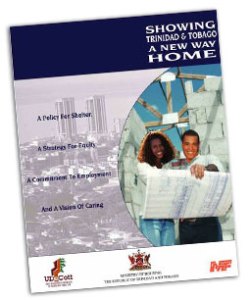 The
The  VIDEO: First Up Interview – 18 May 2010
