On Thursday 14th July, the EFCL published a full-page response to the first article in this series – it was also the same day that the second article in this EFCL Query was published. Although it was comforting to see the clear statements on EFCL’s ‘speak out’ component, Whistle-Blowing policy and procedure and Fraud Policy, the central concerns are greater, if anything.
I deliberately used the word response, since no reasonable person could consider that advertisement to be a reply to my emailed queries.
If EFCL were really replying to my query, it would have been no problem to provide a copy of the documents and answer the simple questions.
EFCL’s preferred course of action is to spend more taxpayers’ money on expensive artwork and advertising, so the further question is ‘Why?’.
Considering that all I was doing was questioning the existence and origin of an important policy of this State-owned company, it is perturbing to be having this level of challenge in getting a simple clarification.
What could be the delay or difficulty in providing a copy of the EFCL’s Confidentiality Policy, as requested?
In the first article in this series, I posted the documents which had been passed to me. The simple question is whether these are the genuine documents. There was no attempt by EFCL to even answer that important query.
It is important because the EFCL advertisement told readers that “…Employees were not asked to sign under threat of dismissal…”
The first sentence of the preamble of the Staff Confidentiality Agreement is –
“All new and existing employees will be given a copy of this confidentiality policy and will be required to sign a confidentiality agreement at the time of hiring or during their service to the company.”
The emphasis is mine – yes, it reads ‘required to sign’.
But there is more, because the EFCL advertisement also stated that –
“Staff who asked for time to get external advice, were allowed to.”
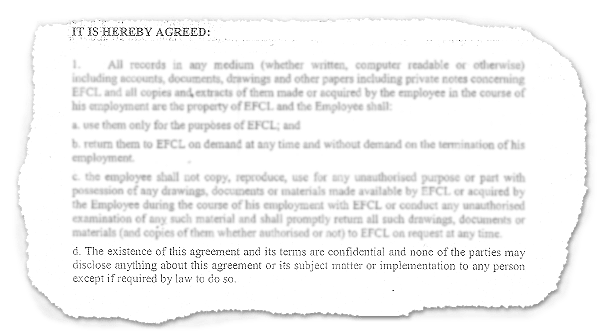
However, clause 1 d. of the Confidentiality Agreement states –
“The existence of this agreement and its terms are confidential and none of the parties to this agreement may disclose anything about this agreement or its subject matter or implementation to any person except if required by law to do so.”
It is clear that the EFCL advertisement and the documents sent to me cannot both be true.
So, which is true?
Why did EFCL not send or publish the documents?
Quite frankly, it appears that EFCL is making a great effort to conceal or obscure its true policy on confidentiality, for whatever reason.
If this is the kind of effort being put into obscuring the elementary policy of this State-owned company, I can scarcely imagine their reaction to queries on particular projects, Directors’ benefits or tender procedure.
The behaviour of the State and its agents must be exemplary. Public Officials have an obligation, in my view, to behave in a fashion which fosters trust and good order.
It is all starting to resemble a tangled web, sad to say.
Again, I hope that my doubts are misplaced.
SIDEBAR
Five simple questions for EFCL…
Is there a new EFCL Confidentiality policy?
When did that come into effect?
Would you please provide a copy of that policy?
Was that policy approved by the Board of Directors?
Is the Ministry of Education aware of this new policy?
Despite the first column in this series, I have had no direct reply or even acknowledgement from any of the EFCL officials to whom my initial queries were directed.
It seems that the people concerned would rather not write, on this matter at least. A meeting has been indirectly suggested, which of course would have to be properly recorded and minuted – no word on that meeting as I write again.
What could be the delay or difficulty in answering the five simple questions posed last week –
Is there a new EFCL Confidentiality policy?
When did that come into effect?
Would you please provide a copy of that policy?
Was that policy approved by the Board of Directors?
Is the Ministry of Education aware of this new policy?
Four of those questions require basic yes/no responses, while only one requires a date.
Expenditure of Public money – Accountability – Transparency = CORRUPTION
The elementary accountability of a public company having its policies available for the public to consider seems to be either lacking or of low priority in the case of EFCL. As we move along, it will be interesting to see how the Transparency part of the equation works out.
In researching this article, it emerged that our country is a signatory to two relevant international conventions. As I understand it, the effect of our State having become signatory to those agreements is that the country has adopted those standards.
The first one is the Inter-American Convention against corruption, which was signed by our country in April 1998. At that time, UNC was in power, under PM Basdeo Panday. At Article III, clause 8, we are obliged to
“…consider the applicability of measures to…create, maintain and strengthen…Systems for protecting public servants and private citizens who, in good faith, report acts of corruption, including protection of their identities, in accordance with their Constitutions and the basic principles of their domestic legal systems…”
The second convention is the United Nations’ Convention against Corruption, which was signed by our country in December 2003. At that time, PNM was in power, under PM Patrick Manning. At Article 8 – Codes of Conduct for Public Officials, clause 4 obliges us to
“…4. Each State Party shall also consider, in accordance with the fundamental principles of its domestic law, establishing measures and systems to facilitate the reporting by public officials of acts of corruption to appropriate authorities, when such acts come to their notice in the performance of their functions…”
So, what is the big secret?
I do understand that staff at companies like this can jeopardize the integrity and effective operations of the organisation by leaking certain confidential information. That would be a proper concern of management and a confidentiality policy is one of the ways that could be dealt with, just one.
During the Uff Enquiry, UDeCoTT claimed several times that this or that document was confidential and used its lawyers to protest strongly, sometimes even seeking the protection of the High Court. That was outrageous conduct by a state-owned company, which appeared to be trying to frustrate the Uff Commission, appointed by the State, by seeking to conceal documents. A case of ‘the tail wagging the dog’.
This situation is one in which it seems that the dangers of leaks in relation to tendering estimates, for example, has been conflated to cover all information in the company. It appears to be part of a new policy which does not conform to either good labour relations or our country’s international obligations with respect to Whistle-Blowers.
Given the electoral promises made by this government and the importance of the struggle to reduce the menace of corruption in our society, it is very important for us to be attentive to these matters.
UDeCoTT wanted to conceal certain documents and one had to wonder why, given that they are not involved in secret work. If it was not so serious it would be comical, they are not a spying, military or health institution. UDeCoTT is just a facilitator for erecting buildings, yet their chiefs were able to pretend to the public that a large part of what they did was confidential. That kind of secrecy could never be in the public interest. Not ever.
Similarly with EFCL, one has to ask – What is the secret? That organisation is responsible for the repair and maintenance of schools, using Public Money to do so.
I wonder if that document, which a number of EFCL staff have now been required to sign, is legal and binding? Could it withstand a challenge in the Courts? Did EFCL take proper legal advice in this matter? Was that advice followed?
The legitimate interests of taxpayers require that the management of State Enterprises take proper steps to handle these integrity challenges – Does the EFCL Confidentiality Agreement achieve this?
There is a certain kind of way in which this episode with EFCL is starting to remind me of the early UDeCoTT grappling, before Uff and so on, with tremendous difficulty in getting basic dialogue going, shadow-boxing and bizarre positions being taken.
I really hope that I am wrong, because the correct, encouraging attitude to Whistle-Blowers is essential for the success of the larger Public Procurement agenda.
Continuing the series of examinations into the purpose and performance of our State Enterprises, this week I am looking at an important issue which seems to be emerging at the Education Facilities Company Ltd. (EFCL).
EFCL is a state-owned company involved in the building and maintenance of schools. It consumes public money in the execution of its functions and that is why it is important to put these points now.
One of the biggest public concerns is the high level of white-collar crime, which means bribery, corruption, fraud, over-billing, ‘back-fitting’, tax-evasion, asset-stripping and so on. White Collar crime is a growth industry, since the rewards are very high, while the risk of being caught or punished is extremely remote.
Due to the size of the State, a great deal of that white collar crime can be found in State Institutions. Once Public Money is being spent, we must demand a high standard of accountability and transparency.
In terms of principles, there needs to be an appropriate balance between the long-established ‘Right of privacy‘ in commercial transactions and the growing ‘Right to know‘ which is part of the emerging social order. There will be different views as to where the correct balance exists and furthermore, the consensus position will shift as time passes.
It seems to me that the default position should be that, in doubtful cases, the right of the public to information should prevail, since we are the ones paying the costs. Indeed, that position forms part of the Freedom of Information Act, so that is substantial support.
In early 2009 we witnessed an attempt by the then PNM government to amend the Integrity in Public Life Act (IPLA) so that people reporting breaches of that Act would have been forced to give their names and addresses. That arrangement would have given even greater protection to corrupt officials, since virtually no-one would want to make a report. Of course people are strongly encouraged to report ‘normal’ crime like rape, robbery, murder and so on – further encouragement is offered by allowing them to make anonymous reports via 800-TIPS, for example. Those proposals to amend the IPLA would have encouraged corrupt behaviour by reducing the reports.
That Bill was piloted by then Attorney-General, Bridget Annissette-George. The proposals were strongly opposed in the Parliament and in the wider society, eventually being withdrawn. One of the strongest protestors in the Parliamentary debate was Dr. Tim Gopeesingh, who was reported to have accused the government of trying to intimidate people into not making reports. [Hansard, 1 May 2009 p.441] On that occasion, the Standing Orders were used by Colm Imbert, to curtail Gopeesingh’s presentation. [Hansard, 1 May 2009 p.455]
The normal good governance provisions for annual accounts, Board Meetings, minutes and so on are very important. But those provisions must be supplemented by an atmosphere and a series of institutional arrangements which facilitate Whistle-Blowers. There must be clear channels and protection for Whistle-Blowers if we are to have any chance of reducing corruption in our country.
Without the assistance of Whistle-Blowers, we would not have known of the Piarco Airport or UDeCoTT fiascos and we know for sure that somebody leaked the file on the Heights of Guanapo Church just prior to last year’s election. We need encouragement for Whistle-Blowers – in some countries they are even given big cash rewards. The JCC has been active with its partners – TTMA, the Chamber of Commerce and the Transparency Institute – in making Public Procurement proposals to the Joint Select Committee. An important element of those proposals is the creation of proper channels for Whistle-Blowers.
I recently received a copy of some EFCL documents, which were stated to be their new Confidentiality Policy Statement and a Staff Confidentiality Agreement for the signature of employees. I was also told, separately, that EFCL staff are being required to sign that Agreement, under threat of dismissal. What is more, the Agreement contains a specific clause which forbids revelation of either the existence or the terms of the agreement.
If those documents are genuine, there are serious grounds for concern, so I made a written query via email on Friday 1st July to the EFCL’s CEO, Paul Taylor, and its Chairman, Ronald Phillip. I outlined what had been reported to me and asked these questions –
I am reliably informed that EFCL staff were recently directed to sign a ‘Confidentiality Agreement’, the rationale being that it is the new Company policy.
Before taking this any further, I am requesting your written response to these questions –
Is there a new EFCL Confidentiality policy? When did that come into effect? Would you please provide a copy of that policy?
Assuming a new Confidentiality Policy is in place, these are my queries –
Was that policy approved by the Board of Directors?
Is the Ministry of Education aware of this new policy?
I would appreciate a timely response.
With best wishes. Afra Raymond
That email was also copied, purely for information, to the Minister of Education. At the time of writing, there has been no acknowledgment or reply.
This is a serious development for these reasons –
The Super-Confidentiality provisions mean that staff are forbidden to obtain any advice, which seems to be a breach of good labour relations, at the very least.
The unilateral imposition of this new document does violence to the proper meaning of the word ‘Agreement’.
The ‘Guiding Principles’ at page 2 refer to ‘privileged information‘ and ‘EFCL’s right to privacy‘, both of which seem to me to be leading away from greater transparency and improved procurement procedures – which leads into the final point
This administration promised, both on the campaign trail and post-election, to make new procurement legislation a priority. The Joint Select Committee on Public Procurement was Chaired by Dr. Tim Gopeesingh, Minister of Education. EFCL is the principal State Enterprise within the Ministry of Education, so what is Dr. Gopeesingh’s position on all this? Is this taking place with Dr. Gopeesingh’s knowledge and/or approval?
It is clear to me that this kind of stealthy restriction on the possibility of staff becoming whistle-blowers is incompatible with the high-profile public statements of support for a new, effective public procurement system. Those statements range from the promises at page 18 of the People’s Partnership Manifesto to numerous speeches by the present Prime Minister.
The reality is inescapable –
Expenditure of Public money – Accountability – Transparency = CORRUPTION
I am closing by wondering, aloud, if this is the shape of the new Information policy for our State Enterprises.
SIDEBAR: What is a Super Injunction?
It is possible for a prominent person to obtain a Court Order called an injunction to prevent the publication of material which is likely to be damaging to their reputation. That is a long-standing legal right and there has been a recent series of decisions in the UK in which super-sensitive, high profile people have been able to obtain ‘Super-injunctions’ from the High Court, which have the effect of prohibiting the publication and further prohibiting revealing the very existence of the injunction itself. Of course the media have been fighting that in Court and there are two investigations underway into whether the ‘Super-Injunction’ is itself an abusive instrument. The emerging thinking seems to be that these ‘Super-Injunctions’ are destroying the information balance I outlined earlier.
This EFCL Confidentiality Policy, if it is so, would seem to be a similar device, doing great violence to the information balance.
Once again, I am using this edition of Property Matters to consider the ever-controversial State Enterprises, against the wider question of the role of the State. This is no small area for examination and I start by using what seems to be the favourite quote of Trade and Industry Minister, Stephen Cadiz, “Government has no business running business“.
Given the politics practiced here, it should be no surprise that all our political parties give emphasis to the important role of the private sector in the economy and society and so on.
The line of reasoning goes like this – “The State is only here to facilitate and clear the way for Private Enterprise. The State does not intend to stand in the way of or compete with Private Enterprise” Those are not actual quotes, but they are just a paraphrasing of the sentiments expressed by various politicians over the years, whatever the party in power.
But the actual scale of the State’s involvement in the economy is in stark contrast to the political speeches. It is my view that the State is in direct competition with the Private Sector in significant areas of the economy. The large numbers of State Enterprises are inescapable examples of that.
We have to remember that it wasn’t always so. A major part of the physical development in this country took place via the Ministries and without the involvement of any State Enterprises. For instance, all the Primary Schools, Government Secondary, Junior and Senior Secondary Schools were built by the Ministry of Education. All the Health Centres were built by the Ministry of Health and the Highways etc – up to the recently-opened extension to the Diego Martin Highway – were all built by Works & Transport.
Our State apparatus is huge, expensive and mystifying.
Growing up in the 1960s and 1970s, I can only remember a few State Enterprises – BWIA, TTEC, WASA, TELCO, Caroni, NP, NHA, PLIPDECO and maybe TRINTOC. That sector grew hugely since that time. So today, for a country of about 1.4M people, we have 26 Ministries, 73 Government Bodies and 58 State Enterprises (according to ttconnect – The Government of Trinidad and Tobago portal). To me, those are staggering numbers. There is more on that in the sidebar.
Clearly the tendency is for that sector to grow, I cannot remember the last time the State disposed of any of their companies. That seems to be given serious consideration only when there is an absolute crisis of the sort which confronted the NAR government in the late-1980s downturn.
In terms of expense, just consider that the 2011 Budget has an anticipated capital expenditure for the State Enterprises of $6.725Bn. That figure is only for projects and so it excludes the salaries, rents and normal running expenses of those companies.
In this article, I am going to start asking about the State Enterprises which are in the Construction/Property field. Those are, in descending order –
UDeCOTT – Urban Development Corporation of T&T
HDC – Housing Development Corporation of T&T
MTS – National Maintenance, Training & Security Company Limited
NIDCO – National Infrastructure Development Company
EFCL – Education Facilities Company Limited
RuDeCoTT – Rural Development Company of T&T
East POS DV Co – East POS Development Company
Some people would include National Insurance Property Development Company (NIPDEC) near the top of that list, but that is not a State-owned company, although many times one would be forgiven for thinking so.
Given the serious allegations of corruption at UDeCOTT leading to the Uff Commission and the continued public concerns on the State Enterprise sector, we are entitled to ask some searching questions.
There has been tremendous growth in the size of the State since independence. Some doubts arise when one tries to consider why we now have so many of these State Enterprises. Even more sobering than the purpose for their existence, are the questions of what has been the real performance of these State Enterprises.
When one considers that the State Enterprises listed are required to engage consultants and enter contracts for those construction works, the question has to be – What value do they add to the process of State procurement?
In the case of both UDeCOTT and the HDC, these State Enterprises are operating without accounts for several years and therefore in breach of the elementary rules of governance. UDeCOTT’s last accounts were at the end of 2006 and NHA/HDC has had none since 2002 (I am informed that HDC recently filed its 2006 accounts). In neither case have the Directors of those companies been sanctioned in any way.
Two of the hugest State Enterprises operating as rogues in a manner which is impermissible by Private Sector norms. Even Lawrence Duprey’s CL Financial group had to publish its accounts within a year.
We have a large, subsidized State Enterprise sector, all paid for by taxing the very people against whom they are competing. That is ‘advantage with a V’.
We need to ask how compatible is this arrangement with our National Development?
I am saying that it is hardly possible to blame this administration for the errors and excesses of the last one, but the honeymoon is running out fast. Some say it is already done.
The point is that there is now an opportunity to engage in some reflection as to the purpose and performance of these huge State Enterprises.
In relation to the property and construction sector, there is also a recently-announced and large-scale national planning exercise taking place in two parts. That is also a good reason to pause to review the character and pace of the State’s activity, particularly in the construction sector.
At the strategic level, there is no clarity as to the purpose of these State Enterprises.
At the level of performance, there is little evidence of value-added, far less value for money.
At the level of Corporate Governance and the transparent management of taxpayers’ dollars, there is extremely poor performance with no apparent intention to penalise the wrongdoers.
This sector of the State is in need of urgent, public and thorough examination.
SIDEBAR: What are the real numbers?
According to the Supplementary Public Sector Investment Program 2011 (p.5) – “…The State Enterprise Sector is comprised of fifty eight (58) companies of which forty seven (47) are wholly owned, six (6) majority owned and five (5) in which Government has a minority shareholding…”
But the TTConnect website shows only 38 State Enterprises on a list which excludes HDC, UdeCOTT, RuDeCoTT, EFCL, VEMCOTT and East POS Development Company. That list also includes the Securities and Exchange Commission – which had never seemed to fit the profile of an enterprise – and Trinidad & Tobago Mortgage Finance, which is only 49% owned by the State, according to their own website.
UDeCOTT Board with Planning Minister Sen. Mary King
Last week’s cover story in the Trinidad and Tobago Guardian paper was of the same title. Readers were treated to a two-page article introducing UDeCOTT’s new Board of Directors and offering several views from the re-appointed Chairwoman, Jearlean John.
As a long-time UDeCOTT-watcher, I was really pleased to see their new Board appointed, but John’s opening quote in that article was provocative in the extreme. Speaking about the scandalous International Waterfront Centre (IWC), UDeCOTT’s flagship project, John is reported to have mused “…Whatever else he did, he did that…” Ms. John was referring to the now-departed Calder Hart.
Truer words were never spoken, but yet it was a provocative opening. How so?
Despite the regime change, it seems that the IWC remains UDeCOTT’s flagship project. On the one hand, its admirers point to the architectural merits of the complex and the repeated claims that it was completed on time and within budget. On the other hand, it is a monument to a chronically-flawed process of project conception and approval, being one of those classic ‘white elephant’ projects, with a ‘break-even’ point at some point in the distant future, if ever.
The IWC represents a serious paradox in the entire UDeCOTT fiasco, but more interestingly, it offers an insight into the extent of the issues facing that State-owned company. Yes, there is an unbroken thread of unreason through this flagship project to the bigger picture.
I will move from the general to the particular.
To begin at the very basic level, UDeCOTT has published no audited accounts since the end of 2006. Yes, that company, one of the hugest in the country, was operated throughout its period of greatest activity without audited accounts. Quite seriously, that indicates a far larger failure in terms of the rules and guidelines for State Enterprises, the oversight of the Parliament and of course the sheer dereliction of the Cabinet. At one point in the Uff Enquiry, UDeCOTT’s attorneys stated that it was a $12Bn company. Of course, the last Prime Minister repeatedly told the public that UDeCOTT was a leading State Enterprise.
At the Uff Enquiry, Calder Hart was questioned under oath by Alvin Fitzpatrick SC, the JCC’s attorney – the relevant extract is at http://wp.me/pBrZN-51 – and said on 28th January 2009 that all the issues with UDeCOTT’s accounts had been resolved. He went on to say that the accounts would be published shortly. Of course that has never happened, so we have to ask why.
In March 2010 I made yet another public call for the publication of those accounts. But even worse, according to a Newsday article on 18th March 2010, Jearlean John, the newly-appointed Chairwoman said
“…Explaining that she adheres to “good corporate governance” in her professional life, John said Udecott will adhere to the law and the standing accounting practices as outlined by the law…”
That published promise was never delivered.
The simple fact is that we cannot continue talking about performance and good governance, far less change, without knowing the condition of our largest State Enterprises.
That is a serious and inescapable point. We were sorely disappointed by the wanton mismanagement of the last regime and its consequences on the State Enterprise sector. The State Enterprises cannot and will not function if the actual strategy is unsound. The State Enterprises are meant to be servants to the Central Government.
I expect better from you both, Minister Mary King and Chairwoman Jearlean John. Much better. No continuation of the past follies and shameless excuses. I am saying plainly to you, Ms. John, that you promised us these accounts nearly a year ago and we have nothing. Sad to say, but a little further and your statements on this important matter could echo Hart’s, as he told his tale.
That article in last week’s BG stated that the new UDeCOTT Board would consider financials for 2008, 2009 and 2010 at its first meeting. No mention of 2007 and I hope that was a mis-print.
Where are the UDeCOTT accounts? What is the mystery? Are the issues resolved or not? Is there yet another ‘Code of Silence’ surrounding this nexus between Calder Hart, the PM’s office and PriceWaterhouse Coopers?
But what does the IWC have to do with all this?
You see, the various UDeCOTT supporters have continued to applaud this project as the flagship and a leading example etc. etc.. Even Jearlean John seems to be going in that direction.
So here are a few facts on that project –
The break-even rent – This is the rent a project needs to earn to repay its cost (those costs include land, professional fees, construction and finance – they do not include for profits or maintenance). In the case of the IWC, that break-even rent was calculated by me, in this column and prior to the Uff Enquiry, as being of the order of $30 per sq. ft. Please note that rents of good quality space in POS at the time this project was approved would have been in the $12 psf range.
The Feasibility test – I questioned Calder Hart under oath at the Uff Enquiry and he stated that only one UDeCOTT project had been the subject of a feasibility test- the very IWC. He stated that its ‘break-even rent’ was ‘…under $20psf…‘, but when I questioned what was the value he had attributed to the land, he replied ‘NIL’. Bogus and unprofessional approaches to massive investments. Hart was prepared to omit the property in order to carry out a feasibility test on a property development. That is the sheer scale of the failure we are looking at. All these projects were approved by the Cabinet, according to Manning’s 13th May 2008 statement to the Senate.
The financing model – UDeCOTT’s 2006 Annual Report was strong on the point that that project in particular did not require a State letter of comfort or guarantee. It was meant to demonstrate the scale of achievement and independence.
When will the IWC break even? – The best offices in POS are rented in the $15 psf range and the IWC comprises some 900,000 sf of offices – that is about nine times the size of the Nicholas Towers on Brian Lara Promenade. Due to its size, it would be reasonable to expect the IWC to fetch a rent of about $12-13psf now, if one were fortunate. Given that background, it seems that this project will never break even.
If UDeCOTT’s best project will never break even, the entire company must be insolvent or so close as to not make a difference.
If their best project is a big-time loser, it is no wonder that the last administration was reluctant to publish UDeCOTT accounts. The very year (2006) that project started was the very year the accounts stopped being published.
The profitability of the Hyatt, which was reportedly cited by John in last week’s article, needs to be backed up by those accounts. In any case the unprofitable offices far eclipse the Hyatt.
It is clear that UDeCOTT’s new Board have a heavy task before them in terms of fixing its many ills, but they need to start with an honest and straightforward approach. If the country has to count our losses, you need to do so now, Chairwoman John. Do so.
There has been a recent, refreshing discussion on the shape and necessity of our welfare state. The Welfare State is used to refer to the various administrative arrangements which redistribute the nation’s wealth to assist the more needy citizens in our midst.
The discussion was initiated in the T&T Review of January 3 in Gregory McGuire’s thoughtful and solidly-based review of the welfare spending trends and their wider consequences. The responses ranged from a two-part article (Part I & Part II) in the Express from Professor John Spence, with an attempted rebuttal from Dr. Errol Mathura in the same newspaper. From the Guardian, there has been a serious commentary on Sunday 16 by Dr. L Trevor Grant – ‘Curb escalating poverty in rich T&T’ – and the editorial of Monday 17, dealing with the fate of the empty HDC houses.
That Guardian editorial – ‘Housing Shame’ – was based on the reports of an investigation into the situation at several of the HDC virtually-completed, but unoccupied housing projects.
Sunday’s Guardian headlined with ‘Scandalous’ on an abandoned $156M HDC project and that is my point of discussion on this Welfare State matter. The empty homes built by the HDC are symbolic of a serious need to re-examine our housing policy.
Above and beyond the case of the vandalized HDC homes, the fundamental public housing situation is scandalous. Scandalous is my word to describe a policy of allocating of scarce resources to build homes, without satisfying the needs of the poorest applicants. That is a blatant misallocation of public resources.
As I wrote in the Trinidad Guardian newspaper in 2007, our housing market is divided into 5 layers, moving from the neediest to the wealthiest –
Homeless – People who have nowhere to live or rely on charity for shelter.
Permanent Renters – People who can never afford to buy.
Transitional Renters – People who are renting now, but will end up as home-owners.
Home Owners – People who own their homes.
Multiple Home-owners – People who are wealthy enough to own more than one home – these people are also the ones who rent property to the others.
According to the latest figures released by the Housing Development Corporation in March 2010, there are over 10,000 empty homes in their stock of newly built units. In addition, there is a waiting-list of hopeful applicants believed to be in excess of 100,000 people. How can we reconcile those figures?
Dr. L Trevor Grant is the only author, to my knowledge, to have written on the plight of the homeless in our society and his column in Sunday’s Guardian gave telling details on the level of need in those communities.
We have constructed a national housing policy which pays only lip-service to the housing needs of the poorest applicants. The clear preference – PNM or PP – is for the applicants who qualify to buy a home from HDC. That is the only explanation for the reality of 10,000 empty new homes and 100,000 waiting applicants.
There have been some recent handovers of new HDC homes to applicants featured in the press and those have all detailed the incredible length of time these applicants waited for their new homes. Waiting periods in excess of 20 years have been mentioned.
There is a severe disconnect between these expensive policies to provide subsidized housing and the reality of being a poor applicant on HDC’s waiting-list.
At this point, an estimated 76% of our people live in owner-occupied property. That is comfortably above the comparative figures for the USA or the UK, where the numbers are in the 68-69% range. It seems clear that we are approaching the limits to which we can realistically grow home-ownership in our country. In some ways we may already have exceeded those limits.
Another point I detailed in my 2010 series ‘Housing Policy Imperatives’, was the nature of the housing subsidy being offered by the HDC. For example, if the HDC sells a home with a market value of $500,000 to an applicant for a price of $325,000, the difference between those two figures is the housing subsidy. Yes, in this example there is a $175,000 housing subsidy to each of those people who buy those homes from HDC.
The big question is – if the HDC can afford to provide these benefits to applicants in the layer of ‘transitional renters’, what are the levels of subsidy and number of new homes being provided to those in the poorer layers?
If that relationship does not improve to favour those who cannot ever afford to buy, we will be stuck in an increasingly frustrating housing fix.
The housing fix is notable for the inequity with which the country’s scarce resources are allocated and the hopelessness of the poorer applicants.
There are also secondary problems which run very deep and those include the issues highlighted in the Guardian’s story on the abandoned HDC estate.
What is the cost of securing all these virtually complete, but vacant homes? I am reliably informed that the annual cost of security is of the order of $50M, yet there are still significant episodes of vandalism and squatting.
Additionally, we have to factor in the cost of maintaining and repairing the unoccupied homes. Empty properties deteriorate at a faster rate and that is a cost to the HDC which could be avoided by putting people to live in these empty homes.
The estimated annual sum of $50M to secure these homes is staggering. That sum of money could build over 200 badly-needed low-income homes every year.
HDC Board
There is a newly-appointed HDC Board and the time is now opportune for a review of this important Welfare State policy.
A critical factor in all this is the role of rent controls, since the long-established rent control boards were allowed to wither on the vine by the last administration.
Rent controls and the planning regime need to form a part of the Housing Policy Review.
This is the time to reflect on the changes we have witnessed in the last year and the several challenges arising from those. This column will attempt to combine the ‘Property Matters’ concerns with the ongoing examination of the CL Financial fiasco.
The Uff Report
Professor John Uff
For me, the largest single event this year was the completion of the work of the Uff Commission of Enquiry into the Public Sector Construction Industry, with particular reference to UDeCOTT and the HDC. The controversial Commission of Enquiry was at the centre of widespread public concerns as to the level of corruption in the State construction sector. To his credit, the Enquiry Chairman, Professor John Uff QC, PhD, insisted that the proceedings be televised and the results of each day’s hearings were also posted to its website.
The Uff Report made history in this country, since it is the first time that a government has published the Report of a Commission of Enquiry. That is no small accomplishment and despite the fact that these massive wrongdoings took place under the last PNM administration, the act of publication has to be welcomed.
But there are still challenges, because, for whatever reason, the Uff Commission’s website, www.constructionenquiry.gov.tt has now been shut down, which is a real pity, since it contains the important testimony of many witnesses on the issues in this area. That website needs to be re-opened and I am calling on the Attorney General, under whose Ministry the Enquiry was operated, to ensure that takes place. It is no large expense to have these important documents made available to the public. In light of their educative content, I would suggest that the actual documents be housed at UWI, as they have a direct bearing on the deliberations of the Engineering and Social Sciences Faculties.
Of course we had the sight of a fleeing Calder Hart and a defeated Patrick Manning, his PNM cohorts drinking bitter tea for his fever, all attributable in my view to the groundbreaking Uff Commission.
Looking forward, we have the fact that the 91 recommendations of the Uff Report were adopted by the Peoples Partnership in the run-up to the 24th May General Election. We have now been promised that those are to be implemented by Minister of Justice, Herbert Volney. We await Volney’s early report as to the implementation.
In that connection and taking from the PNM example, I am, once again, calling for the publication of the report of the Commission of Enquiry into the Piarco Airport project. The Bernard Report must be published now.
CL Financial bailout The other huge event of the year was the budget speech on 8th September 2010, in which Finance Minister, Winston Dookeran, disclosed publicly that he was revising the terms of the CL Financial bailout. That bailout was a hugely suspect act, the largest financial commitment ever undertaken in this country, without proper due diligence or even any proper ventilation in the Parliament. Our Republic had never been so financially violated and in broad daylight. It was encouraging to see the Finance Minister take the point to its logical conclusion and of course that brought about the large-scale organisation of various aggrieved groups to put their point.
That series of organisations, committed to the doubtful mantra of the guaranteed investment – whatever that is – took on a series of bizarre and increasingly combative stances. The signature theme being that ‘We are not responsible for our decision’. We were being treated to a spectacle worthy of any of the ‘Ole Mas’ presentations of yore, in which successful investors – on average at least $700,000 was invested by each of these ‘protestors’ – having benefited from the operation of the capitalist system were seeking 100% redemption from the State.
The entry of the Prime Minister into this debate on 1st October was in my view a turning-point in our development. For the first time in my memory a politician, who had the majority, to achieve the significant changes which had been tabled, stepped back from that act of sheer power to attempt an act of persuasion. It was a signal lesson in the reality of possibility in our lifetime. Even if one is amongst the Clico Policyholders’ Group (CPG) and feeling aggrieved, the calm audacity of the Prime Minister’s decision must be respected.
Most importantly, we now have a one-man Commission of Enquiry established with the eminent UK jurist, Sir John Colman QC sworn in. That Commission is to examine the causes of the CL Financial and Hindu Credit Union collapses. The Colman Commission is expected to start sittings in January 2011 and the Attorney General has directed that its report be delivered in 6 months’ time.
The Manning Factor
Patrick Manning
The most comical event of the year is the bold-faced attempt by the former Prime Minister, Patrick Manning, to shift attention away from the PP’s revelations as to the illegal spying activities of various State agencies. Manning, the original PM, attempted to show-up the Prime Minister, Kamla Persad-Bissessar, with a series of allegations on the status of a house being built with private funds on private lands for a private purpose. The Prime Minister effectively dismissed Manning’s concocted concerns with the telling observation that all the refutations she quoted were available from the public record, if the accuser had ever been interested in examining that open source.
Having stirred to life and found his voice, it is important to note the several matters on which Manning maintains a stony silence –
Calder Hart – Where is Calder Hart? The nation was told solemnly by Manning that he knewCalder Hart’s whereabouts and further, that Hart was not a fugitive. We are now told that Calder Hart cannot be located and Manning needs to speak on this. Is it true that Hart gave Manning his location? Has Hart changed locations? Or is it that Manning has not shared that information with the correct authorities?
Election rationale – What, if any, was his rationale for calling the general election at mid-term? I am not sure that anyone knows the answer to this one, but it is surely of continuing interest.
Guanapo Church – What is the truth behind the ill-fated Guanapo Church? It is not my habit to wax scriptural, but that was a ‘house built on sand’ if ever we saw one. The reason for the State Grant of this land and the rapid grant of full planning permission – a record of only one month between the date of application and the grant – remains unexplained. As for the architect’s plans for this huge church in the grounds of the PM’s residence, the mind boggles. Where is Pastor Pena? We need to insist that Manning tells us more about this miraculous church.
Cleaver Heights – Another area is the wild allegation Manning made, at the close of the 2008 budget debate, as to a ‘missing’ $10M at an HDC project at Cleaver Heights in Arima. Or was it $20M? After inserting that case into the ongoing Uff Commission and having the embarrassment of having the allegation evaporate under cross-examination, Manning needs to tell us just how he came to learn of this allegedly missing money.
CL Financial bailout – Manning’s conduct in this matter has been the crowning-point of his administration, in my view. The then Minister of Finance, Karen Nunez-Teshiera, was accused of using ‘inside information’ to make early withdrawals of her own funds from the CL Financial Group and to compound the mischief, being a shareholder of the CL Financial group in the sum of over $10M. Manning’s steadfast defense of his beleaguered Minister of Finance was a display of loyalty which is seldom seen in higher political circles. We need to know if the Minister told her colleagues that she was indeed a shareholder of the troubled group. Did she or did she not recuse herself from the Cabinet’s deliberations? My reading of the events, as told by the very Minister, is that she did not.
For Manning to fail to come clean on these questions, he would run the risk of damaging his hard-won reputation for upstanding values and leadership.
White Collar Crime The obvious connection between these various events is the fact that White Collar Crime – which is sometimes, mistakenly, called victim-less crime – is afflicting our country in a big way.
The year ahead holds significant challenges as we try to go forward in this morass, to escape the conspiracy which I have titled The Code of Silence.
The only way political rulers can carry on as they do, wasting the country’s money for the benefit of their friends and family, is because they are sure of each other’s silence. The people in the private sector who were responsible for the financial collapse are no different. The financial collapse is not, as some have falsely claimed, in any way connected with the Wall Street crisis. That is only a handy coincidence. If our regulators and politicians were doing their jobs we would not be in this position.
Please remember that the alarm bells on CL Financial were sounded by Trevor Sudama, since the 1999 budget debate. More to the point, many of the people who still inhabit the Parliament were there at the time. Again, I give this administration credit for appointing a Commission of Enquiry into this sordid affair.
Also, please remember that both UDeCOTT and the HDC failed to file accounts for years, in breach of the law and State guidelines. That failure was not remarked upon by members of the then Opposition. More to the point, we have now had a change in administration, with no word on the UDeCOTT accounts. I do acknowledge that certain HDC accounts have now been published and that is to be the subject of upcoming commentary.
The Code of Silence must be broken if we are to progress.
 Despite



 Once again, I am using this edition of Property Matters to consider the ever-controversial State Enterprises, against the wider question of the role of the State. This is no small area for examination and I start by using what seems to be the favourite quote of Trade and Industry Minister, Stephen Cadiz, “Government has no business running business“.




 The other huge event of the year was the budget speech on 8th September 2010, in which Finance Minister, Winston Dookeran, disclosed publicly that he was revising the terms of the CL Financial bailout. That bailout was a hugely suspect act, the largest financial commitment ever undertaken in this country, without proper due diligence or even any proper ventilation in the Parliament. Our Republic had never been so financially violated and in broad daylight. It was encouraging to see the Finance Minister take the point to its logical conclusion and of course that brought about the large-scale organisation of various aggrieved groups to put their point.
 The obvious connection between these various events is the fact that White Collar Crime – which is sometimes, mistakenly, called victim-less crime – is afflicting our country in a big way.
