Learning the Lessons of the UDeCOTT fiasco: Part 2

There has been a powerful and positive response to the first column in this series.  The reflections continue, as they must.  No time for distractions, in this election season.

Last week I paused with the promise to spend some time examining the Special Purpose Entity (SPE) model and its role in national development.  This week, I continue the reflection with focus on the Directors of these companies as key players in the sector.

One of the fascinating aspects of the Uff Report is its discussion of the nature and extent of the independence of the Special Purpose Entities.  Obviously, that discussion was mostly focused onto UDeCOTT and the reporting relationship with its line Ministry.

Some main points would be –

  • Multiple Directorships
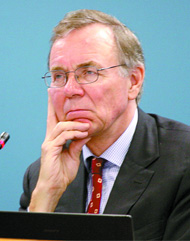
    Calder Hart. Photo courtesy Trinidad Guardian
    Calder Hart

    One thing which is clear from the Calder Hart episode is that one individual had control of a vast slice of State resources.  Hart was Executive Chairman of UDeCOTT, Chairman of the Home Mortgage Bank, Trinidad & Tobago Mortgage Finance, the National Insurance Board (NIB) and the National Insurance Property Development Company (NIPDEC).  He obviously enjoyed a tremendous level of confidence at the very highest levels of government.  It is equally clear, from the Uff Report, that that confidence was woefully misplaced.  Even in the early days of ‘Corporation Sole’ we have never had an individual invested with so much power.  It seems that this individual never had to answer to a Chairman, since he was head of all the Boards he sat on.  Is that a healthy precedent?  For those who would be quick to say that he has been found guilty of nothing, please note that this is the same individual who described himself to the Uff Commission as  –

    Q.      Yes.  But your lawyers misdescribed you in these proceedings as a financial expert.  You would not agree with that description?
    A.       I would not describe myself as an expert of anything.

    See – ‘End-notes on the Uff Commission‘ at http://www.raymondandpierre.com/articles/article77.htm

    Yes, that is the same individual who stated, under oath, that all outstanding issues with the audited accounts of UDeCOTT had been resolved and that we could expect those in February 2009. Yes, that is the man who was in charge of our national savings and pensions.  And yes, I will write it – He could not do such in Canada.  I am saying that no single individual could properly discharge all those functions.  No way.  The fact that so much trust was reposed in that particular individual is indicative of a distorted sense of values.  Time to think again.

    A similar set of contradictions exist with the outspoken Independent Senator, Michael Annisette.  See – https://afraraymond.wordpress.com/2008/01/12/an-unhealthy-choice/.  Incredible as it might seem, Annisette’s position is even more complicated than Hart’s.

  • Over-burdened Directors – Quite apart from the particular issues which beset these two individuals, there is broader issue to consider.  Do  we draw our Directors and leaders from a sufficiently broad cadre of people? In terms of both the State sector and the private sector, it seems to me that we have similarly narrow channels from which we make these appointments.  I am not at all sure that the private sector can claim a superior method or results in terms of over-burdened Directors.  The result, as was clearly the case at UDeCOTT, can be a poor quality of strategic decision-making and lax oversight of the company’s affairs.  That is a sorry result, given that those are core Board functions.One key lesson we should be able to draw from this is that there is no way people can function with this level of multiple responsibilities.  We now need to develop a new set of guidelines for these important roles.  The UDeCOTT episode must not only be used to critique the public sector, for there are surely examples of over-burdened within the private sector as well.
  • Under-development of our society – A paradoxical aspect of the situation is that the thrust to rapid development is given as the rationale for the Special Purpose Entity, yet the method of deployment is somewhat counter-productive.  I am saying that the cadre of people from which we draw our Directors and leaders needs to be wider if we are really to develop our potential as a nation.  That also applies to the private sector, since the prevailing instinct seems to be that we pick people with whom we are comfortable for these leadership positions.  Very understandable, whether we are speaking about the public or private sectors, but the act of restricting the ranks of leaders is itself inimical to our development.
  • The proper role of the State – I am also saying that the State must behave in an exemplary fashion.  That is very important, given the corrosion of proper standards we are living through.  The State has an indispensable role to play in national development and that is not just limited to  construction.

What we saw at UDeCOTT was rampant expediency, with good management and internal controls being violated at every turn.  All in the interest of achieving targets and developing the country.  Huge contracts granted via sole selective tendering, without competition. That means they gave the contracts to their chosen contractor and consultants.  Yes, just so.  Huge payments made before works were done or materials purchased.

Yes, expediency was allowed to eclipse good governance and accountability.  The interest of the taxpayer was jeopardised, supposedly all for the benefit of said taxpayer.

We can now soberly put the question – ‘What was it really all for?

SIDEBAR

The Ordinary citizen

I am also asking that our Prime Minister give details of his conversation with Calder Hart.  Of course, one does not seriously expect an answer.  That, too, is a big part of the problem we are trying to probe with only our wits and words.

UDeCOTT’s Audited Accounts

This column is to be published on 22nd April, four weeks after Jearlean John held her first meeting with the UDeCOTT Board.  Readers might remember that Ms. John, citing her adherence to good standards of governance and professional conduct, promised to publish UDeCOTT’s audited accounts.  Those were last published at the end of 2006.  No accounts for 2007, 2008 or 2009.  Worse yet, no explanation at all.  I have had to dismiss some absurd attempts to explain that the delay has been due to the Uff Commission itself.  Those attempts emanated from a member of the Cabinet who definitely ought to have known better.  Ms. John is now making me wonder ‘What is the mystery?’ Is this one of those cases which gave rise to our folk saying ‘More in the Mortar than the Pestle’?

VIDEO: First Up Interview – 17 March 2010

VIDEO: First Up Interview – 17 March 2010

Afra Raymond sits with Fazeer Mohammed and Jessie May Ventour to discuss, among other things, the “battle” between the Government & the construction industry in Trinidad and Tobago. Video courtesy CNMG

  • Programme Air Date: Wednesday, 17 March 2010
  • Programme Length: 0:38:03

M

VIDEO: First Up Interview – 09 March 2010

VIDEO: First Up Interview – 09 March 2010

Afra Raymond sits with Fitzgerald Hinds and Jessie May Ventour to discuss an updated in-depth look at UDeCOTT subsequent to the resignation of its Executive Chairman, Calder Hart. Video courtesy CNMG

  • Programme Air Date: Tuesday, 9 March 2010
  • Programme Length: 0:43:23

Preparing for the worst – Some implications of a major earthquake on Trinidad & Tobago

Earthquake damage in Port-au-Prince, Haiti. Photo courtesy BBC.

We have all looked on in horror at the scenes of destruction and human suffering, experienced by our Caribbean neighbours in Haiti as a result of the strong earthquake on 12th January. Coming after the horror and attempts to assist, my mind shifted to the possibility of such a disaster in our country. That prompted me to attend the seminar organized by the Association of Professional Engineers of T&T (APETT) and the T&T Contractors’ Association (TTCA) at Crowne Plaza on Wednesday 3rd February. The seminar was excellent and such was the content that this week I am setting aside the other important matters with which I have been dealing.

The Structural situation

We heard several presentations from engineers and the President of the TTCA which set out the structural situation. Some of the main points emerging there were that we are at significant risk because –

  • “An approved national building code does not exist at this time, designers use building codes with which they are familiar,” Darryl Thomson, a standards officer at the Trinidad and Tobago Bureau of Standards (TTBS), said during his presentation.
  • “I would think generally we are not (prepared) and we need to seriously look at what we are doing and change the way we do business where the built environment is concerned,” President of TTCA, Mikey Joseph said.
  • Past-President of APETT, Mark Francois, told us of estimated multi-billion dollar damage to buildings if a natural disaster were to hit our main cities. “Potential building economic loss … in Port of Spain was of the order of US$5 billion and in San Fernando US$6 billion” Francois said. Francois went on to make 3 other important points – firstly, as a former British colony, our professionals had used British Standards up until the late 1960s, with the risk to us being that, since the British Isles are not prone, those standards did not take account of earthquakes. As a result, he stated that major parts of our civil infrastructure, upon which we would rely in a disaster, were not designed or built to withstand earthquakes. His example of the POS General Hospital being one such structure was sobering. Secondly, he stated that building plans are being certified by engineers who do not posses the necessary qualifications in structural work and that he had done assignments to re-design some of those ‘certified’ plans. Thirdly, he dealt with the well-known practice of engaging personnel employed with the regulatory authorities to draw plans for buildings and obtain permission. This begs the question as to how could a public employee on such a ‘PJ’ fail to pass their own plans.

These quotes were drawn from the Trinidad Express story on Friday 5th February – http://www.trinidadexpress.com/index.pl/article_news?id=161591595 .

The Seismic situation

The speaker on this aspect was Dr. Walter Salazar, Senior Research Fellow at the Seismic Research unit at UWI. The three main points from his presentation were firstly, that our country is indeed at similar risk as Haiti in terms of a strong earthquake. Secondly, the most likely areas for the strongest earthquakes are Tobago and the north-west peninsula of Trinidad, particularly Chaguaramus. Thirdly, we are now overdue for that strong earthquake.

The disaster-preparedness situation

The head of our Office of Disaster Preparedness and Management (ODPM), Col. George Robinson has confirmed, in light of natural public concerns, that our systems are in place to deal with such an earthquake. Knowing the individual, there is little doubt in my mind that the necessary diligence has been applied to developing solid systems.

What is the likely financial impact?

My concerns as to our level of earthquake-preparedness are rooted elsewhere and that is at the level of the ‘financial safety-net’ upon which we would rely in the event of such a disaster. Our low national savings rates have long been a concern of economists/financial experts. We do not save enough money, in the view of these experts, to propel our country’s journey to the next level of national development. My concern is the implied question of how we would cope with a destructive earthquake.

Add to that the fact that only a small fraction of our buildings are properly insured and a worrying element to the disaster-preparedness picture starts to emerge.

Aside from the structural concerns and seismic risks as outlined above, there is a question as to the nature and extent of our financial safety-net. Where will we find the money to rebuild? Our lending institutions need effective systems to ensure that the properties they hold as security are properly insured.

Such an earthquake would also damage our infrastructure – roads, water and electrical distribution systems, drains and so on.

As a consequence, even if your own property is undamaged or properly-insured, you could also suffer from the wider damage. If your entire neighbourhood is severely-damaged, apart from the issue of loss of life and physical injury, there would be a negative effect on the value of your property.

This issue affects everyone.

Some suggestions

I am suggesting that this is an issue which needs our urgent attention and that the private sector can take the lead. The Association of Trinidad & Tobago Insurance Companies (ATTIC) and the Bankers’ Association of Trinidad & Tobago (BATT) can take a leadership position here. One way forward could be for the insurance and banking sectors to agree, in their self-interest, a minimum code for design and construction with APETT and the TTCA. That would be one way to set a benchmark in terms of proper standards for all financed or insured construction going forward.

In terms of existing privately-owned building owners, the Central Bank should consider adding a component on the importance of proper insurance to their National Financial Literacy Programme.

The other urgent requirement is the retro-fitting of our major public buildings to meet the challenge of these overdue earthquakes.

Thank you to APETT and the TTCA for organising this important intervention.

PODCAST: RICS Americas Interview – 14 January 2010

PODCAST: RICS Americas Interview – 14 January 2010

RICS logo
This is a podcast Afra Raymond did while in New York on Thursday 14th January at the offices of RICS Americas, the regional HQ of the international professional body, the Royal Institution of Chartered Surveyors.

As you will hear, Afra Raymond was speaking from his positions as a Chartered Surveyor, Managing Director of Raymond & Pierre Limited and of course, President of the Institute of Surveyors of Trinidad & Tobago. He focused on 2 matters

  1. the new Property Tax recently passed by our Parliament and,
  2. the Uff Commission of Enquiry into the Public Sector Construction Industry.

He concluded by reminding listeners that the RICS’ principal cause was that of “serving the public interest” and that that was one of the main engines for him as a campaigning surveyor.

  • Programme Date: Thursday, 14 January 2010
  • Programme Length: 0:05:34

End-notes on the Uff Commission

The Uff Commission ended its hearings last week, amidst even more ‘amazing scenes’.

There are so many examples to draw on, but here are a few choices –

  • Dr. Keith Rowley, MP. Photo courtesy the Trinidad Guardian
    Dr. Keith Rowley, MP

    Cleaver Heights missing money – The entire reason this HDC project was included on the Uff Commission’s agenda is PM Manning’s $10M question to his former Housing Minister, Dr. Keith Rowley ‘Where the money gone?’ After months of evasion, the purging of an HDC Board, the resignation of the HDC’s CEO and the rustication of the UK-based expert, Gerry McCaffrey, the truth is out.  No money missing. Simple so. Given the denials by Noel Garcia, the then-CEO of the HDC, and his principal assistants, the question remains who informed the PM of that missing money. I do not expect our PM to either apologise to or re-appoint Dr. Rowley.

  • Cleaver Heights contract type – Another point which emerged recently is that Cleaver Heights started off as a Design, Finance and Construct and became a modified Design/Build contract without a financing component, seemingly without a corresponding adjustment in the contract sum.  If that is the case, it would be grounds for serious concern.
  • Carl Khan – The ‘surprise witness’, Carl Khan was unchallenged by either Calder Hart’s or UDeCOTT’s attorneys.  They adopted the ambiguous course of trying to cast doubt on that testimony, but yet declining to cross-examine Mr. Khan.  It seems that these attorneys are so ‘bright’, they want to have their dinner ‘both boiled and fried’.  We not so easy to destabilise.  We too have eyes.
  • The new creature – Lastly, it is interesting to consider the new creature all of this has laid bare.  There is now a species of Super State Enterprise, who seem to enjoy an exemption from the rules, norms and guidelines which would apply.  A State Enterprise which can mount a legal challenge to a Cabinet decision and the President of the Republic.  Imagine that.

More questions than answers – The open process adopted by this Enquiry was refreshing, so much so that it has yielded a real ‘windfall’ in terms of public awareness.  Even the least-interested or most-loyal citizens are now aware that something huge is wrong here.  We now see that our PM dismissed a Cabinet Minister on grounds which have all proven baseless, yet continues to publicly defend one of his key lieutenants, whose behaviour is now revealed to be questionable.  That outcome would have been entirely unthinkable to the government at the outset of this bizarre year.  It is a prime example of the Law of Unintended Consequences.

‘Who is Calder Hart?’

Calder Hart. Photo courtesy Trinidad Guardian
Calder Hart

Calder Hart is Executive Chairman of UDeCOTT, Chairman of the Home Mortgage Bank, Trinidad & Tobago Mortgage Finance, the National Insurance Board (NIB) and the National Insurance Property Development Company (NIPDEC).  He obviously enjoys the highest level of trust from the government.  So consider this extract from Calder Hart’s cross-examination, under oath, at the Enquiry on Wednesday 28th January 2009.  Hart is being questioned by Gilbert Peterson SC, attorney for Dr. Keith Rowley –

Continued Cross-Examination By Mr. Peterson:
Q.      Mr. Hart, I am examining your CV.  I see that you attended St. Francis Xavier University.  What degree did you obtain from that University?
A.       Bachelor of Arts in Economics.
Q.      Bachelor of Arts in Economics.  And I also see that you attended a course at MIT?
A.       That’s correct.
Q.      What was the scope of that course?
A.       Well, I think it’s down there as Urban Economics and Public Policy.
Q.      What was the duration of that course?
A.       I think it was either two or three weeks.
Q.      And the one at Alberta?
A.       The University of Alberta I gained managing human resources; the same amount of time, two or three weeks.
Q.      You would not describe yourself as a financial expert, would you?
A.       No, I would not describe myself as a financial expert.  But I would describe myself as a person with a body of experience.
Q.      Yes.  But your lawyers misdescribed you in these proceedings as a financial expert.  You would not agree with that description?
A.       I would not describe myself as an expert of anything.

That cross-examination can be found at page 53 of that day’s transcript – http://www.constructionenquiry.gov.tt/getattachment/6f957486-f0f4-4aad-b585-d644f3212806/COE-Construction-Industry-20090128-Merged-doc.aspx.

‘UDeCOTT’s accounts’

We have repeatedly been told that UDeCOTT is an exemplary and highly-efficient State Enterprise.  In light of those assertions, coming from the PM and his colleagues, we are entitled to be concerned as to their lack of financial transparency.  On 28th January 2009, Calder Hart was cross-examined, also under oath, by Alvin Fitzpatrick SC, attorney for the JCC.  Consider his testimony on the specific issue of UDeCOTT’s audited accounts –

Continued Cross-Examination By Mr. Fitzpatrick

Q.      Now, rather than go through all of them, would you accept that in respect of the audited accounts for the periods which are due at 31st December of each year and the all the accounts from 2003 to 2006 were signed off by your external auditors prior to the end of March of the following year?
A.       That’s correct.
Q.      That’s correct.  And your external auditors are Price Waterhouse?
A.       Yes.
Q.      Now, I notice that there are no audited accounts for the period ending December 2007?
A.       That’s correct.
Q.      Now, that is close to two years ago they are overdue.  Is that so?
A.       Just one year.
Q.      Just one year.
A.       Not quite a year.  Normally they would have been due in March.
Q.      They would have been due in March and they are now overdue?
A.       Yes.
Q.      Now, the period 2007 would have included a number of costs related to the Brian Lara Cricket Academy?
A.       Yes.
Q.      Would you agree that external auditors will not sign off on statements where they are not satisfied with the records or they have some concerns about the records?
A.       No, that’s not my understanding at all.  My understanding is that there were issues surrounding the notes to the accounts in terms of some of the areas where they wanted to change some of the interpretation of what we had been doing.  So there was a long discussion.  I think some of the problems had to do with getting all of the information reconfigured.  So my understanding is that probably before the end of next week we shall have our 2007 accounts.
Q.      I will be very glad to hear that.  So what you are saying is that the accounts have not been signed off by your external auditors, because they did not agree with the existing configuration of some of the figures?
A        Well no, I mean, you have to understand that PWC have been doing our accounts from day one.  But I think that what they wanted to do was to deal with some of the notes as well as the manner in which the structure of our operations—I think what has happened is that as we have moved to expand our financing in the international markets.  My understanding is that they are obviously ensuring that international standards are followed and in looking at them they want to restate some of the elements in it.
And my understanding is that has all been agreed between the accountants.  There were some issues surrounding some of the information and that sort of thing which they have now been satisfied with.  And we are expecting it obviously within the next couple weeks.
Q.      Let me see if I can summarize that.  It was quite a mouthful.  PWC have not signed off because there were some unresolved issues which have now been resolved?
A.       As I understand it, yes.
Q.      And, of course, PWC will not sign off on any financial statements unless they are satisfied that all the issues remain unresolved (sic)?
A.       Mr. Fitzpatrick, let me assure you, there is no flight of fantasy eh.
Q.      Thank you.  Well, I assume before we resume on the next occasion we will have those audited accounts?
A.       Yes.

This part can be found at pages 37 to 39 of the same day’s transcript.

No accounts yet for 2007, none for 2008 and we are near to the end of 2009.  If this is exemplary performance, what next?

Afra Raymond is Managing Director of Raymond & Pierre Limited and President of the Institute of Surveyors of Trinidad & Tobago.  Comments can be sent to afra@raymondandpierre.com.

The Uff Commission – The Final sitting

John Uff. Photo courtesy Trinidad Guardian
John Uff
The controversial Uff Commission is to start the final round of its hearings tomorrow. Please click here for the timetable. This Commission of Enquiry was established to examine and report on the Public Sector Construction Industry, with particular reference to UDeCOTT and the HDC’s Cleaver Heights housing project in Arima.

The huge sums of money involved and the egos of the parties all combined with irregular practices in this matter. The combination produced an unflattering and unforgettable picture of our nation’s leading players under the bright lights of the Uff Commission.

The legal challenge against and resulting resignation of Israel Khan as a Commissioner was just one outcome of the bold stance taken by the UDECOTT Board in this matter. The continuing legal challenges mounted by UDeCOTT against the Uff Commission have greatly diluted the credibility of this government, even in the eyes of its most loyal followers.

The failure to gazette the Enquiry was yet another strange aspect of the matter and, although that lapse has now been rectified, we are yet to hear a cogent explanation as to who was responsible and what was the reason for the failure. On this count alone, we are nurturing irresponsible behaviour by allowing this to pass quietly.

The Commission of Enquiry can only make findings based on the evidence which is properly submitted to it and that is where my concern is rooted. We are down to the final few days of hearings and it is my view that the proposed agenda for the final week of hearing is deficient since it leaves some seminal issues outstanding.

These are key points which could be addressed, even at this late stage, by the Commission issuing the necessary legal notices to have these items placed in evidence.

In order of importance, the outstanding issues are:

  1. UDeCOTT’s missing accounts – The main subject of the enquiry is the operation of UDeCOTT and we have not had their audited accounts for 2007 or 2008. The Performance Monitoring Guidelines for State Enterprises, published by the Investment Division of the Ministry of Finance, requires that these should have been published by now. UDeCOTT’s Executive Chairman, Calder Hart, while testifying to the Commission under oath on 28th January, stated that all the outstanding issues with the audit had been resolved and that those accounts would be published in “…a week or two…”. That testimony can be accessed from the CoE website at http://www.constructionenquiry.gov.tt/getattachment/6f957486-f0f4-4aad-b585-d644f3212806/COE-Construction-Industry-20090128-Merged-doc.aspx on page 43. For any Enquiry into the operation of UDeCOTT to make sound findings, those accounts need to be published now. At the least, UDeCOTT should write to explain the breach of the guidelines issued by its shareholder and the undertaking, given under oath by its high-performing Executive Chairman. Again, I ask, “Is UDeCOTT insolvent?”
  2. Bob Lindquist’s missing report – The original concern on the Cleaver Heights housing project arose when the Prime Minister raised concerns as to ‘Where the Money gone?’ and much was made of $10M or $20M which was said to be missing. The PM used the Budget debate in Parliament last year to ask the question of the former Minister of Housing – Dr. Keith Rowley. We were told that the Housing Development Corporation had appointed the respected forensic accountant, Bob Lindquist, to probe the project in question. The Minister of Planning, Housing and the Environment was reported to be silent on details when questioned on the results of that probe by reporters. [See – ‘Not me and the bacchanal’ published in Newsday on August 29th 2009 – http://www.newsday.co.tt/news/0,106338.html That is simply not good enough and the Commission needs to get Mr. Lindquist’s findings into evidence. We cannot have a satisfactory Enquiry if the government is able to control the flow of evidence.
  3. Housing Development Corporation’s output deficit – The Uff Commission’s terms of reference include ‘project delivery’ and the HDC has failed to account for this chronic deficit in satisfying its prime objective – Housing Development. The entire time spent by this Enquiry on housing has been only in respect of the Cleaver Heights project, but the HDC has never produced more than 50% of its target output in terms of the numbers of new homes built each year. The question remains as to whether the HDC is aware of the reasons for this continuing shortfall. This is a flagship state policy and the shortfall in numbers of new homes produced is itself deserving of proper attention from this Enquiry and the responsible State Enterprise. I submitted a series of written questions on this to the Enquiry and one would hope that some written response is forthcoming from the HDC or the Ministry.

The remaining Commissioners can take steps to preserve their reputations and have the key elements of outstanding information put into evidence. We await with interest.

Afra Raymond is Managing Director of Raymond & Pierre Limited and President of the Institute of Surveyors of Trinidad & Tobago. Comments can be sent to afra@raymondandpierre.com.

Property Matters – Property Taxes 2010

I have included my new series of articles on the proposed property tax here on my website. You can access the articles on it page by clicking the “Property Matters” stub above or by clicking the Title links to retrieve article.

Title Abstract
#1 – An overview The recent proposals for a revision of property taxes have met with a heavy round of criticism. Apart from the government, there have been few supporters for this new tax.


#2 – The Challenge for the TTRA The challenge for the newly-founded Trinidad & Tobago Revenue Authority (TTRA) is considerable, given the depth of criticism against the proposed review of property taxes.


#3 – The proposed 2010 Review This week the actual proposals of the Ministry of Finance are examined. The proposed review is formally set out in the Property Tax Bill 2009, which is to be tabled for debate.


#4 – The Central role of Local Government reform This week I am drawing some conclusions on the property tax proposals, together with a presentation of the corrected data.


Continue reading “Property Matters – Property Taxes 2010”

The Uff Commission – A Final Fix?

It might seem impossible, but we have been pushed into greater confusion by the events of the fortnight since the last Property Matters appeared.

Despite a fresh round of confusing denials, UDeCOTT are reported to have maintained their legal action to challenge the Uff Commission.   That challenge includes claims as to the alleged bias of the Commissioners.  UDeCOTT continues to deny that the purpose of these legal challenges is to de-rail the Uff Commission.  If those actions were to be sustained and to eventually succeed, the Uff Commission would be de-railed.  Some attorneys have pointed out to me that there have been no studied statements as to whether an Enquiry with a reduced number of Commissioners is still effective under the law.  Even so, justice must not only be done, it must appear to be done.  Point being, even if the Enquiry with a reduced number of Commissioners is lawful, it will hardly be able to command any moral authority.  It is my view that a successful legal challenge from UDeCOTT would have the effect of killing the Uff Commission entirely.

I am reliably informed that the hearings for this UDeCOTT challenge could take at least one year.

Some of the major highlights in the swarm of contradictory comments were –

  • Conrad Enill’s opaque statement on the State paying UDeCOTT’s legal fees.  The PNM Chairman referred the question to the Minister of Planning, Housing and the Environment, Dr. Emily Gaynor-Dick-Forde.
  • Attorney General John Jeremie made strong, stirring statements on his no-nonsense approach to white-collar crime.  Mr. Jeremie was adamant that all the necessary steps would be taken to ensure the proper completion of the Enquiry.
  • Minister Gaynor-Dick-Forde is reported to have given a telephone interview to affirm that ‘UDECOTT is right’ in making its legal challenge.  http://guardian.co.tt/news/politics/2009/09/26/udecott-right That incredible assertion can only dilute the limited authority of this Minister, who took prompt action to dismiss the entire HDC board of Directors earlier this year.  The Minister’s explanation was that there was a ‘governance crisis’ at the HDC.  If this behaviour by UDeCOTT does not count as a ‘governance crisis’ of the first order, we have to wonder about the quality of this Minister’s judgment.  Dr. Gaynor-Dick-Forde went so far as to say that the AG and UDeCOTT were saying ‘one and the same thing’.  This Minister is a highly-lettered scholarship winner and has affirmed herself to be a Christian with a ‘big C’.
  • Independent Senator and UDeCOTT Board member Michael Annisette, gave a strong defence to UDeCOTT in his contribution to the budget debate.  More on this later.

UDeCOTT also made a public statement to compare their legal challenge to Dr. Keith Rowley’s action vs. The Integrity Commission, when he was a member of the Cabinet.  That comparison is baseless and misleading, as are so many other statements in this sorry affair.  Just to list three important differences –

  1. Firstly, Rowley paid his own legal fees while UDeCOTT is using taxpayers’ money to defy the government.
  2. Secondly, Rowley sued in his private capacity – i.e. to preserve his reputation – while it is clear that UDeCOTT is suing as a body corporate.
  3. Thirdly, the Rowley lawsuit was against an independent Constitutional Commission, appointed by the President.  In contrast, UDeCOTT is challenging the acts of an Enquiry whose members have been selected and terms specified by the Cabinet.  The President issued the documents for the appointment of the Commission, but the entire Enquiry is a creature of the government’s creation.  For a State Agency to challenge such an Enquiry is utterly unprecedented and scandalous behaviour.

The original Cleaver Heights allegations have been discredited and the attempt to introduce fresh material on that project was compromised with the surprise appearance of Mr. Carl Khan as a witness on the CH allegations.  The last hearings of the Enquiry had the potential to reveal the extent of the waste and corruption which all citizens know to be a reality.

It is clear for all to see that this important Enquiry is being willfully undermined.  The damage to the credibility of the members of the Cabinet is immense.  Even docile and obedient party members are now asking ‘Who really in charge here?’.

Further legal and reasoned justifications will only deepen the loss of faith.  UDeCOTT Board members are acting in defiance of stated government policy.  Or are they in fact following a policy of concealment?  A Board which was acting in defiance of the PM would have been dismissed already.

Only swift, direct and unambiguous action by the PM can retrieve this fiasco.  The confusing antics by the others are fooling less and less people.

SIDEBAR: Is UDECOTT insolvent?

Amidst all the scandal and name-calling, I am reminding readers that UDeCOTT has filed no accounts for 2007 or 2008.  We are entitled to wonder why.

To continue from last week, I have been involved in a series of email enquiries on this question with Minister in the Ministry of Finance, Mariano Browne.  His replies have advised that all the remaining issues on this audit have been resolved, but that there are non-technical reasons why PWC cannot issue the accounts.  He has not advised what those ‘non-technical issues’ were.

This Property Matters series on UDeCOTT has been running for over 2 years and it is useful to step back from the details and return to first principles.

UDeCOTT is a State Enterprise which lists Value for Money, Professionalism and Accountability among its Core Values.

UDeCOTT has been carrying out a large-scale construction programme and has borrowed most of the funds for that.  While the projects were under construction UDeCOTT’s accountants calculated their value by adding the estimated value of the sites (as if they were vacant) to the cost of the completed works (that is called ‘value’ in the Quantity Surveying/Engineering parts of the construction profession).  That method is an acceptable one.

The problem is that upon completion, those projects have to be put onto the Balance Sheet at Market Value.  That means that the properties have to be valued at the estimated price they would fetch in the open market.  Those are the requirements of International Accounting Standards.  We have repeatedly said that not one of these projects represents value for money.  Not one.  The largely vacant International Waterfront Complex was financed via a 15-year bond which, by my calculations, would now be requiring a monthly payment of the order of $14.0M.  That project is UDeCOTT’s flagship and as such it formed a key part of the Executive Chairman’s report in 2006.  The phrase was – “…project financing on competitive terms without the requirement of a Government Guarantee or Government Letter of Comfort…”  In the absence of either of those, how is UDeCOTT paying the financiers for this project?  More to the point, how is the carrying-cost of the largely vacant complex being shown in the accounts.

The terms of finance secured by UDeCOTT were very competitive – the rental value of the complex, if it were occupied, would barely cover the debt service.  How is the high cost of maintenance to be factored into the property valuation and consequently, the accounts?

One of the recurring themes in this series on UDeCOTT has been the fact that the true ‘break-even’ rent of these projects are in fact unachievable in a market flooded by the very same space.  The plain meaning of that is they are all now liabilities in terms of market value, since their rent is insufficient to cover the real cost of land plus the building.

All these issues are present across the entire portfolio of projects many of which are now completing, post-2006.  If I am right, the accounting effect of all this will be a sudden decline in asset values and a simultaneous leap in debt-servicing/maintenance requirements.

Independent Senator and UDeCOTT board member Michael Annisette made recent comments on the indebtedness and accounts of State Enterprises – http://guardian.co.tt/business/business/2009/09/25/williams-regulate-state-debt

Michael Annisette, president of the Seamen and Waterfront Workers Trade Union, said if regulation is not followed through on a timely basis government must clamp down on those entities.

“I agree that monitoring must be exercised in a timely fashion. There must be oversight and superintending of the accounts in a sustainable and fundamental way, that’s the only way you can have checks and balances on these institutions.

“There are cases where action starts after the fact and not before. The action must be preventative and not reactive,” Annisette said. He said people who are given responsibility are not always accountable. Accountability demands a responsibility if you don’t account you pay the price. There must be a deterrent mechanism in place.” Annisette added. “…The state enterprises are simply ignoring these regulations and no one is following up to ensure compliance…”

Afra Raymond is Managing Director of Raymond & Pierre Limited.  Comments can be sent to afra@raymondandpierre.com

The Uff Commission – A Quality Finish?

To produce good, lasting results, it is vital that project managers pay particular attention at the closing stages, since the finish is often the most lasting impression which a project can make on its users.  Thus with the Uff Commission.

It requires fortitude to resist the distractions posed by the ongoing discussions on the proposed property tax revisions.  Those proposals were set out in the 2009/2010 budget, which was laid in Parliament on Monday 7th September.  Coincidentally, that was the same day that Professor John Uff, Chairman of the Enquiry, held his press conference.

Property Matters will keep its focus on the Uff Commission.

The first question arising is – ‘Whose job was it to ensure that the Enquiry was properly established in law/Gazetted etc.?’  Just about everyone I have spoken with either knows and is not saying or does not know and expects no answer.  That is a perturbing part of the reality out here, when one considers that this is supposed to be an educational process towards betterment of a significant national activity.

We have read reports of the obscure stance taken by the last Attorney General when faced with questions as to her possible responsibility.  Her quote is sobering – “My whole attitude to this is that I have reverted to private life and I have no comment (on what cause the non-gazetting)…”  That was reported in the Express of 10th September at http://www.trinidadexpress.com/index.pl/article?id=161529620.

We have also seen reports that the Attorney General has taken the necessary steps to ensure that the oversight is addressed and that is encouraging, for all the reasons stated in last week’s Property Matters.  The opposition UNC is also reported to have pledged their support for any measures brought to Parliament in this matter.  Both these are positive signs.

Restoring the Enquiry’s legality is an important part of a good finish to this important public work, but there is a vital ingredient, which has been missing so far.  I am referring to the constant resistance being mounted by UDeCOTT’s attorneys.  Given the PM’s strong statements to the effect that this government has nothing to hide, it is almost unbelievable that these attorneys acting for Calder Hart and UDeCOTT have taken certain positions.  Unbelievable, but true.  It is like a subsidiary company resisting or obstructing lawful instructions coming from its parent company.  The missing ingredient here would have to be that the Board of UDeCOTT be instructed to desist from such actions, since those are contrary to the atmosphere of transparency and probity which the PM is advocating.

As a reminder to readers, please note that UDeCOTT is one of the State Agencies within the Ministry of Planning, Housing and the Environment (PHE).  The Housing Development Corporation is another State Agency within that Ministry.  The point I am driving at here is to remind readers of the actions of that very Minister when the HDC were trying to complete its second submission to the Enquiry.  The entire HDC Board of Directors, save its Chairman, Andrew McIntosh, were dismissed.  The Minister cited a ‘governance crisis’ and no further explanation has been offered.  A new Board was appointed with the former Chairman staying in place and Abigail Cox re-appointed as a Director.  One can only wonder what kind of governance crisis could lead to the sudden dismissal of an entire Board of Directors and the retention of its Chairman.  How could any ‘governance crisis’ emerge, if the HDC Chairman had been an effective one?  If he was ineffective, what is the thinking of a Minister who would re-appoint such a Chairman?

The simple point is that the government can dismiss an entire Board of Directors for some infraction or other cause.  In that very Ministry they already have, in the course of the Uff Enquiry.  The retention of the UDeCOTT Board of Directors, in these circumstances, is a clear and present peril to the PM’s stated notions of integrity in public affairs.  That those UDeCOTT Directors remain in place is a clear vote of confidence from the PM.  Any further attempts by Mr. Hart’s or UDeCOTT’s attorneys to de-rail the Enquiry would be a recipe for a complete loss of the limited confidence the PM now enjoys.

Insofar as the Enquiry’s examination of the HDC’s performance, I make 2 points.  Firstly, I submitted questions on the project delivery shortfall to the Enquiry to direct to the Minister of PHE.  One would expect that the Enquiry would require that the Minister make a written reply to those legitimate queries.  Secondly, the Bob Lindquist report is also in question.  The renowned Canadian forensic accountant, Bob Lindquist, was hired by the HDC, amidst much fanfare, in January this year, to investigate the alleged missing funds from the Cleaver Heights housing project.  We have never been given an update on his findings, but have recently seen reports of this Minister refusing to answer questions as to whether the report has been completed or will be published.  I smiled while reading the Minister’s firm statement – “…We aren’t interested in all the bacchanal and back and forth people seemed to be focused on…” That story is at http://www.newsday.co.tt/news/0,106338.html.  We would also suggest that the Enquiry use its legal powers have the Bob Lindquist report submitted without delay.

Finally, we come to the big and truly disgusting one.  Yes, I am referring to UDeCOTT’s missing accounts.  According to the Ministry of Finance guidelines published in January 2008, State Enterprises are “…required to publish…audited financial statements…within 4 months to (sic) the end of their financial year…”.  UDeCOTT’s last audited accounts are up to the end of 2006.

On Monday 8th June, the Minister in the Ministry of Finance, Mariano Browne, addressed a corporate governance meeting for leaders of State Enterprises.  In doing so, Senator Browne set out some very clear points – “..you are now required to ensure the timely submission of board minutes, strategic plans, financial statements, cash statements of operations and loan overdraft portfolios…”.

Calder Hart told the Enquiry, under oath on 28th January, that all the outstanding issues for UDeCOTT’s 2007 accounts had been resolved and that those accounts should be available in about 2 weeks’ time.  Yet it seems that we are drifting into the closing chapter of this Enquiry without any accounts for either 2007 or 2008.  That is a breach of the published Guidelines and I am again suggesting that the Enquiry use its powers to seek some public account of these colossal sums of our money.

Afra Raymond is Managing Director of Raymond & Pierre Limited.  Comments can be sent to afra@raymondandpierre.com