
- How Trinidad and Tobago is performing in the Corruption Perception Index
- The current status of procurement legislation
- Proposed amendments related to Government to Government and PPP agreements.
Programme Length: 47:47
This series ends by examining the last five years in relation to the implementation of the Public Procurement and Disposal of Public Property Act, No 1 of 2015 (The Act). This is my final article before I pause for a shift in focus and again, I am drawing on the public record for these positions.
My previous article traced the accountability arc of attempts by PNM governments to dilute our country’s accountability framework. That arc is rooted in the record, serving to dismantle the fanciful tales about ‘morality in public affairs’ and so on. According to Dr. Rowley – “Facts are stubborn things.”
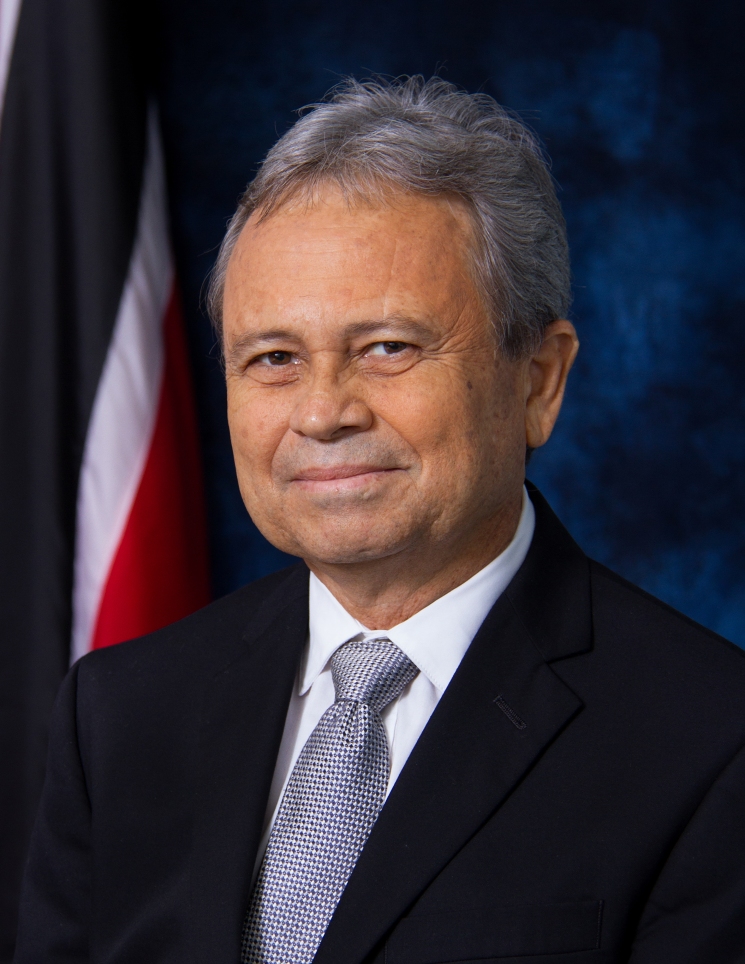
Colm Imbert has served as Finance Minister since PNM’s general election win in September 2015. The provisions of S.7 of The Act, which apply to Government to Government Agreements (G2G) and Public Private Partnerships (PPP) have remained the same over that entire period.
The OPR Board was appointed in January 2018 by then President Anthony Carmona, as his final official act, so it was impossible to implement the new system before that.
Consider the budget statements over the five-year period 2016 to 2020.
Continue reading “Public Procurement Delays – the tangled web”
 Afra Raymond was interviewed on Power Breakfast Show on Power 102.1 FM with Richard Ragoobarsingh and Wendell Clement on the delays in implementing the new Public Procurement system in Trinidad and Tobago.
Programme Date: Thursday 30th January 2020
Programme Length: 00:22:21
“…As Minister of Finance I was very much concerned with the decision to introduce a Central Tenders Board and take away the power to award tenders from elected representatives of local government bodies who enjoyed the privilege under existing legislation. That unsound arrangement, bad in principle, was further vitiated by the tendency of local government councillors not to award tenders to the lowest bidder….”
— Dr. Eric Williams, Inward Hunger: The Education of a Prime Minister. (London: André Deutsch, 1969), pg 250.
This week I juxtapose the delays in implementing the Public Procurement system and the intended amendments declared by Finance Minister Imbert, against the history, so that the wider issue can be understood. Minister Imbert is no outlier, he can be located as the current manifestation of the PNM’s deep and historic unease with modern arrangements for Accountability.
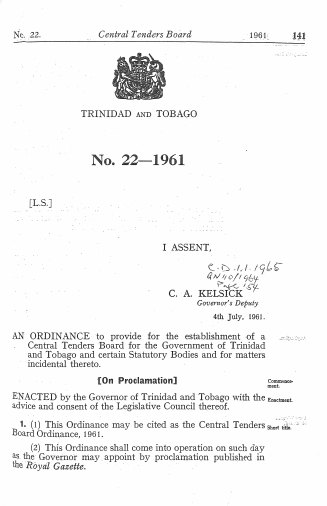 The establishment of the Central Tenders Board in 1961 was a high-water mark set by the first PNM administration in the ongoing struggle to ensure ‘morality in Public Affairs’. Since that 1961 Act, which took five years to implement, there has been a push against those legal provisions by successive PNM administrations, uneven and not always successful, but always in the same dismantling direction.
One needs to excavate actual episodes, so that the accountability arc can be seen, beyond the smoke and mirrors. Continue reading “The Accountability Arc”
PREVENTION OF CORRUPTION IN PUBLIC WORKS AND PUBLIC PROCUREMENT AND CONTRACTING
“…:29. Promoting the inclusion of anti-corruption clauses in all state and public-private-partnership contracts…”
— From the Lima Commitment ‘Democratic Governance against Corruption’ made at the Eighth Summit of the Americas in April 2018, to which Trinidad and Tobago is a signatory.

Finance Minister Imbert responded at the post-Cabinet briefing on Thursday, 16 January 2020 to the pointed questions raised by the media on the unexplained delays in implementing the new Public Procurement system. The Minister’s stated that he had only received a final position from the Office of Procurement Regulation (OPR) on 18 December 2019, which was too late to take action, given that Parliament had its last sitting for 2019 on 16 December. Continue reading “Public Procurement Delays, part three”
 On Wednesday 15 January 2020, Afra Raymond gave an address to the Trinidad Union Club on the ‘Delays in implementing T&T’s new Public Procurement system.’
This continues my series — Part 1 and Part 2 — on the unexplained and unacceptable delays in implementing the new Public Procurement system. Those delays arise from the failure or refusal of the Finance Minister to settle the Regulations which are essential for the Office of Procurement Regulation (OPR) to be fully operationalised.
Despite his firm commitment on 22 February 2019 –
“…I remain committed to attaining full implementation of the Act in the shortest possible time and the Ministry of Finance will continue to work assiduously towards that goal…”
As far as I know, there has been no response from Finance Minister Imbert to the points raised in the previous article. Of course, no response is required, but given the importance of the issue and the highly engaged communication style of that Minister, I certainly had cause for a pause.
This article will continue last week’s examination of the delays, but first, some background. The new Public Procurement system replaces the Central Tenders Board, so it is useful to note that although the CTB Act is a 1961 law, the first Board was not sworn-in until 1966 – a full five years after the law. Note well, too, that this was at a period when the CTB Act had the full support of the first PNM administration of Dr Eric Williams and the opposition forces were then a mere shadow of their current selves.
Given that background, what can we make of these delays in getting the Office of Procurement Regulation (OPR) up and running? Firstly, even though The Act is No. 1 of 2015, the first OPR Board was appointed two years ago, in January 2018, under the Chairmanship of Moonilal Lalchan.

This article will appear on New Year’s Day – 1 January 2020 – and it is a direct criticism of the Trinidad & Tobago government’s unexplained delays in the full implementation of the new Public Procurement and Disposal of Public Property Act (the Act). In my view those delays are unacceptable and a serious cause for public concern.
On 23 November 2018, the Finance and Legal Affairs Joint Select Committee of Parliament, took evidence on the matter of The Implementation of the New Public Procurement System.
That JSC, under the Chairmanship of Independent Senator, Sophia Chote SC, heard from the Office of Procurement Regulation (OPR) and the Ministries of Finance and Public Administration. That JSC Report of 6 May 2019 gives a detailed and encouraging account of the steps being taken to bring this law into full effect. Sad to say, but at page 23 of that Report we are told that – Continue reading “Public Procurement Delays”
What is a Public Secret? Is that an oxymoron? Public bodies use public lands and/or public money to make agreements, supposedly in the pursuance of the public interest. Yet those same bodies often claim that those arrangements are in fact private. Well I tell you.
That proposition has been advanced, repeatedly and by both political sides, against all good sense and to the continuing detriment of the public.
Two high-profile requests for information were recently refused by public officials and that is the matter I will be examining here. Continue reading “Public Secrets”
 AfraRaymond.net