Property Matters – The Business of Government

Once again, I am using this edition of Property Matters to consider the ever-controversial State Enterprises, against the wider question of the role of the State.  This is no small area for examination and I start by using what seems to be the favourite quote of Trade and Industry Minister, Stephen Cadiz, “Government has no business running business“.

Given the politics practiced here, it should be no surprise that all our political parties give emphasis to the important role of the private sector in the economy and society and so on.

The line of reasoning goes like this – “The State is only here to facilitate and clear the way for Private Enterprise.  The State does not intend to stand in the way of or compete with Private Enterprise” Those are not actual quotes, but they are just a paraphrasing of the sentiments expressed by various politicians over the years, whatever the party in power.

But the actual scale of the State’s involvement in the economy is in stark contrast to the political speeches.  It is my view that the State is in direct competition with the Private Sector in significant areas of the economy.  The large numbers of State Enterprises are inescapable examples of that.

We have to remember that it wasn’t always so.  A major part of the physical development in this country took place via the Ministries and without the involvement of any State Enterprises.  For instance, all the Primary Schools, Government Secondary, Junior and Senior Secondary Schools were built by the Ministry of Education.  All the Health Centres were built by the Ministry of Health and the Highways etc – up to the recently-opened extension to the Diego Martin Highway – were all built by Works & Transport.

Our State apparatus is huge, expensive and mystifying.

Growing up in the 1960s and 1970s, I can only remember a few State Enterprises – BWIA, TTEC, WASA, TELCO, Caroni, NP, NHA, PLIPDECO and maybe TRINTOC.    That sector grew hugely since that time. So today, for a country of about 1.4M people, we have 26 Ministries, 73 Government Bodies and 58 State Enterprises (according to ttconnect – The Government of Trinidad and Tobago portal).  To me, those are staggering numbers.    There is more on that in the sidebar.

Clearly the tendency is for that sector to grow, I cannot remember the last time the State disposed of any of their companies.  That seems to be given serious consideration only when there is an absolute crisis of the sort which confronted the NAR government in the late-1980s downturn.

In terms of expense, just consider that the 2011 Budget has an anticipated capital expenditure for the State Enterprises of $6.725Bn.  That figure is only for projects and so it excludes the salaries, rents and normal running expenses of those companies.

In this article, I am going to start asking about the State Enterprises which are in the Construction/Property field.  Those are, in descending order –

  • UDeCOTT – Urban Development Corporation of T&T
  • HDC – Housing Development Corporation of T&T
  • MTS – National Maintenance, Training & Security Company Limited
  • NIDCO – National Infrastructure Development Company
  • EFCL – Education Facilities Company Limited
  • RuDeCoTT – Rural Development Company of T&T
  • East POS DV Co – East POS Development Company

Some people would include National Insurance Property Development Company (NIPDEC) near the top of that list, but that is not a State-owned company, although many times one would be forgiven for thinking so.

Given the serious allegations of corruption at UDeCOTT leading to the Uff Commission and the continued public concerns on the State Enterprise sector, we are entitled to ask some searching questions.

There has been tremendous growth in the size of the State since independence.  Some doubts arise when one tries to consider why we now have so many of these State Enterprises.  Even more sobering than the purpose for their existence, are the questions of what has been the real performance of these State Enterprises.

When one considers that the State Enterprises listed are required to engage consultants and enter contracts for those construction works, the question has to be – What value do they add to the process of State procurement?

In the case of both UDeCOTT and the HDC, these State Enterprises are operating without accounts for several years and therefore in breach of the elementary rules of governance.  UDeCOTT’s last accounts were at the end of 2006 and NHA/HDC has had none since 2002 (I am informed that HDC recently filed its 2006 accounts).  In neither case have the Directors of those companies been sanctioned in any way.

Two of the hugest State Enterprises operating as rogues in a manner which is impermissible by Private Sector norms.  Even Lawrence Duprey’s CL Financial group had to publish its accounts within a year.

We have a large, subsidized State Enterprise sector, all paid for by taxing the very people against whom they are competing.  That is ‘advantage with a V’.

We need to ask how compatible is this arrangement with our National Development?

I am saying that it is hardly possible to blame this administration for the errors and excesses of the last one, but the honeymoon is running out fast.  Some say it is already done.

The point is that there is now an opportunity to engage in some reflection as to the purpose and performance of these huge State Enterprises.

In relation to the property and construction sector, there is also a recently-announced and large-scale national planning exercise taking place in two parts.  That is also a good reason to pause to review the character and pace of the State’s activity, particularly in the construction sector.

At the strategic level, there is no clarity as to the purpose of these State Enterprises.

At the level of performance, there is little evidence of value-added, far less value for money.

At the level of Corporate Governance and the transparent management of taxpayers’ dollars, there is extremely poor performance with no apparent intention to penalise the wrongdoers.

This sector of the State is in need of urgent, public and thorough examination.

SIDEBAR: What are the real numbers?

According to the Supplementary Public Sector Investment Program 2011 (p.5) – “…The State Enterprise Sector is comprised of fifty eight (58) companies of which forty seven (47) are wholly owned, six (6) majority owned and five (5) in which Government has a minority shareholding…

But the TTConnect website shows only 38 State Enterprises on a list which excludes HDC, UdeCOTT, RuDeCoTT, EFCL, VEMCOTT and East POS Development Company.  That list also includes the Securities and Exchange Commission – which had never seemed to fit the profile of an enterprise – and Trinidad & Tobago Mortgage Finance, which is only 49% owned by the State, according to their own website.

2010 Review

This is the time to reflect on the changes we have witnessed in the last year and the several challenges arising from those. This column will attempt to combine the ‘Property Matters’ concerns with the ongoing examination of the CL Financial fiasco.

The Uff Report

Professor John Uff. Photo courtesy Trinidad Guardian
Professor John Uff

For me, the largest single event this year was the completion of the work of the Uff Commission of Enquiry into the Public Sector Construction Industry, with particular reference to UDeCOTT and the HDC.  The controversial Commission of Enquiry was at the centre of widespread public concerns as to the level of corruption in the State construction sector.  To his credit, the Enquiry Chairman, Professor John Uff QC, PhD, insisted that the proceedings be televised and the results of each day’s hearings were also posted to its website.

The Uff Report made history in this country, since it is the first time that a government has published the Report of a Commission of Enquiry.  That is no small accomplishment and despite the fact that these massive wrongdoings took place under the last PNM administration, the act of publication has to be welcomed.

But there are still challenges, because, for whatever reason, the Uff Commission’s website, www.constructionenquiry.gov.tt has now been shut down, which is a real pity, since it contains the important testimony of many witnesses on the issues in this area.  That website needs to be re-opened and I am calling on the Attorney General, under whose Ministry the Enquiry was operated, to ensure that takes place.  It is no large expense to have these important documents made available to the public.  In light of their educative content, I would suggest that the actual documents be housed at UWI, as they have a direct bearing on the deliberations of the Engineering and Social Sciences Faculties.

Of course we had the sight of a fleeing Calder Hart and a defeated Patrick Manning, his PNM cohorts drinking  bitter tea for his fever, all attributable in my view to the groundbreaking Uff Commission.

Looking forward, we have the fact that the 91 recommendations of the Uff Report were adopted by the Peoples Partnership in the run-up to the 24th May General Election.  We have now been promised that those are to be implemented by Minister of Justice, Herbert Volney.  We await Volney’s early report as to the implementation.

In that connection and taking from the PNM example, I am, once again, calling for the publication of the report of the Commission of Enquiry into the Piarco Airport project.  The Bernard Report must be published now.

CL Financial bailout
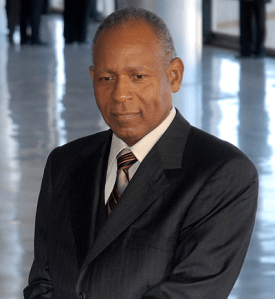
A Bailout Cheque payed by taxpayers to CLICO was stoppedThe other huge event of the year was the budget speech on 8th September 2010, in which Finance Minister, Winston Dookeran, disclosed publicly that he was revising the terms of the CL Financial bailout.  That bailout was a hugely suspect act, the largest financial commitment ever undertaken in this country, without proper due diligence or even any proper ventilation in the Parliament.  Our Republic had never been so financially violated and in broad daylight.  It was encouraging to see the Finance Minister take the point to its logical conclusion and of course that brought about the large-scale organisation of various aggrieved groups to put their point.
That series of organisations, committed to the doubtful mantra of the guaranteed investment – whatever that is – took on a series of bizarre and increasingly combative stances.  The signature theme being that ‘We are not responsible for our decision’.  We were being treated to a spectacle worthy of any of the ‘Ole Mas’ presentations of yore, in which successful investors – on average at least $700,000 was invested by each of these ‘protestors’ – having benefited from the operation of the capitalist system were seeking 100% redemption from the State.

The entry of the Prime Minister into this debate on 1st October was in my view a turning-point in our development.  For the first time in my memory a politician, who had the majority, to achieve the significant changes which had been tabled, stepped back from that act of sheer power to attempt an act of persuasion.  It was a signal lesson in the reality of possibility in our lifetime.  Even if one is amongst the Clico Policyholders’ Group (CPG) and feeling aggrieved, the calm audacity of the Prime Minister’s decision must be respected.

Most importantly, we now have a one-man Commission of Enquiry established with the eminent UK jurist, Sir John Colman QC sworn in.  That Commission is to examine the causes of the CL Financial and Hindu Credit Union collapses.  The Colman Commission is expected to start sittings in January 2011 and the Attorney General has directed that its report be delivered in 6 months’ time.

The Manning Factor

Patrick Manning
Patrick Manning

The most comical event of the year is the bold-faced attempt by the former Prime Minister, Patrick Manning, to shift attention away from the PP’s revelations as to the illegal spying activities of various State agencies.  Manning, the original PM, attempted to show-up the Prime Minister, Kamla Persad-Bissessar, with a series of allegations on the status of a house being built with private funds on private lands for a private purpose.  The Prime Minister effectively dismissed Manning’s concocted concerns with the telling observation that all the refutations she quoted were available from the public record, if the accuser had ever been interested in examining that open source.

Having stirred to life and found his voice, it is important to note the several matters on which Manning maintains a stony silence –

  • Calder Hart – Where is Calder Hart?  The nation was told solemnly by Manning that he knewCalder Hart’s whereabouts and further, that Hart was not a fugitive.  We are now told that Calder Hart cannot be located and Manning needs to speak on this.  Is it true that Hart gave Manning his location?  Has Hart changed locations?  Or is it that Manning has not shared that information with the correct authorities?
  • Election rationale – What, if any, was his rationale for calling the general election at mid-term?  I am not sure that anyone knows the answer to this one, but it is surely of continuing interest.
  • Guanapo Church – What is the truth behind the ill-fated Guanapo Church?  It is not my habit to wax scriptural, but that was a ‘house built on sand’ if ever we saw one. The reason for the State Grant of this land and the rapid grant of full planning permission – a record of only one month between the date of application and the grant – remains unexplained.  As for the architect’s plans for this huge church in the grounds of the PM’s residence, the mind boggles.  Where is Pastor Pena? We need to insist that Manning tells us more about this miraculous church.
  • Cleaver Heights – Another area is the wild allegation Manning made, at the close of the 2008 budget debate, as to a ‘missing’ $10M at an HDC project at Cleaver Heights in Arima.  Or was it $20M?  After inserting that case into the ongoing Uff Commission and having the embarrassment of having the allegation evaporate under cross-examination, Manning needs to tell us just how he came to learn of this allegedly missing money.
  • CL Financial bailout – Manning’s conduct in this matter has been the crowning-point of his administration, in my view.  The then Minister of Finance, Karen Nunez-Teshiera, was accused of using ‘inside information’ to make early withdrawals of her own funds from the CL Financial Group and to compound the mischief, being a shareholder of the CL Financial group in the sum of over $10M.  Manning’s steadfast defense of his beleaguered Minister of Finance was a display of loyalty which is seldom seen in higher political circles.  We need to know if the Minister told her colleagues that she was indeed a shareholder of the troubled group.  Did she or did she not recuse herself from the Cabinet’s deliberations?  My reading of the events, as told by the very Minister, is that she did not.

For Manning to fail to come clean on these questions, he would run the risk of damaging his hard-won reputation for upstanding values and leadership.

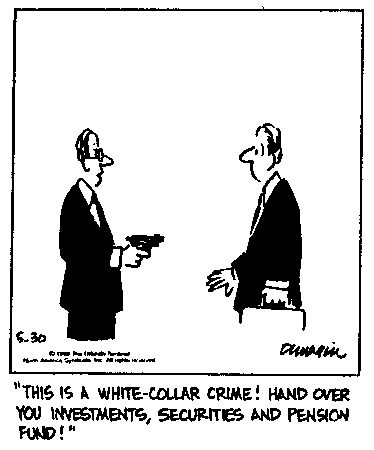
White Collar Crime
white-collar-cartoonThe obvious connection between these various events is the fact that White Collar Crime – which is sometimes, mistakenly, called victim-less crime – is  afflicting our country in a big way.

The year ahead holds significant challenges as we try to go forward in this morass, to escape the conspiracy which I have titled The Code of Silence.

The only way political rulers can carry on as they do, wasting the country’s money for the benefit of their friends and family, is because they are sure of each other’s silence.  The people in the private sector who were responsible for the financial collapse are no different.  The financial collapse is not, as some have falsely claimed, in any way connected with the Wall Street crisis.  That is only a handy coincidence.  If our regulators and politicians were doing their jobs we would not be in this position.

Please remember that the alarm bells on CL Financial were sounded by Trevor Sudama, since the 1999 budget debate.  More to the point, many of the people who still inhabit the Parliament were there at the time.  Again, I give this administration credit for appointing a Commission of Enquiry into this sordid affair.

Also, please remember that both UDeCOTT and the HDC failed to file accounts for years, in breach of the law and State guidelines.  That failure was not remarked upon by members of the then Opposition.  More to the point, we have now had a change in administration, with no word on the UDeCOTT accounts.  I do acknowledge that certain HDC accounts have now been published and that is to be the subject of upcoming commentary.

The Code of Silence must be broken if we are to progress.

The State of the Media

The recent series of changes at CNMG have sparked a series of evolving discussions.  I was one of the three people ‘let go’ from CNMG and that was reported briefly on my blog.

I am starting to reflect on some aspects of all this recent interest, but no, this not an anti-PP column or one about how wicked politicians are and so on.

What kind of talk is that?
The first thing that occurred to me is how the media conversation has blown up in sheer size and how that has had an effect on the quality of our national conversation.

In the so-called ‘good old days’, before the shift I am about to describe, the only people who really had a voice in our society were those who were approved, such as government ministers and their spokespersons, established journalists, the ‘great and good‘ and of course the brave and imaginative ones who were our activists.  In fact, the last-named group were the voice of the voiceless, who fought to uplift our society.  Of course in that group you would have to include the leading calypsonians and ‘troublemakers’ of their era.

From its beginnings about 20 years ago, we have moved far from the post-independence period in which the voices heard on the national media of Radio and TV were very limited.  The NAR regime 1986-1991 decisively brought that to an end with the grant of more broadcast licences and the real birth of ‘talk radio’.  TV call-ins soon followed and of course, the internet/email broke onto the scene in the mid-1990s.  The final stage in this progression is the growth of new-wave social media – such as Facebook, YouTube, Twitter etc. – to the point where they have now eclipsed the older formats like web-pages.

As a result of all that, we now have many people, who never had a voice as individuals, being able to project their ideas onto a huge stage.  That is literally unprecedented.  The new conversation has opened up serious new challenges and opportunities.

One of the most detrimental of our habits is mauvais langue – just plain bad-talking people behind their back, but not showing it when you meet those same people.  As young people would say – Pure hate, just acting normal.

I hold the view that mauvais langue is the biggest cultural obstacle to our development as a nation.  I say that because it is my view that without an open exchange of ideas, the possibility of change is very limited.  In this new situation, someone can add a mischievous or irrelevant comment to the discussion, without ever identifying themselves or backing-up what they are saying.  As a result of those possibilities and its combination with our habits, we now have most of our blog commentators and callers-in choosing to remain  anonymous.

But what are we saying to each other?  The essential message of a large number of the comments on these T&T blogs boil down to ‘Shut Up…I don’t agree with you and don’t want to hear what you have to say…Go away!‘  Our new national conversation is on a huge scale and on a range of issues which is extremely fertile, but the dominant habits of that conversation are perturbing.

To be fair, there is a solid body of research to show that anonymous conversations of this type are extremely effective at finding-out the views of the public, workers or customers.  Indeed, this social media is now a very important part of how progressive states and corporations take their bearings as to where things stand.

One important difference I have seen is that the blogs for newspapers and news-sites in the advanced world have almost no anonymous content – people actually write as themselves.

opm websiteMore to the point, we have a situation where we have embraced the new situation and its possibilities, while our leaders and organisations lag far behind.  Just as an example, the website for the Prime Minister is http://www.opm.gov.tt/ – the last officeholder had no publicly-available email address and that website is now temporarily offline, being under re-construction.

There is also the secondary aspect of all this, the essence of our commitment  to a free press.  Of course, I am talking about the silence of Newsday – ‘The People’s Newspaper which offers daily news from Trinidad & Tobago’.  There was a huge response to the news on Monday 8th November, that Fazeer Mohammed was removed from CNMG’s morning line-up.  I think that article in the Express of the next day had over 825 comments – which must be some kind of local record. It is staggering to me that Newsday had nothing to say about this, until the Thursday after, even as a pure item of news. Just unbelievable.

It is easy to criticise the politicians and their mistakes, but this silence by Newsday is just another level of irresponsibility which would make any right-thinking person pause. Newsday have their own patchy track-record in that they forced-out Kevin Baldeosingh over his challenge to Fr. Henry Charles for plagiarism. The parliament discussions on Friday 12th and the news releases from both the Media Association of Trinidad & Tobago (MATT) and the Congress of the People (CoP) formed the basis of articles on the issue from Thursday 11th. Given that behaviour it is interesting to watch them, as The People’s Newspaper, minimizing a matter of such great concern to so many people. A matter concerning an apparent threat to freedom of the press.

We have to be honest and admit that a significant part of the national conversation is the impatient snarl to ‘shut-up’ the person we do not agree with.  That tendency has borne some strange fruit in the case of Newsday and Fazeer.

Yes, I think Fazeer was forced-out too – given his popularity, it all seems very wrong-headed to me. At several levels, but the pregnant question here is how come the State owns companies which are in competition with private ones.  The notion of the State Enterprise was originally one which performed some specialist task which the private sector did not provide, but the discussion is an involved one.

One of the criticisms of our State Enterprises is that in significant cases, they they are in competition with private business interests.  For example, First Citizen’s Bank, Udecott, HDC, EFCL and so on.  Of course the closest example of this is CNMG.  Ironically enough, the Special Purpose Entities/State-owned sector were the topic of my last show on CNMG and we did discuss this issue of competition.

So, exactly why does the State own CNMG?  How fair is it for the other media houses to have to compete with a State-funded entity?  In my view, CNMG had established a solid reputation as a topical and fearless current affairs and news source.  Of course, all of this is going to damage the brand, so its private sector rivals would be smiling to themselves.

Returning to one of my earlier discussions on the ‘Two Tendencies‘ – published in this space on 16th May 2010 – it seems clear that these are a big part of this story.  The first tendency is to say that our State Enterprises are too important to be run by anyone but the best people.  The second tendency says that, having won an election, all these bodies are ours to command and that is all.  The second tendency can distort good sense and professional standards to the bizarre extent we saw in the Udecott case.  This case of the Fazeer Mohammed ‘re-assignment’ is definitely one in which both tendencies have battled it out on the blogs and the airwaves.

It is unlikely to be settled anytime soon.

The big questions for me are –

  1. Which of the Two Tendencies is in control?
  2. How committed are we to a conversation with people who hold different views?

Termination of services

CNMG termination letterThis is the letter CNMG sent to discontinue the two programmes I was contracted to do with them – a weekly editorial on Friday mornings and a one-hour current affairs program on alternate Sundays .  It was FAXed to me at 16:13pm on Thursday 4th November, but backdated to 1st November.

So, let us see…

  1. Ingrid Isaac, the former CEO was said to have ‘resigned’ on Wednesday 27th October – the same day Ken Ali is said to have started as Interim CEO – see CNMG’s version of events here – http://www.ctntworld.com/LocalArticles.aspx?id=24248
  2. I was ‘discontinued’ on 4th November and
  3. Fazeer Mohammed was re-positioned/offered a new position etc on 6th November…
Ken Ali

All to say that nobody was fired, is just that a number of people are no longer there, but no one was fired and more to the point, I see a report in this morning’s Express newspaper that Ken Ali said “I really have nothing more to say to the media on this matter.”  I could scarcely believe what was on the page before me and hopefully there is a misprint.

Ken, please do confirm to us that you did not say that…

Change, not Exchange – Part 3: Jack Warner

Jack Warner, MP. Photo courtesy Trinidad Guardian
Austin 'Jack' Warner, MP and acting Prime Minister
On 6th June, I wrote in this space about the challenge to the new government to bring about a real change, as opposed to mere exchange.  I ended that column by highlighting the worrying case of Jack Warner, one of my former history teachers, making history by being the first Cabinet Minister to hold other appointments.  My objection to Mr. Warner serving two masters was that it would be impossible for him to give the full energies we have every right to expect from our Cabinet members.

We need to be mindful of the relationship between morals, ethics, law and of course, that scarce commodity, good sense.  Obviously, law is the paramount authority, because we live in a republic ruled by laws, not men. No one should break the law and there are penalties for doing that.  But we also know that in life we make many important decisions without referring to any laws. Those are sound decisions, which form norms, eventually described as custom-and-practice or culture. There are many acts, which are at one and the same time both deeply offensive to right-thinking people (and I think that most people are right-thinking) and in breach of no particular law.  Many acts, with no need for examples, since this is a newspaper any child could pick up and read. There might even be laws against me describing such acts in print.  Who knows?

The reality being that, as important as law is, the proper development of our society depends on far more than just law.  Law is a necessary, but not sufficient ingredient for proper development.  So, what do I mean by proper development?  One of the key signs that we are moving forward would be an increased sense of consequence and the capacity to learn from our errors.  Some examples of our failures in those respects were set out in the prior article in this series.

Some of the main points here were –

  • Board resignations – Jack Warner’s opening statement, made on Indian Arrival Day, was his strong demand that all Board Directors of State Enterprises and Statutory Bodies coming under the control of his Ministry must submit immediate resignations.  In making that call, Mr. Warner relied heavily on custom-and-practice, good practice and established norms.  He was, quite properly, declaring that he expected those high-ranking public servants to behave properly.  No reference to law was considered necessary to see what was the right thing to be done.  Yet when queries arose on Jack Warner’s multiple appointments, we were rapidly boxed-into a strange place where only the law prevails.  That is ‘chinksing’ with a vengeance.
  • Warner’s statement upon his return home on the 15th was most instructive.  Consider please that this was no hasty response to an ambush question and that the entire Piarco reception had been arranged by Warner.  His emphatic reply as to the weakness of Rowley’s case was telling, in as much as it relied on the various examples of PNM wrongdoing that Rowley was accused of having condoned.

    …If Dr Rowley is so concerned about the Parliamentary Code of Ethics, I want to ask him some questions this afternoon. “Why was he so silent when Mr. Manning appointed his wife, not once, not twice, but three times as a minister? “I want to ask him why he was silent when a Minister of Health had his son open pharmacies all over the country to sell CDAP drugs? Wasn’t that code of ethics broken then? “I want to ask him also why he was silent when another Minister of Health had his wife take all the insurance of the Government of Trinidad and Tobago to a company she owned? Why was he silent then?

    See – http://guardian.co.tt/news/politics/2010/06/16/warner-i-have-broken-no-law

    Strange as it might seem, a mere 3 weeks into the honeymoon, we were witnessing a premeditated statement by a senior Minister to the effect that ‘two wrongs make a right’.  Mr. Warner was trying to silence Dr. Rowley, by reference to his condonation.  That is a sad and rickety foundation from which to proceed, but even more telling is Warner’s implicit acceptance that his own position was wrong.

    Warner’s attempt to diminish Rowley’s victory was also interesting –

    Not contented that he removed Patrick Manning from office—he got the easiest political ride in history—he had the temerity to accuse me of breaking some law, or transgressing some code of ethics…

    It has to make you wonder, if that is Jack Warner’s view of Rowley’s victory, what is his view of the PP’s triumph?

  • In the midst of all the lawyers’ opinions, we had an attempt, by Michael Beloff QC, to set these local events in international context –

    …Beloff said he was unaware of any precedent in any common law jurisdiction for a person holding at one and the same time, ministerial office and another post outside of the Government.  “I have little doubt that a main reason is that the demands of ministerial office would usually preclude such dual appointment and the minister could be exposed to criticism for not devoting himself full-time to his government duties…

    see http://www.trinidadexpress.com/news/97564904.html

  • The silence of the lions – Most notable, for me, in all this, was the lack of comment from outspoken people like – Errol McLeod, David Abdullah, Makandal Daaga and Anil Roberts.
  • We voted against the idiosyncratic and bizarre leadership style of Mr. Manning, in which important policies were perverted and new precedents set for a favoured operative.  It seems that the grounds for the decision were limited and the well-established precedents set aside for Mr. Warner and effectively, a ‘special case’ was made for him.

I say again that the State has a duty to be exemplary in its conduct.  We have a right to reasonable, consistent and transparent decision-making by government.  Another aspect of this is that this lawyer-driven decision seems, to me at least, to limit the PM’s power in Cabinet to control her team.

Apart from law, most of the people who supported Jack Warner on this issue seemed to proceed from either the ‘two wrongs’ principle or from the notion that Mr. Warner is a superior performer.  It seems that, in this case, Jack Warner will have to ‘take win’ and all we can do is measure his reputation against his actual performance.

One of the fascinating aspects of this affair is the way in which power has been defined, and re-defined, in the unfolding.  My favourite definition of power was always ‘the ability to set the agenda’.  It has always been the case that the setting of the public agenda was a prerogative of the PM, leaving Leaders of the Opposition lagging one beat behind.  As a result of that pattern, a lot of sound and fury became the norm of Opposition. In his opening statement on 4th June, Dr. Keith Rowley, as the new Leader of the Opposition, set out his objections to Jack Warner’s multiple appointments.  We had comments from every sector of the society on this issue and many group exchanges on radio call-ins and the social media.  Whatever one thinks of the actual objections raised by Dr. Rowley, it is clear that those objections shaped the public agenda. That is no bad thing. In this rounds, it seems that the change we voted for could be coming from unexpected places and with odd timing.

VIDEO: First Up Interview – 18 May 2010
VIDEO: First Up Interview – 18 May 2010

Afra Raymond sits down with Jessie May Ventour and Derek Ramsamooj for a discussion of matters pertaining to the construction industry prior to the national elections. Topics include UDeCOTT, the controversial Guanapo church and the Uff Commission Report.

  • Programme Air Date: Tuesday, 18 May 2010
  • Programme Length: 0:40:33

Change, not Exchange – Part 2

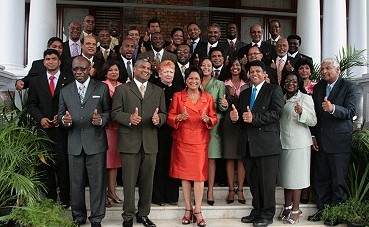
Trinidad & Tobago ministers after swearing in. Photo © Trinidad and Tobago News
Newly sworn-in TT Cabinet and other high government officials.

We are now in an interesting space, between the noise of the election campaign and the appointment of some of the most powerful government officials.  The new Cabinet was sworn in on Friday 28th May and the appointment of officials to the SPEs and Statutory Corporations is about to take place.

As noted previously, these SPEs are arguably now more powerful than the traditional civil service, in both the scale of their operations and the loose oversight regimes within which they exist.

As I noted in the first part of this article, published on 16th April, our history is that newly-elected governments will select their own candidates to fill these vacancies.  Apart from the issues of ritual dismissals which were identified then, there are further points to be made at this stage.

The People’s Partnership has won a resounding electoral victory and it seems that a significant number of voters were voting for a change from the large-scale corruption and bobol which had become commonplace.

There were some precedents set by the last PNM, which were so shocking, even by our elastic standards, that they must be highlighted, so we can ensure they are never repeated.

Even though the People’s Partnership is still in the ‘honeymoon period’, it is timely to set out these precedents for consideration –

  • The Spouse factor – Our last PM made local history when he appointed his wife, Hazel Manning, to the Cabinet in 2001.  The PM went to pains to list his wife’s qualifications to head the Education Ministry.  A few weeks later, he defended his appointment of Howard Chin Lee as Minister of National Security, saying on that occasion that no one needed particular qualifications to serve in his Cabinet.  That was bare nepotism, which paved the way for much of what was to follow.
  • Shareholdings – Almost everyone was shocked to read in these pages the revelation that the then Minister of Finance, author of a learned work on the ethics of the legal profession, was in fact a shareholder of the CL Financial group, which had been bailed out on sweetheart terms, with no punitive action against any of the main players – see http://www.trinidadandtobagonews.com/blog/?p=997.  A Blank Cheque Bailout.  What shocked almost no one was the PM’s stout defense of his colleague “I wish to re-affirm the confidence that I had in the Minister of Finance…” or his bizarre insistence that the criticisms of the Minister’s obvious conflict of interest was rooted in a desire, by those opposed to the government, to erect impediments in its way – see   http://www.newsday.co.tt/news/0,96934.html.
  • Multiple Directorships and Chairmanships – Another bad one was the fact that five (5) Chairmanships of major State-controlled companies were held by a single individual.  That has never happened before and it is impossible for any individual, however talented or hardworking, to discharge all those duties properly.  Although what I am saying is basic good sense, an entire Cabinet acceded to that level of sheer recklessness.   In simple terms of the long-time saying about all of ones eggs in one basket, that situation was a good example of collective irresponsibility on a tragic scale.
  • Overlapping of appointments and portfolios – In the case of the so-called Independent Senator, Michael Annisette, we had to endure that appointment at the same time as he held Directorships in 5 State-controlled companies. Of course Annisette’s position was completely implausible and conflicted, which became obvious when he became an outspoken defender of UdeCOTT during the recent revelations.  Simply unbelievable, but true – all at the same time.
  • Non-accountability of Special Purpose Entities – For example, UDeCOTT has had no audited accounts since the end of 2006 and yet they have enjoyed the PM’s praises, with no censure at all.  The peril this creates is that we can end up with SPEs which are totally out-of-control, with borrowings – all ultimately forming part of the State’s indebtedness – which are concealed due to the lack of accounts.  That is a truly dangerous place to be and what is worse, the people who oversaw this collapse of normal prudent values and good management principles are unlikely to suffer any penalty or loss.  That must change.
  • Parliament proper role – Parliament has to be restored as the principal place in which the people’s business is discussed and the one I am thinking about here is the Caribbean Airlines/Air Jamaica deal.  That was first announced in January and we were told that there would be no monies invested from Trinidad & Tobago.  After much talk about the limits imposed by the confidentiality clause, we learn on 1st May, in the midst of the election campaign, that the deal was signed at a cost of $50M USD – see http://www.usatoday.com/travel/flights/2010-04-30-carribbean-air-jamaica_N.htm. Parliament was never the forum for any proper discussion of this matter, with all its long-term implications yet unrevealed.  We need to restore Parliament to its proper place.
  • SPE in politics – Yet another new low was hit this election season when Kaisha Ince, CEO of the National Infrastructure Development Company Limited (NIDCO) spoke on the platform of a PNM political meeting on 19th May – see – http://www.trinidadexpress.com/index.pl/nart?id=161672510 or http://www.trinidadexpress.com/index.pl/nart?id=161672478 There have been reports that Ms. Ince has now been dismissed from NIDCO by the new government – see http://www.caribdaily.com/article/296300/pnm-affiliated-ceo-of-nidco-has-been-fired/. It is appalling that the head of a SPE could be on a political platform in the heat of the election battle.  What next, I wonder?  Will we soon see Permanent Secretaries and Department Heads joining the fray?  We need to draw a line here.
Jack Warner, MP. Photo courtesy Trinidad Guardian
Austin "Jack" Warner, MP, Minister of Works & Transport and UNC Chairman

Of course, these are all made more painful, by the fact that they are true and  also, by the strange position of Jack Warner MP, our new Minister for Works  and Transport.  As far as I am aware, once one is appointed to serve in Cabinet, which is effectively the highest office, one is obliged to demit all other offices at once.  The notions at work here being the general principle that it is impossible to serve two masters and also this instance being one in which the responsibilities are so serious that ones service must be total and dedicated.

Jack Warner has confirmed that he will be keeping his roles as a Vice-President of FIFA, President of CONCACAF and Special Adviser to the Trinidad & Tobago Football Federation.  Simply amazing.  Of course, I am subject to correction, but it seems to me that this is an absolutely unacceptable situation.  It is impossible for Warner to serve two masters and this is not a precedent which should be tolerated at all, at all.

I want change, not exchange – Question is “Can the People’s Partnership deliver that?”

Change, not Exchange: The Two Tendencies

In view of the season and the issues raised so far in this series, I am setting out some ideas about the scale of challenge we must overcome to achieve change, not exchange.

The State-owned Special Purpose Entities (SPEs) are an important part of the picture in the provision of goods and services to our country.

“The idea that important SPE/State jobs and contracts are available for those in political favour is one of the things we have to change.”

Who is to run these important entities?  In what manner?  These questions of “w” are central to the sharp public concerns over the level of corruption at and performance of, these agencies.  My contention is that there are two contending tendencies in the minds of those who make that sort of decision.

  1. The first of these is the professional, sensible idea that some elements of the SPE-world are so complicated and important that the best people have to lead them, regardless of their political affiliation.  In this space I am sketching, that would include elements like First Citizens’ Bank, Unit Trust Corporation, National Insurance Board (including its affiliates NIPDEC and TTMF), UDeCOTT, HDC, NIDCO, WASA, TTEC, TSTT and so on.  It seems reasonable to take the position that these companies should be run by the most competent staff of integrity and along ‘best-practice’ guidelines.
  2. The second of these is the idea that having been victorious in a national election, the ruling party has the right to appoint whomsoever it wants to key positions.  Some would go so far as to say, it is not just a right, but a duty, given the sacrifice and contribution of certain supporters.  The rationale here being that we exist in a democratic system and the best positions in the State empire rightfully belong to the ruling party, to give to those in political favour.  Those people may be seen as being more sympathetic to the objectives of the ruling party.

The two ideals exist in fundamental tension, moreso since other aspects of the question are also in flux.

There is no clear agreement as to the boundary between the critical SPEs and the rest.  Some of the players believe that every SPE should be subject to their political whims, while others have clear ideas as to which ones must be managed professionally.

Also, it is quite likely that the two ideas co-exist in the minds of some of the main players.  That is, they are themselves severely conflicted on the entire subject.

The idea that important SPE/State jobs and contracts are available for those in political favour is one of the things we have to change.

At this moment we are poised before a snap election, with a highly-charged atmosphere on the issue of SPE corruption.  Even devotees of the ruling party seem to be shocked by the scale of the problem.  Whatever the outcome of this election, there is likely to be considerable action on this aspect of public affairs.

If the present ruling party wins convincingly, we are likely to see a triumphant return to the stated policy of Expediency in Public Affairs.  Those winners could declare that the policy approaches which brought us to this sorry place are the right ones, which were endorsed by the electorate, so we return to mismanagement and dishonesty.

The possibility of a victory of the Peoples’ Partnership also holds challenges in this area, since they could return to old habits.  By that I intend to remind readers that when UNC took office in 1995, there was a widespread series of dismissals of top-level staff at SPEs.  It was so large-scale that the late Grand Master wrote a 1997 calypso on it – ‘De No-Work Band’.  It was never a very popular one of Kitch’s numbers, but those people who suffered sudden and unjustified dismissal will remember the tune, as well as the words.  Plenty names and bitter-sweet too bad.  PNM did much the same thing when they returned to office in 2001.  No kaiso for PNM, though.

That pattern of brusque dismissals and crude exchange is highly questionable, given that both parties have fundamentally similar economic and social policies.  It seems to me that the dismissals are motivated more by by vengeance and a desire to control the vacated jobs, than by any actual difference in ideology or approach..

This is what I mean, in saying that we need change not exchange.

It might seem unlikely, but we could very soon be confronting these issues of who runs our SPEs and how, in what is likely to be a harsher, sharper fashion than ever before.

The ingredients are all there –

  • High stakes in terms of highly-paid jobs;
  • Huge contracts to be distributed;
  • The atmosphere of hubris which seems to fill the highest chambers of our Republic;
  • Either the thrill within the Peoples’ Partnership upon winning this snap election or the sheer triumphalism of the current ruling party to have beaten all its united detractors;
  • The poor moral fibre of those involved.

Yes, come 25th May, we could be seeing a situation which eclipses all the wildness which has gone on so far in this country of ours.

It is clear that there are certain SPEs which must be forensically investigated, with people charged under the law with a view to recovering the stolen funds and restoring a healthy atmosphere to public life in this country of ours.  I have already given a lot of detail on those SPEs.  My point holds ‘irregardless’ of who wins the election.  The situation of gross mismanagement and unpunished corruption is too dangerous to our good health as a nation to be allowed to continue just so.

It is equally clear to me that there are serious, capable and committed people in our SPEs.  Those people have been exemplary in the execution of their duties and added real value to the public service in this country.  They are all now at risk of suffering the fate of other ‘political appointees’ when the other side wins.

It is not good enough for us to shrug and murmur that that is how these things go.  We are a small country, with limited human resources and we cannot spare the intellectual capital which is evaporated every time we go through these purges.