Managing Director, Raymond & Pierre Ltd.
Past-President, Joint Consultative Council for the Construction Industry, Trinidad and Tobago- December 2010 to November 2015.
Past President Institute of Surveyors of Trinidad & Tobago 2009-2010.
The previous article delved into the published information on the three existing State-owned hotels and juxtaposed that with the proposals for a Tobago Sandals. Apart from the unsatisfactory position with the State’s existing hotel investments and the reluctance to give details, I also updated readers on the missing MoU for the Tobago Sandals project.
My dismal readings were based on the very limited publicly-available information, nothing else. I did not refer to any rumours or ‘inside information‘, my work is all based on the published record. The PM and his colleagues surely have ready access to a better quality and quantity of information than the public. That being the case, it begs the question as to what is really happening here.
If indeed, the Sandals project has significant upsides and benefits, those ought to have been estimated and shared by now. If the existing State-owned hotels are doing well, why aren’t the management agreements or accounts published? If those hotels are doing poorly, why are we persisting with that same model? Continue reading “Property Matters – Sandals MoU? Part three”→
The previous article updated readers on my attempts to obtain the Sandals Memorandum of Understanding for the proposed high-end, large-scale resort development in Tobago. That proposed development is said to be a significant part of our country’s diversification efforts so it requires our sober attention if we are to understand what is at stake.
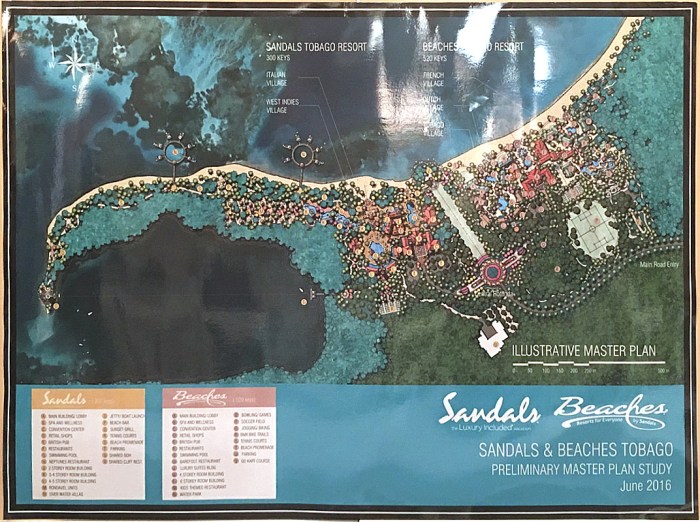
The model for this project is one in which the State either pays for or guarantees the financing of the new resort. The State would pay for the cost of design, financing, construction, fitting and furnishing of the new resort, all to the standards set by Sandals. The completed resort will then be operated by Sandals under a management agreement. T&T is unique in the Caribbean in that our largest hotels were funded by Public Money with the operators working via Management Agreements.
That is the model which has been used thus far in our State-owned hotels. That fact has been cited several times by the PM, quite likely to offer a degree of comfort to those who are unsure about this project. After all, we have done this model before, so what could be the harm if we go along the same road once more?
That approach to a major investment of this type does not offer me any comfort at all. Since September 2016 I have been pursuing a detailed research program into the State-owned hotels, with my colleagues from Disclosure Today and we have been solidly resisted. In my view, we do not have enough information about the existing State-owned hotels – Trinidad Hilton (1962); Magdalena Grand (originally Tobago Hilton, opened in 2000) and Hyatt Regency (2008) – to be confident about this approach. Continue reading “Property Matters – Sandals MoU? Part two”→
Josanne Leonard interviewed Afra Raymond on Monday 12th June 2017 on how the three parts of the state work against the backdrop of constitutional issues such as the separation of powers, the quality of representation and the size, origin and role of the Cabinet. Video courtesy Office of the Parliament
Programme Date: 22 May 2018 Programme Length: 00:21:37
My 27 February 2018 request for that MoU under the Freedom of Information Act (embedded below) was therefore made against that background of both parties’ declaration that there was no secret. The Office of the Prime Minister responded on 22 March 2018 to refuse my request, citing that the MoU contained a confidentiality clause which prevented its disclosure at this time. I have since written to the OPM to request a reply in conformity with the provisions of the Freedom of Information Act – I am still awaiting a reply to that letter.
I have now written to Mr Adam Stewart of Sandals Resorts International to request from him a copy of the MoU. (See below)
This is a proposal of high public importance as it is being advanced as an important part of our country’s diversification strategy, so the correspondence is set out in this article.
From: Afra Raymond
Date: Fri, Jun 15, 2018 at 3:41 PM
Subject: Request for Memorandum of Understanding with Sandals Resorts
To: Adam Stewart
Dear Mr Stewart,
I am writing to request a copy of the signed Memorandum of Understanding between Sandals Resorts International and the Government of the Republic of Trinidad & Tobago – it was recently reported that this MoU was signed on 10th October 2017.
There is no doubt that the proposed 750-room Sandals/Beaches Resort for Tobago will be a large-scale, high-impact development, so there an understandable public interest in those proposals. I was therefore greatly encouraged by your emphatic statements that there is no secrecy in relation to the business arrangement or the MoU and that you refuted any secret deals – as reported in the Trinidad & Tobago press on 27th February 2018.
I was therefore astonished that the Office of the Prime Minister replied on 22nd March 2018 to my request for that MoU by citing a confidentiality clause to refuse its disclosure at this time. I wrote to the OPM on 11th April 2018 requesting a clarification and their reply is still awaited. In the interim, I am requesting from you a copy of the MoU in the public interest of transparency in this large-scale development proposal.
For your information, my earlier article on the Sandals MoU was published in the Express Business on 8th March 2018 and can be accessed here. The related correspondence is attached for ease of reference.
Apart from the strong objections to the re-introduction of property tax, there are tantalising points emerging on the need for those taxes to be used to pay for local government services. Local government is one of the sectors which is in most frequent contact with the needs of communities, such as maintenance of drains and playing-fields; garbage collection; road repairs and many other such services.
One of the common positions on this tax is one in which there is no real objection to property tax as such, but there are local government and property valuation concerns expressed. Most of those persons seem to have a strong preference for the property tax to be used to fund their local government services, which then leads to an objection to the valuation approach. Those persons seem to hold the view that the extent to which one property is more valuable than another ought not to be the basis for setting the property taxes, if those properties are using broadly similar levels of local services. One can understand that this approach would appeal to those who own the more valuable properties, but one can equally say that those who own more modest properties would be displeased if their property tax bills were the same as their neighbours with larger and more valuable properties. It is complicated. Continue reading “Property Matters – more Property Tax FAQs part three”→
This week I will provide further necessary correctives on the impending re-introduction of the Property Tax, which is not a new tax. It previously existed as House Rates in the five cities and Land & Building Taxes in the other parts of the country.
Tax Evasion
Self-employed and professionals and sole traders have always under-reported their earnings and never paid the correct taxes. Those people often use property as a useful place to store their untaxed wealth. We have never really dealt with this tradition of tax evasion amongst our successful citizens and I cannot remember anyone being imprisoned or having property auctioned due to taxes owed. Whatever my doubts about the motivation of the American Imperium in pushing its ‘anti-tax haven’ agenda, some things do give cause for a pause. For instance, the Financial Times article of 28 June 2017 – ‘Trinidad & Tobago left as the last blacklisted tax haven‘. Continue reading “Property Matters – more Property Tax FAQs part two”→
Hema Ramkissoon on CNC3’s The Morning Brew spoke with Chartered Surveyor Afra Raymond about the Property Tax. Mr Raymond said the Tax is not a new tax. Video courtesy CNC3
Programme Date: 29 May 2018 Programme Length: 00:17:38
This is the recording of my interview on On Point on 94.1FM Boom Champions on Property Tax. I was interviewed by Kalifa Clyne, DJ Brent and DJ Hans. Audio courtesy Boom Champions.
Programme Date: 3 June 2018 Programme Length: 00:53:01
The recent series of comments on this Property Tax have prompted my return to this controversial issue. Some of those comments were;
Ved Seereeram’s 8th May 2018 article in the Trinidad Express ‘A terrible way to tax us‘,
Professor Dilip Dan’s subsequent speculation that the tax somehow targeted Indian people and
the many strong criticisms arising from a short Newsday article which reported my views as to the fairness of this proposed tax.
The proposed Property Tax has three main differences from the old system which ended in 2009 –
Revised Valuations – It will be based on updated valuations. In 2009 $143M was raised, the 2017 estimates were for $503M to be raised – the 2018 estimate is $250M, likely due to the delay in passing the required law and the ongoing litigation which is now at the Appeal Court level;
Database – It will require an open database for proper operation. This open database is the decisive element, which I welcome;
Funds – The old system allocated those monies to local government, but the new system directs the Property Tax revenue to the consolidated fund. In my view that is detrimental to proper local government.
Property owners have had an unprecedented tax holiday, with no property tax paid since 2009. At a minimum, using the lower 2009 revenues, $1.287 Billion more remained with our property-owners.
 This is the full CTV interview with Dionne Baptiste on the national housing policy and programme on 1st May 2018. Video courtesy CTV
 Josanne Leonard interviewed Afra Raymond on Monday 12th June 2017 on how the three parts of the state work against the backdrop of constitutional issues such as the separation of powers, the quality of representation and the size, origin and role of the Cabinet. Video courtesy Office of the Parliament
 Apart from the strong objections to the re-introduction of property tax, there are tantalising points emerging on the need for those taxes to be used to pay for local government services. Local government is one of the sectors which is in most frequent contact with the needs of communities, such as maintenance of drains and playing-fields; garbage collection; road repairs and many other such services.
 Hema Ramkissoon on CNC3’s The Morning Brew spoke with Chartered Surveyor Afra Raymond about the Property Tax. Mr Raymond said the Tax is not a new tax. Video courtesy CNC3
 This is the recording of my interview on On Point on 94.1FM Boom Champions on Property Tax. I was interviewed by Kalifa Clyne, DJ Brent and DJ Hans. Audio courtesy Boom Champions.
 The recent series of comments on this Property Tax have prompted my return to this controversial issue. Some of those comments were;
