Second submission to the Commission of Enquiry into the failure of CL Financial Limited, et al

14th February 2011

Afra Raymond’s second submission to the Commission of Enquiry into the failure of CL Financial Limited, Colonial Life Insurance Company (Trinidad) Limited, Clico Investment Bank Limited, Caribbean Money Market Brokers Limited, and The Hindu Credit Union Credit Union Co-operative Society Limited

My name is Afra Martin Raymond and I am a Chartered Surveyor, being a Fellow of the Royal Institution of Chartered Surveyors.  I am Managing Director of Raymond & Pierre Limited – Chartered Valuation Surveyors, Real Estate Agents and Property Consultants.  I am also the President of the Joint Consultative Council for the Construction Industry (JCC), an umbrella organisation which represents the interests of Engineers, Surveyors, Architects, Town Planners and Contractors in this Republic.

This submission is being made in my personal capacity and does not represent the position of either Raymond & Pierre Limited or the JCC.

My work on this vital issue has all been based on the public record and can be seen at www.afraraymond.com.

I am willing to give oral evidence before the Commission.

My areas for focus in this submission are –

Fiduciary Duty of Directors and Officers

The burning question is – When did the Directors and Officers of CL Financial (CLF) know that the group was heading to collapse?  When did the Directors and Officers of the failed subsidiaries know? What did they know and when did they know it? How much warning did their management controls give them?

The question is pertinent and the time-line is instructive –

  • 31st March 2008 – Andre Monteil retires as CLF’s Group Finance Director.
  • 6th August 2008 – Anthony Fifi retires as Managing Director of the Home Construction Limited group, which is wholly-owned by CLF.
  • Mid-October 2008 – CLF purchases Jamaica Money Market Brokers’ 45% shareholding in CMMB.   Please note that CLF owns 40% of JMMB.
  • 7th November 2008 – Michael Carballo, CLF’s Group Finance Director gives an interview to the Business Guardian that the group had assets of $100Bn and could weather any storm.
  • 18th November 2008 – CLF 2007 Annual Report is published – its Consolidated Balance Sheet disclosed a Total Asset Value of $100.666Bn.
  • 8th December 2008 – Robert Mayers proceeds on pre-retirement leave from CMMB, pending his scheduled retirement, on 28th February 2009, as Managing Director.
  • 13th January 2009 – Lawrence Duprey, CLF’s Executive Chairman writes, detailing an asset value of $23.9Bn, to the Governor of the Central Bank to seek urgent financial assistance.  See ‘Finding the Assets‘ published on 23rd August 2009 for the text of that letter.
  • 16th January 2009 – CLF pays a dividend of $3.00 per share.
  • 23rd January 2009 – CLF has its Annual General Meeting at Trinidad Hilton.
  • 30th January 2009 – The bailout is announced at a Press Conference at the Central Bank.

So, there is this contradictory financial manoeuvre in the dying stages of the group.  I am speaking about the CMMB share purchase, in which CLF purchases Jamaica Money Market Brokers’ 45% shareholding in CMMB at a reported $41.37M USD.  That price equates to 16.5 times earnings, given that CMMB’s profit as at March 2008 was $35M.  It is impossible to reconcile that earnings multiple with CMMB’s exceedingly low profit rate and the rapidly-approaching collapse.

Was a professional, independent valuation of those shares obtained prior to the purchase?  How can it have been a proper discharge of their fiduciary duty to shareholders for the CLF Directors to have agreed such a massive, questionable purchase without proper advice?

That transaction drew $262M out of CLF’s rapidly-depleting coffers on terms which are suspect.  It demands close examination.

Another inescapable episode is the last CLF Annual General Meeting, the timing could hardly be better for an insight into the sensibilities of these chiefs.  At the date of that AGM, Friday 23rd January 2009, the bailout letter was 10 days’ old, the dividend cheques were one week old and the bailout itself was a week ahead.

What was the atmosphere at that meeting?  Were the shareholders told frankly of the major challenges and that the group had been forced to seek a State bailout?  Did the Directors offer an explanation for the failure of the group?

It would be important to examine that AGM very carefully.

The Second issue is the treatment of departing Directors and Officers.  Note that three of the most important and senior CLF chiefs departed in the 12 months prior to the collapse.  It is most unlikely that those departures were mere good fortune or coincidence.

It is difficult to probe and verify such agreements when they are oral, much less when they are between parties who are actively collaborating.  Memory can be notoriously unreliable.

I am submitting that those departures can be examined from the documents if one were to approach from the compensation aspect.  What I mean is that these chiefs would have been paid upon departure and that would likely have been documented.

If that approach were taken, the suggested questions would be

  • How much did Messrs. Monteil/Fifi/Mayers receive upon retirement?
  • Was that sum reduced to reflect the impending crash?
  • Were the amounts arrived at by a ‘set’ formula?
  • Were the amounts arrived at by an interpretation of an employment contract which divorced pay from performance?

This would make it possible to have some insight into the way these chiefs treated with themselves, their shareholders and the other stakeholders of the group.

Executive Flexible Premium Annuity (EFPA)

I have written extensively on the EFPA, its growth and the effect of that size upon the entire CL Financial group.

I have no further points to make on those aspects.  My submission here is on the point of set-off and the burden to the taxpayer.

My submission is that in relation to the intended payments from the State to EFPA claimants is that the State must conduct itself in an exemplary fashion.  The State must not be placed at any further disadvantage, having already shouldered this enormous, exceptional payout.

There are now anti money-laundering (AML) laws which require depositors to make declarations as to the Source of Funds, all in an effort to prevent the proceeds of crime from entering the legitimate economy.  In my view it is necessary for the government to be satisfied that the various sums being  claimed were properly declared under the AML laws.  We have had shocking reports about the elementary management controls which were either absent or awry in the CL Financial group, so it would not surprise me if their AML-compliance was lax.  That needs to be thoroughly checked.  It would not be at all acceptable for our taxpayers’ monies to be used to rinse ‘dirty money’.

Also, the claimants who owe on their taxes – VAT, PAYE, Corporation Tax, Income Tax and so on – should not be refunded.

Finally, there is the issue of the many borrowers from Clico, British-American, Clico Investment Bank (CIB).  In the case of CIB alone, we are told that about $1.0Bn of those loans are ‘non-performing’ – which means that the borrowers are not repaying their loans.  It would be perverse for some of those non-performing borrowers to receive refunds from the State.  This is a live part of this situation, since in the case of CIB itself, the very Inspector of Financial Institutions swore in his affidavit filed in the winding-up action for that failed bank –

…With respect to the Creditors of the Petitioner, the Petitioner has met the statutory obligations for the Board of Inland Revenue (except for Corporation Tax Returns for 2007, 2008 and 2009 which are being prepared and remain outstanding)…

That is a glaring example of the kind of wanton wrongdoing at the heart of this mess.  CIB fails to file its Corporation Tax returns for three years, yet keep their banking licence and arrange for the taxpayer to bail them out when it all goes sour.

Some claimants may try to invoke the ‘corporate veil’ to shield themselves from various breaches committed by their companies, but this is an exceptional situation in which the State is making an offer.  In my view, the corporate veil ought properly to be ignored, so that the long-standing commercial principle of ‘set-off’ can be applied to the claimants.

I am submitting to the Commission that everyone over seeking bailout funds exceeding $75,000 be subject to a BIR audit for themselves and any business interests that they may have earned revenues from and they should be denied a taxpayer-funded bailout if they were found to have not paid their taxes.

Political Party Financing

It is my submission that the means by our political parties are financed is at the very heart of this affair.

Governance models, regulatory frameworks and accounting conventions are all important parts of the interlocked issues, but those pale into insignificance beside the influence of this major party financier.

There can be no doubt that CLF was one of the leading contributors to political parties in this country.

In the case of the United National Congress (UNC), which is the leading element of the existing coalition government, their last leader was convicted and imprisoned for failing to declare substantial donations received from Lawrence Duprey – see here and here.

In the case of the People’s National Movement (PNM), there have been published reports as to the payment of sums of the order of $20M to that party by CLF in the 2007 general election – see here and here.

In the case of the former political party, the entire CLICO issue was raised by the respected economist Trevor Sudama MP in the 2002 budget debate.  Sudama was a UNC Cabinet member and posed the question as to whether CLICO, having been found to be insolvent by the Supervisor of Insurance, should be allowed to continue in business.  Sudama was strongly opposed in the debate and eventually removed from the Cabinet.  This can be corroborated from Hansard (p. 757 and 800) and the reports of the Supervisor of Insurance.

In the case of the PNM, the link was even deeper, with the same individual being that party’s Treasurer, CLF’s Group Finance Director and Chairman of two banks – Home Mortgage Bank and CLICO Investment Bank as well as two major State enterprises in the construction sector – Housing Development Corporation and the Education Facilities Company Limited.  That individual is Louis Andre Monteil.

It is clear from the many statements of the Governor of the Central Bank that they were very limited in what they could do as regulators and it is difficult to escape the impression that an undue influence was brought to bear in the case of CLF.

The last Minister of Finance, Karen Nunez-Tesheira – a former law lecturer – was found to have withdrawn her own and her family’s monies from the CLF group just before the crash, was a shareholder of CLF and accepted dividends after the bailout was requested by the beleaguered group.

Only when Nunez-Tesheira was confronted by an informed and relentless media did she admit any of those transactions.  We have never had an account of those dividends.

There is a long-standing and widely-accepted doctrine of Cabinet secrecy.  It is my submission that this is one of those exceptional cases in which the very purpose of the Enquiry will be frustrated unless the Terms of Reference are robustly interpreted.  In this case the situation demands an examination of  the conduct of these matters at the political level.

For a proper understanding of this issue, it is essential that Karen Nunez-Tesheira, Trevor Sudama and Louis Andre Monteil be cross-examined on this political aspect. It is my view that former Prime Ministers Basdeo Panday and Patrick Manning must be questioned if we are to properly apprehend the extent of the financiers’ influence.

I am basing that submission on part (i) of this Enquiry’s Terms of Reference -To enquire into “…the circumstances, factors, causes and reasons leading to the January 2009 intervention…”.  There is no way to satisfy the first part of your mandate, to understand the root causes of the crisis, without getting into this fundamental issue.  Political Party financing is at the centre of the fiasco.  The learning from the Wall Street crisis on this question is unequivocal as to the pernicious influence of these political financiers and lobbyists.

For this Enquiry to achieve the required level of interrogation, information and insight, it must pierce the conventional veil of Cabinet secrecy.  To do that, you need to take a robust view of your Terms of Reference.

I do believe all the items in this submission to be true and correct.

……………………………………………..

Afra M. Raymond B.Sc. FRICS

www.afraraymond.com

Property Matters: Housing Policy Review as an element of the Welfare State

There has been a recent, refreshing discussion on the shape and necessity of our welfare state.  The Welfare State is used to refer to the various administrative arrangements which redistribute the nation’s wealth to assist the more needy citizens in our midst.

The discussion was initiated in the T&T Review of  January 3 in Gregory McGuire’s thoughtful and solidly-based review of the welfare spending trends and their wider consequences.  The responses ranged from a two-part article (Part I & Part II) in the Express from Professor John Spence, with an attempted rebuttal from Dr. Errol Mathura in the same newspaper.  From the Guardian, there has been a serious commentary on Sunday 16 by Dr. L Trevor Grant – ‘Curb escalating poverty in rich T&T’ – and the editorial of Monday 17, dealing with the fate of the empty HDC houses.

That Guardian editorial – ‘Housing Shame’ – was based on the reports of an investigation into the situation at several of the HDC virtually-completed, but unoccupied housing projects.

Sunday’s Guardian headlined with ‘Scandalous’ on an abandoned $156M HDC project and that is my point of discussion on this Welfare State matter.  The empty homes built by the HDC are symbolic of a serious need to re-examine our housing policy.

Above and beyond the case of the vandalized HDC homes, the fundamental public housing situation is scandalous.  Scandalous is my word to describe a policy of allocating of scarce resources to build homes, without satisfying the needs of the poorest applicants.  That is a blatant misallocation of public resources.

As I wrote in the Trinidad Guardian newspaper in 2007, our housing market is divided into 5 layers, moving from the neediest to the wealthiest –

  • Homeless – People who have nowhere to live or rely on charity for shelter.
  • Permanent Renters – People who can never afford to buy.
  • Transitional Renters – People who are renting now, but will end up as home-owners.
  • Home Owners – People who own their homes.
  • Multiple Home-owners – People who are wealthy enough to own more than one home – these people are also the ones who rent property to the others.

According to the latest figures released by the Housing Development Corporation in March 2010, there are over 10,000 empty homes in their stock of newly built units.  In addition, there is a waiting-list of hopeful applicants believed to be in excess of 100,000 people.  How can we reconcile those figures?

Dr. L Trevor Grant is the only author, to my knowledge, to have written on the plight of the homeless in our society and his column in Sunday’s Guardian gave telling details on the level of need in those communities.

Showing Trinidad and Tobago A New Way HomeWe have constructed a national housing policy which pays only lip-service to the housing needs of the poorest applicants.  The clear preference – PNM or PP – is for the applicants who qualify to buy a home from HDC.  That is the only explanation for the reality of 10,000 empty new homes and 100,000 waiting applicants.

There have been some recent handovers of new HDC homes to applicants featured in the press and those have all detailed the incredible length of time these applicants waited for their new homes.  Waiting periods in excess of 20 years have been mentioned.

There is a severe disconnect between these expensive policies to provide subsidized housing and the reality of being a poor applicant on HDC’s waiting-list.

At this point, an estimated 76% of our people live in owner-occupied property.  That is comfortably above the comparative figures for the USA or the UK, where the numbers are in the 68-69% range.  It seems clear that we are approaching the limits to which we can realistically grow home-ownership in our country.  In some ways we may already have exceeded those limits.

Another point I detailed in my 2010 seriesHousing Policy Imperatives’, was the nature of the housing subsidy being offered by the HDC.  For example, if the HDC sells a home with a market value of $500,000 to an applicant for a price of $325,000, the difference between those two figures is the housing subsidy.  Yes, in this example there is a $175,000 housing subsidy to each of those people who buy those homes from HDC.

The big question is – if the HDC can afford to provide these benefits to applicants in the layer of ‘transitional renters’, what are the levels of subsidy and number of new homes being provided to those in the poorer layers?

If that relationship does not improve to favour those who cannot ever afford to buy, we will be stuck in an increasingly frustrating housing fix.

The housing fix is notable for the inequity with which the country’s scarce resources are allocated and the hopelessness of the poorer applicants.

There are also secondary problems which run very deep and those include the issues highlighted in the Guardian’s story on the abandoned HDC estate.

What is the cost of securing all these virtually complete, but vacant homes?  I am reliably informed that the annual cost of security is of the order of $50M, yet there are still significant episodes of vandalism and squatting.

Additionally, we have to factor in the cost of maintaining and repairing the unoccupied homes.  Empty properties deteriorate at a faster rate and that is a cost to the HDC which could be avoided by putting people to live in these empty homes.

The estimated annual sum of $50M to secure these homes is staggering.  That sum of money could build over 200 badly-needed low-income homes every year.

HDC board
HDC Board

There is a newly-appointed HDC Board and the time is now opportune for a review of this important Welfare State policy.

A critical factor in all this is the role of rent controls, since the long-established rent control boards were allowed to wither on the vine by the last administration.

Rent controls and the planning regime need to form a part of the Housing Policy Review.

There is no right way to do the wrong thing.

The State of the Media

The recent series of changes at CNMG have sparked a series of evolving discussions.  I was one of the three people ‘let go’ from CNMG and that was reported briefly on my blog.

I am starting to reflect on some aspects of all this recent interest, but no, this not an anti-PP column or one about how wicked politicians are and so on.

What kind of talk is that?
The first thing that occurred to me is how the media conversation has blown up in sheer size and how that has had an effect on the quality of our national conversation.

In the so-called ‘good old days’, before the shift I am about to describe, the only people who really had a voice in our society were those who were approved, such as government ministers and their spokespersons, established journalists, the ‘great and good‘ and of course the brave and imaginative ones who were our activists.  In fact, the last-named group were the voice of the voiceless, who fought to uplift our society.  Of course in that group you would have to include the leading calypsonians and ‘troublemakers’ of their era.

From its beginnings about 20 years ago, we have moved far from the post-independence period in which the voices heard on the national media of Radio and TV were very limited.  The NAR regime 1986-1991 decisively brought that to an end with the grant of more broadcast licences and the real birth of ‘talk radio’.  TV call-ins soon followed and of course, the internet/email broke onto the scene in the mid-1990s.  The final stage in this progression is the growth of new-wave social media – such as Facebook, YouTube, Twitter etc. – to the point where they have now eclipsed the older formats like web-pages.

As a result of all that, we now have many people, who never had a voice as individuals, being able to project their ideas onto a huge stage.  That is literally unprecedented.  The new conversation has opened up serious new challenges and opportunities.

One of the most detrimental of our habits is mauvais langue – just plain bad-talking people behind their back, but not showing it when you meet those same people.  As young people would say – Pure hate, just acting normal.

I hold the view that mauvais langue is the biggest cultural obstacle to our development as a nation.  I say that because it is my view that without an open exchange of ideas, the possibility of change is very limited.  In this new situation, someone can add a mischievous or irrelevant comment to the discussion, without ever identifying themselves or backing-up what they are saying.  As a result of those possibilities and its combination with our habits, we now have most of our blog commentators and callers-in choosing to remain  anonymous.

But what are we saying to each other?  The essential message of a large number of the comments on these T&T blogs boil down to ‘Shut Up…I don’t agree with you and don’t want to hear what you have to say…Go away!‘  Our new national conversation is on a huge scale and on a range of issues which is extremely fertile, but the dominant habits of that conversation are perturbing.

To be fair, there is a solid body of research to show that anonymous conversations of this type are extremely effective at finding-out the views of the public, workers or customers.  Indeed, this social media is now a very important part of how progressive states and corporations take their bearings as to where things stand.

One important difference I have seen is that the blogs for newspapers and news-sites in the advanced world have almost no anonymous content – people actually write as themselves.

opm websiteMore to the point, we have a situation where we have embraced the new situation and its possibilities, while our leaders and organisations lag far behind.  Just as an example, the website for the Prime Minister is http://www.opm.gov.tt/ – the last officeholder had no publicly-available email address and that website is now temporarily offline, being under re-construction.

There is also the secondary aspect of all this, the essence of our commitment  to a free press.  Of course, I am talking about the silence of Newsday – ‘The People’s Newspaper which offers daily news from Trinidad & Tobago’.  There was a huge response to the news on Monday 8th November, that Fazeer Mohammed was removed from CNMG’s morning line-up.  I think that article in the Express of the next day had over 825 comments – which must be some kind of local record. It is staggering to me that Newsday had nothing to say about this, until the Thursday after, even as a pure item of news. Just unbelievable.

It is easy to criticise the politicians and their mistakes, but this silence by Newsday is just another level of irresponsibility which would make any right-thinking person pause. Newsday have their own patchy track-record in that they forced-out Kevin Baldeosingh over his challenge to Fr. Henry Charles for plagiarism. The parliament discussions on Friday 12th and the news releases from both the Media Association of Trinidad & Tobago (MATT) and the Congress of the People (CoP) formed the basis of articles on the issue from Thursday 11th. Given that behaviour it is interesting to watch them, as The People’s Newspaper, minimizing a matter of such great concern to so many people. A matter concerning an apparent threat to freedom of the press.

We have to be honest and admit that a significant part of the national conversation is the impatient snarl to ‘shut-up’ the person we do not agree with.  That tendency has borne some strange fruit in the case of Newsday and Fazeer.

Yes, I think Fazeer was forced-out too – given his popularity, it all seems very wrong-headed to me. At several levels, but the pregnant question here is how come the State owns companies which are in competition with private ones.  The notion of the State Enterprise was originally one which performed some specialist task which the private sector did not provide, but the discussion is an involved one.

One of the criticisms of our State Enterprises is that in significant cases, they they are in competition with private business interests.  For example, First Citizen’s Bank, Udecott, HDC, EFCL and so on.  Of course the closest example of this is CNMG.  Ironically enough, the Special Purpose Entities/State-owned sector were the topic of my last show on CNMG and we did discuss this issue of competition.

So, exactly why does the State own CNMG?  How fair is it for the other media houses to have to compete with a State-funded entity?  In my view, CNMG had established a solid reputation as a topical and fearless current affairs and news source.  Of course, all of this is going to damage the brand, so its private sector rivals would be smiling to themselves.

Returning to one of my earlier discussions on the ‘Two Tendencies‘ – published in this space on 16th May 2010 – it seems clear that these are a big part of this story.  The first tendency is to say that our State Enterprises are too important to be run by anyone but the best people.  The second tendency says that, having won an election, all these bodies are ours to command and that is all.  The second tendency can distort good sense and professional standards to the bizarre extent we saw in the Udecott case.  This case of the Fazeer Mohammed ‘re-assignment’ is definitely one in which both tendencies have battled it out on the blogs and the airwaves.

It is unlikely to be settled anytime soon.

The big questions for me are –

  1. Which of the Two Tendencies is in control?
  2. How committed are we to a conversation with people who hold different views?

CL Financial bailout: A Season of Unreason

We are now entering a bizarre endgame in this rounds of musical chairs.  The children’s game has returned for us adults, but with a vengeance.

As I wrote on 10th September in this space, the real question is ‘When exactly did the CL Financial group collapse?’.

To understand this huge matter we need to put things in the correct order –

  1. Firstly, the CL Financial chiefs left others holding the risks.  Some dates and names, to support the theory –
    •  L.A. Monteil – retired at the end of March 2008
    • M.A. Fifi – retired in August 2008
    • Robert Mayers – retired in December 2008.

    What did they know and when did they know it?

  2. Secondly, there was a series of large-scale, rapid withdrawals of funds which preceded the start of the bailout.  That pattern of activity would have speeded-up the collapse.  It would be very interesting to see details of who broke their deposits and failed to ‘roll-over’ in that crucial final stage.
  3. Thirdly, post-January 2009, we have the massive payout of State funds, as detailed in the Guardian editorial of 25th October.  Who was the recipient of those funds?  Who benefited?  On 1st October, the Prime Minister promised to publish that list and we await with interest.
  4. Now, with the PP government taking the decision to review the bailout process, we have entered a truly bizarre stage of this matter.  This is the part where all those trusting people who were told to wait and have faith, are realizing that the people in the know have already withdrawn and secured themselves.  Some of those people in the know were the same ones who were telling the faithful to keep on waiting.  What a thing.

There now appear to be at least four groups representing these investors –

  •  The Clico Policyholders’ Group (CPG) – which is the most visible one with Peter Permell, Manny Lawrence and Norris Gomez etc.
  •  The Clico Policyholders’ Protection Association (CPPA), which is the one with Harold Sookhan and Ramesh Lawrence Maharaj.
  •  South Action Group – with Solomon Hem Lee
  •  Denbow Group – a small number of Clico investors who are being represented by Dr. Claude Denbow SC.

Some of the positions being taken by the various groups are indicative of the degree of desperation of the parties, hence the title of this article. The general view emerging from these groups seems to be that the CL Financial group is basically healthy and profitable, so there should be no issue about returning their investment. 

I do not know what those views are based on and it is impractical to continue basing our discussions on the series of rumours and draft reports and suchlike.  We need good quality information to make a quality decision and that is not negotiable.  We need to insist on that as a minimum.

After the first round of organizing and attorneys’ letters, followed by the Prime Minister’s important address on 1st October, we are now into what appears to be an even stranger place.

Two of the stranger proposals emerging from the CPG’s Port-of-Spain meeting on 24th October were –

  •  Prem Beharry of the CPG was reported in the Trinidad Guardian to have said – “…Ryan ALM are saying they would take US$600 million and would convert it to the best debt instrument in the world which is US Treasury Bills,” Beharry said.
    “The Ryan ALM group is saying, within three months if they are engaged, they would be able to sell those bonds and get in cash of US$1.8 billion which is equal to the debt of TT$10.5 billion—that money would be used to pay all the policyholders…” That is literally too good to be true.  It is the same approach that created this mess in the first place – both at the CL Financial group and Hindu Credit Union.  It seemed to me that the CPG was recommending that the government put $600M USD of our taxpayers’ money into this scheme.  Yes, I said scheme.  Maybe if it was really so good they should have just accepted the discounted rates being offered in the budget and invested those funds with Ryan ALM.  After one time is really two times, yes.  I recently read that one Prem Beharry was appointed to the National Gas Company Board. 
  •  Another proposal, this one reportedly stated by Peter Permell, the CPG’s most prominent spokesperson was for the state to pay 40% immediately with the balance being payable in 5 to 7 years.  The persons waiting for delayed payments would earn interest of 4-4.5% on those unpaid balances and also be entitled to a 51% share of any uplift in the value of sold assets.  No, there was no proposal for those CPG members to share in any losses if assets had declined in value.

It may all just be a series of negotiating positions, but it seems pretty clear that no one from these various investors’ groups intends to take a discount or ‘haircut’ on the monies owed to them.  The unstated assumption is that if someone has to stand the bounce or take a haircut, that someone must be the taxpayer.  That could never be the correct position.  So, we need the facts.

The most startling development is the Central Bank’s full page adverts on Thursday 28th October, repudiating the claims that it had offered any guarantees in this situation.  The reaction was immediate, with the CPPA publishing large adverts in opposition the next day and a new anti-bailout group emerging for the first time – at last!  The CPG’s response was a nadir in their campaign, with the Trinidad Guardian reporting that – “…Permell went on to say that they do not care where the Central Bank gets the money from once they guarantee the policyholders’ contracts…” – I could scarcely believe what was on the page before me.  Even the most militant Trade Unionists use more reasonable language.

Which brings us right to the meat of the matter, the order of things.  What is the reason that the investors’ groups are now at the front of the line for assistance from this government?  I could be wrong, but it is easy to get that impression when one hears of Cabinet discussing the matter twice in one week, certain groups giving threatening timetables and so on.  I do not know if our Cabinet – PNM, UNC or PP – has ever given such a total priority to any matter in the past.

There are other claims on the limited monies available to the State.  All of those claims existed before these investors groups.  All.

Many people have poor water supply.  Outstanding payments to contractors and suppliers are in excess of $7.0Bn, according to Central Bank estimates. Insufficient money for OPVs – the estimated cost of $3.0Bn is too much for the country to bear, so national security is falling behind.  More guns and drugs entering our homeland.  Public Servants claims are about $3Bn and that is also a strain on the Treasury.  Not enough police cars.  Sad situation in the public hospitals.

The CPG issued a 2 page advert in the Guardian on Thursday 4th November and it deserves careful reading.  It was good to see their call for the publication of the correct financial information before making a decision.  They set out their proposals for the relief of CPG members – those are the latter of the two above, with the added condition that they be given two seats on the boards of CL Financial and Clico.

The CPG claims that its proposals place no additional burden on the taxpayers, which is a good thing, if that is truly so.  The CPG’s proposals are silent as to how the monies already spent are to be recovered.

The real test will be if the accounts and asset valuations reveal the group to be insolvent.  Will the various investors’ groups accept that or are we in for a long, bitter fight?

SIDEBAR: The Commission of Enquiry

The Attorney General recently announced that he had withdrawn Sir Gavin Lightman QC as the sole Commissioner, due to an apparent conflict of interest.  Lightman had appeared for Clico in a 1991 court case and the PNM did well to have stopped this before it went too far.

Two important further points, though –

  1. Firstly, this is the second such occasion.  In the first case, the Commission of Enquiry into 1990 was announced with retired Appeal Court Judge Mustapha Ibrahim as its chair, until he pointed out that he too had a conflict of interest.  There needs to be some more care taken on this count.
  2. Secondly, the terms of reference need to be qualified, since the AG was reported to have said that “…The COI, he said, covers CL Financial, Colonial Life Insurance Company (Clico), Clico Investment Bank, British American Insurance Company and the HCU…” Having been frustrated in my efforts for the past fortnight to get confirmation of the Terms of Reference from the AG’s Ministry, I am forced to rely on press reports.  Question being, why is CMMB being omitted?

CL Financial bailout: These Turbid Times

Last week I wrote about the Code of Silence observed by our ruling class.  I gave examples to support my idea, but there was not enough space to mention everyone.

The Bankers Association of Trinidad & Tobago (BATT) and the Association of Trinidad & Tobago Insurance Companies (ATTIC) are also part of the situation.
We have a long history of our rulers making huge, stupid, destructive decisions without any commitment to transparency or accountability.  That lack of transparency is what allows corrupt to flourish.  We can never eliminate corruption, but if we are serious about reducing it, we need to proceed differently.

Maybe, just maybe, this is the kind of colossal event which could force some of us to drastically change our ways, despite the positions we now assume.  This is a moment of national peril and the continued observance of the Code of Silence is going to cost our country plenty money.

lawrence dupreyAs it is, we already have been bound to a rotten bailout of the wealthiest individual in the Caribbean by our Treasury at ZERO interest.  Anybody looking to set up a small business has to face the bank and pay interest. None of that for Lawrence Duprey and the CL Financial chiefs.  They have been able to enrich themselves and when the entire thing went wrong, they were able to negotiate a handsome handshake for themselves and then leave the mess for our government to clean-up.
That is the plain meaning of the bailout.  Is not policyholders we bailing-out, is the richest, smartest characters in the country.  The bailout script is unfolding so well that almost the entire discussion is now about the fairness/unfairness of the government’s position with respect to retired policyholders etc.

Real Anansi antics.

The CLICO Policyholders Group (CPG)
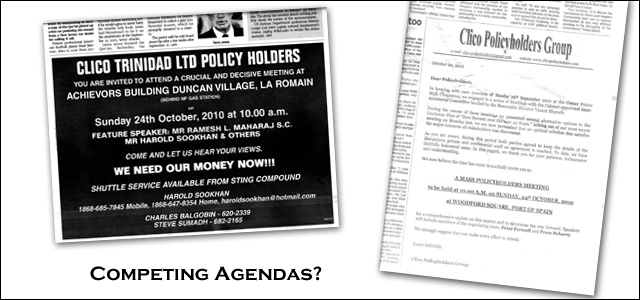
Competing agendas?There was an EFPA group and a CLICO Policyholders group formed just after the budget on 8th September, but they soon merged under the latter name.  I am now seeing what appears to be a substantial split with 2 competing meetings being organised for 10am today – one in Port-of-Spain and the other in San Fernando.

The CPG group has been very successful at getting their views known and making the media circuit, with the eventual meetings with the advisory group set up by the PM.

The main concern being advanced by the CPG is for the recovery of the funds deposited with CLICO and there has been no reply whatsoever to the point that, despite its labelling, the EFPA was largely sold and understood as a deposit.  The accounting rule of thumb as to ‘substance over form‘ in interpretation is an irrefutable part of the debate on this, but CPG have been silent on this point.

Almost all the many people with whom I have discussed this issue, have been very plain in their language – ‘I had my money deposit with CLICO‘ and so on.  But the word Policyholder is more likely to attract sympathy, so the games continue.

We already spent $7.3Bn in cash since the bailout was announced.  Please note that nobody is even talking about how the State is going to recover that loan.  The only talk is about how are they, the depositors, going to recover their monies.

There is a real principle of financial equity being shredded to pieces in the conduct of this bailout and it was disappointing that Mr. Dookeran, as an Educator in the field, did not take the opportunity to expand on this.

The intent is plainly to deprive the Treasury of its limited funds so that the assets of 15,000 people can be preserved.

So, What about those negotiations?

Sen. Vasant Bharath
Sen. Vasant Bharath

When the Prime Minister spoke on 1st October, she created an advisory group (headed by Minister of Food Production, Vasant Bharath)  to meet with the policyholders to seek other options.

The Prime Minister was to meet with concerned persons and activists on Wednesday 7th October in Chaguanas, but that meeting was cancelled at short notice, with no alternative dates given.

What we are left with is lengthy, secret meetings to discuss the review of the bailout terms, with no concrete information emerging.  That secrecy is totally unsatisfactory.  It smacks of secret deal-making and does nothing to inspire the confidence which is supposedly the very purpose of this exercise.

The last regime, with all of their noble intentions and devout Ministers, lost their way in a morass of muddled purposes, secret deals, mixed-up with misleading and false public statements from the highest office in the land.  We all know how that ended.  The question is whether we have learned anything from that bitter experience.  The Peoples’ Partnership were the main beneficiaries of those PNM errors, have they learned from that?

Our money is being spent on this massive exercise and it is not good enough to emerge from these closed meetings with agreed phrases like ‘constructive or meaningful’.  This emerging pattern speaks of disrespect for the acumen of our people.

To re-state my equation:

Expenditure of Public Money – Accountability and Transparency = CORRUPTION

Imagine these bold-faced people declaring that when they are done and settled, the terms will be announced to us who paying for the whole thing.  The first sign of a bad marriage is when the husband is the last to know – some say, the wife.  But the main point is that the public cannot be the last to know.

The simple and painful fact is that public confidence in our leaders is at an all-time low.  The time-honoured notion that a leader is someone wiser, more mature, less reckless and  of overall higher ideals has been tested to destruction by events.  In this particular case, it is easy to understand the charged atmosphere, hence the need for extra ventilation and transparency.

I was recently emailed by a well-meaning group asking that I start setting out some ideas of how CLICO might be rescued and I had to remind them that without basic information, all we can do is argue emptily with each other.  All to the amusement of the masterminds of this, the greatest economic crime in our nation’s history.

I was even ‘phoned, while writing this, by an acquaintance who is a leading member of the CPG to join him and an un-named UK guest in a TV studio on Monday morning to discuss all this.  Yes, I dismissed the request – too much secret-thing for my taste – and challenged the caller to name the person, supposedly a top UK expert.

What would be ‘constructive and meaningful’ would be to publish these long-outstanding reports so that we in the public can inform ourselves on the vital issues –

  • The original Duprey letter of 13th January 2009.
  • The audited accounts of the CL Financial group for the years ending 31st December 2008 and 2009 – Have PwC completed that?  When are they to be published?
  • Wendell Mottley, Colin Soo Ping Chow, Steve BideshiThe Mottley Report – There was a team of three advisers – Wendell Mottley, Colin Soo Ping Chow and Steve Bideshi – appointed to examine the CL Financial group and we need to know what were the findings of this group.
  • Given that we are being asked to bailout and clean-up Mr. Duprey’s crisis, I feel we need to be told  the names and details of those who benefitted from the $7.3Bn paid out so far, as well as those details for the borrowers of the $1.0Bn of ‘non-performing loans’ in CIB’s portfolio.
  • Finally, we also need to have the position of the CLICO Policyholders’ Group published.  What exactly are they claiming?

We have seen reports in the press about the very long Cabinet meeting on Thursday 21st at which the CLICO issue was said to be part of that agenda.

It would be totally unacceptable for a deal to be sealed without properly informing us, the taxpaying public, as to the true background.

The People’s Partnership has already distinguished itself, positively, by announcing Commissions of Enquiry into the attempted coup in 1990 and the Financial collapse (CL Financial and HCU).  This is no time to get diverted into back-room deals.

I am working for betterment and from you, our elected rulers, I expect better.

Barbados Free Press spreads the word for AfraRaymond.com


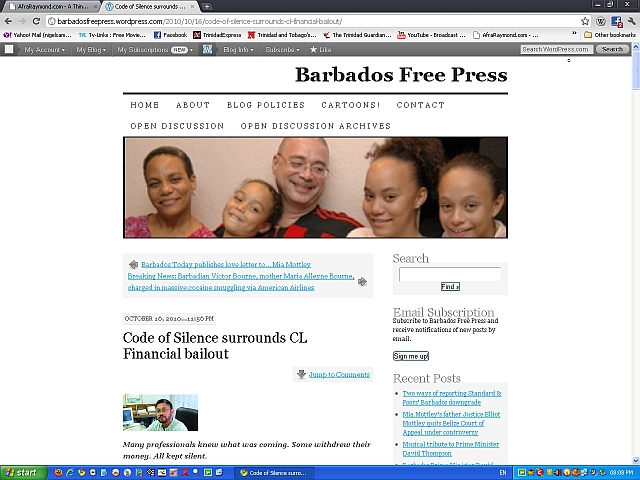
Code of Silence was an article in two parts – the first dealing with the agents and effects of that Code and the second dealing with the unfolding case of AIC.

As usual, I sent the article to my main blogging-collaborator Barbados Free Press (BFP) who split it apart into those halves. Maybe they felt that the bond default by AIC Barbados in the second half deserved a separate focus for their readers – who knows?

So, BFP published Code of Silence surrounds CL Financial bailout on Saturday 16th and Michael Lee-Chin’s AIC Finance – Another CL Financial CLICO situation in progress? on Monday 18th.

Later that day, the AIC story was picked-up by Forbes.com and that story is here, Forbes picks up Barbados Free Press news feed!

Housing Policy Imperatives – part 6

I am bringing this analysis to a close by asking the question as to which individuals are ultimately responsible for this scandalous situation.  The age-old questions persist – Are we mere creatures of circumstance?  What influence can one individual have on transforming a situation?  Do modern outlooks over-emphasise the power of the individual?

We need to close the circle to understand the role of the high-powered individuals in charge of this policy.

The Author of the Policy

Calder Hart
Former HMB and UDeCOTT CEO, Calder Hart

Calder Hart, then CEO of Home Mortgage Bank and well-known to be a protégé of Andre Monteil’s, claimed to have authored our National Housing Policy – ‘Showing Trinidad & Tobago a new way home

In October 2002, Hart told me that in his office and he made a point of seeking my views of the new policy.

I questioned the originality, relevance and feasibility of the proposed policies and a frank discussion ensued.  It seemed clear, from Hart’s reaction and subsequent behaviour, that he had indeed taken authorship of that misguided policy.

That policy can be viewed at here.  Given their non-involvement in the later stages, it is interesting that the cover-page of the housing policy highlights UdeCOTT as a main state agency in its implementation.

The Minister of Housing

Keith Rowley
Former Min. of Housing, Dr. Keith Rowley, M.P.

The Minister of Housing with longest tenure through this period was Dr. Keith Rowley, M.P., currently leader of the Opposition PNM – he was in that office from  November 2003 to November 2007 – see http://www.ttparliament.org/members.php?mid=26&pid=5&id=KRO01.

The HDC was launched on 1st October 2005 to replace the National Housing Authority.  The Trinidad and Tobago Guardian newspaper reported Dr. Rowley’s remarks at that time – see http://legacy.guardian.co.tt/archives/2005-10-15/news7.html

Earlier, Rowley said the NHA was restructured because it lacked accountability.

There are a lot of things that did not go right in the NHA and one of those things had to do with accountability…The HDC is not going to function like that. We are required by law to have the accounts ready in a certain period of time.  The CEO will be held accountable and the Cabinet will hold the minister accountable and the Parliament will hold the Cabinet accountable. That is what the HDC means.

“…the HDC never published any accounts in the 5 years of its existence. It goes even further, since the NHA’s accounts for the period 2002 to 2004 have only recently been prepared.”

Continue reading “Housing Policy Imperatives – part 6”

Housing Policy Imperatives – part 5

This week the examination shifts to the scale of the failure of our national housing policy – see <http://www.vision2020.info.tt/pdf/Policies and Procedures/Strategic_Corporate Plans/Housing Plan.pdf>.  Three main points for consideration are –

  1. Meeting the targets
    The original target was for the HDC to construct 100,000 new homes in a decade, which figure was generated from the 1994 ‘PADCO reports’—The Review of Shelter and Land Development Policy Study (PADCO reports): The PADCO reports is a series generated by The Planning and Development Collaborative International, Inc. and Laughlin and Associates Limited (who were contracted by the Government of Trinidad and Tobago in 1993)—that study is available at the Ministry of Housing & Environment’s library.  The annual target was reduced to 8,000.  As noted in the previous article, the reduced targets should have yielded 60,000 new homes by now, but the HDC has built only 15,394 new homes.The HDC made a recent statement that the number of empty new homes was approximately 10,000.  So just about 5,000 new homes have been built and distributed since the inception of this ‘accelerated housing programme’ in September 2002.  Even if we omit 2002, that is an annual average of 667 new homes being built and distributed. Even with the most optimistic assumptions, one is looking at considerable challenges in achieving these demanding targets.  At the current rate of performance it would take over 140 years to satisfy the original target.  That is how far off-track this accelerated housing programme has gone.  Deep into the long grass.
  2. The Cost-based Pricing model
    In previous articles in this series, I have been critical of the HDC’s cost-based approach to pricing its units.  In terms of the central mission of the Ministry of Housing  – i.e. creation and distribution of housing to the needy – that pricing model is inappropriate.  That is because it does not identify either the housing subsidy allocated to successful applicants or the opportunity cost of the HDC’s policies. The value-based approach is the more appropriate model to satisfy those basic requirements.  That is because it offers greater clarity to policymakers, since it is based on the market value of the completed homes, with the housing subsidy and the opportunity cost being the difference between the value and the actual HDC selling price. On 21st March 2008, this newspaper carried a report headlined “PM’s son in line for apartment” – see http://legacy.guardian.co.tt/archives/2008-03-21/news8.html – on allegations that Brian Manning, son of the then-PM was in line to receive one of the HDC apartments at Fidelis Heights in St. Augustine.  Noel Garcia, the then-MD of the HDC, was reported to have said –

    …the Government had taken a decision not to subsidise this  particular development. It is being sold at market rates in HDC’s thrust to expand and attract an open market clientele.

    Noel Garcia, former MD of HDC. Photo courtesy Trinidad Guardian
    Noel Garcia, former MD of HDC. Photo courtesy Trinidad Guardian

    Given that the units were reportedly being sold for a maximum of $875,000 and that they were worth a minimum of $1.7M, it is clear that each new home there is sold with at least $800,000 in housing subsidy.  The only way Garcia’s incredible statements could be correct is if one were using the misleading cost-based approach.

    I entirely agree with his statement that the Fidelis Heights development “…is therefore not part of HDC’s provision of subsidised housing for low-income earners.”  It is really subsidised housing for the middle-income groups, but that could never be right when the waiting list is bulging with needy people who cannot even get an HDC unit to rent.

    Fidelis Heights was, even by its name, a monument to misleading and wrong-headed thinking.  The HDC project with probably the highest level of housing subsidy per unit was built for the least needy on their waiting list.  Only if the underlying philosophies and resulting models are appropriate, can we avoid a repetition of this blatant waste of public funds in the face of real, human need.

    Given that the HDC is unable to satisfy the needs of the people it was intended to serve – the poorest citizens who cannot afford a proper home – it is scandalous that its scarce resources should have been diverted to Fidelis Heights, or the one at Federation Park in Port-of-Spain.

    The selection of this pricing model is proof of misguided policy at the most elementary level.  The basic concept of opportunity cost appears to have eluded the responsible officials and, what is more, that misguided policy appears to have been approved at the very highest level.

    Wrong-headed thinking can only encourage corrupt behaviour.

  3. Costs
    What has the national housing programme cost this country?  That is no rhetorical question, since this fact sits at the heart of the analysis.  The Housing Development Corporation (HDC) is the State’s implementing agency for production of new housing, it was formed in 2005 by an Act of Parliament and replaced the National Housing Authority (NHA).  The HDC’s funding comes from four sources –

    1. Treasury allocations – Those are announced in the budget and can be established from the Estimates of Expenditure as Capital Allocations to the Ministry of Housing.
    2. Sale of new homes – When the HDC sells a new home, that money is also available to them.
    3. Bond Issues – The HDC has also raised money by occasional bond issues; those funds can be used to either build more homes or ‘pay down’ on more expensive loans.  The bonds issued are government-guaranteed, so they are considered as virtually risk-free ‘sovereign debt’.  Given that the government itself issues bonds at lower rates of interest, it begs the question as to why these SPE’s are allowed to borrow on these terms.  That issue was raised by in the BG View of 20th August 2009 – see http://guardian.co.tt/business/business-guardian/2009/08/20/debt-depreciation-or-discipline.
    4. Bank Financing – The HDC also borrows money from commercial banks or the IADB to fund their construction programme.

    Try as I might, it has proven impossible to determine just how much the HDC has spent on building new homes in any given year.  That is because there are no accounts at all which are available to the public.

    The HDC Act, at section 18 and 19, mandates that the Board shall keep and properly audit accounts.  Section 20 requires the Board to submit its annual report to the line Minister within 3 months of the end of the financial year.  The line Minister is in turn obliged, by section 20 (2), to lay that report in Parliament within 3 months of receipt.  See – http://mphe.gov.tt/home/images/stories/pdfs/tthdc%20act%2024%20of%202005.pdf.

    The HDC has never laid either its annual report or audited accounts into Parliament for the public.  The failure to publish accounts is one of the most serious warning-signs of companies in financial trouble.

    That failure to publish HDC or NHA accounts over such a long period (since 2002 at least) spanning several administrations, is a serious indictment of the main participants – the politicians, the Board Directors and of course, the professionals involved in the entire huge operation.

    I have been reliably informed that the HDC’s new management is attempting to rectify this situation and that must be a priority if we are to properly assess the performance of this vital social programme.

The overall picture is stark –

  • Gross under-performance in terms of the output of new homes, only about one-quarter of the reduced target has been achieved:
  • Poor financial and project controls – as revealed in the Uff Report (at para 25:30 – see http://www.raymondandpierre.com/articles/article84.htm), not one HDC project has a signed contract:
  • No accounts or annual reports, given the preceding point, that is not surprising:
  • An inequitable allocations policy, with lower priority given to those who cannot afford to buy.
  • Approximately 10,000 new homes remain empty and that is the one which tops them all.  The ongoing adverse consequences include – vandalism, the greater rate of general deterioration afflicting empty homes, the high cost of security and of course, the continued pressure on those people on the waiting list ‘holding strain’.

Given the combined effect of all this, which is probably hidden to most of today’s readers, one can only wonder at the patience of our needy citizens.

The entire situation also raises potent questions about the purpose and performance of the SPEs.

SIDEBAR: The concept and importance of opportunity cost and housing subsidy

Let’s use a typical home at Fidelis Heights as an example.

  • Unit Cost – $825,000 (and it is not clear if land and professional fees were included)
  • Selling Price – $825,000
  • Market Value – $1.7M
  • In the prevailing cost-based pricing model, this is considered a satisfactory, ‘zero-subsidy’ result, since the State has recovered all of its costs. Another phrase in the lexicon is the ‘cost-recovery’ model of pricing.

    The danger, as shown in the example in this article, is that the ‘cost-based’/’cost-recovery’ model ignores opportunity cost.

    The opportunity cost is the difference between the actual selling price of the unit and the market value. The HDC could sell each Fidelis Heights home for $1.7M, but has made the decision to sell at a reduced price of $825,000, which means that each sale is at the loss of those possible earnings. That amount of the loss incurred by the decision to sell at a lower price is called the opportunity cost. It is important that opportunity cost be identified and quantified as an element in all decision-making, both private and public sector. A decision-making process which ignores or obscures opportunity cost is negligent at the very least and can encourage corrupt practices and the dilution of capital.

    In this example, the opportunity cost is $1,700,000 – $825,000 = $875,000.
    Opportunity cost

    $875,000 is enough money to build at least three modest homes, yet this system has allocated that much money to each Fidelis Heights purchaser, each of whom qualified for a mortgage at that level.

    As a result of this questionable choice and the resultant shaky pricing model, there is an enormous ‘leakage’ of housing subsidy and opportunity cost.

    The opportunity cost can also be described as the housing subsidy since that is the difference between what a Fidelis Heights unit actually sold for and what a purchaser in the open market would have to pay for a similar unit.
    The two terms are therefore synonymous – Opportunity Cost is exactly equal to Housing Subsidy.

    http://guardian.co.tt/news/general/2009/03/25/quality-performance-must

    A version of this commentary appeared in print on August 5, 2010, on page 13 of the Business Guardian.

    Related reading: