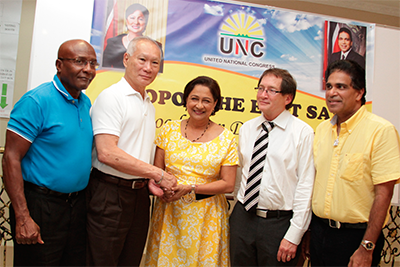
Prime Minister Kamla Persad-Bissessar greets former Clico chairman Gerard Yetming, second left, and former Senate president Timothy Hamel-Smith, second right, after they showed up at a UNC “foot soldiers” mobilisation meeting in Debe on Tuesday. Also in photo are Oropouche East MP Dr Roodal Moonilal and UNC campaign manager Rodney Charles, left. PHOTO: RISHI RAGOONATH
I smiled at the page three photo in another newspaper of the Prime Minister holding hands with recently-dismissed CLICO Chairman, Gerald Yetming, at a UNC meeting in Debe on Tuesday 23 June 2015. As serious as the situation is, I just couldn’t help myself.
Yetming was a UNC Minister of Finance during the Panday administration and had been appointed on 28 September 2010 as Chairman of CL Financial Ltd, the parent company of the ‘CLICO group’ being bailed-out by the State.
I declined many requests for comment on this controversial episode, since something about it did not seem quite right. The actual CLICO dismissals were incredible to my mind, not only because there did not seem to be any conflict between the stipulations in the CBTT’s 3 June Press Release and the reported beneficiaries – that is explained in the sidebar. It is even more bizarre when one considers that Yetming, in whom all confidence was apparently lost after allegedly-unauthorised payments to former CLICO Directors, still serves as Chairman of the parent company, CL Financial Ltd.
There is a widely-held view that the CL Financial chiefs should not be recovering any of their money from this huge collapse before the completion of the Colman Commission and the publication of its Report. I share the public concern that no money should be paid to the persons who were in charge of that sinking ship. Not one cent. Nothing should be paid to the CLF chiefs until we have had the proper opportunity to consider the findings of the Colman Commission. Even with its severe limitations, that Colman Report would be our closest opportunity to understand this epic financial crime. To pay out money to those Directors and Officers who were responsible before the Report is published would be reckless in the extreme and jeopardises the public interest. Continue reading “CL Financial Bailout – False Firing?”→
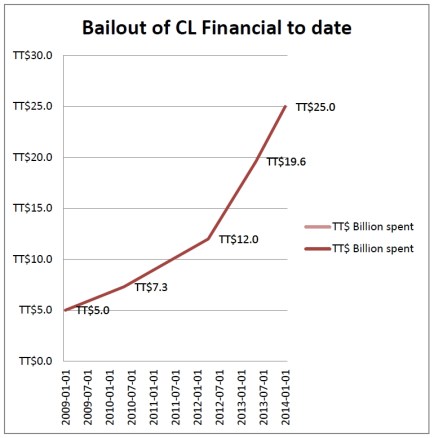
Today is the 30th of January 2014: five years since the State bailout of CL Financial was announced to a shocked nation and region. It is necessary to mark this moment in time with solid facts and stern meditation.
The Carnival season is upon us, so J’ouvert is near the front of my thoughts. J’ouvert is simple, yet tremendous, because of the experience of passing from night into daylight and of course those around you becoming clearer as the light overcomes the darkness. For me, the defining feature of Jouvert is the terrifying portrayals of ‘Devil mas‘ in its various forms – ugly and dirty, covered with mud, oil or paint; real noisy, beating pitch-oil tins and such; forceful, in demanding payment from you before you could pass. You have to pay the Devil to go away. Pay the Devil, so he could leave without dirtying you up.
The vast amount of detail which has emerged in the last five years, means that I can only focus on one key aspect of the CL Financial bailout scandal.
My main theme is that vast amounts of Public Money have been committed to repay the debts of CL Financial, while the chiefs who directed and controlled that conglomerate seem free to come and go as they please. Or, in the case of Duprey, who refused to testify at the Colman Commission, to go and refuse to come. Once again, Trinis in the running for some awards for innovation and so on, with Duprey being the world’s first ‘Penniless Philanthropist‘.
How much Public Money has been spent on this exercise? How much of that Public Money will the State recover? That is my focus.
When the Memorandum of Understanding was signed on 30th January 2009, it was on the basis that CL Financial assets would be sold to recover the Public Money being advanced, which was estimated to be about $5Bn.
Winston Dookeran’s first budget speech on 8th September 2010 was a critical turning-point, as it appeared to me that he was attempting to stem the flow of Public Money out of the Treasury. Dookeran made a case which was based on the huge and unprecedented liabilities facing the State at pg 9 –
“…The total funding provided as at May 2010 by the Government and the Central Bank, excluding indemnities and guarantees to First Citizens Bank amounted to approximately $7.3 billion. As of June 2010, CLICO and British American combined total liabilities were approximately $23.8 billion but total assets were $16.6 billion…” .
Immediately, in protest at Dookeran’s attempt to limit the cost to our Treasury, there were several ‘Policyholders’ and Depositors’ groups‘ formed. The word ‘Depositors’ was soon omitted when it was realised that it would not suit their purposes.
With Dookeran isolated and the government under mounting pressure from these new protest groups, there were new laws drafted to stifle the protestors’ legal options. At this point, we had the historic address to Parliament by the PM on 1st October 2010 – historic because even with the required majority of votes to pass the intended new laws, the PM chose to explain and persuade the public. The bailout was extended to Hindu Credit Union and the Commission of Enquiry was announced to find the causes of the collapse of the CL Financial group and HCU.
Most notable was the PM’s outrage at the mystery of the bailout – at pgs 25-26
“…The $5 Billion has been spent—we are advised—to repay matured EFPA policies in an ad hoc and unstructured manner where payment arrangements were entered into based on levels of funds invested. What criteria did you use to repay investors? Whom did you choose to pay? How were they chosen? These questions need to be answered. Because if it is today after the $7.3 Billion, all these EFPA people, the policy group and so on, they are out there, where is their money? Where is their money? Did you have a priority listing of who should be paid? Why did you go—and you are now crying crocodile tears about trade unions, credit unions, the poor man and the small man—why did you not pay them first? Why did you not pay them first? Where did that $7 Billion go? We need those answers, Mr. Speaker. We deserve those answers. The taxpayers need to know. Because when a parent has to buy school books and bags to send his/her children to school but they have to pay tax out of the little money, they need to know where that money has gone…Where, how and why; we need to know…”
In September 2011 Parliament approved a new law authorising the State to borrow an additional $10.7 Billion to fund the bailout.
Para 21         (a)      $5.0Bn already provided to CLICO;
                (b)      $7.0Bn paid to holders of the EFPA and
Para 22                  $12.0Bn estimated as further funding to be advanced.
Recent estimates have now risen to ‘$25b and counting‘ according to the Sunday Express report of 4th May 2013. Given the shock with which the estimated bailout cost of $5 Billion was received a mere five years ago, it is sobering that $25 Billion can now be bandied-about by Public Officials in this fashion.
Will our money ever be repaid? If so, how and when?
Now and again, official statements are made to assure the public that the matter is being resolved and the CL Financial Shareholders Agreement is extended for this reason or that. There is an appearance of diligence and purpose, but there are also other statements which we must consider.
“…Mr. President, we shall never recover all the funds that have been put into the group, but our focus is to try and maximize what we can and to reduce the borrowing that we need to do…”.
Even more concerning is that there has been secretive disposal of assets of the CL Financial group – to cite one example, Valpark Shopping Plaza was recently sold to Courts, without any public advertisement.
All the while, the State is mounting strong resistance to my lawsuit to force publication of the details of this bailout. The secrecy is inimical to the wider public interest, which is being sacrificed for the comfort and benefit of the ruthless few.
Every single established mechanism for oversight, transparency and accountability in public affairs has been sidelined in this sordid CL Financial scandal. Integrity in Public Life Act – nothing. Audited Accounts – not available. Freedom of Information Act – legally disputed. Briefing to Parliament – exempted.
Ask yourself – “Would you trust a public official with $1M to spend if there were no requirement for them to account properly?” If not, why should we trust any public official or institution with the authority to spend 24,000 million dollars with no oversight or accounting.
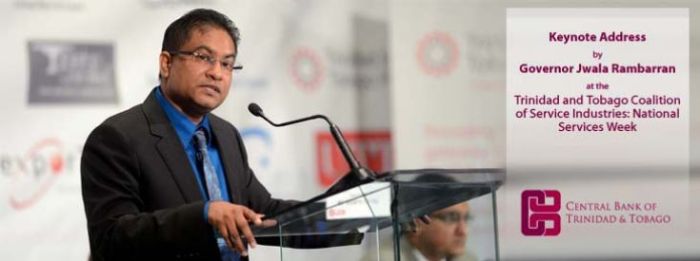
I am responding to the points made by Central Bank Governor, Jwala Rambarran, in his 6 November speech to the T&T Coalition of Service Industries.
This speech attempted to both re-affirm the Central Bank’s important role in our economy –
…as the country‟s prime financial regulator, the Central Bank has an almost fifty year record of maintaining the safety and soundness of the financial system…
and to distinguish Rambarran’s tenure as Governor since July 2012 –
…These are just a few of the initiatives the Central Bank has been working on over the last fifteen months to rebuild confidence, strengthen financial stability and to help create our future financial system…
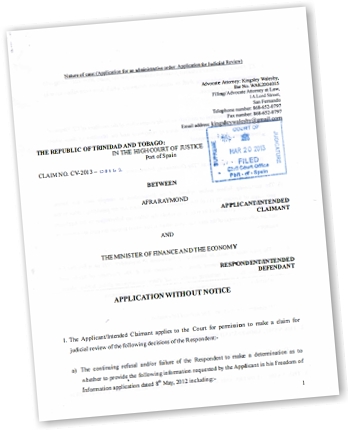
This is the Pre-Action Protocol letter to the Minister of Finance challenging his failure to reply to my Freedom of Information Act request of 18 March 2013, seeking details of the beneficiaries of the CL Financial bailout, particularly the EFPA holders.
Afra Raymond chats on the show ’Forward Thinkers‘ with David Walker on 104.7FM, dealing with the CL Financial bailout and my lawsuit against the Minister of Finance to get at the detailed information as to how the $24B in Public Money was spent. 24 October 2013. Audio courtesy More 104.7 FM
The case is a critical challenge to the detrimental notion that $24Bn of Public Money can be spent without Accountability or Transparency. That notion does violence to any healthy conception of the Public Interest, so I expect this contest to be a sharp one.
“Power concedes nothing without a demand…” Frederick Douglass…Freedom Fighter and esteemed ancestor…
“Sunlight is the best disinfectant!” Former US Supreme Court Justice Louis Brandeis…
Afra Raymond chats with Fazeer Mohammed on the Morning Edition show giving a year end wrap up of issues including the Colman Commission and The CL Financial bailout. Video courtesy TV6
We are entering the endgame of the Colman Commission, so we need to maintain full vigilance. We must bear witness in a sober manner.
The PNM element
Former PNM Ministers Danny Montano, Conrad Enill and Mariano Browne were recently named by Commission Chairman Sir Anthony Colman as having declined to testify.
“It is noticeable that there has been a remarkable lack of cooperation from others, who were responsible for political decision-taking — to mention a few names: Mr. Enill, Mr. Browne and Mr. Montano in particular — have not offered to come and give evidence,” Sir Anthony said at Winsure Building, Richmond Street, Port-of-Spain.
“It is surprising perhaps that those who were the political representatives of the people of Trinidad and Tobago have not been able to provide assistance to the Commission in circumstances where it might have been expected of them,” he added.
Colman then named three former Cabinet ministers who had been previously named in testimony at the enquiry in relation to the HCU.
“To mention but a few names Mr (Conrad) Enill, Mr (Mariano) Browne and Mr (Danny) Montano in particular have not co-operated to come and give evidence,” Colman said.
That refusal to appear before a Commission of Enquiry amounts to a kind of contempt of court, since it is wilful disrespect for a lawful enquiry. These are PNM Seniors, whose testimonies would have been invaluable in unraveling this series of financial collapses.
Here is why those missing testimonies are so important –
Mariano Browne is a Chartered Accountant who left a successful career as a Banker – including a significant part of that career spent at CLF, Browne was the first head of Clico Investment Bank and CLF’s Barbados Banking arm – to become Minister of Trade and Minister in the Ministry of Finance after the 2007 general elections. In addition, he is PNM Treasurer, so he could have given a rare insight into the linkages between these collapses and the large-scale donations made by both the CL Financial Group and the Hindu Credit Union (HCU).
Conrad Enill comes from a Credit Union background, was also Minister in the Ministry of Finance up to the 2007 general elections and served as PNM Chairman up to their 2010 election loss. Enill called for an investigation into the finances of HCU as far back as mid-2002, but swiftly withdrew from that course of action after reportedly being pressured by then PM Manning.
Danny Montano is also a Chartered Accountant, who was Minister of Labour at the time of the HCU collapse (that Ministry has supervisory responsibility for Credit Unions).
“…THE Hindu Credit Union (HCU) financed Karen Nunez-Tesheira’s successful campaign to become the Member of Parliament for D’Abadie/O’Meara in the 2007 general election.
However, Nunez-Tesheira was not the only People’s National Movement (PNM) candidate who secured campaign financing from the HCU during that election.
This was revealed yesterday as the commission of enquiry into the collapse of CL Financial and the HCU resumed at the Winsure Building on Richmond Street in Port of Spain.…”
“….THE Hindu Credit Union (HCU) financed the campaigns of the country’s two major political parties—the People’s National Movement (PNM) and the United National Congress (UNC)—in the 2007 general election, former HCU president Harry Harnarine said yesterday….”
It is clear that the testimony of these three former PNM Cabinet Ministers would have been crucial to the Colman Commission unravelling this financial fiasco. I am convinced that the matter of what Cabinet knew at the time it took the bailout decision is crucial. For one thing, was Cabinet told that the beleaguered CL Financial group had paid a dividend on 16 January 2009, three days after they had written to the Central Bank for the bailout? If the Cabinet knew of the illegal dividend payout, why were no provisions made in the MoU of 30 January 2009 for the recovery of those monies? If the Cabinet were not told, then we are contemplating what might be a prior case of a senior Minister misleading colleagues to get the required result. A kind of pre-S.34 situation.
Both Browne & Montano are Chartered Accountants, so this reported refusal to give evidence seems to be a case of ‘conduct unbecoming a professional’.
The PNM is now making serious efforts to market itself as a party which stands for good values in terms of Accountability, Transparency and Good Governance. Given the PNM’s track record that is a great challenge. These reported refusals are doing great damage to those efforts.
Ironically enough, at this moment Dr. Bhoe Tewarie and Karen Nunez-Teshiera, are both looking better than these three former Ministers, given that they have appeared before the Commission. Just imagine that.
Sir Anthony Colman was reported to have issued subpoenas for certain missing witnesses in the HCU matter and held them in contempt of court when they failed to appear. I am waiting to hear whether the same treatment will apply to these PNM Seniors.
“…THREE witnesses have been held in contempt of court for not responding to subpoenas issued by the Commission of Enquiry into the collapse of CL Financial and the Hindu Credit Union.
A commission of enquiry has the same status as that of a High Court.
Those deemed to be in contempt of court yesterday by commissioner Sir Anthony Colman are former chief executive officer of HCU Communications, Gawtam Ramnanan, former HCU financial consultant Jameel Ali and Dave Jagpat…“
It seems like this is yet another episode of inconsistent behaviour which serves to reinforce my belief in this potent ‘Code of Silence’. Let me explain with these facts set out above. One group of witnesses have offered weak excuses of the familiar kind – questionable medical certificates and so on – they were served with orders compelling their attendance (those are called subpoenas) and when they failed to respond, Colman made a ruling that they were in contempt of court. That group was HCU witnesses.
Another group of witnesses took a different approach….they actually have decided not to testify and communicated that to the Colman Commission as described above. Why has Colman not issued subpoenas or made any adverse rulings against these reluctant witnesses?
They are former member of the PNM cabinet, so I have to ask myself if there is a tacit agreement as to areas which will not be ventilated in this Enquiry.
Those areas which are seemingly off-limits now seem to include serious questions as to whether the Cabinet was misled. This is a sobering example of the channels of power. We have to bear witness.
Roger Gaspard, SC, DPP“…I am particularly concerned that an otherwise credible prosecution might be stopped by the court on the grounds that a defendant’s right to a fair trial had been fatally compromised by the publicity attendant upon your enquiry. As such, I shall be issuing a press release warning the media against the publication of any material which may jeopardise the police investigation and any potential criminal proceedings…”
We also read that “…Gaspard also issued a stern warning to media houses last night to cease publication of “anything which might jeopardise, hinder or otherwise prejudice the investigation or any possible proceedings which might result from it…“.
The Colman Commission has maintained the modern standard of Public Enquiries in that the public can choose from attendance in person, live TV, streaming webcasts, online transcripts and online witness statements. It seemed to me that the position being taken by the DPP could jeopardise the public interest in having this information broadcast in the widest possible terms.
On 10 November, my mind churned as I read this – “…Meantime, the Commission of Enquiry is set to restart on December 3 with former Central Bank Governor Ewart Williams and Inspector of Financial Institutions Carl Hiralal expected to take the witness stand…”
At this stage we are expecting to hear the testimony of the Chiefs in this series of disasters – Lawrence Duprey, Ewart Williams, Carl Hiralal, Robert Mayers, Ram Ramesh, Faris Al-Rawi, Amjad Ali, Anthony Rahael, Andre Monteil. I am very concerned that we are now seeing what appears to be a detrimental development in terms of complete transparency.
“I remain mindful of competing public interest factors including the fair trial rights of potential defendants, the freedom of the press and the requirement of open justice.”
This is definitely an aspect which needs our most intense scrutiny.
The former CLICO CEO
Gene Dziadyk
Finally, we come to the matter of former CLICO CEO, Gene Dziadyk, with whom I have been in correspondence, writing and offering to tell the inside scoopon what went wrong inside CLICO.
I have read his material and he takes a completely opposite view to me as to what has happened here.
My own view is that the CL Financial group was able to use its track-record of huge political donations and other links to obtain full State support on favourable turns when the inevitable crisis emerged. The CLF group was able to use its links to take advantage of the State. Dziadyk’s view is that the State used the crisis to take advantage of the CLF group in general and the CLICO policyholders in particular.
I cannot see any way that we could both be right. The critical point is that only the publication of the audited, consolidated accounts and other details I have been pursuing will allow us to see the truth of this matter.
But the fact that Dziadyk is a trained actuary, who was at the centre of the scene for so long, makes his testimony invaluable for the insights it will allow the Colman Commission. I was therefore very surprised to read that he is not going to be called as a witness.
Readers who are interested in having the testimony of Gene Dziadyk form part of the Colman Commission to state their support for that to happen – the Secretary to the Enquiry is Judith Gonzales and her email address is comsecclfhcu@gmail.com.
These kinds of issues are exactly the ones on which the public input of Seenath Jairam, SC is sorely missed. Having decided to take the Ministry of Finance brief and later deciding to return it, any of Jairam’s subsequent public utterances will be coloured by those decisions.
That is the point I was making in the previous column on the sacrifices which leadership demands.
Afra Raymond chats in ‘The Barbershop‘ with John Wayne Benoit on i95.5FM about the CL Financial bailout and Public Procurement issues and other topics. 30 June 2012. Audio courtesy i95.5FM
 Today is the 30th of January 2014: five years since the State bailout of CL Financial was announced to a shocked nation and region. It is necessary to mark this moment in time with solid facts and stern meditation.
 I am responding to the points made by Central Bank Governor, Jwala Rambarran, in his
  Afra Raymond chats on the show ’Forward Thinkers‘ with David Walker on 104.7FM, dealing with the CL Financial bailout and my lawsuit against the Minister of Finance to get at the detailed information as to how the $24B in Public Money was spent. 24 October 2013. Audio courtesy More 104.7 FM


 Afra Raymond chats in ‘The Barbershop‘ with John Wayne Benoit on i95.5FM about the CL Financial bailout and Public Procurement issues and other topics. 30 June 2012. Audio courtesy i95.5FM
 AfraRaymond.net