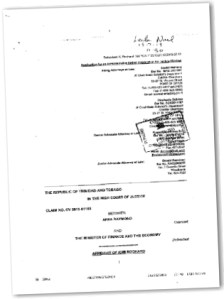
This is my reply to the Ministry’s affidavit of 12 July which seemed to rely on the fact that CL Financial is a private company to refuse publication of the requested information.
Of course that line of reasoning is yet another emerging threat to our country’s Integrity Framework, so our reply challenges the validity of this assertion.
At our hearing on 1 October, Justice Boodoosingh ordered me to formally notify CL Financial and we have done that, so at our hearing earlier today, CL Financial were represented by a team led by Stephen Singh and various dates were set, with our next hearing on 27 February 2014. Of course that is the very Carnival week, so stay tuned. I expect there will be significant other developments well before that.
Having written four critical articles consequent on the Appeal Court’s 27th June 2013 ruling and having been preceded by two leading commentators — Andre Bagoo & Anthony Wilson — I was intrigued by this Public Notice published at p. 49 of the Sunday Express of 6 October 2013.
It does not mention any particular articles and purports to clarify the ruling. I will be continuing this examination in my reply.
Invader’s Bay has re-emerged from the shadows via PNM Senator Faris Al-Rawi’s budget contribution on Monday 23 September 2013 (pp. 168-175). The twists and turns in this controversial proposed scheme are detailed at JCC’s webpage.
Invader’s Bay is a 70-acre parcel of reclaimed State land off the Audrey Jeffers Highway – just south of PriceSmart & MovieTowne – in the western part of Port-of-Spain. Its value was estimated by the State in 2011 to be in excess of $1.2Bn, so these are prime development lands, possessing these attributes –
Water, Electricity and all urban services are readily available;
Flat/gently-sloping terrain;
Direct access to Audrey Jeffers Highway;
Waterfront location.
Before proceeding to the latest revelations, it is important to restate the main objections raised by the JCC and others with respect to this proposed development –
The Request for Proposals (RFP) was published by the Ministry of Planning in August 2011 seeking Design-Build proposals for the development of these lands and specifying an entirely inadequate 6 weeks for submissions;
There has been no public consultation at all, so the public has not been involved in this, the largest proposed development in our capital in living memory;
The RFP was silent as to the other three, extant strategic plans for the POS area, all paid for with Public Money. Given that the RFP was published by the Ministry of Planning, that is a tragic irony, to say the least;
EIA – The RFP is silent as to the requirement for an Environmental Impact Assessment in a development of this scale;
The proposals were to be evaluated against the “Invader’s Bay Development Matrix and Criteria Description”, which was only published after the closing-date for submissions. That is a clear breach of proper tender procedure, which renders the entire process voidable and therefore illegal.
Property Tax is back and the controversy has naturally returned since the ‘Axe the Tax‘ movement was a signal moment of unity in the anti-PNM campaigns of 2009/2010.
In my opinion, the anti-Property Tax movement was an important measure of the extent to which our national discourse is now irrational and baseless. The disenchantment with the Manning administration and the thirst to have them removed seemed to occupy more time than any substantial discussion as to the merits of the proposed Property Tax.
Now, as then, I hold the view that our nation’s Property Tax regime is long-overdue for reform and updating. I support the proposals to do so and we will have to wait for more detail to analyse these proposals further.
Here are a few of the basic facts on Property Tax.
The size of the Property Tax Take – Proportionally
The Estimates of Revenue disclose that in 1995 property tax was 2% of tax revenue and in 2009 it was expected to be a mere .18%. Property tax, when last collected, contributed a small fraction of the amount it did 15 years ago. The official projections for the Property Taxes proposed by the PNM were for that revenue to increase to $325M in 2010 – even at that level, the contribution would have barely exceeded 1% of the national tax revenue.
The Draft Estimates of Revenue (2014) published in the recently-approved budget are unclear and I have requested an official clarification before making any detailed comments on those. As an example the Total Tax Revenue 2014 is estimated (at p. vii) to be $46.8Bn, with ‘Taxes on Property’ comprising $3.914M, which is a tiny proportion of the total, about 100,000th of 1%. The accompanying chart, on that very page, shows Property Tax at 1% of the total. There is more to say, but I am awaiting the requested information, hopefully before next week’s deadline.
The key point here is that property is a vibrant engine of wealth in our country and has been so for many decades, every successful person knows that. Given that fundamental, it is obvious that property has to be properly taxed if any kind of economic justice is to emerge. The historically paltry percentage of revenues raised via Property Taxes is solid justification for a comprehensive mapping of who owns what and the where. This is a flourishing sector of the economy, so proper taxes are long-overdue.
The size of the Property Tax Take – Absolutely
Total Property Tax 1993-2009. Click image to see expanded version.
*The PNM’s 2009 proposal was to abolish both the L&B Taxes and the House Rates, with the replacement Property Tax anticipated to earn $325M in the year 2010 – from Ministry of Finance, Estimates of Revenue 2010 (at pg v )
The figures tell a story, since they depict an unexplained decline in Property Tax revenue from $132.16M in 1994 to $83.44M in 1995 and modest increases to $95.08M in 2001, before restoration to $129.65M in 2002. L&B Taxes were payable outside of Municipalities, while House Rates were payable within the 5 Municipalities – POS, San Fernando, Arima, Point Fortin and Chaguanas.
According to the official records, the real decline in Property Tax income in that period occurred in non-Municipal areas, with L&B Taxes falling from $109.38M in 1994 to $60.38M in 1995, never rising above $64M, before restoration in 2002 to $94.08M. In clear contrast, House Rates in the corresponding period rose steadily from $22.78M to $35.97M.
I am an outsider examining these aspects of the Property Tax challenge from the published record and one wonders just who is responsible for this level of sheer recklessness. After all, 45% of the revenue from L&B Taxes vanished in a mere 12 months and in any properly-managed organisation that would send alarm bells ringing. Over the seven fiscal years 1995-2001, an annual average of $50M in Land & Building Taxes went unpaid – which makes a total of about $350M in missing revenue, at a minimum. What was the reaction within the Board of Inland Revenue? What steps did they take to identify and eliminate this leakage? Was there any tax evasion? Was anyone charged for that criminal offence?
These are essential questions to be resolved if we are to master the challenge of the proposed Property Tax system.
The Local Government element
2009 Municipal Corporations funding. Click image to see expanded version.
Both PNM and Peoples Partnership proposed to send the Property Taxes direct to the Consolidated Fund. The effect of that would be to reduce Municipalities to having just over 2% of their funding free from Central Government controls. That critical element must form part of any discussion on Local Government reform.
Next week, I delve into the question of income tax on rental income and the likely levels of tax on your property.
I am fully in support of a vigorous and conscientious Integrity Commission (IC). I do not want to see the IC abolished or sidelined. The IC must realign its limited resources to ensure a decisive impact on the conduct of Public Officials. The proposals contained in its 2012 Annual Report show clearly that the Gordon Commission has started to seriously grapple with that challenge.
The derailment of the IC between 2004 and 2009 is a clear example of what can happen to an Independent Commission if we do not maintain vigilant oversight.
This matter is of the greatest interest for those of us campaigning for Public Procurement reform so as to get effective control over all transactions in Public Money. The arrangements we are proposing include new Independent Commissions/Officeholders. It is therefore critical that we learn the lessons from this debacle so as to safeguard the bodies we are proposing. The stakes are very high for our nation’s Integrity Framework, which must be strengthened, with swifter resolution of allegations.
To continue in the current manner is to drag the system into further disrepute, encourage even more bold-faced thieves, more reckless public officials and we can expect complete loss of the residual respect for the post-independence civilization we have tried to grow. That would be an ugly and violent future for our society, so this episode requires stern and conscientious examination. Continue reading “Integrity Threat – Part 4”→
The previous column discussed the Appeal Court judgment in #30 of 2008, in which both TSTT and the Integrity Commission sought to challenge the High Court ruling in #1735 of 2005. That High Court ruling found that the phrase contained at para 9 of the Schedule to the Integrity in Public Life Act (IPLA) was to be taken ‘as read’ to define those people who are subject to its provisions –
“Members of the Boards of all Statutory Bodies and State Enterprises including those bodies in which the State has a controlling interest.”
The Appeal Court – comprising CJ Archie, together with Mendonca JA and Smith JA – ruled that –
“CONCLUSION
TSTT is not a State Enterprise. The members of its Board are not subject to the Integrity Provisions.
It is only the members of the Boards of those Statutory Bodies which exercise public functions that are subject to the jurisdiction of the Commission.“ Continue reading “Integrity Threat: Part 2 & 3”→
Afra Raymond chats with Joseph Berment-McDowall on Heritage Radio 101.7 FM about the Treasury Scandal article. 27 August 2013. Audio courtesy Heritage Radio 101.7 FM
TSTT is not a State Enterprise. The members of its Board are not subject to the Integrity Provisions.
It is only the members of the Boards of those Statutory Bodies which exercise public functions that are subject to the jurisdiction of the (Integrity) Commission.
Telecommunications Company of Trinidad & Tobago (TSTT) is a company established between the T&T State and the British-based multinational, Cable & Wireless. C&W holds 49% of the shares in TSTT, while the State holds about 42% of the shares together with the right to nominate 5 of its 9 Directors.
That unanimous ruling has serious consequences for the viability of our nation’s integrity framework.
The intended purpose of that framework is to ensure a satisfactory level of transparency and accountability in the way Public Money is transacted and Public Functions are discharged. There is still a strong case for this Integrity Framework as a necessary ingredient in the Good Governance of our nation. The Integrity Framework includes the Auditor General; the Integrity Commission; the Investments Division of the Ministry of Finance and the two Parliamentary Accounts Enterprises Committees. Ours is the most vibrant Caribbean economy and the State is clearly the largest player, so the proper management of that sector is critical. Given the continuing rise in the waste and theft of Public Money, there will always be a need for an improved, more effective Integrity Framework to oversee these huge, controversial operations. Continue reading “Integrity threat from the Appeal Court”→
I wonder if is Bobol?
What dey doing with Taxpayer’s Money at all!?
I wonder if is Bobol?
What dey doing with Taxpayer’s Money at all!?
—Opening stanza of ‘The Treasury Scandal’ by Atilla the Hun (1937)
I took this title from the late 1930’s kaiso by the great Atilla the Hun (Raymond Quevado) on the scandal of some $200,000 missing from T&T’s Treasury. His outrage was rooted in the fact that the story came-out in bits and pieces and of course, none of the ‘Big-Boys’ was ever jailed, or even charged for that theft. That was a massive amount of money in the 1930s – at that time a good Woodbrook house cost about $6,000 – so that could give you an idea. Atilla was lamenting the lack of accountability and transparency in how Public Money was being managed. The ‘Treasury Scandal’ was a true episode from the bad-old-colonial-days of the 1930s, but of course we have progressed a great deal since then, having achieved Independence, Republican status and universal education.
Winston Dookeran, MP
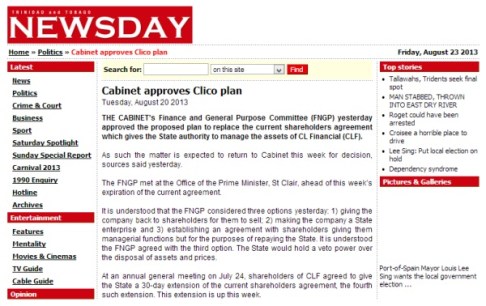
The problem is that despite the obvious movement forward, we are witness to yet another ‘Treasury Scandal’. I am referring to the CL Financial bailout, announced in January 2009 and still ongoing at an anticipated cost of $24Bn – according to paras 21 and 22 of the 3 April 2012 affidavit of then Finance Minister, Winston Dookeran.
It is vital to look back before we go forward. In 2008 and 2009, the Indo-Trinbago Equality Council (ITEC) campaigned strongly on the issue of the Secret Scholarship Scandal’. The suspicion was that there was a secret scholarship fund operated by the State without any transparency and ITEC used its Parliamentary representatives and the Freedom of Information Act to force the Patrick Manning-led PNM administration to publish the details they had been trying to conceal.
The published details included the names of those who benefited from the funds as well as the amounts, dates of payments and details of the courses of study to be pursued. Some of the more controversial issues to emerge from the publication of those scholarship details were –
The PNM administration was never able to demonstrate how those scholarships had been advertised, or for that matter, any objective process used to choose from the applicants;
Unlike other Scholarship arrangements, there was no requirement for these scholarship winners to do any kind of national service;
A number of people who were reported to have received money, went public to say they had never even applied for, far less received, scholarships. The question arising was ‘Where did that money really go?’;
A total of $46M of Public Money was paid during the 5 year period under examination. The President of ITEC at that time was Devant Maharaj and its leading attorney was Anand Ramlogan, both of whom now serve in the Cabinet.
I fully supported ITEC in that use of the Freedom of Information Act to force publication of important information on the use of Public Money, which is the property of every citizen.
In my view the failure and or refusal to account for the colossal and unprecedented expense of the CL Financial bailout is indicative of a ‘Quiet Coup‘ against our Republic. I am deliberately borrowing Simon Johnson’s potent phrase, used to describe the coup of Financial Capital against the USA published in a fascinating and essential article from The Atlantic. The fact that two successive administrations have remained bound to these arrangements and the low priority given to transparency and accountability in this matter all speak to the potency of the plotters.
“Emerging-market governments and their private-sector allies commonly form a tight-knit—and, most of the time, genteel—oligarchy, running the country rather like a profit-seeking company in which they are the controlling shareholders… As masters of their mini-universe, these people make some investments that clearly benefit the broader economy, but they also start making bigger and riskier bets. They reckon—correctly, in most cases—that their political connections will allow them to push onto the government any substantial problems that arise.”
—Simon Johnson. “The Quiet Coup” in The Atlantic. 2009.
The CL Financial group was able to use its considerable political clout and financial footprint to achieve a binding agreement that our Treasury would be used to pay its debts. Absolutely unprecedented and all negotiated in less than three weeks, we are told. That is the official version of this astonishing story.
Given the likely existence of a ‘Code of Silence’ in this tangled affair, I have been making use of the Freedom of Information Act in my campaign for transparency and accountability in the CL Financial bailout.
If we are ever to start to untangle this web of deceit and betrayal, we must get details of who got their money out, how much, on what terms and when. On 8 May 2012, I applied to the Ministry of Finance via the FoIA – from which the Central Bank is exempt – to request this information –
Accounts – The audited accounts for the CLF group or whatever figures the Minister is relying on;
The briefing given to the Independent Senators in September 2011 before debate of the two supplementary bailout Bills;
Details of the creditors, especially EFPA holders, to see who got what money;
Whether the Minister required CLF’s Directors to comply with the Integrity in Public Life Act.
The Ministry replied on 14 August to say that the information requested is likely to be exempt and I am now challenging them in Court.
If it is right and proper to use the FoIA to force publication of the details of a Secret Scholarship Scheme of some $46M over 5 years, why is it acceptable to conceal the details of some $24Bn in Public Money? That is over 521 times more Public Money being spent in secret…yes, $24Bn is over 521 times more money than $46M.
For all we know, some of the people on the Ministry’s list of persons who have been paid could be the same ones protesting via the various Policyholders’ Groups.
Maharaj said yesterday that he rejected Williams’ claim thatthen prime minister Patrick Manning’s handwritten note on one of the applications for the matter to be handled quietly was ministry protocol, as was claimed by Yuille-Williams. “It seems as if this was the overriding motto for the disbursement of these funds,” Maharaj added. “This was a blatant attempt to hide the facts from the glare of public scrutiny.”
Russell Martineau, SC
At this time the Ministry of Finance is publicising the end of the CL Financial bailout so that all the Public Money spent on this can be repaid and there are various official reports of how this is to be achieved. At the very same moment, the said Finance Ministry has engaged a high-powered and expensive legal team, headed by Russell Martineau SC, to oppose my attempts to have the basic information published.
This is a most interesting document for several reasons –
Attorneys – The legal team is led by Russell Martineau SC, former AG and former President of the Law Association. Martineau was lead attorney for CL Financial’s auditors, PricewaterhouseCoopers, during the recently-concluded Colman Commission and he strongly opposed my submissions as you can see in this revealing clip. His Junior in this case is Gerald Ramdeen, who was Junior Counsel to the said Colman Commission.
My recent supplemental application – On 18th March, I made a further application under the FoIA for the details of the creditors of CL Financial, particularly the EFPA holders, in relation to the amounts repaid and claimed. It is interesting that the Ministry of Finance chose to treat with this in their affidavit.
The objection – Despite several readings of this 5-page affidavit, I am not clearly able to see just what is the Ministry’s real reason for objecting to the release of the requested info.
State-controlled Enterprises – The recent Appeal Court ruling in #30 of 2008 on the meaning of State-controlled Enterprises is a real threat to the public interest in relation to the governance arrangements in situations like this. The final sentence of para #14 is “In any event, CL Financial Ltd. is a private company and is not a public authority under the provisions of the Freedom of Information Act.” Well I tell you.
The fundamental position – At the Court hearing on 23rd May, the lead attorney for Finance, Russell Martineau SC, was emphatic in stating to Justice Ronnie Boodoosingh that there was no intention of compromising or considering the release of even some of the requested information. It is going to be a fight for every item of information.
Public Secret – We are now being told that the bailout process for CL Financial is nearing its end with a procedure having been agreed for the recovery of the Public Money which has been spent. Serious and justified concerns are being voiced at this time since there is no way to be sure how much money has been spent or the terms of the final settlement. I will be writing more on this shortly. We are being told that the agreed terms of the settlement are solid in protecting the public interest, yet this very Ministry, Finance, is using a highly-paid legal team to oppose the publication of fundamental information.
 Having written four critical articles consequent on the Appeal Court’s 27th June 2013 ruling and having been preceded by two leading commentators — Andre Bagoo & Anthony Wilson — I was intrigued by
  Invader’s Bay has re-emerged from the shadows via PNM Senator Faris Al-Rawi’s


 I am fully in support of a vigorous and conscientious Integrity Commission (IC). I do not want to see the IC abolished or sidelined. The IC must realign its limited resources to ensure a decisive impact on the conduct of Public Officials. The proposals contained in its 2012
 On 27th June 2013 the Appeal Court ruled that –


 AfraRaymond.net