This shows the attempts by various parties to object to my showing the PowerPoint presentation…some of those parties and their attorneys include –
Central Bank – represented by London-based Bankim Thanki QC
Lawrence Duprey – represented by London-based Andrew Mitchell QC
PriceWaterhouseCoopers – represented by Russell Martineau SC, former Attorney General and former President of the Law Association
Andre Monteil – represented by Martin Daly SC, Sunday Express columnist and former President of the Law Association
It is really instructive to consider the various arguments put forward by these parties in an attempt to limit my testimony and ultimately to deny it the benefit of clear illustration via PowerPoint.
There is going to be a real struggle to show the information on this series of financial and economic crimes. That information needs to be shown in as digestible a form as possible, which was the point of my presentation.
Between the strong opposition of the parties who were at the centre of the crisis and the refusal of the government to fund multi-media facilities, we have a fight on our hands to get at the facts.
Continuing from last week’s critique of the revised bailout and its implications, I have further concerns as to the process by which the legislation was passed.
I am aware that the Members of Parliament were given a briefing, so that they would be better informed on this complex matter. That briefing was conducted personally by the Minister of Finance and the Governor of the Central Bank, together with their advisers and certain CLICO officials.
The briefing provided background information on these areas –
The status of the various outstanding audited accounts;
A ‘profile’ of the monies owed in terms of amounts owed to certain classes of policyholders. I am told that quite a small number of these claimants held a large proportion of the monies being claimed;
The various lawsuits/judgments against the Central Bank;
The rationale given for extinguishing the right to sue the Central Bank in this matter was that public rights and stability were being given preference over the exercise of private rights.
I am also told that the Members of Parliament were not given copies of the presentations, which seems to have effectively limited them to gaining certain impressions or the limited notes they would have been able to take during the briefing.
That account of events, given to me by more than one Parliamentarian, seems to suggest that the very rationale of the exercise, said to be the elevation of public rights over private ones, could have been subverted.
The reality is that, despite the extensive debate on the matter, this is the position –
Accounts – There has still been no proper, clear statement on the status of these CL Financial and CLICO accounts, which is unsatisfactory. An emerging view is that this is a calculated silence, since the companies are insolvent, which would make the Directors liable for the criminal offence of ‘trading while insolvent’. That is a considerable issue, which could only be overcome by the State issuing a guarantee to the group’s creditors, which would have exposed the Treasury to the full extent of the huge claims. The silence is a shabby ‘third way’, which gives a further insight into why the bailout remains untenable to so many of us.
There is no publicly-available profile of the monies owed in terms of amounts owed to certain classes of policyholders. That is a major omission and one can only wonder why the information is being effectively suppressed. In addition, there were statements that the claims of Credit Unions and Trade Unions will be fully-paid, which seems to be a favourable treatment in comparison to the individual claimants.
In respect of the lawsuits and judgments, I do not see how the block on lawsuits against the Central Bank can stop claims in foreign Courts.
The rationale of public rights being preferred over private rights is a solid one in a matter of this type, but upon reflection one is left with a different impression. How can public rights be said to prevail in a situation where the public is denied the essential parts of the picture?
The Parliament benefits from briefings on complex and important matters, but it is unacceptable that those briefings should be somehow shrouded in secrecy. The Minister of Finance and Governor of the Central Bank need to publish their full Parliamentary briefing, without delay, to remove any lingering doubts. Good governance, transparency and accountability demand no less.
Duprey, Monteil, Sakal
Another aspect of the emerging situation is the recent reports that the Board of Inland Revenue is investigating the three top CL Financial executives for alleged non-payment of taxes. The report in the Sunday Express of 13 November stated that the tax filings of Lawrence Duprey, Andre Monteil and Gita Sakal were under official scrutiny, incredibly enough, it was also stated that Duprey’s chauffeur was in receipt of up to $3.9M in a particular year.
I had always wondered at whether people who enjoyed favour at the highest level really paid all their taxes. I have pointed out that in the case of Clico Investment Bank (CIB) there are serious and unanswered questions on that point arising from the affidavits of the Inspector of Financial Institutions in the CIB winding-up action. It seems that fresh and serious doubts are now arising on the tax compliance of some of the top CL Financial officials, so we will see. In view of the relaxed stance taken in relation to Anti-Money Laundering and Tax Evasion in the revised bailout process, we should not be surprised if these BIR cases slip into obscurity.
We need to be alert to the costs and other consequences of this crisis. Huge sums of taxpayers’ money are being spent to rescue companies who do not appear to have complied with our tax laws and there are no accounts being discussed.
Last week Wednesday and Thursday I appeared before the Colman Commission to give my testimony in this matter. On Wednesday afternoon there was a very negative reaction to my attempts to introduce a Power-Point presentation as a way to better illustrate some of the points I have been making. It was a frustrating and comical experience for me to hear supposedly learned men asking ‘What is this?’ and one of them even saying that he had no idea what it was…Here, in Port-of-Spain in 2011, we have learned men saying that they don’t know what a Power Point presentation is for. Of course, I am all for transparency, so their patently transparent ‘blocking tactics’ were most welcome, because they showed the viewers on TV just ‘Who is Who and What is What’. Thank you, colleagues, for doing a better job than I ever could have. The public is not stupid and your behaviour has had a clear impact on those who were viewing. That said, the Commissioner ruled that my evidence would be taken the next morning and so it was.
For those who are interested and want to know what all the fuss was about, stay tuned to www.afraraymond.com for a full article on this situation, including the so-called ‘offensive’ slides.
With respect to the method of presenting the evidence in the Colman Commission, I have some serious concerns as to the effect of relying only on written or oral testimony. The volume and complexity of the material and the fact that a wide audience, beyond the attorneys, is watching this Public Enquiry, means that there needs to be an upgrade in the way in which the information is presented. I have written to the Commission on this already and was shocked to learn that a request for further funding for multi-media was apparently rejected at the highest level.
There have been two Power Point presentations to the Colman Commission – my own and Ms. Maria Daniel of Ernst & Young, who was just before me – and in both cases the witnesses had to rent their own equipment.
The purpose of this Public Enquiry is to bring some light and justice to this very shadowy and crooked episode. I am here asking the Prime Minister, Minister of Finance and the Attorney General to take proper leadership on this issue. The people need to see the evidence if they are to understand.
I can well remember the Prime Minister’s campaigning words, echoing in my mind “Serve the People! Serve the People! Serve the People!”.
Finally, I am writing to the Integrity Commission this week to request, again, that they obtain declarations from the Directors of CL Financial, as required under the Integrity in Public Life Act.
If you are not outraged, you haven’t been paying attention…
The first one prevents any lawsuits against the Central Bank by claimants, while the second gives the Minister of Finance the right to borrow up to $10.7Bn and places the Republic Bank Ltd. (RBL) shares formerly held by CLICO into a new investment vehicle, NEL 2.
These seem to represent what I am calling the Final Solution, in that the clamour and protest which had marked the last year seems to have been fading away. There have been queries from the various ‘Policyholders’ groups’, but those have been limited.
Whatever one thinks of the actual bailout, which I maintain is a perversion of our Treasury, there are valuable lessons to be learned from all this. The main lesson for me is the Power of the Few. In that although only about 16,000 investors were affected, they were able to mount a successful campaign to improve their position. We need to note that lobbying and campaigning can be effective in gaining benefits for limited groups. To all the weak-hearts who say nothing ever changes, please take note.
We also saw the position set out by the PM in her important speech on 1 October 2010 being reversed, in that the claimants’ rights to sue the Central Bank have been extinguished. There are rumblings about a challenge to the constitutionality of that restriction, but we will have to wait on that one to play out. The fact that the right to challenge the Central Bank’s actions in respect of the bailout has been removed opens fresh dangers in terms of the payout process.
We have all had bad experiences of what usually happens when serious unrestricted power is held by someone who does not have to answer for their actions. My concern is that there does not seem to be any avenue for oversight of or appeal/redress against the Central Bank, in the event that claimants feel they are receiving unfair treatment. That concern will have to be addressed at some stage.
Even as an account of the payout, we have deficient reporting with no true profile of the wealth being returned having been presented for public consideration. The Central Bank and Ministry of Finance is in possession of this critical information as to the amounts of money to be returned to claimants, but that is being suppressed, for whatever reason. This episode has been a real stain on our stated ambitions towards accountability, transparency and the ever-distant ‘Good Governance’.
A related point is that the PM gave a clear commitment to revealing who benefited from the first wave of bailout funds, said at the time to be of the order of $7.3Bn. The PM’s speech is at pages 19 to 34 of Hansard – at pg 24 –
…The previous administration injected $5 billion into Clico and they spent $2.3 billion to bail out the other distressed entities such as CIB in particular, so coming to a total of $7.3 billion has gone into that hole and yet today the Government and, therefore, the taxpayers of this country have been called upon to come up with another $16 billion to $19 billion. So what happened to that $7.3 billion? Where did it go? Who are the people that were paid? How was it utilized? What happened to that $7.3 billion?…
The concern here is that we are not at all sure that this new arrangement will in fact yield the required information as to who are the real beneficiaries of this bailout. In view of the fact that the entire deal is a burden on our Treasury, this opaque arrangement is unacceptable.
After all –
Expenditure of Public money – Accountability – Transparency = CORRUPTION
Quite apart from those concerns, the fact is that provisions should have been made for Anti-Money Laundering and Tax Evasion screening. The Treasury must not be used for Money-Laundering and the proper safeguards need to be put in place to prevent this.
The lack of accounts for the CL Financial group, after 31 months under State management, is also unacceptable. The essential terms of the bailout are being sidelined, since the original agreement was for the State injections of cash to be repaid via asset sales. Both 2009 agreements – the January MoU and the June CL Financial Shareholders’ Agreement – also spoke to the preparation of accounts and provision of information.
The perturbing aspect is that there continues to be a uniform silence as to the preparation of these overdue accounts, so the taxpayer must wonder just how, or if ever, these vast sums of bailout money are to be recovered. This is the burning question which is at the root of my outrage.
The new arrangement is also silent as to the position with respect to other creditors of the CL Financial group, so there is no certainty as to how those claims would be treated. On 31 October, Trinidad and Tobago Newday reported on ‘CLICO Bahamas seeks $365M from CL Financial’. There are substantial regional and local claims outstanding, so the entire cost appears is an unknown quantity at this time, given the lack of accounts.
As I pointed out previously, the Directors and Officers of the CL Financial group and its subsidiaries ought to be subject to the provisions of the Integrity in Public Life Act, by reason of its being a State-controlled company. The Integrity Commission needs to demand the required declarations from those persons, if we are to secure the required level of transparency.
The continuing failure of the Central Bank to make rulings as to the extent to which CL Financial’s Directors and Officers at the time of the collapse are ‘fit and proper persons’ is the final piece of the sorry picture.
The State’s period controlling the CL Financial group, ends on 11 June 2012 – a mere 7 months away – at which time the group will return to its owners. Given the fact that the Central Bank has not made an adverse ‘Fit & Proper’ finding against Lawrence Duprey, in the absence of accounts and with a significant part of the RBL shares divested in this fashion, what will be the out-come? Is the stage now set for Lawrence Duprey to return?
I spent last Wednesday afternoon in New York’s Zucotti Park, with so many points to share on that experience. For now, I leave this striking slogan of the Occupy Wall Street movement –
If you are not outraged, you haven’t been paying attention…
The way the Ministry of Planning & the Economy (MPE) is persisting in their course of action on the Invader’s Bay development is perturbing in terms of the long term consequences of short-term decision-making.
At Section 2.0 of the Request for Proposals (RFP) for Invader’s Bay we read
…For Trinidad and Tobago this is a “major waterfront transformation” along the line of other signature waterfront developments such as Darling Habour (sic) in Sydney, Baltimore Inner Habour (sic), the Habour-front (sic) in Toronto, London Docklands and Teleport City in Tokyo. Although the genesis of the projects may vary, the result has generally been bold and dramatic. With the change in the manner in which ports operate and cargo is transported, waterfront property is now more valuable for its residential, retail and recreational function than simply for port activity with heavy industry, docks and fenced off warehouses, as is the case currently in Port of Spain…
We are being asked to consider the Invader’s Bay initiative ‘along the line’ of other leading international examples, which in itself is a good place to proceed from. The reality is that those developments cited by the MPE all took decades to conceive and what is more, the authors of the RFP know that. Yet we are also being asked to believe that a workable concept/s could be devised for Invader’s Bay in an RFP which is silent on the current strategic plans for the capital and only gives proposers 6 weeks to prepare.
Of course the lack of consultation will severely limit the participation of many important developers, not to mention the public.
The point is that in all those cities cited by the RFP, there is a serious commitment to consultation, which means that those large-scale transformations took considerable time to conceptualise.
In the city of New York, for example, there has been a long-standing commitment to community-based development. Check this 6 October webcast from The New School – the introduction is instructive –
For decades, deliberations over land use in New York City have included developers, community boards, elected officials, the Department of City Planning and other city agencies. Do the people who live and work in city neighborhoods have a sufficient voice? Do residents improve the process, or impede progress? Who is best positioned to determine a neighborhood’s needs, and what are the best structures for public participation? New York has long been a leader in community-based development but as the city recovers from the Great Recession, what does the future hold?
And that is just one reference, readers can ‘Google’ to find the many other supportive examples. In the very RFP, as well as in the recent budget, there is a clear commitment to consultation in national development. Except in this case.
But there is more.
As I wrote in the opening of ‘Reflections on Republic Day’, on the Raymond & Pierre website on 27 September 2007 –
The best example I can think of for the kind of broad commitment to consultation is, of course, the site of the World Trade Centre in Lower Manhattan: Ground Zero. This is a very interesting example since the site is privately owned and the City of New York is controlled by the Democrats while the Republicans control the national government of the USA. Against this background of different players we have the fact that the destruction of the WTC was a most severe blow to US prestige and power. The entire defense apparatus was rendered useless by that attack. Arguably, there could be no site in the world with a more urgent claim to large-scale redevelopment.
Yet, the fact is that a sort of compact has been arrived at between the parties to the effect that no redevelopment will take place unless and until everyone has had their say. For example, there was a recently concluded international competition for the design of the 911 Memorial. There were over 5,000 entries from more than 60 countries and a winner was just selected.
As expected, the consultations have been controversial and emotional but the fact is that an environment existed in which such an understanding could work. Whatever one’s view of the American imperium, there is a potency to the existence of that huge crater at the heart of their main city while the necessary conversations go on. Time for us to think again.
At that time I was protesting the haste and waste of the then PNM regime, a consequence of their pattern of proceeding with huge developments without any consultation.
At Section 3.1 of the RFP –
TENURE ARRANGEMENT
The proposed Developer will be chosen via this RFP process and shall then enter into a Memorandum of Understanding (MOU) with the Government of Trinidad and Tobago (Ministry of Planning and the Economy) for an agreed lease rate. It is expected that this activity would be finalized within one (1) month of the submission of the said RFP.
Which means that we can expect the choice of the proposed Developer will be made and the lease agreements completed in one month from the closing date. Yes, Friday 4 November.
Sad to say, there is even more. The RFP also specifies –
“…If financing has to be sourced from an external source, the Developer MUST submit a letter of guarantee from the financier as well as a profile of the financier. Failure to comply with this requirement will result in disqualification…”
When we raised the point that this is an impossible condition for new bidders to satisfy, given the sheer scale of the proposed development, both Ministers – Tewarie and Cadiz – attempted to indicate that this mandatory condition was flexible. Unbelievable, but true.
As leaders, whether in government or non-governmental organisations, we have an obligation to learn from the past. This is an effort to document the events in this episode, so that there will be a record, when the Invader’s Bay matter comes to be critically examined in the future.
The clear inconsistency of the position taken in the budget on urban planning was highlighted in last week’s column. With respect to this project, we noted the attempt to cast this development in the same light as other examples which all involved long-term consultation, the silence on the existing plans, the impossibly-short timetable to elicit fresh proposals, the even-shorter timetable for selection and agreement of lease terms, the wobbling on the financial requirements and incredibly, that the scoring criteria were to be finalized after the proposals were submitted.
It is literally impossible to determine which of these is worse than the others and it is beyond the imagination of any fiction writer I know to take a plot this far. But this is what is happening in our country today.
In my mind, all of these, taken together, show that the publication of the RFP is a form of sham dialogue and openness. If this is the genuine attempt by the MPE, to properly seek the public interest, then I am giving them an ‘F’ for effort.
What we are seeing here is a recipe for disaster, we already have all the ingredients of corruption, so what is next?
It really does make me wonder who runs this country and when, if ever, can we achieve consistent and equitable government. Who is the real power?
The Ministry of Planning & the Economy (MPE) announced last week that 10 proposals had been received in response to its RFP for Invader’s Bay.
Given that MPE has not carried out a Needs Assessment for this prime property, for whatever reason, I will continue to outline the relevant elements for the Invader’s Bay property. This is not intended to be complete, just a list of what I consider to be the critical items a proper Needs Assessment would include –
Investment – This is a parcel of land estimated to be worth at least $1.0Bn, so any attempt to describe this process as ‘not being an investment’ would be completely wrong. In the literal sense, it might not involve any expenditure of State money, but, in every other sense, the disposal of this $1.0Bn asset would constitute a major State investment in Invader’s Bay.
The National Interest – At this moment the imperative is to diversify our economy so as to find sustainable replacements for our declining energy revenues, so this is an apt point. Following on last week’s column, it seems reckless that such an attractive State-owned property would be developed without consideration of the strategic issue. Even on the conventional basis of announcements of construction jobs and permanent jobs etc., it is difficult on purely financial grounds to justify most types of development on that site, especially given the generally depressed market. The decisive factor, given the level of interest such a unique offering is likely to attract, would be to have as an identified ‘Need’ that only projects which were net earners of foreign exchange would be considered. Such a condition would eliminate any offices, apartments, foreign franchise restaurants or shopping malls and set the stage for a different development discussion. A necessary discussion at this point in our country. Please note that the RFP does state that the project should generate foreign exchange, but that is only expressed as an ‘expectation’, which is far too flexible, given the influence of the traditional property developers. If the intention is genuinely to break with the past and set off in a new direction, the conditions need to be strong enough to break the grip of the past.
Balanced Development and Lagging areas – The RFP speaks to these concerns as follows – “…The Government recognizes the value of long term planning as well as problems created when long term planning is ignored. In order to ensure balanced development and restore lagging areas, care must be taken in the development of new areas…” Those are real concerns, but they seem at odds with the intention of the RFP, since the execution of that plan gives us yet another major development in our capital. We should consider if this is an area we want to develop at this time – bearing in mind that scarce private-sector resources may be required in other part of the country – for instance, the San Fernando Waterfront and other areas – so that development can be balanced instead of continuing the last administration’s emphasis on POS. The sidebar contains a comparison of three large-scale ‘urban development’ districts which formed part of the budget.
There is always the question of who controls the terms of these public debates. The intention from this side is to have that flawed RFP withdrawn. To proceed as things stand is to continue on a path which lacks the necessary transparency and public participation. The quantities of money involved and the absence of those critical elements means that we would be proceeding with all the ingredients for corruption.
This RFP amounts to an invitation to tender, so the bogus idea that this is just a discussion or consideration of proposals must be discredited. It is nothing of the sort. This RFP is a tender process to put these valuable public lands into private hands, which is quite different from a consultation. We have to stop any attempt to mix-up the two processes.
The State and its agencies have an over-riding obligation to be exemplary in their conduct.
SIDEBAR – A budget comparison
The 2012 budget sets out three urban development projects, at pages 31 and 32 –
Invader’s Bay – “…significant interest has been expressed in the transformation of the waterfront along Invader’s Bay. This development has great potential for promoting commercial activities in the services sector and will benefit the country significantly. Such projects are meant to be private sector initiatives utilizing green building technologies and will assist in making Trinidad and Tobago an attractive destination for new investments…”
Sustainable City Project – East Port of Spain – “…This initiative, is part of a wider “Emerging and Sustainable Cities Initiative” supported by the Inter-American Development Bank of which Port of Spain has been chosen as one of the five pilot cities from170 eligible cities in the hemisphere…This project is being developed in partnership with the East Port of Spain Council of Community Organizations, the Caribbean Network for Urban and Land Management at UWI, the East Port of Spain Development Company, and other key stakeholders. This exercise has also engaged the Making Life Important Initiative of the Ministry of National Security…”
Chaguaramas – “…the Chaguaramus Development Authority is spearheading development in the North-Western region and a master plan detailing land use proposals for that region will soon be subject to public discussion…”
Of course those three proposals are favouring Trinidad’s north-west peninsula, which returns to the theme of balanced development, but a further description of their relative merits is beyond the scope of this article. I am inviting readers to consider the varying approaches to an important long-term large-scale issue such as urban development.
In the cases of east POS and Chaguaramas, the commitment to widespread consultation is manifest, yet there is no such commitment evident in the case of Invader’s Bay, which seems to me to be ‘the jewel in the crown’. The three current strategic plans for POS, all paid for by Public Money, are being ignored by the very Ministry responsible for Planning.
Good Public Administration requires actions which foster the confidence and trust of the public, that is indisputable. Those policies and actions must be transparent, reasonable and, above all, consistent, if the public is to place real trust in the hands of the administration.
For all those reasons, it is unwise for any administration to operate in an inconsistent fashion.
In the case of Invader’s Bay, with the stakes so very high, it would be reckless to continue in this manner.
My last column addressed the imperative of controlling State expenditure as an element in the national budgeting process. I made the point that a new Public Procurement system needs to come into effect to give us the tools to control these huge expenditures.
The Ministry of Planning & the Economy (MPE) published a Request for Proposals (RFP) at the end of August for the development of Invader’s Bay, a 70-acre parcel of State-owned reclaimed land – shown in this plan below:
The Invader’s Bay lands are absolutely prime property – flat, waterfront land with easy access to highways and all the urban infrastructure of water, electricity and sewers. These are valuable public lands, with an estimated value of at least $1.0Bn.
That RFP invited proposals with a closing-date of 4 October, which is an entirely inadequate 6 weeks. The Joint Consultative Council for the Construction Industry (JCC) has taken a strong position against that RFP process, including writing the MPE and meeting with the Minister, Sen. Dr. Bhoendradatt Tewarie and Minister of Trade and Industry Stephen Cadiz, MP.
The JCC wants work for its members, but that must be after a proper process, it is not our intention to stop any particular project
The JCC wants a proper participatory process.
The first “official” response to our publicity was an article in the Newsday of Monday 3 October – ‘Cadiz: JCC jumped the gun‘, the leading point being that the government was trying to open-up the procurement process so as to invite suitable proposals.
Cadiz is reported to have said
…What the Government has done is asked interested parties for proposals for concepts,” he said. “I don’t see that there is any issue at all. There were proposals made and the Government felt that this is public land and we should open it up and we gave people six weeks, we feel that is enough time…
Public Procurement can be described as the process which results in the spending or earning of ‘Public Money’. Public Money is money which is due to or payable by the State, or any debts for which the State is ultimately liable. Therefore Public Money must include the contracts entered into by the State as well as the disposal, by sale or otherwise, of State assets. The Invader’s Bay RFP is the start of a large-scale Public Procurement process, since its stated intention is to lease land to developers who make ‘suitable proposals’.
The publication of the RFP and those statements all give the impression that a proper procurement process is underway at Invader’s Bay.
Nothing could be further from the truth. Let me explain.
The first step in the Procurement cycle is the ‘Needs Identification’. The two main questions in the case of Invader’s Bay would be –
What do we want to do with this property? That must also include ones assumptions as to what uses are not desirable there.
Why do we want to do these things?
For example, the answer to the ‘What’ question could be that the property would be used for recreation or parkland. The answer to the ‘Why’ question could be either for private profit or to create new recreational facilities as a ‘public good’, those being free facilities which increase the amenity of a district or city. The Brian Lara Promenade and the San Fernando Hill facility are two examples of that.
Without a Needs Assessment it is impossible to objectively assess what is a ‘suitable project’. To carry out a Needs Assessment, it would have been necessary for the MPE to have consulted widely with the public and stakeholders. The Invader’s Bay lands are in our capital and are about one-third the size of the Queen’s Park Savannah. My point being that any proper Needs Assessment must involve substantial public and stakeholder consultation.
There has been no consultation whatsoever. None.
What is even more unacceptable is that the RFP, which was published by the Ministry of Planning & the Economy, is silent as to the 3 existing strategic plans for the Port-of-Spain area. The 3 plans are:
Final Draft Development Plan: A Strategic Planning Framework for Metropolitan Port of Spain (Volume 2 Implementation Plan – The Port of Spain City Corporation) [Main Link] [Alternate Link]
A Strategy for the Economic, Social and Physical Transformation of East Port of Spain: East Port of Spain Strategic Development Plan – September 2007
Port of Spain Waterfront Project Strategic Development Plan for lands from Sea Lots to the Mucurapo Foreshore, still unpublished.
All of those plans paid for with Public Money. A straight case of – ‘nearer to Church, further from God’.
So, how are the proposals to be assessed? How will the decisions be made?
At para 3.5 of the RFP, at ‘Project Assessment’, we read –
“Proposals will be scored using the “Invader’s Bay Development Matrix and Criteria Description”.
We asked for that document when we met with the Ministers, but were told that it would be completed after the closing-date.
In the absence of these rules, how can developers know the ingredients of a winning proposal? Given that the evaluation rules are due to be completed after the closing-date, how can we be sure that this is a transparent process?
This could be an opportunity to demonstrate best-practice for public procurement, as promised by the People’s Partnership.
What is happening here is a recipe for accusations, blunders and confusion, just like in the previous decades of ‘old politics’. All the ingredients for corruption are present and that is why the JCC has made this call for the immediate withdrawal of this deeply-flawed RFP and its revision, after wide consultation.
We need to move away from the pattern of the biggest projects being set-up in secret , so that by the time the public gets to hear about it, all the vital details are fixed.
Expediency taking precedence over proper process has long been a costly constant in the governance of our society.
We must do better and it is not too late to do the right thing.
Expenditure of Public money – Accountability – Transparency = CORRUPTION
SIDEBAR: Criticisms by Cadiz
Minister of Trade and Industry, Stephen Cadiz, MP
It is instructive to consider the criticisms of the JCC which were reportedly made by Cadiz.The headline accused the JCC of ‘jumping the gun’, implying undue haste and thoughtless speed. Cadiz is quoted as saying, “…I think the JCC jumped the gun,” he said. “If you cannot do it by six week then how long? Six months?”.
At another point in the same article, Cadiz is quoted as saying, “We need to get these things going,” he said. “The JCC only made representation of their disappointment four weeks into the RFP…” The implication being that the JCC were tardy and should have acted more swiftly.
If this Invader’s Bay situation were not so serious, it would be comical. The question in my mind is ‘Which of those explanations does Minister Cadiz believe?’
What seems clear is the hostility with which the Minister views the intervention of the JCC.
Afra Raymond is interviewed on the “Centre Stage” show on Power 102 FM in Trinidad and Tobago, hosted by Chris Seon, Cliff Learmond and Sherma Wilson, on the Colman Commission and the revelations and possible consequences.
As readers can see, this is exactly the document posted as part of the first story in this series, published in the Sunday Guardian on 9th July 2011. Which means that my essential assertions remain unanswered in that staff who are forbidden to disclose the existence of an agreement would be unable to get external advice on it, without being in breach. Which has the real effect of giving this document an oppressive flavour.
Of course it also puts into question the assertion in Lalla’s first letter to me, that this new EFCL policy was “…consistent with what obtains in many companies…” Literally unbelievable. Obviously.
I can only hope that this policy was not approved by our Ministry of Education.
But we will revert to EFCL after the budget season…readers can draw their own conclusions.
The Colman Commission into the failure of CLF Financial and the Hindu Credit Union is just about to move into its second round of Hearings and the public can expect to have further testimony on the losses suffered by people who deposited monies with CL Financial.
I have made several submissions to the Commission and have been invited to give evidence. I am reliably informed that there have been strong and unanimous objections to my participation in the Colman Commission. It would seem that only the Commission itself is interested in having my testimony go onto the record.
It is not surprising to me that objections of that sort would be arising now, but readers need to have a context.
The Colman Commission was established to find out how this fiasco occurred, recommend methods to stop a recurrence and also to identify responsible people who are apt for lawsuits or criminal charges. The main parties can be expected to give self-serving evidence, designed to exonerate themselves from any blame. We can also expect to hear more attempts to put the blame onto Wall Street, despite the claims in the CL Financial 2007 Annual Report– this is from the preamble –
…“The Next Wave of Growth” is the theme of this annual report, highlighting, to quote our Chairman, “that out of any crisis opportunities will emerge and our progress during the year under review prepares us to seize those opportunities and unlock value.” We have confidence in our ability to not only navigate this financial storm but to find fresh and profitable opportunities within it…
That Annual Report was published on 23 January 2009 – yes, that is 10 days after Duprey wrote to the Central Bank Governor for urgent financial assistance and one week before the bailout was signed on 30 January.
The Colman Commission is a Public Inquiry into a matter of major importance; it was approved by the Cabinet and installed by the President of the Republic. A Commission of Enquiry can only make findings on the evidence submitted to it, so it would be very important for some people to have certain evidence omitted.
One of the most outrageous aspects of the entire Uff Enquiry was the use of public money by UDECOTT to attempt to block certain documents coming into evidence. Those various attempts to limit the scope of the Uff Enquiry were disgusting to all right-thinking people and seemed to be a straight case of the ‘tail wagging the dog‘.
It is unacceptable that the Ministry of Finance could be taking a position which is seeking to exclude my evidence from the Commission. If that were so, it would mean that Ministry is acting in a manner which effectively dilutes the Commission and what is more, appears to be incompatible with the intention of the Cabinet to have a full public enquiry into this matter of national concern. In addition, the Central Bank is also reported to have objected.
The Colman Commission needs to be robust in getting at the truth of this financial disaster.
The new Bailout Plan
At the time of writing I have no details of the new bailout plan, proposed to be laid in Parliament for debate on Wednesday 14 September. According to a report in the Trinidad and Tobago Guardian, the proposed plan is in two limbs, the first includes the issuance of new bonds to raise monies for the payment of policyholders, while the second is the creation of a prohibition against lawsuits against the Central Bank.
The three concerns I have at this stage are –
Accounts– The last published audited accounts for the CL Financial group were for 2007, but despite the tremendous resources which have been deployed by the State in this matter there is no clue as to when accounts are to be brought up to date. Given that both the 2009 agreements – the MoU of 30 January 2009 and the CL Financial Shareholders Agreement of 12 June 2009– exist in a framework of State funds being paid to the group’s creditors and recovered by asset sales, this situation is totally unacceptable. What is more, there has never been any attempt to explain the delay in completing those accounts.
As a result we have two insurance companies operating in our country without any accounts, which is in breach of the very regulatory framework of the Central Bank.
The Finance Minister must address these relevant concerns if this proposal is to gain any support. It brings to mind the recent point made by Independent Senator Subhas Ramkhelewan, in debating the recent proposals to increase the State borrowing limits, that the Parliament needs proper details of the ways in which those monies are proposed to be spent, because no person could borrow money from a diligent lender without giving details. We need, as a country, to insist on these higher standards.
We need to move away from the black box and the magician’s hat, towards a more transparent situation in which large-scale public spending decisions are based on a solid series of rationales.
Colman Commission – The concern here is that the second limb of this proposal will prevent lawsuits against the Central Bank; at this point I am not sure if that only applies to CL Financial-related matters. The Terms of Reference of the Colman Commission state –
…2. To make such findings, observations ad (sic) recommendations arising out of its deliberations, as may be deemed appropriate, in relation to:
(i) whether there are any grounds for criminal and civil proceedings against any person or entity; whether criminal proceedings should therefore be recommended to the Director of Public Prosecutions for his consideration; and whether civil proceedings should be recommended to the Attorney General for his consideration;
It seems to me that the result of these proposals could be to thwart that part of the functions of the Colman Commission as they relate to the Central Bank.
Insurance Act – Finally, I am concerned that as we are on the eve of a possible ‘solution’ to the problems of the policyholders, there may be other fragile insurance companies with solvency issues. The fact that these matters are now so high on the public agenda means that we should not waste the opportunity to bring forward the new Insurance Bill, which has been drafted for some time, for discussion.
It is at moments like this that a responsible and long-term approach to these huge issues is in the interest of the entire nation.
CORRECTION
In this article, which was published on September 13th 2011, I stated that there were unanimous objections to my appearance as a witness at the Colman Commission. I wrote that on the basis of certain reports given to me by persons who were present at those meetings, but after receiving a challenge from the attorneys for the Trinidad & Tobago Securities & Exchange Commission (TTSEC), it was impossible to corroborate that aspect of the article – i.e. that the TTSEC had objected to my appearance.
This notice is to correct the record in that respect, I do regret any inconvenience or damage caused to the TTSEC by my publication of those allegations. – a Correction with similar effect was published in the Business Guardian of 18th November and I do regret the delay in publishing this one here for blog-readers.
 Continuing from last week’s critique of the revised bailout and its implications, I have further concerns as to the process by which the legislation was passed.
 Last week Wednesday and Thursday I appeared before the Colman Commission to give my testimony in this matter. On Wednesday afternoon there was a very negative reaction to my attempts to introduce a Power-Point presentation as a way to better illustrate some of the points I have been making. It was a frustrating and comical experience for me to hear supposedly learned men asking ‘What is this?’ and one of them even saying that he had no idea what it was…Here, in Port-of-Spain in 2011, we have learned men saying that they don’t know what a Power Point presentation is for. Of course, I am all for transparency, so their patently transparent ‘blocking tactics’ were most welcome, because they showed the viewers on TV just ‘Who is Who and What is What’. Thank you, colleagues, for doing a better job than I ever could have. The public is not stupid and your behaviour has had a clear impact on those who were viewing. That said, the Commissioner ruled that my evidence would be taken the next morning and so it was.
 The way the Ministry of Planning & the Economy (MPE) is persisting in their course of action on the Invader’s Bay development is perturbing in terms of the long term consequences of short-term decision-making.
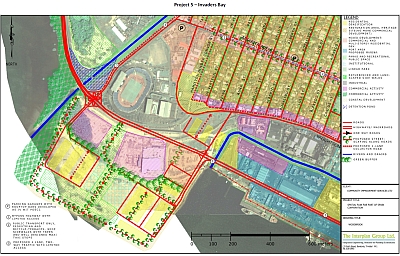 Given that MPE has not carried out a Needs Assessment for this prime property, for whatever reason, I will continue to outline the relevant elements for the Invader’s Bay property. This is not intended to be complete, just a list of what I consider to be the critical items a proper Needs Assessment would include –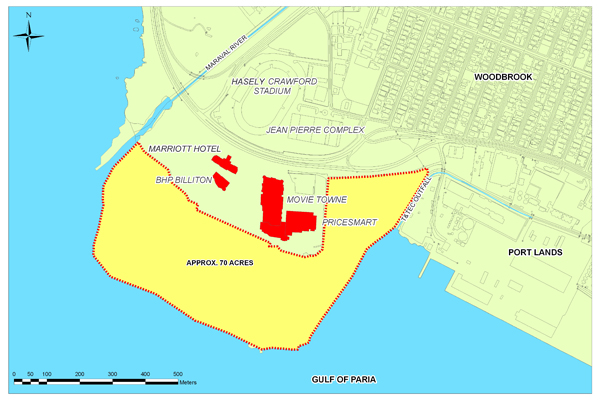


 On Wednesday 21st September I received
  The Colman Commission into the failure of CLF Financial and the Hindu Credit Union is just about to move into its second round of Hearings and the public can expect to have further testimony on the losses suffered by people who deposited monies with CL Financial.
 AfraRaymond.net