Afra Raymond and Peter Permell are interviewed on the ‘Election Hardtalk‘ show on Power 102FMFM by Tony Fraser about the continuing impact of the CL Financial bailout on the economy and the request to get back the company by Lawrence Duprey. 16 July 2015. Audio courtesy Power 102FM
“They’ve got twelve Aces up their sleeve!
So who the Hell can we believe?”
—Rudder, David Michael. “Back to the Same Ole Same.” The Autobiography of The Now.Lypsoland, 2001. Used with permission
The CL Financial bailout seems to be entering its end-game, with repeated claims from the Minister of Finance that the recovery of the $25 Billion of Public Money spent is now on the cards. The consistent failure or refusal to publish any audited accounts and my ongoing research are telling. We are witness to yet another ‘Plot to Pervert Parliament’, this time it is the biggest project to ever hit this country. The CL Financial bailout.
Plots to Pervert Parliament
In January 2013, I identified the first of these, otherwise known as the ‘S.34 Fiasco’, which of course led me to the CLF Bailout Perversion, committed in January 2009 when our country was presented with its largest-ever public expenditure. The original bailout, presented to our Parliament, as a fait accompli, was the original Plot to Pervert Parliament.
I have come to the sobering conclusion, after much research and consideration, that the Colman Commission is not ever going to provide the details we were led to believe it would. I am now of the view that once again we have been misled and bamboozled by our Parliament. Yet another sick trick, a third ‘Plot to Pervert Parliament’.
The rationale stated for the Colman Commission of Enquiry is in serious conflict with the terms of reference for and consequently, the conduct of that Commission. This article will detail those assertions and show how the public interest is once again being subordinated to powerful private interests.
To understand this crime, one must take a stern view of dates and time.
30 January 2009 – The bailout is announced at a Press Conference on Friday 30 January 2009 at the Central Bank. At that time, we were told that the estimated cost was about TT$5 Billion.
12 June 2009 – Ministry of Finance signs the ‘CL Financial Shareholders’ Agreement’ which, for the first time, discloses that shareholders’ interests were to be specifically protected.
8 September 2010 – Winston Dookeran’s first budget statement as Minister of Finance, following the Peoples Partnership electoral victory in May 2010, was notable since Dookeran announced a dramatic policy shift. The entire CL Financial bailout was declared to be the first of the ‘great uncertainties’ to be resolved. Dookeran outlined the problem before reducing the rate at which Public Money would be paid for this bailout. A huge storm of protest erupted, with several ‘Depositors and Shareholders groups’ emerging to represent those interests. With Dookeran isolated and the government under mounting pressure from these new protest groups, laws were swiftly drafted to stifle the protestors’ legal options.
1st October 2010 – The PM’s historic address to Parliament on 1 October 2010 at which the Commission of Enquiry was announced. Most notable was the PM’s outrage at the mystery of the bailout – at pgs 25-26 –
“…The $5 Billion has been spent—we are advised—to repay matured EFPA policies in an ad hoc and unstructured manner where payment arrangements were entered into based on levels of funds invested. What criteria did you use to repay investors? Whom did you choose to pay? How were they chosen? These questions need to be answered. Because if it is today after the $7.3 Billion, all these EFPA people, the policy group and so on, they are out there, where is their money? Where is their money? Did you have a priority listing of who should be paid? Why did you go—and you are now crying crocodile tears about trade unions, credit unions, the poor man and the small man—why did you not pay them first? Why did you not pay them first? Where did that $7 Billion go? We need those answers, Mr. Speaker. We deserve those answers. The taxpayers need to know. Because when a parent has to buy school books and bags to send his/her children to school but they have to pay tax out of the little money, they need to know where that money has gone…Where, how and why; we need to know…”
The main argument made by the PM was that this was a case which needed serious investigation to establish what had caused this huge collapse and where had over TT$7 Billion of Public Money gone. I could not agree more.
17 November 2010 – The Colman Commission with its Terms of Reference published in the Trinidad and Tobago Gazette. Those were divided into two limbs, causes and consequences. The first to examine the causes of the crisis and the second to make recommendations for prosecutions or other policy changes to prevent a repetition of the crisis.
In September 2011, the Parliament voted unanimously to pass two laws related to the CL Financial bailout. The first was to permit the Minister of Finance to borrow a further TT$10.7 Billion to fund the bailout and the second was to grant the Central Bank, which was administering the bailout on government’s behalf, immunity from any legal challenge. For those who consider these assertions of mine to be harsh, just look at Winston Dookeran’s closing words to the Senate on 16 September 2011 –
“…I just want to give you the assurance which I gave to the Lower House when we debated this, that already the Ministry, along with the Central Bank and Clico, have begun the preparation of a public document—many questions that are still to be answered—to provide the necessary information. In addition to that, we did present to the hon. Senators, for those who afforded us the opportunity to accept our invitation, a document that is in the vicinity of 57 pages as of now, outlining all the necessary information that led to the story that assess what is the current challenges and why the proposals to go forward have been put forward. This document, I assure you, along with the questions and answers, will be converted into a simple, easy to read, hopefully, document for the sake of establishing that this Parliament has mandated us to put this as an anchor document for the purposes of evaluating our performance in the future…”.
I requested that document via the Freedom of Information Act but it was not provided, which is why my litigation started.
In the course of recent research it became clear to me that the PM’s outraged demands for detailed information as to how the huge sums of Public Money spent in the bailout had been discarded, just like a flimsy Carnival Costume. At no point in its Terms of Reference was the Colman Commission required to examine the details of the actual Public Money spent on the bailout. A new species of lie is born here in T&T, once again…we used to have one called the ‘White Lie’ in those bad-old-days, now we have the ‘Bright Lie’. Right up in our face, as the Parliament is told one thing, with an entirely different thing being done. The Carnival was over, but the Ole Mas was now starting.
One can imagine the ebb and flow as these public promises were neutered in private discussions. Reasons are never given. I suspect that the influence of party financiers and voting blocks was a great element in this travesty. The public right to know how and why these vast sums of Public Money were spent is obviously of low priority for the highest public officials in this Republic.
Truth has a Power all of its own. At this point, in litigation against the Ministry of Finance for that information – the Ministry is represented by a five-member team headed by former AG, Russell Martineau SC and CL Financial is represented by three attorneys. Something resembling legal overkill to prevent publication of information which the PM told the Parliament it was her intention to unearth. Information which then Finance Minister Dookeran assured the Parliament he was compiling into a public document. Another writer has labelled the situation – ‘Afra, the Deviant‘. I tell you.
At every turn, the public interest has been subordinated to secretive private interests. The Courts are literally the last refuge to uphold the lawful rights of the public to obtain detailed information on these matters of the highest importance.
Accountability Calamity
Safeguard
Status of query
Audited accounts for CL Financial?
NONE
Details of Management accounts, Estimates, Drafts or any figures used by Ministry of Finance?
NONE
Details of official briefing to Independent Senators in September 2011?
CLAIMED TO BE EXEMPT
Details of Public Money paid out to people and institutions owed money by CL Financial?
NONE
CL Financial is now under State control, so do its Directors comply with the Integrity in Public Life Act?
NOT ACCORDING TO MY EXAMINATION OF INTEGRITY COMMISSION RECORDS.
Do we understand why the CL Financial group is enjoying this beneficial exemption from the lawful obligation to file declarations?
NO WORD YET FROM THE INTEGRITY COMMISSION.
All of the usual integrity, accountability and transparency safeguards have been disconnected. All.
The public is being told that the CL Financial bailout is being resolved, while at the same time the Minister of Finance & the Economy is withholding the fundamental information which any prudent person would need to make a decision. So, what is the secret?
Apart from the details I have been asking for, there are other questions which occur to me –
Directors’ Fees – What is the comparative level of Directors’ fees before and after the bailout on 30 January 2009? In particular, what are the fees & expenses payable to CL Financial Directors? Have those increased? If so, to what level and on what rationale?
Related Party dealings – We were told that one of the main causes of the CL Financial collapse was excessive related-party transactions. Has that pattern of dealings has really changed? What are the contracts between the group and companies in which Directors hold an interest? Does the group, or the Minister of Finance, keep a record of these connected contracts? Does the group have a robust procurement procedure which would ensure value for money in all its significant transactions?
Asset disposals – Which of the group’s assets have been disposed-of since the bailout and on what terms? Were proper valuations obtained before these disposals?
The original complaint is here –
———- Forwarded message ———-
From: Afra Raymond <afraraymond@gmail.com>
Date: Mon, Sep 10, 2012 at 11:12 PM
Subject: Compliance of CL Financial Directors with the Integrity in Public Life Act
To: registrar@integritycommission.org.tt
To – Mr. Martin Farrell, Registrar of the Integrity CommissionDear Sir,
The Integrity in Public Life Act requires that “Members of the Boards of all Statutory Bodies and State Enterprises including those bodies in which the State has a controlling interest” are required to file returns and declare interests with the Integrity Commission.
Clause 3.1. of the CL Financial Shareholders’ Agreement of 12th June 2009 – see https://afraraymond.net/wp-content/uploads/2010/03/mou21.pdf – specifies that the Board of Directors of CLF shall consist of seven Directors, four of which shall be nominated by the Government. The GORTT has a controlling interest and it is public knowledge that the GORTT has exercised those rights, amounting to strong influence evidencing control.
It seems clear that the directors of CL Financial Ltd are therefore persons who should file declarations, and therefore also the directors of subsidiaries under their influence and control, but having visited your offices earlier today to examine the Register of Interests it seems that these Directors have not been filing returns with you.
For your information, your staff confirmed to me today that none of these people have filed declarations or been required to file such for 2009, 2010 or 2011 –
Gerald Yet Ming (CLF’s current Chairman)
Hayden Charles (CLICO Director)
Ronald Harford (Republic Bank’s Chairman)
Dr Euric Bobb (former CLF Chairman)
Rampersad Motilal (Managing Director of Methanol Holdings Limited)
I am therefore requesting, in the public interest, your confirmation that Directors of CL Financial and the companies within its control are required to file declarations or your confirmation that those Directors are not required to file or such other informative response that will satisfy this complaint of apparent non-compliance.
SIDEBAR: Integrity and the CL Financial bailout – the nexus as noted by Afra Raymond on 28 May 2009
There is an interesting nexus between the Integrity in Public Life Act (2000) and the CLF bailout.
The Act obliges that public officials make a declaration of their income, assets, liabilities and interests to the Integrity Commission on or before 31 May of each year. There are penalties for non-compliance. We have seen high-profile investigations and prosecutions with the proposed amendments to the Act now being debated in the Senate.
The Integrity Commission website lists ten classes of persons in public life who must file declarations with them. That list can be found at http://www.integritycommission.org.tt/whofile.html. The ninth class of person is “Members of the Boards of all Statutory Bodies and State Enterprises including those bodies in which the State has a controlling interest.”
CL Financial has already signed over its shareholdings in Republic Bank Ltd. (55%) and Methanol Holdings Trinidad Ltd (56%) to the State under the MoU, and the State has taken complete control of CLICO. Will CLICO, MHTL and Republic Bank Directors be filing returns on or before 31 May?
From: Afra Raymond [mailto:afraraymond@gmail.com]
Sent: Thursday, 20 March 2014 09:56 PM
To: Registrar, Integrity Commission
Subject: Fwd: Compliance of CL Financial Directors with the Integrity in Public Life Act
Dear Mr. Farrell,
I am seeking an update from you on your progress in relation to this formal report made to the Integrity Commission on 10th September 2012.
Apart from a brief telephone conversation we had a few days after its submission, I have had neither acknowledgment or reply to this report.
On Fri, Mar 21, 2014 at 4:54 PM, Registrar, Integrity Commission <Registrar@integritycommission.org.tt> wrote:
Dear Mr Raymond
Our recollection in the office is that a response was sent to you and we are examining our records.
In any case, a response will be sent to you.
Registrar
On Fri, Mar 21, 2014 Afra Raymond <afraraymond@gmail.com> wrote:Hello Mr. Farrell,
I appreciate your early attention to my query.
Regards
Afra Raymond
From: Afra Raymond <afraraymond@gmail.com>
Date: Thu, May 22, 2014 at 11:44 AM Subject: Re: Compliance of CL Financial Directors with the Integrity in Public Life Act To: “Registrar, Integrity Commission” <Registrar@integritycommission.org.tt>
Hello Mr. Farrell,
I wrote to you on 20th March 2014 seeking an update to my formal report of 10th September 2012 to the Integrity Commission on this matter. You replied the next day indicating that you thought that a reply had already been sent but that in any case a reply would be sent to me.
To date I have had no response to my formal complaint or the request for an update as to its status. In the interim, I have carefully examined the Commission’s 2012 and 2013 Annual Reports and found no mention of my complaint in the sections which provide an outline of the various investigations being undertaken. According to those Reports, the status of those investigations seem to fall into three categories – ‘Closed’ – denoting those matters which have been effectively dismissed, due to lack of evidence or irrelevance; ‘Completed’ – denoting those matters which have been investigated or ‘Continuing’ for those matters which are still under investigation. I am starting to wonder if my formal complaint has been relegated to some new, as yet undisclosed, category.
I am also going to point out that, according to the Integrity Commission’s Public Notice at pg 49 of the Sunday Express of 6th October 2013, the Integrity in Public Life Act applies to State Enterprises. At the fourth para of that Public Notice, which was intended to clarify published concerns as to the implications of the Appeal Court ruling in #30 of 2008, you state that State Enterprises are companies which are controlled by the State, so I would again invite your attention to the particulars of my original complaint in this matter. As you would appreciate from my published analysis, the position taken by the Commission in that Public Notice is one with which I strongly disagree, nonetheless, that position is the Integrity Commission’s formal statement on the matter.
I am closing by pointing out that this is a matter of the gravest possible public concern, since CL Financial has been the recipient of over $25 Billion TTD in Public Money and its affairs remain shrouded in an intentional obscurity which does violence to the modern notions of Transparency, Accountability and Good Governance. That obscurity includes the channelling of those huge sums of Public Money via the Central Bank which is exempt from the Freedom of Information Act; new laws to approve the exemption of the Central Bank from any judicial review of its actions in this matter (that has now been ruled as unconstitutional by the High Court in #4383 of 2012, of course the State has appealed that, so the fight is on); the failure/refusal of CL Financial to publish audited accounts and the failure/refusal of CL Financial’s Directors to comply with the Integrity in Public Life Act.
That is the factual background against which I lodged my formal complaint. The delay and ambiguity with which the Integrity Commission appears to be treating my complaint on this most serious matter is sobering, to say the least.
I trust that you can give this matter your early attention, in the meantime, I will be publishing this as a record of these developments.
On behalf of Mr. Farrell I do apologize for not responding to your query. Please note that your query was not classified as a compliant so you would not find it in the complaints section of the 2012 or 2013 Annual Report. With respect to your query we have sought and obtained legal advice. However the Commission is not properly constituted ( a Commissioner having resigned and not yet replaced by his Excellency the President) at this time and therefore cannot make decisions. As soon as the Commission becomes properly constituted the matter will be placed before the Commission for a decision.
In the interim I would appreciate if you can provide us with a copy of the CL Financial Shareholders Agreement.
Yours respectfully
Lisa Phillips
Acting Registrar
Integrity Commission
From: Afra Raymond [mailto:afraraymond@gmail.com]
Sent: Thursday, 22 May 2014 05:12 PM To: Registrar, Integrity Commission Subject: Re: Compliance of CL Financial Directors with the Integrity inPublicLife Act
Hello Ms. Phillips,
I thank you for your swift reply and trust that this matter can now receive proper attention.
The Ministry of Finance made a Press Release on 12th June 2009 -http://www.afraraymond.files.wordpress.com/2011/03/minoffin_pr_12jun2009.pdf – which I received prior to the actual Shareholders Agreement being released to me pursuant to my Freedom of Information request. As requested, the actual CL Financial Shareholders Agreement of 12th June 2009 is here – https://afraraymond.net/wp-content/uploads/2010/03/mou21.pdf – for your consideration.
I await your reply.
On Friday, May 23, 2014, Registrar, Integrity Commission <Registrar@integritycommission.org.tt> wrote:
Dear Mr. Raymond
Thanks for your understanding. However used the link provided but most of the pages of the Agreement are blank.
Regards
Lisa Phillips
Acting Registrar
From: Afra Raymond [mailto:afraraymond@gmail.com]
Sent: Friday, 23 May 2014 09:06 AM To: Registrar, Integrity Commission Subject: Re: Compliance of CL Financial Directors with the Integrity in PublicLife Act
Hello Ms. Phillips,
The Shareholders’ Agreement is showing ok at my end, the scanned copy I was sent seemed a little faded, that was all.
The link I sent you yesterday was included in my original email of 10th September 2012, so it’s not clear whether that actually received proper attention.
I suppose that the Finance Ministry would provide a copy if you asked, seeing that they sent it to me.
On 1st June 2014, my former colleague and Business Guardian Editor, Anthony Wilson, made a call for a ‘national debate’ on the proposed disposal of CLICO’s traditional portfolio of insurance business. This is the first of my responses.
We are now entering the chaotic endgame of this epic CL Financial bailout fiasco. Some of the recent official statements are –
CL Financial’s other assets, including majority shareholdings in Republic Bank Limited and Methanol Holdings to be sold;
Full repayment of Public Money advanced in this bailout is expected.
CLICO’s traditional insurance policy portfolio is being professionally valued prior to its intended disposal;
Atrius Ltd., set up in 2013 as an alternative vehicle for CLICO’s continuing business, is to be effectively abandoned;
All of CLICO’s sales agents are to be terminated by the end of this month, June 2014;
The recent statements of both the Minister of Finance, Larry Howai, and the Governor of the Central Bank, Jwala Rambarran, could give the public an impression that this financial disaster has now been mostly resolved and we are on some kind of smooth track to a complete solution.
I remain sceptical as to the extent to which these problems have been resolved. The complete lack of detailed information, despite many requests by myself and others, leaves one to wonder just what is the basis for these serious decisions.
So, why am I saying this?
The money being used in the CL Financial bailout is ‘Public Money’, which we sometimes call tax-payers’ dollars. The leading learning from which we have to draw serious lessons is Lord Sharman’s 2001 Report to the British Parliament ‘Holding to Account‘, which was a thorough examination of the definition, role and need for control of ‘Public Money’. In the Public Procurement campaign we expanded on Sharman’s definition of ‘Public Money’ so as to capture the full range of possibilities, but we have accepted his key finding as to the requirement that ‘Public Money’ is to be managed to a higher standard of Accountability and transparency than Private Money – see 2.23 on pg 15.
The contemporary, best-practice position in respect of the management of and accountability for Public Money being that the private sector rules are the bare minimum.
CL Financial Ltd. is a holding company for the Duprey empire, comprising major companies such as Republic Bank Ltd.; the Angostura Group; Methanol Holdings Trinidad Ltd; Home Construction Group of Companies; British-American Insurance Company Ltd; Lascelles-Mercado Ltd. (the Jamaican owners of Appleton and Wray & Nephew rums).
The last audited accounts for the CL Financial group were published on 18 November 2008, for the financial year ending 31 December 2007. The function of consolidated audited accounts is to give investors and management the necessary information with which to make decisions as to the future of the company.
Since 2009 I have been making requests under the Freedom of Information Act for these items of information –
Audited Accounts for the CL Financial group, or the basis of the various statements by successive Ministers of Finance;
Senate Briefing – details of the high-level briefing given to Independent Senators in September 2011 prior to the vote on the two new laws – one to allow the State to borrow an additional $10.7 Billion to settle the bailout and the Act to shield the Central Bank from the supervision of the Courts;
Payments – details of the payments to the various claimants under the terms of the bailout, in particular EFPA-holders;
Integrity Commission – confirmation of whether the Minister of Finance was requiring the CL Financial Directors to file declarations as required by law.
I have effectively withdrawn the last of those requests and am now in litigation against the Minister of Finance & the Economy for the first three items. The State has resisted those claims and the litigation continues. I have continued my quest on the compliance of CL Financial’s Directors with the Integrity in Public Life Act with the Integrity Commission, despite the serial delays and unresponsiveness which have beset those requests.
The question before us now is, “How can the State and our government be making these serious, long-term decisions in the absence of the basic information?” Put another way, “How can we continue to allow these serious decisions to be made in our name on our behalf and supposedly, for our benefit, while the State continues to withhold the basic information?”
We have now entered the unimaginable territory of unexamined State power being exercised on an unprecedented scale in the pursuit of an unknown agenda.
This is the big picture and it is an ugly one.
Try to imagine the Board of a major, privately-owned, holding company proposing to its Shareholders that its major assets be disposed-of without the basic information, such as audited accounts or details of meetings with major stakeholders. Such an action would be seen as a gross violation of elementary norms of corporate governance and quite likely be rejected with swift, high-level dismissals. Yet, here we have our government (the Board of Directors) proposing these actions while refusing the reasonable requests of shareholders (citizens such as myself and others) for the rationale for and basic information underlying this process.
The fundamental, best-practice principle that Public Money is to be managed to and accounted for to a higher standard than Private Money has seemingly been rejected. Rejected by the Minister of Finance & the Economy and the Governor of the Central Bank.
That is the scale of this ‘thing without a name’. I tell you.
We, the citizens and taxpayers of this Republic, are being told that this unprecedented expenditure of Public Money of $25 Billion is to be resolved by a questionable process. The long-time saying is buzzing through my head – ‘What eh meet yuh, eh pass yuh‘.
Some points to remember in thinking about this issue –
CL Financial Shareholders’ Agreement expires at the end of June 2014;
Asset Sales have continued with the unadvertised sales of Valpark and Atlantic Plazas;
No Interest was charged on the huge sums of Public Money spent to settle the indebtedness of the CL Financial group. The Board of Inland Revenue is a Division of the Ministry of Finance & the Economy and annual interest of 20% is charged to taxpayers who are late in their payments.
‘Fit & Proper’ regulations have never been applied to this CL Financial collapse, as mandated by Central Bank’s regulations, despite my continuing calls. One has to wonder if the stage is being set for a return of Lawrence Duprey & his cohorts to our country’s high-level corporate lifestyle.
On 28 May 2014, the Business Express ‘Opinion‘ was entitled ‘Bringing closure to the CLICO debacle‘ and one of the statements in that editorial was stunning –
“…Thus far, Rambarran and Finance Minister Larry Howai have been forthcoming in their handling of the CLICO issue…”
I could not agree less. The taxpayers and citizens of Trinidad & Tobago are being abused in this entire process.
The current Government to Government (G2G) arrangements are a direct threat to our country’s fundamental interests.
The key element of the G2G arrangement is that a larger, more advanced, country will assist a smaller, less-advanced country by building or operating complex facilities which are beyond the reach of the smaller state.
One of the features the G2G arrangements have in common with the other large-scale projects is the high degree of secrecy with which the proposals are developed. That secrecy raises doubts as to whether proper Needs Assessments are undertaken and as to the degree to which the views of citizens and stakeholders are sought, far less considered. The fundamental issue as to the necessity for these projects is thus routinely sidelined, which is inimical to the public interest.
The main criticisms of the G2G arrangements are –
Sidelining of the elementary Tendering Process – the procurement process is effectively outsourced, since the more powerful country has the right to select the contractor;
Limited, if any, role for Local Participation in terms of labour, professionals, suppliers, or contractors;
Weak or nonexistent contract controls, due to the disparity in power between the parties;
Serious drain on Foreign Exchange;
Lack of the promised Transfer of Technology.
These arrangements have been heavily criticised in our country for almost 35 years, starting with Winston Riley’s October 1979 paper which identified many of the emerging problems. As a result of that rising tide of criticism, an official enquiry was established by then PM, George Chambers. In March 1982, the Ballah Report was published and the G2G programme was brought to a halt as a result of its dire findings.
Despite the learning, successive political administrations seem unable to resist the appeal of these G2G arrangements, so we have today’s situation as shown in the table.
Physical Development Projects via G2G – April 2014
Readers who access this article online can view the background info via the hyperlinks
The total cost of these projects is just under $8.4 Billion TTD.
That is the background, against which we must consider these further elements –
Regional Strategy – As a leading nation within CARICOM, it is important for Trinidad & Tobago to give serious consideration to the role of the various bilateral G2G arrangements China is pursuing in our region and the implications of those arrangements on our aspirations for healthy regionalism. I have been reading the February 2013 Research Note by UWI’s Dr. Annita Montoute – ‘Caribbean-China Economic Relations: what are the Implications?‘ The scope of Dr. Montoute’s research and her findings are sobering – at pg 115 “…CARICOM Trade with China is on the increase; however it is overwhelmingly in China’s favour…”. The regional issue is a serious one to which we must address our energies.
Trinidad & Tobago’s Strategy – Now consider these statements by then Finance Minister, Winston Dookeran, at the September 2011 ceremony to sign the $207M TTD loan for NAPA (POS) ‘remedial works’ –
“…Dookeran said it was now imperative that TT deepens its ties with China…’In the first instance China has now emerged as a very significant player, especially in light of the recent tremors and uncertainties in the world economy,’ he said. ‘China…is now an economy that we will have to rely upon. It is in that context that it is very appropriate and timely for Trinidad and Tobago to start to intensify its relationship with China.’..”
Winston Dookeran is now Trinidad & Tobago’s Minister of Foreign Affairs.
The Uff Report – The 42nd and 43rd recommendations of the 2010 Uff Report deal directly with this issue –
The Government’s policy on the use of foreign contractors and consultants for public construction projects should be transparent and open to review.
Local contractors and consultants who compete with foreign companies should be provided with the same or equivalent benefits as enjoyed by those foreign companies and should be protected from unfair competition through matters such as soft loans…
Uff was calling for the establishment of a national policy on this series of issues and the JCC has been requesting a consultation between government and stakeholders, so that a proper strategy can be developed in open collaboration. That would include labour, professionals, the State, the contracting sector and all the associated elements such as suppliers of building materials, financiers, skills training and so on. The JCC wrote to the PM on this in April 2012, but to date there has been no response to our calls for those consultations in the national interest.
NAPA, again – The Minister of Culture, Dr. Lincoln Douglas, told the Senate on 8 April 2014 of the serious issues arising at NAPA (POS), with an estimated further $100M being required for more repairs. It is not certain if the issues of disrepair are all due to inadequate maintenance, but it is unacceptable for such issues to have emerged for a structure less than 5 years old.
Shanghai Construction Group – Despite the bad record at NAPA, the selected contractor for the $1.8 Billion Couva Children’s Hospital and the other sporting facilities is the said Shanghai Construction Group.
Proposed Public Procurement Law – most alarmingly, Clause 7 of the proposed Public Procurement & Disposal of Public Property Bill 2014 specifically excludes Government to Government Arrangements and projects funded by International Financial Institutions from oversight. That proposed exclusion is entirely unacceptable as it further jeopardises our national interest.
The PM has made a call for a National Conversation and this is one topic which needs addressing. Our country cannot continue exporting our jobs, capital and skilled people in favour of unexamined and undisclosed foreign policies.
This is the Pre-Action Protocol letter to the Minister of Finance challenging his failure to reply to my Freedom of Information Act request of 18 March 2013, seeking details of the beneficiaries of the CL Financial bailout, particularly the EFPA holders.
Afra Raymond chats on the show ’Forward Thinkers‘ with David Walker on 104.7FM, dealing with the CL Financial bailout and my lawsuit against the Minister of Finance to get at the detailed information as to how the $24B in Public Money was spent. 24 October 2013. Audio courtesy More 104.7 FM
This is my reply to the Ministry’s affidavit of 12 July which seemed to rely on the fact that CL Financial is a private company to refuse publication of the requested information.
Of course that line of reasoning is yet another emerging threat to our country’s Integrity Framework, so our reply challenges the validity of this assertion.
At our hearing on 1 October, Justice Boodoosingh ordered me to formally notify CL Financial and we have done that, so at our hearing earlier today, CL Financial were represented by a team led by Stephen Singh and various dates were set, with our next hearing on 27 February 2014. Of course that is the very Carnival week, so stay tuned. I expect there will be significant other developments well before that.
I am fully in support of a vigorous and conscientious Integrity Commission (IC). I do not want to see the IC abolished or sidelined. The IC must realign its limited resources to ensure a decisive impact on the conduct of Public Officials. The proposals contained in its 2012 Annual Report show clearly that the Gordon Commission has started to seriously grapple with that challenge.
The derailment of the IC between 2004 and 2009 is a clear example of what can happen to an Independent Commission if we do not maintain vigilant oversight.
This matter is of the greatest interest for those of us campaigning for Public Procurement reform so as to get effective control over all transactions in Public Money. The arrangements we are proposing include new Independent Commissions/Officeholders. It is therefore critical that we learn the lessons from this debacle so as to safeguard the bodies we are proposing. The stakes are very high for our nation’s Integrity Framework, which must be strengthened, with swifter resolution of allegations.
To continue in the current manner is to drag the system into further disrepute, encourage even more bold-faced thieves, more reckless public officials and we can expect complete loss of the residual respect for the post-independence civilization we have tried to grow. That would be an ugly and violent future for our society, so this episode requires stern and conscientious examination. Continue reading “Integrity Threat – Part 4”→
Afra Raymond chats with Joseph Berment-McDowall on Heritage Radio 101.7 FM about the Treasury Scandal article. 27 August 2013. Audio courtesy Heritage Radio 101.7 FM
 Afra Raymond and Peter Permell are interviewed on the ‘Election Hardtalk‘ show on Power 102FMFM by Tony Fraser about the continuing impact of the CL Financial bailout on the economy and the request to get back the company by Lawrence Duprey. 16 July 2015. Audio courtesy Power 102FM

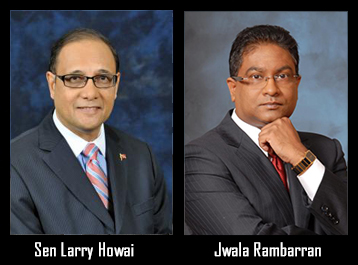 The recent statements of both the Minister of Finance, Larry Howai, and the Governor of the Central Bank, Jwala Rambarran, could give the public an impression that this financial disaster has now been mostly resolved and we are on some kind of smooth track to a complete solution.
 Regional Strategy – As a leading nation within CARICOM, it is important for Trinidad & Tobago to give serious consideration to the role of the various bilateral G2G arrangements China is pursuing in our region and the implications of those arrangements on our aspirations for healthy regionalism. I have been reading the February 2013 Research Note by UWI’s Dr. Annita Montoute – ‘
 Afra Raymond chats on the show ’Forward Thinkers‘ with David Walker on 104.7FM, dealing with the CL Financial bailout and my lawsuit against the Minister of Finance to get at the detailed information as to how the $24B in Public Money was spent. 24 October 2013. Audio courtesy More 104.7 FM
 I am fully in support of a vigorous and conscientious Integrity Commission (IC). I do not want to see the IC abolished or sidelined. The IC must realign its limited resources to ensure a decisive impact on the conduct of Public Officials. The proposals contained in its 2012
 AfraRaymond.net