 For me, the key point at which we lost our way in the UDeCOTT/HDC/NIDCO bobol, was the crossroads of the Investment Decision.
That Investment Decision is an indispensable part of any rational process of development, for families, businesses and countries alike. The national level is my concern and there must be broader considerations in making those decisions.
It is clear from the depth of the failure, that the last administration lost its way completely, insofar as elementary concepts such as opportunity cost, payback periods, cost-benefit analysis and so on. We have only now begun to scratch the surface in terms of understanding the extent of the losses and corruption – readers, please be reminded that as yet, we have no accounts for UDeCOTT or HDC for several years. In normal business thinking, the failure to publish accounts without even an attempt at an explanation is tantamount to an admission of the most serious problems. Only State-owned organisations can get away with that kind of irregular conduct, which is maybe why they do it.
My concern in this article, is that apart from the Investment Decision in the case of specific projects, the State has an obligation to consider the wider picture in terms of fine-tuning, timing and phasing those projects. Our last land-use plan in our country was approved by the Parliament in 1984 and we have had several fruitless attempts to revise that plan.
The focus here is on the need for a proper practice of integrated planning, in particular long-term land-use and town-planning. By integrated planning I am speaking to an approach which takes account of varying principalities, such as land-use, financial constraints and national targets. In addition, the approach allows a balance to be struck between the competing demands within various time-horizons, such as immediate demands, medium term demands (say, 10 to 20 years) and longer-term considerations.
Lack of an updated national Land-use plan
As I wrote in the Business Guardian of 9th October 2008 –
“The Minister of Planning, Housing and the Environment spoke at a breakfast meeting of the Couva/Point Lisas Chamber of Commerce on September 10, and some of her reported comments deserve our close attention.
The minister told her audience that the National Physical Development Plan was passed in 1984 and had been continually updated, but that “that plan has somehow never reached to Parliament.” Somehow. The mind boggles.
One report said, “Dick-Forde said the external and internal committees on national development were working towards the completion of the National Development Plan, which will be taken to Parliament in the next two years.”
When this tidal wave of development is at an ebb, we will then have a plan tabled in Parliament for discussion. To what end?” see http://www.newsday.co.tt/politics/0,85974.html
Given the last Minister’s stated timetable, we ought now to be having a draft plan published for consideration. Where is this, Minister King? When do the consultations start?
Transportation planning

This is a vital, related area and Minister of Works & Transport, Jack Warner, told us that the PNM government paid $21M for an incomplete Comprehensive National Transportation Study (CNTS) – see http://guardian.co.tt/news/general/2010/10/09/warner-pnm-paid-21m-non-study – and I agree. That fact only makes the situation more doubtful, since we seem to be making major transportation system decisions in the absence of a strategic plan.
Just consider –
- The Tunnel to Maracas
This was first announced in the 2011 Budget – see http://www.finance.gov.tt/content/Budget%20Statement%202011.pdf at page 24…We all know how difficult it is to access Maracas Bay through the North Coast Road.
Currently, it takes approximately 45 minutes to get from Santa Cruz to Maracas Bay. Furthermore, landslips on the North Coast road are a major deterrent to persons wishing to access this scenic route for pleasure or business. As a result we will do a business plan for a new: ‘Connective Development Project’. This project would create an underground tunnel from Maracas Valley to Maracas Bay, to enable quicker access to the North Coast…
That strange project was then taken up by Warner at length – see http://guardian.co.tt/news/general/2010/09/26/warner-s-tunnel-take-next-year
- The expansion of the Highway Network
We are now aware that the National Infrastructure Development Company (NIDCO) is proceeding with ambitious Highways packages from San Fernando to Point Fortin, with the San Fernando to Mayaro route under active discussion – see http://www.newsday.co.tt/politics/0,124988.html. - Coastal Water Taxis
It seems that the government has changed its mind, three times, on this part of our public transportation system. Firstly, we were disposing of two of the four new water-taxis as being superfluous. Secondly, there was an about-face, in which it was decided to keep the new water-taxis. Most recently, I have seen advertisements for the provision of brokerage services for the disposal of these vessels. Again, what is the basis?
Sewer Treatment plants and the threat of cholera
We recently had shocking stories about the leaking of significant amounts of untreated sewage into the Maraval reservoir – see http://guardian.co.tt/news/general/2010/11/19/wasa-boss-moka-residents-must-pay-repair-sewerage-plant. That is no surprise, given the widespread practice of property developers walking away with their profits in hand upon completing the sales of their properties, but with no proper plan for the maintenance of the sewer treatment plants.
Once again, this is an area which urgently needs to be addressed in terms of town planning, local health, WASA regulations and adequate financial mechanisms for ongoing maintenance of these facilities.
The Housing Development Corporation (HDC)
 The HDC’s new target for 2011 is 6,500 new homes and that is still a huge number. Given our limited land resources and the absence of a national planning framework, how is this to proceed?
There remains the unanswered question as to what is the basis for these decisions?
The Limits of our financial resources
The Minister of Finance recently called for Ministries to not implement any new large projects, due to the financial limits constraining state expenditure – see http://www.newsday.co.tt/news/0,129148.html. That is a valid call, which shows that the time is ripe for us to plan our major strategies and projects so that they can conform to some sort of national context.
That context would have to include elements such as land-use, transportation implications, financial limits and the question of the capacity of the economy to meet the targets being set.
SIDEBAR: Fuel subsidies in national planning
The question of fuel subsidies is an important part of this integrated planning discussion, since, at approximately $2.8Bn, they are a large part of our national expenditure. More to the point, the effect they have on our behaviour is largely unremarked, which is paradoxical – the gas price being so low that we do not really consider it in our daily choices.
It is a classic example of the sort of ‘policy silos’ which the integrated planning approach seeks to overcome.
The Minister of Works & Transport speaks out strongly against the heavy subsidies necessary for the operation of the Coastal Water Taxis – no statement from Warner on the larger sums spent on the fuel subsidy. The Minister of Energy, in the run-up to the budget, says that these fuel subsidies may need to be reduced. The Minister of Finance, in his budget address, said –
“…The largest Subsidy is on petroleum products, particularly gasoline which usually represents one to two percent of GDP per annum. All of our citizens benefit from this subsidy. It is often difficult to determine whether resources are being used wisely to achieve the intended objectives of subsidies. We are currently reviewing whether alternate options are more efficient…”
We need to develop a holistic view of the various subsidies being paid in our economy and transportation subsidies, including fuel, are important considerations.
The goal of promoting the wider use of public transportation has to be adopted with some vigour and creativity. The fuel subsidies enjoyed by small vehicles – say, less than 12 passengers – should be gradually reduced with a shift of those subsidies to larger-capacity vehicles. They make more efficient use of our limited roadways and would reduce the adverse effects of traffic and pollution.
The three Ministries concerned should join with the Ministry of Planning in mapping out these strategies and policies.
The strategic goal should be to decrease the convenience of individual car-journeys and increase the convenience of the mass-transit approach.
It is no easy shift to go from today’s congested reality to the medium-term goal of a much-improved transportation system with travelers having several choices. That journey would involve a virtual culture-shock for most of us, but it is one we should start, sooner than later, for our common good.
That is one of the examples of how an integrated planning approach can offer fresh solutions to serious problems.



 The Auditors – The various PWC professionals who prepared and signed those audits. Will we see the release of the hidden accounts? How much longer can they remain concealed? There must be some quiet desperation creeping into Balisier House and PWC, just edging forward, along Victoria Avenue.



 The new situation is charged with peril and one is reminded of Naipaul’s father, the intrepid journalist from A House for Mr. Biswas whose favourite tagline was “…amazing scenes were witnessed…”
 The recent series of changes at CNMG have sparked a series of evolving discussions. I was one of the three people ‘let go’ from CNMG and that
 TV call-ins soon followed and of course, the internet/email broke onto the scene in the mid-1990s. The final stage in this progression is the growth of new-wave social media – such as Facebook, YouTube, Twitter etc. – to the point where they have now eclipsed the older formats like web-pages.
 More to the point, we have a situation where we have embraced the new situation and its possibilities, while our leaders and organisations lag far behind. Just as an example, the website for the Prime Minister is
 It is easy to criticise the politicians and their mistakes, but this silence by Newsday is just another level of irresponsibility which would make any right-thinking person pause. Newsday have their own patchy track-record in that they forced-out Kevin Baldeosingh over his challenge to Fr. Henry Charles for plagiarism. The parliament discussions on Friday 12th and the news releases from both the Media Association of Trinidad & Tobago (MATT) and the Congress of the People (CoP) formed the basis of articles on the issue from Thursday 11th. Given that behaviour it is interesting to watch them, as The People’s Newspaper, minimizing a matter of such great concern to so many people. A matter concerning an apparent threat to freedom of the press.
 This is the letter CNMG sent


 The Bankers Association of Trinidad & Tobago (BATT) and the Association of Trinidad & Tobago Insurance Companies (ATTIC) are also part of the situation.
 As it is, we already have been bound to a rotten bailout of the wealthiest individual in the Caribbean by our Treasury at
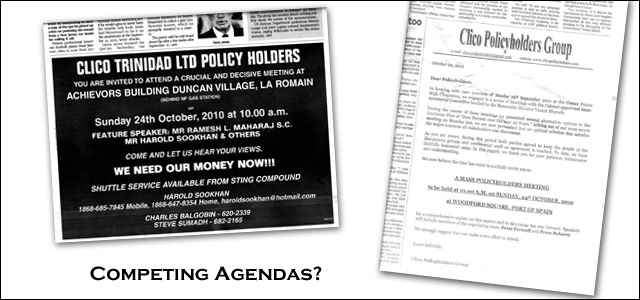 There was an EFPA group and a CLICO Policyholders group formed just after the budget on 8th September, but they soon merged under the latter name. I am now seeing what appears to be a substantial split with 2 competing meetings being organised for 10am today – one in Port-of-Spain and the other in San Fernando.
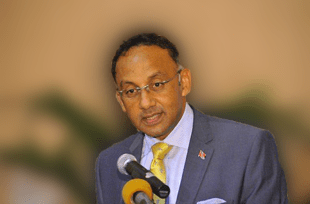
 The Mottley Report – There was a team of three advisers – Wendell Mottley, Colin Soo Ping Chow and Steve Bideshi – appointed to examine the CL Financial group and we need to know what were the findings of this group.
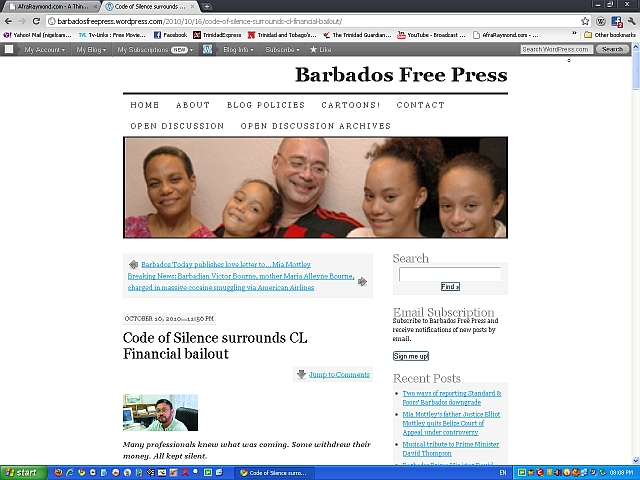

 Throughout this series of articles on the CL Financial bailout I have touched on the existence and effect of a Code of Silence amongst our ruling elite.
 This is one of the leading Professional Bodies and their silence has been deafening. The President of the Law Association is former Independent Senator, Sunday Express columnist and eminent Senior Counsel, Martin Daly. Daly is widely regarded as a fearless and irreproachable voice on many matters.
 The entire collapse is shot through with a failure of accountants at several levels and yet this professional body has been silent on all this. After ignoring my open letter and other attempts to start some dialogue on this, Anthony Pierre, ICATT’s President, agreed to appear on a TV interview with me on CNMG. That interview was broadcast on Sunday 26th September 2010 – it can be viewed at
 There has been very limited engagement from UWI on this matter, which is a pity when one considers that the areas of study there include economics, finance, law, business management and accounting.

 Yes, the TTTI did make a strong statement calling for improved accountability in the bailout process. That is a Civic Society body doing its job.
 Robert Mayers was the former Managing Director of CMMB, who retired on 8th December 2008 – see
 CIB was chaired by Mervyn Assam, recently appointed as a Special Ambassador with responsibility for Trade and Industry. Faris Al-Rawi, attorney-at-law, was a Director on that Board and he is now a PNM Senator.
 Ian Narine, writing in the Business Guardian on Thursday 14th October –
 In the last part of September, AIC Finance has been advertising surprisingly high rates of interest in daily newspaper adverts which also offer ‘Preferential rates to Trinidad & Tobago Association of Responsible Persons (TTARP) members’.

 A version of this commentary appeared in print on October 17, 2010, on page A31 of the Sunday Guardian.

