Barbados Free Press spreads the word for AfraRaymond.com


Code of Silence was an article in two parts – the first dealing with the agents and effects of that Code and the second dealing with the unfolding case of AIC.

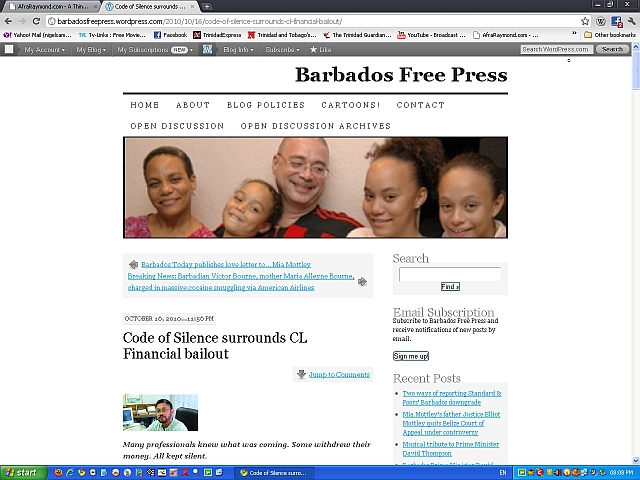
As usual, I sent the article to my main blogging-collaborator Barbados Free Press (BFP) who split it apart into those halves. Maybe they felt that the bond default by AIC Barbados in the second half deserved a separate focus for their readers – who knows?

So, BFP published Code of Silence surrounds CL Financial bailout on Saturday 16th and Michael Lee-Chin’s AIC Finance – Another CL Financial CLICO situation in progress? on Monday 18th.

Later that day, the AIC story was picked-up by Forbes.com and that story is here, Forbes picks up Barbados Free Press news feed!

CL Financial bailout: The Code of Silence

Throughout this series of articles on the CL Financial bailout I have touched on the existence and effect of a Code of Silence amongst our ruling elite.

This is sometimes called the Information Age, with the latest news and ideas being ‘pinged’ or ‘tweeted’ across the Social Networks.  The new reality demands a complete shift in our attitudes to information.  Our leadership class has blatantly refused to share their information and insights at moments of crisis, which shows the challenge facing us if we are to progress.  Just to give two examples, think of the many secret reports from all the Commissions of Enquiry before the Uff Commission and the steadfast refusal of our political leaders, for many years, to even consider a Commission of Enquiry into the Coup.  It is widespread and literally sickening to all right-thinking people.

We have had a new start and some reason to hope for change, by the PP government’s appointment of Commissions of Enquiry into the 1990 Coup and the financial collapse (CL Financial and Hindu Credit Union).

Even now, alongside those hopes, the new government has still not published the Bernard Report into the Piarco Airport Project.

Despite the progress, we cannot be complacent, the slope is slippery and the stakes are high.

The Code of Silence is deep and powerful in the case of the CL Financial bailout.

On 3rd October, I set out a few of the failures on the part of the regulators.  Those failings are real and serious, but sometimes a shift in focus can be beneficial.

If we look beyond the legally-empowered regulators, there are other informal ‘regulators’ upon whom society relies to make decisions.  Those would include Civic Society Organisations, Trade Unions, Institutions of Higher Learning and Professional Bodies.  Society has been able to rely on these because they are seen to represent collective knowledge and insight, rising above individual interests to attain broader perspectives.

Those bodies, with one notable exception, have been silent throughout this CL Financial fiasco and have failed the broader society in this colossal matter.  I am being forced by these events to re-examine my fundamental assumptions on the degree of our reliance on these bodies.  This is the real nadir of corruption, when we seem to have lost our way in the long grass and we not even talking about the politicians and so on.  This one is not about them.  It is about us and our feet of clay.

Let me explain –

  • Law AssociationThis is one of the leading Professional Bodies and their silence has been deafening.  The President of the Law Association is former Independent Senator, Sunday Express columnist and eminent Senior Counsel, Martin Daly.  Daly is widely regarded as a fearless and irreproachable voice on many matters.

    The tangled web in this CL Financial bailout has included early withdrawals, overlapping Directorships between depositors and bankers, payment of dividends after asking for state financial assistance, misleading negotiating positions taken by the CL Financial chiefs, a huge zero-interest payout to the CL Financial chiefs which left their shareholdings intact, attempts to sell assets in breach of the MoU.  Most of all, the serious and inescapable conflict of interest of the then Minister of Finance, who is an attorney – every single attorney I have spoken with agrees that this was a clear case of conflict of interest.

    Yet, not a word from the Law Association.  Am I alone in expecting any better?

  •  

  • Institute of Chartered Accountants of Trinidad & Tobago (ICATT)The entire collapse is shot through with a failure of accountants at several levels and yet this professional body has been silent on all this.  After ignoring my open letter and other attempts to start some dialogue on this, Anthony Pierre, ICATT’s President, agreed to appear on a TV interview with me on CNMG.  That interview was broadcast on Sunday 26th September 2010 – it can be viewed at http://wp.me/pBrZN-qW – in the ‘Sunday Morning Politics’ slot.  When I put the question to him as to the errors and/or omissions of the professional accountants in this huge collapse, Pierre took the position that there was no cause for concern. I do not accept that position, but of course the Commission of Enquiry and hopefully the publication of those long-overdue accounts will shed some more light.
  •  

  • University of the West Indies (UWI)There has been very limited engagement from UWI on this matter, which is a pity when one considers that the areas of study there include economics, finance, law, business management and accounting.

    Of course, the former Campus Principal and now Director of UWI’s Institute of Critical Thinking is Dr Bhoendratt Tewarie, who was also a member of CL Financial’s pre-collapse Board.  That is the same Board which approved payment of a dividend 3 days after CL Financial’s Executive Chairman wrote to the Central Bank for urgent financial assistance.  Dr Tewarie is also reported to have been at the final Annual General Meeting of CL Financial, held at Trinidad Hilton on 23rd January 2009.  The timing couldn’t be better for a report to shareholders – after all, the Central Bank had been written to 10 days before, the dividends approved a week before and the bailout itself was just 7 days away.  So what happened at that AGM?  Were shareholders given an honest report from the custodians of their capital?

    The late Professor Dennis Pantin did write several times on the CL Financial collapse and bailout in his Sunday Guardian column.  Dennis made the early call for a Commission of Enquiry into this entire mess and that has now been acted upon.

    Sen. Patrick Watson
    Sen. Dr. Patrick Watson
    Another UWI figure in the whole mess is Dr. Patrick Watson, who is Professor of Economics and Director of the Sir Arthur Lewis Institute for Social and Economic Studies (SALISES).  Professor Watson is a government Senator in the current Parliament, who after maintaining his silence on this economic catastrophe since January 2009, has now become most vocal since the budget speech.

    Is a straight case of nearer to Church further from God.

  •  

  • Trade UnionsThe two groups which one can normally expect to have a public position on these long-term, large-scale issues are the Oilfields Workers’ Trade Union (OWTU) and of course, the Federation of Independent Trade Unions and NGOs (FITUN).  Neither of those bodies rose to the challenge and we are the poorer for it.
  •  

  • Trinidad & Tobago Transparency Institute (TTTI)Yes, the TTTI did make a strong statement calling for improved accountability in the bailout process.  That is a Civic Society body doing its job.

What really happened?
But apart from us in the Civil Society, there is another level of the Code of Silence being practiced in that some of the very people who were in charge of this huge crash have rejoined public life, saying nothing about the crash.

They have been recycled.  Yes, I know that recycling is good, but this one is toxic.

Caribbean Money Market Brokers (CMMB)Robert MayersRobert Mayers was the former Managing Director of CMMB, who retired on 8th December 2008 – see http://legacy.guardian.co.tt/archives/2008-12-09/business2.html – which is less than two months before that company collapsed.  Mayers is a most articulate and willing public speaker, who was recently discussing the national budget on the electronic media.

We have heard nothing from Mayers on how the collapse presented itself and there is no concerted attempt to pass on any lessons learned to a younger generation of citizen.

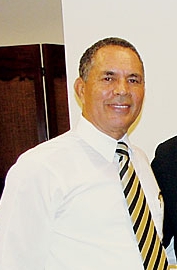
Clico Investment Bank (CIB)Faris Al-Rawi and Mervyn AssamCIB was chaired by Mervyn Assam, recently appointed as a Special Ambassador with responsibility for Trade and Industry.  Faris Al-Rawi, attorney-at-law, was a Director on that Board and he is now a PNM Senator.

Neither man has made any attempt to publicly explain CIB’s shocking insolvency, which was estimated by the Central bank to be of the order of $4.7Bn.

All those people appear to have been anointed, in what must have been a private ceremony, then re-presented as ready to serve.  We deserve no less than a proper explanation from these Directors and Officers and I was pleased to see PNM Senator Penelope Beckles recently joining me in calling for them to be questioned publicly.

The case of AIC Finance
Ian Narine, writing in the Business Guardian on Thursday 14th October – http://guardian.co.tt/business/business-guardian/2010/10/14/there-enough-everyone – attempted to point out the way he had tried to warn the investing public on the perils of CL Financial.  That column made interesting reading, but what would be the position of the press if any such situation were unfolding right now?

Just as an example, AIC Finance is owned and run by the Jamaican billionaire, Michael Lee-Chin, who came in for mention in Anthony Wilson’s 15th October 2009 BG View ‘Will Lee-Chin avoid Duprey’s fate?’ – see http://guardian.co.tt/business/business-guardian/2009/10/15/will-lee-chin-avoid-duprey-s-fate.  I commented on that in the Trinidad & Tobago Review of 2nd November 2009 in ‘Duprey’s fate’ – see http://wp.me/pBrZN-43 or http://www.tntreview.com/?p=887 and the points are once again pertinent.

AIC Barbados, the regional holding company for the group, defaulted on a USD bond in 2009 – in other words, they were unable to pay their debts – see http://guardian.co.tt/business/business/2009/06/06/lee-chin-late-us47m-bond-payment or http://www.jamaica-gleaner.com/gleaner/20100818/business/business1.html.

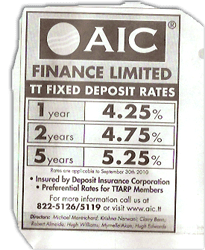
AIC advertIn the last part of September, AIC Finance has been advertising surprisingly high rates of interest in daily newspaper adverts which also offer ‘Preferential rates to Trinidad & Tobago Association of Responsible Persons (TTARP) members’.

COMPARISON TABLE for 12-month fixed deposit rates for amounts up to $500,000 as at 30th September 2010

Financial Institution Range of interest rates
First Citizens’ Bank 1.25% to 2.1%
RBTT 0.2% to 1.45%
Scotiabank Up to 0.75%
Republic Bank 0.30% to 0.75%
Unit Trust Corporation (Money Market Fund) 2.15%
First Citizens’ Bank Abercrombie Fund 1.90%
Fidelity Finance (part of the Maritime group) 1.8%
AIC Finance 4.25%

If CL Financial could not sustain this strategy, how can AIC continue to offer these rates in today’s market?

That is the question.

According to recent press advertisements, the Board of Directors of AIC Finance Limited comprises –
Michael Montrichard
Krishna Narwani
Clarry Benn
Robert Almeida
Hugh Williams
Myrnelle Akan
Hugh Edwards

Further details are at http://www.aic.tt/page.asp?page=Board+of+Directors

A version of this commentary appeared in print on October 17, 2010, on page A31 of the Sunday Guardian.

CL Financial bailout – Closing the circle

Inquiring What Went Wrong. Illustration by NiCam GraphicsAmidst the raging debate on the rights of the disappointed depositors versus those of the anxious taxpayer, I am continuing to examine some more of the fundamental issues. Yes, I accept that there are depositors amongst the taxpayers, but those interests are not in alignment, hence the discussion.

By making a legislative proposal to frustrate the CLICO Policyholders Group (CPG) litigation, the government seemed to have conceded the merit of the protestors’ case. Those proposals have now been withdrawn and on Friday 1st October, the Prime Minister gave an extensive reply to the CPG. The strategic decision seems to have been to retreat from the narrow corridors of legality and strive for the broad perspectives of the entire nation. The apparent decision is to favour an act of persuasion over one of sheer power. Given our norms of governance in these parts, that is no small shift and it is a welcome sign, quite apart from my agreeing with the stance taken.

Most importantly, the Prime Minister announced a Commission of Enquiry into the collapse of both CL Financial and Hindu Credit Union (HCU).

Once again, I am going to refrain from discussing the legal issues, despite the tempting developments in this aspect of the matter. I am going to keep deepening this discourse so that we can have a better quality of discussion

What was the EFPA?

Firstly, it is necessary to spend a little time on the true nature of the Executive Flexible Premium Annuity (EFPA), since that product is what the majority of this dispute is about. The product was approved for marketing by the Supervisor of Insurance in 1990.

An annuity is an investment product for an individual, to save for a specified future expense by means of periodic payments. CLICO had an approval for a Flexible Premium Annuities, which was attractive to those people who had fluctuating incomes, but soon led to the sale of Single Premium Annuities. Those are investments in which the investor pays a single premium and receives the benefits after CLICO had held the funds for a short term.

So the single premium can be viewed as a deposit, which is what many of the agents called it. While the annuity, traditionally a long-term investment product, then assumed a norm in which most EFPAs were held for 5 years or less.

In saying so, it is interesting to consider the question of just how an organisation can purchase an annuity, which is an investment product for an individual. The fact that so many organisations did so, does damage to the notion that this EFPA was sold in conformity with its true nature.

So, in summary we have an approved annuity, which is mainly sold as a single-premium, short-term, high-interest investment product to anyone who wants one, including Credit Unions, private companies – several CLICO agents tried, repeatedly, to get deposits from our firm – and State-owned corporations. At some point that annuity morphed, by this series of changes, which seem, to me at least, to have fundamentally altered the character of the approved instrument

All of which returns to the basic accounting principle that when one is trying to interpret a situation such as this, the correct procedure is to be guided by the substance rather than the form of the transaction. That is the background to my assertion that the correct interpretation of the EFPA is as a deposit.

When you consider the very high interest rates offered and the unique way that CLICO altered the EFPA, one has to wonder how the regulator viewed these activities. But more on the regulators later.

What did CLICO become?

Even beyond the changes which the EFPA underwent in the hands of CLICO, the reverse was also to take place. That happened because CLICO changed the EFPA to suit the strategy of its parent company, CL Financial, but the parent group (and ultimately CLICO) in the end were irreversibly changed and then destroyed by the EFPA’s success. Let me explain –

In our system, there are 3 species of financial institution –

  • Banks and other Financial Institutions (approved as Deposit-taking Institutions by the Deposit Insurance Corporation);
  • Insurance Companies and
  • Credit Unions.

CLICO’s liabilities, as stated by the Finance Minister, were $6Bn to traditional insurance policyholders and $12Bn to depositors. The question being, given that two-thirds of their liabilities are non-insurance, how could it be legitimate to consider CLICO an insurance company? More to the point and looking forward, where does a company like CLICO fit into our regulatory framework? That is an important aspect for us to consider for the future of our financial services market.

What were the Regulators doing?

The Regulators! Coulda, Woulda, Shoulda!That is the burning question at this time and a large part of the blame for the CL Financial collapse must lay with the regulators.  In this case it seems that the Governor of the Central Bank and Inspector of Financial Institutions both have serious questions to answer.  The situation is really too much to even imagine, but a few examples –

  • The Governor repeatedly stated his doubts on the stability of the CL Financial group, yet admitted later, in a written statement – see http://www.central-bank.org.tt/news/releases/2009/mr090204.pdf – that he had deposited money at CLICO Investment Bank (CIB).
  • The Governor stating his strong disapproval the conduct of the CL Financial chiefs – The Governor spoke on 23rd April 2009 – “If you ask me whether CL Financial did everything that was honourable and beyond reproach, the answer is no! The answer is no!”  see – http://guardian.co.tt/business/business/2009/04/24/cl-financial-bailout-cost-5-billion-over-two-years .  Yet he has not invoked ‘fit and proper’ regulations to disqualify those offending people from holding office in any financial institution, which is within his ambit.
  • Carl Hiralal, Inspector of Financial Institutions, swears an affidavit in the CIB winding-up action in which, at para 23, he confirms that CIB had filed no Corporation Tax Returns in 2007, 2008 or 2009.  The plain meaning of which is that they did not pay their taxes, yet  were able to keep their banking licence and when it all went wrong, were also able to get a bailout.
  • The Statutory Fund – We have heard many statements since this collapse that the CLICO Statutory Fund was not paid-up in full and yet they too were able to retain their licences.
  • When, if ever, did the CLICO sales force stop selling?   Answer is they never did, and have continued to remain open for business despite their self-confessed insolvency.  Is it true that CIB was seeking deposits up to the last?
  • Mismatch of funding tenor and risk – It was clear that CL Financial, in addition to morphing an approved product beyond recognition, then ballooning those receipts up to over-balance the entire company, operated with a fundamental ill at the heart of the thing.  Having coaxed many investors to place their eggs in one basket, the very company they had trusted with their savings turned around and broke yet another fundamental financing rule.  CL Financial used short-term/high-interest funds to finance long-term investments, which was evident from its accounts.  Did the regulators have a risk ranking or some other tool to allow closer monitoring of these activities?
  • The Nature of the thing – Finally, we have the issue raised above – i.e. the EFPA that became something else and the insurance company that also became something else. Like some bizarre horror or science fiction movie, but is our country.  My question being that there must be some point at which an approved product stops resembling the original one, to the extent that the regulator needs to have the clarity and integrity to stop those sales.  In consequence of the prior failure, CLICO stop resembling CLICO and also became something else.

What is to become of these self-confessed, slack regulators?  The state has already saddled a considerable burden in assisting these depositors, but are we to have a continuation of this disastrous performance?

I ask the question because the CLICO pattern is not over, not at all.  There are still other doubtful financial institutions offering incredible rates of interest, with special incentives for the vulnerable.  Yes, it is still going on – see the sidebar.  Do we have the will to do differently?  Can we do better?

As a matter of urgency, we need to have published the full details of those who gained from the $7.3Bn already spent in this scandalous bailout.  We need names, addresses, amounts of capital and interest and date of payments as a minimum.  Those monies are public monies and if it was correct to insist on disclosure in the shocking case of the ‘Secret Scholarship Scandal‘ last year, it is equally right in this disgusting case.

What is good for the Goose is Good for the Gander’.

Expenditure of Public Money – Accountability and Transparency = CORRUPTION

We also need to have published the full details of the $1.0Bn of ‘non-performing’ loans on CIB’s books.

The Impossible Claim – denied?

The size of the outstanding claims is a total of about $18Bn, which is colossal when compared to the largest pool of money available to the state – i.e. the Heritage and Stabilisation Fund, which itself holds about $18Bn.  The state cannot bankrupt itself

SIDEBAR: The case of AIC Finance

AIC Finance is owned and run by the Jamaican billionaire, Michael Lee-Chin, who came in for mention in this debate in Anthony Wilson’s 15th October 2009 BG View ‘Will Lee-Chin avoid Duprey’s fate?’ – see http://guardian.co.tt/business/business-guardian/2009/10/15/will-lee-chin-avoid-duprey-s-fate.  I commented on that in Trinidad & Tobago Review of 2nd November 2009 in ‘Duprey’s fate’ – see http://wp.me/pBrZN-43 or http://www.tntreview.com/?p=887 and the point is again pertinent.

AIC Finance defaulted on a USD bond last year – in other words, they were unable to pay their debts – see http://guardian.co.tt/business/business/2009/06/06/lee-chin-late-us47m-bond-payment or http://www.jamaica-gleaner.com/gleaner/20100818/business/business1.html.

AIC advertIn the last fortnight or so, the same company has been advertising surprisingly high rates of interest in daily newspaper adverts which also offer ‘Preferential rates to Trinidad & Tobago Association of Responsible Persons (TTARP) members’.  Those interest rates range from three to four times the rates being offered by the commercial banks.  If CL Financial could not sustain this strategy, how can AIC continue to offer these rates in today’s market?

That is the question.

SIDEBAR: Two points in the PM’s speech need emphasizing

The First, is in the positive, democratic interpretation of the revised bailout being offered to the estimated 250,000 people affected as policyholders and depositors.  All 225,000 policyholders – those with life, pension and health insurance policies – will have their claims honoured by the State.  10,000 of the 25,000 depositors are owed amounts less than $75,000 and those claims can be settled now.  Which leaves 15,000 depositors to choose between litigation or accepting the present offer of a discount on their monies.

In summary, 235,000 of the 250,000 claimants are being fully settled and that is 94%.

The Second, is in relation to the erroneous portrayal of the impact of discounting on the claimants who accept the government’s offer.  There seems to be an error in the calculations upon which the PM relied in making her statement –

…We are going to give some help.  These installment instruments I am saying can be cashed in early at financial institutions.  Yes, they will be cashed in at a discount. But I have been informed by the hon. Minister of Finance, Mr. Winston Dookeran, that based on discussions with local financial institutions, that if the first five years of installment notes were cashed in, the discount could be as high as or as low as—when we look at it the glass is half-full or half-empty, depending on how you look at it—5 to 10 per cent.  What this means is for every dollar, you could get between 90 to 95 cents per dollars if you decide to discount.  I am so advised…

Apart from my not understanding the selection of the first five years of investment notes as a point for discussion, the calculations are misleading, since the actual discount at those rates (with which I concur) will have a far greater impact – see http://wp.me/pBrZN-qh for a detailed explanation.

CL Financial bailout: What is this campaign?

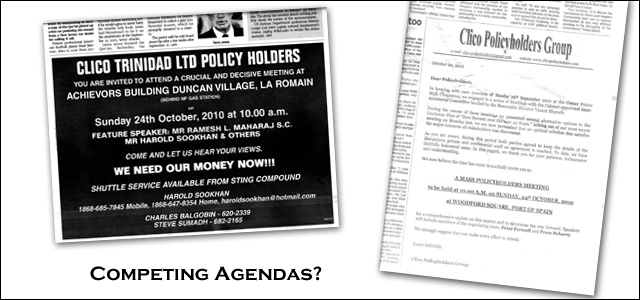
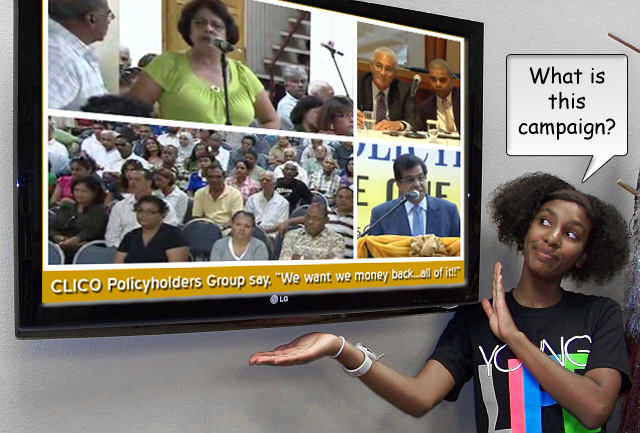
Clockwise from top right, Norris Gomez and Peter Permell; Ramesh Lawrence maharaj; CLICO Policyholders Group meet; a speaker at CLICO Policyholders meeting. Illustration by NiCam Graphics.We are witness to a second wave of assault on our Treasury.  Let us be sure, those of us who are not in line to benefit directly from the bailout, that the picture is complicated and it contains perils for the entire country.

The original bailout was an unjustifiable and colossal facility granted to the CL Financial Chiefs and the shareholders of that failed, privately-owned, group.  I say facility because the taxpayers’ money in our Treasury was pledged to repay the debts of the CL Financial group.  The deal was hatched in secret and fact is, upon reflection, its terms were never formally debated in our Parliament.  What was debated was a series of amendments to the laws governing distressed Banks and Insurance companies.  A lot was said about the issue and many notable contributions were made to the debate in Parliament, but the agenda item for debate was not the terms of the bailout.

The 30th January 2009 Memorandum of Understanding had already been signed and was on its way to implementation when our Parliament debated and agreed to amend the legislation.  The nation had witnessed a ‘Quiet Coup’ to draw from the title of Professor Simon Johnson’s seminal article (in the May 2009 edition of The Atlantic) on this process in the USA – see http://www.theatlantic.com/magazine/archive/2009/05/the-quiet-coup/7364/.

I have no intention of arguing the legal merits of the case being advanced by the CLICO Policyholders’ Group (CPG), leave that to the learned.  I just note that we are yet to hear the voice of the traditional policyholder in the declarations of this Policyholders’ Group.

The bare facts need to be laid out for consideration, it would be far better to conduct this discussion in a more informed manner, with some of the missing details requested at the close of last week’s column.  But is best to start from where we are.  So, the bare facts –

  • CIB’s insolvency is estimated, according to the winding-up petition being heard in the High Court, to be of the order of $4.7Bn
  • According to the Finance Minister in his budget speech, the combined insolvency of British American and CLICO is of the order of $7.2Bn.  It is not possible to tell from that speech if those estimated figures included the monies already drawn from the Treasury in pursuance of this bailout.
  • The amount said to be spent on the bailout, up to May 2010, was $7.3Bn.
  • The amount being owed to the 225,000 policyholders is estimated to be $6Bn.  That covers traditional insurance products such as pensions, health plans and life insurance – it works out at an average of $26,666 owed to each person.
  • The amount being owed to the 25,000 depositors is estimated to be $12Bn, which works out at an average of $480,000 owed to each person.  But there is another way to look at that information and that is in the sidebar.
  • The Governor of the Central Bank, the very official the CPG is seeking to have affirmed as the proper decision-maker in this matter, in April last year made public statements that all the assets of the group are encumbered.

In the absence of the accounts and operating with the available information, it seems reasonable to believe that the CL Financial group is insolvent and further that our Treasury has swallowed an impossible series of obligations.  Furthermore, there is no obligation on the borrowers – the CL Financial shareholders – to pay one cent of interest. Even worse, Para ‘A’ of the 12th June 2009 CL Financial Shareholders’ Agreement actually obliges the State to protect the interest of the shareholders – see http://wp.me/pBrZN-bP.

Of course this leads to yet another ‘$57,000 question’ – ‘If the CL Financial group is insolvent, then how are we paying for all this?’  Yes, that is the big one.

It seems that the CPG is intent on advancing its sectoral interest and while we know that is how things work, it is even more important to be watchful of our nation’s wealth.  We are actually being asked to put out an additional $12Bn to rescue the 15,000 CPG members, with no reasonable hope of recovering those monies.

For the record, no one from the previous government or the Central Bank, for that matter, has ever even attempted to justify the rotten terms of this bailout.  Not even an attempt to explain the interest-free, unlimited, unsecured loan to that lucky group of 325 CL Financial shareholders.

Even now, with the new terms being hotly debated, please note carefully that no new terms are being announced for the ultimate borrowers, the CL Financial shareholders.

Selwyn Ryan
Selwyn Ryan

Professor Selwyn Ryan of UWI, who was, last year, a strong critic of the bailout process and its glaring conflicts of interest, now appears to have become a leading party in the CPG, calling for that suspect deal to be honoured.  A deep contradiction in terms, I tell you.  How do you honour a rotten deal?  Politics does make strange bedfellows and yes, history is truly rich in irony.

Emmanuel "Manny" Lawrence

Even stranger still, is the presence in the CPG of Emmanuel ‘Manny’ Lawrence, former Sales Director of CLICO and now head of one of its sales agencies.  In the three years before the CL Financial group collapsed, all the CLICO agents I knew made intense efforts to get deposits from me.  Not once did these agents even attempt to sell me a life insurance plan or health plan.  These agents consciously and deliberately coaxed many of those people who are now protesting to place all or most their investments in this one instrument.  That is the kind of irresponsible behaviour which led many people to be in breach of the basic investment guideline against over-concentration of risk – to avoid putting all ones eggs in one basket.  That is the kind of biased and unsound advice which no proper professional would render to a client.   It is a decisive factor in this entire scenario.

The ingredients included the requirement for cash by an expanding industrial/commercial group, the resulting lucrative commissions being paid, the trust of the investors and the poor level of general financial literacy.  Those factors all contributed to this appalling picture.  To be fair, despite the titles adopted by some of these salesmen, they were not true Investment Advisers, since they were selling CLICO products.

Also, as to the discussion about the sophistication of the investors, the fact is that even an organisation as large as the National Gas Company, could be seen to have placed undue reliance on the high-interest/high-risk products being offered by the CL Financial group.  At one point, according to its 4th February 2009 Press Release, over 45% of NGC’s funds were in CL Financial – see http://wp.me/pBrZN-ec .

SIDEBAR: The depositors re-examined

I just made the point that the 225,000 ‘traditional, long term policyholders’ are owed an average of $26,666 per policyholder.

Also, that the 25,000 depositors are owed an average of $480,000 per depositor. It is interesting that if you subtract the maximum of $75,000 which would be due to each of the 10,000 ‘small-scale’ depositors, the total owed to the remaining 15,000 depositors is reduced to $11,250,000,000.  That adjustment carries the average amount due to the real protestors in this CPG to no less than $750,000 per depositor.  Yes, that is twenty-eight times the amount due to the traditional policyholders.

Ironically enough, the voice of the traditional policyholders, who outnumber the depositors nine-to-one, is virtually silent in all this.  I am yet to hear anything from the CPG on behalf of those traditional policyholders.  But then again, it is clear that by far the larger amount is owed to the depositors and further, that they appear, on average at least, to be owed about 18 times more than the typical policyholder. Yes, as Growling Tiger did sing “Yuh know very well that Money is King’’.

CL Financial bailout: Disturbing Arrangements in the 2011 Budget

A Bailout Cheque payed by taxpayers to CLICO was stoppedWinston Dookeran’s budget proposals to re-order the ongoing CL Financial bailout have sparked considerable controversy. Dookeran stated his first priority to be “…Stop the drift and indecision…” – ironically enough, it appears that the sentiments of the public are moving in another direction entirely. A new mood of protest and threats of impending lawsuits have emerged. This is a live example of the law of unintended consequences.

The budget’s revised proposals are –

  • Immediate stop on all interest payments;
  • $75,000 claims from depositors to be settled immediately;
  • Balances exceeding that threshold to be repaid over 20 years, with no interest payable. For an example, click here;
  • The group to be re-structured, with CLICO and British-American Insurance Company (BAICO) to be merged and prepared for divestment;
  • …Those responsible for this crisis must be held accountable.…

Clearly, Dookeran took the decision to review the MoU of 30th January and the Shareholders’ Agreement of 12th June 2009. He reduced the burden on the State by increasing the sacrifice of those who were anticipating the return of all their funds under the terms of the original agreements. The latter aspect is arousing serious protest, but there are other areas which also deserve attention.

The entire picture is very confused, which seems to be deliberate.  There were two main types of investments made in this situation – firstly, the basic and traditional insurance products such as pensions; life, health and general insurance and secondly, the depositor who was seeking high returns.  It is true that the pension products offered an optimistic 12% rate of return, but the short-term depositors were different.

Much of the current discussion and argument is actually about the repayment of the depositors, not the traditional insurance policyholders.  The fate of the policyholders is often invoked by people who are actually arguing for the return of their own deposits and that is why the separation between the two, which Dookeran makes, is so important.

To quote  – “The number of traditional, long term policyholders affected by this crisis, covering pensions, life and health insurance, is around 225,000 persons and accounts for $6 billion in liabilities…”  That is an average of $26,666 per policyholder.

Again – “…There are approximately 25,000 customers holding these short term contracts, and the liability to this group is in the region of $12 billion…”  That is an average of $480,000 per depositor.

Ironically enough, the voice of the traditional policyholders, who outnumber the depositors nine-to-one, is virtually silent in all this.  But then again, it is clear that by far the greater liability lies with the depositors and further, that they appear, on average at least, to be owed about 18 times more than the typical policyholder.  Yes, I am aware that there are depositors who are also policyholders and so on.

For those of us who did not invest with CLICO, the mere idea of our taxpayers’ funds being used to rescue those who placed high-return deposits is deeply offensive. Both the CL Financial chiefs and the depositors who took the chance at investing at those incredible rates of return are being spared the consequences of their decisions by the bailout process. But those groups are being differently treated from each other and that is the point in this commentary.

On the principle, the absence of consequence is inimical to any development, personal or national.

When I consider the appeals from Credit Union and Trade Union leaders, as well as individual investors, it makes me wonder if there is a live concept of responsibility in this place. All those people withdrew money from the slow-but-steady accounts of the traditional banks and put it into the high-interest accounts at CL Financial and HCU were indulging in riskier choices. How can they be so bold-faced as to tax the rest of us for their adventure?

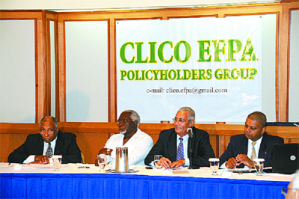
Some members of the CLICO EFPA group including (l-r) William Aguiton, Selwyn Ryan, Norris Gomez and Peter Permell
CLICO EFPA Policyholders group at press conference on Sept. 21

There are now two groups organized to lobby for the interest of the disappointed depositors – the ‘CLICO EFPA Policyholders’ and the ‘CLICO Depositors Interest Group.’ Some of the leading members are themselves leading CLICO sales agents, so the decline continues. They are asking for an urgent meeting with the Minister of Finance and litigation is threatened, so this will form part of this ongoing series.

Credit Unions fear collapse’ was the headline of a story in this newspaper on 17th September – at http://guardian.co.tt/news/general/2010/09/17/credit-unions-fear-collapse – reporting on the concerns of the Credit Union League (CUL), given the scale of their investments in the CL Financial group. Figures were presented for four large credit Unions and those have an average of less than 4% of their assets in CLICO. See the table here:

CREDIT UNIONS’ reported CLICO Holdings
Credit Union CLICO Deposits Total Assets Proportion
Eastern CU $17,000,000 $1,234,000,000 1.37%
Teachers’ CU $24,000,000 $503,000,000 4.77%
Rhand CU $28,100,000 $395,000,000 7.11%
Venture CU $21,000,000 $333,000,000 6.29%
Summary $90,100,000 $2,474,700,000 3.64%

Note – The data in this table is taken from the Guardian article cited, except for the Eastern Credit Union Asset Value which is from its 2009 Annual Report.

The CUL has not made any convincing case for a possible collapse and it seems reckless to even suggest further collapses on the basis of these figures.

But the confusion is continuing, with contradictory positions being taken on this issue. The idea that the Credit Union movement is under threat is a very serious one, which would be of great public concern, so we need to examine these statements carefully.

At page 10 of the Express of 22nd September ‘Credit Unions seek help from Rowley’ – see http://www.trinidadexpress.com/business/Credit_unions_seek_help_from_Rowley-103498744.html?corder=reverse – the Credit Union League met with the Opposition Leader, Dr. Keith Rowley. Once again, the idea that Credit Unions are in serious trouble was advanced – “…They said they would not be able to sustain daily operations. …” That is a very startling statement, this time given without any attempt to provide evidence.

To add to the confusion, the Guardian of that same day (22nd September) reported, at page 13 “CFF welcomes move to meet with CU on Clico” – see http://guardian.co.tt/news/general/2010/09/22/cff-welcomes-move-meet-cu-clico – on statements by Esme Raphael, President of the credit union’s Central Finance Facility (CFF) on this situation – “…Raphael said while the credit union movement was under no threat of collapse, the 20-year repayment plan would make it less competitive in delivering credit union services…”.

These contradictory messages will detract from the credibility of the Credit Union movement and must be clarified.

The idea that there is any such thing as a ‘guaranteed investment’ is preposterous. An absolute oxymoron is generating all this argument.

Yes, the last government made certain pledges and I have been critical of those, but here we are entering an even more turbid situation.

As outlined above, the PP government has decided to alter the terms of the existing bailout agreement as to refunds to depositors, so it is clear that it regards the terms of those agreements to be negotiable.

In my view, the most odious aspect of the entire bailout is that the wealthiest individual in the Caribbean was able to negotiate the largest-ever loan from our Treasury at zero interest on the basis of a letter. If the terms of the bailout agreement are negotiable, why are we not insisting on charging a proper rate of interest to compensate the State for these massive loans? Who is protecting our country’s wealth? In view of the fact that they are essentially unsecured loans, the only proper interest rate would be a punitive one.

There are live, cogent notions of financial equity and economic justice which are being abused in this entire scenario, but that is for a separate series.

The amounts involved are massive – “…The total funding provided as at May 2010 by the Government and the Central Bank, excluding indemnities and guarantees to First Citizens Bank amounted to approximately $7.3 billion” Emphasis in the original. That equates to over $456M a month to rescue Mr. Duprey. I wonder how much is the total of the indemnities and guarantees?

The bailout terms were revised to reduce the amount of the State payout to the depositors, but no additional pressure is being put on the CL Financial group in terms of interest payments. It is resembling a comfortable arrangement for Duprey.

Another aspect of the budget which was difficult to follow was the shifting focus between CLICO and CL Financial.

The proposal to merge and prepare CLICO and BAICO for divestment needs a fuller explanation. That is because the leading insurance ratings agency, AM Best, just de-listed CLICO, due to its failure to provide financial data – see http://insurance-technology.tmcnet.com/news/2010/09/14/5004871.htm. In addition, BAICO was declared insolvent in November 2009 – see https://afraraymond.net/wp-content/uploads/2009/11/baico_resolution_strategy.pdf – and filed for bankruptcy in the Florida courts in March – see http://www.thevoiceslu.com/local_news/2010/march/02_03_10/British_American_Files_for_Bankruptcy.htm. To quote Dookeran – “…As of June 2010, CLICO and British American combined total liabilities were approximately $23.8 billion but total assets were $16.6 billion” Emphasis his. That is an insolvency of the order of $7.2Bn and it is not at all clear how, if at all, that can be divested.

We need a better quality of information to move ahead with this, so it was encouraging to hear Dookeran’s clear post-budget statement “…No more shall we have secret government,…” – see http://www.newsday.co.tt/news/0,127330.html.

Minister, these facts need to be made public if we are to eliminate secret government :

  • The original Duprey letter of 13th January 2009 – I have applied twice under the Freedom of Information Act for this and the second application has been in your Ministry since 28th June, unacknowledged.
  • The audited accounts of the CL Financial group for the year ending 31st December 2008 – Have PwC completed that? When are they to be published?
  • The Lindquist Report – Bob Lindquist was reportedly appointed to examine CLICO. Has he submitted a report? Are we to be told of any of his findings?
  • The Mottley Report – There was a team of three advisers – Wendell Mottley, Colin Soo Ping Chow and Steve Bideshi – appointed to examine the CL Financial group and we need to know what were the findings of this group.
  • The Central Bank’s winding-up petition for CIB in the High Court has given us a disturbing insight into the operations of ‘The House on the Corner’. When are we going to get reports into the collapses at CMMB, British-American or CLICO?
  • Given that we are being asked to bailout and clean-up Mr. Duprey’s crisis, I feel we need to be told who are the borrowers of the $1.0Bn of ‘non-performing loans’ in CIB’s portfolio. The fact is that these are some of the delinquents we are being asked to bailout and the names would surprise the public. Local banks customarily publish the names etc of people who have non-performing loans, so why can you not do the same thing in this case?
  • To quote the budget statement – “…This crisis was caused by…wrong financial reporting…” False Accounting is a criminal offence under our laws – When are criminal charges to be laid? Those people – the accountants who were accused of that grave offence – belong to professional bodies, both here and overseas. Is there any intention to make formal reports to these professional bodies?
  • Quoting again – “…This fiasco was caused by reckless corporate governance and the glaring failure of our financial regulatory institutions…” What action is to be taken against these slack regulators?
  • Is there any intention to invoke the ‘Fit and Proper’ provisions against any of the CL Financial Directors or Officers?
  • Finally, do you intend to insert an interest clause into the ‘sweetheart bailout agreement’?

Mr. Dookeran, you have the opportunity to inject notions of solid responsibility and proper conduct into this sorry situation.

Next, I am going to delve into the promise to ensure accountability of the responsible persons.

SIDEBAR: The Hindu Credit Union peril

Amidst all this and completely to be expected, the PP government is bailing-out HCU depositors on identical terms to those now being offered to CL Financial depositors. For the record, the Finance Minister’s statement was as plain as it was unsettling –

“…Although the failure of HCU did not carry a systemic risk to the financial system since it represents less than one percent of the total assets of the financial sector, this Government is of the view that these funds of these small investors must be protected…”

We were told directly that this HCU collapse is not a risk at all to the system, but these disappointed savers are still to be rescued by the Treasury.

This is a poor precedent, since when the next Financial Institution collapses, the then Minister of Finance would have to deal with those unrealistic expectations.

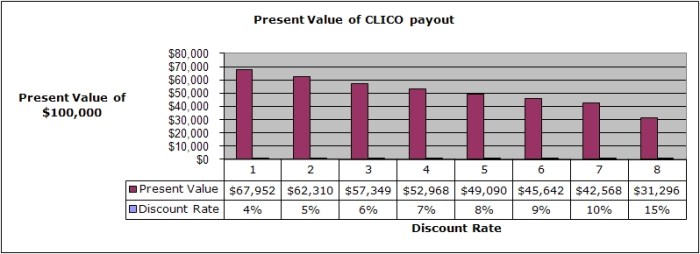
Present Value of $100,000 under CLICO bailout plan

Back to Previous Page

The new proposals for refunds of amounts over $75,000 are that those will be repaid in equal annual payments over a 20-year period, via zero-interest bonds.

Claimants can either wait 20 years or, if they need money right now, sell their right to receive these future sums of money at a discount.  The future value of money is lower than its present value a long-time truth made powerful by the force of inflation and the threat of devaluation – the effect being that this lower value of future sums of money is shown in the discount rate applied to the right to receive these sums.

There is no way to know for sure exactly what/how the various negotiations will play out between the claimants and the people they are seeking to sell their bonds to.  There is a widespread belief that the discount rates will match the rates at which bonds are floated and that view has merit.

These are some specimen calculations for the benefit of our readers:

Notional Sum is $100,000 payable over 20 years at zero interest
Discount Rate Present Value
4% $67,952
5% $62,310
6% $57,349
7% $52,968
8% $49,090
9% $45,642
10% $42,568
15% $31,296

Back to Previous Page

Property Matters: Some comments on the property and construction proposals of Budget 2011

Winston Dookeran, MP and Min. of Finance reading Budget 2010. Original photo courtesy Trinidad GuardianThis was the inaugural budget for both the newly-elected People’s Partnership and its Finance Minister, Winston Dookeran.

The burning question for me in preparing these comments was the big one – “Is the Honeymoon over?”

In my view, the honeymoon for this new government will last about 6 months, given the sheer scale of the mess they have inherited.

There were real expectations aroused in the recent election campaign and the reduced revenues available to the State would have made the budget into a balancing-act, particularly when one considers the repeated promises of ‘No New Taxes’.

The main items on the property and construction aspects were –

  1. PROPERTY TAX
    The Property Tax was ‘Axed’ as promised – “…The Property Tax will be replaced by the old Lands and Building Taxes regime at the old rates and old values. There will be a waiver of lands and buildings tax for the year 2010…”There has been a misleading rebuttal on this from the Opposition Leader, Dr. Keith Rowley, in that the 2011 Estimates of Revenue tell us that the Land & Building  Taxes are expected to increase from $71.4M to $173.8M.  Rowley’s statement would lead one to think that the property tax take would be of the order of $300M, due to the omission of the municipalities. In fact, that is not the case, since the revenue of the five municipalities (POS, San Fernando, Arima, Chaguanas and Point Fortin) are found in the Estimates of Revenue for Statutory Boards and Similar Bodies etc.  Due to the fact that one of the effects of the controversial property tax was to relieve these municipalities of their powers to tax property, the 2011 estimates of revenue need to be properly interpreted.  The municipalities are estimated to raise revenue of nil in 2011, since all their revenue – as well as that of the regional corporations – is collected by the Counties and transmitted to the Central Government.The true picture is that $142.52M was the estimate of revenue from property taxes in 2009 – that is the combined figure for House Rates, paid in municipalities, and Land & Building taxes paid elsewhere.  We are therefore anticipating an increase in revenue from this source of the order of 18%.

    No rationale was given for the waiver of property taxes for 2010, which was an astonishing decision, given the background against which the budget was drawn up.

    Before I leave the property tax topic, it is interesting to consider that rental income is also subject to income tax.  Not many people who own rental property actually pay income tax on that rental income – if you don’t believe me, just ask a few friends or relatives who own rental property.  This seems to me to be an area in which the Finance Minister can easily collect the data and increase the State’s revenue by staying within the ‘No New Taxes’ promise and implementing the laws which are already on the books.  But more on that in a later article.

  2. HOUSING
    The Minister of Finance made strong statements in support of home ownership, he also outlined what appears to be a merger between several State-controlled mortgage companies.  No target numbers of new homes to be built were given. The Housing and Environment Minister, Dr. Roodal Moonilal, recently announced that the Housing Development Corporation’s (HDC) new output target is 6,000 new homes in 2011. The Housing and Environment Ministry have zero allocation of capital funding according to the 2011 Estimates of Expenditure.  There is an allocation of $845M to the Hosuing and Settlements programme shown in the Public Sector Investment Program (PSIP).  Those estimates should cross-reference with each other and the fact that they do not is cause for concern, to say the least. This is the pattern of State spending on new homes, derived from the capital allocations only –

    Year Housing Ministry Capital Allocation ($M)
    2008 $718.70
    2009 $1,342.40
    2010 $860.40
    2011 $845.00

    There was also the revival of an annual tax credit of $18,000 per household for first-time owners for the first five years.  That measure is expected to cost $20M, which implies that just over 1,100 households will benefit from this provision.  To quote – “…This measure will generate significant investment in the private sector housing industry….”  Given the quantity of unsold, privately-built homes and the volume of HDC units soon to be released onto the market, it seems quite unrealistic to expect that this measure could yield ‘significant investment‘.

    What is of greater concern to me is the question of whether we are at the limits of possibility as to home-ownership levels.  76% of our households now own their homes, the comparative figure for the USA is 69% and for the UK it is 68%.  How realisitic is it to keep pushing for increasing home-ownership?

    The HDC’s low-cost ‘Accelerated Housing Program’ stalled, with over 10,000 empty homes as proof, due to a shortage of applicants who could qualify for a mortgage.

    The Minister of Finance spoke of the neglect with which our organisational and institutional infrastructure had been treated and I could not agree more.  On this count, there needs to be proper consideration given to the resucitation of the Rent Control Boards.  Also, the HDC needs to start giving some of those empty homes to people who just want to rent.

  3. Special Purpose Entities (SPEs) – What is their future in this new dispensation

    Mr. Speaker, no coherent, co-ordinated planning or strategy for state enterprises exists. As a result we have begun to rationalize the state enterprises, including the special purpose companies, which will incorporate a new accountability system that goes beyond the presently operating company ordinances. It is these loopholes in public accountability that resulted in the UDeCOTT scandal. This must never again happen in Trinidad and Tobago.

    Now that this just not so since there is a Performance Monitoring Guide of State Enterprises, published by the Investments Division of the Ministry of Finance in 2008. (see – http://www.finance.gov.tt/content/pub0DCE11.pdf)

    This issue, as always in our country, is one of implementation.  The provisions  of that guide are not being followed and the wrongdoers are not being called to order.

    The issue for us is to prevent the recurrence of that pattern of mismanagement and disorder in public affairs.  That can only happen if we enforce the present guidelines and systems.

In the next column, I will discuss the attempt to map out a new philosophy in this budget and the CL Financial/HCU bailout.