Afra Raymond is interviewed on the “Centre Stage” show on Power 102 FM in Trinidad and Tobago, hosted by Chris Seon, Cliff Learmond and Sherma Wilson, on the Colman Commission and the revelations and possible consequences.
Following my last article on the Colman Commission –Balancing the Scale– in which the recent private meeting of Attorneys was discussed, I wrote the following to its Secretary.
To – Judith Gonzalez, Secretary to the Colman Commission
Dear Ms. Gonzalez,
I was perturbed to learn, only recently, that the Commission had convened a meeting on Friday 8th July at which one of the items discussed was whether my various submissions should be admitted as evidence and if so, what should be the ‘status’ accorded it.
Here we had the situation of a Public Enquiry into a matter of Public concern, convening a private meeting which discussed as one item of business my inclusion as a witness. As a participant in the Enquiry, not a party, I was excluded from the discussion as to whether my evidence should be omitted…I was not invited to that meeting and only found about this afterwards, almost in passing. I also understand that the various parties are to be given the opportunity to make submissions on those issues on my testimony, on which the Commissioner can make a ruling.
My work on this matter of grave public concern has been a solo exercise, except for the occasional assistance of friends. I am without legal representation at this important forum.
Given the substantial parties involved – all of whom are represented by attorneys – and the limits placed on my input by the Commission’s decision to deny me the status of a party, one can scarcely imagine a more lop-sided scenario than this one. Natural Justice is not negotiable.
All that said, the meeting in question has already taken place, so I am requesting that you give proper consideration to inviting my participation when this matter is next to be discussed.
As readers can see, this is exactly the document posted as part of the first story in this series, published in the Sunday Guardian on 9th July 2011. Which means that my essential assertions remain unanswered in that staff who are forbidden to disclose the existence of an agreement would be unable to get external advice on it, without being in breach. Which has the real effect of giving this document an oppressive flavour.
Of course it also puts into question the assertion in Lalla’s first letter to me, that this new EFCL policy was “…consistent with what obtains in many companies…” Literally unbelievable. Obviously.
I can only hope that this policy was not approved by our Ministry of Education.
But we will revert to EFCL after the budget season…readers can draw their own conclusions.
Commission of Enquiry into the failure of
CL Financial Limited
Colonial Life Insurance Company (Trinidad) Limited
Clico Investment Bank Limited
Caribbean Money Market Brokers Limited and
The Hindu Credit Union Credit Union Co-operative Society Limited
My name is Afra Martin Raymond and I am a Chartered Surveyor, being a Fellow of the Royal Institution of Chartered Surveyors. I am Managing Director of Raymond & Pierre Limited – Chartered Valuation Surveyors, Real Estate Agents and Property Consultants. I am also the President of the Joint Consultative Council for the Construction Industry (JCC), an umbrella organisation which represents the interests of Engineers, Surveyors, Architects, Town Planners and Contractors in this Republic.
This submission is being made in my personal capacity and does not represent the position of either Raymond & Pierre Limited or the JCC.
The Colman Commission into the failure of CLF Financial and the Hindu Credit Union is just about to move into its second round of Hearings and the public can expect to have further testimony on the losses suffered by people who deposited monies with CL Financial.
I have made several submissions to the Commission and have been invited to give evidence. I am reliably informed that there have been strong and unanimous objections to my participation in the Colman Commission. It would seem that only the Commission itself is interested in having my testimony go onto the record.
It is not surprising to me that objections of that sort would be arising now, but readers need to have a context.
The Colman Commission was established to find out how this fiasco occurred, recommend methods to stop a recurrence and also to identify responsible people who are apt for lawsuits or criminal charges. The main parties can be expected to give self-serving evidence, designed to exonerate themselves from any blame. We can also expect to hear more attempts to put the blame onto Wall Street, despite the claims in the CL Financial 2007 Annual Report– this is from the preamble –
…“The Next Wave of Growth” is the theme of this annual report, highlighting, to quote our Chairman, “that out of any crisis opportunities will emerge and our progress during the year under review prepares us to seize those opportunities and unlock value.” We have confidence in our ability to not only navigate this financial storm but to find fresh and profitable opportunities within it…
That Annual Report was published on 23 January 2009 – yes, that is 10 days after Duprey wrote to the Central Bank Governor for urgent financial assistance and one week before the bailout was signed on 30 January.
The Colman Commission is a Public Inquiry into a matter of major importance; it was approved by the Cabinet and installed by the President of the Republic. A Commission of Enquiry can only make findings on the evidence submitted to it, so it would be very important for some people to have certain evidence omitted.
One of the most outrageous aspects of the entire Uff Enquiry was the use of public money by UDECOTT to attempt to block certain documents coming into evidence. Those various attempts to limit the scope of the Uff Enquiry were disgusting to all right-thinking people and seemed to be a straight case of the ‘tail wagging the dog‘.
It is unacceptable that the Ministry of Finance could be taking a position which is seeking to exclude my evidence from the Commission. If that were so, it would mean that Ministry is acting in a manner which effectively dilutes the Commission and what is more, appears to be incompatible with the intention of the Cabinet to have a full public enquiry into this matter of national concern. In addition, the Central Bank is also reported to have objected.
The Colman Commission needs to be robust in getting at the truth of this financial disaster.
The new Bailout Plan
At the time of writing I have no details of the new bailout plan, proposed to be laid in Parliament for debate on Wednesday 14 September. According to a report in the Trinidad and Tobago Guardian, the proposed plan is in two limbs, the first includes the issuance of new bonds to raise monies for the payment of policyholders, while the second is the creation of a prohibition against lawsuits against the Central Bank.
The three concerns I have at this stage are –
Accounts– The last published audited accounts for the CL Financial group were for 2007, but despite the tremendous resources which have been deployed by the State in this matter there is no clue as to when accounts are to be brought up to date. Given that both the 2009 agreements – the MoU of 30 January 2009 and the CL Financial Shareholders Agreement of 12 June 2009– exist in a framework of State funds being paid to the group’s creditors and recovered by asset sales, this situation is totally unacceptable. What is more, there has never been any attempt to explain the delay in completing those accounts.
As a result we have two insurance companies operating in our country without any accounts, which is in breach of the very regulatory framework of the Central Bank.
The Finance Minister must address these relevant concerns if this proposal is to gain any support. It brings to mind the recent point made by Independent Senator Subhas Ramkhelewan, in debating the recent proposals to increase the State borrowing limits, that the Parliament needs proper details of the ways in which those monies are proposed to be spent, because no person could borrow money from a diligent lender without giving details. We need, as a country, to insist on these higher standards.
We need to move away from the black box and the magician’s hat, towards a more transparent situation in which large-scale public spending decisions are based on a solid series of rationales.
Colman Commission – The concern here is that the second limb of this proposal will prevent lawsuits against the Central Bank; at this point I am not sure if that only applies to CL Financial-related matters. The Terms of Reference of the Colman Commission state –
…2. To make such findings, observations ad (sic) recommendations arising out of its deliberations, as may be deemed appropriate, in relation to:
(i) whether there are any grounds for criminal and civil proceedings against any person or entity; whether criminal proceedings should therefore be recommended to the Director of Public Prosecutions for his consideration; and whether civil proceedings should be recommended to the Attorney General for his consideration;
It seems to me that the result of these proposals could be to thwart that part of the functions of the Colman Commission as they relate to the Central Bank.
Insurance Act – Finally, I am concerned that as we are on the eve of a possible ‘solution’ to the problems of the policyholders, there may be other fragile insurance companies with solvency issues. The fact that these matters are now so high on the public agenda means that we should not waste the opportunity to bring forward the new Insurance Bill, which has been drafted for some time, for discussion.
It is at moments like this that a responsible and long-term approach to these huge issues is in the interest of the entire nation.
CORRECTION
In this article, which was published on September 13th 2011, I stated that there were unanimous objections to my appearance as a witness at the Colman Commission. I wrote that on the basis of certain reports given to me by persons who were present at those meetings, but after receiving a challenge from the attorneys for the Trinidad & Tobago Securities & Exchange Commission (TTSEC), it was impossible to corroborate that aspect of the article – i.e. that the TTSEC had objected to my appearance.
This notice is to correct the record in that respect, I do regret any inconvenience or damage caused to the TTSEC by my publication of those allegations. – a Correction with similar effect was published in the Business Guardian of 18th November and I do regret the delay in publishing this one here for blog-readers.
Commission of Enquiry into the failure of
CL Financial Limited
Colonial Life Insurance Company (Trinidad) Limited
Clico Investment Bank Limited
Caribbean Money Market Brokers Limited and
The Hindu Credit Union Credit Union Co-operative Society Limited
My name is Afra Martin Raymond and I am a Chartered Surveyor, being a Fellow of the Royal Institution of Chartered Surveyors. I am Managing Director of Raymond & Pierre Limited – Chartered Valuation Surveyors, Real Estate Agents and Property Consultants. I am also the President of the Joint Consultative Council for the Construction Industry (JCC), an umbrella organisation which represents the interests of Engineers, Surveyors, Architects, Town Planners and Contractors in this Republic.
This submission is being made in my personal capacity and does not represent the position of either Raymond & Pierre Limited or the JCC.
On Friday 2 September, the EFCL’s attorneys delivered to my office this letter dated 8 August 2011.
That letter was written by Larry N. Lalla who warned me in his opening paragraph that EFCL was concerned at the tenor of my articles on their Confidentiality Policy. (Parts 2 and 3 here.)
The letter ended by warning me that EFCL would meet any defamatory statements with legal action…seeing that he never said “…further defamatory statements…” or identified any such, this appears to be yet another waste of taxpayers’ money in an attempt to avoid answering my five original questions.
The intention here seems to be intimidation.
It is sad and ineffective, let me tell you why.
Sad, because, according to clause d. of EFCL’s Staff Confidentiality Policy Statement which was sent to me, employees are forbidden to reveal the terms of the policy or even its very existence. Lalla’s letter states at 2. that EFCL’s Confidentiality Policy is “…consistent with what obtains in many companies…”. Both of those cannot be true, since it is simply not the norm that a normal commercial company forbids its employees from even disclosing the existence of a policy. Those provisions are not at all consistent with what obtains.
The sad part is that the only way to settle this is for EFCL to release its Confidentiality Policy, as I have been requesting. They have been reluctant to do so, for whatever reason.
EFCL prefers to spend money to obfuscate and intimidate rather than just answer these simple questions, originally contained in my email of 1 July –
Is there a new EFCL Confidentiality policy?
When did that come into effect?
Would you please provide a copy of that policy?
Was that policy approved by the Board of Directors?
Is the Ministry of Education aware of this new policy?
There seems to be an attempt to change the reality that all these State Enterprises are spending public money and therefore ought to be responsive to our reasonable requests.
Earlier today I made a request under the provisions of the Freedom of Information Act and we will see what happens next.
A copy of EFCL’s attorneys’ letter dated 8th August was hand-delivered to my office earlier today and I will soon be replying to those points in public.
In particular, I noted the third point in that letter –
“3. EFCL remains at all times committed to the principles of transparency in all aspects of its operations.”
Accordingly, I am again requesting a copy of the EFCL’s Confidentiality Policy.
Of course I am publishing this, in keeping with our shared commitment to transparency.
The Colman Commission held its first session of Hearings in the last week of June, so we were able to have moving reports from witnesses who had lost-out from various investments with the Hindu Credit Union (HCU).
I read those transcripts and it was painful to see the shape of this problem. The most striking aspect for me was that the various attorneys seemed to have struck a compromise as to the parts of that evidence which would form part of the public record.
HCU Investors were allowed by the Colman Commission not to state investment amounts. They seemed to set the agenda.
The main concession was that those witnesses did not have to state the amount of their investments for the record. The reasoning seems to have been a stated fear of crime, but it is my view that this concession will compromise the effectiveness of the Colman Commission. Given that the Commission is scheduled to resume its Hearings on 19 September, it seems timely to put these matters forward now.
To begin with, the two Golden Rules of investment are –
The Risk and Reward paradigm – Risk and Reward have an inescapable relationship – i.e. the greater the Risk, the greater the Reward and vice versa.
Investments need to be spread out so as to avoid undue concentration of risk – in colloquial terms, you should not put all your eggs into one basket, or bet all your money on one horse.
From these time-honoured ‘Golden Rules’, we derived the ‘Prudential Criteria’ which guide how financial institutions balance risk and reward.
Yet, despite the ‘Golden Rules’ the CLF and HCU chiefs were able to devise products which tempted tens of thousands of people to abandon those basic safeguards and invest in their products. People who were normally sensible were tempted to abandon good sense and break both ‘Golden Rules’. That is the measure of this tragedy.
Another point is that it was not only individuals who made that type of error, there were other people, with responsibility for managing monies, who also gave into the various temptations. The sidebar has details on that.
Let us be clear that the scope of this fiasco is as broad as it is deep, with boundaries stretching from the delayed and misleading accounts to the mismatched funding/investment practices of the core companies, from the absence of proper corporate governance described by Dr. Euric Bobb to the negative impact of the extensive political donations made by the CLF group. The Executive Flexible Premium Annuity (EFPA) is at the heart of the tragedy – the most successful investment product ever designed and built in the Caribbean, while being, at one and the same time, arguably the most toxic.
The duty of the Colman Commission is to probe how this fiasco occurred, recommend methods to stop a recurrence and also to identify responsible people who are apt for lawsuits or criminal charges.
We are now contemplating an inquiry into a large-scale financial collapse, which appears to have conceded the right of witnesses to withhold details about their investments. We are able to read the name and age of the witness, but effectively barred from information as to the size of their investment or the proportion of their total portfolio that figure represents. A Public Enquiry into a financial failure has conceded the right of the public to the basic financial information. I say basic, because the fact is that without those thousands of EFPA and INC investments, there would not have been the cashflow to allow CL Financial to embark on that fateful journey.
This appears to me to be a cloudy concession, to say the least, since it might represent the thin edge of the wedge in setting a precedent to allow subsequent witnesses to try obscuring or omitting financial details. More importantly, the effect of that kind of concession is that it will almost certainly mask the extent to which the basic financial rules were violated. That is not a philosophical question, because the CLF disaster only attained this scale and consequence as a result of these basic rules being broken. Ergo, it is not at all possible to credibly examine the causes of the crisis, if one has conceded that those are areas which will not be publicly examined.
There was public campaign to persuade people to make these risky investments. That campaign was calculated to have them set aside the norms of good sense – the ‘Golden Rules’ were abandoned. The Agents, many of whom masqueraded as ‘Investment Advisors’, appealed to people to close-off their other accounts and sell other investments so as to put as many eggs into that one basket as possible. After all, the more money you put with them, is the more interest CL Financial was offering. We all know that is how the thing went.
At the same time, these agents were busy telling people that their product offered these tremendous rates of return and complete security of funds, etc. etc. I bet everyone reading this heard those lyrics, at least once.
This concession is short-sighted and I am urging the Colman Commission to reconsider its position urgently. There must be no easy concession to allow less light.
Sunlight is the best disinfectant.
The depth of this tragedy can only be plumbed if we are able to see the true extent to which the ‘Golden Rules’ were broken.
The Colman Commission has to keep its focus. That concession needs to be renegotiated, if it is not already too late.
SIDEBAR: The levels of responsible investors
Apart from the individual investors who suffered from their misplaced faith in the CL Financial and HCU Products, there are others who also need to be examined by the Colman Commission if we are to have a proper picture of those events.
Firstly, there are the Credit Unions, who were acting for many small and relatively unsophisticated investors. Several Credit Unions placed heavy investments into these EFPA products, which of course was a product approved for individual investors. The nature and extent of those Credit Union investments need to be a living part of this enquiry.
Secondly, there were yet another species of large-scale investors who were the chiefs of the State-owned National Gas Company (NGC) and the nation’s largest pension plan, the National Insurance Board. Those two companies were reported to have invested the sums of $1.1Bn and $700M, respectively, in a Clico Investment Bank (CIB) product called the Investment Note Certificate (INC). This was another ‘gravity-defying’ product which offered attractive rates of interest along with the guarantee of being backed by good-quality investments. Like a close relative of the EFPA. In ‘Taking in Front’ published here on 25th April 2010, I examined the NGC’s involvement in those CIB products. At one point, up to 40% of NGC’s money was with the CL Financial group, so it is clear that its own Board policy on the placement of large-scale, short-term deposits did not insulate that State Enterprise from the temptations which afflicted others.
Given that the highest levels of commission were paid to the agents for these products which yielded so much cash for the CL Financial group, Colman has to ask whether inducements were ever offered to these people in positions of trust. Apart from the question of possible inducements, the real question is whether the kind of over-concentration of deposits which exists is at all compatible with the proper execution of one’s fiduciary duty. Colman will never know unless he withdraws that fatal concession.

 On Wednesday 21st September I received
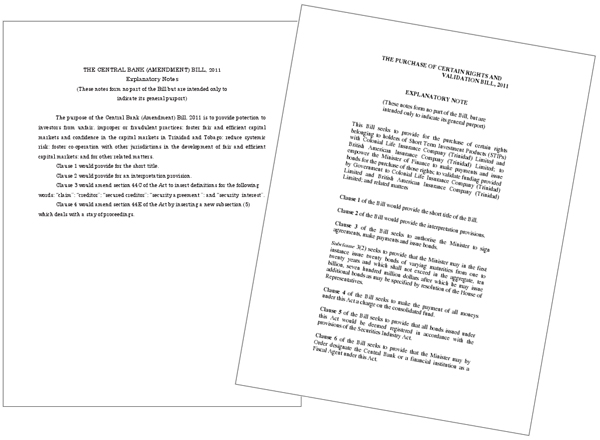 These are the two draft Bills which contain the Government’s proposals to resolve the CL Financial bailout fiasco. The latest article on this blog ‘
 The Colman Commission into the failure of CLF Financial and the Hindu Credit Union is just about to move into its second round of Hearings and the public can expect to have further testimony on the losses suffered by people who deposited monies with CL Financial.
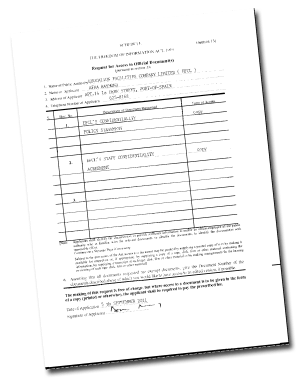 On Friday 2 September, the EFCL’s attorneys delivered to my office
 Yes, Readers, I received

 Secondly, there were yet another species of large-scale investors who were the chiefs of the State-owned National Gas Company (NGC) and the nation’s largest pension plan, the National Insurance Board. Those two companies were reported to have invested the sums of $1.1Bn and $700M, respectively, in a Clico Investment Bank (CIB) product called the Investment Note Certificate (INC). This was another ‘gravity-defying’ product which offered attractive rates of interest along with the guarantee of being backed by good-quality investments. Like a close relative of the EFPA. In

