Board Games – part 2

state-boards-logos

SIDEBAR: Correction on Court Case

With apologies to readers, in the previous article, I mistakenly named UTT as the SoE which had sued its Directors over allegations of a negligent 2005 investment, in fact it is eTeck which sued its Board. A lawsuit was launched by UTT on a similar series of allegations, but that was abandoned in July 2015.

Both those Boards were headed by Professor Ken Julien.

The previous article prompted a series of extremely interesting responses, so I will continue this examination of the State Controlled Agencies. That phrase includes State-owned Enterprises (such as UDECOTT, Caribbean Airlines and EFCL) and Statutory Agencies (like WASA, TTEC, CDA, PATT and HDC).

Some sharp objections were made to my comparison of the relation between the State, the Government and Citizens to a Company, its Board of Directors and its shareholders. I maintain that this is a valid comparison for us to reflect on the proper roles and responsibilities of the various public officials, but perhaps more importantly, the responsibilities of us citizens. Continue reading “Board Games – part 2”

CL Financial bailout – Duprey’s Story: SIFI vs PIFI

Artwork by NiCam Graphics

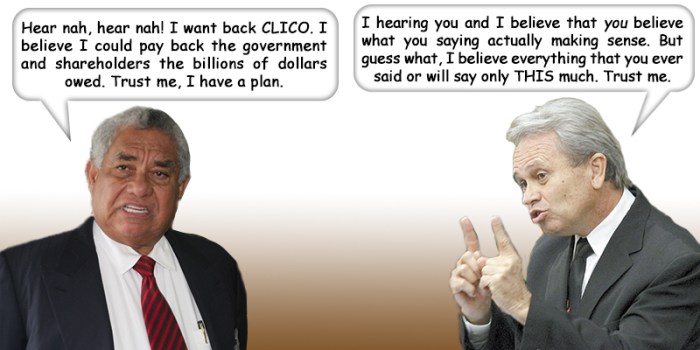
On Sunday 22nd May 2016, the front-page story in this newspaper was headlined ‘We will pay it back‘. That article featured very interesting quotes from former CL Financial Executive Chairman, Lawrence Duprey as well as the Minister of Finance & the Economy, Colm Imbert, on the prospects for repayment of the huge sums of Public Money spent on this CL Financial bailout.

Duprey claimed to have made a formal proposal to the State to repay taxpayers and all stakeholders who are owed money, while insisting that the amount owed was yet to be determined. The failure or refusal of the State to publish any audited statements in relation to this CL Financial bailout appears to be impeding the discussions as to a settlement of this massive debt. The sidebar contains a summary of how the Public Money spent on this bailout has grown from the initial 2009 estimates of $5 Billion to a 2016 figure now said to exceed $24 Billion. Continue reading “CL Financial bailout – Duprey’s Story: SIFI vs PIFI”

Board Games

demming xed out
Dennise Demming (left) was “removed and replaced” as the chair of the Tourism Development Company by Corporation Sole. Standing with Demming are Tourism minister, the Hon. Shamfa Cudjoe MP and TDC director Tonya Laing. Photo courtesy Trinidad Express.

The recent controversy over the dismissal of Dennise Demming as Chair of the Tourism Development Company (TDC) has sparked yet another round of debate on the role and operation of State-owned-Enterprises (SoEs).

Some of the issues which have arisen are –

  • What is the purpose of these SoEs?
  • How do the Boards of these SoEs get appointed?
  • Are Board Directors of SoEs required to follow directions from the line Minister?
  • Do Board Directors of SoEs have the right to get involved in managerial decisions such as hiring of staff and awarding of contracts?
  • Do Ministers and Permanent Secretaries have the right to meet with or direct staff of the SoEs without the input of the Board of Directors?
  • Given the recent Appeal Court decision in the eTeck case, what is the legal liability of Board Directors of SoEs?

Continue reading “Board Games”

Privacy Pros & Cons

The recent high-level of public concern over the SSA Amendment Bill was of limited concern to me, until I started listening properly. In the event, the proposed law was passed by the Parliament and there is some threat from the Opposition of a lawsuit to test its constitutionality. We will see.

Two very interesting stances surfaced during the heated debates and it is at these kind of moments that I sometimes think of our so-called political divide. Those were the Right to Privacy stance disclosed by the AG and the private briefing of Parliamentarians as a legislative tool.

Sen. Faris Al Rawi, Attorney General
Faris Al Rawi, Attorney General

The AG, Faris Al Rawi, was emphatic on 2nd May 2016 that we have ‘…no enshrined right to privacy under the law…‘. He was almost immediately contradicted by former CJ, Michael de la Bastide QC, who relied on Section 4 (c) of the Constitution which specifies ‘the right of the individual to respect for his private and family life’. In ‘The creep of Tyranny‘ on Monday 9th May 2016 in this newspaper, my colleague Michael Harris also made strong objections to the AG’s stance. Of course we have rights to privacy and those are entrenched in our Constitution, but now those rights can be limited by the new law, intended to promote national security. Continue reading “Privacy Pros & Cons”

CL Financial Bailout – Duprey’s Gambit

Lawrence Duprey. Photo courtesy the T&T Review
Lawrence Duprey

Last week we learned that Lawrence Duprey and his fellow CL Financial shareholders are victims of a badly-handled bailout. According to the Duprey version, the State must halt all asset disposals and he must regain control of the CL Financial group of companies. In what seemed to be an immediate response, Minister of Finance & the Economy, Colm Imbert, said he was so alarmed at the gross mismatch in the bailout figures that he decided to order a forensic audit on the entire process. These two contrasting stories are the latest big news on the CL Financial bailout.

I have always objected to the CL Financial bailout and it has become a strong example of how the Public Interest can be perverted under a series of disguises.

The Duprey Gambit is just the latest attack on good values in our country. It is a nasty, shocking outbreak of moral hazard. It needs to be dismantled and discredited, nothing less will do.

The Imbert Initiative looks like a welcome move to examine the details of this scandalous waste of Public Money. The proposed forensic audit seems to signal some official appetite for disclosure. However, if this is to properly protect the Public Interest, there are some ‘litmus tests’ which can show the official commitment to disclosure

This article will examine those two proposals so that some meaning might emerge from this utter, deliberate confusion.
Continue reading “CL Financial Bailout – Duprey’s Gambit”

Telling Truths

“…The first responsibility that devolves upon you is the protection and promotion of your democracy. Democracy means more, much more, than the right to vote and one vote for every man and every woman of the prescribed age…”
Dr Eric Williams, in his first Independence address, on 31st August 1962.

We are now at a place in which our political parties routinely subject us to misleading promises to win elections, followed by a sharp dose of reality as we realise which financiers are actually in charge of important public policy. This has been happening for a while now, but while we can criticise the various political parties, our gullibility is at the root of the problem. Many of us still believe in ‘Father Christmas’, so we remain stuck in a loop of high expectations leading to deep disappointment. Frustration and outrage appear to be key features of the ‘new normal’ we are all now living.

Obviously, we need a big shift in how the membership of the political parties hold their leaders accountable once office is attained, but there are other aspects of public affairs which need to change. Some say that once we choose not to vote, we have lost the right to criticise the actions of public officials, since we are effectively opting-out of the system. I believe it is important to remember that politics is not a single choice made by the voter at elections: politics is how we live our lives together and choose everyday.
Continue reading “Telling Truths”

Property Matters – Housing Issues – part 6

hdc-logoOn Thursday 17th March 2016, the Office of the Prime Minster confirmed that the appointment of Housing & Urban Development Minister, Marlene McDonald, had been revoked. On Tuesday 22nd March 2016, the Housing Development Corporation (HDC) Board issued a Press Release to confirm that its Managing Director, Jearlean John, had been dismissed.

In less than one week, the two top public officials in our country’s housing program had been removed from office. It does not seem decisive that both those dismissed officials were female, but it is more likely that there is another connection between these events.

We have lacked proper standards of governance in our country for so many decades that some people are seeing these dismissals as a ‘breath of fresh air’ in which those new standards are being set. An apparent case of actions speaking louder than words. Continue reading “Property Matters – Housing Issues – part 6”

Property Matters – Housing Issues – part 5

hdc-logo

SIDEBAR: CORRECTION

With apologies to readers, this is to correct my figures in relation to the amount of Public Money which TTMF received in relation to the 2% subsidised mortgage programme. The figures disclosed in TTMF’s Summary Financial Statements are actually liabilities, being the reducing balance on the original allocation of $200M for this programme.

The recalculated figures for TTMF’s recovery of 2% mortgage subsidy 2007 to 2014 are

YEAR SUBSIDY (cumulative)
2007 $.9M
2008 $5.3M
2009 $16.5M
2010 $34.1M
2011 $52.7M
2012 $70.4M
2013 $87.4M
2014 $105.2M

These figures are far less than those I cited in my article, since only $105.2M has been drawn from the original allocation of $200M, as against my erroneous claim that $1,227.5M of Public Money had been spent on this subsidy.

Last week I examined housing subsidy to illustrate the ways in which Public Money is used to provide better housing opportunities.

The sidebar contains my correction, which shows that a total of $105.2M was spent in this 2% subsidised mortgage programme between 2007-2014. I was also informed that the 2% subsidised mortgage had been granted to 1,466 applicants, who earn less than $10,000 per month, to buy homes under $850,000. In late 2014, TTMF also started offering 5% mortgages to applicants who earn up to $30,000 per month for homes up to $1.2M – 298 of those mortgages have been granted to date.

This revision and the new information will require that we pay even greater attention to the HDC’s operations, since it far outstrips the other agencies providing housing options.

So, what is the proportion of applicants between the lower and middle income groups? At pg 28 of the Vision 2020 Housing Sub Committee Report (2005) that is estimated as follows –

…shows that more than half of the demand for housing to 2020 (57.3%) falls within the low-income group with 30.7% in the middle income group and 12% in the high-income group…”.

It is difficult to reconcile those researched conclusions as to the demand for homes with the actual distribution of new HDC homes, in which only 21.7% were rentals. The pattern of distribution of those homes seems to indicate that the decision was taken to promote home-ownership in preference to building rental units. There is no doubt that this decision was detrimental to the neediest applicants, who were unable to qualify for mortgages, while at the same time being beneficial to those whose earnings qualified them for mortgages. Continue reading “Property Matters – Housing Issues – part 5”

Call for OPEN DATA for Parliamentary expenses

No More Secret Spending! Public Money is Our Money!

opendata

This is an open call for the Administration of our Parliament to take the lead in publishing all the details of Parliamentarian’s expenses for the past ten years – 1st January 2005 to 31st December 2015.

Recent revelations have sparked a national discussion on the use and abuse of MPs’ entitlement to Public Money for the operation of Constituency Offices. We are now having a vital and long overdue national conversation about the proper use of MPs’ benefits and the need for the public to scrutinize this aspect of public money expenditure.

Our Parliament provides freely-available information with great ease of access at www.ttparliament.org and in its various online broadcasts, as well as GISL and 105.5FM.

The details of the Constituency Office expenses of MP Marlene McDonald were disclosed to Fixin T&T under the Freedom of Information Act. That precedent having been established, it is difficult to imagine that any tenable objection could be raised to the publication of the same information for the other 40 MPs.

We are therefore proposing to the Administration of the Parliament that they take this historic opportunity to lead the transition from the current ‘Freedom of Information’ paradigm, in which citizens have to apply for information, to the modern, more proactive, approach of ‘OPEN DATA’ in which public information of interest is routinely published on a voluntary basis online, in searchable databases.

We also suggest that the Legislature consider the lessons from the UK Parliament (often considered to be the our ‘Mother’ Institution), which, as a response to the parliamentary expenses scandal in 2009, announced the creation of the Independent Parliamentary Standards Authority (IPSA), intended to manage Members’ expenses at “arm’s length” from the House.

Our Parliament is our highest Court and it is important that it take the lead in setting higher standards of Transparency, Accountability and Good Governance. These challenging times call for non-partisan and decisive leadership: we expect no less from our Parliament.

Specifically, our call is for the details of MPs expenses to be published for the ten year period – January 1st 2005 to December 31st 2015, with quarterly updates as necessary. The expenses which should be disclosed are –

  • Details of annual allocation of Public Money to be spent via Parliament for operation of Constituency Offices;
  • Guidelines on the use of those sums of Public Money, together with changes in those guidelines, with updates to show when these were in force;
  • MP’s names;
  • In relation to each MP’s office/s, names of employees to include period of employment, position held, salary etc;
  • In relation to each MP and their office/s, details of the non-salary expenses claimed and paid, to include utilities (TTEC, TSTT, WASA etc) furniture/equipment rental etc;
  • In relation to each MP’s office/s, details of the rentals paid, lease/tenancy agreement;
  • Annual Financial Reports submitted to the Parliament by MPs and the consolidated Financial Reports to the Parliament.

Many of the positive steps taken by our Parliament in relation to disclosure of information were supported by former Speaker of the House, Wade Mark. We expect this to be continued by the current Speaker of the House, Bridgid Annisette-George.

Friday 25th March 2016 Trinidad Express Link
Afra Raymond
Disclosure Today
Trinidad & Tobago Transparency Institute
Constitution Reform Forum