Housing Policy Imperatives – part 5

This week the examination shifts to the scale of the failure of our national housing policy – see <http://www.vision2020.info.tt/pdf/Policies and Procedures/Strategic_Corporate Plans/Housing Plan.pdf>.  Three main points for consideration are –

  1. Meeting the targets
    The original target was for the HDC to construct 100,000 new homes in a decade, which figure was generated from the 1994 ‘PADCO reports’—The Review of Shelter and Land Development Policy Study (PADCO reports): The PADCO reports is a series generated by The Planning and Development Collaborative International, Inc. and Laughlin and Associates Limited (who were contracted by the Government of Trinidad and Tobago in 1993)—that study is available at the Ministry of Housing & Environment’s library.  The annual target was reduced to 8,000.  As noted in the previous article, the reduced targets should have yielded 60,000 new homes by now, but the HDC has built only 15,394 new homes.The HDC made a recent statement that the number of empty new homes was approximately 10,000.  So just about 5,000 new homes have been built and distributed since the inception of this ‘accelerated housing programme’ in September 2002.  Even if we omit 2002, that is an annual average of 667 new homes being built and distributed. Even with the most optimistic assumptions, one is looking at considerable challenges in achieving these demanding targets.  At the current rate of performance it would take over 140 years to satisfy the original target.  That is how far off-track this accelerated housing programme has gone.  Deep into the long grass.
  2. The Cost-based Pricing model
    In previous articles in this series, I have been critical of the HDC’s cost-based approach to pricing its units.  In terms of the central mission of the Ministry of Housing  – i.e. creation and distribution of housing to the needy – that pricing model is inappropriate.  That is because it does not identify either the housing subsidy allocated to successful applicants or the opportunity cost of the HDC’s policies. The value-based approach is the more appropriate model to satisfy those basic requirements.  That is because it offers greater clarity to policymakers, since it is based on the market value of the completed homes, with the housing subsidy and the opportunity cost being the difference between the value and the actual HDC selling price. On 21st March 2008, this newspaper carried a report headlined “PM’s son in line for apartment” – see http://legacy.guardian.co.tt/archives/2008-03-21/news8.html – on allegations that Brian Manning, son of the then-PM was in line to receive one of the HDC apartments at Fidelis Heights in St. Augustine.  Noel Garcia, the then-MD of the HDC, was reported to have said –

    …the Government had taken a decision not to subsidise this  particular development. It is being sold at market rates in HDC’s thrust to expand and attract an open market clientele.
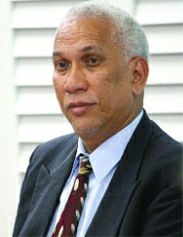
    Noel Garcia, former MD of HDC. Photo courtesy Trinidad Guardian
    Noel Garcia, former MD of HDC. Photo courtesy Trinidad Guardian

    Given that the units were reportedly being sold for a maximum of $875,000 and that they were worth a minimum of $1.7M, it is clear that each new home there is sold with at least $800,000 in housing subsidy.  The only way Garcia’s incredible statements could be correct is if one were using the misleading cost-based approach.

    I entirely agree with his statement that the Fidelis Heights development “…is therefore not part of HDC’s provision of subsidised housing for low-income earners.”  It is really subsidised housing for the middle-income groups, but that could never be right when the waiting list is bulging with needy people who cannot even get an HDC unit to rent.

    Fidelis Heights was, even by its name, a monument to misleading and wrong-headed thinking.  The HDC project with probably the highest level of housing subsidy per unit was built for the least needy on their waiting list.  Only if the underlying philosophies and resulting models are appropriate, can we avoid a repetition of this blatant waste of public funds in the face of real, human need.

    Given that the HDC is unable to satisfy the needs of the people it was intended to serve – the poorest citizens who cannot afford a proper home – it is scandalous that its scarce resources should have been diverted to Fidelis Heights, or the one at Federation Park in Port-of-Spain.

    The selection of this pricing model is proof of misguided policy at the most elementary level.  The basic concept of opportunity cost appears to have eluded the responsible officials and, what is more, that misguided policy appears to have been approved at the very highest level.

    Wrong-headed thinking can only encourage corrupt behaviour.

  3. Costs
    What has the national housing programme cost this country?  That is no rhetorical question, since this fact sits at the heart of the analysis.  The Housing Development Corporation (HDC) is the State’s implementing agency for production of new housing, it was formed in 2005 by an Act of Parliament and replaced the National Housing Authority (NHA).  The HDC’s funding comes from four sources –

    1. Treasury allocations – Those are announced in the budget and can be established from the Estimates of Expenditure as Capital Allocations to the Ministry of Housing.
    2. Sale of new homes – When the HDC sells a new home, that money is also available to them.
    3. Bond Issues – The HDC has also raised money by occasional bond issues; those funds can be used to either build more homes or ‘pay down’ on more expensive loans.  The bonds issued are government-guaranteed, so they are considered as virtually risk-free ‘sovereign debt’.  Given that the government itself issues bonds at lower rates of interest, it begs the question as to why these SPE’s are allowed to borrow on these terms.  That issue was raised by in the BG View of 20th August 2009 – see http://guardian.co.tt/business/business-guardian/2009/08/20/debt-depreciation-or-discipline.
    4. Bank Financing – The HDC also borrows money from commercial banks or the IADB to fund their construction programme.

    Try as I might, it has proven impossible to determine just how much the HDC has spent on building new homes in any given year.  That is because there are no accounts at all which are available to the public.

    The HDC Act, at section 18 and 19, mandates that the Board shall keep and properly audit accounts.  Section 20 requires the Board to submit its annual report to the line Minister within 3 months of the end of the financial year.  The line Minister is in turn obliged, by section 20 (2), to lay that report in Parliament within 3 months of receipt.  See – http://mphe.gov.tt/home/images/stories/pdfs/tthdc%20act%2024%20of%202005.pdf.

    The HDC has never laid either its annual report or audited accounts into Parliament for the public.  The failure to publish accounts is one of the most serious warning-signs of companies in financial trouble.

    That failure to publish HDC or NHA accounts over such a long period (since 2002 at least) spanning several administrations, is a serious indictment of the main participants – the politicians, the Board Directors and of course, the professionals involved in the entire huge operation.

    I have been reliably informed that the HDC’s new management is attempting to rectify this situation and that must be a priority if we are to properly assess the performance of this vital social programme.

The overall picture is stark –

  • Gross under-performance in terms of the output of new homes, only about one-quarter of the reduced target has been achieved:
  • Poor financial and project controls – as revealed in the Uff Report (at para 25:30 – see http://www.raymondandpierre.com/articles/article84.htm), not one HDC project has a signed contract:
  • No accounts or annual reports, given the preceding point, that is not surprising:
  • An inequitable allocations policy, with lower priority given to those who cannot afford to buy.
  • Approximately 10,000 new homes remain empty and that is the one which tops them all.  The ongoing adverse consequences include – vandalism, the greater rate of general deterioration afflicting empty homes, the high cost of security and of course, the continued pressure on those people on the waiting list ‘holding strain’.

Given the combined effect of all this, which is probably hidden to most of today’s readers, one can only wonder at the patience of our needy citizens.

The entire situation also raises potent questions about the purpose and performance of the SPEs.

SIDEBAR: The concept and importance of opportunity cost and housing subsidy

Let’s use a typical home at Fidelis Heights as an example.

  • Unit Cost – $825,000 (and it is not clear if land and professional fees were included)
  • Selling Price – $825,000
  • Market Value – $1.7M
  • In the prevailing cost-based pricing model, this is considered a satisfactory, ‘zero-subsidy’ result, since the State has recovered all of its costs. Another phrase in the lexicon is the ‘cost-recovery’ model of pricing.

    The danger, as shown in the example in this article, is that the ‘cost-based’/’cost-recovery’ model ignores opportunity cost.

    The opportunity cost is the difference between the actual selling price of the unit and the market value. The HDC could sell each Fidelis Heights home for $1.7M, but has made the decision to sell at a reduced price of $825,000, which means that each sale is at the loss of those possible earnings. That amount of the loss incurred by the decision to sell at a lower price is called the opportunity cost. It is important that opportunity cost be identified and quantified as an element in all decision-making, both private and public sector. A decision-making process which ignores or obscures opportunity cost is negligent at the very least and can encourage corrupt practices and the dilution of capital.

    In this example, the opportunity cost is $1,700,000 – $825,000 = $875,000.
    Opportunity cost

    $875,000 is enough money to build at least three modest homes, yet this system has allocated that much money to each Fidelis Heights purchaser, each of whom qualified for a mortgage at that level.

    As a result of this questionable choice and the resultant shaky pricing model, there is an enormous ‘leakage’ of housing subsidy and opportunity cost.

    The opportunity cost can also be described as the housing subsidy since that is the difference between what a Fidelis Heights unit actually sold for and what a purchaser in the open market would have to pay for a similar unit.
    The two terms are therefore synonymous – Opportunity Cost is exactly equal to Housing Subsidy.

    http://guardian.co.tt/news/general/2009/03/25/quality-performance-must

    A version of this commentary appeared in print on August 5, 2010, on page 13 of the Business Guardian.

    Related reading:

    Housing Policy Imperatives – Part 4

    Having set out a framework for a more effective and equitable national housing policy, it is time to deepen the discussion.  In this week’s column, I will further analyse the existing housing policy so as to highlight those errors which we must avoid if we are to do better.

    My proposed framework would quantify housing subsidy and allocate that in accordance with identified housing need, with the quality of the new homes also being monitored to ensure constant improvement.

    To go further into the issues requires that we examine these aspects –

    • National Planning – It will be very difficult to achieve improved levels of housing quality if we proceed to build large numbers of new homes without reference to a national land-use plan.  1984 was the last time our Parliament approved a national land-use plan.  Over 25 years have elapsed and the position of the last government was that the national land use plan was being prepared for discussion in the next 2 years or so.  We have very limited developable land in this country – only about 9 to 10% of the total – so it is critical to plan and co-ordinate our future for best results with our limited resources.  Transportation, education, shopping, health-care, industry, housing and recreation are the main aspects which need to be fit onto those developable lands.  This ongoing housing programme has already had grievious cases of the alienation of agricultural lands for housing.  Alienation of agricultural lands is when we pave over farmland for non-agricultural development.  That land is permanently lost in terms of our food supply, but we need to preserve our agricultural lands.  That is vital in terms of maintaining our food security.
    • Intensity of development – An associated aspect that we need to reconsider is whether we can spare the land to continue HDC developments of  homes with gardens.  The HDC must publish its figures on the numbers of new homes built; the amount of land consumed; the numbers of houses versus the numbers of multiple-family homes and of course, the numbers of these various types of homes which have actually been occupied.  At this point the HDC has only built 15,394 new homes, compared to their annual target output of 8,000 new homes, which, if attained, would have been 60,000 new homes.  The HDC has only built a quarter of the intended number of new homes, which means that we still have time to adjust and improve the programme.
    • Pricing – The more I consider the dilemma in which this housing policy has been caught, the more it seems that the fundamentals were poorly-considered.  Just consider the issue of the pricing of the units – How did the pricing model evolve?  I have already, in part 2 of this series, critiqued the HDC’s cost-based model for its erroneous outputs in terms of assessing the quantities of housing subsidy being allocated.  One can go further to ask how these price points emerged.  Was any reference made to the incomes of the people on the waiting-list or were the HDC prices driven by the demands of the physical development agenda?  It seems to me that the latter was what took place, if indeed any conscious process of setting prices ever did occur.  If we are aiming for people-centred development, that entire misguided approach to pricing needs to be revised.  We need to give serious consideration to building more modest multiple-family homes for rental.
    • Quality – Another matter which has been in the news from both the last administration and now the new one, is the issue of the poor quality of some of the new homes.  We have been given various ‘horror stories’ about poor construction and the need for further works and so on.  But there is more to this story.  The fact is that the norm in the construction industry is that a contractor only has a valid claim to be paid in the case of ‘works properly executed’, so how did the HDC end up paying for all these defective buildings?  I am not seeking to exonerate the contractors from any wrongdoing, but the simple fact is that someone in HDC ought to have had the responsibility to inspect and approve the works before payment was authorized.  Either the HDC has a process for doing that or not.  If yes, what went wrong?  Who signed-off on those poorly-built homes?  If there is no such process, then the HDC system is one which exposes the Treasury and the neediest families in the land to real abuse.  These are serious questions which need to be answered, and soon.  If there are indeed civil servants and consultant advisers who have been approving defective work, they need to be dealt with.  If that were so, it seems to me that such actions would amount to grave professional misconduct, at the very least.  Such people should be banned from any State work for a period, as a minimum.  The real horror story is the official silence on the fact that someone from the HDC had to approve these very same defective works.  Lying by omission – see http://guardian.co.tt/commentary/letters/2010/06/03/don-t-blame-contractors-only-shoddy-hdc-work.  That continuing dishonesty is the real horror story.  To remind readers that this is no new issue, please see – http://guardian.co.tt/news/general/2010/04/26/capacity-firms-weak-non-existent.

    I close this week by renewing my call for Minister Moonilal to take leadership on this burning national issue.  A conference on revising Housing Policy should include participation from the leading civil society organizations such as the JCC, the National Land Tenants’ and Rate-payers’ Association, the Sou-Sou Land group, Habitat for Humanity and the Salvation Army.

    Basic facts need to be compiled and distributed to seed the discussion.  The framework and philosophy need to be clearly articulated, if we are to get it right this time around.

    The continuing presence of over 10,000 empty homes is intolerable – it is solid proof of a seriously failed policy.  Our silence has to be broken on this issue.  We cannot continue this way.

    Related reading:

    Housing policy imperatives – part 3

    hdc-logoLast week’s column delved into the vital issue of housing subsidy and its mis-allocation.  This week, I will set out some suggestions as to how this wrong-headed allocation of public subsidy might be re-oriented to better serve our needy citizens.


    The existing system is fundamentally flawed and in urgent need of reform, if we are to better apply the limited quantities of housing subsidy to the nation’s real housing needs.

    In order to create a more effective and transparent equation for the allocation of housing subsidy we need to establish three things.  Those are the quantity of housing subsidy which is available for the State to dispense; the housing need of those on the HDC’s waiting list and the housing quality of the new units produced by the HDC, since those ought to be raising the general standard of housing accommodation.

    The key point here is that there is only limited housing subsidy available and a clear choice has to be made as to its allocation.  That choice has been made under the existing policy, which in my view is inequitable and counter-productive.  If we accept that the proper measure of a successful housing policy is needy families moving into new HDC homes which improve their living conditions, we also need to accept that a policy which can generate over 10,000 empty homes is a failure.

    A supplementary point is that if we are spending vast sums to build new homes, we also need to obtain a measurable improvement in the nation’s housing standards.

    The main points could be outlined in this way –

    • Housing Subsidy – First of all, we need to establish the quantity of housing subsidy the State is prepared to dispense.  That can be determined by the sale of the new homes, as recently proposed by Minister Moonilal.  The figure here being the difference between the market value of the new homes and the HDC’s sale price.  I am of the view that we are at, or very close to, the ceiling as to the national percentage of home-ownership.  Another approach would be to establish the difference between the market rental value of the HDC units and the rents affordable to the applicants on the waiting list.  That figure can be capitalized to allow comparison between the policy choices.  The proposed effort to sell the new homes will in fact be inimical, since it will have the effect of decreasing the amount of housing subsidy available to those who cannot afford to buy.  In other words, the neediest people on the waiting list are being discriminated against by the policy of the HDC.
    • Housing Need Index (HNI) – We need to develop a framework for measuring the housing need of applicants for HDC housing.  That analysis would need to include such items as size of the family, family income and their living conditions, as well as any special needs such as disabilities and the location of the extended family.  The UK’s Department of the Environment and its implementing agency, The Housing Corporation, have already done substantial work in developing the HNI as a means of properly allocating State funding for housing across the nation.  The USA’s Department of Housing and Urban Development (HUD) has also done considerable work on this complex series of questions.
    • Housing Quality Index – In 1993 I proposed a Housing Quality Index for the UK which would have been a tool for measuring how effectively the State funding had been applied in creating good quality housing.  The main elements of my proposal were to measure the quality of design of and amenity provided by new homes.  The Housing Corporation’s approach to this can be viewed at http://www.housingcorp.gov.uk/upload/pdf/710_HQI_Form_v3-1.pdf, see also this view from the UK’s Homes and Communities Agency (HCA) – http://www.homesandcommunities.co.uk/housing_quality.  Training is available at the Housing Quality Network – http://www.hqnetwork.org.uk/index.

    We need to allocate the limited housing subsidy to those in the greatest need.  That is the only reasonable policy for this critical area of national development.  That can only proceed properly on the basis of understanding the parts of the puzzle.  Anything other than a comprehensive review of these wrong-headed policies is a recipe for more waste and empty homes.

    Which brings me to an issue raised in last week’s column; the incidence of ‘policy silos’.  That phrase – ‘policy silos’ – refers to a condition in which the activities of various State agencies impinge on the same issues and yet, incredibly, there seems to be scant, if any, co-ordination between those agencies.  The aspects addressed last week can be summarized as –

    • The Minister of Housing and the Environment, Dr. Roodal Moonilal, making extensive statements on the sale of new homes, but being silent on the burning issue of new homes for rent.  Silence as to the greater area of need, alongside ambitious proposals to advance futile policies in favour of the less-needy.
    • The Minister of Science, Technology and Tertiary Education (MSTTE), Fazal Karim, proposes blanket rental subsidies for students in tertiary education.
    • The Legal Affairs Minister, Prakash Ramadhar, who is responsible for the rent control system, declares that he prefers that rents be determined by market forces.

    Those are exactly the ‘policy silos’ we need to dismantle if we are to make any real progress on these vital issues.

    Minister Moonilal should take the lead on this issue by convening a symposium or conference to debate these issues and establish some kind of policy consensus.  We cannot continue this way.

    We need to go beyond the numbers game of billions spent, jobs created and new homes built.  We need to move to a new, clear space where our national housing policy is declared as existing to improve the living conditions of our neediest citizens.  We need to move beyond the narrow perspectives which glorify home-ownership as the only correct answer.  There are many productive and honest families, in advanced countries, who never own a home.  They are no less worthwhile than those of us who are home-owners.

    Most of all, Minister Moonilal should take urgent steps to distribute the ‘…approximately 10,000…’ homes to the most needy.

    SIDEBAR: Re-purchase programmes

    There ought to be a programme for those people who have HDC homes and no longer need them.  That program would offer a cash payment to those HDC tenants who vacated their units.  That would have the practical effect of releasing additional housing units to the HDC without the expense and delay of having to construct new ones.

    Related reading:

    Housing policy imperatives – Part 2

    Last week’s column set out my principal queries as to our nation’s housing policy – see http://www.vision2020.info.tt/pdf/Policies and Procedures/Strategic_Corporate Plans/Housing Plan.pdf – and the intervening events have only put those into better focus.

    Key points –
    Cheaper Govt Houses’ in the Sunday Guardian of 27th June featured an interview with Dr. Roodal Moonilal, Minister of Housing and the Environment.  The Minister touched on some of the key issues and confirmed that

    …Some people simply cannot afford the market value of the homes. As a result, Government is looking to provide a further subsidy to assist with the purchasing of homes. I intend to take a proposal to Cabinet to consider the price reduction of the housing units…

    – see http://guardian.co.tt/news/politics/2010/06/27/cheaper-govt-houses-pg-6 .

    There was no mention of rented housing in that article, so it seems that the new Minister has adopted the existing policy of preferring to sell the new homes built by the Housing Development Corporation (HDC).  In addition, he is proposing to increase the housing subsidy.  An important  correction is that HDC houses are not sold at ‘market value‘ as the Minister implied.  Market value is the amount the new home could sell for on the open market and the HDC offers the new homes to applicants at a lower price.

    What is Housing Subsidy?

    This is an important aspect of the housing policy discussion and these are the basic points –

    • Public funding – To create new homes, the HDC has to spend public money for land acquisition, professional fees and cost of construction – these are ‘first costs’ for new homes, but there are other significant costs of getting a needy family to move in.
    • Housing subsidy – For example, if the market value of a new HDC home is $900,000 and those homes are sold to applicants for $425,000, the housing subsidy in that case is $475,000.  Please note that I am not relating the sale price to the cost of production of the new home – that is a mistaken approach, because it ignores the opportunity cost of the investment decision to sell at that reduced price.  Effectively, this ignores the market to the detriment of the taxpayer.  Even in the case of rented housing, the same basis would apply, with the difference between the market rent and the actual rent being the weekly housing subsidy.
    • The allocation of Housing SubsidyFidelis Heights at Bates Trace in St. Augustine is a new HDC development of townhouses near to UWI – in my view, the homes there are middle-income units which should not have been built by the HDC.  In that case the housing subsidy per unit is in excess of $850,000.  In view of the desperate national housing shortage and the scarcity of resources, it was a grievious mis-allocation of both public capital and housing subsidy to have embarked on this scheme.  In the examples cited by the new Minister, the housing subsidy is far lower.  The people who purchased units at Fidelis Heights got them at between $780,000 to $900,000.  I am also aware that those homes were allocated without reference to housing need – i.e. some of them went to single people, without children.  To put it plainly, there is no case for allocating $850,000 in housing subsidy to a single person, when there are entire families in greater need, who are not catered for by the system.  There is a very poor quality of discussion on the issue of housing subsidy.  That is because of the system of cost-based pricing, as mentioned above, which error is compounded by the sparse references in the official statistics.  I have only been able to unearth a single official attempt to quantify housing subsidy in the ‘2010 Draft Estimates of Development Programmehttp://www.finance.gov.tt/documents/publications/pub07D7E4.pdf ‘Provision of Housing Subsidies at Greenfield sites’ is stated, at line H 003 to be $3,058,863.  I am not saying that there is a poor understanding of the role of housing subsidy.  That would be untrue, since the people who are manipulating the system all understand the real value of housing subsidy very well.
    • Rent control – ‘Rent subsidies for tertiary students’, also in Sunday’s Guardian – see http://guardian.co.tt/news/politics/2010/06/27/rent-subsidies-tertiary-students – featured a discussion on the housing situation affecting 14,000 UWI students.

      [Minister of Science, Technology and Tertiary Education (MSTTE) Fazal] Karim said while the university has established mechanisms to register landlords “there exist no mechanisms to monitor prices, ensure quality accommodation, minimise security anxiety or seek the interests of the landlords and students.” In the near future, Karim said, the MSTTE and the Health Ministry will establish a committee that will make recommendations to establish mechanisms for the provision of subsidies “on rents to all students residing in the region and who are registered at tertiary institutions in the area.”

    It seems from his statements that the MSTTE is proposing a rental subsidy to all tertiary students, whatever their means.  In a situation of scarce resources, that type of policy can have inequitable consequences, since some of these students are not needy at all.

    The Minister of Legal Affairs, Prakash Ramadhar, attending as MP for the area, said –

    …what adds to the problem is the lapsing by the Rent Assessment Board. “We nationally had to debate the issue if this country would go into a free market in terms of rent or rent restriction.”

    Ramadhar said he would like to see free market forces determine rents.

    Legal Affairs Minister Prakash Ramadhar, left, Fazal Karim, Science, Technology and Tertiary Education Minister, right, listen attentively to the landlords during yesterday’s discussion. Photo: Jennifer Watson. Courtesy Trinidad Guardian
    Legal Affairs Minister Prakash Ramadhar, left, Fazal Karim, Science, Technology and Tertiary Education Minister, right, listen attentively to the landlords during yesterday’s discussion. Photo: Jennifer Watson

    So here we have the paradox deepening, with the Minister responsible for the rent control system seeming to say that he is against those controls.

    The outlook for the state’s intervention into the housing arena is confusing, to say the least.  Confusion is the ideal atmosphere to breed under-performance and corruption.

    Our needy citizens deserve better.  This entire debate should be to create reasonable, redistributive and  sustainable housing policies for our nation.

    The allocation of scarce housing subsidy must be reported and improved, so that the most needy receive the most subsidy.

    Next week, we expand to include questions as to how many of the HDC houses are occupied by the legitimate tenants?  Are steps being taken to deal with those who have broken the terms of their tenancy?  Also, some discussion on the use of re-purchase schemes as another way to create extra units of housing.

    SIDEBAR: The numbers’ game

    Last week’s column asked Dr. Moonilal to specify how many new homes were empty at this time and it was very disappointing to read that “…approximately 10,000 homes, including defective units, are unoccupied…”.  The new administration has to strive to do better than the one they just replaced and it is just not acceptable that the HDC cannot (or will not?) report on an elementary matter like this.

    Related reading:

    Housing policy imperatives – part 1

    Proper housing is an essential part of decent human rights and the development of a just society.  For those of us who have proper housing, we can be virtually blind to the plight of those who do not.

    Dr. the Honourable  Roodal Moonilal, Minister of Housing and Environment
    Dr. the Honourable Roodal Moonilal, Minister of Housing and Environment

    We now have a new government – the People’s partnership (PP) – and given  the swirling claims and counterclaims around State housing, it is important to re-open this discussion.

    The first aspect of housing policy to be considered would have to be the basic model – ‘What is it?’

    The main housing policy of the first UNC government was to provide serviced lots – i.e. land was acquired and developed with infrastructure (roads, drainage, electricity and water supplies etc.) before being distributed.  That approach is based on the notion that it allowed the State to have a positive impact on the housing shortage with the use of limited resources.  Between 1995 and 2001, that policy yielded a modest result, since only about 2,200 serviced lots were sold, with 376 new homes built.

    Showing Trinidad and Tobago A New Way HomeThe current national housing policy, entitled “Showing Trinidad and Tobago a New Way HOME” was initiated in September 2002 by then Minister Danny Montano with the stated goal being 100,000 new homes to be built in a decade.  The annual  target was soon reduced to 8,000, with those new homes to be sold to applicants.  The aim was to increase the quantity and quality of housing available to those who were unable to afford housing in the open market.  That program never achieved its targets and there was a consistent pattern of over-stating its achievements.  The last claims we heard were that the total output had been adjusted (downward, of course) from 26,000 to only 15,394 new homes in the 7-year period from 2003 to 2009.

    In terms of gross output, the PNM policy easily outstripped the UNC’s, even if, in terms of its own targets, it was a signal failure.  From the aspect of output versus target numbers, the results are so mixed that it is difficult to settle the question of which policy was the more successful one.

    For me, a key test of a housing policy’s success would have to be the number of people who have benefitted from an improvement in the quality of their housing.  In that case, the existing policy is seriously wanting, since, despite the output of 15,394 new homes, most of those remain in the hands of the Housing Development Corporation (HDC).  Just like with the actual numbers built, there has been a pattern of cover-up, shifting figures and plain dishonesty.  Despite my efforts, I am unable to locate a published record of how many of these new homes have been given out.

    Dr. Moonilal, we need a clear statement of just how many new, empty homes the HDC has on its hands.

    “Rent control is a thorny housing policy issue, but it deserves a second thought, since so many of our needy citizens occupy rented housing”

    I went to the 2007 conference of the Caribbean Association of Housing Finance Institutions (CASHFI) and the PS of the Ministry of Housing said that a major issue was the fact that about 90% of the people on their waiting-list could not qualify for a mortgage.  If the objective of the existing model is to promote home ownership in preference to rental units and 90% of the applicants cannot afford to buy, there is a clash between those policies and the reality of the needy.

    New forms of housing finance were devised to overcome that hurdle and those included mortgages –

    • at 2%;
    • with zero-percent deposits;
    • even 100+% models which allowed the new home owner to spread the cost of appliances and furnishings over the period of the mortgage.

    We need to re-consider our housing policy in fundamental terms –

    • What is the extent of housing need in our country? In last week’s ‘BG View’, there was a call for the national pensions proposals to be based on the results of the 2010 census – see http://guardian.co.tt/business/business-guardian/2010/06/17/pension-promises-deferred .  The review of national housing policy must be based on realistic housing need data and that should also emerge from the census later this year.  In “A critique of State Housing Policy‘, published here on 2nd August 2007 – see http://www.raymondandpierre.com/articles/article35.htm – I proposed that our country has a 5-part housing market.  In my view the task would be to determine the numbers occupying each parts and which of them we intend to provide for.
    • Is large-scale construction the only way to assist those in housing need? Another aspect which needs review is the matter of rent-control, since that is a cheap way of assisting those in housing need without spending vast sums of taxpayers’ dollars.  The reality is that although rent-control legislation remains on our law-books, the rent control boards which regulate that area of civic affairs have been allowed to wither and die.  Rent control is a thorny housing policy issue, but it deserves a second thought, since so many of our needy citizens occupy rented housing.
    • Are we at realistic limits in terms of tenure? To make a simple contrast, in 1992, when US President Bill Clinton launched his expansionary proposals to ramp-up home-ownership, about 62% of the homes in the US were owner-occupied.  At the end of 2008, after a massive and disastrous experiment intended to increase home-ownership, about 68% of US homes were owner-occupied.  Our current home-ownership percentage is about 76%.  Given the poverty of those on the waiting-list, does it really makes sense to keep on building new homes for sale to poor people.  Are we at the ‘Limits to growth’ where home-ownership is concerned?
    • What types of homes should we build? Large swathes of agricultural land have been ‘paved-over’ to build these  new homes, which is to the permanent detriment of our food security, to name just one obvious concern.   The fact is that we do not have enough land in this country to continue that pattern of large-scale development.

    Next week, the focus shifts to issues of build quality, allocations policy, land grabbing and value-for-money aspects.
    Related reading:

    VIDEO: First Up Interview – 18 May 2010
    VIDEO: First Up Interview – 18 May 2010

    Afra Raymond sits down with Jessie May Ventour and Derek Ramsamooj for a discussion of matters pertaining to the construction industry prior to the national elections. Topics include UDeCOTT, the controversial Guanapo church and the Uff Commission Report.

    • Programme Air Date: Tuesday, 18 May 2010
    • Programme Length: 0:40:33

    Healing our capital’s Heritage buildings

    I had intended to write on the Heritage Buildings in our capital for some time, but the UDeCOTT scandal and other public concerns kept me occupied.  The recent shocking collapse of a major part of President’s House eventually acted as a trigger for this article.  As I said at the time, that was a shame and a natural result of seriously misplaced priorities.

    “The failure to repair or maintain so many essential buildings is a tragic symbol of our disdain for history and the simple sense of proper maintenance.”

    The present position of the Heritage Buildings is one we can only make sense of by adding some context.  In my view, the background to the present situation is –

    • Economic Boom – We are at the tail-end of a 15-year-long and unprecedented boom in our national revenues.  No one could have predicted the huge growth in national fortunes.
    • Construction Boom – There has also been a corresponding boom in construction activity in our country with a large number of new buildings erected in that period.
    • ‘Monumental Architecture’ – Within that building boom, there has been a series of new buildings which could be classed as a modern thrust toward monumental architecture.  That phrase is used here to describe buildings which are long-lasting landmarks of a civilisation, by virtue of their location, size and use.  The recent examples of this Monumental Architecture are Piarco Airport Terminal, NALIS (National Library in POS), Prime Minister’s Residence and Diplomatic Centre, National Academy for the Performing Arts (NAPA, North), International Waterfront Centre.

    Some of the Heritage Buildings in our capital have benefited from repair and renovation and those would include –

    • QRC restoration – The main eastern building has now been refurbished at a reported cost in the region of $44M.  This job took longer than expected and cost an extra $10M over the original budget of $34M, but it is a welcome sight, especially when floodlit at night.
    • Knowsley restoration – This was done recently and the program of works included the addition of a new block in the south-eastern corner of the site.  This building was formerly the Ministry of Foreign Affairs, but they have recently moved to the International Waterfront Centre.  The expanded and renovated Knowlsey is to become the new home of the National Museum, which is still at its original location, the Royal Victoria  Institute on the corner of Keate and Frederick Streets – see http://www.newsday.co.tt/news/0,115008.html.
    • Former Shell Sports Club – This is at the corner of Queen’s Park West and Cipriani Boulevard and is now under Petrotrin.  The building was restored over a long period at what must have been great expense and now that it has been completed about a year or so ago, it appears to be unoccupied.
    • Police Headquarters – This is at the corner of St. Vincent and Sackville Streets and was badly damaged during the 1990 coup attempt.  The building was repaired and renovated at great expense, but is now showing signs of poor maintenance.

    There have also been these significant failures –

    • Mille Fleur – This is one of the ‘Magnificent Seven’ along Maraval Road. It was leased to the Law Association, which was revoked in 2004 by the State when they did not carry out the required repairs.  The building was then placed under the control of UDeCOTT for repairs and refurbishment, but there has been serious deterioration in its condition and no sign of the necessary work.
    • Stollmeyer’s Castle – This is the northernmost of the ‘Magnificent Seven’ and is also in poor repair; it is also said to be under the control of UDeCOTT for repair and refurbishment.  According to UDeCOTT’s website, both these projects were to have been completed in ‘late 2008’ – see http://www.newsday.co.tt/news/0,51637.html.
    • Boissiere House – This is on Queen’s Park West, about midway between All Saints’ Church and Cipriani Boulevard.  It is in poor condition and was the subject of the “Save the Boissiere House” campaign, which drew the State into negotiations with the property owners.  Those negotiations appear to have failed in terms of agreeing a price and the building continues to deteriorate.
    • National Museum Building – The original Royal Victoria Institute building is still in use and one hopes that it will not be allowed to fall into disrepair.

    The failure to repair or maintain so many essential buildings is a tragic symbol of our disdain for history and the simple sense of proper maintenance.

    These are the Heritage Buildings which really need urgent and high-quality attention –

    • Red House
      The Red House
      The Red House

      This is the seat of our Parliament and it is a true failure of repairs and maintenance.  There has been an ongoing repair/replacement of the Red House roof for at least 10 years. There is an immense scaffold which is occasionally relocated and the project literally seems to have no end.  In addition to the roof repairs, which were originally being undertaken by NIPDEC, there is an ambitious program of Red House works set out on UDeCOTT’s website at http://www.udecott.com/index.php/cc/cc_project_item/restoration_of_the_red_house/.  Our Parliament deserves a no less than a solid restoration job and a proper maintenance program.

    • Trinidad Public Library
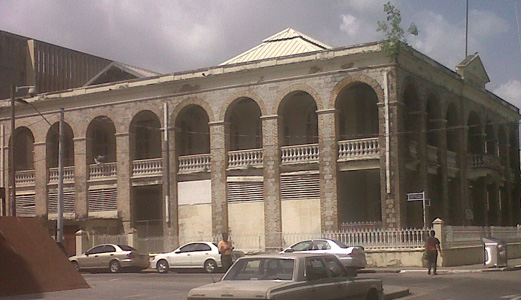
      Trinidad Public Library
      Trinidad Public Library

      This historic building, at the corner of Knox and Pembroke Streets, is in a sad state of disrepair.  It is in need of a serious program of repairs and renovation.

    • President’s House
      President's House
      President's House

      The western wing of the official residence of the Head of State of our Republic collapsed through lack of maintenance. President’s House is alongside the spanking-new, elaborate Prime Minister’s Residence and Diplomatic Centre, recently opened at a cost in the region of $200M.  This building has not been properly maintained for a long time and it was shocking to hear Colm Imbert stating to the media that it had been declared unsafe about 10 years ago.  Even the parts of the building which are still standing are now also condemned.  There had actually been official functions taking place there up to the day before the collapse.

    President’s House has to be a priority project for high-quality repair and renovation.

    SIDEBAR: A legal and financial framework

    We do not have a legal and financial framework which will preserve our architectural heritage.  The Planning and Development of Land Bill (1997) piloted by the last UNC administration contained provisions which would have addressed many of the issues highlighted in this article.

    We need to re-start our discussion on national development, including property and housing.  That discussion must include a place for our built heritage.

    Learning the Lessons: Part 4

    Last week I promised readers some details of the scale of the failure at the HDC and UDeCOTT.

    The failure is systemic and exists at every level.

    “That is nothing less than scandalous and deceptive behavior from those we trusted with our national wealth. It is like doing a business plan to open a ‘Chicken and Chips’ outlet and leaving-out the cost of the chicken. Bogus.”

    The Special Purpose Entities (SPEs) were established to achieve a more rapid rate of national development.  The idea was that we, the public, would benefit from the ‘best of both worlds’, so to speak, in that the ‘best practice’ of the private sector would be used in the SPEs to satisfy the requirements of the public for better roads, housing or other goods or services.

    Starting at the level of underlying purpose of these SPEs –

    1. HDC was established in 2005 as the successor agency to the NHA.  The target set in the 2002 National Housing Policy is for 100,000 new homes to be built in a decade, but that annual target was reduced in the first year to 8,000.housinginside

      In the seven years between 2003 and 2009, there should have been an output of 56,000 new homes, but the total output claimed was repeatedly given by the PM and the Minister of Planning, Housing and the Environment as being about 26,000.  In March, I publicly challenged the accuracy of those claims and the new MD of the HDC, Jearlean John, released revised figures – see http://guardian.co.tt/news/politics/2010/03/28/unc-claims-hdc-voter-padding-opposition-strongholds-marginals – which showed a total of 15,394 new homes built in the period.  An annual average of about 2,200 new homes, about a quarter of the reduced target.

      That is at least 10,000 less new homes than the HDC’s chiefs had been claiming.  What trouble is this?!  Now, at the same time as we thanked Ms. John for setting the record straight, just try to imagine the record-keeping and integrity of an organization which could repeatedly overstate its achievements in this fashion.

      That is the scale of the problem.

    2. UDeCOTT’s mission is to develop the structures that form part of Vision 2020 and which “will be achieved in accordance with…commercially viable principles…” – see http://www.udecott.com/index.php/cc/cc_sub_level/C6.  Those claims are equally baseless, since Calder Hart admitted under my cross-examination that only one of UDeCOTT’s many projects had been the subject of a feasibility test.  Only one.  That was the International Waterfront Complex and my further questioning revealed that the value of the land had been omitted from the equation.  That is nothing less than scandalous and deceptive behavior from those we trusted with our national wealth.  It is like doing a business plan to open a ‘Chicken and Chips’ outlet and leaving-out the cost of the chicken.  Bogus.  Our PM went to great lengths when he addressed the Senate on 13th May 2008 to point out that UDeCOTT’s projects were all approved by Cabinet, after a thorough review process – see http://www.ttembassy.org/051308.htm.  Additional claims were also made as to the ways in which Cabinet monitored UDeCOTT’s operations.  As I wrote in this column, early in my critique of UDeCOTT – There is either a sobering naivete or a lack of rectitude in the highest chambers in our Republic.

      That is the scale of the problem.

    In both cases, we are witness to fundamental dishonesty on a huge scale.

    Moving on to the findings of the Uff Report –

    Looking at the controversial Cleaver Heights project, at para 25.30, the Report states

    …The absence of a written contract was put in context in the cross-examination of Minister Dick-Forde when she confirmed advice from HDC to the effect that none of their large projects and none of the small projects either had a signed contract .   It was subsequently confirmed that as at January 2009 HDC had 64 large projects ongoing and 591 small projects, none of which had a signed contract. Large projects were those over $50m in value. Thus, while there appeared to be no good reason why a formal contract was not signed between NHA and NHIC, it seems clear that to have done so would have been a highly unusual step and one which was presumably regarded, both by NHA and HDC, as unnecessary.…”

    Not one HDC contract has been formally drawn up or executed.    Not one.

    My colleague, Ken Ali, put out a hard-hitting exclusive on the ‘HDC’s Silent Projects’, published in last Monday’s Guardian at http://guardian.co.tt/news/general/2010/04/26/capacity-firms-weak-non-existent.

    UDeCOTT was also involved in its own widespread and unconventional practices, namely ‘back-fitting’ of data, as described in the sidebar.

    On the blighted Brian Lara Cricket Academy (BLCA), being built by Hafeez Karamath Ltd. (HKL), we are told –

    • Para 16.16 – referring to advance payments to the contractor –

      …As a result money was advanced in circumstances which do not appear to have been governed by any ascertainable rules and amounted effectively to very substantial loans to HKL. Such a procedure is quite unique in the experience of the Commissioners. It calls for explanation but none has been offered…

    • Para 16.17 – referring to UDeCOTT’s accounting system –

      …UDeCOTT’s administration and recording of the payment process was “appalling” and required a great deal of detective work to get to the bottom…

    • Para 16.21 – referring to UDeCOTT’s attempts to explain its management of the BLCA –

      …does not by any means explain why UDeCOTT staff had gone to such extraordinary lengths to ensure that HKL was paid as soon as the money became available; why UDeCOTT was seemingly so anxious to make payments substantially beyond the value of work carried out (and in circumstances where the contractor was already in default such that TAL had long since recommended termination); and why UDeCOTT chose to disregard the opinions of the appointed engineer (TAL)…

    • Para 12.45, citing the work of MacCaffrey –
      1. Of 79 Certificates issued for advance payments, 39 were wrong in relation to the sum for payment of advance payment, 60 were wrong in relation to the amount of advance payment made to date and only 4 out of 79 correctly recorded the advance payment and the amount of repayment.
      2. UDeCOTT’s contemporaneous reporting of advance payment is materially wrong (i.e. under-reported) by tens of millions of TT$ for the vast majority of the duration of the project.
      3. UDeCOTT decided to back-fit Payment Certificates in February 2008. Those back-fitted Certificates also materially under-reported the amount of advance payments made. All the back-fitted Certificates have been endorsed by at least two signatories and in some cases three.

    Little wonder that UDeCOTT’s audited accounts have not been published since the end of 2006.

    The Cancerous Cozy Consensus

    Given the scale of the bobol revealed in this single Enquiry, one can only wonder what else is taking place at other SPEs.  The relationships are so cozy that one seldom, if ever, hears of anyone being made to repay the monies stolen or even face the Courts.  I am repeating my call that it is time for us to review the performance and proper role of the SPEs.

    It might also be useful at this stage, for those of us who exist in the ‘comfort zone’ of private sector superiority to reflect on how seldom, if ever, we act against ‘White-collar’ crime.

    SIDEBAR: ‘Back-Fitting’ of Financial Documents

    One of the hidden practices of UDeCOTT which was revealed in the Uff Report was that of ‘back-fitting’ of payment certificates so that various erratic and unsupported payments could continue, all under the veil of accountability.  For readers who are unfamiliar with this sort of practice or surprised that such could be the practice at the ‘best-performing SPE’, they might find it easier to understand if the colloquial phrase is used…Yes, ‘Ratchefee”…

    Learning the Lessons of the UDeCOTT fiasco: Part 2

    There has been a powerful and positive response to the first column in this series.  The reflections continue, as they must.  No time for distractions, in this election season.

    Last week I paused with the promise to spend some time examining the Special Purpose Entity (SPE) model and its role in national development.  This week, I continue the reflection with focus on the Directors of these companies as key players in the sector.

    One of the fascinating aspects of the Uff Report is its discussion of the nature and extent of the independence of the Special Purpose Entities.  Obviously, that discussion was mostly focused onto UDeCOTT and the reporting relationship with its line Ministry.

    Some main points would be –

    • Multiple Directorships
      Calder Hart. Photo courtesy Trinidad Guardian
      Calder Hart

      One thing which is clear from the Calder Hart episode is that one individual had control of a vast slice of State resources.  Hart was Executive Chairman of UDeCOTT, Chairman of the Home Mortgage Bank, Trinidad & Tobago Mortgage Finance, the National Insurance Board (NIB) and the National Insurance Property Development Company (NIPDEC).  He obviously enjoyed a tremendous level of confidence at the very highest levels of government.  It is equally clear, from the Uff Report, that that confidence was woefully misplaced.  Even in the early days of ‘Corporation Sole’ we have never had an individual invested with so much power.  It seems that this individual never had to answer to a Chairman, since he was head of all the Boards he sat on.  Is that a healthy precedent?  For those who would be quick to say that he has been found guilty of nothing, please note that this is the same individual who described himself to the Uff Commission as  –

      Q.      Yes.  But your lawyers misdescribed you in these proceedings as a financial expert.  You would not agree with that description?
      A.       I would not describe myself as an expert of anything.

      See – ‘End-notes on the Uff Commission‘ at http://www.raymondandpierre.com/articles/article77.htm

      Yes, that is the same individual who stated, under oath, that all outstanding issues with the audited accounts of UDeCOTT had been resolved and that we could expect those in February 2009. Yes, that is the man who was in charge of our national savings and pensions.  And yes, I will write it – He could not do such in Canada.  I am saying that no single individual could properly discharge all those functions.  No way.  The fact that so much trust was reposed in that particular individual is indicative of a distorted sense of values.  Time to think again.

      A similar set of contradictions exist with the outspoken Independent Senator, Michael Annisette.  See – https://afraraymond.wordpress.com/2008/01/12/an-unhealthy-choice/.  Incredible as it might seem, Annisette’s position is even more complicated than Hart’s.

    • Over-burdened Directors – Quite apart from the particular issues which beset these two individuals, there is broader issue to consider.  Do  we draw our Directors and leaders from a sufficiently broad cadre of people? In terms of both the State sector and the private sector, it seems to me that we have similarly narrow channels from which we make these appointments.  I am not at all sure that the private sector can claim a superior method or results in terms of over-burdened Directors.  The result, as was clearly the case at UDeCOTT, can be a poor quality of strategic decision-making and lax oversight of the company’s affairs.  That is a sorry result, given that those are core Board functions.One key lesson we should be able to draw from this is that there is no way people can function with this level of multiple responsibilities.  We now need to develop a new set of guidelines for these important roles.  The UDeCOTT episode must not only be used to critique the public sector, for there are surely examples of over-burdened within the private sector as well.
    • Under-development of our society – A paradoxical aspect of the situation is that the thrust to rapid development is given as the rationale for the Special Purpose Entity, yet the method of deployment is somewhat counter-productive.  I am saying that the cadre of people from which we draw our Directors and leaders needs to be wider if we are really to develop our potential as a nation.  That also applies to the private sector, since the prevailing instinct seems to be that we pick people with whom we are comfortable for these leadership positions.  Very understandable, whether we are speaking about the public or private sectors, but the act of restricting the ranks of leaders is itself inimical to our development.
    • The proper role of the State – I am also saying that the State must behave in an exemplary fashion.  That is very important, given the corrosion of proper standards we are living through.  The State has an indispensable role to play in national development and that is not just limited to  construction.

    What we saw at UDeCOTT was rampant expediency, with good management and internal controls being violated at every turn.  All in the interest of achieving targets and developing the country.  Huge contracts granted via sole selective tendering, without competition. That means they gave the contracts to their chosen contractor and consultants.  Yes, just so.  Huge payments made before works were done or materials purchased.

    Yes, expediency was allowed to eclipse good governance and accountability.  The interest of the taxpayer was jeopardised, supposedly all for the benefit of said taxpayer.

    We can now soberly put the question – ‘What was it really all for?

    SIDEBAR

    The Ordinary citizen

    I am also asking that our Prime Minister give details of his conversation with Calder Hart.  Of course, one does not seriously expect an answer.  That, too, is a big part of the problem we are trying to probe with only our wits and words.

    UDeCOTT’s Audited Accounts

    This column is to be published on 22nd April, four weeks after Jearlean John held her first meeting with the UDeCOTT Board.  Readers might remember that Ms. John, citing her adherence to good standards of governance and professional conduct, promised to publish UDeCOTT’s audited accounts.  Those were last published at the end of 2006.  No accounts for 2007, 2008 or 2009.  Worse yet, no explanation at all.  I have had to dismiss some absurd attempts to explain that the delay has been due to the Uff Commission itself.  Those attempts emanated from a member of the Cabinet who definitely ought to have known better.  Ms. John is now making me wonder ‘What is the mystery?’ Is this one of those cases which gave rise to our folk saying ‘More in the Mortar than the Pestle’?

    VIDEO: First Up Interview – 17 March 2010

    VIDEO: First Up Interview – 17 March 2010

    Afra Raymond sits with Fazeer Mohammed and Jessie May Ventour to discuss, among other things, the “battle” between the Government & the construction industry in Trinidad and Tobago. Video courtesy CNMG

    • Programme Air Date: Wednesday, 17 March 2010
    • Programme Length: 0:38:03

    M