
These are the documents from my Request for Access to Official Document(s) Under the Freedom of Information Act, 1999 from the State and the agents acting on behalf of the State, in the referenced hotels.
These are the documents from my Request for Access to Official Document(s) Under the Freedom of Information Act, 1999 from the State and the agents acting on behalf of the State, in the referenced hotels.
 This is my address to the 6th Annual Caribbean Valuation and Construction Conference: Best Practices and Experience Sharing hosted by the Royal Institution of Chartered Surveyors, the International Property Tax Institute, and the Institute of Surveyors of T&T held at the Trinidad Hilton on Friday 3 November 2017.
I spoke on the topic “Best Procurement Practice” in which I outlined the new Public Procurement and Disposal of Public Property Act and posed the question, “How effective are laws if we do not conduct ourselves ethically?” Video courtesy PixelPlay Media.
Programme Date: 3 November 2017
Programme Length: 00:28:26
DISCLAIMER: These opinions are mine and not those of the RICS, the IPTI or the ISTT.
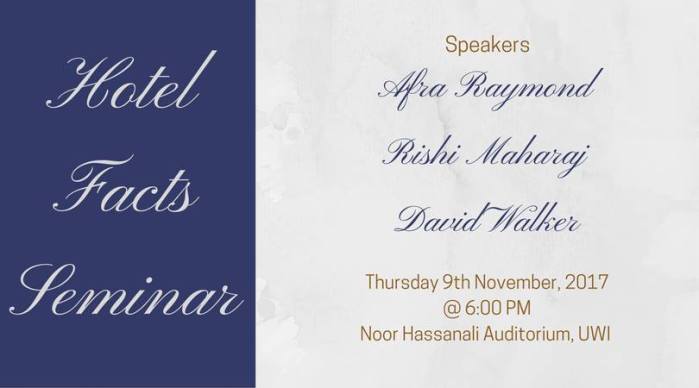
I have written extensively on the surfeit of maladies plaguing our governance. Now, I will be joining some of my most esteemed colleagues in a discussion around the Hotel Facts that are in desperate need of uncovering.
We have undertaken the monumental task of becoming archeologists for truth, and we are honoured to host a public discussion to put our artifacts on display.
We welcome everyone who shares a vested interest in truth discovery to join us at our Hotel Facts Seminar on Thursday at 6:00 PM in the Noor Hassanali Auditorium, The UWI, St Augustine. (The Noor Hassanali Auditorium is housed on the same site as the Sir Arthur Lewis Institute of Social and Economic Studies (SALISES, see map below), on the western side of the main Campus of the UWI, St Augustine, adjacent to, and north of, the Institute of International Relations.)
Speakers
Afra Raymond
Rishi Maharaj CEO of Disclosure Today
David Walker
Moderator – Rhoda Bharath of The UWI’s Dept. of Modern Languages and Linguistics
Date: Thursday, 9 November, 2017
Time: 6:00 PM
Admission: FREE!

In the previous article, the most glaring lacuna in the procurement puzzle was identified as the gap between the recommendations made by the State Enterprises and the decisions taken by the Cabinet in relation to the award of large-scale contracts.
In this context, a lacuna is an informative, usually intentional, gap in a discourse. Just consider that, in all the many statements on these interlocking issues, not one person has actually said ‘Cabinet ratified this recommendation by that State Enterprise‘ or ‘Cabinet made that decision which was not recommended by this State Enterprise‘. Fascinating, really, almost as if there is a joint select decision not to discuss how they reach their decisions. In relation to the Invaders’ Bay imbroglio, I dubbed that kind of thing ‘carefully cultivated confusion‘. You see?
A gap analysis measures actual against desired performance so as to establish what are the changes needed to improve results. This article will sketch a gap analysis of this crucial stage in the public procurement process and suggest the implications of those gaps. Continue reading “Property Matters – The Gap Analysis”
 After the imbroglio with NIDCO’s award last month of a $400M contract to KALLCO for a 5Km stretch of highway, we have once again been treated to a series of related high-profile announcements.
On Monday, 16 October 2017, Minister of Legal Affairs, Stuart Young MP, announced the counter-suit by State-owned Estate Management & Business Development Co (EMBD) against five contractors; former Minister of Housing and Urban Development, Dr Roodal Moonilal MP; and its former CEO, Gary Parmassar. The five contractors were:
According to Young, there was over 18 months of investigative work to ground those counter-claims which allege collusion and bid-rigging, resulting in over $200M defrauded from the State. The most decisive allegation seems to have been that then-Minister Moonilal was making the decisions on those contract awards. I have not yet been able to read the EMBD’s court filing.
Continue reading “Property Matters – Horses for Courses”
Last week’s article outlined the research I have been conducting, with the support of my colleagues from Disclosure Today, into the ‘Underlying Commercial Arrangements‘ of the State-owned hotels in this country. Those are the decisive details which drive projects of this nature and from which the substantial public benefits ought to flow.
Details of the unhelpful responses from the various agencies with whom we engaged via the Freedom of Information Act only went to show that the actual conduct of these large-scale public private partnerships were virtually opposite to the repeated statements about openness and having nothing to hide. The Ministry of Finance was the only public authority to give a prompt and clear response.
As I stated in ‘Everything but the Truth‘, published in this space on 10 June 2014, in relation to Public Money –
“The leading learning from which we have drawn serious lessons is Lord Sharman’s 2001 Report to the British Parliament ‘Holding to Account‘, which was a thorough examination of the definition, role and need for control of ‘Public Money‘. We expanded on Sharman’s definition of ‘Public Money‘ so as to capture the full range of possibilities, but we have accepted his key finding as to the requirement that ‘Public Money‘ is to be managed to a higher standard of Accountability and Transparency than Private Money – see 2.23 on pg 15. The contemporary, best-practice position in respect of the management of and accountability of Public Money being that the private sector rules are the bare minimum.”
This proposed large-scale investment would require significant sums of Public Money to be committed to the project. That commitment would be via direct investment or lease rentals; tax/duty concessions and expensive externalities such as improvements in the water/sewerage and electricity services or the expansion of the Crown Point Airport facilities. Continue reading “Property Matters – Tobago Sandals part three”
This Season of Reflection closes with yet another Sankofa Moment in which I will contemplate our past efforts so as to better understand our future. This huge project is being promoted, at the highest levels, by highly-optimistic and quite ambiguous statements.
The entire effort is based on notions of government having nothing to hide and the huge benefits to be derived from this project, albeit on rickety estimates. My colleagues and I have been engaged in a research program on these very issues for the last year. Our preliminary results pose a serious challenge to the notion of there being nothing to hide. In my view nothing could be further from the truth, that is how serious this is.
The three largest hotels in our country are State-owned – Trinidad Hilton & Conference Centre; Hyatt Regency and Magdalena Grand – with the hotels operated via Management Agreements. Our formal attempts to obtain information were met with a type of evasion and unresponsibility which was staggering. It reminded me of the infamous ‘Code of Silence‘ which belies the CL Financial bailout fiasco. No room for surprise there, after all, ours is a small country. As one of my confidantes often quips – It is like an Eleventh Commandment – ‘Thou shalt not be found out!‘ Continue reading “Property Matters – Tobago Sandals part two”
- User groups and other interest groups should be properly consulted on decisions regarding public building projects, to ensure that relevant views can be expressed at the appropriate time and taken into account before decisions are made…
(The emphasis is mine)
Is there a link between the Uff Report and Tobago Sandals? Is Tobago Sandals such a unique opportunity that we ought to adopt unique standards to assess its costs and benefits? What are the various benefits being proclaimed by the supporters of that project? This article will examine some of those claims against the factual background.
I returned to the large-scale and controversial proposals for Tobago Sandals by using that important Uff Report recommendation as my opener. The Uff Enquiry into the Construction Industry arose due to strong protests and complaints from the JCC, T&T Transparency Institute, myself and other individuals. One of the most decisive voices calling for those operations to be probed was Dr Keith Rowley, who was at that stage at loggerheads with his colleagues in government. I think Dr Rowley gained considerable kudos for taking a stand against the improper practices of his colleagues in that area. Continue reading “Property Matters – Tobago Sandals”
 This is an interview on the Power Breakfast Show on Power 102.1 FM with Rhoda Bharath and Wendell Stephens to discuss Eden Gardens Complex Fraud. Audio courtesy Power 102.1 FM.
Programme Date: 10 July 2017
Programme Length: 00:43:10

 The High Court issued a ruIing by Justice Frank Seepersad on Friday 19 May 2017 that the Valuation Return Forms (VRFs) which property owners had been required to complete for the implementation of the Property Tax was to be subject to a “….stay of the implementation and/or enforcement…”. That stay is pending the full hearings of the judicial review case brought by former AG, Anand Ramlogan SC, on behalf of former PP Minister, Devant Maharaj. The State has already filed an appeal and that is to be heard at the Appeal Court on Monday 22nd May 2017.
This important national policy is now before the Courts for determination as to the legality of its implementation at this time. To be sure, there are sharp political rivalries at stake here and heavy questions of how do we attain good public administration. Continue reading “Property Tax Setbacks”

