This is the video of the segment from the show Making A Difference with Felipe Noguera called Caribbean Economic Forum. Appearing with guest Afra Raymond was David Walker, another prominent analyst on the CLICO debacle. Video courtesy Making a Difference
12:52 pm – 1,425 word column submitted. Article was intended for publication in Business Guardian of Thursday 5 January, 2012.
2:59 pm – Wilson emails “…Afra this column is not up to your usual standard…” with notes for my review.
7:24 pm – Copy submitted to my webmaster and Barbados Free Press for their publication.
Saturday December 31, 2011
12:11 pm – Final text agreed with Wilson.
4:18 pm – Wilson emails me to say that he has had legal advice that my column is defamatory. I reply that the attorney ought to have been told that all of Wilson’s queries had been satisfied.
Sunday January 1, 2012
12:02 pm – Wilson replies to say that the attorney had suggested that Nunez-Tesheira be given sight of my column (that was later contradicted by Wilson’s post of Thursday 5 January at 4:41 pm on Judy Raymond’s Facebook Wall – “…the subject of the article has not been asked to comment on the allegations. I think at the very least in order to fall within Reynolds, a comment should be procured…” That advice could never be the same thing as sending my entire column for comment.) Wilson sent my column to Nunez-Tesheira and emails me to say that she had found “…that the piece was defamatory of her, that it lacked balance and that it contained several errors of fact and critical omissions…”
3:17 pm – I reply that “…KNT’s claim that the column is defamatory comes as no surprise, so I frankly attach no weight to it. What is surprising to me is that you shared this column with the person who was its subject. That seems to be taking this into unprecedented territory.
I answered all the queries you directed to me, Tony. Your concerns on the question of defamation were directed to your attorneys and I do think that it would have been important to brief the attorney that your factual concerns were satisfied.
This CL Financial matter continues to cast a long shadow…”
4:17 pm – Wilson replies, opening his email with the statement that “…It is by no means unprecedented territory…”.
Tuesday January 3, 2012
1:25 pm – I follow-up, by emailing “…Given that you showed my column to Karen Nunez-Tesheira, without my prior knowledge or consent, I am interested in whether you would be prepared to share her comments with me…the actual text of those, please, not a condensed or edited version…as you know, Primary Sources are most important.
I am also curious as to when it was sent to KNT and also the contents of the legal advice on which you are relying…I am taking my own advice at this time…”
2:53 pm – My attorney emails his advice that, apart from one phrase – which I removed – ‘…the Article does not contain defamatory material…”.
3:59 pm – Wilson emails to say that Nunez-Tesheira did not give written comments.
4:43 pm – I email my legal advice toWilson, with a request to see the advice on which he is relying.
8:00 pm – Wilson & I speak on the ‘phone, during which I tell him that the article is already on BFP, which he did not know before.
Wednesday January 4, 2012
3:18pm – I email my resignation to Wilson.
4:32pm – Wilson emails the legal advice on which he was relying.
6:13pm – AfraRaymond.com publishes the article ‘Swearing an Oath’ in conformity with our legal advice.
For those who are only now joining the story, this is a summary of what I feel are the vital issues here. My commentary column on the former Minister of Finance, Karen Nunez-Tesheira, was sent to her for comment by the Guardian’s Acting Editor-in-Chief, Anthony Wilson. That is a completely improper action, which is a breach of basic media ethics. When I challenged that action as being surprising and unprecedented, Wilson responded that “…It is by no means unprecedented territory…”. At which point I resigned as a Guardian columnist and this broad discussion started.
…In response to Mr Raymond’s comment, let me say that I have NEVER before sent any commentary to any politician or anyone else, apart from our attorneys, for pre-publication vetting. I say that without fear of contradiction and also state that that is NOT the newspaper’s policy or practice. (For Mr Raymond to pursue this point after this denial would simply be compounding the defamation.)…
Quite apart from the unnecessary legal threats, since it was never my intention to defame anyone, we are being told that this was a one-off decision to send my entire column for vetting.
Two questions arise –
Firstly, why did Wilson seek to tell me, in relation to his decision, that “…It is by no means unprecedented territory…”?
Secondly, if we accept that his reversal is now the true state of things, there is another issue. Why was this exceptional consideration shown to the former Minister of Finance?
That is the ‘sole and only issue’.
The three alibis that Wilson has been using on the internet need to be set aside at once –
The attorney told me to do it – According to Wilson’s post of Thursday 5 January 2012 at 4:41 pm on Judy Raymond’s Facebook Wall, the Guardian’s attorney’s advice on this question was – “…the subject of the article has not been asked to comment on the allegations. I think at the very least in order to fall within Reynolds, a comment should be procured…” That advice could never be the same thing as sending my entire column.
The article was published before by Barbados Free Press (BFP) – My article was published by BFP on Friday 30 December 2011, but the first point is that when we spoke on the evening of 3 January 2012, Wilson told me that he did not know it had been published. Also, even if Karen Nunez-Tesheira saw the BFP posting as soon as it was published, how does that explain Wilson’s decision to send it to her for comment before making his own decision?
I thought it was entirely defamatory so I showed it to the subject – Wilson, from his post on Judy Raymond’s Facebook Wall at about 1:00 pm on Friday 6 January 2012– “…I sent the entire commentary to Ms Tesheira because I formed the view that the entire commentary, from its proposed headline to the last sentence, was defamatory…” So, if Wilson had already decided it was defamatory, why did Karen Nunez-Tesheira need to see the column? Why did Wilson send it to her?
Please note that at no point has Wilson admitted to doing anything wrong or breaking any principles or proper editorial policy. He started-off by trying to tell me that his decision is nothing unusual, then that course of action went sour when BFP put the only logical meaning to the Guardian’s position. So his first post to BFP (January 5, 2012 at 3:16 pm) was to threaten action for defamation, problem being that the BFP article was based on his words, so that was a dead-end. Next move, Wilson reverses his position by stating that this was a one-off decision and threatening legal action for defamation, again, if I continue.
Wilson has reversed his course with no admission of error or wrong-doing or anything being out-of-order at all.
Sad to say, it is reminding me of CJ Archie and Justice Kangaloo returning their ‘Silks’ to the President, while being careful to point-out that they are not guilty of any error or wrongdoing, going further to confirm that their actions are not intended to be critical of either the Administration or the President. To my eye, the parallels are powerful.
In addition to finding out why Wilson took that decision to send my column to Karen Nunez-Tesheira, there is another question. Given that Wilson is its Acting Editor-in-Chief and he has not accepted that he did anything out-of-order, I feel entitled to ask what is the position in going forward? Has the integrity of the Guardian been compromised by this unusual accommodation offered to a politician? After all, their Acting Editor-in-Chief does not appear to see that decision as being anything improper.
Well yes, I never imagined that the occasion would arise for me to quote Karl Hudson-Phillips with approval, but here goes…new times bring new issues, which demand new responses. I tell you.
From the leading story of the Express of Saturday 6 January 2012 about the CJ & Justice Kangaloo returning their silks – Hudson-Phillips is criticising the CJ for his first Press Release on the issue:
…an alarming lack of understanding of what is thought to be a very important institution in Trinidad and Tobago under his purview. His release can be considered a perverse avoidance of a serious issue. The sole and only issue is that sitting judges should not apply for and accept silk…
In my view that powerful statement is relevant to this discussion on the decision by the Guardian acting Editor-in-Chief, Anthony Wilson, to send my entire column on Karen Nunez-Tesheira to her for comment. Here is my version, paraphrasing Hudson-Phillips –
…Wilson shows an alarming lack of understanding of what is thought to be a very important institution in Trinidad and Tobago under his purview (the T&T Guardian). His postings on the internet in relation to this issue can be considered a perverse avoidance of a serious issue. The sole and only issue is that Editors should not send entire columns to the subjects for their comment…
An additional level of perversity intrudes here when one considers the fine Guardian editorial of Thursday 5 January 2012 on the broad matter of quality in our society and its implications for the ‘Silk controversy’.
Given the history of this aspect of the media, my view is that we need to be vigilant in this matter, since it is reminding me of the earlier situations involving Aldwyn Chow, Jones P Madeira et al in February-May 1996 with the media having to face-down over-ambitious politicians and public figures. We need to guard against the perils of self-censorship.
As I said, in the closing part of my resignation email –
“As far as I am concerned, this is a vital issue, hence my spending this amount of my limited time and energy on it. An independent, high-quality, courageous and honest media is essential to the advancement of our country. That conviction has been at the centre of my work with The Guardian and I am thankful for the opportunity to have had my views published in those pages.
The enduring questions are how do we speak truth to power and more to the point, how can we be honest with ourselves.”
Endnotes
Under the terms of my contract as a Commentator with Guardian Media Limited, the copyright of the work is mine.
Franka Philip’s post on Judy Raymond’s Facebook Wall, and subsequent commentary is the source of many quotes in this article. The link for Facebook members/friends is https://www.facebook.com/heyjudes/posts/304560422918876. Included in the other commentators were editors, former editors and journalists from the Guardian and Trinidad Express newspapers–Maxie Cuffy, Judy Raymond, Franka Philip, Atillah Springer, Kevan Gibbs, Rhoda Bharath–who lend a sense of probity and specific knowledge that I, as a columnist, have not acquired as yet.
An interesting thesis required for a MA in Mass Commission was discovered online by a friend researching the earlier incident with the Guardian and its editors Alwin Chow, Jones P Madeira, et al. Entitled “TRYING TO GO IT ALONE AND FAILING IN AN AUTHORITARIAN DEVELOPING STATE: A CASE STUDY OF THE INDEPENDENT IN TRINIDAD” by Cassandra D. Cruickshank (December 2005). It studies the fate of an independent newspaper in a “pseudo-democratic state” and the lessons learnt from that experience that can be applied by today’s media houses. http://etd.fcla.edu/UF/UFE0012001/cruickshank_c.pdf
Continuing from last week’s critique of the revised bailout and its implications, I have further concerns as to the process by which the legislation was passed.
I am aware that the Members of Parliament were given a briefing, so that they would be better informed on this complex matter. That briefing was conducted personally by the Minister of Finance and the Governor of the Central Bank, together with their advisers and certain CLICO officials.
The briefing provided background information on these areas –
The status of the various outstanding audited accounts;
A ‘profile’ of the monies owed in terms of amounts owed to certain classes of policyholders. I am told that quite a small number of these claimants held a large proportion of the monies being claimed;
The various lawsuits/judgments against the Central Bank;
The rationale given for extinguishing the right to sue the Central Bank in this matter was that public rights and stability were being given preference over the exercise of private rights.
I am also told that the Members of Parliament were not given copies of the presentations, which seems to have effectively limited them to gaining certain impressions or the limited notes they would have been able to take during the briefing.
That account of events, given to me by more than one Parliamentarian, seems to suggest that the very rationale of the exercise, said to be the elevation of public rights over private ones, could have been subverted.
The reality is that, despite the extensive debate on the matter, this is the position –
Accounts – There has still been no proper, clear statement on the status of these CL Financial and CLICO accounts, which is unsatisfactory. An emerging view is that this is a calculated silence, since the companies are insolvent, which would make the Directors liable for the criminal offence of ‘trading while insolvent’. That is a considerable issue, which could only be overcome by the State issuing a guarantee to the group’s creditors, which would have exposed the Treasury to the full extent of the huge claims. The silence is a shabby ‘third way’, which gives a further insight into why the bailout remains untenable to so many of us.
There is no publicly-available profile of the monies owed in terms of amounts owed to certain classes of policyholders. That is a major omission and one can only wonder why the information is being effectively suppressed. In addition, there were statements that the claims of Credit Unions and Trade Unions will be fully-paid, which seems to be a favourable treatment in comparison to the individual claimants.
In respect of the lawsuits and judgments, I do not see how the block on lawsuits against the Central Bank can stop claims in foreign Courts.
The rationale of public rights being preferred over private rights is a solid one in a matter of this type, but upon reflection one is left with a different impression. How can public rights be said to prevail in a situation where the public is denied the essential parts of the picture?
The Parliament benefits from briefings on complex and important matters, but it is unacceptable that those briefings should be somehow shrouded in secrecy. The Minister of Finance and Governor of the Central Bank need to publish their full Parliamentary briefing, without delay, to remove any lingering doubts. Good governance, transparency and accountability demand no less.
Duprey, Monteil, Sakal
Another aspect of the emerging situation is the recent reports that the Board of Inland Revenue is investigating the three top CL Financial executives for alleged non-payment of taxes. The report in the Sunday Express of 13 November stated that the tax filings of Lawrence Duprey, Andre Monteil and Gita Sakal were under official scrutiny, incredibly enough, it was also stated that Duprey’s chauffeur was in receipt of up to $3.9M in a particular year.
I had always wondered at whether people who enjoyed favour at the highest level really paid all their taxes. I have pointed out that in the case of Clico Investment Bank (CIB) there are serious and unanswered questions on that point arising from the affidavits of the Inspector of Financial Institutions in the CIB winding-up action. It seems that fresh and serious doubts are now arising on the tax compliance of some of the top CL Financial officials, so we will see. In view of the relaxed stance taken in relation to Anti-Money Laundering and Tax Evasion in the revised bailout process, we should not be surprised if these BIR cases slip into obscurity.
We need to be alert to the costs and other consequences of this crisis. Huge sums of taxpayers’ money are being spent to rescue companies who do not appear to have complied with our tax laws and there are no accounts being discussed.
Last week Wednesday and Thursday I appeared before the Colman Commission to give my testimony in this matter. On Wednesday afternoon there was a very negative reaction to my attempts to introduce a Power-Point presentation as a way to better illustrate some of the points I have been making. It was a frustrating and comical experience for me to hear supposedly learned men asking ‘What is this?’ and one of them even saying that he had no idea what it was…Here, in Port-of-Spain in 2011, we have learned men saying that they don’t know what a Power Point presentation is for. Of course, I am all for transparency, so their patently transparent ‘blocking tactics’ were most welcome, because they showed the viewers on TV just ‘Who is Who and What is What’. Thank you, colleagues, for doing a better job than I ever could have. The public is not stupid and your behaviour has had a clear impact on those who were viewing. That said, the Commissioner ruled that my evidence would be taken the next morning and so it was.
For those who are interested and want to know what all the fuss was about, stay tuned to www.afraraymond.com for a full article on this situation, including the so-called ‘offensive’ slides.
With respect to the method of presenting the evidence in the Colman Commission, I have some serious concerns as to the effect of relying only on written or oral testimony. The volume and complexity of the material and the fact that a wide audience, beyond the attorneys, is watching this Public Enquiry, means that there needs to be an upgrade in the way in which the information is presented. I have written to the Commission on this already and was shocked to learn that a request for further funding for multi-media was apparently rejected at the highest level.
There have been two Power Point presentations to the Colman Commission – my own and Ms. Maria Daniel of Ernst & Young, who was just before me – and in both cases the witnesses had to rent their own equipment.
The purpose of this Public Enquiry is to bring some light and justice to this very shadowy and crooked episode. I am here asking the Prime Minister, Minister of Finance and the Attorney General to take proper leadership on this issue. The people need to see the evidence if they are to understand.
I can well remember the Prime Minister’s campaigning words, echoing in my mind “Serve the People! Serve the People! Serve the People!”.
Finally, I am writing to the Integrity Commission this week to request, again, that they obtain declarations from the Directors of CL Financial, as required under the Integrity in Public Life Act.
If you are not outraged, you haven’t been paying attention…
The way the Ministry of Planning & the Economy (MPE) is persisting in their course of action on the Invader’s Bay development is perturbing in terms of the long term consequences of short-term decision-making.
At Section 2.0 of the Request for Proposals (RFP) for Invader’s Bay we read
…For Trinidad and Tobago this is a “major waterfront transformation” along the line of other signature waterfront developments such as Darling Habour (sic) in Sydney, Baltimore Inner Habour (sic), the Habour-front (sic) in Toronto, London Docklands and Teleport City in Tokyo. Although the genesis of the projects may vary, the result has generally been bold and dramatic. With the change in the manner in which ports operate and cargo is transported, waterfront property is now more valuable for its residential, retail and recreational function than simply for port activity with heavy industry, docks and fenced off warehouses, as is the case currently in Port of Spain…
We are being asked to consider the Invader’s Bay initiative ‘along the line’ of other leading international examples, which in itself is a good place to proceed from. The reality is that those developments cited by the MPE all took decades to conceive and what is more, the authors of the RFP know that. Yet we are also being asked to believe that a workable concept/s could be devised for Invader’s Bay in an RFP which is silent on the current strategic plans for the capital and only gives proposers 6 weeks to prepare.
Of course the lack of consultation will severely limit the participation of many important developers, not to mention the public.
The point is that in all those cities cited by the RFP, there is a serious commitment to consultation, which means that those large-scale transformations took considerable time to conceptualise.
In the city of New York, for example, there has been a long-standing commitment to community-based development. Check this 6 October webcast from The New School – the introduction is instructive –
For decades, deliberations over land use in New York City have included developers, community boards, elected officials, the Department of City Planning and other city agencies. Do the people who live and work in city neighborhoods have a sufficient voice? Do residents improve the process, or impede progress? Who is best positioned to determine a neighborhood’s needs, and what are the best structures for public participation? New York has long been a leader in community-based development but as the city recovers from the Great Recession, what does the future hold?
And that is just one reference, readers can ‘Google’ to find the many other supportive examples. In the very RFP, as well as in the recent budget, there is a clear commitment to consultation in national development. Except in this case.
But there is more.
As I wrote in the opening of ‘Reflections on Republic Day’, on the Raymond & Pierre website on 27 September 2007 –
The best example I can think of for the kind of broad commitment to consultation is, of course, the site of the World Trade Centre in Lower Manhattan: Ground Zero. This is a very interesting example since the site is privately owned and the City of New York is controlled by the Democrats while the Republicans control the national government of the USA. Against this background of different players we have the fact that the destruction of the WTC was a most severe blow to US prestige and power. The entire defense apparatus was rendered useless by that attack. Arguably, there could be no site in the world with a more urgent claim to large-scale redevelopment.
Yet, the fact is that a sort of compact has been arrived at between the parties to the effect that no redevelopment will take place unless and until everyone has had their say. For example, there was a recently concluded international competition for the design of the 911 Memorial. There were over 5,000 entries from more than 60 countries and a winner was just selected.
As expected, the consultations have been controversial and emotional but the fact is that an environment existed in which such an understanding could work. Whatever one’s view of the American imperium, there is a potency to the existence of that huge crater at the heart of their main city while the necessary conversations go on. Time for us to think again.
At that time I was protesting the haste and waste of the then PNM regime, a consequence of their pattern of proceeding with huge developments without any consultation.
At Section 3.1 of the RFP –
TENURE ARRANGEMENT
The proposed Developer will be chosen via this RFP process and shall then enter into a Memorandum of Understanding (MOU) with the Government of Trinidad and Tobago (Ministry of Planning and the Economy) for an agreed lease rate. It is expected that this activity would be finalized within one (1) month of the submission of the said RFP.
Which means that we can expect the choice of the proposed Developer will be made and the lease agreements completed in one month from the closing date. Yes, Friday 4 November.
Sad to say, there is even more. The RFP also specifies –
“…If financing has to be sourced from an external source, the Developer MUST submit a letter of guarantee from the financier as well as a profile of the financier. Failure to comply with this requirement will result in disqualification…”
When we raised the point that this is an impossible condition for new bidders to satisfy, given the sheer scale of the proposed development, both Ministers – Tewarie and Cadiz – attempted to indicate that this mandatory condition was flexible. Unbelievable, but true.
As leaders, whether in government or non-governmental organisations, we have an obligation to learn from the past. This is an effort to document the events in this episode, so that there will be a record, when the Invader’s Bay matter comes to be critically examined in the future.
The clear inconsistency of the position taken in the budget on urban planning was highlighted in last week’s column. With respect to this project, we noted the attempt to cast this development in the same light as other examples which all involved long-term consultation, the silence on the existing plans, the impossibly-short timetable to elicit fresh proposals, the even-shorter timetable for selection and agreement of lease terms, the wobbling on the financial requirements and incredibly, that the scoring criteria were to be finalized after the proposals were submitted.
It is literally impossible to determine which of these is worse than the others and it is beyond the imagination of any fiction writer I know to take a plot this far. But this is what is happening in our country today.
In my mind, all of these, taken together, show that the publication of the RFP is a form of sham dialogue and openness. If this is the genuine attempt by the MPE, to properly seek the public interest, then I am giving them an ‘F’ for effort.
What we are seeing here is a recipe for disaster, we already have all the ingredients of corruption, so what is next?
It really does make me wonder who runs this country and when, if ever, can we achieve consistent and equitable government. Who is the real power?
The Ministry of Planning & the Economy (MPE) announced last week that 10 proposals had been received in response to its RFP for Invader’s Bay.
Given that MPE has not carried out a Needs Assessment for this prime property, for whatever reason, I will continue to outline the relevant elements for the Invader’s Bay property. This is not intended to be complete, just a list of what I consider to be the critical items a proper Needs Assessment would include –
Investment – This is a parcel of land estimated to be worth at least $1.0Bn, so any attempt to describe this process as ‘not being an investment’ would be completely wrong. In the literal sense, it might not involve any expenditure of State money, but, in every other sense, the disposal of this $1.0Bn asset would constitute a major State investment in Invader’s Bay.
The National Interest – At this moment the imperative is to diversify our economy so as to find sustainable replacements for our declining energy revenues, so this is an apt point. Following on last week’s column, it seems reckless that such an attractive State-owned property would be developed without consideration of the strategic issue. Even on the conventional basis of announcements of construction jobs and permanent jobs etc., it is difficult on purely financial grounds to justify most types of development on that site, especially given the generally depressed market. The decisive factor, given the level of interest such a unique offering is likely to attract, would be to have as an identified ‘Need’ that only projects which were net earners of foreign exchange would be considered. Such a condition would eliminate any offices, apartments, foreign franchise restaurants or shopping malls and set the stage for a different development discussion. A necessary discussion at this point in our country. Please note that the RFP does state that the project should generate foreign exchange, but that is only expressed as an ‘expectation’, which is far too flexible, given the influence of the traditional property developers. If the intention is genuinely to break with the past and set off in a new direction, the conditions need to be strong enough to break the grip of the past.
Balanced Development and Lagging areas – The RFP speaks to these concerns as follows – “…The Government recognizes the value of long term planning as well as problems created when long term planning is ignored. In order to ensure balanced development and restore lagging areas, care must be taken in the development of new areas…” Those are real concerns, but they seem at odds with the intention of the RFP, since the execution of that plan gives us yet another major development in our capital. We should consider if this is an area we want to develop at this time – bearing in mind that scarce private-sector resources may be required in other part of the country – for instance, the San Fernando Waterfront and other areas – so that development can be balanced instead of continuing the last administration’s emphasis on POS. The sidebar contains a comparison of three large-scale ‘urban development’ districts which formed part of the budget.
There is always the question of who controls the terms of these public debates. The intention from this side is to have that flawed RFP withdrawn. To proceed as things stand is to continue on a path which lacks the necessary transparency and public participation. The quantities of money involved and the absence of those critical elements means that we would be proceeding with all the ingredients for corruption.
This RFP amounts to an invitation to tender, so the bogus idea that this is just a discussion or consideration of proposals must be discredited. It is nothing of the sort. This RFP is a tender process to put these valuable public lands into private hands, which is quite different from a consultation. We have to stop any attempt to mix-up the two processes.
The State and its agencies have an over-riding obligation to be exemplary in their conduct.
SIDEBAR – A budget comparison
The 2012 budget sets out three urban development projects, at pages 31 and 32 –
Invader’s Bay – “…significant interest has been expressed in the transformation of the waterfront along Invader’s Bay. This development has great potential for promoting commercial activities in the services sector and will benefit the country significantly. Such projects are meant to be private sector initiatives utilizing green building technologies and will assist in making Trinidad and Tobago an attractive destination for new investments…”
Sustainable City Project – East Port of Spain – “…This initiative, is part of a wider “Emerging and Sustainable Cities Initiative” supported by the Inter-American Development Bank of which Port of Spain has been chosen as one of the five pilot cities from170 eligible cities in the hemisphere…This project is being developed in partnership with the East Port of Spain Council of Community Organizations, the Caribbean Network for Urban and Land Management at UWI, the East Port of Spain Development Company, and other key stakeholders. This exercise has also engaged the Making Life Important Initiative of the Ministry of National Security…”
Chaguaramas – “…the Chaguaramus Development Authority is spearheading development in the North-Western region and a master plan detailing land use proposals for that region will soon be subject to public discussion…”
Of course those three proposals are favouring Trinidad’s north-west peninsula, which returns to the theme of balanced development, but a further description of their relative merits is beyond the scope of this article. I am inviting readers to consider the varying approaches to an important long-term large-scale issue such as urban development.
In the cases of east POS and Chaguaramas, the commitment to widespread consultation is manifest, yet there is no such commitment evident in the case of Invader’s Bay, which seems to me to be ‘the jewel in the crown’. The three current strategic plans for POS, all paid for by Public Money, are being ignored by the very Ministry responsible for Planning.
Good Public Administration requires actions which foster the confidence and trust of the public, that is indisputable. Those policies and actions must be transparent, reasonable and, above all, consistent, if the public is to place real trust in the hands of the administration.
For all those reasons, it is unwise for any administration to operate in an inconsistent fashion.
In the case of Invader’s Bay, with the stakes so very high, it would be reckless to continue in this manner.
My last column addressed the imperative of controlling State expenditure as an element in the national budgeting process. I made the point that a new Public Procurement system needs to come into effect to give us the tools to control these huge expenditures.
The Ministry of Planning & the Economy (MPE) published a Request for Proposals (RFP) at the end of August for the development of Invader’s Bay, a 70-acre parcel of State-owned reclaimed land – shown in this plan below:
The Invader’s Bay lands are absolutely prime property – flat, waterfront land with easy access to highways and all the urban infrastructure of water, electricity and sewers. These are valuable public lands, with an estimated value of at least $1.0Bn.
That RFP invited proposals with a closing-date of 4 October, which is an entirely inadequate 6 weeks. The Joint Consultative Council for the Construction Industry (JCC) has taken a strong position against that RFP process, including writing the MPE and meeting with the Minister, Sen. Dr. Bhoendradatt Tewarie and Minister of Trade and Industry Stephen Cadiz, MP.
The JCC wants work for its members, but that must be after a proper process, it is not our intention to stop any particular project
The JCC wants a proper participatory process.
The first “official” response to our publicity was an article in the Newsday of Monday 3 October – ‘Cadiz: JCC jumped the gun‘, the leading point being that the government was trying to open-up the procurement process so as to invite suitable proposals.
Cadiz is reported to have said
…What the Government has done is asked interested parties for proposals for concepts,” he said. “I don’t see that there is any issue at all. There were proposals made and the Government felt that this is public land and we should open it up and we gave people six weeks, we feel that is enough time…
Public Procurement can be described as the process which results in the spending or earning of ‘Public Money’. Public Money is money which is due to or payable by the State, or any debts for which the State is ultimately liable. Therefore Public Money must include the contracts entered into by the State as well as the disposal, by sale or otherwise, of State assets. The Invader’s Bay RFP is the start of a large-scale Public Procurement process, since its stated intention is to lease land to developers who make ‘suitable proposals’.
The publication of the RFP and those statements all give the impression that a proper procurement process is underway at Invader’s Bay.
Nothing could be further from the truth. Let me explain.
The first step in the Procurement cycle is the ‘Needs Identification’. The two main questions in the case of Invader’s Bay would be –
What do we want to do with this property? That must also include ones assumptions as to what uses are not desirable there.
Why do we want to do these things?
For example, the answer to the ‘What’ question could be that the property would be used for recreation or parkland. The answer to the ‘Why’ question could be either for private profit or to create new recreational facilities as a ‘public good’, those being free facilities which increase the amenity of a district or city. The Brian Lara Promenade and the San Fernando Hill facility are two examples of that.
Without a Needs Assessment it is impossible to objectively assess what is a ‘suitable project’. To carry out a Needs Assessment, it would have been necessary for the MPE to have consulted widely with the public and stakeholders. The Invader’s Bay lands are in our capital and are about one-third the size of the Queen’s Park Savannah. My point being that any proper Needs Assessment must involve substantial public and stakeholder consultation.
There has been no consultation whatsoever. None.
What is even more unacceptable is that the RFP, which was published by the Ministry of Planning & the Economy, is silent as to the 3 existing strategic plans for the Port-of-Spain area. The 3 plans are:
Final Draft Development Plan: A Strategic Planning Framework for Metropolitan Port of Spain (Volume 2 Implementation Plan – The Port of Spain City Corporation) [Main Link] [Alternate Link]
A Strategy for the Economic, Social and Physical Transformation of East Port of Spain: East Port of Spain Strategic Development Plan – September 2007
Port of Spain Waterfront Project Strategic Development Plan for lands from Sea Lots to the Mucurapo Foreshore, still unpublished.
All of those plans paid for with Public Money. A straight case of – ‘nearer to Church, further from God’.
So, how are the proposals to be assessed? How will the decisions be made?
At para 3.5 of the RFP, at ‘Project Assessment’, we read –
“Proposals will be scored using the “Invader’s Bay Development Matrix and Criteria Description”.
We asked for that document when we met with the Ministers, but were told that it would be completed after the closing-date.
In the absence of these rules, how can developers know the ingredients of a winning proposal? Given that the evaluation rules are due to be completed after the closing-date, how can we be sure that this is a transparent process?
This could be an opportunity to demonstrate best-practice for public procurement, as promised by the People’s Partnership.
What is happening here is a recipe for accusations, blunders and confusion, just like in the previous decades of ‘old politics’. All the ingredients for corruption are present and that is why the JCC has made this call for the immediate withdrawal of this deeply-flawed RFP and its revision, after wide consultation.
We need to move away from the pattern of the biggest projects being set-up in secret , so that by the time the public gets to hear about it, all the vital details are fixed.
Expediency taking precedence over proper process has long been a costly constant in the governance of our society.
We must do better and it is not too late to do the right thing.
Expenditure of Public money – Accountability – Transparency = CORRUPTION
SIDEBAR: Criticisms by Cadiz
Minister of Trade and Industry, Stephen Cadiz, MP
It is instructive to consider the criticisms of the JCC which were reportedly made by Cadiz.The headline accused the JCC of ‘jumping the gun’, implying undue haste and thoughtless speed. Cadiz is quoted as saying, “…I think the JCC jumped the gun,” he said. “If you cannot do it by six week then how long? Six months?”.
At another point in the same article, Cadiz is quoted as saying, “We need to get these things going,” he said. “The JCC only made representation of their disappointment four weeks into the RFP…” The implication being that the JCC were tardy and should have acted more swiftly.
If this Invader’s Bay situation were not so serious, it would be comical. The question in my mind is ‘Which of those explanations does Minister Cadiz believe?’
What seems clear is the hostility with which the Minister views the intervention of the JCC.
Discussion is revolving around the country’s earnings from our energy resources and the likely size of the next year’s budget, expected to be delivered in early October.
Given the fact that our energy resources are reported to be declining in both quantity and value, it is very important that we make best use of that stream of resources to both sustain the existing arrangements and create a new series of industries to replace those declining earnings.
In my view, our focus in this critical transitional period has to be on making best use of those limited tax dollars. Although that is an objective on which we can assume broad consensus, there seems to me to be far too little discussion on the ways in which that can be achieved.
When we consider that most of the capital expenditure in the country takes place via the State and its agencies, it is clear that proper control of that expenditure is key to making the transition for our society. The other parts of State expenditure are recurrent, such as salaries and rents.
The growth of corruption in State expenditure is a clear danger to good order and national development. White-Collar crime, as it is sometimes called, is a growth industry because there is almost zero chance of being detected or punished and huge rewards.
The danger to good order is the fact that merit has a declining role in the way State spending decisions are made. It is clear that other factors have become dominant – things like friends, family and political affiliation are now well-understood to be the ingredients of success in getting work from the State. That is the case for all political administrations so far in our country, but it must change if we are to make the transition to a sustainable economy in which different values and income sources take the lead.
The budget of the present financial year is the largest in our country’s history and it is true that the major part of that expenditure could be classed as exceptional items, having to deal with settling large debts of State Enterprises and the huge CL Financial bailout payments. The point here is that those huge expenses arose in situations with a distinct lack of transparency and accountability, from the lack of accounts at UDECOTT and HDC to the naked corruption of the CL Financial bailout, there is a pattern.
If there is no transparency and no accountability, there will be corruption and that is inescapable.
Expenditure of Public money – Accountability – Transparency = CORRUPTION
Public Procurement
Public Procurement refers to any expenditure or receipt of public money, which is money due to, or ultimately payable by, the State. That definition covers all the Ministries and State agencies as well as modern arrangements such as BOLT, PPP, concessions and so on. In the PP’s first budget, there were disclosed plans to spend almost $14.0Bn in the capital program of the Ministries and State Agencies. We need a proper Public Procurement system to manage these vast sums of money.
It is for this reason that the People’s Partnership commitment to implementing a new and effective Public Procurement system is to be welcomed. The JCC and its partners – the Chamber of Commerce, the Manufacturers’ Association and the Transparency Institute – have submitted a draft Bill for consideration of the Joint Select Committee established by Parliament.
Finance Minister Winston Dookeran made good on the PP’s pre-election promise to lay in Parliament the new Public Procurement proposals within one month of the election.
The level of political support for this initiative has been encouraging, but there is the issue of priorities to confront in this matter.
I am referring to the fact that the second part of the PP commitment to a new and effective Public Procurement system was that it was to have taken effect on the anniversary of the election.
That target has been missed and the work of the Joint Select Committee has been preserved so that it can proceed when the Parliament re-opens at the Waterfront.
The challenge we have to confront is the race to implement public projects in a manner which reminds me of the phrase I had coined for the last administration – ‘Project Fever’, like a new strain of political dengue.
The need to stimulate economic activity is something everyone appreciates and the perceived competition between Ministers is becoming part of the new reality. Provided that there are effective local content provisions, the more projects the country is doing, means more work for our professionals, contractors, workforce and suppliers. No one would argue against an increase in economic activity.
The problem is that, in the absence of proper controls, those short-term imperatives can lead directly to the dire long-term consequences which I referred to earlier. The State now has to spend immense sums to clear up debts which arose during an earlier spending frenzy, with operatives, who would have all said at the time that this or that project was essential.
These frenzied moments of activity are the correct place for the application of real leadership in terms of the national priorities, particularly in relation to the issue of expenditure. I am calling on Finance Minister Dookeran to make this issue of controlling expenditure a number-one priority in this budget.
Given that the ongoing flow of projects is strong and constant, a proposed program would look like this –
New Public Procurement policy – Minister Dookeran must make this new system an absolute priority with a firm commitment to have the new framework made law by the end of this session of Parliament, which is in December. That is an indispensable part of building a new economy going forward and it would definitely be a manifestation of New Politics.
Embargo new projects – In relation to projects which are not yet at the stage of Requests for Proposals, there needs to be an embargo until the new Public Procurement system is in place. There will be appeals that the struggle is for economic stimulus over proper process, but those must be dismissed. There is no way you can get to the right place after making a wrong turn. No way. Everybody knows that. Expediency taking precedence over principle has cost our country enormously, both in cash terms and lost opportunity.
Projects ‘in the pipeline’ – Projects which are already at the stage of Requests for Proposals must conform with the principles underlying the new Public Procurement proposals – Transparency, Accountability and Value for Money.
Without proper control over expenditure, we will continue to lurch from crisis to crisis. We need to stabilize the economy and restore the importance of merit in our public decision-making.
Afra Raymond is interviewed on the “Centre Stage” show on Power 102 FM in Trinidad and Tobago, hosted by Chris Seon, Cliff Learmond and Sherma Wilson, on the Colman Commission and the revelations and possible consequences.
As readers can see, this is exactly the document posted as part of the first story in this series, published in the Sunday Guardian on 9th July 2011. Which means that my essential assertions remain unanswered in that staff who are forbidden to disclose the existence of an agreement would be unable to get external advice on it, without being in breach. Which has the real effect of giving this document an oppressive flavour.
Of course it also puts into question the assertion in Lalla’s first letter to me, that this new EFCL policy was “…consistent with what obtains in many companies…” Literally unbelievable. Obviously.
I can only hope that this policy was not approved by our Ministry of Education.
But we will revert to EFCL after the budget season…readers can draw their own conclusions.


 Continuing from last week’s critique of the revised bailout and its implications, I have further concerns as to the process by which the legislation was passed.
 Last week Wednesday and Thursday I appeared before the Colman Commission to give my testimony in this matter. On Wednesday afternoon there was a very negative reaction to my attempts to introduce a Power-Point presentation as a way to better illustrate some of the points I have been making. It was a frustrating and comical experience for me to hear supposedly learned men asking ‘What is this?’ and one of them even saying that he had no idea what it was…Here, in Port-of-Spain in 2011, we have learned men saying that they don’t know what a Power Point presentation is for. Of course, I am all for transparency, so their patently transparent ‘blocking tactics’ were most welcome, because they showed the viewers on TV just ‘Who is Who and What is What’. Thank you, colleagues, for doing a better job than I ever could have. The public is not stupid and your behaviour has had a clear impact on those who were viewing. That said, the Commissioner ruled that my evidence would be taken the next morning and so it was.
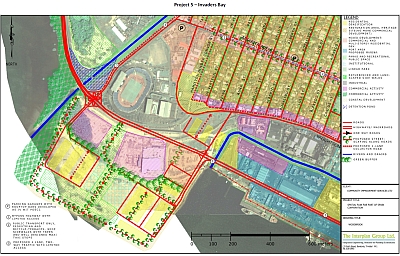
 The way the Ministry of Planning & the Economy (MPE) is persisting in their course of action on the Invader’s Bay development is perturbing in terms of the long term consequences of short-term decision-making.
 Given that MPE has not carried out a Needs Assessment for this prime property, for whatever reason, I will continue to outline the relevant elements for the Invader’s Bay property. This is not intended to be complete, just a list of what I consider to be the critical items a proper Needs Assessment would include –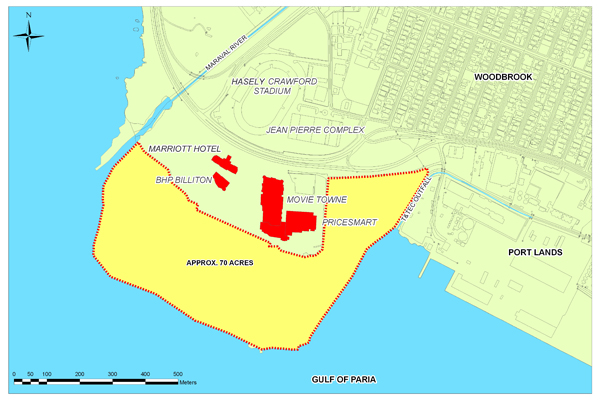


 On Wednesday 21st September I received
  AfraRaymond.net