Property Matters – Invaders’ Bay Reboot

invadersbay-bw
Once again, controversial development proposals for Invaders’ Bay are back in the news. Those proposals of the Peoples Partnership government appeared to have stalled after the successful legal action taken by the JCC in 2012, but we are now hearing of substantial proposals from the PNM government. Some serious questions have to be answered so that the public can understand the situation.

Invaders’ Bay is a 70-acre parcel of State-owned reclaimed land south of the Movietowne/Pricesmart/Marriott complex near to the National Stadium in west POS. In August 2011, the Ministry of Planning and the Economy published a Request for Proposals (RFP) inviting offers to develop those lands by design, finance and construct proposals.

The entire RFP process was deeply flawed and strongly criticized by the JCC, the T&T Chamber of Commerce, the T&T Manufacturers’ Association and the T&T Transparency Institute, as well as the PNM, then in opposition. To make just one example, the RFP entries were judged in accordance with Assessment Criteria which were published a full month after the closing date. At the time, I labelled the entire scheme as possessing all the ingredients for corruption – see http://www.jcc.org.tt/invadersbay.htm – but most importantly, the RFP was issued in breach of the Central Tenders Board Act.
Continue reading “Property Matters – Invaders’ Bay Reboot”

Private State?

In Privacy Pros and Cons, I considered the Parliamentary debate around the recent SSA Amendment Bill. Most of that debate seemed to be concerned with the limits on the rights of citizens to privacy, but my concern was that there was precious little comfort being offered in terms of the secret conduct of our public affairs.

If we are to evolve to developed nation status it is essential that the State seriously reform its culture of obscurity and secrecy, that is the contention I am advancing here. Continue reading “Private State?”

AUDIO: The Power Breakfast Show interview on 102.1 FM – 1 June 2016

Power 102 FMAfra Raymond is interviewed on the ‘The Power Breakfast‘ show on Power 102 FM by Rhoda Bharath and Richard Ragoobarsingh discussing the ongoing CL Financial bailout saga. 1 June 2016. Audio courtesy Power 102 FM

  • Programme Date: Wednesday, 1 June 2016
  • Programme Length: 35:04

Board Games – part 2

state-boards-logos

SIDEBAR: Correction on Court Case

With apologies to readers, in the previous article, I mistakenly named UTT as the SoE which had sued its Directors over allegations of a negligent 2005 investment, in fact it is eTeck which sued its Board. A lawsuit was launched by UTT on a similar series of allegations, but that was abandoned in July 2015.

Both those Boards were headed by Professor Ken Julien.

The previous article prompted a series of extremely interesting responses, so I will continue this examination of the State Controlled Agencies. That phrase includes State-owned Enterprises (such as UDECOTT, Caribbean Airlines and EFCL) and Statutory Agencies (like WASA, TTEC, CDA, PATT and HDC).

Some sharp objections were made to my comparison of the relation between the State, the Government and Citizens to a Company, its Board of Directors and its shareholders. I maintain that this is a valid comparison for us to reflect on the proper roles and responsibilities of the various public officials, but perhaps more importantly, the responsibilities of us citizens. Continue reading “Board Games – part 2”

CL Financial bailout – Duprey’s Story: SIFI vs PIFI

Artwork by NiCam Graphics

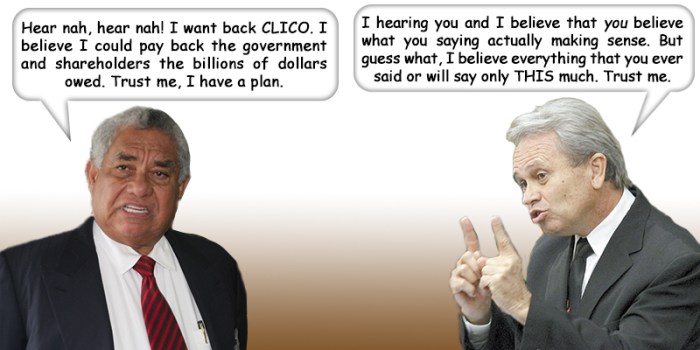
On Sunday 22nd May 2016, the front-page story in this newspaper was headlined ‘We will pay it back‘. That article featured very interesting quotes from former CL Financial Executive Chairman, Lawrence Duprey as well as the Minister of Finance & the Economy, Colm Imbert, on the prospects for repayment of the huge sums of Public Money spent on this CL Financial bailout.

Duprey claimed to have made a formal proposal to the State to repay taxpayers and all stakeholders who are owed money, while insisting that the amount owed was yet to be determined. The failure or refusal of the State to publish any audited statements in relation to this CL Financial bailout appears to be impeding the discussions as to a settlement of this massive debt. The sidebar contains a summary of how the Public Money spent on this bailout has grown from the initial 2009 estimates of $5 Billion to a 2016 figure now said to exceed $24 Billion. Continue reading “CL Financial bailout – Duprey’s Story: SIFI vs PIFI”

Privacy Pros & Cons

The recent high-level of public concern over the SSA Amendment Bill was of limited concern to me, until I started listening properly. In the event, the proposed law was passed by the Parliament and there is some threat from the Opposition of a lawsuit to test its constitutionality. We will see.

Two very interesting stances surfaced during the heated debates and it is at these kind of moments that I sometimes think of our so-called political divide. Those were the Right to Privacy stance disclosed by the AG and the private briefing of Parliamentarians as a legislative tool.

Sen. Faris Al Rawi, Attorney General
Faris Al Rawi, Attorney General

The AG, Faris Al Rawi, was emphatic on 2nd May 2016 that we have ‘…no enshrined right to privacy under the law…‘. He was almost immediately contradicted by former CJ, Michael de la Bastide QC, who relied on Section 4 (c) of the Constitution which specifies ‘the right of the individual to respect for his private and family life’. In ‘The creep of Tyranny‘ on Monday 9th May 2016 in this newspaper, my colleague Michael Harris also made strong objections to the AG’s stance. Of course we have rights to privacy and those are entrenched in our Constitution, but now those rights can be limited by the new law, intended to promote national security. Continue reading “Privacy Pros & Cons”

CL Financial Bailout – Duprey’s Gambit

Lawrence Duprey. Photo courtesy the T&T Review
Lawrence Duprey

Last week we learned that Lawrence Duprey and his fellow CL Financial shareholders are victims of a badly-handled bailout. According to the Duprey version, the State must halt all asset disposals and he must regain control of the CL Financial group of companies. In what seemed to be an immediate response, Minister of Finance & the Economy, Colm Imbert, said he was so alarmed at the gross mismatch in the bailout figures that he decided to order a forensic audit on the entire process. These two contrasting stories are the latest big news on the CL Financial bailout.

I have always objected to the CL Financial bailout and it has become a strong example of how the Public Interest can be perverted under a series of disguises.

The Duprey Gambit is just the latest attack on good values in our country. It is a nasty, shocking outbreak of moral hazard. It needs to be dismantled and discredited, nothing less will do.

The Imbert Initiative looks like a welcome move to examine the details of this scandalous waste of Public Money. The proposed forensic audit seems to signal some official appetite for disclosure. However, if this is to properly protect the Public Interest, there are some ‘litmus tests’ which can show the official commitment to disclosure

This article will examine those two proposals so that some meaning might emerge from this utter, deliberate confusion.
Continue reading “CL Financial Bailout – Duprey’s Gambit”

Property Matters – Housing Issues – part 5

hdc-logo

SIDEBAR: CORRECTION

With apologies to readers, this is to correct my figures in relation to the amount of Public Money which TTMF received in relation to the 2% subsidised mortgage programme. The figures disclosed in TTMF’s Summary Financial Statements are actually liabilities, being the reducing balance on the original allocation of $200M for this programme.

The recalculated figures for TTMF’s recovery of 2% mortgage subsidy 2007 to 2014 are

YEAR SUBSIDY (cumulative)
2007 $.9M
2008 $5.3M
2009 $16.5M
2010 $34.1M
2011 $52.7M
2012 $70.4M
2013 $87.4M
2014 $105.2M

These figures are far less than those I cited in my article, since only $105.2M has been drawn from the original allocation of $200M, as against my erroneous claim that $1,227.5M of Public Money had been spent on this subsidy.

Last week I examined housing subsidy to illustrate the ways in which Public Money is used to provide better housing opportunities.

The sidebar contains my correction, which shows that a total of $105.2M was spent in this 2% subsidised mortgage programme between 2007-2014. I was also informed that the 2% subsidised mortgage had been granted to 1,466 applicants, who earn less than $10,000 per month, to buy homes under $850,000. In late 2014, TTMF also started offering 5% mortgages to applicants who earn up to $30,000 per month for homes up to $1.2M – 298 of those mortgages have been granted to date.

This revision and the new information will require that we pay even greater attention to the HDC’s operations, since it far outstrips the other agencies providing housing options.

So, what is the proportion of applicants between the lower and middle income groups? At pg 28 of the Vision 2020 Housing Sub Committee Report (2005) that is estimated as follows –

…shows that more than half of the demand for housing to 2020 (57.3%) falls within the low-income group with 30.7% in the middle income group and 12% in the high-income group…”.

It is difficult to reconcile those researched conclusions as to the demand for homes with the actual distribution of new HDC homes, in which only 21.7% were rentals. The pattern of distribution of those homes seems to indicate that the decision was taken to promote home-ownership in preference to building rental units. There is no doubt that this decision was detrimental to the neediest applicants, who were unable to qualify for mortgages, while at the same time being beneficial to those whose earnings qualified them for mortgages. Continue reading “Property Matters – Housing Issues – part 5”