Afra Raymond chats in ‘The Barbershop‘ with John Wayne Benoit on i95.5FM about the CL Financial bailout and Public Procurement issues and other topics. 30 June 2012. Audio courtesy i95.5FM
This is the video of the segment from the show Making A Difference with Felipe Noguera called Caribbean Economic Forum. Appearing with guest Afra Raymond was David Walker, another prominent analyst on the CLICO debacle. Video courtesy Making a Difference
The former Minister of Finance, Karen Nunez-Tesheira, is once again in the news, due to her dispute with the Integrity Commission as well as her expected testimony at the next session of the Colman Commission.
The former Minister has had to defend against allegations of insider information1 related to her early withdrawals from CLICO Investment Bank (CIB). [Hansard report of February 4, 2009 calls it “PERSONAL EXPLANATION Allegations of Insider Trading.”] There was a lengthy address to the Parliament on Wednesday 4 February 2009. The 7 March 2009 revelation in the Trinidad and Tobago Guardian Newspaper, that Nunez-Tesheira was a CL Financial shareholder was also the cause of further defensive statements to Parliament on 27 March 2009. In the first wave of defence, there was silence as to the fact of Nunez-Tesheira’s shareholdings in CLF. In November 2011, her attorney attempted to challenge my position on this at the Colman Commission, but I maintained that ‘If the genuine attempt was to address the perception of corruption in a forthright fashion, all the information should have been given’. In the second wave of defence, there was no mention of the fact that the insolvent CL Financial group paid a dividend to its shareholders after writing that fateful letter to the Central Bank for financial assistance. Again, through the unfolding scandal we are witness to responsible officials who chose to be selective in making the required full and frank disclosure. All to the detriment of the tax payer.
Those attempts to defend against the allegations were only partially successful, since there is little doubt that Nunez-Tesheira’s reputation has been damaged by the entire episode.
Nunez-Tesheira is now alleging that the Integrity Commission failed to properly notify her of exactly what possible charges have been notified to the Director of Public Prosecutions. I understand that the charges relate to an allegation that the CLF shareholding held by Nunez-Tesheira amounts to a conflict of interest in relation to the discharge of her duties as Minister of Finance at the time of the bailout.
If the former Minister’s concerns are true, that may negate the fundamental investigation, which would be a real pity in terms of settling the elementary accounts of that turbid period.
I have my own serious concerns, derived from the same set of facts, about the lessons to be learned from the decisions of that individual, Karen Nunez-Tesheira.
Form of Oath (affirmation) for A Minister or Parliamentary Secretary
I, A.B.. do swear by………… (solemnly affirm) that I will bear true faith and allegiance to Trinidad and Tobago and will uphold the Constitution and the law, that I will conscientiously, impartially and to the best of my ability discharge my duties as ………… and do right to all manner of people without fear or favour, affection or ill will.
To my mind, the only reasonable reading of the phrase ‘conscientiously, impartially‘ is that personal, family, friends or other commercial interests must never be present or considered when discharging public duties. The closing phrase specifies without fear or favour, affection or ill will, the plain meaning of which only reinforces the previous point.
I keep returning to the National Gas Corporation (NGC) Press Release of 4 February 2009 in response to widespread rumours that its heavy withdrawals had prompted the collapse of the CL Financial group. That Press Release rebutted those allegations, but was interesting in that it also spoke of CIB’s failure to return significant deposits in November and December 2008. This citation from the Press Release –
That official NGC statement establishes that the CL Financial group was known to have been in very serious financial difficulties as far back as November 2008 – after all, over a three-month period CIB was unable to repay in excess of $250M in matured deposits. Given the high degree of trust between the CL Financial group and the government of the day, that breach must have been known at the very highest level.
Then I move to consider the extensive interview Nunez-Tesheira gave on 4 February 2009 to the Trinidad Express on the broken deposits, the headline being truly priceless ‘Everybody knew CIB was in trouble’. That interview formed part of my submission at the Colman Commission, with neither its inclusion, nor my inferences from it, being challenged by Nunez-Tesheira’s attorney during his cross-examination on 10 November.
…She then said: “On December 31, 2008, I withdrew an account which had matured on December 31, 2008”. Since then, Express investigations have discovered that Nunez-Tesheira had (not one) but two accounts with CIB, which matured (not on December 31) but was due to mature in April and August 2009 respectively. And she applied on December 30 to break these two deposits.
In an interview with the Express on February 4, Nunez-Tesheira also confirmed that her sister made an application on December 30 to break the $2.1 million deposit held in her late mother’s name, Una Nunez. In that interview Nunez-Tesheira said: “Everybody knew CIB was in trouble.” But she stressed that she only received the formal brief on the issue of CL Financial troubles on January 14.
In an interview on the same day with this newspaper, she stated: “The information about CIB and the concerns about CIB, were out there in the public domain for a long time, and my sister being a banker, would have been one of the persons who would have heard the concerns about CIB.”
Asked if in hindsight she should have declared her investments in CIB and CMMB before making any statements in the Parliament on the issue, Nunez-Tesheira said she had no need to do so. “In answering that question, it would imply that there was something that somehow was untoward,” she said, adding that there was not(hing untoward)…
In her statements to the Parliament Nunez-Tesheira was emphatic on these important points – from page 629 of Hansard of 4 February 2009 –
...Prior to January 14 of this year, I can truthfully state that I had no personal, formal or informal information about the extent of the liquidity difficulties the Clico Investment Bank has found itself in, other than the information known and available to any other citizen of Trinidad and Tobago and those on the other side, for that matter. Like any other citizen of this country, I also have to attend to my personal affairs and I did so until December 30, 2008 with respect to my personal transactions with Clico Investment Bank…
The emphasis is mine.
The emphasis on extent, as distinct from the existence of the liquidity difficulties, is crucial. The way that statement to Parliament is crafted, it is possible to have been aware of the existence of the liquidity problems and still claim to have been ignorant of the extent of those problems. In my view, Nunez-Tesheira’s choice of words is artful, since she is already on the record as to her motivations in ensuring that her family monies were withdrawn from CIB when she learned of the financial problems there.
The then Minister of Finance was also clear that she took official action only at the point when she was officially informed.
In my view, this sequence of facts represents a real, clear example of breach of public duty and breach of the ministerial oath of office. By her very own words Nunez-Tesheira was informed and believed that the group had problems, as a result of which, she took the necessary steps to protect her own family’s financial position. Following that, the then Minister was officially advised that the CL Financial difficulties were now going to be requiring a State bailout at which stage she took official steps to deal with the crisis.
In my opinion, the Oath of Office does not permit that course of action. Under the terms of that Oath, officeholders are required to properly discharge their duties at all times. A holder of ministerial office ought not to allow family interests to come into conflict with his/her duty to protect national/public interests. It seems clear to me that the actual course of decisions by Nunez-Tesheira in this episode is contrary to both the spirit and intent of the Oath of Office.
So, firstly, we have Nunez-Tesheira’s apparent decision that the information as to CIB’s financial crisis – wherever it came from – was solid enough to take immediate steps to protect personal interests. Apparently, the public, proper duties of that office awaited an official letter. I tell you.
Next, we have the payment of the final dividend by CLF and the burning question of whether her Cabinet colleagues were informed by Nunez-Tesheira that she was not only a shareholder, but also in receipt of dividends from the very group that was seeking a State bailout. Those are the questions which can only be answered by lifting the conventional veil of Cabinet secrecy.
If you are not outraged, you haven’t been paying attention…
This is the recording of my actual testimony on my Witness Statement and the amended Power Point presentation.
I was led in evidence by Counsel to the Colman Commission, Peter Carter QC, with questions at the close from these parties –
Gita Sakal, former CL Financial Corporate Secretary – represented by Justin Phelps, who had a few questions on the post-Shareholders’ Agreeement Directorships.
Karen Nunez-Tesheira, former Minister of Finance – represented by Frederick Gilkes, who questioned my assertions on the Minister’s undeclared shareholding.
This shows the attempts by various parties to object to my showing the PowerPoint presentation…some of those parties and their attorneys include –
Central Bank – represented by London-based Bankim Thanki QC
Lawrence Duprey – represented by London-based Andrew Mitchell QC
PriceWaterhouseCoopers – represented by Russell Martineau SC, former Attorney General and former President of the Law Association
Andre Monteil – represented by Martin Daly SC, Sunday Express columnist and former President of the Law Association
It is really instructive to consider the various arguments put forward by these parties in an attempt to limit my testimony and ultimately to deny it the benefit of clear illustration via PowerPoint.
There is going to be a real struggle to show the information on this series of financial and economic crimes. That information needs to be shown in as digestible a form as possible, which was the point of my presentation.
Between the strong opposition of the parties who were at the centre of the crisis and the refusal of the government to fund multi-media facilities, we have a fight on our hands to get at the facts.
The Bailout Timeline aroused great concern, with one attorney going so far as to call for the removal of the photos since they might be seen “…as a rogue’s gallery…” Another area of concern was the inclusion of the phrase “…final and fateful…” to describe the CL Financial AGM on 23 January 2009…yes, folks, that is the same one that gave a glowing account of the group’s plans to find opportunity in the global storm, a mere 10 days after writing to the Central Bank for urgent financial assistance and only 7 days before the MoU was signed. Of course, all of those objections ignore the fact that this timeline was published here in ‘CL Financial Bailout – Retirement Planning‘ on 28th April 2011
The Governor of the Central Bank slide was also the source of tremendous concern as no-one even wanted to call his name or the title of his office…VS Naipaul really had it right when he spoke of ‘…a thing with no name…‘ Again, the fact is that every one of the statements cited in this slide come from the Governor’s prepared statements, as shown in the footnotes.
After:
The Commissioner, Sir Anthony Colman ruled that the requested changes would be made and that slideshow can be seen here on the Commission’s website.
The Colman Commission was established about a year ago as a Public Enquiry into the failure of the CL Financial group, some of its subsidiaries, and the Hindu Credit Union. The Commission is also mandated to report on the causes of these costly failures, so that it can make recommendations for possible prosecutions and the regulatory or systemic changes needed to avoid further collapses.
There has been a lot of fresh information revealed at the Commission and that is good, since the public now has a much better view of the various episodes behind the scenes. The sole Commissioner, Sir Anthony Colman, has now made a statement which outlines his progress in this huge and complex matter. Colman expects to take at least one more year and will be continuing his examination of the HCU matter when the CL Financial stage is completed.
Despite all the evidence about staggering sums of money and the heated public discussion that has sparked, I am perturbed by the way the essential information is being handled.
Since it is a Public Enquiry into a huge financial collapse, the financial information has to be front and centre if we are to get at the facts.
It is common knowledge that the link between performance and pay is essential in obtaining quality results in any competitive situation. That basic fact, with which most people would agree, is now seriously challenged by some of the key events in the global financial meltdown. It is beyond the scope of this article to delve into the new learning emerging from this global crisis, suffice to say that the old learning has literally been ‘tested to destruction’.
An unhealthy relationship between pay and performance would be a problem for any company, but in a financial company the issue is worse. That is because the investors expect those companies to endure and prosper, so that they can collect the expected returns.
The Colman Commission will be unable to fulfill its mandate if it does not uncover the relationship between pay and performance in the failed companies. Colman will also need to consider the motives and behaviour of the investors, who must also form a significant part of the story. Without their participation and investments, the failed companies would have had no money to lose.
There is a strong interest in keeping the real figures and circumstances out of the news and some of the main items are –
The Accounts
The true levels of salaries, fees, dividends and bonuses
The identities and sums of money returned to those who have benefited from the bailout
The delinquent borrowers who owe the failed companies huge sums of money
The extent to which the failed companies and their chiefs complied with our tax laws
In ‘The Colman Commission – Cloudy Concessions’, published here on 1 September, 2011, I pointed out the danger of allowing the HCU claimants to testify without stating the amounts invested for the public record. It was my view that those concessions represented the ‘thin edge of the wedge’ in terms of the entire exercise being a Public Enquiry into a series of financial collapses.
In this recent, third session of evidence Hearings, we have had three examples of the ‘widening wedge’ in respect of financial information.
The first example is the recent imbroglio on the testimony of the CEO of Methanol Holdings (MHTL), in which significant financial information was excluded, apparently by agreement between the various parties and the Commission. This is exactly the kind of danger I had been warning about, since MHTL is a significant, supposedly healthy, part of the failed CL Financial group and there is bound to be considerable public interest in its financial performance. Yet, the Colman Commission agreed to exclude that financial information, so the public is none the wiser as to the overall health of the CLF group, despite paying for a public Enquiry. This issue was highlighted in the Guardian editorial of Tuesday 15 November, 2011, which ended by emphasizing the public’s right to know.
The second example was the decision on Directors’ monies – as reported in the Business page of this newspaper on 16 November, 2011 “…Commission Colman has ruled that the means of remuneration for CL Financial officials should be disclosed to the Commission but not the actual quantification of them…”. That bizarre concession removed any possibility of reporting on the real state of affairs at these failed companies. If the Commission continued with that arrangement, it would have been impossible for any real understanding of the crisis and its causes to be derived from their work.
The third, most notable, example was even more noteworthy, being the reversal of that decision and the grounds for that reversal, as reported in the Express of 16 November, 2011
…The board appearance fee was revealed yesterday on the same day that Sir Anthony Colman, the lone commissioner in the Commission of Enquiry, ruled that the remuneration packages of those involved with the conglomerates collapse could be made public….
Colman yesterday reversed a decision he made on Tuesday…
“My attention has been drawn to the fact that in fact some evidence has already been circulated in regard to Mr (Michael) Carballo’s remuneration package and also Mr (Lawrence) Duprey’s remuneration,” Colman said.
“I have come to the conclusion that it would be grossly unfair if there were a general bar on further evidence as to remuneration of participants so I reverse the ruling which I made yesterday and the result would be that the remuneration of participants can be put into evidence,” he said.
“I do not accept that if the remuneration emanated from any of the companies involved there could be any question of confidentiality,” Colman said”
It is remarkable to me that an appeal restricted to the principle of fair-play seemed to have caused this reversal, in a situation where the initial concession was toxic to the fundamental enquiry which is being conducted at public expense, supposedly for our benefit.
This is an Enquiry into a colossal financial collapse, so therefore the money must be front and centre at all times. We must have scrutiny as to its origin, rationale/contract for payment and its disposition for tax purposes.
Sir Anthony Colman needs to be watchful of the wily attorneys, who may seek again to tempt him to agree to conceal some more financial information which might be awkward for their clients. The fact is that all those companies are now being funded by the Treasury and we have a right to know what caused this huge mess.
It is not a concession, we now own the mess, so we must be allowed to see all of its parts. No sacred cows.
Sidebar: Colman’s Challenge
Colman’s statement as to the difficulty of running the Enquiry was most instructive, with a total of 49 lawyers appearing for various parties and a further 5 for the Commission.
Colman has had to maneuvre between 18 parties to the Enquiry, three non-parties and over 800,000 documents.
Which only makes it all the more important that the Colman Commission be given the necessary administrative/legal support and multi-media resources so that it can better serve the purposes for which it was established.
We have the resources in this country to give each SEA student a new laptop, so it should be no challenge to provide those resources to the Colman Commission.
Continuing from last week’s critique of the revised bailout and its implications, I have further concerns as to the process by which the legislation was passed.
I am aware that the Members of Parliament were given a briefing, so that they would be better informed on this complex matter. That briefing was conducted personally by the Minister of Finance and the Governor of the Central Bank, together with their advisers and certain CLICO officials.
The briefing provided background information on these areas –
The status of the various outstanding audited accounts;
A ‘profile’ of the monies owed in terms of amounts owed to certain classes of policyholders. I am told that quite a small number of these claimants held a large proportion of the monies being claimed;
The various lawsuits/judgments against the Central Bank;
The rationale given for extinguishing the right to sue the Central Bank in this matter was that public rights and stability were being given preference over the exercise of private rights.
I am also told that the Members of Parliament were not given copies of the presentations, which seems to have effectively limited them to gaining certain impressions or the limited notes they would have been able to take during the briefing.
That account of events, given to me by more than one Parliamentarian, seems to suggest that the very rationale of the exercise, said to be the elevation of public rights over private ones, could have been subverted.
The reality is that, despite the extensive debate on the matter, this is the position –
Accounts – There has still been no proper, clear statement on the status of these CL Financial and CLICO accounts, which is unsatisfactory. An emerging view is that this is a calculated silence, since the companies are insolvent, which would make the Directors liable for the criminal offence of ‘trading while insolvent’. That is a considerable issue, which could only be overcome by the State issuing a guarantee to the group’s creditors, which would have exposed the Treasury to the full extent of the huge claims. The silence is a shabby ‘third way’, which gives a further insight into why the bailout remains untenable to so many of us.
There is no publicly-available profile of the monies owed in terms of amounts owed to certain classes of policyholders. That is a major omission and one can only wonder why the information is being effectively suppressed. In addition, there were statements that the claims of Credit Unions and Trade Unions will be fully-paid, which seems to be a favourable treatment in comparison to the individual claimants.
In respect of the lawsuits and judgments, I do not see how the block on lawsuits against the Central Bank can stop claims in foreign Courts.
The rationale of public rights being preferred over private rights is a solid one in a matter of this type, but upon reflection one is left with a different impression. How can public rights be said to prevail in a situation where the public is denied the essential parts of the picture?
The Parliament benefits from briefings on complex and important matters, but it is unacceptable that those briefings should be somehow shrouded in secrecy. The Minister of Finance and Governor of the Central Bank need to publish their full Parliamentary briefing, without delay, to remove any lingering doubts. Good governance, transparency and accountability demand no less.
Duprey, Monteil, Sakal
Another aspect of the emerging situation is the recent reports that the Board of Inland Revenue is investigating the three top CL Financial executives for alleged non-payment of taxes. The report in the Sunday Express of 13 November stated that the tax filings of Lawrence Duprey, Andre Monteil and Gita Sakal were under official scrutiny, incredibly enough, it was also stated that Duprey’s chauffeur was in receipt of up to $3.9M in a particular year.
I had always wondered at whether people who enjoyed favour at the highest level really paid all their taxes. I have pointed out that in the case of Clico Investment Bank (CIB) there are serious and unanswered questions on that point arising from the affidavits of the Inspector of Financial Institutions in the CIB winding-up action. It seems that fresh and serious doubts are now arising on the tax compliance of some of the top CL Financial officials, so we will see. In view of the relaxed stance taken in relation to Anti-Money Laundering and Tax Evasion in the revised bailout process, we should not be surprised if these BIR cases slip into obscurity.
We need to be alert to the costs and other consequences of this crisis. Huge sums of taxpayers’ money are being spent to rescue companies who do not appear to have complied with our tax laws and there are no accounts being discussed.
Last week Wednesday and Thursday I appeared before the Colman Commission to give my testimony in this matter. On Wednesday afternoon there was a very negative reaction to my attempts to introduce a Power-Point presentation as a way to better illustrate some of the points I have been making. It was a frustrating and comical experience for me to hear supposedly learned men asking ‘What is this?’ and one of them even saying that he had no idea what it was…Here, in Port-of-Spain in 2011, we have learned men saying that they don’t know what a Power Point presentation is for. Of course, I am all for transparency, so their patently transparent ‘blocking tactics’ were most welcome, because they showed the viewers on TV just ‘Who is Who and What is What’. Thank you, colleagues, for doing a better job than I ever could have. The public is not stupid and your behaviour has had a clear impact on those who were viewing. That said, the Commissioner ruled that my evidence would be taken the next morning and so it was.
For those who are interested and want to know what all the fuss was about, stay tuned to www.afraraymond.com for a full article on this situation, including the so-called ‘offensive’ slides.
With respect to the method of presenting the evidence in the Colman Commission, I have some serious concerns as to the effect of relying only on written or oral testimony. The volume and complexity of the material and the fact that a wide audience, beyond the attorneys, is watching this Public Enquiry, means that there needs to be an upgrade in the way in which the information is presented. I have written to the Commission on this already and was shocked to learn that a request for further funding for multi-media was apparently rejected at the highest level.
There have been two Power Point presentations to the Colman Commission – my own and Ms. Maria Daniel of Ernst & Young, who was just before me – and in both cases the witnesses had to rent their own equipment.
The purpose of this Public Enquiry is to bring some light and justice to this very shadowy and crooked episode. I am here asking the Prime Minister, Minister of Finance and the Attorney General to take proper leadership on this issue. The people need to see the evidence if they are to understand.
I can well remember the Prime Minister’s campaigning words, echoing in my mind “Serve the People! Serve the People! Serve the People!”.
Finally, I am writing to the Integrity Commission this week to request, again, that they obtain declarations from the Directors of CL Financial, as required under the Integrity in Public Life Act.
If you are not outraged, you haven’t been paying attention…
The first one prevents any lawsuits against the Central Bank by claimants, while the second gives the Minister of Finance the right to borrow up to $10.7Bn and places the Republic Bank Ltd. (RBL) shares formerly held by CLICO into a new investment vehicle, NEL 2.
These seem to represent what I am calling the Final Solution, in that the clamour and protest which had marked the last year seems to have been fading away. There have been queries from the various ‘Policyholders’ groups’, but those have been limited.
Whatever one thinks of the actual bailout, which I maintain is a perversion of our Treasury, there are valuable lessons to be learned from all this. The main lesson for me is the Power of the Few. In that although only about 16,000 investors were affected, they were able to mount a successful campaign to improve their position. We need to note that lobbying and campaigning can be effective in gaining benefits for limited groups. To all the weak-hearts who say nothing ever changes, please take note.
We also saw the position set out by the PM in her important speech on 1 October 2010 being reversed, in that the claimants’ rights to sue the Central Bank have been extinguished. There are rumblings about a challenge to the constitutionality of that restriction, but we will have to wait on that one to play out. The fact that the right to challenge the Central Bank’s actions in respect of the bailout has been removed opens fresh dangers in terms of the payout process.
We have all had bad experiences of what usually happens when serious unrestricted power is held by someone who does not have to answer for their actions. My concern is that there does not seem to be any avenue for oversight of or appeal/redress against the Central Bank, in the event that claimants feel they are receiving unfair treatment. That concern will have to be addressed at some stage.
Even as an account of the payout, we have deficient reporting with no true profile of the wealth being returned having been presented for public consideration. The Central Bank and Ministry of Finance is in possession of this critical information as to the amounts of money to be returned to claimants, but that is being suppressed, for whatever reason. This episode has been a real stain on our stated ambitions towards accountability, transparency and the ever-distant ‘Good Governance’.
A related point is that the PM gave a clear commitment to revealing who benefited from the first wave of bailout funds, said at the time to be of the order of $7.3Bn. The PM’s speech is at pages 19 to 34 of Hansard – at pg 24 –
…The previous administration injected $5 billion into Clico and they spent $2.3 billion to bail out the other distressed entities such as CIB in particular, so coming to a total of $7.3 billion has gone into that hole and yet today the Government and, therefore, the taxpayers of this country have been called upon to come up with another $16 billion to $19 billion. So what happened to that $7.3 billion? Where did it go? Who are the people that were paid? How was it utilized? What happened to that $7.3 billion?…
The concern here is that we are not at all sure that this new arrangement will in fact yield the required information as to who are the real beneficiaries of this bailout. In view of the fact that the entire deal is a burden on our Treasury, this opaque arrangement is unacceptable.
After all –
Expenditure of Public money – Accountability – Transparency = CORRUPTION
Quite apart from those concerns, the fact is that provisions should have been made for Anti-Money Laundering and Tax Evasion screening. The Treasury must not be used for Money-Laundering and the proper safeguards need to be put in place to prevent this.
The lack of accounts for the CL Financial group, after 31 months under State management, is also unacceptable. The essential terms of the bailout are being sidelined, since the original agreement was for the State injections of cash to be repaid via asset sales. Both 2009 agreements – the January MoU and the June CL Financial Shareholders’ Agreement – also spoke to the preparation of accounts and provision of information.
The perturbing aspect is that there continues to be a uniform silence as to the preparation of these overdue accounts, so the taxpayer must wonder just how, or if ever, these vast sums of bailout money are to be recovered. This is the burning question which is at the root of my outrage.
The new arrangement is also silent as to the position with respect to other creditors of the CL Financial group, so there is no certainty as to how those claims would be treated. On 31 October, Trinidad and Tobago Newday reported on ‘CLICO Bahamas seeks $365M from CL Financial’. There are substantial regional and local claims outstanding, so the entire cost appears is an unknown quantity at this time, given the lack of accounts.
As I pointed out previously, the Directors and Officers of the CL Financial group and its subsidiaries ought to be subject to the provisions of the Integrity in Public Life Act, by reason of its being a State-controlled company. The Integrity Commission needs to demand the required declarations from those persons, if we are to secure the required level of transparency.
The continuing failure of the Central Bank to make rulings as to the extent to which CL Financial’s Directors and Officers at the time of the collapse are ‘fit and proper persons’ is the final piece of the sorry picture.
The State’s period controlling the CL Financial group, ends on 11 June 2012 – a mere 7 months away – at which time the group will return to its owners. Given the fact that the Central Bank has not made an adverse ‘Fit & Proper’ finding against Lawrence Duprey, in the absence of accounts and with a significant part of the RBL shares divested in this fashion, what will be the out-come? Is the stage now set for Lawrence Duprey to return?
I spent last Wednesday afternoon in New York’s Zucotti Park, with so many points to share on that experience. For now, I leave this striking slogan of the Occupy Wall Street movement –
If you are not outraged, you haven’t been paying attention…
 Afra Raymond chats in ‘The Barbershop‘ with John Wayne Benoit on i95.5FM about the CL Financial bailout and Public Procurement issues and other topics. 30 June 2012. Audio courtesy i95.5FM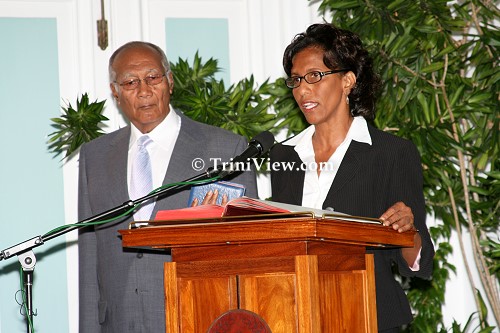

 or view below
 The
The  Continuing from last week’s critique of the revised bailout and its implications, I have further concerns as to the process by which the legislation was passed.
 Last week Wednesday and Thursday I appeared before the Colman Commission to give my testimony in this matter. On Wednesday afternoon there was a very negative reaction to my attempts to introduce a Power-Point presentation as a way to better illustrate some of the points I have been making. It was a frustrating and comical experience for me to hear supposedly learned men asking ‘What is this?’ and one of them even saying that he had no idea what it was…Here, in Port-of-Spain in 2011, we have learned men saying that they don’t know what a Power Point presentation is for. Of course, I am all for transparency, so their patently transparent ‘blocking tactics’ were most welcome, because they showed the viewers on TV just ‘Who is Who and What is What’. Thank you, colleagues, for doing a better job than I ever could have. The public is not stupid and your behaviour has had a clear impact on those who were viewing. That said, the Commissioner ruled that my evidence would be taken the next morning and so it was.
 AfraRaymond.net