CL Financial Bailout – Lessons from the Financial Crisis

This is an edited version of my address to the 4th Biennial Business Banking and Finance Conference (BBF4) held at the Trinidad Hilton from 22 to 24 June, 2011. The session I participated in was devoted to ‘Lessons from the Financial Crisis: The Resolution of Failed Entities.’ [See the acknowledgement letter from the conference convenor here.]

Thanks for the invitation to speak at this forum, it was last-minute, but welcome, since our local Institutions of Higher Learning have not spent the necessary time to explain and analyse this financial fiasco.  I have been very critical of the Institute of Business, the Institute of Social and Economic Research, the Faculties of Economics and Management and the Caribbean Centre for Money & Finance, so it is great to see you making a start on this overdue work.  It is my pleasure to participate in these proceedings.

I want to start by shifting focus to the arena of the mind and the existence of elements such as moral and ethical values, as well as social standards. In 1971 there was a famous series of psychological experiments in which selected students entered a two-week role-play as prison-guards in control of other people who were playing the role of prisoners.

That experiment was conducted at Stanford University in California and the results were that most of the prison guards adopted cruel behaviour with most of them being upset when the experiment was stopped after only six days. The entire experiment was filmed and the prisoners suffered from regular acts of wickedness, abuse and sheer perversity – one-third of the guards acted sadistically.

The Stanford Prison Experiment as it is now known, was heavily criticised as being unethical and unprofessional.  Of course the other aspect is that it re-opened the perennial discussion into the nature of things.  The nature of our nature, as it were – ‘Are we humans naturally evil and cruel?‘  The learning seems to be that well-adjusted and reasonable people can very quickly lose their moral compass in a situation with a lack of the conventional controls such as disapproval and laws.

No surprise to those familiar with history and politics, but the lesson for us in T&T is that if you let people get the idea that they can never be punished, there is virtually no limit to the rules they will break.  Asset-stripping, Bribery and Corruption can become the new norms of a governing class and that is what has happened in our country.

We have never had a strong tradition of detecting and punishing White-Collar Criminals, so if we are to make a start in terms of the resolution of failed entities, that has to be the starting-point.  We cannot reconstruct or resolve the failed entities if we do not change that aspect of our culture – the absence of consequence has to be abolished.

The absence of consequence is inimical to any development – personal, national or regional.  It is no point bringing new regulations or ‘approaches’ to this huge problem, until and unless the basic culture changes.

So that is the challenge for us – we have to change the way we think and behave around these issues of White-Collar Crime.  It is a very damaging type of crime which can affect the lives of many, many people – as we have seen in the CL Financial fiasco.  But we have to make that choice to change our culture around these issues.

The current financial disaster amounts to the greatest ever destruction of capital in peacetime – these are literally epochal events, but we do need to be careful as there is yet another big lie out there.  It suits the CL Financial chiefs to promote a version of events that has the blame attached to the Wall Street events of 2007/2008. The people promoting that version are buffoons, whose story is unable to withstand serious examination. I call it the Wall Street hoax and it is useful since it allows the CL Financial chiefs to escape the reality of their failure, to put it charitably, by blaming events way beyond their control.

Nothing could be further from the truth. We need to be very clear on the scale of this particular lie and the public mischief it represents. Even close examination of CL Financial’s 2007 audited accounts shows only tiny exposures to Wall Street  But what is worse is that the entire CL Financial pattern of behaviour and the burning question of the extent to which the CLF chiefs were ‘fit and proper’ are not new issues.  If we consider the 15 July 1996 ‘Circular Letter to Shareholders‘ issued by Republic Bank Limited under the hand of then Chairman, the late Frank Barsotti, it is all there. Fifteen years ago we knew the threat to which we were exposing this country by letting CLICO take over Republic Bank…it is 66-pages long, but very important to read – it is on my blog.

We don’t have a Wall Street problem, what we have here is a St. Vincent Street problem.  Yes, from the Central Bank (at the foot of the Street) to the Treasury (paying for the whole entire wretched bailout) to the Red House (where the real discussion has never taken place), right up to #29 – the CL Financial headquarters. Yes, is a real St. Vincent Street problem we suffering from. This is we own creation we fighting with.

The CL Financial fiasco is estimated to be costing at least ten times as much, as a proportion of GDP, as the Wall St. crisis.  Yet we still have mischief-makers who want to make misleading comparisons between the two, to justify the bailout.

A powerful parallel with the Wall Street crisis is the fact that the CL Financial fiasco was also characterized by ‘Shadow Banking’, meaning vast sums of money solicited from investors and being traded outside of the conventional regulatory umbrella.

Here are some extracts from the Financial Crisis Inquiry Commission’s Final Report (the FCIC is the US government’s official Commission of Inquiry into the Wall St crisis) –

From pg. XX (20) of the ‘Conclusions’ section –

…Within the financial system, the dangers of this debt were magnified because transparency was not required or desired. Massive, short-term borrowing, combined with obligations unseen by others in the market, heightened the chances the system could rapidly unravel. In the early part of the 20th century, we erected a series of protections—the Federal Reserve as a lender of last resort, federal deposit insurance, ample regulations—to provide a bulwark against the panics that had regularly plagued America’s banking system in the 19th century. Yet, over the past 30-plus years, we permitted the growth of a shadow banking system—opaque and laden with short-term debt—that rivaled the size of the traditional banking system. Key components of the market—for example, the multitrillion-dollar repo lending market, off-balance-sheet entities, and the use of over-the-counter derivatives—were hidden from view, without the protections we had constructed to prevent financial meltdowns. We had a 21st-century financial system with 19th-century safeguards…

Every line of that paragraph rings true to our local situation.  We are grappling with a shadow banking threat to the savings of the nation.  Our national wealth has been pledged to rescue adventurers at the very edge of the financial universe and that is what is wrong with the bailout.

I am no supporter of the Peoples’ Partnership, but what is right is right and the fact is that our Minister of Finance, Dookeran, is spot-on with this part of his analysis and action.  When Dookeran spoke in his inaugural budget speech on 8 September 2010, he took the approach of combining the assets and liabilities of both CLICO and British-American Insurance, which showed an insolvency in the order of $7.3Bn.

More to the point, the approach showed ‘traditional insurance‘ liabilities – i.e. Health, Pension and Life – of the order of $6Bn and ‘non-traditional/investment’ liabilities – i.e. EFPAs – of the order of $12Bn.

So what we are seeing is insurance companies whose non-insurance business is twice the size of their insurance portfolio and what is more, the supposedly guaranteed investment is nowhere to be found, hence the tremendous problem in repaying the EFPA holders.  That is the dilemma facing the country now and that is what Dookeran was explaining to us – a Shadow Banking arena that has grown to eclipse the core business and threaten the entire nation.

Another important part of the false discourse in all this is the promotion of the utter nonsense that there is any such thing as a ‘Guaranteed Investment’.  Absolute and complete lies.  There is no such thing and that is the fact.  Yet we have had CL Financial’s  Boards of Directors of the ‘Great & Good’ promoting that kind of deceptive dangerous nonsense.  You Investment Professionals need to find the courage of your convictions to speak-out on this smartman behaviour.

We had a product being promoted as offering twice the market rate of interest and also your entire investment is guaranteed and blah blah blah.  The Central Bank and the Supervisor of Insurance sat there and allowed that deceptive advertising to take place and it was a campaign, with thousands of letters.  A straightforward assault on good sense and the gatekeepers stood silent.

The final point we need to drive home is that, whatever the temptations, we must not lay the entire blame onto Lawrence Duprey & Andre Monteil.  It took plenty more than the main CL Financial chiefs to get us to this point.  There is a network of lawyers, accountants, agents who pretended to be financial advisers and of course, the many Board Directors.  That network is hundreds of people all of whom share a responsibility, quite probably culpability, for this crisis.

The Colman Commission has to work very hard to preserve its effectiveness.

Property Matters – The EFCL Query part 3

On Thursday 14th July, the EFCL published a full-page response to the first article in this series – it was also the same day that the second article in this EFCL Query was published.  Although it was comforting to see the clear statements on EFCL’s ‘speak out’ component, Whistle-Blowing policy and procedure and Fraud Policy, the central concerns are greater, if anything.

I deliberately used the word response, since no reasonable person could consider that advertisement to be a reply to my emailed queries.

If EFCL were really replying to my query, it would have been no problem to provide a copy of the documents and answer the simple questions.

EFCL’s preferred course of action is to spend more taxpayers’ money on expensive artwork and advertising, so the further question is ‘Why?’.

Considering that all I was doing was questioning the existence and origin of an important policy of this State-owned company, it is perturbing to be having this level of challenge in getting a simple clarification.

As I wrote in this space last week – ‘So, what is the secret?

What could be the delay or difficulty in providing a copy of the EFCL’s Confidentiality Policy, as requested?

In the first article in this series, I posted the documents which had been passed to me.  The simple question is whether these are the genuine documents.  There was no attempt by EFCL to even answer that important query.

It is important because the EFCL advertisement told readers that “…Employees were not asked to sign under threat of dismissal…

The first sentence of the preamble of the Staff Confidentiality Agreement is –

All new and existing employees will be given a copy of this confidentiality policy and will be required to sign a confidentiality agreement at the time of hiring or during their service to the company.

The emphasis is mine – yes, it reads ‘required to sign’.

But there is more, because the EFCL advertisement also stated that –

Staff who asked for time to get external advice, were allowed to.

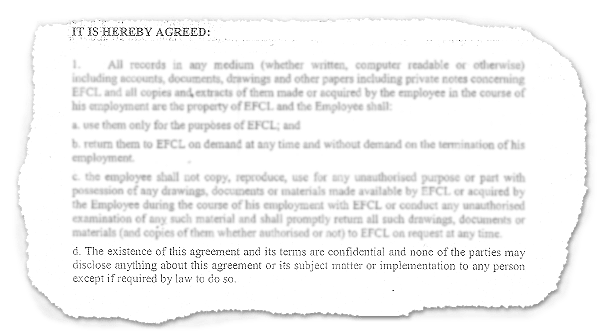
However, clause 1 d. of the Confidentiality Agreement states –

The existence of this agreement and its terms are confidential and none of the parties to this agreement may disclose anything about this agreement or its subject matter or implementation to any person except if required by law to do so.

It is clear that the EFCL advertisement and the documents sent to me cannot both be true.

So, which is true?

Why did EFCL not send or publish the documents?

Quite frankly, it appears that EFCL is making a great effort to conceal or obscure its true policy on confidentiality, for whatever reason.

If this is the kind of effort being put into obscuring the elementary policy of this State-owned company, I can scarcely imagine their reaction to queries on particular projects, Directors’ benefits or tender procedure.

The behaviour of the State and its agents must be exemplary.  Public Officials have an obligation, in my view, to behave in a fashion which fosters trust and good order.

It is all starting to resemble a tangled web, sad to say.

Again, I hope that my doubts are misplaced.

SIDEBAR

Five simple questions for EFCL…

  • Is there a new EFCL Confidentiality policy?
  • When did that come into effect?
  • Would you please provide a copy of that policy?
  • Was that policy approved by the Board of Directors?
  • Is the Ministry of Education aware of this new policy?

Property Matters – The EFCL Query part 2

efcl-confidentialDespite the first column in this series, I have had no direct reply or even acknowledgement from any of the EFCL officials to whom my initial queries were directed.

It seems that the people concerned would rather not write, on this matter at least.  A meeting has been indirectly suggested, which of course would have to be properly recorded and minuted – no word on that meeting as I write again.

What could be the delay or difficulty in answering the five simple questions posed last week –

  1. Is there a new EFCL Confidentiality policy?
  2. When did that come into effect?
  3. Would you please provide a copy of that policy?
  4. Was that policy approved by the Board of Directors?
  5. Is the Ministry of Education aware of this new policy?

Four of those questions require basic yes/no responses, while only one requires a date.

I closed Sunday Guardian’s article by reminding readers of the equation

Expenditure of Public money – Accountability – Transparency = CORRUPTION

The elementary accountability of a public company having its policies available for the public to consider seems to be either lacking or of low priority in the case of EFCL.  As we move along, it will be interesting to see how the Transparency part of the equation works out.

In researching this article, it emerged that our country is a signatory to two relevant international conventions.  As I understand it, the effect of our State having become signatory to those agreements is that the country has adopted those standards.

The first one is the Inter-American Convention against corruption, which was signed by our country in April 1998.  At that time, UNC was in power, under PM Basdeo Panday.  At Article III, clause 8, we are obliged to

…consider the applicability of measures to…create, maintain and strengthen…Systems for protecting public servants and private citizens who, in good faith, report acts of corruption, including protection of their identities, in accordance with their Constitutions and the basic principles of their domestic legal systems…

The second convention is the United Nations’ Convention against Corruption, which was signed by our country in December 2003.  At that time, PNM was in power, under PM Patrick Manning.  At Article 8 – Codes of Conduct for Public Officials, clause 4 obliges us to

4. Each State Party shall also consider, in accordance with the fundamental principles of its domestic law, establishing measures and systems to facilitate the reporting by public officials of acts of corruption to appropriate authorities, when such acts come to their notice in the performance of their functions…

So, what is the big secret?

I do understand that staff at companies like this can jeopardize the integrity and effective operations of the organisation by leaking certain confidential information.  That would be a proper concern of management and a confidentiality policy is one of the ways that could be dealt with, just one.

During the Uff Enquiry, UDeCoTT claimed several times that this or that document was confidential and used its lawyers to protest strongly, sometimes even seeking the protection of the High Court.  That was outrageous conduct by a state-owned company, which appeared to be trying to frustrate the Uff Commission, appointed by the State, by seeking to conceal documents.  A case of ‘the tail wagging the dog’.

This situation is one in which it seems that the dangers of leaks in relation to tendering estimates, for example, has been conflated to cover all information in the company.  It appears to be part of a new policy which does not conform to either good labour relations or our country’s international obligations with respect to Whistle-Blowers.

Given the electoral promises made by this government and the importance of the struggle to reduce the menace of corruption in our society, it is very important for us to be attentive to these matters.

UDeCoTT wanted to conceal certain documents and one had to wonder why, given that they are not involved in secret work.  If it was not so serious it would be comical, they are not a spying, military or health institution.  UDeCoTT is just a facilitator for erecting buildings, yet their chiefs were able to pretend to the public that a large part of what they did was confidential. That kind of secrecy could never be in the public interest.  Not ever.

Similarly with EFCL, one has to ask – What is the secret?  That organisation is responsible for the repair and maintenance of schools, using Public Money to do so.

I wonder if that document, which a number of EFCL staff have now been required to sign, is legal and binding?  Could it withstand a challenge in the Courts?  Did EFCL take proper legal advice in this matter?  Was that advice followed?

The legitimate interests of taxpayers require that the management of State Enterprises take proper steps to handle these integrity challenges – Does the EFCL Confidentiality Agreement achieve this?

There is a certain kind of way in which this episode with EFCL is starting to remind me of the early UDeCoTT grappling, before Uff and so on, with tremendous difficulty in getting basic dialogue going, shadow-boxing and bizarre positions being taken.

I really hope that I am wrong, because the correct, encouraging attitude to Whistle-Blowers is essential for the success of the larger Public Procurement agenda.

Colman Commission considerations

This is a rapid look at some of the news coming out of the Colman Commission – the first live evidence was given on Monday 4th July.

That evidence has so far been into the Hindu Credit Union (HCU) and already some peculiar things are emerging.  I do not follow it on TV and just read the newspaper reports –

  • Breach of Trust – It seems clear to me that the depositors had a seriously misplaced faith in HCU and Harry Harnarine, which itself raises certain questions as to who was really fooling who.  It is basic and inescapable that a higher rate of return will mean a higher level of risk, which is why it is important to be more sceptical about high-return investments.  My point being that as a Credit Union, one has to become a member to participate and therefore one has a stake in the success of the organisation – with access to the accounts and attendance at the AGM, one can only wonder what kind of dance existed between the HCU chiefs and its ordinary members.  Yet, we are hearing from people who seem to have deposited their money at these  incredible rates of return and adopted attitudes of complete trust.  The witnesses need to be more seriously probed on what happened at those AGMs and so on – if they HCU conducted its AGMs anything like the CL Financial’s final AGM, it will be quite a story.   We need to get past the various heartbreaking stories, to the nexus of responsibility which is where this entire game is played.  I am sure there is plenty more to come out, plenty more.
  • farid scoon
    Farid Scoon

    Farid Scoon, Attorney-at-Law – Was expected to explain how he could be representing a group of HCU depositors and the former HCU chief, Harry Harnarine, at the same time.

There also seems to be a strange situation on CL Financial, since I am told that none of the affected people are willing to come forward to testify.  I am not very surprised at that and it is yet another indication of the extent of that toxic ‘Code of Silence‘.

What a shame!  25,000 policyholders said to be affected by the failure of CL Financial, yet only one is willing to testify.  Only One!   I wrote before in this space about the probability that a high proportion of those EFPA monies had never been screened by rigorous Anti Money Laundering (AML) procedures.  I suggested to the Minister of Finance that provisions be made in the payout agreements for the applicants for bailout monies to have the source of their funds vetted for compliance with VAT, PAYE, Income and Corporation taxes.  The Minister did not adopt those proposals.

So, what we now have is the spectacle of the Colman Commission set up by the government to examine the causes of the collapse and finding that few want to speak, very few.  I don’t know if it’s dirty money, or ‘keeping it in the family‘ or what…but I do hope that Colman takes a robust approach by using his powers to sub-poena people to appear and testify.

The Colman Commission needs to deploy more resources in getting info up onto its website in a timely fashion.  Just as a simple example, the opening arguments which were heard last week have been posted onto the website in very erratic, delayed fashion.   The session of Monday 27th June was posted on Tuesday 28th June, but the sessions of Wednesday 29th and Thursday 30th June were posted on Tuesday 5th July, no explanation given.  If more resources are required those need to be deployed.  The Colman Commission must not be allowed to become an orphan in our land of grandiose schemes and projects.

Of course we have seen the expected attempts by Lawrence Duprey to remove himself from being enquired into or even being required to answer questions.  At this time those attempts appear to have been thwarted, but we can surely expect more spoiling tactics and not just from Duprey, either.

Property Matters – The EFCL Query

Continuing the series of examinations into the purpose and performance of our State Enterprises, this week I am looking at an important issue which seems to be emerging at the Education Facilities Company Ltd. (EFCL).

EFCL is a state-owned company involved in the building and maintenance of schools.  It consumes public money in the execution of its functions and that is why it is important to put these points now.

efcl excerpt 3

One of the biggest public concerns is the high level of white-collar crime, which means bribery, corruption, fraud, over-billing, ‘back-fitting’, tax-evasion, asset-stripping and so on.  White Collar crime is a growth industry, since the rewards are very high, while the risk of being caught or punished is extremely remote.

Due to the size of the State, a great deal of that white collar crime can be found in State Institutions.  Once Public Money is being spent, we must demand a high standard of accountability and transparency.

In terms of principles, there needs to be an appropriate balance between the long-established ‘Right of privacy‘ in commercial transactions and the growing ‘Right to know‘ which is part of the emerging social order.  There will be different views as to where the correct balance exists and furthermore, the consensus position will shift as time passes.

It seems to me that the default position should be that, in doubtful cases, the right of the public to information should prevail, since we are the ones paying the costs.  Indeed, that position forms part of the Freedom of Information Act, so that is substantial support.

In early 2009 we witnessed an attempt by the then PNM government to amend the Integrity in Public Life Act (IPLA) so that people reporting breaches of that Act would have been forced to give their names and addresses.  That arrangement would have given even greater protection to corrupt officials, since virtually no-one would want to make a report.  Of course people are strongly encouraged to report ‘normal’ crime like rape, robbery, murder and so on – further encouragement is offered by allowing them to make anonymous reports via 800-TIPS, for example.  Those proposals to amend the IPLA would have encouraged corrupt behaviour by reducing the reports.

That Bill was piloted by then Attorney-General, Bridget Annissette-George.  The proposals were strongly opposed in the Parliament and in the wider society, eventually being withdrawn.  One of the strongest protestors in the Parliamentary debate was Dr. Tim Gopeesingh, who was reported to have accused the government of trying to intimidate people into not making reports. [Hansard, 1 May 2009 p.441] On that occasion, the Standing Orders were used by Colm Imbert, to curtail Gopeesingh’s presentation. [Hansard, 1 May 2009 p.455]

The normal good governance provisions for annual accounts, Board Meetings, minutes and so on are very important.  But those provisions must be supplemented by an atmosphere and a series of institutional arrangements which facilitate Whistle-Blowers.  There must be clear channels and protection for Whistle-Blowers if we are to have any chance of reducing corruption in our country.

Without the assistance of Whistle-Blowers, we would not have known of the Piarco Airport or UDeCoTT fiascos and we know for sure that somebody leaked the file on the Heights of Guanapo Church just prior to last year’s election.  We need encouragement for Whistle-Blowers – in some countries they are even given big cash rewards.  The JCC has been active with its partners – TTMA, the Chamber of Commerce and the Transparency Institute – in making Public Procurement proposals to the Joint Select Committee.  An important element of those proposals is the creation of proper channels for Whistle-Blowers.

I recently received a copy of some EFCL documents, which were stated to be their new Confidentiality Policy Statement and a Staff Confidentiality Agreement for the signature of employees.  I was also told, separately, that EFCL staff are being required to sign that Agreement, under threat of dismissal.  What is more, the Agreement contains a specific clause which forbids revelation of either the existence or the terms of the agreement.

efcl excerpt 2

If those documents are genuine, there are serious grounds for concern, so I made a written query via email on Friday 1st July to the EFCL’s CEO, Paul Taylor, and its Chairman, Ronald Phillip.  I outlined what had been reported to me and asked these questions –

From: Afra Raymond <afraraymond@gmail.com>
Date: Fri, Jul 1, 2011 at 1:13 PM
Subject: EFCL Confidentiality Policy
To: paul.taylor@efcl.co.tt
Cc: ronald.phillip@efcl.co.tt

Hello Paul,

I am reliably informed that EFCL staff were recently directed to sign a ‘Confidentiality Agreement’, the rationale being that it is the new Company policy.

Before taking this any further, I am requesting your written response to these questions –

  1. Is there a new EFCL Confidentiality policy?  When did that come into effect?  Would you please provide a copy of that policy?

Assuming a new Confidentiality Policy is in place, these are my queries –

  1. Was that policy approved by the Board of Directors?
  2. Is the Ministry of Education aware of this new policy?

I would appreciate a timely response.

With best wishes.
Afra Raymond

That email was also copied, purely for information, to the Minister of Education.  At the time of writing, there has been no acknowledgment or reply.

efcl excerpt 1

This is a serious development for these reasons –

  1. The Super-Confidentiality provisions mean that staff are forbidden to obtain any advice, which seems to be a breach of good labour relations, at the very least.
  2. The unilateral imposition of this new document does violence to the proper meaning of the word ‘Agreement’.
  3. The ‘Guiding Principles’ at page 2 refer to ‘privileged information‘ and ‘EFCL’s right to privacy‘, both of which seem to me to be leading away from greater transparency and improved procurement procedures – which leads into the final point
  4. This administration promised, both on the campaign trail and post-election, to make new procurement legislation a priority.  The Joint Select Committee on Public Procurement was Chaired by Dr. Tim Gopeesingh, Minister of Education.   EFCL is the principal State Enterprise within the Ministry of Education, so what is Dr. Gopeesingh’s position on all this?  Is this taking place with Dr. Gopeesingh’s knowledge and/or approval?

It is clear to me that this kind of stealthy restriction on the possibility of staff becoming whistle-blowers is incompatible with the high-profile public statements of support for a new, effective public procurement system. Those statements range from the promises at page 18 of the People’s Partnership Manifesto to numerous speeches by the present Prime Minister.

The reality is inescapable –

Expenditure of Public money – Accountability – Transparency = CORRUPTION

I am closing by wondering, aloud, if this is the shape of the new Information policy for our State Enterprises.

SIDEBAR: What is a Super Injunction?

It is possible for a prominent person to obtain a Court Order called an injunction to prevent the publication of material which is likely to be damaging to their reputation.  That is a long-standing legal right and there has been a recent series of decisions in the UK in which super-sensitive, high profile people have been able to obtain ‘Super-injunctions’ from the High Court, which have the effect of prohibiting the publication and further prohibiting revealing the very existence of the injunction itself.  Of course the media have been fighting that in Court and there are two investigations underway into whether the ‘Super-Injunction’ is itself an abusive instrument.  The emerging thinking seems to be that these ‘Super-Injunctions’ are destroying the information balance I outlined earlier.

efcl excerpt 4

This EFCL Confidentiality Policy, if it is so, would seem to be a similar device, doing great violence to the information balance.

Fourth submission to the Commission of Enquiry into the failure of CL Financial Limited, et al

4 July 2011

Afra Raymond’s fourth submission to the Commission of Enquiry into the failure of:

CL Financial Limited
Colonial Life Insurance Company (Trinidad) Limited
Clico Investment Bank Limited
Caribbean Money Market Brokers Limited and
The Hindu Credit Union Credit Union Co-operative Society Limited

My name is Afra Martin Raymond and I am a Chartered Surveyor, being a Fellow of the Royal Institution of Chartered Surveyors.  I am Managing Director of Raymond & Pierre Limited – Chartered Valuation Surveyors, Real Estate Agents and Property Consultants.  I am also the President of the Joint Consultative Council for the Construction Industry (JCC), an umbrella organisation which represents the interests of Engineers, Surveyors, Architects, Town Planners and Contractors in this Republic.

This submission is being made in my personal capacity and does not represent the position of either Raymond & Pierre Limited or the JCC.

My work on this vital issue can be seen at www.afraraymond.com.

I am willing to give oral evidence before the Commission.

This submission is supplementary, providing an update on the work which I have published since the first submission on 14 February 2011.

I have attached a ‘live’ table of contents in pdf form, for ease of reference.

I do believe all the items in this submission to be true and correct.

……………………………………………..

Afra M. Raymond B.Sc. FRICS

www.afraraymond.com
Apt. #14, Highsquare Condominiums,
1a Dere Street,
Port-of-Spain
625 8168 (h)
678 9802/350 6215 (c)
625 6230 (d)
afraraymond@gmail.com

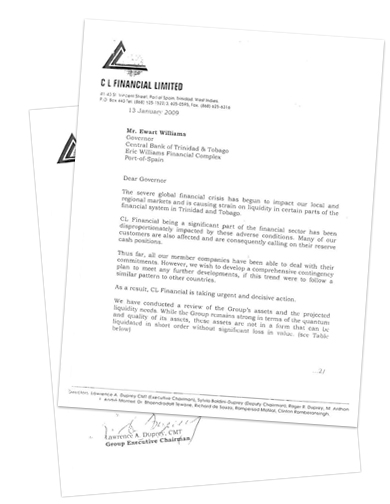
The Duprey Letter

clf-cbtt letterThis is the CL Financial letter of 13th January 2009, signed by their ‘Trinity Chief’ Lawrence Duprey, for readers’ comments. I dub Lawrence Duprey the ‘Trinity Chief’ since he was the majority shareholder, Chairman of the Board and CEO of CL Financial.

I made three applications for this document under the Freedom of Information Act. The first was to the then Minister of Finance, who held over 10,000 shares in CL Financial, Karen Nunez-Tesheira. The reply to that application directed me to the Central Bank, to whom the letter was addressed, which was an obvious ploy to thwart my enquiry, since Central Bank is immune from the Freedom of Information Act. My two subsequent applications (2 & 3) to the current Minister of Finance, Winston Dookeran, have done little better – those were never even acknowledged.

It seems to contain the same text as the one Karen Nunez-Tesheira read into Hansard on 4th February 2009 – see ‘Finding the Assets‘ – except that the table in the copy is titled “CL Financial Group – Assets Available for Restructuring“.

CLF LETTER TO CENTRAL BANK

CL Financial Bailout – The big question

twintowers_conversationThe current talking-point is the major lawsuit launched by the Central Bank against CL Financial sowatees, Lawrence Duprey and Andre Monteil.
From what has been in the press, the lawsuit seems to be aimed at recovering huge sums of money alleged to have been improperly taken from the CL Financial group.

There has been a mass of press comment and the reactions have ranged from relief at the launch of the lawsuit to great skepticism as to its duration, cost and effectiveness.

In the Business Guardian View of June 9, entitled ‘The path of good intentions‘, the Editor-in-Chief of that newspaper set out cogent grounds for his skepticism on the new Central Bank lawsuit.  The old saying comes to mind – The road to hell is paved with the very best intentions.

For my part, I am doubtful of the choice of targets in the apparent attempt to deal with this financial fiasco.

The early questions emerging from this action by the Central Bank are for me ‘Why this lawsuit?’ and ‘Why now?’.

In the case of the CL Financial fiasco, the basic ‘fit and proper’ requirements have been ignored by the Central Bank, exposing us all to continued levels of risk.

The fit and proper requirements set a standard for those people who are responsible for the safe custody and investment of our monies.  If they are upheld as an important part of the financial system’s architecture, they contribute to stability and confidence.

If they are not upheld, for whatever reason, we are all left to wonder, what is the point of having yet another set of rules which are not being enforced?

Here is an outline of the bare facts –

  • The ultimate Trinity – Lawrence Duprey was the majority shareholder, CEO and Chairman of the Board of the CL Financial group.  In those multiple senses, he was the Chief of chiefs and the main figure of authority.
  • The Duprey letter – That elusive bailout request of 13 January 2009, signed by Lawrence Duprey, on CL Financial letterhead is the most solid piece of the puzzle. The plain meaning of that letter is that the CL Financial group had run out of money and was in imminent danger of insolvency.  The reading of that letter into the Hansard on 4 February 2009, appeared to have been motivated by the desire of the then Minister of Finance, Karen Nunez-Tesheira, to protect her reputation from allegations of insider-dealing.  That the signature on that letter was Lawrence Duprey’s is important.  Having made three fruitless applications under the Freedom of Information Act, it seems clear that there is no will to disclose the Duprey letter.
  • The bailout negotiations which were consequent on the request are additional proof of the ‘failed or failing‘ companies.
  • The 30 January 2009 MoU was irrefutable proof that 5 companies had failed – CL Financial, Clico Investment Bank (CIB), British American Insurance, CLICO and Caribbean Money Market Brokers (CMMB).
  • Given the background, a finding by the Central Bank that the Directors and Officers of those 5 failed companies are no longer fit and proper would have been incontestable.
  • That action would have sent a strong and unmistakable signal that this type of costly failure cannot occur without some sanction.  Of course we know of the deep links between the PNM party, then in government, and the CL Financial group.  I have also written about the fact that these CL Financial chiefs are embedded into all our political parties and that is one of the externalities of this entire fiasco.
  • The Central Bank never took that line of action against the CL Financial group. Throughout all this time, the Central Bank has never disclosed its reasons for not implementing these elementary safeguards, which led to the position of four of the former Executive Directors of CMMB being able to obtain a licence to open yet another investment house in late 2010, KSBM.

The CL Financial group has failed on a colossal scale, so what are the penalties to be levied against their Directors and Officers?

cbtt letterThe sidebar shows a Central Bank letter of May 2011, which is clear and strong in calling for the rigorous application of the fit and proper standards to all Directors and Officers of insurance companies.  That letter was signed by the Inspector of Financial Institutions, Carl Hiralal, so the call for upholding of the correct standards came from the very top regulator.  No right-thinking person could object to its contents.  I think it is a strong and necessary letter.

The emerging issue for me here, given these events, is the extent to which our Central Bank could be under political control.   What is the desirable level of political control to which the Central Bank should be subject?

Those questions on the degree of independence of the Central Bank would inevitably lead to consideration of the charged issue of campaign finance/political party funding.  There is considerable evidence that CL Financial made large political donations and that is a key part of the story here.

So, to summarise on the new lawsuit, the Central Bank did not take the effective, incontestable actions available to it in the CL Financial matter.  It chose instead, having steadfastly maintained its silence on its inaction, a complex, risky and expensive course of action.  Why?

What are the results of this new lawsuit?

  1. The Central Bank at last appears to be taking decisive action
  2. The forensic reports are now placed outside the consideration of the Colman Commission, which can limit damage to the CL Financial chiefs and the regulators, auditors etc. That is because the Colman Commission is televised with its daily proceedings posted onto its website, while the High Court is proceeding under antiquated rules which prohibit any private recording devices, cameras or even the use of pen and paper!
  3. The potent issue of ‘double jeopardy’ will no doubt rear its head, sooner rather than later, with the probable effect of derailing the Colman Commission.

The big question for me, given their positions, is whether the Governor of the Central Bank and the Inspector of Financial Institutions are themselves fit and proper to continue in their ruling on this matter.  If any decision has to be made on this CL Financial matter, it will only be human for them to give some consideration to how that decision might possibly affect their individual interest, as the responsible people for such a significant period in the build-up to this fiasco.

CL Financial Bailout – The final AGM

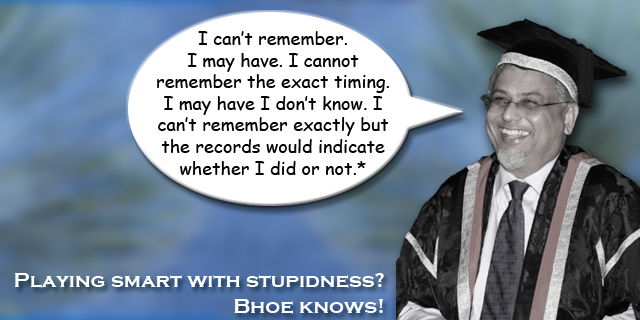
bhoe-knows* In response to a question whether he took part in the reported decision to pay CLF dividends even after the approach to the State in 2009.

CL Financial’s final Annual General Meeting was the most interesting meeting in the saga of its collapse.

That meeting took place at the Trinidad Hilton on Friday 23 January 2009, so consider the timeline –

  • 18 November 2008 – CLF publishes its 2007 Annual Report, including its audited accounts, which showed assets of $100.666Bn and after-tax profits of $1.74Bn.
  • 13 January 2009 – CLF writes, under Lawrence Duprey’s signature, to the Governor of the Central Bank to request urgent financial assistance.  See pg 628 of Hansard of 4 February 2009 for the text of that letter, which specified that CLF’s asset value was $23.9Bn.
  • 16 January 2009 – CLF pays a dividend of $3.00 per share.
  • 23 January 2009 – CLF convenes its final AGM before the ‘official’ collapse.
  • 30 January 2009 – The bailout of CLF is announced at a Press Conference at the Central Bank.  All the speakers at that event stated the CLF asset value at $100Bn.

Given that the normal function of an AGM is to inform a company’s shareholders and stakeholders of its performance and prospects, that timeline raises some intriguing questions.

For whatever reason, there have been no published reports of that final CLF AGM, so I posed these questions to a CLF shareholder in an email exchange –

Q       Did you attend that AGM?
A        Yes
Q       Was it at the Ballroom of the Trinidad Hilton on Friday 23rd January 2009?
A        It was at the Hilton but not in their ballroom. It was in one of the restaurants/meeting rooms that overlooks the Savannah. Can’t remember the name.
Q       About how many shareholders were there in attendance?
A        I would guess about 30-40
Q       Which Directors were present?
A        Clinton Ramberansingh, Rampersad Motilal, Bhoe Tewarie, Gita Sakal and Michael Carballo.
Q       Which Executive Directors were present?
A        Roger Duprey (I think)
Q       What was the ‘tone’ of the meeting?  Was there any clue as to the grave difficulties facing the CLF group?  Was the ‘bailout letter’ mentioned at all?
A        The tone of the meeting was “normal”. There certainly was no indication that CLF  (or the CLF group) was in any imminent danger. The effects of the global downturn was mentioned in light of the reduced dividend (from $5 to $3) and we were told by Carballo that although the group, like everyone else, was feeling the effects of the global recession, it was still performing well and that he expected the performance to improve over the course of the coming year. One interesting “fact” that did emerge (I say “fact” because I have no idea as to the veracity of the claim) had to do with the value of CLF shares. One shareholder had complained about not really being able to derive any value from his CLF shares apart from receiving a dividend. No bank would accept it as security. Carballo advised that CIB would accept the shares as security for a loan………….had I known I’d have taken a big loan and never paid it back!! Certainly the bailout letter was never disclosed to the shareholders.

If true, this account of the events is deeply disturbing.

The question is whether CLF’s Independent Directors were aware of its true position.  Could it be that the Board was unaware of Duprey’s letter and that they were surprised when the bailout was announced?  If that were the case, it would mean that Board of Directors was kept in the dark over this bailout.

If the Board was informed as to the bailout letter, we would be contemplating an even more unacceptable case.  If that is what happened, it would have been fraudulent for the CLF Directors to have carried out that AGM without informing the shareholders of the company’s true position.

Michael Carballo was the CLF Group Financial Director since Andre Monteil’s retirement in early 2008. Given Carballo’s position in the group and the high quality of his professional skills, it is very difficult to accept that he did not himself know CLF’s true position.

Dr Bhoe Tewarie swearing-in

According to this email exchange, neither Lawrence Duprey nor Andre Monteil attended CLF’s final AGM. With only one week to go, they would likely have been attaching more priority to the negotiations for the bailout.

So, Dr. Tewarie – a shareholder and former Director of CLF – is now appointed to Cabinet at the very moment that it is reviewing the bailout of the same CL Financial group.  That man, noted in the field of business education – his last post, before this appointment, being Director of UWI’s Institute of Critical Thinking – when asked about his attendance and participation in the Board meeting which approved those CLF dividends is reported to have said – “I cannot remember, I may have, I cannot remember the exact timing, I may have—I don’t know…The records would indicate whether I did or not...”.

We are being asked to believe that Dr. Tewarie cannot really remember this meeting, probably the final one before CL Financial folded and likely the most eventful in even a high-profile career such as his.  The old people have a saying that you start as you mean to go on.  Dr. Tewarie’s reply can hardly inspire confidence.  It verges on being dismissive and  disrespectful of the public.  We are paying for all the mess created by CL Financial and yes, that is the same public Dr. Tewarie just swore to serve.  It does not augur well.

The essential questions for Dr. Tewarie include his attendance and participation in this final AGM and what he knew about the state of the group at the time.

It seems unacceptable to me for holders of high office in our country to be persons who would be disqualified under the ‘fit and proper’ criteria.  That practice must be revised as part of the New Politics we are being promised.

Given the tremendous stakes and the complete silence by all the responsible people, we need to ensure that this affair does not carry our country any further into peril.

These responsible and silent people must be banished into obscurity, at the very least.

SIDEBAR

PricewaterhouseCoopers
It is a well-established custom that AGMs of large organisations are attended by the responsible partner of the auditor’s firm, who reads the auditor’s letter to the audience.  Did a partner of PriceWaterhouseCoopers attend this meeting?  Which one?  Did a PwC partner read aloud that auditor’s letter?

Real Responsibility
On the one hand, a Cabinet Minister is dismissed over a $100,000 contract and I consider that to be good progress in the correct direction.  The fact that a reasonable suspicion had arisen cost that Minister her job, which is good.  In keeping with the State’s exemplary behaviour, our leaders should not behave in a fashion which causes suspicion or derision.

On the other hand, we are seeing a replacement Cabinet Minister, who at last record was known to be a shareholder of the huge, failed CL Financial group and one of its Board Directors at the time of the colossal crash.  The official version is that CL Financial is a $100Bn group.  There have been recent reports that the Cabinet is about to consider a new approach to the bailout and the public is bound to wonder at the timing of this appointment.

Fit and Proper
The Central Bank’s ‘Fit and Proper’ Guideline (sic) sets out the official position as to the type of person held to be ‘fit and proper’ to be a Director or Officer of a Financial Institution.

It states –

3.1 In accordance with governing legislation a person is considered to be fit and proper if the person essentially is of good character, competent, honest, financially sound, reputable, reliable and discharges and is likely to discharge his/her responsibilities fairly.

Setting the Standard

The PP government is establishing a ‘new normal’ insofar as ethics and acceptable standards of behaviour in public office are concerned.  As with any real-time and complex situation, the signals are mixed, but from my point of view, the direction is a welcome one.

To me, the main positive signs were –

  • Coup Enquiry – The July announcement of the Commission of Enquiry into the 1990 attempted Coup, now underway, was most welcome.  It seems certain that we would still be waiting in vain, if either Manning or Panday were still in power.
  • CL Financial bailout – Dookeran’s decision to review the payout to beneficiaries of the bailout was necessary and long-overdue.  Dookeran has done his cause no favours by with-holding the accounts and seeming to suppress vital information, but the decision to revise the bailout terms was a sound one.  On that occasion, he also took the steps of introducing relief for Hindu Credit Union depositors, which was a step in the direction of equity. Even those of us who did not support any bailout can concede that point.
  • On October 1, the Prime Minister resisted the temptation to use the PP’s Parliamentary majority to force through a new law to limit the legal rights of CLICO policyholders.  The PM chose to set aside that legislative proposal and embark on an act of persuasion.  That was a defining moment in our nation’s development of a democratic culture.  The announcement of a Commission of Enquiry into the entire financial collapse (CL Financial and HCU) was another high point.
  • Nizam Mohammed’s removal as Chairman of the Police Service Commission was overdue in my view, but not because of his ‘last-ditch/red-herring‘ attempts to martyr himself.  His primary and unpardonable offence, given his position, was his bold-faced abuse of power in that traffic police episode.
  • mary king
    Mary King

    Even Mary King’s removal from office earlier this week was a welcome sign despite the doubts over who knew what and when.  That was a good move because it is the first time a Minister has been fired for acting in a manner which causes reasonable suspicion.  Up until now in this country the rule followed by the various Ruling Parties has been the ‘wrong and strong‘ one, joined-up with the ‘do as I say and not as I do‘ one.  To have moved away from those immoral practices is a big step in the right direction, despite the ragged edges.

Even when I consider the disastrous Reshmi-gate episode, that list adds up to substantial progress in the right direction.  Democracy is a messy affair and coalition politics has particular challenges, so progress will be uneven, with some pauses along the way.  But progress we must.

The Prime Minister reportedly commented that there was no pressure from COP to replace Mary King with another of its members, so that the replacement would be chosen on merit.

I am very concerned at the fact that the CL Financial collapse has cast a literal shadow over our country.  Aside from the financial costs, there are significant areas of collateral damage which are now becoming visible.  I referred in an earlier article to one of the main externalities in this episode being the fact that many of the CL Financial chiefs are deeply embedded in our political parties.

Even now, with this new government – their honeymoon will end on the first anniversary, I think – we are witnessing acts which can make one wonder if the CL Financial disaster ever really happened.

The official Terms of Reference for the Colman Inquiry into this financial fiasco were published in the Trinidad and Tobago Gazette of 17th November 2010 – No. 144 in Volume 49.  Here is the first sentence in the second paragraph –

…And whereas the President on the advice of the Cabinet has deemed it advisable and for the public welfare that a Commissioner be appointed to enquire into the failure of CL Financial Limited, Colonial Life Insurance Company (Trinidad) Limited, CLICO Investment Bank Limited, British American Insurance Company (Trinidad) Limited, Caribbean Money Market Brokers Limited and the Hindu Credit Union Cooperative Society Limited with a  view to ascertaining why such events occurred…

robert mayers
Robert Mayers

Caribbean Money Market Brokers (CMMB)
The first example is Robert Mayers, former Managing Director of CMMB up until 7 December 2008 – see here.   Mayers is also a Deputy Political Leader of the Congress of the People (CoP), a leading element in the Peoples’ Partnership government.  CMMB collapsed along with some of the significant companies in the CL Financial group – the Terms of Reference for the Colman Commission refer.

On 20 November, there were reports that Robert Mayers had been offered a position as a Director of our Central Bank.  Mayers is reported to have declined that offer on the basis of a conflict of interest.  The burning question has to be ‘What kind of process could produce such a recommendation?

Consider this arresting headline ‘Investment pros set up new business‘ at page 10 of the Business Guardian of 9th December.  It was reported that a new investment house, KSBM, was launched and it seemed that they were profiling.

Given that all four of KSBM’s Executive Directors are ex-CMMB chiefs, Robert Mayers among them, there are inescapable questions –

How come the former chiefs of CMMB, a financial institution which is known to have failed on this scale, can be permitted to open another one?  We are acting as if we have no capacity to learn from our errors.  Just carrying on as though nothing happened.  What is the role of the SEC and the Central Bank in all this?  Have we learned nothing?

mervyn assam
Mervyn Assam

Clico Investment Bank (CIB)
Mervyn Assam was the Chairman of CIB at the time of the collapse.  Assam had been one of CIB’s founders in 1990 and was reportedly ‘cleaning house’ at the bank, which I do believe to be true.

But the picture is far from a simple one.  On 22 January 2009, CIB hosted its inaugural Investment Seminar at the CL Duprey box at the Queen’s Park Oval – I spoke at that event, together with Professor Patrick Watson.  Now, according to  para 5 of the April 2010 affidavit submitted to the High Court by the Inspector of Financial Institutions, Carl Hiralal, in the CIB winding-up petition, the CIB liquidity problem was disclosed to him in a meeting on the 15 January.  I have serious doubts as to the veracity of that statement, but yes, it is still a full week before the Investment Seminar.

Assam held 7,500 shares in CLF as at 7 February 2009.

Assam also launched a lawsuit to recover $1M he had deposited with CIB, that case went against him in January this year – see the judgment – and he is reported to have filed an appeal.

In October, Assam was appointed as Ambassador Extraordinaire and Plenipotentiary of Trade and Industry.  He has served in the NAR period as High Commissioner to London and as a UNC Senator, both in Cabinet and during their recent spell in opposition.

Dr. Bhoendradatt Tewarie

CL Financial (CLF)
Dr Tewarie was a Director on the Board of the parent company, CLF, which wrote to the Central Bank, seeking a bailout, on 13 January 2009.  On 16 January 2009, CLF paid dividends of $3.00 per share to its shareholders.  According to the CLF Annual Return of 7 February 2009, Dr Tewarie held 1,171 shares.

As I write this, we are informed that Dr Tewarie has been sworn in, to replace Mary King.

To be perfectly clear, I am making no allegation of theft against Mayers, Assam or Dr. Tewarie.

Does the ‘fit and proper’ criteria apply to these CLF chiefs?  Should those criteria apply to the holders of high office in our country?  What do you think?

We need new politics like no time before in our country, but that must involve new thinking.  The State must behave in an exemplary fashion if we are to uplift ourselves without civil disturbance and unnecessary confusion.  The State needs to set the standard.

I trust that the Colman Commission will give the proper attention to these episodes.