On Wednesday 15 January 2020, Afra Raymond gave an address to the Trinidad Union Club on the ‘Delays in implementing T&T’s new Public Procurement system.’
- Programme Date: 15 January 2020
- Programme Length: 00:55:04
On Wednesday 15 January 2020, Afra Raymond gave an address to the Trinidad Union Club on the ‘Delays in implementing T&T’s new Public Procurement system.’

This continues my series — Part 1 and Part 2 — on the unexplained and unacceptable delays in implementing the new Public Procurement system. Those delays arise from the failure or refusal of the Finance Minister to settle the Regulations which are essential for the Office of Procurement Regulation (OPR) to be fully operationalised.
Despite his firm commitment on 22 February 2019 –
“…I remain committed to attaining full implementation of the Act in the shortest possible time and the Ministry of Finance will continue to work assiduously towards that goal…”
As far as I know, there has been no response from Finance Minister Imbert to the points raised in the previous article. Of course, no response is required, but given the importance of the issue and the highly engaged communication style of that Minister, I certainly had cause for a pause.
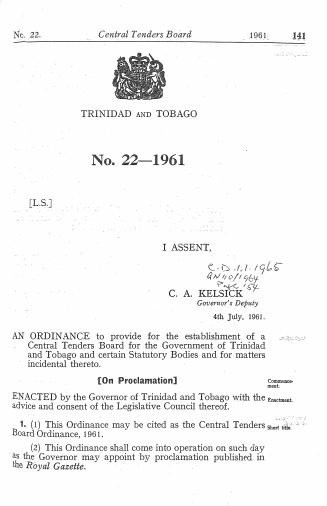
This article will continue last week’s examination of the delays, but first, some background. The new Public Procurement system replaces the Central Tenders Board, so it is useful to note that although the CTB Act is a 1961 law, the first Board was not sworn-in until 1966 – a full five years after the law. Note well, too, that this was at a period when the CTB Act had the full support of the first PNM administration of Dr Eric Williams and the opposition forces were then a mere shadow of their current selves.
Given that background, what can we make of these delays in getting the Office of Procurement Regulation (OPR) up and running? Firstly, even though The Act is No. 1 of 2015, the first OPR Board was appointed two years ago, in January 2018, under the Chairmanship of Moonilal Lalchan.

This article will appear on New Year’s Day – 1 January 2020 – and it is a direct criticism of the Trinidad & Tobago government’s unexplained delays in the full implementation of the new Public Procurement and Disposal of Public Property Act (the Act). In my view those delays are unacceptable and a serious cause for public concern.
On 23 November 2018, the Finance and Legal Affairs Joint Select Committee of Parliament, took evidence on the matter of The Implementation of the New Public Procurement System.
That JSC, under the Chairmanship of Independent Senator, Sophia Chote SC, heard from the Office of Procurement Regulation (OPR) and the Ministries of Finance and Public Administration. That JSC Report of 6 May 2019 gives a detailed and encouraging account of the steps being taken to bring this law into full effect. Sad to say, but at page 23 of that Report we are told that – Continue reading “Public Procurement Delays”

In this article I continue to examine the PPPs in Tobago against the role of the responsible elites or officials for these important matters.
Before returning to those large-scale, misbegotten PPP schemes, it is important to give the background in terms of learning and the institutional framework.
The Finance Ministry’s PPP Unit was established in August 2011, to promote public private partnerships for infrastructure in Trinidad and Tobago. The National PPP Policy was approved by Cabinet on May 31, 2012, as an institutional framework for the development and implementation of projects through the PPP modality. Continue reading “Property Matters – More Tobago Love”
Tobago Love n.
Trinidad & Tobago
1. The act of beating one’s partner to prove one’s love…from TriniMummy.com [Via http://www.skettel.com/ an online Caribbean dictionary.]
This article uses the threads I have been exploring in relation to the two large-scale Public Private Partnerships (PPPs) in Tobago to discuss the risks which are likely to arise quite soon in that arena.
The case will be made in three parts – the existing two PPPs, with a note on the Tobago Sandals MoU fiasco; the emerging arrangements for new PPPs in Tobago and the perils arising from the failure or refusal to examine the failed PPPs.

This 198-room hotel was built in 2000 on the Tobago Plantations estate by Vanguard Holdings, which comprised Guardian Holdings, Angostura Ltd and the T&T State via e Teck, with Hilton International having a minor shareholding. The project was financed with a $16.75M USD bond from Citicorp and was soon in difficulty, as in 2008 the State had to bail-out the private shareholders and commit large sums of Public Money to repair the buildings, which were by then badly-damaged by sea-blast.
Continue reading “Property Matters – Tobago Love”

Afra Raymond made a presentation at the 4th Caribbean International Tourism Conference at UWI’s Cave Hill Campus in Barbados on Trinidad & Tobago’s State-owned hotels to outline the results and provisional conclusions of his research examining the existing State-owned hotels as a way of understanding the real prospects for the large-scale Tobago Sandals proposed by the incumbent government in 2015.
‘Manufactured consent’ is supported by “…effective and powerful ideological institutions that carry out a system-supportive propaganda function by reliance on market forces, internalized assumptions, and self-censorship, and without overt coercion…“.
—Noam Chomsky
This article is based on notes for my presentation today to the Fourth Caribbean International Tourism Conference (CITC 2019) at UWI’s Cave Hill campus. My presentation will be on Trinidad & Tobago’s State-owned hotels to outline the results and provisional conclusions of my research. I designed that research program to examine the existing State-owned hotels as a way of understanding the real prospects for the large-scale Tobago Sandals being proposed by the current government in 2015.
I am questioning the role of our responsible elites in light of Dr Terrence Farrell’s ‘Where do we go from here‘ speech to the Queen’s Park Cricket Club on 22 November 2019. Dr Farrell also chaired a THA-appointed Committee to recommend a Medium-Term Policy and Planning Framework for Tobago. Those proposals were made on 12 November 2019 and included three new all-inclusive hotels for Tobago adding about 1,800 new rooms. Continue reading “Property Matters – State owned hotels”
“…A nod is as good as a wink to a Blind Horse…”
—A cynical Cockney view of political tricks.
“…You drink your rum, well let me drink mine…”
—A cynical local saying on how improper behaviour is tacitly accepted.
In this case, the THA, making its long-standing case for increased autonomy, seems comfortable to defend the wretched MILSHIRV agreement almost in the same breath as its perennial complaints of severe financial hardship. Well I tell you.

The misbegotten MILSHIRV project is ground-zero in the workbook for how PPPs and BOLT arrangements can violate the Public Interest. Our responsible senior Public Officials agreed to change the terms of the lawsuit so that the legality of this BOLT contract was never tested by the Court, so the matter was converted by agreement to become an ‘interpretation‘ issue. Given the Court of Appeal ruling on 21st October 2019, the Public Interest has once again been grossly violated.
Typical views of failed projects consider delayed completions, cost over-runs or structural failure but despite the popularity, such views are entirely incorrect. The proper position is that the only failed project is one from which we learn no lessons. That is the real learning here.
This article takes a closer look at the Court of Appeal judgment in this matter and the real implications for the public interest. Continue reading “Property Matters – THA BOLT Appeal, part two”
This article examines the recent Court of Appeal ruling that the THA did not have the power to enter certain PPPs as had been done in the MILSHIRV project.

In November 2011, the THA entered a Public Private Partnership with the Rahael Holdings group for MILSHIRV, a new office building at the corner of Claude Noel Highway and Shirvan Road in western Tobago. I was heavily critical of that project as it was clear to me that the basic principles of needs assessment had been violated, as detailed later in this article. Continue reading “Property Matters – THA BOLT Appeal”