 T&T Transparency Institute presented “Sangre Grande Plenty Pepper! A Community Event” on Tuesday, September 29, 2015 at which Afra Raymond, in his capacity as president of the JCC, was the feature speaker. His topic was “Facing the Facts!”
Tag: transparency
Dismantling the Code of Silence
This letter was published in Sunday Express on 27th September 2015.
From: Afra Raymond <afraraymond@gmail.com>
Date: Thu, Sep 24, 2015 at 10:00 AM
Subject: Dismantling the Code of Silence
To:
The Editor,
 Noel Garcia served as General Manager of the Housing Development Corporation during the period in which critical decisions were made on the Las Alturas housing project. That project, in which two apartment buildings failed, is now the subject of a Commission of Enquiry. There have been several reports in the press (see below) that Mr Garcia was unwilling to testify to that Enquiry. We have been unable to locate any published responses from Mr Garcia to those reports.
Noel Garcia has now been appointed as Chairman of the UDECOTT Board. The JCC’s position is that the penalties for the failure or refusal to appear as a witness to a Commission of Enquiry must be increased sharply so as to discourage this deplorable behaviour. The present fine for non-attendance is only $2,000, which is why so many persons can show open disdain for a request to testify at a Commission of Enquiry.
The prospect of the Chairman of a State Enterprise declining to testify at a Commission of Enquiry is unacceptable and of course any continuing ambiguity can only feed suspicion.
The Las Alturas Enquiry resumes its evidence hearings on Monday 28th September 2015 and it would be a refreshing change from the ‘bad old days‘ if Mr Garcia, or his attorneys, were to promptly confirm his willingness to appear as a witness.
Afra Raymond
President
JCC
Noel Garcia responded via a media release, which was copied on social media on Sunday 27 September 2015 as follows:
Getting the Facts Right
I refer to a letter to the editor from Afra Raymond entitled “Dismantling the code of Silence” published in the September 27, 2015 edition of the Express Newspaper.
In his letter, Mr. Raymond, in reference to me and the Commission of Enquiry into the Las Alturas Project, speaks disparagingly of “the prospect of the Chairman of a State Enterprise declining to testify at a Commission of Enquiry”.I wish to categorically state that I have never refused to give evidence before the Commission of Enquiry into the Las Alturas Project. Despite what Mr. Raymond claims to have read (and what he erroneously plainly believes), the Commission has never at any time contacted or subpoenaed me on the matter of the Las Alturas Project. This, although my postal address, email address and telephone number have remained unchanged for years.
For the record, I have never shirked my duty or my responsibility to give evidence before any court or any tribunal with respect to matters within my knowledge as a former employee of the HDC. I have previously given evidence in the High Court on behalf of the HDC and I have only recently filed an affidavit in support of the HDC’s position in another High Court matter. I am no stranger to and have given evidence repeatedly at Commissions of Enquiry including in the Piarco Airport Enquiry, the Landate Enquiry and the UFF Commission.
I wish to make my position abundantly clear that, were I to be subpoenaed or contacted to give evidence at the Commission of Enquiry into the Las Alturas Project, I would have absolutely no difficulty in assisting the Commission.
In his self-appointed role as guardian of the public conscience, Mr. Raymond ought to be more careful about permitting his officious zeal to lead him into making what can be considered to be defamatory imputations about others. Mr. Raymond’s self-confessed inability to locate any published responses from me to press reports he has read is no licence for him to do so.
Noel Garcia.
This clarification was all we were seeking, so I responded later that night, on social media, as follows –
“…Noel Garcia’s post ‘Getting the Facts Right’ is very helpful, it is the first public response I have seen to the several articles earlier on this issue – I thank him for it…as I said elsewhere on FB yesterday, one of the Officials in the Las Alturas Enquiry told me that they had been ‘unable to locate’ Mr Garcia, to which I responded that as he was the new UDECOTT Chairman, it was now impossible to sustain that claim…”
For ease of reference – these are the previous press reports –
- Trinidad Guardian of 7th April 2015 – ‘Las Alturas Hearing resumes today‘
“…Singh also assured Ibrahim that efforts were being made to locate former executive chairman of the Urban Development Corporation of T&T Calder Hart, and former HDC general manager Noel Garcia, to have them appear before the Commission…” then “…Garcia is said to be living and working in Ghana. HDC’s attorney Vincent Nelson, QC, had previously indicated that Garcia had declined to provide a witness statement when asked, following which they lost contact with him. Seemingly dissatisfied with Mohammed’s answer that every effort was being made to have Hart present himself before the Commission, Ibrahim suggested that there were legal means which could be employed to compel him to appear.”Ibrahim has promised that accommodations would be made not to keep Hart unduly when he does appear, while there was also the recommendation that an offer be made to pay Garcia’s travel expenses back to T&T, in order for him to testify. Both Hart and Garcia have been deemed “important witnesses” in the enquiry. During the 13-day enquiry four witnesses have so far testified before the Commission…“ - Trinidad Express – 20th March 2015 – ‘HDC lawyers ‘lost all contact with Garcia’‘ –
“…Attorneys representing the Housing Development Corporation (HDC) have lost all contact with former HDC managing director Noel Garcia. This was revealed yesterday during the sitting of the commission of enquiry into the Las Alturas housing project at the Caribbean Court of Justice in Port of Spain.“Garcia, who was expected to be called as a witness in the enquiry, is said to be currently residing in Ghana.“Junior counsel for the commission Jagdeo Singh told the commission all attempts by HDC’s legal team to locate Garcia had been unsuccessful. “Every effort has been made thus far to locate Mr Garcia and at some point in time Mr Garcia was in communication with the legal team for the HDC, but he has since ceased all communication with them,” Singh said.“Nelson had said at a previous hearing that Garcia did not appear to be willing to testify in the proceedings.“Chairman of the commission Mustapha Ibrahim noted Garcia’s participation in the enquiry was necessary, as he was a “very important witness”…“
- CTNT News – 5th March 2015 – ‘QC: Garcia’s presence crucial to Las Alturas Enquiry‘ –
“…The absence of former HDC Managing Director Noel Garcia at the Commission of Enquiry into the Las Alturas Housing Project was raised by the company’s Attorney on Day Four of the proceedings. Mr. Garcia is one of the key persons who would be best able to add the pieces to the already puzzling situation which led to the partial demolition of two towers at the million dollar housing complex due to shifting soil.”At Thursday’s session, the Attorney representing the Housing Development Corporation, Queen’s Counsel Vincent Nelson, mentioned that Mr. Garcia currently works and lives outside T&T.”The position there is that Mr. Noel Garcia, who is a pivotal person in the project at the time, is someone who really, although it is difficult because he is outside the jurisdiction for the Commission to summon him, he is an important and pivotal person in terms of what occurred at the time.”Mr. Nelson was then asked by the Commission Chairman Mustapha Ibrahim if any efforts were made to bring him back to T&T for the Enquiry, including offering to pay his airfare.“No. We haven’t done so but obviously that is something that I could take instructions on. I am told we lost communication with him at the moment. So that is the position but we will make further efforts but in the meantime, the position is the Commission may consider whether to call the Board at the time and/or see when Mr. Garcia is available.’…” There is also a TV clip here.
- Newsday of 6th March 2015 – ‘Noel Garcia not willing to testify‘ –
“…NOEL Garcia, former managing director of the Housing Development Corporation (HDC), has indicated to lawyers for the HDC, that he is unwilling to testify at the Las Alturas Commission of Inquiry, attorney Vincent Nelson QC said yesterday…“
I have not seen any responses from Noel Garcia before his response on Sunday 27th September 2015.
Our Land – The Review
“…A small State such as Trinidad & Tobago must accord a very high priority to the judicious management and utilization of its land resources or perish. All elements of land policy must be designed to ensure that these finite resources are efficiently utilized and husbanded in such a manner as to serve the long term interests of the national community…”
—Conclusion of “A New Administration and Policy for Land” (19 November, 1992)
The PNM won national elections on 7 September 2015 by 23-18.
Two key themes emerged during the PNM’s successful campaign –
- Firstly, there was a strong emphasis on the critical need to restore proper standards of Accountability, Transparency and Good Governance;
- Secondly, a commitment was given to ‘keep the various promises made by the PP government’.
When one considers the various promises, policy changes and actions of the PP in relation to land and property, it seems clear to me that those two campaign commitments made by the PNM are entirely incompatible.
Our country has a very high population density and the previous Minister of Land and Marine Resources estimated that some 63% of our country’s land belongs to the State. It is therefore a cardinal State responsibility to properly manage those critical resources so that short and long term interests can be reconciled in a sustainable manner. The present situation is so serious and damaging to our collective interests that I am calling for a halt to any attempt to keep promises with respect to land and property while a fact-finding and policy review is conducted.
 The opening quotation is from the National Land Policy 1992, which is now a virtually unknown document since its very existence is denied by all the relevant agencies. This Policy provides critical guidance for how this scarce resource should be best managed in the Public Interest.
The severe crisis now evident in relation to our State Lands resembles a ‘Tragedy of the Commons‘ in which this crucial resource which should offer long-term collective benefits is effectively abused by self-seeking individuals. The pattern of abuse is facilitated by gross mismanagement, in profitable partnership with deliberate obscurity in how the State Land system actually operates.
Food Security
 This remains elusive since in March 2012 the Ministry of Agriculture, Land & Marine Resources published its Food Production Action Plan 2012-2015. The major goal of that Action Plan was to halve the country’s annual $4.0 Billion food import bill. Yet in March 2014, the Food Production Minister, Senator Devant Maharaj, stated that the food import bill had been reduced by only 2% since 2010.
The significant reduction of our food import bill will require a flexible plan, with dedicated implementation and continuous monitoring. The one inescapable requirement is for farmers to have access to land of suitable quantity, quality and location. Without a good supply of land, no food security plan can succeed.
Land for the Landless
The proposed revisions to the State Lands Act 1998 were approved by the Lower House of Parliament on 3 June 2015 and withdrawn after the JCC raised certain objections. The proposed change in the ‘Land for the Landless’ policy were approved by Cabinet on 19 March 2015 with these main elements –
- Occupation Date – Was moved from January 1998 to June 2014, which means many more persons would qualify.
- Income Limits – Previously the maximum monthly family income was $8,000, this was now revised to $30,000.
- Definition – the 1998 Act defined a landless person as one who was ‘disadvantaged’ according to the Ministry of Social Development, that word was deleted from the revised proposals.
- Designated Areas – these were specified in an extensive list of over 400 areas covering the entire country.
- The Numbers – The total number of persons identified was 250,000 and a commitment was given to regularise some 60,000 of those.
A policy which was originally intended to alleviate the plight of our poorest citizens has now effectively been extended to offer ‘Land for Everybody’. The existing commitment in respect of 60,000 lots will consume about 8,000 acres of land.
EMBD
https://vimeo.com/7987617
 The EMBD website states that it is responsible for the development of the former Caroni lands – some 7,500 residential lots are being prepared for ex-Caroni workers as part of their retrenchment package, with a further 8,400 agricultural leases of 2-acre parcels reportedly being processed. That means about 940 acres are to be used for the residential lots, with at further 18,500 additional acres for the agricultural plots. The total land area to be used would be about 19,420 acres, which is about a quarter (26%) of the estimated area of the Caroni lands.
Caroni Lands
 Caroni Lands were leased to ex–Caroni workers as part of their retrenchment compensation – they were entitled to one residential lot and a two-acre parcel for food-crop farming. The use of those lands for those purposes was intended to be controlled by the restrictive covenants in those leases. For instance, the residential lots were to be developed by a residential building within three years and the agricultural lots were to be held by the ex-workers for food-crop farming. In the 2015 budget, the restriction on sale of those agricultural lands was removed (pg 14). In addition, Cabinet Minute 3093 of 6 November 2014 approved the removal of the restrictive covenants in the leases to ex-Caroni workers – both agricultural and residential. No restriction on sale and no requirement to build on the lots.
This is tantamount to the State entirely gifting the development and transactional rights to these lessees, with no effective means of ensuring the originally desired results.
Housing Development Corporation (HDC)
 The HDC sells new homes at heavily-subsided rates to middle-income families, subject to restrictive covenants which prohibit open-market sale within the first ten years. Under the terms of that clause, the owner of one of these homes is required to offer the property to the HDC at the original price. It now seems that the HDC has relinquished those restrictive covenants. I have seen several letters signed by the HDC which authorise the open-market sale of those homes within the ten-year embargo period. I am not aware of any policy decision which supports that pattern of approvals and none of the vendors I have spoken with have paid any penalties of profit-share to the HDC.
This is yet another example of the State or its agents abandoning its fundamental duty to properly manage the public property rights within its remit.
Property Tax
The proposed Property Tax would require a live, open-access database which would allow anyone to examine the details of any property in the country. Those details would include land area, building area, number of bedrooms/bathrooms and other facilities, transaction history, ownership and assessed taxes. One of the strongest sources of opposition to the Property Tax is persons who would wish to keep the details of their property holdings and dealings as secret as possible.
The new Property Tax system and the modern database is in fact a key element in unearthing the facts of our country’s property ownership and occupation.
Property Tax must therefore be a priority in this arena.
The unrealistic policy of homes with gardens consumes too much land and will jeopardise our country’s sustainable future.
VIDEO: TOO BIG TO HIDE?
A five-minute clip on the CL Financial bailout, the State and the ‘Code of Silence’ around how $25 Billion of your taxpayers’ Dollars were spent.
At a time when we hear of falling State revenues and we know there is no soap or toilet paper in our public hospitals, this is the story of how $25 Billion of our money was used to bailout the wealthiest man in the Caribbean.
This is the story of the fight by the Ministry of Finance to conceal the details of that massive payout.
Expenditure of Public Money
Minus Transparency
Minus Accountability
Equals CORRUPTION
Minus Transparency
Minus Accountability
Equals CORRUPTION
CL Financial Bailout – The Real Case
In 2013 I sued the Minister of Finance & the Economy for his continuing failure or refusal to provide the details relating to the huge $25 Billion bailout of the failed CL Financial group.
On Wednesday 22 July 2015, the High court ruled in my favour by ordering the release of all the requested information.
The basic principle behind the Freedom of Information Act is that the information held by Public Authorities belongs to the public, unless one of the valid exemptions is applicable.
The Court also granted the State a 28-day stay of execution which seems intended to allow them the time to decide whether to appeal before they have to provide the requested information. Given the ongoing Information War and the high stakes to maintain the ‘Code of Silence’ in relation to this bailout, I would not be at all surprised if the State were to appeal against this ruling.
The unexplained gap
On 1 October 2010, the Prime Minister addressed Parliament to explain that $7.3 Billion had been spent on the bailout and that a further estimated $7.0 Billion was required to settle all debts. That is a 2010 estimate of $14.3 Billion to settle the CL Financial bailout, but the current estimated cost of the bailout is in excess of $25 Billion. That means that over $10.5 Billion more than the 2010 estimate has been spent, so where did all that extra money go? That information and the defined official policy of secrecy are at the heart of this scandal. Continue reading “CL Financial Bailout – The Real Case”
CL Financial Bailout – Steal of a Deal
The CL Financial bailout was a steal of a deal for the owners of that troubled company. After all, the wealthiest man in the Caribbean was able to obtain an interest-free loan exceeding $25 Billion in Public Money at a time when no one else would lend him. Our Treasury was effectively the ‘lender of last resort’, so those terms were hugely in favour of CL Financial and its controlling shareholder, Lawrence Duprey. What is more, the shareholders kept all their shares.
In the previous column, I stated my view that Mariano Browne had taken what seemed to be a position supportive of Lawrence Duprey’s attempt to regain control of CLICO. I also pointed out that Browne was a member of the Cabinet when that fateful and detrimental deal was made to bail out CL Financial in 2009 and called on the significant members of that Cabinet to explain their rationale. I went further to say that Browne was one of the five significant persons who had been requested to testify and refused to do so.
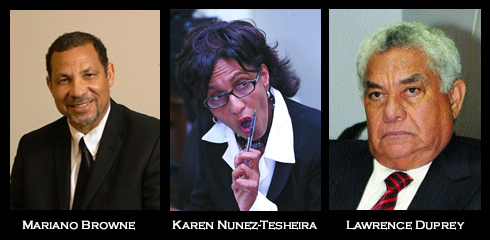 I am pleased that Mariano Browne has replied on the record, so this column will deal with those valuable points. For starters, it is even clearer than before that former Minister of Finance, Karen Nunez-Tesheira, has serious questions to answer in relation to her central role in this bailout. Given that financial training and experience formed a weak part of her profile, one can only wonder at what prompted Manning to appoint Nunez-Tesheira to that position. We will see. In addition, the terms which were negotiated between the State and CLF are essential to understand today’s dilemma with respect to Duprey’s ambitions. A related issue which needs clarity is the role of the powerful, unelected ‘bigger heads’ who are seemingly in control of our country.



Duprey and his cohorts benefitted from an unprecedented degree of access to key decision-makers in the Cabinet and the Central Bank.
One of the enduring paradoxes in how our society is governed is the lopsided distribution of information. There is an abundance of relatively unimportant information, alongside a severe scarcity of critical facts on the big issues of the day. It seems that we are now ‘Amusing ourselves to Death‘, to borrow an insightful phrase from Neil Postman.
There is a world seen and a world unseen. The challenge is to discern the scope and influence of the unseen world. The current lexicon describes the unseen world as the ‘Deep State‘. I have no doubt that such a state of affairs exists in our country. So what do we know about the huge decisions in our society’s governance and how do we come to know those things?
For instance, the most serious decisions are taken by the Cabinet, which consists only of members of Parliament – some directly-elected as MPs and others appointed as Senators. Some of those decisions are announced at the Thursday afternoon post-Cabinet Press Conference. But the coverage is always partial with my suspicion being that stories are often presented so as to conceal their less-favourable aspects.
Cabinet seems to operate according to two conventions – the first being ‘Collective Cabinet Responsibility’ and the second being that the discussions of Cabinet are secret. The Freedom of Information Act gives Cabinet documents a 10-year embargo against publication. So, the first problem is that the highest decision-making Chamber in our Republic is essentially a secret one. I have always felt that the veil of secrecy which covers Cabinet’s deliberations is most times severely detrimental to our collective interests. This sordid CLF bailout fiasco fortifies that view.
Another critical aspect of the current arrangements is the role of the powerful Party Political Financiers, which is rarely revealed, but often suspected. In the case of the CL Financial group, we know that CLICO was a major funder of both major parties, which gives this bailout fiasco its lingering, bitter, flavour. There are few opportunities for us to get a real insight, beyond rumours, as to the true role of the party financier. Apart from the role of CL Financial as financiers, we also learned in the Colman Commission that Nunez-Tesheira’s 2007 campaign benefitted from Hindu Credit Union (HCU) financing.
The 2009 negotiations
One question I always ask is whether Karen Nunez-Tesheira told her colleagues that CLF had paid a dividend three days after it requested a bailout? As a shareholder, she would have been in receipt of dividends. If the Cabinet was told, they should have insisted on immediate repayment of any dividend since an insolvent company cannot pay a dividend. If the Cabinet was not told, we are dealing with a most deceptive course of action. Which was it?
So, what did Browne say about those negotiations?
…I have said that Duprey’s (and other shareholders) legal position is strong as the government depended on a MOA (memorandum of Agreement) the time frame of which has long since passed. On that basis, the shareholders have rights. Even if the state has expended money, the State and or its agents (the Central Bank) must do so in way that protects both the policy holders and the shareholders.
That was my advice in cabinet and at the Finance Policy Committee. The view of the Minister of Finance prevailed. I am of the opinion that Karen Nunez Tesheira was wrong then and is wrong now…
Browne is concurring with my view that the State’s position is weak in this bailout endgame, the key point being “…the shareholders have rights…”. Being bound by the first convention of ‘Collective Cabinet Responsibility’, Browne kept his silence during the raging controversy of the past 6 years, but he has now chosen to break the secrecy convention. I am grateful to him and it is telling that the most expert Cabinet member in that critical arena of finance and economics is now revealing his recollections of these critical events.

Nunez-Tesheira needs to share the rationale for the bailout formula which let Duprey and the other shareholders keep their shares and loaned those huge sums of Public Money to the wealthiest man in Caribbean on an interest-free basis. What were the public policy considerations which could possibly have supported such a course of action?
Browne goes further to outline a situation in which he seems to have been excluded from the negotiations –
…And for the record I have not been part of any negotiations with Clico or CLF as part of the bailout action. Neither was I a part of the cabinet which took the decision to support the CLF/ CLICO Group. Those decisions were taken at a Cabinet meeting of which I was not a part on 29th January 2009 as I was in Barbados representing the Minister of Finance at a COFAP meeting. This bailout was always the province of the Minister of Finance and the Governor of the Central Bank and (sic) had no part in those decisions.
Further, Clico/CLF/Duprey made no contributions to the PNM during my tenure as Treasurer…
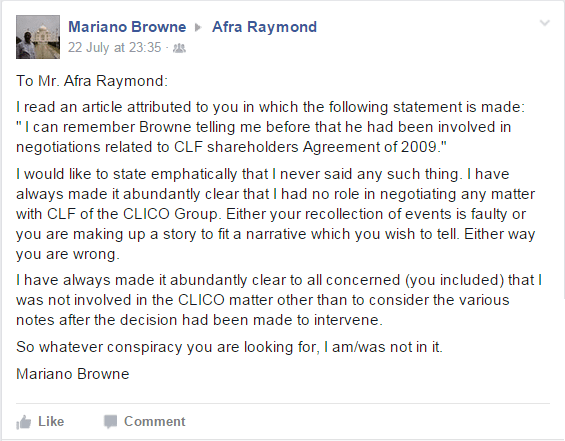
I can remember Browne telling me before that he had been involved in negotiations related to the CLF Shareholders Agreement of June 2009. That Agreement, at para A of its preamble, undertakes to protect the interest of shareholders. Note – Browne has since denied this claim of mine, so that has to be noted.
Of course, we know that Browne was part of the Cabinet which made those decisions, even if he was not in attendance at those particular meetings (I have no reason to doubt him), it is immaterial. As a member of that Cabinet he bears collective responsibility.
Duprey’s intended re-entry
Browne contested my statement that he seemed to be supporting Duprey’s attempt to regain control of CLICO –
…With regard to your opinion, I am am (sic) supporting nothing…The state only owns 49% of the company. If the shareholders act in concert there is nothing to prevent them from having an extra ordinary shareholders (EGM) Meeting and replacing the state appointed Directors. It is unlikely that Lawrence Duprey can pass the fit and proper rule and therefore cannot be appointed to CLICO’s Board, but he can be appointed to the CLF Board…
Browne listed the reasons which seemed to favour Duprey’s position, which position is fortified by his interpretation of the fit & proper rules. In his view, those rules would have prevented Duprey’s appointment to CLICO’s Board, but he would have still been eligible to sit on CL Financial’s Board. If we are considering a situation in which CLICO would still have CLF as its majority shareholder, that is an entirely misplaced view.
In the Central Bank’s ‘Fit and Proper Guideline‘, the question of ‘Who should be Fit and Proper?’ is addressed at page 2 –
“…4.1 According to governing legislation the following persons referred to in this Guideline as holding “key positions” are required to be fit and proper: -…
…4.1.4 Controlling Shareholder – may be an individual or a corporate entity
- Under the IA, any person who is entitled to control at least one-third of the voting power at any general meeting of the company.
- Under the FIA, any person who controls twenty five per cent or more of the voting power at any general meeting…
Before the bailout about 89% of CLICO’s shares were owned by CLF, so Duprey cannot regain control of CLICO, either directly or via a holding company, if the fit and proper regulations are enforced. As I said previously, the acid question is whether the Central Bank will summon the will to apply those rules without fear or favour.
This is no academic dispute, since Duprey has made it clear that he is seeking to regain control of CLICO, so that financial company and the rules which govern it, must be central concerns in this matter.
Sunlight is the best disinfectant. Come clean.
CL Financial Bailout – Impunity Insanity?

The headline ‘Duprey wants back CLICO‘ in the Sunday Express of June 28th 2015, did not surprise me at all. That is exactly the threat against which I have been warning throughout my campaign against this appalling and unprecedented bailout.
To allow Lawrence Duprey to regain control of CLICO would do serious violence to the fundamental notions of the law not allowing persons to benefit from their wrongdoing.
Already, we can see various positions being taken – the Movement for Social Justice and Peter Permell of the CLICO Policyholders’ Group stating their objections, while Mariano Browne (former PNM Treasurer and Minister in the Ministry of Finance) and Mary King (economist and former Minister of Planning) setting out what seem to be supportive positions.
Continue reading “CL Financial Bailout – Impunity Insanity?”
CL Financial Bailout – False Firing?

I smiled at the page three photo in another newspaper of the Prime Minister holding hands with recently-dismissed CLICO Chairman, Gerald Yetming, at a UNC meeting in Debe on Tuesday 23 June 2015. As serious as the situation is, I just couldn’t help myself.
Yetming was a UNC Minister of Finance during the Panday administration and had been appointed on 28 September 2010 as Chairman of CL Financial Ltd, the parent company of the ‘CLICO group’ being bailed-out by the State.
I declined many requests for comment on this controversial episode, since something about it did not seem quite right. The actual CLICO dismissals were incredible to my mind, not only because there did not seem to be any conflict between the stipulations in the CBTT’s 3 June Press Release and the reported beneficiaries – that is explained in the sidebar. It is even more bizarre when one considers that Yetming, in whom all confidence was apparently lost after allegedly-unauthorised payments to former CLICO Directors, still serves as Chairman of the parent company, CL Financial Ltd.
There is a widely-held view that the CL Financial chiefs should not be recovering any of their money from this huge collapse before the completion of the Colman Commission and the publication of its Report. I share the public concern that no money should be paid to the persons who were in charge of that sinking ship. Not one cent. Nothing should be paid to the CLF chiefs until we have had the proper opportunity to consider the findings of the Colman Commission. Even with its severe limitations, that Colman Report would be our closest opportunity to understand this epic financial crime. To pay out money to those Directors and Officers who were responsible before the Report is published would be reckless in the extreme and jeopardises the public interest. Continue reading “CL Financial Bailout – False Firing?”
Our Land – Land for Everybody? Part 2
SIDEBAR: The Minister responds
This is a short video (courtesy of TV6) in which the Minister of Land & Marine Resources, Jairam Seemungal, responds to questions on the occupation of State lands in Couva by SIS Ltd, one of the main financiers of the Peoples Partnership.
The ‘Land for the Landless’ program, which is being implemented by the Land Settlement Agency (LSA), has now been redefined in such stark terms that I have decided to call it by a more appropriate title ‘Land for Everybody’.
The previous article set out the main points of the revised program. That detrimental law was approved by the House of Representatives on Wednesday 3rd June. Although we have now heard that the new law to amend the State Lands 1998 Act was withdrawn just before the close of our Parliament on Friday 12th June 2015, we are also being told that it will be approved if the Peoples Partnership is returned to office after the national elections in September.
This change to our country’s squatter regularisation law is therefore now being held out as an expansive election promise to regularise the status of some 60,000 landless people. That proposed program is a severely detrimental one which will likely lead to greater problems in the important question of our country’s human settlement policy. It is therefore necessary to highlight the dangers this new ‘Land for Everybody‘ program poses to our collective interests.
The Minister of Land and Marine Resources, Jairam Seemungal, gave several interviews which attempted to rebut my criticisms, so it is important that that these fundamental issues be properly understood. The public interest demands nothing less.
Food Security
Food security is that elusive state in which we can feed ourselves at a decent standard of nourishment and at an affordable price, without heavy reliance on imported food. The very issue of how food security is defined is hotly debated, but it is clear that we are far away from even the simple one I offered.
In March 2012 the then Ministry of Agriculture, Land & Marine Resources published its Food Production Action Plan 2012-2015. The major goal of that Action Plan was to halve the country’s annual $4.0 Billion food import bill. Yet in March 2014, the Food Production Minister, Senator Devant Maharaj, stated that the food import bill had been reduced by only 2% since 2010. That is a sobering reflection on how serious is the challenge of moving to some significant degree of food security, even for an administration with substantial links in the agricultural sector.
The significant reduction of our food import bill will require a flexible plan, with dedicated implementation and continuous monitoring. The one inescapable requirement is for farmers to have access to land of suitable quantity, quality and location. Without a good supply of land, no food security plan can succeed.
The issue is a long-term one, so it is clear from the failure to achieve the targets that a deeper commitment of resources and monitoring is needed if we are to improve our collective position. The Food Production Action Plan 2012-2015 is now up for thorough review which must include serious input from the public and stakeholders.
Shiraz Khan, President of the Trinidad United Farmers’ Association, has spoken out about the disastrous land use policies now unfolding and I have also heard Omardath Maharaj join the calls for a holistic discussion of agriculture policy.
What is the policy?
We are reliably informed that the new ‘Land for the Landless’ policy was approved by Cabinet on 19th March 2015, but there is no clarity as to whether this policy conforms to the existing 1992 Land Policy. The recently-approved policy ought to be subordinate to the wider Land Policy, which states at page 9 –
“4. LAND USE POLICY
4.2 The New Land Policy proposes:
(a) that the existing system of land use zoning be strengthened to ensure that prime agricultural land is not mis-managed or converted to non-agricultural uses except on the basis of a significant spatial or economic development rationale…”
It is imperative that our country’s human settlement policies take proper account of the need to preserve our limited supply of arable land, so that we can maintain some degree of food security.
The critical point is that our total supply of land is very limited, due to the tiny size of our country. The supply of arable land which has not been developed is even more limited, so the choices are stark. There is not enough land for us to continue with this reckless policy of land distribution or large-scale building of houses with gardens. To continue with those policies would be watching a disaster unfold before our very eyes.
I have heard occasional statements from the HDC or Housing Ministry, in this and previous administrations, but that is merely to mention a major issue. This is a serious issue with dire long-term consequences for our society and a proper, wide-ranging policy review is urgently required. That review must include the 2002 Housing Policy, the 2003 UWI Report on the future of Caroni lands, the 1992 Land Policy and the Land for the Landless policy.
How many people will be affected by this policy?
There was some dispute over numbers, with the PM claiming that 30,000 squatters were to be regularised, the Minister of Land & Marine Resources doubling that to 60,000, all while the LSA website states that there are 250,000 squatters.
At one point, the official rebuttal seemed to be that there were 60,000 households with 250,000 inhabitants, but since the three cited statements were referring to ‘squatters’, that line has now been abandoned. We are now told that the intention is to regularise 60,000 of an estimated total of 250,000 ‘squatters’.
How are the 60,000 eligible persons to be selected?
So, which 60,000 people are to be regularised out of the 250,000? How is that selection to be made? Even after all this defensive talk, I am not at all clear on that.
Will the decisive point be the date of application or the length of time a squatter community has been established? The date-based approach would have some legal weight, given that squatters’ rights have usually accrued in accordance with the period of occupation. To my mind, that would be a weak basis on which to proceed, given the shortage of land and variety in its quality.
In the alternative would the choices of communities to be regularised be based on an assessment of alternative uses or land value? What role would the fertility of the soil play in making these important decisions? If we are to have a reasonable chance of tackling the food security issue, it is critical that these factors play an important part in making these decisions. That is not negotiable.
Finally, one has to mention the elephant in the room. Could it be that the selection of those 60,000 squatters is a political one? Are marginal constituencies to be favoured? Is that a possible outcome we ought to guard against? Which are the constituencies in which the selected communities are located?
The Bill to amend the State Lands Act 1998 comprised 24 pages and we need to note that 20 of those pages was an expansive list covering at least 500 areas or districts in our country. I quipped ‘Charlotteville to Los Iros‘, but the point is that with so expansive a list of areas, just about anywhere could be eligible for regularisation. You see?
The point of how these critical selections are being made is one which must be answered as soon and as clearly as possible.
Who qualifies as ‘landless’?
SIDEBAR: The LSA’s abortive meeting with JCC
In March 2015, the LSA wrote informally to seek dialogue with JCC on this revised ‘Land for the Landless’ program and we responded by requesting an agenda and a formal invitation. Despite our constant efforts, we are still awaiting a response.
This is the most damaging part of this proposed policy shift, with the new income levels having shifted to a monthly maximum of $30,000, together with the elimination of ‘disadvantaged’ as a decisive criteria having the combined impact of making these scarce lands available to anyone. The fact is that a family with a monthly income in the $30,000 can readily qualify for a mortgage in the $1.6-1.7M range and there are plenty of good-quality homes in that price range for sale in our country.
The CSO’s 2009 data on monthly Household Income shows a national average in the $8,000 range. Yet we have a Minister, supported by his professional staff, advancing a policy which is seeking to extend a program intended for the benefit of our neediest citizens to just about anyone.
One can only wonder what was the research on which this bizarre policy was based.
This is no time for inadvisable and ill-considered electoral promises, from either side. Our children’s children will wonder just what kind of intentions did we have. History will judge us harshly if we continue with this foolhardy basket of policies.
“Couch Discussion” on Making Legislation Work at Trinidad & Tobago Transparency Institute’s Anti-Corruption Conference Friday 20th March 2015 – Ian Chinapoo, Catherine Kumar, Afra Raymond – moderated by Winston Rudder
Afra Raymond’s main remarks are between 19:26 and 32:15
 AfraRaymond.net