
Our Land

landpolicy

10 CONCLUSION

10.1   A small State such as Trinidad & Tobago must accord a very high priority to the judicious management and utilization of its land resources or perish. All elements of land policy must be designed to ensure that these finite resources are efficiently utilized and husbanded in such a manner as to serve the long term interests of the national community.

—Conclusion of “A New Administration and Policy for Land” (19 November, 1992)

Click here to download the 1992 Land Policy

Long-standing public concerns over land allocation have been increased by a number of recent events. Most notably there have been reports of leases of waterfront land at ‘Chagville’ for a waterpark and the Chaguaramas Convention Centre for a hotel project. The other episode to have attracted interest is the alleged occupation of 35 acres of Caroni land by SIS in Couva in contested circumstances.

hdc-logoWhen one considers the recently-announced projections for distribution of 100 new homes per week by the Housing Development Corporation (HDC) and the huge ‘Land for the Landless‘ proposals, it is clear that land is a hot topic. It is tempting to dismiss these proposals as being mere electioneering, but that would be a grave error, in view of the importance of land in our society. Justifiably so.

This article will set out some of the inescapable facts about our country’s land and housing situation. It is not possible to cover these vast, complicated and interlocking issues in a single column, so this is the start of an important series. History demands nothing less.

Proceeding from the general to the particular will mean deferring discussion of the specific controversies arising at this time so that the fundamental and serious issues can be properly framed.

The main points are –

  1. The Land

    tt-land-map
    Landsat image map of Trinidad. Click image for linked article. See p 156 of linked article.

    The land area of Trinidad & Tobago is 5,128 sq. kilometres (1,980 sq miles), but apart from the raw quantity of land, we have to take proper account of the quality of our land. By which I mean to say that a majority of our land area is swamp, forest and mountainous terrain which is not suited for easy development – in my estimation, at least 60% of our land is in those zones.

    The existence of those development-free zones is essential for the sustainability of the other zones, the developed ones. Some of the elements in that sustainability equation would include green cover on high ground to reduce run-off from heavy rainfall; aquifers which can replenish with clean water; swamps/mangrove coastal areas to buffer high-tides and form a vital link in the food-chain; forests to act as living repositories of our bio-diversity and so on.

    The balance between the two types of zones is in constant tension, given the high level of national wealth; the tendency of wealthy persons to land-hoard; the tendency of poor people to take up unauthorised occupation of land and our growing environmental awareness. Those rising tensions as to land use can only be properly addressed by balancing of the needs of the human population against those of the other living elements; the present generation against those of the unborn and not least, the appetites of the wealthy against the needs of the poor.

    Idealists would suggest that those elements are not in actual conflict with each other, but realism and the facts before us speak of a grim kind of contest. The systems for environmental study, public consultation and urban & regional planning are all intended to set norms for the resolution of those conflicting demands.

  2. Population density

    popdensitymap-tt
    Population distribution map. Courtesy CSO. Click to enlarge.

    Since the land area of our country is static (at 5,128 sq kilometres) apart from marginal gains and losses due to reclamation and erosion, the actual population is an important measure of the pressure that our lands are under.

    The population density of T&T as at 2011 is 262 persons per sq kilometre, which places us 31st in terms of world population density, out of 194 countries measured at the Index Mundi website. Of course that figure is a serious underestimate, given the fact that our ‘official’ population has been recorded as virtually static at about 1.3M for quite some time now. The underestimate in terms of population is clear when one considers the electoral list of over-18s, which is just under 1,060,000 as at 2011. The situation is even starker when considered with the relevant figures for owner-occupation and the huge numbers shown in the HDC’s waiting-list.

    It seems clear that our actual population is significantly higher than the official figure, which means that the population density is much higher than stated by Index Mundi.

  3. Land Policy

    For the reasons outlined earlier, there has been a steady stream of criticism of the systems in place for environmental management, public consultation and planning in relation to our nation’s physical development.

    There is almost no discussion as to our land policy. The fact is that the national land policy was established in 1992 and has not been revised, superceded or withdrawn. As a practitioner in the field, I am aware of the policy and consider its contents to be substantially beneficial to our collective interests.

    The problem is that the official land policy is seldom observed, so much so that I often wonder how widely-known is its existence or contents.

    To test my suspicions, I decided to try an experiment by asking some surveyor colleagues at a recent conference and was astonished at the number of people who had no idea if there was a land policy. Some colleagues went beyond uncertainty to flatly deny its existence.

    But that is not all, not at all.

    I then caused queries to be raised with the relevant official bodies as to the existence of a national land policy. The replies need to be carefully noted, so that we can understand the turmoil and confusion which exists at the official level.

    Here is what we were told –

    • Ministry of Housing & Urban Development – Did not confirm or deny, but referred us to the Land Settlement Agency, which is a Division of that Ministry.

    • LSA_logonewLand Settlement Agency – Stated that they were unaware of any official land policy in existence and suggested that we contact the Ministry of Planning & Sustainable Development.
    • Ministry of Planning & Sustainable Development – Did not confirm or deny, but referred us to the Ministry of Land & Marine Resources. Another query to MPSD yielded the suggestion to contact the Town & Country Planning Division of that Ministry, but the TCPD then stated that “a policy was in process but nothing had been finalised.”
    • min-lmr-logoMinistry of Land & Marine Resources – Did not confirm or deny, but referred us to the Commissioner of State Lands, which office is yet to answer our repeated calls. Further queries to other departments within MLMR only yielded repeated statements that no such policy exists.

    This official level of confusion and ignorance is unacceptable, given the critical importance of land in “satisfying the long-term interests of the national community.”

    Quite frankly, the fact that only one of the many officials we spoke with was willing to give a name, which was actually someone else’s, speaks volumes to the pitiful position of official ignorance or obfuscation on this critical national resource. The responsible officials behaving irresponsibly in matters of the first importance. What is this?

We are either witness to woeful ignorance or a species of wilful blindness which can never serve our collective interests. The worst type of ignorance being displayed by those who do not know that they do not know. I tell you.

Given what is happening with State land in our country, this matter deserves our sternest scrutiny, so next week I will delve deeper.

Riding the Dragon

las alturas
Las Alturas buildings cracked. Courtesy T&T Guardian.

This article is about the Las Alturas Enquiry into the collapse of two new Morvant apartment buildings erected by China Jiangsu International Corporation (CJIC) for the Housing Development Corporation (HDC). This Enquiry seems a politically-motivated one into a serious failure of professional practice which could have cost human lives. It is only in its opening stages, but it is already clear to me that this episode is one which contains serious lessons for our country in terms of the role of Enquiries; the role of the Chinese contractors; the culture of non-enforcement which we practice and of course, the impact of targets and political objectives on proper process. In the case of Las Alturas this is a large-scale multiple-housing project constructed on a former quarry-site on the Lady Young Road, just south of the lookout. Two apartment buildings which were completed in late 2010 were eventually declared uninhabitable due to severe cracking and the proposed demolition of those structures was announced at the end of May 2012. Each building comprised 24 three-bedroom/two-bathroom apartments, with the total cost of those buildings stated by HDC to be in the $29M range. The buildings were erected by CJIC on the design/build basis which usually places all responsibility for soil investigation, design and construction onto the contractor.

The role of Enquiries

The JCC offered to work with HDC in determining the causes of this serious failure and that offer was accepted, but our joint exercise did not last very long. The Commission of Enquiry was announced in September 2014 by the Prime Minister and despite the serious nature of the failure at this project, it seemed to suggest an attempt to discredit the Leader of the Opposition, Dr Keith Rowley, who was Minister of Housing between 2003-2007. I still feel that it was a poor choice of issue to investigate, given the burning questions at Invader’s Bay, the Beetham Water Recycling Project, UWI Debe and EFCL, to name just a few. The Terms of Reference of the Enquiry were published in the Gazette of 3 December 2014 and a five-month period was stipulated for its Report to be made to the President.The Enquiry, which is chaired by retired Justice of Appeal Mustapha Ibrahim, is to examine the causes of the structural failure of two blocks of apartments built in 2008-2010 for the HDC by CJIC. The other two Commissioners are eminent Structural Engineers, Dr. Myron Chin and Anthony Farrell. We have also seen reports of the contractor, CJIC, declining to appear at the Enquiry. I consider that refusal to be deplorable and a real sign that serious penalties need to be attached to that course of action. As it is, the fines for non-attendance are nominal, so people can refuse on a whim, since there are few prosecutions for that.

The role of the Chinese contractors

The really stunning revelation here is that the State was aware, since 2011, that these two buildings at Las Alturas had to be demolished. Despite this, CJIC was able, from early 2012 onwards, to compete for and secure the $500M+ contract for UWI’s Debe campus. The JCC protested at the poor process used in procuring that large-scale project. UWI Principal Professor Clement Sankat was advised that in view of the poor performance by CJIC in local State projects – including UTT Tamana, ETeck Wallerfield and various EFCL – no proper evaluation could proceed to recommend that further contracts be granted to that firm. Given that the normal pre-qualification process requires prospective bidders to identify claims, litigations or disputed matters, one can only wonder how CJIC was able to prevail in that project.

Culture of non-enforcement

One of the seldom-discussed findings of the Uff Enquiry was as to the lack of any culture of enforcement of contracts in the State construction sector, as set out in the sidebar. So, I was both thrilled and intrigued by the headline in this newspaper on Friday 6 March 2015 ‘HDC to sue Chinese contractor‘. The role and reputation of Chinese contractors in the local market have long been a bone of contention for the JCC. That statement was made in opening remarks by Vincent Nelson QC, who is the lead Counsel for HDC at this Enquiry –

“…The Housing Development Corporation (HDC) is moving to pursue legal action against China Jiangsu International Corporation (CJIC), the company contracted to construct the two towers at Las Alturas, Morvant, which subsequently had to be demolished because of structural damage resulting from land slippage. Attorney for the HDC, Vincent Nelson, was adamant about this as he delivered his opening statement at the Commission of Enquiry into the housing project yesterday at the Caribbean Court of Justice in Port of Spain…”

The culture of non-enforcement, considered with the chiefs at HDC (who transferred there after abruptly departing Caribbean Airlines), together with the special influence seemingly enjoyed by the Chinese contractors, all make me very sceptical as to whether a real and forceful lawsuit will ever emerge against CJIC.

The role of targets

Finally, one needs to consider the detrimental role of politically-motivated overambitious targets. The 2002 National Housing Policy set an unforgettable target of 100,000 new homes to be built in 10 years, which translates to an annual average of 10,000, which means a literally impossible 200 homes per week. Those are the facts behind the bizarre ‘numbers game’ which in turn likely had a decisive influence on the decision-makers at UDECOTT, HDC and of course the Housing Ministry. It would be useful, in this season of 100 houses a week and a billion dollars in land each year being promised, to reconsider the role of over-ambitious targets in distorting proper process.

SIDEBAR: The Outline Timeline

This is only an outline, but it is instructive –

  • December 2002 – UDECOTT acquires the Las Alturas site.
  • 2003 – Initial layout prepared for a total of 120 apartments, which was revised later that year to 292 units given the Town & Country Planning Division’s advice on the allowable number of units.
  • December 2003 – CJIC wins tender to design & build 297 apartments.
  • November 2004 – Start on Site.
  • 2005/2006 – Soil problems identified on part of the site.
  • July 2005 – UDECOTT rejects project redesigns for lower units numbers of 142 and 167 apartments. Those redesigns were intended to avoid the unsuitable soils.
  • July 2006 – the project is transferred from UDECOTT to HDC.
  • 2008-2010 – Blocks H & I are built onto the areas reported to be unsuitable.
  • 2011 – Blocks H & I are recommended to be demolished due to severe cracking.

We have also seen reports that both UDECOTT and the HDC were resistant to any reduction in unit numbers on the site.

SIDEBAR: Uff’s understanding

The 2010 Uff Report into the Public Sector Construction Industry contains remarkable findings which were not listed amongst the 91 formal recommendations. At page 269 –

“Holding to account 29.21. …A recurrent feature of practice in the construction industry in Trinidad & Tobago is the extent to which rights and obligations prescribed by the Contract are or are not enforced. A simple example, discussed above, is the apparently mutual ignoring of contract provisions…”

At page 271 –

“…29.26. Underlying all the foregoing, however, is the question of enforcement of contractual rights and duties. What has been observed by the Commissioners is a culture of non-enforcement of rights, which appears to operate mutually, for example, by contractors not pressing for payment of outstanding sums while the employer does not enforce payment of liquidated damages. Whatever the explanation, the non-enforcement of contractual rights available to Government is a serious dereliction of duty on the part of those charged with protecting public funds. Equally, the non-pursuit of sums properly owed to commercial companies is a dereliction on the part of the directors of that company…”

The key point disclosed here is that contractual rights are seldom enforced in State contracts. A move to such a regular practice would require a major shift in our country’s governance culture.

Carlton Savannah Swirl

wademark-cartoon
The escalating episode of the apparent conflict between the oversight of Parliament and the Courts in this matter is a real learning experience for us all. I am clear that the Speaker spoke on Friday 23 January 2015 with the intention to convey that the High Court had sent him an official Notice which was decisive in the conduct of the business of Parliament.

Here is the contentious sentence of Speaker Wade Mark’s statement –

…I received only a few hours ago a notice from the High Court of the Republic of Trinidad and Tobago dated January 16, 2015, a matter involving Larry Howai and Azad Ali of the Sunshine Publishing Company Limited…

It seems very clear to me what the Speaker intended to say. Of course we now know that the statement was baseless and misleading. Misleading in the extreme.

The Speaker’s attempt to correct his statement only came after the Judiciary issued an unequivocal rebuff

“…While there appears to be some misunderstanding which we expect the Honourable Speaker of the House to clarify, the Judiciary can confirm that no Notice, letter or any other communication on the matter was forwarded by the Court or any of its officers to the Speaker or any officers of the Parliament…”

How many people believe that the Speaker would have attempted to clarify, for that is all it was, if the Judiciary had said nothing?

Sidebar: TIMELINE

  1. 24 December 2014 – Larry Howai’s attorneys issue a pre-action protocol letter against the Sunshine Newspaper for the article “$470 MILLION LOAN TO LOK JACK and Others”
  2. 26 December 2014Sunshine Newspaper publishes “$470 MILLION LOAN TO LOK JACK and Others”
  3. 30 December 2014 – Jack Warner MP files no confidence motion against Minister of Finance & the Economy, Senator Larry Howai.
  4. 5 January 2015 – Warner’s motion is approved by the Speaker, Wade Mark.
  5. 16 January 2015 – Larry Howai’s attorneys file suit against Sunshine Newspapers for libel.
  6. 22 January 2015 – Larry Howai wrote to the Speaker.
  7. 23 January 2015 – Warner’s motion is on the agenda for Private Members Day in Parliament. After the Speaker’s statements, the motion was abandoned.
  8. 26 January 2015The Judiciary issues a statement to deny the Speaker’s false assertions.
  9. 26 January 2015The Speaker issues a statement apologises to the Judiciary and admitting, for the first time, that the letter came from Senator Larry Howai.
  10. 30 January 2015The Speaker issues a new statement which apologised again to the Judiciary and claimed that he had not tried to censure the debate.

Sidebar: EMBA story

In November 2013, Wade Mark threatened to sue the Trinidad Expess over its articles on the controversy surrounding the award of an Executive Masters in Business Administration (EMBA) to him by the Arthur Lok Jack Graduate School of Business (ALJ-GSB). I have heard nothing more about that lawsuit.

That episode was one with very serious allegations of improper conduct of examination processes at the ALJ-GSB, which allegedly culminated in the award of the EMBA to the Speaker of Parliament, Wade Mark.

I was very concerned over that series of allegations, given the potential impact on the reputation of the UWI, the ALJ-GSB and ultimately, the very reputation of our Parliament, if they were proven to be factual. Most unacceptable was the silence coming from the Speaker on the central issues – Was it true that the Speaker had scored 91% in the Management Accounts exam? Had the Speaker been allowed more chances than usually permitted in those exams? Had the Speaker really written to the ALJGSB on his official letterhead? If so, why?

I confronted Mark directly the next time we met, which was on the grounds of the Parliament on Tuesday 3 February 2014. After a heated exchange, during which he told me that his performance in mathematics had always been weak, Mark declined my urging to clear the air on those serious concerns and took the position that his degree had been awarded by the ALJ-GSB.

It would really be useful if the ALJ-GSB could publish the range of marks for that MBA-level Management Accounts final exam, so that we could assess the frequency with which marks over 70% are achieved.

Sen Larry Howai
Sen Larry Howai

When Parliament sat on 23 January, the first item on the Agenda of the Private Members’ Day was the no-confidence motion against Larry Howai filed by Jack Warner. The Speaker gave everyone the impression that the High Court had sent an official Notice to Parliament and never mentioned that in fact he had received those documents as part of a correspondence from Senator Larry Howai, Minister of Finance & the Economy. That Notice was said to relate to the litigation between the Minister and the Sunshine Newspaper on the financing by State-owned FCB (which had been headed by the Minister during that period) of the Carlton Savannah Hotel in Cascade. That presentation was very misleading and raised the genuine issue as to whether Members facing potentially embarrassing questions in the House had discovered a novel way to seek the protection of the Courts.

Before inviting Members to speak, the Speaker issued a clear caution –

…And in those circumstances, unless the Member who is about to speak can tell this House that what he is about to say is not going to be in any way, adverse, to what is before the High Court of Trinidad and Tobago, I would have to deny this Motion although it has been approved…

Ultimately, Warner relented and effectively withdrew his motion.
The Timeline in the Sidebar sets out the sequence of events and it is a stark example of how the Parliament and the Courts have become entwined in this latest rounds of the Silly Season.

The worse part is the third statement, made on 30 January 2015, which did little to restore confidence. It seemed that the Speaker’s was attempting to reverse his earlier clear caution to the House, claiming that –

…I wish in closing to ask Honourable Members to note that after I brought to the attention of the House the existence of the said legal proceedings, in exercise of my discretion as the Presiding Officer, I permitted debate on the motion to commence. I did not deny or shut down debate on the motion. It was the mover of the motion who, of his own volition, after he commenced his contribution, decided not to proceed…

It is true that Mark did not directly rule that the debate had to be halted, but his caution effectively shut-down the debate. That caution was based on a false statement and omitted the critical fact that the party to the debate was in fact invoking the Sub Judice principle.

At this point, I am still unclear. If Speaker Mark is in fact saying that he had no objections to the motion being debated, then that debate should be reconvened at the earliest possible sitting. The stream of letters which are beneath this disturbing sequence of events must be published, the sooner the better.

The position of Senator Howai is also inexplicable. Howai and Leader of Government Business in the House, Dr. Roodal Moonilal MP both claim to have been ready to debate the motion. So why send the letter to the Speaker?

This is real mind-games with the peoples’ business, I hold no brief for Warner or any of the other Members, they are all capable of seeking their own interest. The issues of the Carlton Savannah Hotel financing seem to be serious ones and we need to insist that the debate is started at the earliest opportunity. Some points on that issue are in the Sidebar.

I am not calling on the Speaker, or anyone for that matter, to resign. The Speaker can start to restore this situation by publishing those letters and convening an early debate on Warner’s motion.

Sidebar: Carlton Savannah Hotel

carlton-savannahIt has been reported that FCB is owed over $400M borrowed for the construction of this elegant hotel on the outskirts of the Queen’s Park Savannah. That hotel is now up for sale via the receivers, Deloitte, at an asking price in the region of $120M.
The key issue evident here is the huge impact of the Hyatt Hotel on its POS rivals since its opening in early 2009. A combination of its virtual monopoly of State functions and the imperatives imposed by how it was funded have made Hyatt a unique hybrid, being at once the most elegant and most economic. Carlton Savannah seems to have been eclipsed by Hyatt and it is not the only one.

Some of the key questions would be how was the project appraised? Was sufficient security taken for this loan? What accounts for the tremendous decline in the value of this asset?

Public Procurement Priorities

The Public Procurement & Disposal of Public Property Bill was passed by the Senate on Tuesday 16 December 2014, completing its journey through the legislative process. That is an historic achievement for our country, so it is essential that we take our bearings and properly record the moment.

This important new law to control transactions in Public Money was the objective of a long-term, collective campaign by the Private Sector Civil Society group (PSCS) of which JCC was a member. The JCC met with the leaders of the Peoples Partnership in April 2010, with one of the key promises emerging from that meeting being that new Public Procurement laws would be passed within one year of an election victory. It has taken four and a half years for the government to achieve that.

This achievement was only possible because of our collective efforts. Ours was a diverse group which resolved to campaign together for this critical reform of our country’s laws to ensure effective control over transactions in Public Money. Continue reading “Public Procurement Priorities”

Re-Route Reboot

The continued dispute over the Debe-Mon Desir Link of the Point Fortin Highway and the growing public debate over this issue require further attention to certain critical aspects.

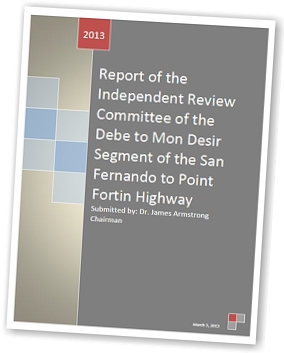
The Armstrong Reportcover-tilt was published in March 2013 after a process agreed between parties to the dispute over this highway link.  It is a significant achievement in the journey to a more considered and consultative approach to national development.  Given the shifting grounds of the dispute and the nature of the various statements, it is necessary to clarify some of the key issues.

The three main issues to be clarified are –

The Armstrong Report

The State’s position in relation to The Armstrong Report is a critical element of the dispute, so it is important to detail how this has morphed, like so much else in this matter.  The Ministry of Works & Infrastructure Press Statement of 3 December 2012welcomed the inputs…from the JCC, FITUN, T&T Transparency Institute and Working Women‘ and went on to note that ‘the discussions had been very fruitful‘.  That statement settled a basic framework for a Review of the elements of the link which were in dispute, with the preliminary Report to be provided within 60 days ‘to NIDCO for its consideration and publication thereafter’.  Some people have tried to restrict the meaning of NIDCO’s ‘consideration’ of The Armstrong Report to a merely editorial vetting which implied no commitment to any post-publication consideration.  The only conceivable reason for a party to this kind of process to have the right to review the preliminary Report would be to address factual errors in a situation in which the completed Report is of some significance.

At the post-Cabinet Press Briefing on Thursday 14 February 2013, the then ‘line Minister’ for NIDCO, Emmanuel George, said that the Report gave the State the ‘green light’, thanked the members of the Highway Review Committee and was reported to have agreed to ‘…as far as possible, accommodate their suggestions and recommendations…‘.

The only reasonable meaning to put to the State’s actions and agreements at the time was that there was a commitment to consider the recommendations of the Report.  Of course we are now hearing from officials that there was no commitment to adopt or consider any of the recommendations in The Armstrong Report.

As a reality check, just ask yourself what would have been the position if The Armstrong Report had fully vindicated the State’s actions.

You see?

The Highway Contract

The high cost of halting construction is the main argument being used by the State to criticise The Armstrong Report and in its litigation with the Highway Re-Route Movement (HRM).  On 25 February 2013, NIDCO wrote to JCC with its comments on the preliminary Report and the first page of that letter noted its concern that no consideration had been given to the fact that a $5.2Billion construction contract was in existence for this project. (Comment #2 on p. 30)  That complaint is fundamentally misplaced, to say the least, since technical and scientific reviews do not normally take financial or commercial elements into account as material considerations.

At the level of general principles, two examples can clarify the position. In the widely-used two-envelope tendering situations, the tenderers submit separate technical and financial proposals, which are examined independently, with points awarded for each.  The eventual selection is made after considering both those scores.

The most recent Commission of Enquiry was announced by the Prime Minister on 18 September 2014 into the HDC apartment blocks which had to be demolished in 2012 at Las Alturas in Morvant. (pp. 68-70) When HDC recognised that the stability of these newly-constructed hillside apartment blocks was in jeopardy, they obtained technical advice from professional engineers. It is doubtful whether those reports considered the financial and commercial fact that the building had already been erected or the losses that would accrue if they were to be demolished.  Very doubtful.  Indeed, one would rightly be suspicious of technical advice which was coloured by commercial considerations.

SIDEBAR: NIDCO’s reply to JCC

The JCC wrote to NIDCO on 10 October 2014 to request a detailed statement as to how the ten recommendations of The Armstrong Report had been treated and we met with NIDCO’s team on 17 October to discuss that request.  NIDCO agreed to provide the details to JCC by Friday 24 October, but that reply is still awaited at the time of this writing.

Now, to deal directly with NIDCO’s criticism of The Armstrong Report, we need to note two facts –

  1. Terms of Reference – If, despite the general principle, NIDCO had wished to have the construction contract for the highway considered alongside the other factors to be examined during the 60-day Review, it could have made that request.  The fact is that NIDCO never made that request, so the construction contract was not included in the terms of engagement for this review exercise.
  2. The Highway Review – If, having not requested that the construction contract be included in the review, NIDCO subsequently wanted it considered, there was an option to submit it. NIDCO never submitted the contract to the JCC or the Highway Review Committee.

Proceeding from the general principle to the particulars of this case, it is therefore clear why the Highway Review Committee did not consider the contract as part of the review process.

Note also that NIDCO has not submitted the contract to the Court during this extended litigation with the HRM.

Submitting the contract to either the Highway Review Committee or the Court would have exposed the underlying financial and commercial arrangements, as well as the repeated claims of adverse cost implications, to critical scrutiny.

Tender Truths

Lastly, there is now a series of new statements emerging from the HRM and its supporters which did not form part of the original concerns of that group. The most striking of these is that the highway contract was not tendered. That allegation can be found in the HRM’s International Media Release of 24th September 2014 on their Facebook page and on the AVAAZ campaign webpage, as well as in other media statements by various persons supporting the HRM.  That assertion is most alarming for two reasons.

Firstly, that is an entirely false assertion since the highway contract was tendered in 2010.  Consider this extract from the top of page 19 of The Armstrong Report

…On May 07, 2010, the closing date for this procurement, three proposals were submitted by 1.00 p.m. (from the 29 Request for Proposals issued)
The three entities submitting tenders were, in alphabetical order:

  1. China Railway Construction Corporation Limited;
  2. Construtora OAS Ltda (OAS); and
  3. GLF Construction Corporation…

On May 13, 2010 The NIDCO Evaluation Committee submitted its Final Report and recommended OAS as the Preferred Respondent, and so informed OAS by letter dated May 25, 2010…”

Secondly, those baseless assertions by the HRM show a lack of familiarity with the contents of The Armstrong Report.  The HRM has relied heavily upon The Armstrong Report in its recent campaigning, so one can only wonder at the implications of these repeated claims.
Given the public positions taken by the protagonists, it seems unlikely that mediation can be a real option.

The Armstrong Report is a serious advance in terms of our nation’s development, being to my knowledge the first Civil Society review of a State-sponsored project in the Caribbean region.  That Report would not have existed without Dr. Wayne Kublalsingh’s sacrifice, but the full benefits of the Report can only be realised by a proper and open consideration of its recommendations.  Only then can we gain from the increased public attention to the complex issues of national development and really start to learn the lessons.

National development is a real and inescapable challenge which will continue to evolve, whoever is in government.  That challenge can only be properly addressed by a fact-based approach adopted by all parties.

Money is the Problem

One of the big unanswered questions arising out of the recent ‘grand corruption’ cases in relation to the Public Sector remains – ‘How can we lawfully punish those wrongdoers who are looting our country?

Most discussions proceed along the lines of what I call the ‘bag of money‘ idea, in which we are looking for the actual stolen money.  The belief being that the stolen loot can actually be located and linked to the thieves, who will then face a harsh penalty.  My preferred solution is for full disgorgement of all the stolen monies as a starting-point, even if that is a remote goal.

In re-examining the issue practically, one has to ask “Why do we persist in these ‘pipe-dreams’, while ignoring the ‘low-hanging fruit’ all around us?”  So I am considering a new strategy for action on these critical issues.

‘Public Money’ is the term used to describe money due to or payable by the State, including those sums for which the State would be ultimately liable in the event of a default.  Public Money is sometimes called Taxpayers’ Money, it is our Money. Continue reading “Money is the Problem”

The Elephant in the Room – part 2

Port of Spain
Port of Spain

The recent announcements as to the upcoming completion of the ‘Government Campus Plaza’ offices in POS and the relocation of significant State agencies to central Trinidad are charged with meaning for the office sector. The previous article on this topic examined the huge quantity of State-owned incomplete office buildings in greater Port-of-Spain, the impact of that on the incomplete private office projects and the role of the ongoing process of decentralisation.  For the purposes of this discussion, greater POS is the area bounded by the sea to the South, the WestShore Clinic to the West, the Queen’s Park Savannah to the North and the Lady Young Road to the East. This is going to be a closer look at those aspects, so that we might discern how this issue is going to be settled. There are interlocking issues which have created the Elephant in the Room –

  1. the incomplete State offices, which will impact on the private office rental market as they are completed;
  2. the existing offices leased by the State, which need to be re-examined;
  3. the trend towards decentralisation, with its own profound implications.

To understand the issue requires the reconciliation of these large, seemingly-conflicting, elements.  The first is of course, the ‘sunk capital’ in terms of the State-owned, incomplete office buildings in POS.  The second is the existing leases the State holds from landlords of office space in POS.  The third element is the ongoing programme to relocate significant Ministries and State Agencies out of POS, generally to Central Trinidad.   I am also of the view that we need to enquire into the progress of the ongoing decentralisation process.  The details we need are – Which Ministries/State Agencies are to be relocated from POS?  What are the preferred locations for these offices?  What progress has been made on those relocations?   Has land been purchased/leased?  Has State land been allocated? Has a building been identified?  If a new building is to be constructed, what progress has been made in terms of project scoping, design, tendering and construction?  When are these new non-POS State offices anticipated to be occupied? The key enquiries in this matter would be –

  • State Leases

    We need to know exactly what offices the State is leasing and that info would include – the Ministry or State Agency in occupation; the addresses of the buildings; the size of the office space and its facilities; the number of carparking spaces; the rent paid; the service charge paid; the parties; the extent of the lease/tenancy agreement (when did the lease start and for how long was it agreed).  Apart from the info being presented in that type of detail for each rental, the overall picture will be instructive, as it will show the amount of space occupied  and at what cost. That information will in turn disclose the average (mean) rent per square foot paid.  Without details on the present arrangements for State offices, we cannot properly judge the alternatives.

  • Empty Buildings

    Alexandra PlaceAn additional enquiry has to be raised on the particular instances where the State is paying a rent for property which remains unoccupied.  The same details listed above need to be sought in those cases, but in addition, we need to be told why those properties are still unused.  A great concern was raised recently on #One Alexandra, which concern was mostly justified in my opinion, but the fact is that it is not the only one.  The public needs to be told the full extent to which the State pays rent for unoccupied offices.
  • Re-location progress

    On 2 April 2014, Minister of Planning & Sustainable Development, Dr. Bhoe Tewarie, gave some details in the Senate on these relocations –

    • Ministry of Tertiary Education and Skills Training and some of its portfolio agencies are to be relocated to an ‘integrated administrative complex‘ 15-acre site north of the Divali Nagar on the eastern side of the Uriah Butler Highway. No size was given for the complex and construction was noted to have started in April 2014.
    • Ministry of Community Development is to be relocated to new offices at a 10-acre site near the Divali Nagar on the eastern side of the Uriah Butler Highway. No size or start-date was given for these offices.
    • Ministry of Food Production is considering relocating out of its long-established offices at St. Clair Circle, at the northern end of the Magnificent Seven strip, to either Chaguanas or Farm Road in Curepe.  That decision is pending.

    COSTATT2-595x340

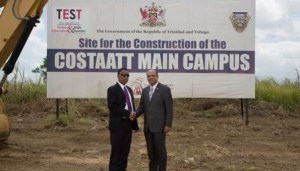
    In the last week we have been told that the headquarters of COSTAATT, which is a part of UTT, is to be relocated from Melville Lane in POS to a location near the new Chaguanas Administrative Complex.   The main building occupied by COSTAATT is said to comprise 86,000sf, which is rented for $13.00psf – the total annual rent is $13.473M.  We were also told that COSTAATT’s POS operations require further rental space to the annual amount of $1.64M.  The new building is costing $168M inclusive of VAT, but no details were given as to its size or proposed completion date.  There are other relevant questions as to the convenience of the new location for students and faculty, but the fact that Chaguanas remains the fastest-expanding town in the country for the past 20 years is a part of that issue.

  • UDECOTT’s rollout

    governmentcampus
    Government Campus

    As per the previous article in this series, the State has built, but not completed, a total of 1,329,000sf of offices in POS.  According to Minister of Finance & the Economy, Larry Howai, on 5 May 2014 –  “Cabinet has approved a sum of approximately $1.5 billion to complete the Government Campus buildings in downtown Port-of-Spain,” said Howai. Once this is completed in the next 12 months I expect that the OSH problems being complained of at the BIR will be a thing of the past.”

    That Cabinet approval equates to $1,129 per sq ft, which seems high unless one considers that a significant part of that money is stated to be for remedial works and not strictly for fittings and finishes. The impending completion of those offices will be a sea-change in the fortunes of POS, since their occupation will force the landlords who were renting to the State to seek other tenants. In my estimation at least half the rented offices in the capital are occupied by the State, so that office market is largely driven by the public sector.

    I have heard many colleagues attempting to rationalise the coming change by reference to OSHA requirements which require more office space allocated to each worker and therefore those requirements would ease the impact of the impending new offices.  Another rationalisation I have heard is the one about how some landlords would be leaving their places locked-up so they will not actually be offering those on the market, so there will be no real effect and so on.

All of those are coping mechanisms for dealing with the reality of change on an epic scale.  This is the Manning Plan, in full effect.  To quote the CEO of leading private sector office developer, RGM, Gerard Darcy, in a May 2013 interview  – “…The Government Campus is still the 800-pound gorilla in the room because it is too large to ignore…”.  I expect a significant adjustment in office rent levels in POS in the medium term. The financial sector, especially those who have expanded their loan portfolios on the basis of the property boom, will need to take careful stock of the extent to which these rapidly-approaching changes imply severely impaired assets.

TSTT Inquiry

The Trinidad & Tobago Parliament is now conducting an Inquiry into TSTT and this article is an edited version of my submission to that Inquiry.

The Joint Select Committee’s (JSC) ‘Invitation for Written Submissions‘ was published on the TT Parliament website on Wednesday 23 April 2014, with the deadline for submissions set at 4:00 pm on Friday 2 May 2014. Only ten (10) days.

When one considers the far-reaching scope of the Inquiry as specified in its ten (10) objectives; the size and role of TSTT and the recent published reports as to the proposals for the State to relinquish a critical 2% of its share in TSTT, it is clear that these matters are of the utmost, long-term public importance. Placed in that context, the JSC decision to Inquire into these matters is commendable, but the time-frame is so short as to raise serious doubts as to the quantity and quality of submissions which could comply.

The deadline for submissions to this JSC Inquiry should be extended to allow a greater degree of public and stakeholder participation.

This submission is focused on the third of the Inquiry’s ten objectives –

  1. “ To determine the adequacy and effectiveness of the Company’s policies and procedures as it pertains to ensuring accountability, transparency and sound Corporate Governance in its operations and to determine whether these are being adhered to…“

It is my considered view that TSTT has engaged in a series of determined and long-range legal manoeuvres to place itself outside two of our Republic’s principal accountability and transparency laws. Those two laws are the Integrity in Public Life Act and the Freedom of Information Act.

The Integrity in Public Life Act

ictt-vs-tsttThe Integrity in Public Life Act established the Integrity Commission, which states its role to be “…to promote integrity, particularly among “persons in public life” – from the level of Ministers of Government and Members of Parliament to Permanent Secretaries, Chief Technical Officers and members of the Boards of Statutory Bodies and State Enterprises…

In 2005, the Integrity Commission applied to the High Court for an interpretation of its remit, the particular aspect of that matter which has a bearing on this Inquiry was specified at para 1. (2) of the Court’s ruling in that case –

“(2) What is the meaning of the expression ― “Members of the Boards of all Statutory Bodies and State Enterprises including those bodies in which the State has a controlling interest” in paragraph 9 of the Schedule to the Integrity in Public Life Act as amended?”

TSTT was granted leave to be heard on the application, according to paras 3 & 4 of that ruling.

In 2007, the High Court ruled, in relation to that aspect that the IPLA applied to Directors of State Enterprises and bodies in which the State had a controlling interest. The plain meaning of which was that TSTT’s Directors were required to comply with the provisions of the IPLA.

TSTT appealed that ruling, once again seeking to place its Directors outside the remit of the IPLA. That appeal was part of the deliberate, long-term series of legal actions by TSTT to challenge the stated intent of the Integrity Commission in relation to its Directors. The fact that the legal action proceeded that far is ample testimony to the support extended by the government (the Executive) to TSTT in this endeavour.

On 27 June 2013, the Appeal Court ruled that –

CONCLUSION

  1. TSTT is not a State Enterprise. The members of its Board are not subject to the Integrity Provisions.”

That ruling marked the successful completion of the TSTT campaign to remove itself from oversight by the Integrity Commission.

One could view these events as being the lawful exercise of various parties’ rights to seek the Courts’ interpretation of the law and the result as being the product of due deliberation.

That view is too limited, since the wider constitutional question is begged as to the true intent of Parliament in creating the IPLA. This situation represents nothing less than an open dismantling of the clear intentions of Parliament by the concerted actions of the Executive and its agents, together with the independent Integrity Commission.

On 6 October 2000, the Parliament passed the IPLA, but on 13 October 2000, the Parliament passed an amendment to the Schedule of the IPLA. The clear intention of the Parliament in approving that amendment was to include members of the Boards of State Enterprises and those bodies in which the State has a controlling interest.

The intended result of this TSTT litigation was to remove its Directors from Integrity Commission oversight and that was achieved. The intended will of the Parliament was effectively frustrated by these legal manouevres.

The Freedom of Information Act

The Freedom of Information Act 1999 is intended to give the public the right to obtain information about Public Authorities. The Freedom of Information Unit (within the Office of the Prime Minister) provides a list of Public Authorities which are subject to the provisions of the FoIA. TSTT is listed as the 145th on that list of 199 No. Public Authorities.

On 17 January 2006, Magdalene Samaroo filed suit against TSTT under the Freedom of Information Act to obtain publication of a copy of “…the letter from the Integrity Commission to the Directors of the Board of TSTT informing them that they are not required to give annual declarations…in accordance with the IPLA as amended…”.

The requested letter is itself astounding, given that it would appear to be a formal undertaking from the Integrity Commission intended to subvert the law requiring that Directors of State Enterprises submit declarations to the said Commission. As far as I know, the existence of that letter has never been officially denied.

On 19 July 2010, the High Court ruled that TSTT is a Public Authority (para 18) and further, that it was required to provide the requested documents (para 25).

TSTT filed an appeal against that ruling, which ended in a final hearing before the Appeal Court on 28 October 2013.

The appeal was compromised by consent, meaning that the parties agreed to end the litigation, so costs were not awarded by the Appeal Court. The Court, having accepted that the matter was at a close, went on to set aside the 2010 ruling by the late Justice Carlton Best. To cite the transcript of that final hearing

“…we can say that the appeal is compromised, we can set aside the decision of Justice Best and enter the Order that there be no Order to costs which does three things, or two things, at least: it meets your agreement; it removes the precedent that is creating some difficulty for you…” (emphasis mine)

The action of the Appeal Court in removing the difficult precedent facilitated TSTT in achieving its desired outcome of no transparency or accountability in relation to these issues.

Here again, we are witness to another determined effort by TSTT to seek the assistance of the Courts to frustrate the proper intentions of the Parliament.

I asked the Inquiry to recommend to Parliament that it –

  • Rectify the contradiction arising from the Appeal Court judgment in #30 of 2008 with respect to TSTT’s obligations under the IPLA. The Parliament must ensure that TSTT is formally and conclusively brought within Integrity Commission oversight, as is the case for all State Enterprises.
  • Ensure prompt publication of the Integrity Commission’s letters to the TSTT Directors exempting them from compliance with their obligations under the IPLA.
  • Ensure TSTT’s compliance with the provisions of the Freedom of Information Act, as lawfully required for all Public Authorities.

There is now the unacceptable contradiction of a JSC of our Parliament convening this Inquiry into TSTT’s operations, in the proper exercise of its supervisory responsibility for that State Enterprise, while the Appeal Court has ruled that TSTT is not a State Enterprise for the purposes of the IPLA. As I complete this column, TSTT officials are live on the Parliament channel giving evidence to this Inquiry on Friday 9 May.

To add to the brew, Cable & Wireless, the 49% shareholder in TSTT, is proposing that the State relinquish 2% of its shareholding into an arrangement which would effectively end State control of this important national asset.

How can we find out what is the true position of TSTT in our nation’s affairs if our lawful rights to accountability and transparency into its operations are being eroded in this fashion?

This unacceptable situation is a challenge to the Parliament to reassert its proper authority in this matter.

Submission to Joint Select Committee Inquiry into the administration and operations of TSTT

In response to an invitation for written submissions to the Joint Select Committee of Parliament on Ministries, Statutory Authorities and State Enterprises (Group 2) Inquiry into the administration and operations of the Telecommunications Services of Trinidad and Tobago, I delivered the following:

From: jscgroup2 <jscgroup2@ttparliament.org>
Date: Mon, May 5, 2014 at 9:32 AM
Subject: RE: Public Enquiry into TSTT
To: Afra Raymond <afraraymond@gmail.com>
Cc: Candice Skerrette <cskerrette@ttparliament.org>Dear Mr. Raymond,

On behalf of the Committee, I extend sincere gratitude for your response to the Committee’s request for submissions regarding its inquiry into the operations of TSTT. The Committee will consider your comments and if necessary, may seek to engage with you further.

In addition, the Committee is expected to convene a Public Hearing with officials of TSTT on Friday May 09, 2014 at 10:00am. This hearing will be aired LIVE on the Parliament Channel.

Best regards,

Julien Ogilvie
Secretary to the Committee

Parliament of the Republic of Trinidad & Tobago
G-7 Tower D, Port of Spain International Waterfront Centre
1A Wrightson Road, Port of Spain, Trinidad
PBX: +1 (868) 624-PARL(7275) Ext 2277 FAX: +1 (868) 625-4672 EMAIL: jogilvie@ttparliament.org

ttparliament.org | facebook/TTparliament | twitter/TTParliament

Disclaimer: This email, any file(s) it may contain or have attached and transmitted with it are the property of the Office of the Parliament of the Republic of Trinidad and Tobago and therefore deemed private and confidential. It is intended solely for the use of the individual(s) listed in the address. If you have received this email in error please immediately notify the sender and permanently delete the email. Further, as you are not the intended recipient, you are hereby notified that any review, dissemination, disclosure, alteration, printing, copying or transmission of this e-mail or any file(s) contained is strictly prohibited and might have legal implications if treated with, in any other manner than stated prior.

G2G Policy

The current Government to Government (G2G) arrangements are a direct threat to our country’s fundamental interests.

The key element of the G2G arrangement is that a larger, more advanced, country will assist a smaller, less-advanced country by building or operating complex facilities which are beyond the reach of the smaller state.

One of the features the G2G arrangements have in common with the other large-scale projects is the high degree of secrecy with which the proposals are developed.  That secrecy raises doubts as to whether proper Needs Assessments are undertaken and as to the degree to which the views of citizens and stakeholders are sought, far less considered.  The fundamental issue as to the necessity for these projects is thus routinely sidelined, which is inimical to the public interest.

The main criticisms of the G2G arrangements are –

  • Sidelining of the elementary Tendering Process – the procurement process is effectively outsourced, since the more powerful country has the right to select the contractor;
  • Limited, if any, role for Local Participation in terms of labour, professionals, suppliers, or contractors;
  • Weak or nonexistent contract controls, due to the disparity in power between the parties;
  • Serious drain on Foreign Exchange;
  • Lack of the promised Transfer of Technology.

These arrangements have been heavily criticised in our country for almost 35 years, starting with Winston Riley’s October 1979 paper which identified many of the emerging problems.  As a result of that rising tide of criticism, an official enquiry was established by then PM, George Chambers.  In March 1982, the Ballah Report was published and the G2G programme was brought to a halt as a result of its dire findings.

Despite the learning, successive political administrations seem unable to resist the appeal of these G2G arrangements, so we have today’s situation as shown in the table.

Physical Development Projects via G2G – April 2014

Readers who access this article online can view the background info via the hyperlinks

COUNTRY PROJECT/S DATE AMOUNT COMMENTS
CHINA NAPA – North & South 2008
  • TT$818M as’final cost’
  • TT$207M for ‘remedial works’
NAPA (POS) completed in 2009, NAPA (San Fernando) completed in 2012stated final cost of both projects was $130M USD ($818M TTD). A further $207M was borrowed from EXIM Bank of China in 2011 for ‘remedial works‘ on NAPA (POS). Design & Build contractor was Shanghai Construction Group.
AUSTRIA San Fernando Teaching Hospital 2011 TT$739M Opened in January 2014
CANADA Penal Hospital 2012 Undisclosed Involvement with Canada’s nominated designer SNC-Lavalin was discontinued after serious concerns over that firm’s international banning for corrupt business practices.
CHINA
  1. Couva Children’s Hospital,
  2. three national sports facilities in Couva,
  3. three multi-sports facilities in other parts of the country.
2012 TT$1.8 Billion Loan Agreement signed in March 2013 with EXIM Bank of China, with Shanghai Construction Group selected as the contractor for all the projects.These projects include the swimming & cycling complex at Balmain and the sporting complex at Tacarigua Savannah in Orange Grove.
CHINA Lake Asphalt 2013 Undisclosed MoU, with a Confidentiality Agreement, signed on 30 May 2013 between Lake Asphalt T&T Ltd and a Chinese contractor. One of the official objectives of the February 2014 State visit to China, according to the Office of the PM, was “…Removal of asphalt from the Pitch Lake in greater capacities…”.
CHINA La Brea Port and seven industrial parks. 2014 US$750M (TT$4.83 Billion) Agreement signed in February 2014 to have these facilities built by China Harbour and China Construction.

The total cost of these projects is just under $8.4 Billion TTD.
That is the background, against which we must consider these further elements –

  • china-caricomRegional Strategy – As a leading nation within CARICOM, it is important for Trinidad & Tobago to give serious consideration to the role of the various bilateral G2G arrangements China is pursuing in our region and the implications of those arrangements on our aspirations for healthy regionalism.  I have been reading the February 2013 Research Note by UWI’s Dr. Annita Montoute – ‘Caribbean-China Economic Relations: what are the Implications?‘  The scope of Dr. Montoute’s research and her findings are sobering – at pg 115  “…CARICOM Trade with China is on the increase; however it is overwhelmingly in China’s favour…”.  The regional issue is a serious one to which we must address our energies.
  • Trinidad & Tobago’s Strategy – Now consider these statements by then Finance Minister, Winston Dookeran, at the September 2011 ceremony to sign the $207M TTD loan for NAPA (POS) ‘remedial works’ –

    “…Dookeran said it was now imperative that TT deepens its ties with China…’In the first instance China has now emerged as a very significant player, especially in light of the recent tremors and uncertainties in the world economy,’ he said. ‘China…is now an economy that we will have to rely upon. It is in that context that it is very appropriate and timely for Trinidad and Tobago to start to intensify its relationship with China.’..”

    Winston Dookeran is now Trinidad & Tobago’s Minister of Foreign Affairs.

  • The Uff Report – The 42nd and 43rd recommendations of the 2010 Uff Report deal directly with this  issue –
    1. The Government’s policy on the use of foreign contractors and consultants for public construction projects should be transparent and open to review.
    2. Local contractors and consultants who compete with foreign companies should be provided with the same or equivalent benefits as enjoyed by those foreign companies and should be protected from unfair competition through matters such as soft loans…

    Uff was calling for the establishment of a national policy on this series of issues and the JCC has been requesting a consultation between government and stakeholders, so that a proper strategy can be developed in open collaboration. That would include labour, professionals, the State, the contracting sector and all the associated elements such as suppliers of building materials, financiers, skills training and so on.  The JCC wrote to the PM on this in April 2012, but to date there has been no response to our calls for those consultations in the national interest.

  • NAPA, again – The Minister of Culture, Dr. Lincoln Douglas, told the Senate on 8 April 2014 of the serious issues arising at NAPA (POS), with an estimated further $100M being required for more repairs.  It is not certain if the issues of disrepair are all due to inadequate maintenance, but it is unacceptable for such issues to have emerged for a structure less than 5 years old.
  • Shanghai Construction Group – Despite the bad record at NAPA, the selected contractor for the $1.8 Billion Couva Children’s Hospital and the other sporting facilities is the said Shanghai Construction Group.
  • Proposed Public Procurement Law – most alarmingly, Clause 7 of the proposed Public Procurement & Disposal of Public Property Bill 2014 specifically excludes Government to Government Arrangements and projects funded by International Financial Institutions from oversight.  That proposed exclusion is entirely unacceptable as it further jeopardises our national interest.

The PM has made a call for a National Conversation and this is one topic which needs addressing. Our country cannot continue exporting our jobs, capital and skilled people in favour of unexamined and undisclosed foreign policies.