From THA/BOLT to Calcutta – tangled webs: Part 2

Last week I set out my main concerns in relation to poor procurement processes with the THA/BOLT project.  A large amount of Public Money was being committed to a project with little apparent regard to Value for Money concerns in an arrangement which seems to expose the THA to the principal risks at a time of limited financial resources.

This article is a critical examination of the controversial proposed purchase of 50.6 acres of land at Calcutta Settlement by the Housing Development Corporation (HDC).

The HDC’s role is to build and maintain homes to satisfy the requirements of its main client, the Ministry of Housing and the Environment.  According to that Ministry –

The Corporation is mandated by the Act to:

  • Provide affordable shelter and associated community facilities for low and middle income persons and;
  • Carry out the broad policy of the Government in relation to housing.

With over 125,000 applicants on the HDC’s waiting-list, there is no doubt that, for many poor people, the HDC is their only hope of getting a reasonably affordable home of decent quality.  That means that the HDC is an important implementing agency in our nation’s welfare provisions, which is a role I fully support.

edengardensplanThis post is about ‘Eden Gardens’, which is on the western side of Calcutta Settlement Road No. 2 in Freeport, just north of Central Park, opposite to Madoo Trace.  The property comprises 264 residential lots at an average size of 5,600 square feet, 2 residential/commercial lots, 2 nursery school sites, 2 recreation grounds and 4 playgrounds.

In November 2011, the HDC obtained a valuation from Linden Scott & Associates at $52M.  In January 2012, the owners of Eden Gardens, Point Lisas Park Limited, offered the property to the HDC at $200M.

That is an intriguing sequence of events, since the HDC would hardly pay for a valuation on a property they were not interested in.  If we accept that the property was likely offered to the HDC before they ordered the Scott valuation, then one has to ask on what terms was it offered.  That letter of offer, the original one, must be disclosed now.

In April 2012 the Commissioner of Valuations advised the HDC that the current open market value of the property was $180M.  In June 2012 Cabinet approved the HDC purchase of that property for $175M, which is $663,000 per lot – at an average lot size of 5,600sf that equates to $118 per sf.

The normal professional and commercial practice when buying in this quantity, is to obtain a discount on the unit price.  It would be reasonable to expect that these lots could be sold for significantly more than the HDC agreed to pay.  We will see.

There was a lot of argument in the public about this transaction, so I was prompted to look closely at the deal.

I have these serious concerns –

  1. Point Lisas Park Limited (PLP)
    1. On 1 June 2004, Anthony Sampath, Patrick Soo Ting and Azad Niamat agreed with the owner, Sookdeo Deousaran, to buy the property for $17M. That Sale Agreement is registered as deed # DE2006 023638 20D001.
    2. On 26 April 2007, PLP was incorporated as Co. # P2956 (95), with the same three individuals who agreed to buy the property for $17M as its Directors.  On 6 May 2011, the Companies Register recorded that  Kayam Mohammed became a Director.
    3. On 3 February 2010, according to deed # DE2010 007816 95D001, PLP purchased the property from Sookdeo Deousaran for $5M, paying Stamp Duty of $350,000.

    These purchasers were prepared to pay $17M for this undeveloped property in mid-2004, but ended up paying only $5M for it in early 2010.  This is the same property which was offered to the HDC at $200M in early 2012, two years later.  Literally unbelievable.

    calcutta-timeline_v4

    The stated payment of $5M shown in that 2010 deed is a massive understatement of value, probably being only 10% of the true market value.  The Stamp Duty properly payable on a $50M sale of land would have been $3.5M.  The Stamp Duty Section of the Board of Inland Revenue has the discretion to refer transactions to the Commissioner of Valuations in cases where they suspect that the consideration shown on the deeds is understated.  I am reliably informed that in this case the BIR did not seek an opinion from the Commissioner of Valuations.

    I am calling for that 2010 transaction to be revisited immediately, with a view to the State recouping the proper Stamp Duty.  The Public Interest demands no less.

  2. The missing link 
    163940Between 2004 and 2012, the infrastructure for Eden Gardens was built, which included the roads, street lights, drains, water and electricity supply. Eden Gardens lots were available in 2011 via at least two real estate agents – Golden Key Real Estate Ltd. and Samko Realty – at $400,000 per lot.  This was widely advertised.
  3. The valuations
    • Linden Scott & Associates in November 2011 – $52M
    • Commissioner of Valuations in April 2012 – $180M

    Those lots were known to have been on sale at $400,000 in 2011, so the entire development of 264 lots could have earned its owners a total of say $106M.  Even if we allow a figure of $5M for the “2 residential/commercial lots and the 2 nursery school sites”, we are still in the range of $110M as the ‘Gross Development Value’.

    Given that these lots were clearly not selling at the $400,000 price-point, those estimates are at the upper end of possibility.  Which means that we have to adopt a lower ‘Gross Development Value’, say $95M-100M.

    If the entire development is to be acquired by a single purchaser in early 2012, that purchaser must deduct from the Gross Development Value to cater for –

    • Stamp Duty – at 7% of the Purchase Price;
    • Legal Fees;
    • Developer’s Profit – at a minimum of 25%;
    • Agents’ fees for the sale of the lots;
    • Cost of Finance to account for the cost of borrowing that sum until the lots are sold;
    • Time Value of Money, to account for the element of delay in recouping one’s investment.

    I estimate that those discounts would amount to 35-40% of the Gross Development Value.  If we adopt that approach, the maximum net present value of Eden Gardens in early 2012 as a fully-infrastructured property would be in the $60M range.

The meaning of it all

The usual accepted practice of residential development can be expressed by this ‘rule-of-thumb’, to spend less than twice the cost of the lot does not make best use of that land.

Even if we ignore the ‘rule-of-thumb’, one has to wonder

In what way does this transaction satisfy the HDC’s mandate?

It is most disturbing that there has been this amount of debate without the issue of the end-user ever being mentioned.  How do the real needs of the homeless feature in this massive HDC transaction, if at all?

To my mind this Calcutta Settlement scheme resembles the HDC’s flagship project at Fidelis Heights in St. Augustine which created an elaborate, expensive multiple-family project with no allocation of new homes to the needy people on the waiting-list.

I have established via a separate enquiry that only about 2% of the HDC output of new homes is allocated to those who can only afford to rent and this project is likely to be a continuation of that detrimental trend.  The HDC continues to allocate vast sums of money to housing those who can afford to buy, while leaving the left-overs for those who can only afford to rent.  That policy is inimical to the interest of the poorest members of the public, to whom the HDC is literally the last refuge for decent housing.

In all the circumstances, it seems that we need to have the air cleared on these issues –

  • What is being done about the under-stated consideration in the 2010 deed for the sale of Eden Gardens?
  • How many of the 264 lots were sold at the 2011 asking-price of $400,000?  That is important since it establishes a benchmark for the proper value of these lots in the open market.
  • When did Eden Gardens receive all the required approvals?
  • When was the infrastructure completed at Eden Gardens?
  • On what terms was Eden Gardens originally offered to the HDC?
  • There is an abundance of develop-able State-owned lands in the vicinity, particularly since the 2004 closure of Caroni Ltd.  So why did Cabinet agree to buy private lands in Calcutta Settlement at these prices?
  • Who owns Point Lisas Park Limited?

I close by reminding readers of the corruption ratio set out in the first article.  As I wrote in June 2008, referring to the Manning government and its UDECOTT antics –

…Either the Cabinet or its advisers are responsible. We are either dealing with a lack of rectitude at the highest level of our republic or a sobering naivete…

Declarations

  • Raymond & Pierre Limited, under my leadership, provided certain professional advice on this property in 2007.  No aspect of that advice has formed part of this article.
  • Linden Scott is a former colleague of mine, having trained at Raymond & Pierre Limited.  He is now a rival professional.
  • Raymond & Pierre Limited have provided professional advice to the HDC in the past.

Property Matters – Only a matter of time

whooshThe way the Ministry of Planning & the Economy (MPE) is persisting in their course of action on the Invader’s Bay development is perturbing in terms of the long term consequences of short-term decision-making.
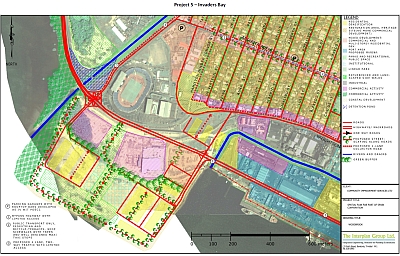
At Section 2.0 of the Request for Proposals (RFP) for Invader’s Bay we read

…For Trinidad and Tobago this is a “major waterfront transformation” along the line of other signature waterfront developments such as Darling Habour (sic) in Sydney, Baltimore Inner Habour (sic), the Habour-front (sic) in Toronto, London Docklands and Teleport City in Tokyo. Although the genesis of the projects may vary, the result has generally been bold and dramatic. With the change in the manner in which ports operate and cargo is transported, waterfront property is now more valuable for its residential, retail and recreational function than simply for port activity with heavy industry, docks and fenced off warehouses, as is the case currently in Port of Spain…

We are being asked to consider the Invader’s Bay initiative ‘along the line’ of other leading international examples, which in itself is a good place to proceed from.  The reality is that those developments cited by the MPE all took decades to conceive and what is more, the authors of the RFP know that.  Yet we are also being asked to believe that a workable concept/s could be devised for Invader’s Bay in an RFP which is silent on the current strategic plans for the capital and only gives proposers 6 weeks to prepare.

Of course the lack of consultation will severely limit the participation of many important developers, not to mention the public.

The point is that in all those cities cited by the RFP, there is a serious commitment to consultation, which means that those large-scale transformations took considerable time to conceptualise.

In the city of New York, for example, there has been a long-standing commitment to community-based development.  Check this 6 October webcast from The New School – the introduction is instructive –

For decades, deliberations over land use in New York City have included developers, community boards, elected officials, the Department of City Planning and other city agencies. Do the people who live and work in city neighborhoods have a sufficient voice? Do residents improve the process, or impede progress? Who is best positioned to determine a neighborhood’s needs, and what are the best structures for public participation? New York has long been a leader in community-based development but as the city recovers from the Great Recession, what does the future hold?

And that is just one reference, readers can ‘Google’ to find the many other supportive examples.  In the very RFP, as well as in the recent budget, there is a clear commitment to consultation in national development.  Except in this case.

But there is more.

As I wrote in the opening of ‘Reflections on Republic Day’, on the Raymond & Pierre website on 27 September 2007 –

The best example I can think of for the kind of broad commitment to consultation is, of course, the site of the World Trade Centre in Lower Manhattan: Ground Zero. This is a very interesting example since the site is privately owned and the City of New York is controlled by the Democrats while the Republicans control the national government of the USA. Against this background of different players we have the fact that the destruction of the WTC was a most severe blow to US prestige and power. The entire defense apparatus was rendered useless by that attack. Arguably, there could be no site in the world with a more urgent claim to large-scale redevelopment.

Yet, the fact is that a sort of compact has been arrived at between the parties to the effect that no redevelopment will take place unless and until everyone has had their say. For example, there was a recently concluded international competition for the design of the 911 Memorial. There were over 5,000 entries from more than 60 countries and a winner was just selected.

As expected, the consultations have been controversial and emotional but the fact is that an environment existed in which such an understanding could work. Whatever one’s view of the American imperium, there is a potency to the existence of that huge crater at the heart of their main city while the necessary conversations go on. Time for us to think again.

At that time I was protesting the haste and waste of the then PNM regime, a consequence of their pattern of proceeding with huge developments without any consultation.

At Section 3.1 of the RFP –

TENURE ARRANGEMENT

The proposed Developer will be chosen via this RFP process and shall then enter into a Memorandum of Understanding (MOU) with the Government of Trinidad and Tobago (Ministry of Planning and the Economy) for an agreed lease rate. It is expected that this activity would be finalized within one (1) month of the submission of the said RFP.

Which means that we can expect the choice of the proposed Developer will be made and the lease agreements completed in one month from the closing date. Yes, Friday 4 November.

Sad to say, there is even more.  The RFP also specifies –

“…If financing has to be sourced from an external source, the Developer MUST submit a letter of guarantee from the financier as well as a profile of the financier. Failure to comply with this requirement will result in disqualification…”

When we raised the point that this is an impossible condition for new bidders to satisfy, given the sheer scale of the proposed development, both Ministers – Tewarie and Cadiz – attempted to indicate that this mandatory condition was flexible. Unbelievable, but true.

As leaders, whether in government or non-governmental organisations, we have an obligation to learn from the past. This is an effort to document the events in this episode, so that there will be a record, when the Invader’s Bay matter comes to be critically examined in the future.

The clear inconsistency of the position taken in the budget on urban planning was highlighted in last week’s column. With respect to this project, we noted the attempt to cast this development in the same light as other examples which all involved long-term consultation, the silence on the existing plans, the impossibly-short timetable to elicit fresh proposals, the even-shorter timetable for selection and agreement of lease terms, the wobbling on the financial requirements and incredibly, that the scoring criteria were to be finalized after the proposals were submitted.

It is literally impossible to determine which of these is worse than the others and it is beyond the imagination of any fiction writer I know to take a plot this far. But this is what is happening in our country today.

In my mind, all of these, taken together, show that the publication of the RFP is a form of sham dialogue and openness. If this is the genuine attempt by the MPE, to properly seek the public interest, then I am giving them an ‘F’ for effort.

What we are seeing here is a recipe for disaster, we already have all the ingredients of corruption, so what is next?

It really does make me wonder who runs this country and when, if ever, can we achieve consistent and equitable government. Who is the real power?

Property Matters – The Needs Assessment

The Ministry of Planning & the Economy (MPE) announced last week that 10 proposals had been received in response to its RFP for Invader’s Bay.

Given that MPE has not carried out a Needs Assessment for this prime property, for whatever reason, I will continue to outline the relevant elements for the Invader’s Bay property.  This is not intended to be complete, just a list of what I consider to be the critical items a proper Needs Assessment would include –

  • Investment – This is a parcel of land estimated to be worth at least $1.0Bn, so any attempt to describe this process as ‘not being an investment’ would be completely wrong.  In the literal sense, it might not involve any expenditure of State money, but, in every other sense, the disposal of this $1.0Bn asset would constitute a major State investment in Invader’s Bay.
  • The National Interest – At this moment the imperative is to diversify our economy so as to find sustainable replacements for our declining energy revenues, so this is an apt point.  Following on last week’s column, it seems reckless that such an attractive State-owned property would be developed without consideration of the strategic issue.  Even on the conventional basis of announcements of construction jobs and permanent jobs etc., it is difficult on purely financial grounds to justify most types of development on that site, especially given the generally depressed market.  The decisive factor, given the level of interest such a unique offering is likely to attract, would be to have as an identified ‘Need’ that only projects which were net earners of foreign exchange would be considered.  Such a condition would eliminate any offices, apartments, foreign franchise restaurants or shopping malls and set the stage for a different development discussion.  A necessary discussion at this point in our country.  Please note that the RFP does state that the project should generate foreign exchange, but that is only expressed as an ‘expectation’, which is far too flexible, given the influence of the traditional property developers.  If the intention is genuinely to break with the past and set off in a new direction, the conditions need to be strong enough to break the grip of the past.
  • Balanced Development and Lagging areas – The RFP speaks to these concerns as follows – “The Government recognizes the value of long term planning as well as problems created when long term planning is ignored. In order to ensure balanced development and restore lagging areas, care must be taken in the development of new areas…”  Those are real concerns, but they seem at odds with the intention of the RFP, since the execution of that plan gives us yet another major development in our capital.  We should consider if this is an area we want to develop at this time – bearing in mind that scarce private-sector resources may be required in other part of the country – for instance, the San Fernando Waterfront and other areas – so that development can be balanced instead of continuing the last administration’s emphasis on POS.  The sidebar contains a comparison of three large-scale ‘urban development’ districts which formed part of the budget.

There is always the question of who controls the terms of these public debates.  The intention from this side is to have that flawed RFP withdrawn.  To proceed as things stand is to continue on a path which lacks the necessary transparency and public participation.  The quantities of money involved and the absence of those critical elements means that we would be proceeding with all the ingredients for corruption.

This RFP amounts to an invitation to tender, so the bogus idea that this is just a discussion or consideration of proposals must be discredited.  It is nothing of the sort.   This RFP is a tender process to put these valuable public lands into private hands, which is quite different from a consultation.  We have to stop any attempt to mix-up the two processes.

The State and its agencies have an over-riding obligation to be exemplary in their conduct.

SIDEBAR – A budget comparison

The 2012 budget sets out three urban development projects, at pages 31 and 32 –

  • Invader’s Bay – “…significant interest has been expressed in the transformation of the waterfront along Invader’s Bay. This development has great potential for promoting commercial activities in the services sector and will benefit the country significantly. Such projects are meant to be private sector initiatives utilizing green building technologies and will assist in making Trinidad and Tobago an attractive destination for new investments…”
  • Sustainable City Project – East Port of Spain – “…This initiative, is part of a wider “Emerging and Sustainable Cities Initiative” supported by the Inter-American Development Bank of which Port of Spain has been chosen as one of the five pilot cities from170 eligible cities in the hemisphere…This project is being developed in partnership with the East Port of Spain Council of Community Organizations, the Caribbean Network for Urban and Land Management at UWI, the East Port of Spain Development Company, and other key stakeholders. This exercise has also engaged the Making Life Important Initiative of the Ministry of National Security…”
  • Chaguaramas – “…the Chaguaramus Development Authority is spearheading development in the North-Western region and a master plan detailing land use proposals for that region will soon be subject to public discussion…”

Of course those three proposals are favouring Trinidad’s north-west peninsula, which returns to the theme of balanced development, but a further description of their relative merits is beyond the scope of this article.  I am inviting readers to consider the varying approaches to an important long-term large-scale issue such as urban development.

In the cases of east POS and Chaguaramas, the commitment to widespread consultation is manifest, yet there is no such commitment evident in the case of Invader’s Bay, which seems to me to be ‘the jewel in the crown’.  The three current strategic plans for POS, all paid for by Public Money, are being ignored by the very Ministry responsible for Planning.

Good Public Administration requires actions which foster the confidence and trust of the public, that is indisputable.  Those policies and actions must be transparent, reasonable and, above all, consistent, if the public is to place real trust in the hands of the administration.

For all those reasons, it is unwise for any administration to operate in an inconsistent fashion.

In the case of Invader’s Bay, with the stakes so very high, it would be reckless to continue in this manner.

Property Matters – The EFCL Query part 3

On Thursday 14th July, the EFCL published a full-page response to the first article in this series – it was also the same day that the second article in this EFCL Query was published.  Although it was comforting to see the clear statements on EFCL’s ‘speak out’ component, Whistle-Blowing policy and procedure and Fraud Policy, the central concerns are greater, if anything.

I deliberately used the word response, since no reasonable person could consider that advertisement to be a reply to my emailed queries.

If EFCL were really replying to my query, it would have been no problem to provide a copy of the documents and answer the simple questions.

EFCL’s preferred course of action is to spend more taxpayers’ money on expensive artwork and advertising, so the further question is ‘Why?’.

Considering that all I was doing was questioning the existence and origin of an important policy of this State-owned company, it is perturbing to be having this level of challenge in getting a simple clarification.

As I wrote in this space last week – ‘So, what is the secret?

What could be the delay or difficulty in providing a copy of the EFCL’s Confidentiality Policy, as requested?

In the first article in this series, I posted the documents which had been passed to me.  The simple question is whether these are the genuine documents.  There was no attempt by EFCL to even answer that important query.

It is important because the EFCL advertisement told readers that “…Employees were not asked to sign under threat of dismissal…

The first sentence of the preamble of the Staff Confidentiality Agreement is –

All new and existing employees will be given a copy of this confidentiality policy and will be required to sign a confidentiality agreement at the time of hiring or during their service to the company.

The emphasis is mine – yes, it reads ‘required to sign’.

But there is more, because the EFCL advertisement also stated that –

Staff who asked for time to get external advice, were allowed to.

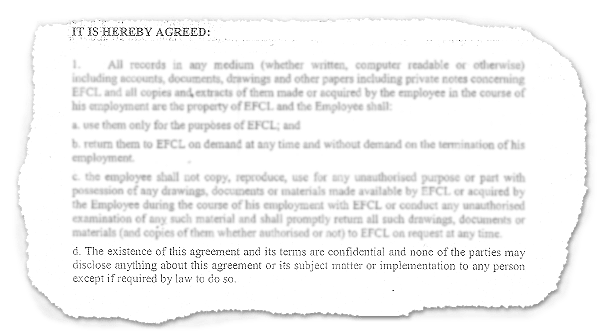
However, clause 1 d. of the Confidentiality Agreement states –

The existence of this agreement and its terms are confidential and none of the parties to this agreement may disclose anything about this agreement or its subject matter or implementation to any person except if required by law to do so.

It is clear that the EFCL advertisement and the documents sent to me cannot both be true.

So, which is true?

Why did EFCL not send or publish the documents?

Quite frankly, it appears that EFCL is making a great effort to conceal or obscure its true policy on confidentiality, for whatever reason.

If this is the kind of effort being put into obscuring the elementary policy of this State-owned company, I can scarcely imagine their reaction to queries on particular projects, Directors’ benefits or tender procedure.

The behaviour of the State and its agents must be exemplary.  Public Officials have an obligation, in my view, to behave in a fashion which fosters trust and good order.

It is all starting to resemble a tangled web, sad to say.

Again, I hope that my doubts are misplaced.

SIDEBAR

Five simple questions for EFCL…

  • Is there a new EFCL Confidentiality policy?
  • When did that come into effect?
  • Would you please provide a copy of that policy?
  • Was that policy approved by the Board of Directors?
  • Is the Ministry of Education aware of this new policy?

Property Matters – The EFCL Query part 2

efcl-confidentialDespite the first column in this series, I have had no direct reply or even acknowledgement from any of the EFCL officials to whom my initial queries were directed.

It seems that the people concerned would rather not write, on this matter at least.  A meeting has been indirectly suggested, which of course would have to be properly recorded and minuted – no word on that meeting as I write again.

What could be the delay or difficulty in answering the five simple questions posed last week –

  1. Is there a new EFCL Confidentiality policy?
  2. When did that come into effect?
  3. Would you please provide a copy of that policy?
  4. Was that policy approved by the Board of Directors?
  5. Is the Ministry of Education aware of this new policy?

Four of those questions require basic yes/no responses, while only one requires a date.

I closed Sunday Guardian’s article by reminding readers of the equation

Expenditure of Public money – Accountability – Transparency = CORRUPTION

The elementary accountability of a public company having its policies available for the public to consider seems to be either lacking or of low priority in the case of EFCL.  As we move along, it will be interesting to see how the Transparency part of the equation works out.

In researching this article, it emerged that our country is a signatory to two relevant international conventions.  As I understand it, the effect of our State having become signatory to those agreements is that the country has adopted those standards.

The first one is the Inter-American Convention against corruption, which was signed by our country in April 1998.  At that time, UNC was in power, under PM Basdeo Panday.  At Article III, clause 8, we are obliged to

…consider the applicability of measures to…create, maintain and strengthen…Systems for protecting public servants and private citizens who, in good faith, report acts of corruption, including protection of their identities, in accordance with their Constitutions and the basic principles of their domestic legal systems…

The second convention is the United Nations’ Convention against Corruption, which was signed by our country in December 2003.  At that time, PNM was in power, under PM Patrick Manning.  At Article 8 – Codes of Conduct for Public Officials, clause 4 obliges us to

4. Each State Party shall also consider, in accordance with the fundamental principles of its domestic law, establishing measures and systems to facilitate the reporting by public officials of acts of corruption to appropriate authorities, when such acts come to their notice in the performance of their functions…

So, what is the big secret?

I do understand that staff at companies like this can jeopardize the integrity and effective operations of the organisation by leaking certain confidential information.  That would be a proper concern of management and a confidentiality policy is one of the ways that could be dealt with, just one.

During the Uff Enquiry, UDeCoTT claimed several times that this or that document was confidential and used its lawyers to protest strongly, sometimes even seeking the protection of the High Court.  That was outrageous conduct by a state-owned company, which appeared to be trying to frustrate the Uff Commission, appointed by the State, by seeking to conceal documents.  A case of ‘the tail wagging the dog’.

This situation is one in which it seems that the dangers of leaks in relation to tendering estimates, for example, has been conflated to cover all information in the company.  It appears to be part of a new policy which does not conform to either good labour relations or our country’s international obligations with respect to Whistle-Blowers.

Given the electoral promises made by this government and the importance of the struggle to reduce the menace of corruption in our society, it is very important for us to be attentive to these matters.

UDeCoTT wanted to conceal certain documents and one had to wonder why, given that they are not involved in secret work.  If it was not so serious it would be comical, they are not a spying, military or health institution.  UDeCoTT is just a facilitator for erecting buildings, yet their chiefs were able to pretend to the public that a large part of what they did was confidential. That kind of secrecy could never be in the public interest.  Not ever.

Similarly with EFCL, one has to ask – What is the secret?  That organisation is responsible for the repair and maintenance of schools, using Public Money to do so.

I wonder if that document, which a number of EFCL staff have now been required to sign, is legal and binding?  Could it withstand a challenge in the Courts?  Did EFCL take proper legal advice in this matter?  Was that advice followed?

The legitimate interests of taxpayers require that the management of State Enterprises take proper steps to handle these integrity challenges – Does the EFCL Confidentiality Agreement achieve this?

There is a certain kind of way in which this episode with EFCL is starting to remind me of the early UDeCoTT grappling, before Uff and so on, with tremendous difficulty in getting basic dialogue going, shadow-boxing and bizarre positions being taken.

I really hope that I am wrong, because the correct, encouraging attitude to Whistle-Blowers is essential for the success of the larger Public Procurement agenda.

Property Matters – The EFCL Query

Continuing the series of examinations into the purpose and performance of our State Enterprises, this week I am looking at an important issue which seems to be emerging at the Education Facilities Company Ltd. (EFCL).

EFCL is a state-owned company involved in the building and maintenance of schools.  It consumes public money in the execution of its functions and that is why it is important to put these points now.

efcl excerpt 3

One of the biggest public concerns is the high level of white-collar crime, which means bribery, corruption, fraud, over-billing, ‘back-fitting’, tax-evasion, asset-stripping and so on.  White Collar crime is a growth industry, since the rewards are very high, while the risk of being caught or punished is extremely remote.

Due to the size of the State, a great deal of that white collar crime can be found in State Institutions.  Once Public Money is being spent, we must demand a high standard of accountability and transparency.

In terms of principles, there needs to be an appropriate balance between the long-established ‘Right of privacy‘ in commercial transactions and the growing ‘Right to know‘ which is part of the emerging social order.  There will be different views as to where the correct balance exists and furthermore, the consensus position will shift as time passes.

It seems to me that the default position should be that, in doubtful cases, the right of the public to information should prevail, since we are the ones paying the costs.  Indeed, that position forms part of the Freedom of Information Act, so that is substantial support.

In early 2009 we witnessed an attempt by the then PNM government to amend the Integrity in Public Life Act (IPLA) so that people reporting breaches of that Act would have been forced to give their names and addresses.  That arrangement would have given even greater protection to corrupt officials, since virtually no-one would want to make a report.  Of course people are strongly encouraged to report ‘normal’ crime like rape, robbery, murder and so on – further encouragement is offered by allowing them to make anonymous reports via 800-TIPS, for example.  Those proposals to amend the IPLA would have encouraged corrupt behaviour by reducing the reports.

That Bill was piloted by then Attorney-General, Bridget Annissette-George.  The proposals were strongly opposed in the Parliament and in the wider society, eventually being withdrawn.  One of the strongest protestors in the Parliamentary debate was Dr. Tim Gopeesingh, who was reported to have accused the government of trying to intimidate people into not making reports. [Hansard, 1 May 2009 p.441] On that occasion, the Standing Orders were used by Colm Imbert, to curtail Gopeesingh’s presentation. [Hansard, 1 May 2009 p.455]

The normal good governance provisions for annual accounts, Board Meetings, minutes and so on are very important.  But those provisions must be supplemented by an atmosphere and a series of institutional arrangements which facilitate Whistle-Blowers.  There must be clear channels and protection for Whistle-Blowers if we are to have any chance of reducing corruption in our country.

Without the assistance of Whistle-Blowers, we would not have known of the Piarco Airport or UDeCoTT fiascos and we know for sure that somebody leaked the file on the Heights of Guanapo Church just prior to last year’s election.  We need encouragement for Whistle-Blowers – in some countries they are even given big cash rewards.  The JCC has been active with its partners – TTMA, the Chamber of Commerce and the Transparency Institute – in making Public Procurement proposals to the Joint Select Committee.  An important element of those proposals is the creation of proper channels for Whistle-Blowers.

I recently received a copy of some EFCL documents, which were stated to be their new Confidentiality Policy Statement and a Staff Confidentiality Agreement for the signature of employees.  I was also told, separately, that EFCL staff are being required to sign that Agreement, under threat of dismissal.  What is more, the Agreement contains a specific clause which forbids revelation of either the existence or the terms of the agreement.

efcl excerpt 2

If those documents are genuine, there are serious grounds for concern, so I made a written query via email on Friday 1st July to the EFCL’s CEO, Paul Taylor, and its Chairman, Ronald Phillip.  I outlined what had been reported to me and asked these questions –

From: Afra Raymond <afraraymond@gmail.com>
Date: Fri, Jul 1, 2011 at 1:13 PM
Subject: EFCL Confidentiality Policy
To: paul.taylor@efcl.co.tt
Cc: ronald.phillip@efcl.co.tt

Hello Paul,

I am reliably informed that EFCL staff were recently directed to sign a ‘Confidentiality Agreement’, the rationale being that it is the new Company policy.

Before taking this any further, I am requesting your written response to these questions –

  1. Is there a new EFCL Confidentiality policy?  When did that come into effect?  Would you please provide a copy of that policy?

Assuming a new Confidentiality Policy is in place, these are my queries –

  1. Was that policy approved by the Board of Directors?
  2. Is the Ministry of Education aware of this new policy?

I would appreciate a timely response.

With best wishes.
Afra Raymond

That email was also copied, purely for information, to the Minister of Education.  At the time of writing, there has been no acknowledgment or reply.

efcl excerpt 1

This is a serious development for these reasons –

  1. The Super-Confidentiality provisions mean that staff are forbidden to obtain any advice, which seems to be a breach of good labour relations, at the very least.
  2. The unilateral imposition of this new document does violence to the proper meaning of the word ‘Agreement’.
  3. The ‘Guiding Principles’ at page 2 refer to ‘privileged information‘ and ‘EFCL’s right to privacy‘, both of which seem to me to be leading away from greater transparency and improved procurement procedures – which leads into the final point
  4. This administration promised, both on the campaign trail and post-election, to make new procurement legislation a priority.  The Joint Select Committee on Public Procurement was Chaired by Dr. Tim Gopeesingh, Minister of Education.   EFCL is the principal State Enterprise within the Ministry of Education, so what is Dr. Gopeesingh’s position on all this?  Is this taking place with Dr. Gopeesingh’s knowledge and/or approval?

It is clear to me that this kind of stealthy restriction on the possibility of staff becoming whistle-blowers is incompatible with the high-profile public statements of support for a new, effective public procurement system. Those statements range from the promises at page 18 of the People’s Partnership Manifesto to numerous speeches by the present Prime Minister.

The reality is inescapable –

Expenditure of Public money – Accountability – Transparency = CORRUPTION

I am closing by wondering, aloud, if this is the shape of the new Information policy for our State Enterprises.

SIDEBAR: What is a Super Injunction?

It is possible for a prominent person to obtain a Court Order called an injunction to prevent the publication of material which is likely to be damaging to their reputation.  That is a long-standing legal right and there has been a recent series of decisions in the UK in which super-sensitive, high profile people have been able to obtain ‘Super-injunctions’ from the High Court, which have the effect of prohibiting the publication and further prohibiting revealing the very existence of the injunction itself.  Of course the media have been fighting that in Court and there are two investigations underway into whether the ‘Super-Injunction’ is itself an abusive instrument.  The emerging thinking seems to be that these ‘Super-Injunctions’ are destroying the information balance I outlined earlier.

efcl excerpt 4

This EFCL Confidentiality Policy, if it is so, would seem to be a similar device, doing great violence to the information balance.