The Ministry of Planning & the Economy (MPE) announced last week that 10 proposals had been received in response to its RFP for Invader’s Bay.
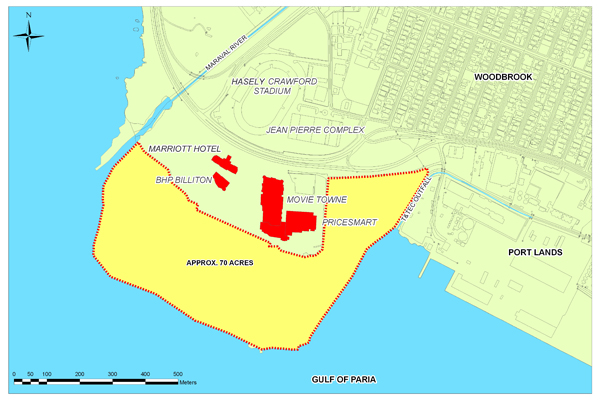
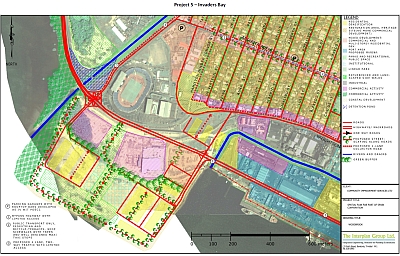 Given that MPE has not carried out a Needs Assessment for this prime property, for whatever reason, I will continue to outline the relevant elements for the Invader’s Bay property. This is not intended to be complete, just a list of what I consider to be the critical items a proper Needs Assessment would include –
- Investment – This is a parcel of land estimated to be worth at least $1.0Bn, so any attempt to describe this process as ‘not being an investment’ would be completely wrong. In the literal sense, it might not involve any expenditure of State money, but, in every other sense, the disposal of this $1.0Bn asset would constitute a major State investment in Invader’s Bay.
- The National Interest – At this moment the imperative is to diversify our economy so as to find sustainable replacements for our declining energy revenues, so this is an apt point. Following on last week’s column, it seems reckless that such an attractive State-owned property would be developed without consideration of the strategic issue. Even on the conventional basis of announcements of construction jobs and permanent jobs etc., it is difficult on purely financial grounds to justify most types of development on that site, especially given the generally depressed market. The decisive factor, given the level of interest such a unique offering is likely to attract, would be to have as an identified ‘Need’ that only projects which were net earners of foreign exchange would be considered. Such a condition would eliminate any offices, apartments, foreign franchise restaurants or shopping malls and set the stage for a different development discussion. A necessary discussion at this point in our country. Please note that the RFP does state that the project should generate foreign exchange, but that is only expressed as an ‘expectation’, which is far too flexible, given the influence of the traditional property developers. If the intention is genuinely to break with the past and set off in a new direction, the conditions need to be strong enough to break the grip of the past.
- Balanced Development and Lagging areas – The RFP speaks to these concerns as follows – “…The Government recognizes the value of long term planning as well as problems created when long term planning is ignored. In order to ensure balanced development and restore lagging areas, care must be taken in the development of new areas…” Those are real concerns, but they seem at odds with the intention of the RFP, since the execution of that plan gives us yet another major development in our capital. We should consider if this is an area we want to develop at this time – bearing in mind that scarce private-sector resources may be required in other part of the country – for instance, the San Fernando Waterfront and other areas – so that development can be balanced instead of continuing the last administration’s emphasis on POS. The sidebar contains a comparison of three large-scale ‘urban development’ districts which formed part of the budget.
There is always the question of who controls the terms of these public debates. The intention from this side is to have that flawed RFP withdrawn. To proceed as things stand is to continue on a path which lacks the necessary transparency and public participation. The quantities of money involved and the absence of those critical elements means that we would be proceeding with all the ingredients for corruption.
This RFP amounts to an invitation to tender, so the bogus idea that this is just a discussion or consideration of proposals must be discredited. It is nothing of the sort. This RFP is a tender process to put these valuable public lands into private hands, which is quite different from a consultation. We have to stop any attempt to mix-up the two processes.
The State and its agencies have an over-riding obligation to be exemplary in their conduct.
SIDEBAR – A budget comparison
The 2012 budget sets out three urban development projects, at pages 31 and 32 –
- Invader’s Bay – “…significant interest has been expressed in the transformation of the waterfront along Invader’s Bay. This development has great potential for promoting commercial activities in the services sector and will benefit the country significantly. Such projects are meant to be private sector initiatives utilizing green building technologies and will assist in making Trinidad and Tobago an attractive destination for new investments…”
- Sustainable City Project – East Port of Spain – “…This initiative, is part of a wider “Emerging and Sustainable Cities Initiative” supported by the Inter-American Development Bank of which Port of Spain has been chosen as one of the five pilot cities from170 eligible cities in the hemisphere…This project is being developed in partnership with the East Port of Spain Council of Community Organizations, the Caribbean Network for Urban and Land Management at UWI, the East Port of Spain Development Company, and other key stakeholders. This exercise has also engaged the Making Life Important Initiative of the Ministry of National Security…”
- Chaguaramas – “…the Chaguaramus Development Authority is spearheading development in the North-Western region and a master plan detailing land use proposals for that region will soon be subject to public discussion…”
Of course those three proposals are favouring Trinidad’s north-west peninsula, which returns to the theme of balanced development, but a further description of their relative merits is beyond the scope of this article. I am inviting readers to consider the varying approaches to an important long-term large-scale issue such as urban development.
In the cases of east POS and Chaguaramas, the commitment to widespread consultation is manifest, yet there is no such commitment evident in the case of Invader’s Bay, which seems to me to be ‘the jewel in the crown’. The three current strategic plans for POS, all paid for by Public Money, are being ignored by the very Ministry responsible for Planning.
Good Public Administration requires actions which foster the confidence and trust of the public, that is indisputable. Those policies and actions must be transparent, reasonable and, above all, consistent, if the public is to place real trust in the hands of the administration.
For all those reasons, it is unwise for any administration to operate in an inconsistent fashion.
In the case of Invader’s Bay, with the stakes so very high, it would be reckless to continue in this manner.

 AfraRaymond.net