On 17th June 2026, the Housing Development Corporation (HDC) reportedly issued its formal Notice to halt the intended award of 11 contracts totalling $3.4 Billion to build 3,700 new homes for sale, on public interest grounds.
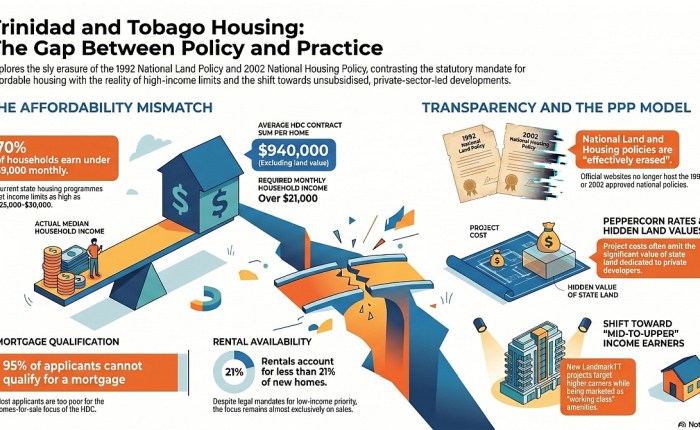
That announcement has triggered official statements on the HDC’s intention to get the process right and to deliver these badly needed new homes for sale. All sides are going to great lengths to satisfy the Office of Procurement Regulation’s (OPR’s) requirements, so that aspect certainly represents real progress. But those statements can only offer comfort if one ignores the reality of the HDC’s extensive waiting-list, in which over 90% of the applicants can only afford to rent.
“…Whereas the People of Trinidad and Tobago—…(b) respect the principles of social justice and therefore believe that the operation of the economic system should result in the material resources of the community being so distributed as to subserve the common good…”
From the preamble of our Republic’s current Constitution (1976)
The simple truth is that the overwhelming majority of HDC’s applicants can only afford to rent, but nothing is being built for rent. That is the challenge we face in terms of realising the objectives of our Housing Policy.
I thought this would be a two-part analysis, but the final conclusions required a fuller treatment, hence this closing article to place those issues in a public policy context. My analysis led me to the conclusion that the HDC’s projects could not in any way have satisfied a proper needs assessment, as required by the Public Procurement and Disposal of Public Property Act (PPDPPA). As such, this is a call for the OPR to engage these public policy issues with the required seriousness.
The State’s provision of affordable housing to low and middle-income applicants has been delivered primarily by the Housing Development Corporation (HDC) and, to a lesser extent, the Land Settlement Agency (LSA).
The current Housing Policy—”Showing Trinidad & Tobago a New Way Home“—was established in 2002 with the ambitious target of producing 100,000 new homes within a decade. Before the HDC was established in 2005, that role was fulfilled by the National Housing Authority (NHA), which was established in 1962. Despite allocations of public money and private sector borrowings exceeding $20 billion since 2002, the NHA/HDC completed less than 25,000 new homes.
Beyond the gross totals and their serious implications lies a more insidious issue: the actual effectiveness of this large-scale public housing program when we consider the human element. The HDC Act stipulates that its purpose as a statutory agency is to facilitate affordable housing for low and middle-income applicants. Yet over 90% of applicants on the HDC waiting list cannot qualify for a mortgage because they are simply too poor, while only 21% of new HDC homes are available for rent. Given the amounts of public money invested in this program and the desperate housing needs of our poorest citizens, this represents a tremendous misallocation of scarce resources.
The HDC’s low output compared to original targets, combined with its failure to serve the majority of applicants for affordable housing, constitutes a serious indictment of its performance.
Since 2003, NHA/HDC has not had audited Financial Statements, so there are substantial financial accountability issues in addition to those noted earlier. HDC stated that the financial statements for 2003 to 2009 were audited, but those financial statements were accompanied by Independent Auditors Reports, issued by KPMG Chartered Accountants, every one of which was subject to a Disclaimer of Opinion. The Disclaimer of Opinion is many times worse than a mere qualified audit since it means that the auditor has so little confidence in the records that it is impossible to form a responsible professional opinion.
During the recently concluded election campaign, I was astonished by Jearlean John’s promise to deliver 500 new homes per week and “…we are looking to build at least 10,000 houses per year…” if the UNC were elected. Ms. John served as HDC’s Managing Director from November 2009 to March 2016 and provided serious assistance to my public housing research during that period. There is no doubt that she is well-informed on these matters.
The Housing Ministry now has a Minister and two Ministers of State—a considerable commitment of political capital to this important public policy area.
We must avoid the errors of the past if we are to do better. If the newly elected UNC Administration wishes to succeed where others have failed, it must act fundamentally differently from the previous PNM government.
Afra Raymond, Managing Director of property advisory company, Raymond & Pierre, speaks at the company’s 50th anniversary celebration, a mini-Conference on Land and Property in Trinidad and Tobago, hosted at the Centre of Excellence on Tuesday 13th December 2022. His first topic there was ‘Public Procurement law through the lens of professional responsibility‘. His second topic there was ‘Land & Housing Policy in post-Independence Trinidad and Tobago‘ that sees to the needs of poor people.
Programme Date: 13 December 2022
Programme Length: 00:16:02 and 00:12:38
Playlist contains 2 videos. Select in top right corner.
Afra Raymond gave a second guest lecture to Cultural Studies Post-Graduate students at UWI St. Augustine in their course, “Debates in Caribbean Cultural Identity”. His lecture dealt with the topic, “The poor, their housing, and how Government policies have ‘worked’ in the Republic of Trinidad & Tobago.” The presentation on Government policies was in relation to the Course theme of Identity / Policing Caribbean Identities.
The previous article continued my Season of Reflection by exposing yet another counterfactual, the myth that the Trinidad and Tobago Housing Development Corporation (HDC) builds affordable housing as required by our Housing Policy (2002) and the HDC Act (2005).
Any basic examination of the facts reveals that the majority of the HDC’s output of new homes are not affordable. I estimated that un-affordable majority as being virtually 80% of the new homes produced for HDC.
The official silence is eloquent and damning. Except that officials are not always silent, so let me share a short social encounter last week with a high-ranking housing official. That official took the astonishing step of telling me that I did not know what I was writing about and that even the information I was relying on was incorrect. When I pointed out that my work is all based on the HDC’s data, checked and supplied by its authorised officers, the conversation took an even more bizarre turn, well beyond the scope of this article. Continue reading “Property Matters – Affordability and Legality part two”→
The previous three articles, I, II and III exposed counterfactuals, those being baseless claims, hypotheses or beliefs. In those cases, I dealt with large-scale toxic untruths, shamelessly promoted by those who know better. All that is in it.
This week I continue my Season of Reflection, turning to T&T’s Housing Policy and Program. The Housing Policy (2002) was implemented via the National Housing Authority (NHA), which was succeeded in 2005 by the Housing Development Corporation – established by the HDC Act. This week’s counterfactual is that our housing policy and the HDC are dedicated to producing affordable housing.
The Rotary Club of Penal invited me to speak at their handing-over ceremony on Saturday 29th June 2019. My presentation summarised recent findings of my research into national policies and programs for social housing. I started that research in 2004 and the officials at the Housing Ministry and the NHA/HDC have always been supportive of my work over that period. I again thank them publicly – it is important to say that.
The national housing policy (18th September 2002) states the provision of affordable housing for low and middle income applicants as its main objective. Having carefully examined the housing market and the details provided from the public officials, it is clear that the national program for social housing is not proceeding in conformity with the actual housing policy. I have closely examined the 16 years in which the housing policy was in effect 2003 to 2018.
“…that this is “a defining moment for the housing construction industry in Trinidad and Tobago”, the Minister stated that “the Government through agencies like the HDC, remains committed to providing affordable, well-designed housing accommodation and adequate infrastructure and amenities for the various low and middle income citizens…”
—Statement by Housing and Urban Development Minister, Major-General Edmund Dillon at launch of the HDC’s latest housing initiative.
HDC Chairman, Newman George (seated, second from right) presents a copy of the signed agreement to Zhou Xing, Executive Vice President, CGGC. Looking on are Lui, Huailiang, General Manager, CGGC (left) and HDC Managing Director, Brent Lyons. Also witnessing are (standing from left) Paula Gopee-Scoon, Minister of Trade and Industry; Attorney General and MP for San Fernando West, Faris Al Rawi; Chinese Ambassador to T&T, Song Yumin; Housing and Urban Development Minister, Major General (ret’d)Edmund Dillon; Minister of Public Administration and MP for Port of Spain South and Minister of Foreign and CARICOM Affairs, Dennis Moses. Photo credit: The HDC
On Friday 17 May 2019, the HDC signed contracts for an extensive program of new public housing with China Gezhouba Group International Engineering Co. Ltd (CGGC). The arrangement is that CGGC will design, finance and construct 5,000 new homes for the HDC in phases.
The first two-year phase is for 204 flats at South Quay in POS and 235 at Lady Hailes Avenue in San Fernando at a cost of $71,739,411 USD. The contract sum for the first phase was stated in USD, which raises for me questions as to why it was not stated in TTD. The contract sum is equivalent to $490M TTD, so the average cost per unit exceeds $1.1M. That does not count the land of course, since we always seem to place no value on the land. Continue reading “Property Matters – New Public Housing”→


 The
The  This week I continue my Season of Reflection, turning to T&T’s Housing Policy and Program. The Housing Policy (2002) was implemented via the National Housing Authority (NHA), which was succeeded in 2005 by the Housing Development Corporation – established by the HDC Act. This week’s counterfactual is that our housing policy and the HDC are dedicated to producing affordable housing.
 This is a short telephone interview I did with ieTV on Monday, 1 July 2019 on my critique of the Housing Policy & Program. Video courtesy ieTV

