CL Financial Bailout – The Hidden Truth

We are now in what I call the Season of Reflection, which for me covers the period from Emancipation Day on 1 August to Independence Day on 31 August, right up to Republic Day on 24 September. Those celebrations appear in proper historical sequence in our calendar and every year I find this two-month ‘season’ to be a sobering period for deep reflection. This year, with this CL Financial judgment and the impending election seeming to converge, the reflections are piercing ones.

Sad to say, this CL Financial bailout is resembling a situation in which well-connected persons are getting what they can, anyway they can, but making sure not to get caught. Who were the beneficiaries of this lavish payout? What is this reluctance to release details?

That is the Code of Silence in effect.

Sen. Larry Howai, Min of Finance

I was not at all surprised at the reported statements of the Minister of Finance, Larry Howai, on the 22 July 2015 High Court judgment ordering him to provide the detailed information I had requested on the CL Financial bailout. The High Court granted a 28-day stay of execution and the Ministry is reportedly in consultation with its lawyers, claiming that “A decision will be made within the period of time allowed by the court,”. The article closed with this quote –

“…Finance Minister Larry Howai said in the statement it should be noted, none of the requests refer to “how over $25b was spent in the Clico bailout”…”

Given that the very request was for the detailed financial information which has been deliberately suppressed since 2009, it is of course impossible to say with any certainty just how much Public Money was actually spent on this CL Financial bailout. That is the inescapable fact at the centre of this scandal. The Minister’s tautology is really a powerful explanation of this point.
Continue reading “CL Financial Bailout – The Hidden Truth”

CL Financial Bailout – The Real Case

Sen. Larry Howai, Min of Finance
Sen. Larry Howai, Min of Finance & the Economy

In 2013 I sued the Minister of Finance & the Economy for his continuing failure or refusal to provide the details relating to the huge $25 Billion bailout of the failed CL Financial group.

On Wednesday 22 July 2015, the High court ruled in my favour by ordering the release of all the requested information.

The basic principle behind the Freedom of Information Act is that the information held by Public Authorities belongs to the public, unless one of the valid exemptions is applicable.

The Court also granted the State a 28-day stay of execution which seems intended to allow them the time to decide whether to appeal before they have to provide the requested information. Given the ongoing Information War and the high stakes to maintain the ‘Code of Silence’ in relation to this bailout, I would not be at all surprised if the State were to appeal against this ruling.

The unexplained gap

On 1 October 2010, the Prime Minister addressed Parliament to explain that $7.3 Billion had been spent on the bailout and that a further estimated $7.0 Billion was required to settle all debts. That is a 2010 estimate of $14.3 Billion to settle the CL Financial bailout, but the current estimated cost of the bailout is in excess of $25 Billion. That means that over $10.5 Billion more than the 2010 estimate has been spent, so where did all that extra money go? That information and the defined official policy of secrecy are at the heart of this scandal. Continue reading “CL Financial Bailout – The Real Case”

CL Financial Bailout – Steal of a Deal

The CL Financial bailout was a steal of a deal for the owners of that troubled company. After all, the wealthiest man in the Caribbean was able to obtain an interest-free loan exceeding $25 Billion in Public Money at a time when no one else would lend him. Our Treasury was effectively the ‘lender of last resort’, so those terms were hugely in favour of CL Financial and its controlling shareholder, Lawrence Duprey. What is more, the shareholders kept all their shares.

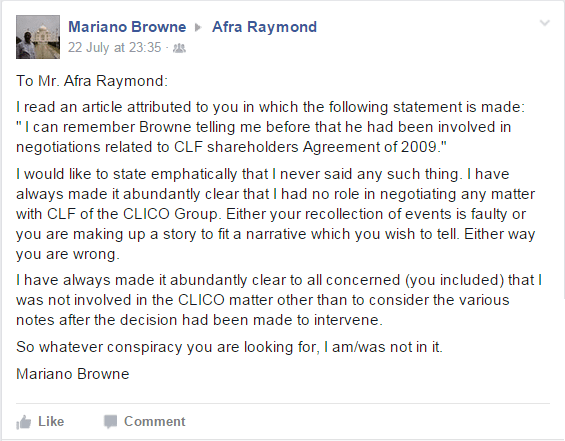
In the previous column, I stated my view that Mariano Browne had taken what seemed to be a position supportive of Lawrence Duprey’s attempt to regain control of CLICO. I also pointed out that Browne was a member of the Cabinet when that fateful and detrimental deal was made to bail out CL Financial in 2009 and called on the significant members of that Cabinet to explain their rationale. I went further to say that Browne was one of the five significant persons who had been requested to testify and refused to do so.
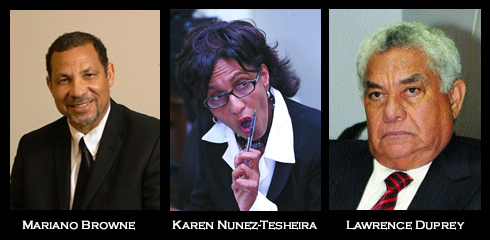
browne-karen-dupreyI am pleased that Mariano Browne has replied on the record, so this column will deal with those valuable points. For starters, it is even clearer than before that former Minister of Finance, Karen Nunez-Tesheira, has serious questions to answer in relation to her central role in this bailout. Given that financial training and experience formed a weak part of her profile, one can only wonder at what prompted Manning to appoint Nunez-Tesheira to that position. We will see. In addition, the terms which were negotiated between the State and CLF are essential to understand today’s dilemma with respect to Duprey’s ambitions. A related issue which needs clarity is the role of the powerful, unelected ‘bigger heads’ who are seemingly in control of our country.

mariano-to-afra1mariano-to-afra2mariano-to-afra3

mariano-to-afra4

Duprey and his cohorts benefitted from an unprecedented degree of access to key decision-makers in the Cabinet and the Central Bank.

One of the enduring paradoxes in how our society is governed is the lopsided distribution of information. There is an abundance of relatively unimportant information, alongside a severe scarcity of critical facts on the big issues of the day. It seems that we are now ‘Amusing ourselves to Death‘, to borrow an insightful phrase from Neil Postman.

There is a world seen and a world unseen. The challenge is to discern the scope and influence of the unseen world. The current lexicon describes the unseen world as the ‘Deep State‘. I have no doubt that such a state of affairs exists in our country. So what do we know about the huge decisions in our society’s governance and how do we come to know those things?

For instance, the most serious decisions are taken by the Cabinet, which consists only of members of Parliament – some directly-elected as MPs and others appointed as Senators. Some of those decisions are announced at the Thursday afternoon post-Cabinet Press Conference. But the coverage is always partial with my suspicion being that stories are often presented so as to conceal their less-favourable aspects.

Cabinet seems to operate according to two conventions – the first being ‘Collective Cabinet Responsibility’ and the second being that the discussions of Cabinet are secret. The Freedom of Information Act gives Cabinet documents a 10-year embargo against publication. So, the first problem is that the highest decision-making Chamber in our Republic is essentially a secret one. I have always felt that the veil of secrecy which covers Cabinet’s deliberations is most times severely detrimental to our collective interests. This sordid CLF bailout fiasco fortifies that view.

Another critical aspect of the current arrangements is the role of the powerful Party Political Financiers, which is rarely revealed, but often suspected. In the case of the CL Financial group, we know that CLICO was a major funder of both major parties, which gives this bailout fiasco its lingering, bitter, flavour. There are few opportunities for us to get a real insight, beyond rumours, as to the true role of the party financier. Apart from the role of CL Financial as financiers, we also learned in the Colman Commission that Nunez-Tesheira’s 2007 campaign benefitted from Hindu Credit Union (HCU) financing.

The 2009 negotiations

One question I always ask is whether Karen Nunez-Tesheira told her colleagues that CLF had paid a dividend three days after it requested a bailout? As a shareholder, she would have been in receipt of dividends. If the Cabinet was told, they should have insisted on immediate repayment of any dividend since an insolvent company cannot pay a dividend. If the Cabinet was not told, we are dealing with a most deceptive course of action. Which was it?

So, what did Browne say about those negotiations?

…I have said that Duprey’s (and other shareholders) legal position is strong as the government depended on a MOA (memorandum of Agreement) the time frame of which has long since passed. On that basis, the shareholders have rights. Even if the state has expended money, the State and or its agents (the Central Bank) must do so in way that protects both the policy holders and the shareholders.

That was my advice in cabinet and at the Finance Policy Committee. The view of the Minister of Finance prevailed. I am of the opinion that Karen Nunez Tesheira was wrong then and is wrong now…

Browne is concurring with my view that the State’s position is weak in this bailout endgame, the key point being “…the shareholders have rights…”. Being bound by the first convention of ‘Collective Cabinet Responsibility’, Browne kept his silence during the raging controversy of the past 6 years, but he has now chosen to break the secrecy convention. I am grateful to him and it is telling that the most expert Cabinet member in that critical arena of finance and economics is now revealing his recollections of these critical events.

karenandlawrence

Nunez-Tesheira needs to share the rationale for the bailout formula which let Duprey and the other shareholders keep their shares and loaned those huge sums of Public Money to the wealthiest man in Caribbean on an interest-free basis. What were the public policy considerations which could possibly have supported such a course of action?

Browne goes further to outline a situation in which he seems to have been excluded from the negotiations –

…And for the record I have not been part of any negotiations with Clico or CLF as part of the bailout action. Neither was I a part of the cabinet which took the decision to support the CLF/ CLICO Group. Those decisions were taken at a Cabinet meeting of which I was not a part on 29th January 2009 as I was in Barbados representing the Minister of Finance at a COFAP meeting. This bailout was always the province of the Minister of Finance and the Governor of the Central Bank and (sic) had no part in those decisions.

Further, Clico/CLF/Duprey made no contributions to the PNM during my tenure as Treasurer…

I can remember Browne telling me before that he had been involved in negotiations related to the CLF Shareholders Agreement of June 2009. That Agreement, at para A of its preamble, undertakes to protect the interest of shareholders. Note – Browne has since denied this claim of mine, so that has to be noted.

Of course, we know that Browne was part of the Cabinet which made those decisions, even if he was not in attendance at those particular meetings (I have no reason to doubt him), it is immaterial. As a member of that Cabinet he bears collective responsibility.

Duprey’s intended re-entry

Browne contested my statement that he seemed to be supporting Duprey’s attempt to regain control of CLICO –

…With regard to your opinion, I am am (sic) supporting nothing…The state only owns 49% of the company. If the shareholders act in concert there is nothing to prevent them from having an extra ordinary shareholders (EGM) Meeting and replacing the state appointed Directors. It is unlikely that Lawrence Duprey can pass the fit and proper rule and therefore cannot be appointed to CLICO’s Board, but he can be appointed to the CLF Board…

Browne listed the reasons which seemed to favour Duprey’s position, which position is fortified by his interpretation of the fit & proper rules. In his view, those rules would have prevented Duprey’s appointment to CLICO’s Board, but he would have still been eligible to sit on CL Financial’s Board. If we are considering a situation in which CLICO would still have CLF as its majority shareholder, that is an entirely misplaced view.

In the Central Bank’s ‘Fit and Proper Guideline‘, the question of ‘Who should be Fit and Proper?’ is addressed at page 2 –

“…4.1 According to governing legislation the following persons referred to in this Guideline as holding “key positions” are required to be fit and proper: -…
…4.1.4 Controlling Shareholder – may be an individual or a corporate entity

  1. Under the IA, any person who is entitled to control at least one-third of the voting power at any general meeting of the company.
  2. Under the FIA, any person who controls twenty five per cent or more of the voting power at any general meeting…

Before the bailout about 89% of CLICO’s shares were owned by CLF, so Duprey cannot regain control of CLICO, either directly or via a holding company, if the fit and proper regulations are enforced. As I said previously, the acid question is whether the Central Bank will summon the will to apply those rules without fear or favour.

This is no academic dispute, since Duprey has made it clear that he is seeking to regain control of CLICO, so that financial company and the rules which govern it, must be central concerns in this matter.

Sunlight is the best disinfectant. Come clean.

AUDIO: Election Hardtalk interview on Power 102FM – 16 Jul 2015

Power 102 FMAfra Raymond and Peter Permell are interviewed on the ‘Election Hardtalk‘ show on Power 102FMFM by Tony Fraser about the continuing impact of the CL Financial bailout on the economy and the request to get back the company by Lawrence Duprey. 16 July 2015. Audio courtesy Power 102FM

  • Programme Date: Thurday, 16 July 2015
  • Programme Length: 1:19:47

CL Financial Bailout – Impunity Insanity?

© 2015 Dion Jennings
© 2015 Dion Jennings. Used with permission.

The headline ‘Duprey wants back CLICO‘ in the Sunday Express of June 28th 2015, did not surprise me at all. That is exactly the threat against which I have been warning throughout my campaign against this appalling and unprecedented bailout.

To allow Lawrence Duprey to regain control of CLICO would do serious violence to the fundamental notions of the law not allowing persons to benefit from their wrongdoing.

Already, we can see various positions being taken – the Movement for Social Justice and Peter Permell of the CLICO Policyholders’ Group stating their objections, while Mariano Browne (former PNM Treasurer and Minister in the Ministry of Finance) and Mary King (economist and former Minister of Planning) setting out what seem to be supportive positions.

Continue reading “CL Financial Bailout – Impunity Insanity?”

Integrity Inquiry

ic-logo

“…The question really is integrity, and if he or she does not have it he or she should not be a Commissioner in the first place. The simple fact is that try as we might, we cannot legislate for integrity…”

From Press Release of 21 June 2013 by then Integrity Commission Chairman, Ken Gordon, in response to strong criticisms of his meeting privately and alone with opposition Leader, Dr Keith Rowley.

Once again we are beset by what appears to be yet another fiasco at the Integrity Commission, so Ken Gordon’s fateful words echo in my mind.

Given the current political season, there is every temptation to discuss this crisis as being caused by the impending election, together with either the improper behaviour of the present Peoples Partnership government or the ‘PNM operatives’ who infest the public service. You can take your pick from those prevailing theories, but I think these recent and alarming events were preceded by earlier ones. So much so that when the entire situation is placed in context, we are facing a troubling scenario in terms of the extent to which we can trust high public officials.

The current crisis is serious enough grounds to require a full Commission of Enquiry into the conduct of the Integrity Commission since the 2000 revisions to the Integrity in Public Life Act (IPLA).

I do not agree with those who call for the abolition of the Integrity Commission, since it is critical that any progressive society establish what are its aspirations and work towards those. Despite the social, religious and legal restrictions on murder, robbery and rape, those acts occur all the time. That sobering truth is no reason at all to retreat from putting strong legal and social prohibitions in place. Society needs laws and institutions to promote its values, so I am not calling for any move towards abolition of the Integrity Commission at all.

Such a Commission of Enquiry is necessary to clear the air on strategic issues and its Terms of Reference would cover aspects such as –

General

  • What is the record of the Integrity Commission in deterring corrupt and improper behaviour by Public Officials?
  • To what extent would the amendments to the IPLA, as proposed by the Ken Gordon-led Commission in its 2012 Annual Report, be effective in improving the Commission’s performance?
  • Given their growing importance of Public Private Partnerships in large-scale projects and commercial enterprises, to what extent should the IPLA apply to those organisations.
  • Apart from the legal framework as outlined above, how can the limited resources of the Integrity Commission be best applied to promote ‘Integrity in Public Life’?

The specific issues

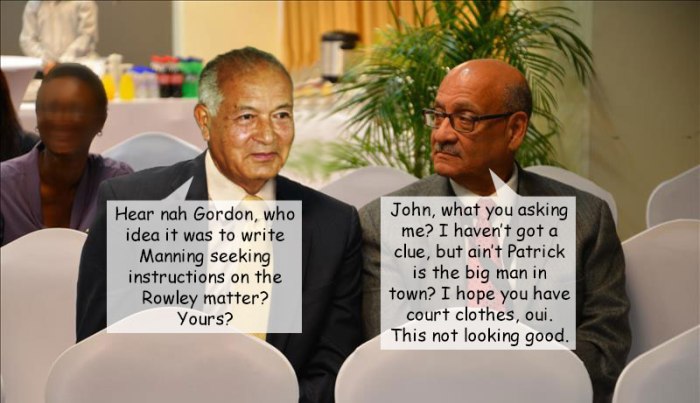
  • 19th October 2004 – The Integrity Commission wrote to then PM Patrick Manning seeking detailed instructions on how to handle Ganga Singh’s complaint against Dr Keith Rowley. According to the ruling in the case brought by Dr Rowley against the Commission – “…The Court does not accept the Integrity Commission’s explanation as to why it wrote to the Honourable Prime Minister on the 19th October, 2004, to ascertain whether an inquiry was to be undertaken and if so, the names of the persons to man the enquiry and their terms of reference…”. The public needs a full and proper explanation as to how and why the Integrity Commission took such an extraordinary decision.
    gordondeane-johnmartin
  • The TSTT exemption – In 2006 the Commission was alleged to have written to TSTT Directors to confirm that they were exempted from filing declarations as required by the IPLA. That letter was the subject of Freedom of Information litigation at both High Court and Appeal Court levels – Magdalene Samaroo vs TSTT CV 2006-0817 and CA 180 of 2010 – and it is fundamental that at no point was the existence of that letter denied. A simple denial would have readily defeated the request for that letter since the Court cannot order publication of a document which simply never existed. The matter was ‘compromised’ by agreement between the parties at an Appeal Court hearing on 28 October 2013, which means that both sides agreed to discontinue the lawsuit. There is obviously something substantial and improper at work here, so an Enquiry can force publication of that suppressed correspondence.
  • The TSTT litigation – Since 2005 TSTT has been in prolonged litigation to remove its Directors from Integrity Commission oversight. The High Court ruled in 2007 that TSTT’s Directors were required to file declarations under the IPLA. That judgment was reversed in the Appeal Court ruling of 27 June 2013 that TSTT was not a State Enterprise, with its Directors therefore not required to file declarations to the Integrity Commission. Upon careful reading of those judgments it seems clear that the Integrity Commission offered little, if any, resistance to the TSTT challenge. This sustained collaboration between the Executive, the supposedly-independent Integrity Commission and the Public Private Partnership also known as TSTT is nothing less than remarkable, given the challenges in getting agreement on important and beneficial matters. A proper account is also required for how and why the Commission agreed to this course of action.
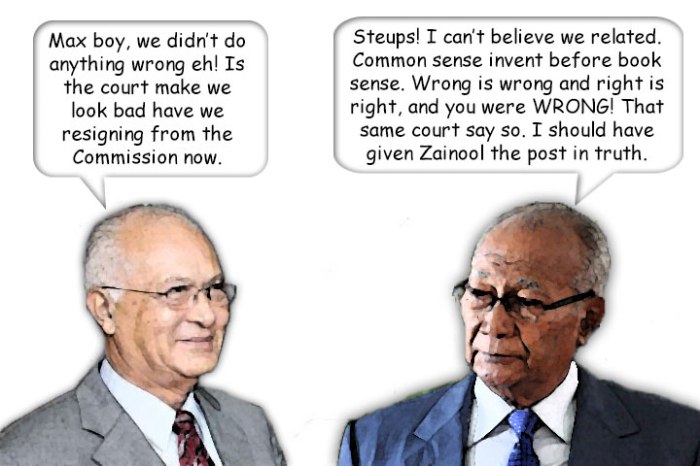
  • The 2009 collapse – The newly-appointed Commission collapsed in early 2009 due to disastrous appointments by then President Max Richards. One of the several outstanding issues at that time was the strong complaint from Justice Zainool Hosein who claimed that President Richards had promised him the position of Deputy Chairmanship and then reneged on that commitment. President Richards proceeded on an extended leave before deigning to make a public statement on 29th May 2009 which amounted to a stunning ‘I don’t have to explain myself’. An important part of this Enquiry would be to establish just how this series of unfortunate appointments were made.
    max-and-martin
  • CL Financial group of companies – The Commission has never explained its failure or refusal to seek declarations from the Directors of the CL Financial group of companies, which have been under State control since June 2009. I have personally checked and those Directors do not submit declarations to the Commission. CL Financial is the largest by far of the ‘bodies under the control of the State’, yet the Commission has not exercised its lawful duties in respect of proper oversight, so a full and public examination is necessary.
    3-wise-monkeys
  • Emailgate Fiasco – The Commission’s role in this charged affair certainly needs a full, public Enquiry if trust is to be restored. Fixin’ T&T claimed, in its 7 May 2015 letter to the Commission, that the PM had claimed to have had possession of certain files ‘containing information which the IC had requested from Google’. The Commission was asked in that letter whether it was aware of any information being passed onto the PM or any other person. The Commission’s response on the same day was remarkable, in that there was neither confirmation or denial of any information being passed to anyone else. That reticence on such a critical point is even more remarkable when one examines the Commission’s letter of 19th May 2015, which confirmed the end of its ‘Emailgate’ investigation. The first part of that letter states that the provisions of S.35 (1) & (2) of the IPLA prohibits any release of information unless charges are to be recommended. On the one hand, the Commission declines to say if information was released to the PM or anyone else, yet, on the other hand, it stresses the legal rules against such a release. So what is really happening here? What is more, the resignation of two of the IC’s five Commissioners can only add to the sense of confusion in the air. The first resignation came from Dr Shelly Ann Lalchan, supposedly for personal reasons, but the clear statements from the second Commissioner to resign, former Deputy Chairman, Justice Sebastien Ventour, are worrying to say the least. Can it be true that the media was the first place the Commissioners were made aware of that important letter of the 19 May? If that is indeed so, it is clearly unacceptable for a public body to conduct itself in that fashion.

A final issue for an Enquiry to consider would be the role of whistleblowing within bodies such as the Integrity Commission. On the one hand the Commission could not perform its work without reports from people who are reporting suspected wrongdoing, probably in breach of their employers’ rules, yet the very officers within the Commission are prevented from reporting wrongdoing in its own operations. That is the true irony at work and a proper Enquiry will be able to take evidence and make recommendations to deal with this.

A full and urgent Commission of Enquiry into the Integrity Commission is now required.

Our Land – The Caroni case Part 2

The previous article outlined the size of the Caroni lands and some of the intended uses to which that land would be put. I contrasted the positions taken by UWI in 2003 and my own from 2004, with the current situation.

UWI’s July 2003 Position Paper – ‘A Framework for National Development: Caroni Transformation Process‘ – was developed by diverse contributions, mostly made at a special seminar on 27 April 2003. At that time there were strong rumours that the then PNM government, headed by Patrick Manning, intended to close Caroni (1975) Ltd. The expressed fears at the time were that PNM supporters, friends, family and financiers would all benefit from a ‘land grab’. Caroni was a State Enterprise which had made heavy losses in the virtually 30 years since it had been purchased from its British owners, sugar giant Tate & Lyle.

The UWI Seminar was most timely since their Position Paper was issued in July 2003 and presented to the then Minister of Agriculture, Land & Marine Resources, John Rahael, in September 2003. Caroni (1975) Ltd was closed on Emancipation Day 2003.

The UWI study took a long-range view of the Caroni issues and as such it is an important document which set a framework for these Caroni lands. The land area was determined, at Appendix 1, to be 74,780 acres. At page 30, ‘Consultation’ is specified as the first requirement for the development of these lands.

The UWI Position Paper sets out its Recommendations at Chapter Eight on pages 71 & 72 –

  1. Govt to prepare & publish a comprehensive plan for Caroni.
  2. Govt to convene an urgent National consultation on the Caroni resources and the published plan.
  3. Any departure from the National Physical Development Plan be done through the legally- stipulated process which includes bringing those proposals to Parliament.
  4. That all terms and conditions for the leasing and tenure of the Caroni lands be detailed to the public in a public document, to meet the requirements of transparency.
  5. That Govt establish a skills bank so that the Caroni workers would have choices as to how they would be integrated in future planned enterprises.
  6. That the State establish an independent Screening Committee to stringently screen potential investors who seek Caroni lands as their location of business.
  7. That the Ministry of Agriculture Land and Marine Resources establish an independent authority charged with the implementation of plans for agriculture and agriculture-related industries.
  8. That Govt establish a comprehensive system of water control on the Caroni lands, in order to facilitate irrigation, as an essential pre-condition for the establishment of agricultural enterprise on the Caroni lands.
  9. The the Govt establish a Lease Income Funding Enterprise System and embark upon a comprehensive joint funding venture with companies in the heavy industrial sector, in order to fund national platforms for development, such as the following ones proposed by this Position Paper:
    1. A Botanical Plan
    2. A Technological & Vocational Institute
    3. A Buffalo Reconstruction program
    4. A Model Program for Untenured Residents
    5. A Food Park Plan
    6. A Research and Development Mandate, for the University of the West Indies and other research institutes in order to support Agro-Industrial Development.

As far as I am aware, none of those sensible recommendations have been implemented.

Dr. the Honourable Roodal Moonilal, Minister of Housing and Environment

After Caroni was closed, there was a serious debate in the Parliament – here is Dr Roodal Moonilal MP, speaking in the Agricultural Census Order debate on Friday, 14 May 2004

“…We want to challenge the Government yet again, as we did with the Member for Port of Spain North/St. Ann’s West to come to the House and bring the plan for Caroni (1975) Limited to the House. Let us debate their plan for Caroni (1975) Limited…” (pg 601)

Chandresh Sharma MP, speaking in the same debate (pg 637)

Chandresh Sharma MP
Chandresh Sharma MP

“…Mr. Speaker, I was talking about UWI ’s recommendations based on the Caroni (1975) Limited lands that say there should be no land grabbing. These qualified minds thought of the process and they have looked at what obtains in the Government. Some of the best agricultural lands in this country were taken by the PNM —Aranguez and Trincity—and some of the best sugar came from there, and also cocoa in the earlier days. They built houses to secure PNM votes. They must not forget that the East-West Corridor—stretching from Chaguanas to Arima—has 14 seats, which the PNM hopes to control all the time. The seats that they do not control are the ones involved in agriculture like Barataria/San Juan, St. Augustine, St. Joseph, and Tunapuna would return to us soon. So they took the best agricultural lands and built houses on them. The thinkers saw the PNM at work…”

Also –

“…I have just identified some of the thinking from the University Position Paper which is A Framework for National Development Caroni Transformation Process produced by UWI in July 2003. It is instructive to note that to date the Government has not responded to any of the proposals obtained in this document. This is another clear demonstration of how they intend to treat with agriculture and those who are involved in agriculture…” (pg 638)

So, the UNC’s key speakers were insisting, in 2004, that the UWI plan must be considered.

It is striking to consider the identity of some of the Contributors listed at page i of the UWI Position Paper –

  • Winston Dookeran (then an MP, now Minister of Foreign Affairs, after serving as Minister of Finance)
  • Dr Roodal Moonilal (then an MP, now Minister of Housing and Urban Development)
  • Rudranath Indarsingh (then President of the All Trinidad General Workers’ Trade Union Union, now Minister in the Ministry of Finance)
  • Professor Clement Sankat (then at the Engineering Faculty, but now UWI Principal)
  • Dr Asad Mohammed (then a UWI academic, now Chairman of the National Planning Task Force)

It seems clear to me that the Caroni lands were identified as critical national resources which needed an urgent, strategic intervention from our leading thinkers to preserve the Public Interest. That UWI Position Paper is extremely important for our long-term collective interests. Sad to say, but it seems to have been sidelined and forgotten, just like the 1992 Land Policy.

What is more, we do not have any clear account as to what happened to those Caroni lands in either the period between 2003 and the PP’s election victory in May 2010, or the period between May 2010 and now.

After one time, is really two times.

UWI must, as a matter of urgency, reconvene a seminar to examine what has happened to the Caroni lands. That is imperative.

Next, I will consider the role of EMBD and the LSA in developing our lands, particularly the Caroni area.

SIDEBAR : The SIS episode

Hon. Jairam Seemungal, MP. Minister of Land and Marine Resources

One of the controversial episodes arising recently in relation to Caroni land is the occupation of 35 acres of land at Couva by SIS Ltd, the contractor company linked to many controversial State projects. There were claims by farmers who had been in occupation of the land that SIS had put them off the site before fencing it, with further statements by the Commissioner of State Lands (who has responsibility for management of State Lands) that SIS did not have a tenancy for that land and were in illegal occupation. To add to the brew, the Minister of Land & Marine Resources, Jairam Seemungal, was reported in the Trinidad Express newspaper on 12 March 2015 as denying that there was no agreement for SIS to occupy that land. When asked what were the terms of that lease or tenancy, the Minister is reported to have said –

“…When you enter into an agreement the arrangement in the agreement itself is private, the State land is State land but when you enter into an agreement when the Commissioner enters into an agreement or anybody enters into an agreement with any person whatsoever then the process itself whatever documentation all these things inside of the agreement those become a private matter unless it is registered in the Ministry of Legal Affairs where one can go and do a search…”

A private agreement for Public Lands. I tell you.

To crown-off the entire episode, the Prime Minister told Parliament, on Friday 13 March 2015 –

“…I have spoken to the hon. Minister of Land and Marine Resources. He has indicated that at no time did he state that lease or other agreements with regard to state lands entered into between SIS and the Government is a private matter and therefore should not be disclosed…”

Complete denial. What is clear is that there is a serious hostility to the truth on display here. Simply appalling.

Carlton Savannah Swirl

wademark-cartoon
The escalating episode of the apparent conflict between the oversight of Parliament and the Courts in this matter is a real learning experience for us all. I am clear that the Speaker spoke on Friday 23 January 2015 with the intention to convey that the High Court had sent him an official Notice which was decisive in the conduct of the business of Parliament.

Here is the contentious sentence of Speaker Wade Mark’s statement –

…I received only a few hours ago a notice from the High Court of the Republic of Trinidad and Tobago dated January 16, 2015, a matter involving Larry Howai and Azad Ali of the Sunshine Publishing Company Limited…

It seems very clear to me what the Speaker intended to say. Of course we now know that the statement was baseless and misleading. Misleading in the extreme.

The Speaker’s attempt to correct his statement only came after the Judiciary issued an unequivocal rebuff

“…While there appears to be some misunderstanding which we expect the Honourable Speaker of the House to clarify, the Judiciary can confirm that no Notice, letter or any other communication on the matter was forwarded by the Court or any of its officers to the Speaker or any officers of the Parliament…”

How many people believe that the Speaker would have attempted to clarify, for that is all it was, if the Judiciary had said nothing?

Sidebar: TIMELINE

  1. 24 December 2014 – Larry Howai’s attorneys issue a pre-action protocol letter against the Sunshine Newspaper for the article “$470 MILLION LOAN TO LOK JACK and Others”
  2. 26 December 2014Sunshine Newspaper publishes “$470 MILLION LOAN TO LOK JACK and Others”
  3. 30 December 2014 – Jack Warner MP files no confidence motion against Minister of Finance & the Economy, Senator Larry Howai.
  4. 5 January 2015 – Warner’s motion is approved by the Speaker, Wade Mark.
  5. 16 January 2015 – Larry Howai’s attorneys file suit against Sunshine Newspapers for libel.
  6. 22 January 2015 – Larry Howai wrote to the Speaker.
  7. 23 January 2015 – Warner’s motion is on the agenda for Private Members Day in Parliament. After the Speaker’s statements, the motion was abandoned.
  8. 26 January 2015The Judiciary issues a statement to deny the Speaker’s false assertions.
  9. 26 January 2015The Speaker issues a statement apologises to the Judiciary and admitting, for the first time, that the letter came from Senator Larry Howai.
  10. 30 January 2015The Speaker issues a new statement which apologised again to the Judiciary and claimed that he had not tried to censure the debate.

Sidebar: EMBA story

In November 2013, Wade Mark threatened to sue the Trinidad Expess over its articles on the controversy surrounding the award of an Executive Masters in Business Administration (EMBA) to him by the Arthur Lok Jack Graduate School of Business (ALJ-GSB). I have heard nothing more about that lawsuit.

That episode was one with very serious allegations of improper conduct of examination processes at the ALJ-GSB, which allegedly culminated in the award of the EMBA to the Speaker of Parliament, Wade Mark.

I was very concerned over that series of allegations, given the potential impact on the reputation of the UWI, the ALJ-GSB and ultimately, the very reputation of our Parliament, if they were proven to be factual. Most unacceptable was the silence coming from the Speaker on the central issues – Was it true that the Speaker had scored 91% in the Management Accounts exam? Had the Speaker been allowed more chances than usually permitted in those exams? Had the Speaker really written to the ALJGSB on his official letterhead? If so, why?

I confronted Mark directly the next time we met, which was on the grounds of the Parliament on Tuesday 3 February 2014. After a heated exchange, during which he told me that his performance in mathematics had always been weak, Mark declined my urging to clear the air on those serious concerns and took the position that his degree had been awarded by the ALJ-GSB.

It would really be useful if the ALJ-GSB could publish the range of marks for that MBA-level Management Accounts final exam, so that we could assess the frequency with which marks over 70% are achieved.

Sen Larry Howai
Sen Larry Howai

When Parliament sat on 23 January, the first item on the Agenda of the Private Members’ Day was the no-confidence motion against Larry Howai filed by Jack Warner. The Speaker gave everyone the impression that the High Court had sent an official Notice to Parliament and never mentioned that in fact he had received those documents as part of a correspondence from Senator Larry Howai, Minister of Finance & the Economy. That Notice was said to relate to the litigation between the Minister and the Sunshine Newspaper on the financing by State-owned FCB (which had been headed by the Minister during that period) of the Carlton Savannah Hotel in Cascade. That presentation was very misleading and raised the genuine issue as to whether Members facing potentially embarrassing questions in the House had discovered a novel way to seek the protection of the Courts.

Before inviting Members to speak, the Speaker issued a clear caution –

…And in those circumstances, unless the Member who is about to speak can tell this House that what he is about to say is not going to be in any way, adverse, to what is before the High Court of Trinidad and Tobago, I would have to deny this Motion although it has been approved…

Ultimately, Warner relented and effectively withdrew his motion.
The Timeline in the Sidebar sets out the sequence of events and it is a stark example of how the Parliament and the Courts have become entwined in this latest rounds of the Silly Season.

The worse part is the third statement, made on 30 January 2015, which did little to restore confidence. It seemed that the Speaker’s was attempting to reverse his earlier clear caution to the House, claiming that –

…I wish in closing to ask Honourable Members to note that after I brought to the attention of the House the existence of the said legal proceedings, in exercise of my discretion as the Presiding Officer, I permitted debate on the motion to commence. I did not deny or shut down debate on the motion. It was the mover of the motion who, of his own volition, after he commenced his contribution, decided not to proceed…

It is true that Mark did not directly rule that the debate had to be halted, but his caution effectively shut-down the debate. That caution was based on a false statement and omitted the critical fact that the party to the debate was in fact invoking the Sub Judice principle.

At this point, I am still unclear. If Speaker Mark is in fact saying that he had no objections to the motion being debated, then that debate should be reconvened at the earliest possible sitting. The stream of letters which are beneath this disturbing sequence of events must be published, the sooner the better.

The position of Senator Howai is also inexplicable. Howai and Leader of Government Business in the House, Dr. Roodal Moonilal MP both claim to have been ready to debate the motion. So why send the letter to the Speaker?

This is real mind-games with the peoples’ business, I hold no brief for Warner or any of the other Members, they are all capable of seeking their own interest. The issues of the Carlton Savannah Hotel financing seem to be serious ones and we need to insist that the debate is started at the earliest opportunity. Some points on that issue are in the Sidebar.

I am not calling on the Speaker, or anyone for that matter, to resign. The Speaker can start to restore this situation by publishing those letters and convening an early debate on Warner’s motion.

Sidebar: Carlton Savannah Hotel

carlton-savannahIt has been reported that FCB is owed over $400M borrowed for the construction of this elegant hotel on the outskirts of the Queen’s Park Savannah. That hotel is now up for sale via the receivers, Deloitte, at an asking price in the region of $120M.

The key issue evident here is the huge impact of the Hyatt Hotel on its POS rivals since its opening in early 2009. A combination of its virtual monopoly of State functions and the imperatives imposed by how it was funded have made Hyatt a unique hybrid, being at once the most elegant and most economic. Carlton Savannah seems to have been eclipsed by Hyatt and it is not the only one.

Some of the key questions would be how was the project appraised? Was sufficient security taken for this loan? What accounts for the tremendous decline in the value of this asset?

Integrity Strategy

ic-logoThe Integrity Commission is continuing its efforts to revise the Integrity in Public Life Act (IPLA) to give greater effect to its anti-corruption work. I fully support those efforts.

LifeSport-logoThe key challenge is to discern how Public Officials commit the corrupt acts the Commission is meant to reduce. It is therefore necessary to conduct a scrupulous examination of Commissions of Enquiry and other Inquiry (eg LifeSport) Reports & evidence; Auditor General’s Annual Reports; as well as the leading international learning on these questions.

Once the main methods of corrupt agents are discerned, it will then be necessary to consider how the existing powers of the Commission might be deployed in tackling those and if there are new powers needed.

  1. Public Money

    ‘Public Money’ is the term used to describe money due to or payable by the State, including those sums for which the State would be ultimately liable in the event of a default. Public Money is sometimes called Taxpayers’ Money. It is our Money. The leading learning from which we have drawn serious lessons in the campaign for Public Procurement reform is Lord Sharman’s 2001 Report to the British Parliament – Holding to Account – which was a thorough examination of the definition, role and need for control of ‘Public Money.’ We expanded on Sharman’s definition of ‘Public Money‘ so as to capture the full range of possibilities, but we have accepted his key finding as to the requirement that ‘Public Money‘ is to be managed to a higher standard of Accountability and Transparency than Private Money. The contemporary, best-practice position in respect of the management of and accountability for Public Money being that the private sector rules are the bare minimum. That position must be at the centre of any reform of the IPLA and should be enshrined in law.

  2. Code of Conduct

    The IPLA effectively contains two limbs – the first requires that Public Officials make declarations of their income, assets and liabilities and the second requires those officials to perform their duties in accordance with the ‘Code of Conduct’ as set out in Part IV. The majority of cases brought by or Notices from the IC are directed at Public Officials who fail to make proper declarations. Is there a single case in which breaches of the ‘Code of Conduct’ were cited in making a case or an adverse finding? It is in this failure or refusal to apply those IPLA provisions that much of the current mischief in our Public Affairs is left to flourish. Some of the largest State Enterprises are functioning in breach of the ‘Code of Conduct’ and as such the Public Officials running those bodies are liable to censure. The IPLA does not contain any penalties for breach of the ‘Code of Conduct’, so that needs to be rectified. I support the Commission’s proposals to make examination of declarations optional, as that shift would release resources for a greater focus on the ‘Code of Conduct’.

  3. Power to make recommendations

    S.36 (1) of the IPLA states –

    “36. (1) A person in public life or a person exercising a public function may, by application in writing, request the Commission to give an opinion and make recommendations on any matter respecting his own obligations under this Act.”

    The key flaw with this power is that it is limited to cases in which the Public Official first requests an investigation and what is more, the Commission can only release its findings/recommendations with the consent of that Official. That power must be extended to all cases, with the discretion as to publication of its findings/recommendations left to the Commission. The fundamental importance of the Public Interest should not be subordinated to the agenda of obstructive Public Officials. A good example of how those powers were used recently in a positive way was the Commission’s 12 September 2014 Report on the Ministry of the Environment & Water Resources with relation to issues of alleged improper conduct in relation to the grant of Saw-Millers Licences.

  4. Notification

    At present, the Commission notifies Public Officials who are being investigated. It seems counter-productive, to say the least, that the same Public Officials who are in charge of the papers which could prove their guilt are being notified by the Commission at the start of investigations. Little wonder that the Commission has had little impact on corruption. It is emblematic of the flagrant double-standards with respect to the detection and prosecution of ‘White Collar Crime’. One can hardly imagine the courtesy of ‘prior notice’ being extended to suspected rapists or murderers. The Commission needs to eliminate that practice of notifying persons to be investigated.

  5. Improving the impact of the Commission’s findings

    The Commission’s findings and recommendations must be effectively linked with other ‘gatekeeper’ regulators – eg ‘Fit & Proper’ regulations as controlled by the Central Bank, Professional bodies, T&T Securities and Exchange Commission and the Stock Exchange. The linkages need to be backward and forward, so that the Public Interest can be upheld by better-informed regulatory bodies. I have seen notices of penalties imposed by the TTSEC in relation to various Public Bodies which have issued bonds and failed to provide timely accounts. If the TTSEC fines were paid, it would have been out of Public Money, so there would be no personal cost to those Directors for their lawbreaking. Those findings would seem to constitute a breach of the ‘Code of Conduct’, but was the Commission formally notified? – examples are in the sidebar.

    SIDEBAR – Lawbreaking State Business

    The SEC has made Orders in respect of Contraventions of the Securities Industry Act 1995 and the Securities Industry Bye-Laws 1997. Those Orders are in relation to the failure of these huge State-owned Enterprises to publish their accounts –

    1. 19 March 2010 against HDC, with fines totalling $121,000 – see http://www.ttsec.org.tt/content/pub100326.pdf.
    2. 15 June 2011 against UDECOTT, with fines totalling $120,000 – see http://www.ttsec.org.tt/content/Order-for-settlement-re-UDECOTT.pdf.
    3. 25 July 2011 against HDC, with fines totalling $400,000 – see http://www.ttsec.org.tt/content/Order-for-settlement-re-Trinidad-and-Tobago-Housing-Development-Corporation.pdf.

    SIDEBAR – Public Companies, Private Business

    Some of the largest State Enterprises and Statutory Bodies are operating in breach of the ‘Code of Conduct’ in the IPLA, which requires at S.24 (3) that –

    “(3) No person to whom this Part applies shall be a party to or shall undertake any project or activity involving the use of public funds in disregard of the Financial Orders or other Regulations applicable to such funds.”

    At this time, there are no audited accounts for Caribbean Airlines Ltd (since 2008) or UDECOTT (since 2005) or Housing Development Corporation (since its inception in 2005). That is very serious since some of the largest State Enterprises and Statutory Bodies are refusing or failing to publish audited accounts as required by the published guidelines of the Ministry of Finance or their own statutes.

  6. Declarations also to be linked

    The declarations of Public Officials must also be linked to the Inland Revenue and Financial Intelligence Unit, so that they can be reconciled. With today’s information technology, that is no great task.

  7. The Judiciary

    The October 2007 High Court ruling that members of the Judiciary were exempt from the provisions of the IPLA needs to be urgently revisited. The fact is that the Judiciary has an immense amount of power and discretion which at present is being exercised outside of the framework which binds other Public Officials. It is true that judicial decisions are subject to review, but the appearance of a beneficial exemption from the Integrity Framework does not inspire confidence.

  8. Secret Shareholding

    The G20 countries recently agreed to start moves against secret shareholdings and nominee Directors. The effect of those proposed changes would be to effectively embargo Nominee Directors, Unissued shares and other ‘masking devices’ which are intended to conceal the ‘Ultimate Beneficial Owner’ of a company. Our Integrity laws need to reflect those practices.

  9. Public Private Partnerships

    The IPLA needs to restate the position that all Directors of State Enterprises and bodies under the control of the State are liable to its provisions. Of course, that would include the gigantic CL Financial.

It is critical that we get these issues right, there is no room for compromise here.