Afra Raymond speaks to Ria Roopchandsingh on the ongoing CL Financial bailout debacle in light of the renewed threats by Lawrence Duprey to regain his company. Video courtesy CNMG.
Programme Date: 29 May 2017 Programme Length: 00:16:27
The Wilson-King Congruence. Graphic by NiCam Graphics.
Recent events have forced a further re-examination of the proposition that Lawrence Duprey and his chiefs could regain control of the CL Financial group. The Public Interest has been betrayed or badly delayed at every stage of this matter, which is the only reason we are forced to have this painful conversation.
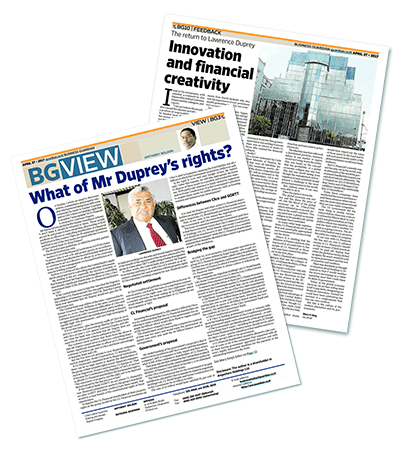
Lawrence Duprey and the other CL Financial chiefs could soon be regaining their positions, which is a public concern at this time. I consider that to be an unacceptable prospect and that was stated in my joint open letter to the Central Bank Governor on 31 January 2017. Both Anthony Wilson and Mary King took issue with those views of mine in the Business Guardian of 27 April 2017.
The arguments coming from Wilson and King emphasise Duprey’s property rights as the major shareholder of CLF. Wilson, who is the Business Guardian editor, appears to agree with me that the CLF chiefs could not satisfy the central bank’s ‘fit and proper’ rules which apply to those who direct, manage and hold controlling shareholdings in financial institutions. He also made the important point that there are companies in CLF which are not financial institutions and therefore Duprey ought to be able to regain control of those, provided the bailout sums are recovered. The main non-financial companies in the CLF group are Home Construction Ltd., Angostura, CL World Brands and CL Marine. I am still unclear, from Mary King’s article, whether she holds the view that the CLF chiefs are still fit and proper persons. Continue reading “CL Financial bailout – the endgame”→
On 31st January 2017 I co-signed an open letter to the Central Bank Governor on the CL Financial bailout. My collaborators were Rishi Maharaj of Disclosure Today and David Walker, with our common purpose to pointedly question the Central Bank’s handling of the bailout.
When over two months passed without a reply or acknowledgment, we decided to act again to bring the issues forward. On 19th April 2017, we delivered the letter again to the Governor’s office, this time with media coverage.
That approach seems to have worked, since the Central Bank actually replied on 21st April 2017 – see attached.
Of course there is no real reply to our queries, so we will be doing a thorough reply on those issues.
This is my interview with Rennie Bishop on 107.7 FM on Sunday 30 April 2017 to discuss the controversial Property Tax and the prospect of CL Financial being returned to its owners. Video courtesy TTRN -Trinidad and Tobago Radio Network Limited.
PM issues Statement on CLICO Report of Sir Anthony David Colman, QC. Courtesy news.gov.tt
“…Whilst in the last five-year administration, the management of Clico, CLF and the associated companies were shrouded in secrecy by the UNC administration, this PNM Government has no intention of operating in that manner. This Government will operate in an open, transparent and accountable manner as it has been doing…“ (The emphases are mine)
On the issue of interest due on Public Money advanced for the CL Financial bailout
I have been stating that the Public Money advanced for this CL Financial bailout was interest-free and that was a clear indication of the ‘most-favoured’ status of the borrowers. With apologies to my readers, CLICO’s 2015 audited accounts, (which were issued on 17th October 2016) disclose at its 32nd note that 4.75% was charged on the first tranche of $5Bn which was lent in 2009, so my prior claims on that item are now withdrawn. That first advance was converted to 4.75% preference shares, so interest was charged on the bailout monies but at such a paltry rate as to leave my fundamental point undisturbed, as explained below.
The Weighted Average Cost of Capital (WACC) is a metric used to show what is the average cost of the capital raised by a company. It is a vital tool in strategic management and allows the company’s leaders to make effective borrowing decisions.
If we apply this approach to the CL Financial bailout the answer is instructive. So, one can assume that the total advanced is $25Bn with only 4.75% interest on the first $5Bn and no interest on any more of the Public Money advanced to CLF. Accordingly, given that only 20% of the CLF bailout pays interest at 4.75% and the other 80% is at zero-percent, the WACC is .95%. Yes, less than 1% is the interest due from CLF for this epic loan. I tell you.
Once again, there are multiple versions of reality operating in relation to the CL Financial bailout, like some award-winning ScyFy movie. In one dimension, we have the PM accusing the previous regime of untoward secrecy while pledging to be open, transparent and accountable. In another dimension, we have a Minister of Finance promising to give us all the details of the monies spent on this bailout, while battling in the Appeal Court to overturn the High Court judgment I won to have those same details published. At the same time, Lawrence Duprey lobbies for the return of the CL Financial companies to him, while sidestepping any proper explanation of what went wrong. Both the PM and the Central Bank Governor label the CL Financial chiefs in scathing terms, while refusing to insist on proper commercial terms for the enormous financial assistance of the State. In yet another dimension, the State is said to be weathering a series of tough financial challenges, while showing stunning generosity to the wealthiest man in the Caribbean.
To paraphrase Pulitzer Prize-winning author, Junot Diaz – ‘ScyFy? What ScyFy?! The Antilles was Scyfy before there was ScyFy!‘
In July 2015, the High Court ruled in my favour that details of the CLF bailout were to be published by the Ministry of Finance, but that ruling has now been appealed.
Min of FInance, Colm Imbert, MP
The Ministry’s appeal, which was submitted on Friday 30th December 2016, has these main points –
CLF Accounts – The order to provide the accounts used by a previous Finance Minister to prepare a High Court affidavit is being contested as being a breach of legal professional privilege;
Parliamentary briefing – The order to provide the briefing to Independent Senators prior to debate on two laws on the CLF bailout is being contested as a breach of parliamentary privilege;
Who got paid? – The order to provide the names of those who were paid in the CLF bailout and the date of those payments is being contested as inimical to the confidentiality which a private person should enjoy.
Those arguments are only now being introduced, for the first time, during this appeal. That fact alone I consider to be unacceptable, but the points are being contested strongly and of course the Court of Appeal will be ruling on them.
For those readers who might consider the ScyFy comparison to be an overdone one, just consider how the Minister of Finance has approached the appeal with these further excerpts from Dr Rowley’s important address to the Parliament –
“…once the Minister of Finance has completed his on-going audit, he will come to Parliament and tell the citizens of Trinidad and Tobago the exact amount of money expended by the Government with respect to the said bailout. This will include the cost incurred by lawyers, accountants, professionals and all others. Furthermore, any and all disposal of assets from the group will be announced to the public in an open and transparent manner as well…”
At a time of economic sacrifice, the free-ticket given to CLF in January 2009, by the Patrick Manning-led Cabinet is being endorsed and renewed for further travel by the Keith Rowley-led Cabinet…this is where we are…
‘…Doublethink is the ability to hold two completely contradictory beliefs at the same time and to believe they are both true…’
—from George Orwell’s ‘1984’
On 25 January 2017 the annual Corruption Perceptions Index report was published by Transparency International, with the results reflecting poorly on our country. T&T’s score fell from 39 in the previous year to 34 in 2016 – this scale measures greater perceptions of public sector corruption as declining scores, with the countries seen as least corrupt having the highest score. As a result of the declining score, our ranking fell from 72nd out of 168 countries to 101st out of 176. That decline in perception was a serious one and really little surprise to the attentive citizen, none whatsoever. Of course perceptions take some time to change, so the question is whether the post-September 2015 regime can improve those poor perceptions.
I believe that there is now an outbreak of tragic ‘doublethink’ within our country’s leadership, in relation to the CL Financial bailout. That must be challenged if we are to ever see any improvement in our nation’s fortunes, not to mention the slide in terms of perception of corruption. Continue reading “CL Financial bailout – DoubleThink”→
CORRECTION: On the issue of interest due on Public Money advanced for the CL Financial bailout
I have been stating that the Public Money advanced for this CL Financial bailout has been interest-free and that was a clear indication of the most-favoured status of the borrowers. With apologies to my readers, I now accept that 4.75% was charged on the first tranche of $5Bn which was lent in 2009, so my prior claim needs to be withdrawn – see comments below. Yes, interest was charged on the bailout monies but at such a paltry rate as to leave my fundamental point undisturbed, as explained below.
The Weighted Average Cost of Capital (WACC) is a metric used to show what is the average cost of the capital raised by a company. It is a vital tool in strategic management and allows the company’s leaders to make effective borrowing decisions. For example, a company which had borrowed half of its capital at 10% and the other half at 14%, would have a WACC of 12%.
If we apply this approach to the CL Financial bailout the answer is instructive. So, we can assume that the total advanced is $25Bn – there are many estimates floating out there, but $25Bn is recurs quite frequently – with only 4.75% being charged on the first $5Bn and no interest on any more of the Public Money advanced to CLF. According to my calculations, given that only 20% of the CLF bailout pays interest at 4.75% and the other 80% is at zero-percent, the WACC is .95%, less than 1% is the interest due from the CL Financial chiefs for this epic loan. I tell you. It really looks like those insurance and investment gurus had it right, eh…party political investment is really the best insurance policy.
Having said that, the two questions arising are still of high importance –
firstly, why was no interest charged on the rest of the Public Money advanced?
Secondly, why was the low rate of 4.75% charged on that first tranche?
That rate is significantly less than the mortgage rate at that time, so how and why did a distressed borrower qualify for that kind of favour?
The return of Lawrence Duprey was the Sunday Express lead story on 15th January 2017 – ‘Rebirth of Duprey‘. This is one of those times when one is really sorry that an original suspicion was true.
We seem to be striding straight toward a precipice with no clear information at all about why, or how. The largest-ever special interest deal now seems set to return CL Financial to Lawrence Duprey and his cohort, which will be hugely detrimental to the public interest.
These bailout conditions in no way resemble the Wall St examples, despite the comical claims of its defenders that it was the same thing. There are three important differences –
the CL shareholders kept their shares;
the massive loan of over $20 Billion to the Caribbean’s wealthiest individual was made at a zero interest rate, that’s right, zero;
the CL Financial chiefs were never required to give a public explanation of what caused this massive collapse.
Those terms were agreed by the Cabinet in January 2009. It is a real ‘sweetheart deal’ to assist Mr Duprey and his cohorts to a soft recovery so they could get back control of the companies when things improved. We are now reaping what our rulers sowed, hence the title of this article. Continue reading “CL Financial bailout – Bitter Brew”→
30th January is the anniversary of the infamous 2009 CL Financial bailout, so I collaborated on this open letter to the Central Bank Governor, Dr Alvin Hilaire, to raise some urgent and important questions on the Central Bank’s management of this situation.
Our letter was sent on 31st January 2017 and was signed by David Walker, Disclosure Today and I.

 In the BG of 27th April 2017, both Anthony Wilson and Mary King took aim at my assertion that Lawrence Duprey and his chiefs should not be allowed to regain control of the CL Financial group. Last week I responded to them, but subsequent statements from the CLF chiefs show that regaining control of the entire group is the target. Those events include the abortive meeting between Lawrence Duprey and the CLICO Policyholders’ Group, led by Peter Permell; the several press statements from Duprey and his spokesmen, Carlton Reis and Claudius Dacon and the Mid-Year Budget Review from Finance Minister, Colm Imbert.
 Lawrence Duprey and the other CL Financial chiefs could soon be regaining their positions, which is a public concern at this time. I consider that to be an unacceptable prospect and that was stated in my joint open letter to the Central Bank Governor on 31 January 2017. Both Anthony Wilson and Mary King took issue with those views of mine in the Business Guardian of 27 April 2017.
 On 31st January 2017 I co-signed an open letter to the Central Bank Governor on the CL Financial bailout. My collaborators were Rishi Maharaj of Disclosure Today and David Walker, with our common purpose to pointedly question the Central Bank’s handling of the bailout.
 This is my interview with Rennie Bishop on 107.7 FM on Sunday 30 April 2017 to discuss the controversial Property Tax and the prospect of CL Financial being returned to its owners. Video courtesy TTRN -Trinidad and Tobago Radio Network Limited.
 This is my interview on the ‘CL Financial Bailout‘ on Power 102.1 FM on Tuesday, 21 February 2017 with Richard Noray.


 AfraRaymond.net