CL Financial Bailout – Lessons from the Financial Crisis

This is an edited version of my address to the 4th Biennial Business Banking and Finance Conference (BBF4) held at the Trinidad Hilton from 22 to 24 June, 2011. The session I participated in was devoted to ‘Lessons from the Financial Crisis: The Resolution of Failed Entities.’ [See the acknowledgement letter from the conference convenor here.]

Thanks for the invitation to speak at this forum, it was last-minute, but welcome, since our local Institutions of Higher Learning have not spent the necessary time to explain and analyse this financial fiasco.  I have been very critical of the Institute of Business, the Institute of Social and Economic Research, the Faculties of Economics and Management and the Caribbean Centre for Money & Finance, so it is great to see you making a start on this overdue work.  It is my pleasure to participate in these proceedings.

I want to start by shifting focus to the arena of the mind and the existence of elements such as moral and ethical values, as well as social standards. In 1971 there was a famous series of psychological experiments in which selected students entered a two-week role-play as prison-guards in control of other people who were playing the role of prisoners.

That experiment was conducted at Stanford University in California and the results were that most of the prison guards adopted cruel behaviour with most of them being upset when the experiment was stopped after only six days. The entire experiment was filmed and the prisoners suffered from regular acts of wickedness, abuse and sheer perversity – one-third of the guards acted sadistically.

The Stanford Prison Experiment as it is now known, was heavily criticised as being unethical and unprofessional.  Of course the other aspect is that it re-opened the perennial discussion into the nature of things.  The nature of our nature, as it were – ‘Are we humans naturally evil and cruel?‘  The learning seems to be that well-adjusted and reasonable people can very quickly lose their moral compass in a situation with a lack of the conventional controls such as disapproval and laws.

No surprise to those familiar with history and politics, but the lesson for us in T&T is that if you let people get the idea that they can never be punished, there is virtually no limit to the rules they will break.  Asset-stripping, Bribery and Corruption can become the new norms of a governing class and that is what has happened in our country.

We have never had a strong tradition of detecting and punishing White-Collar Criminals, so if we are to make a start in terms of the resolution of failed entities, that has to be the starting-point.  We cannot reconstruct or resolve the failed entities if we do not change that aspect of our culture – the absence of consequence has to be abolished.

The absence of consequence is inimical to any development – personal, national or regional.  It is no point bringing new regulations or ‘approaches’ to this huge problem, until and unless the basic culture changes.

So that is the challenge for us – we have to change the way we think and behave around these issues of White-Collar Crime.  It is a very damaging type of crime which can affect the lives of many, many people – as we have seen in the CL Financial fiasco.  But we have to make that choice to change our culture around these issues.

The current financial disaster amounts to the greatest ever destruction of capital in peacetime – these are literally epochal events, but we do need to be careful as there is yet another big lie out there.  It suits the CL Financial chiefs to promote a version of events that has the blame attached to the Wall Street events of 2007/2008. The people promoting that version are buffoons, whose story is unable to withstand serious examination. I call it the Wall Street hoax and it is useful since it allows the CL Financial chiefs to escape the reality of their failure, to put it charitably, by blaming events way beyond their control.

Nothing could be further from the truth. We need to be very clear on the scale of this particular lie and the public mischief it represents. Even close examination of CL Financial’s 2007 audited accounts shows only tiny exposures to Wall Street  But what is worse is that the entire CL Financial pattern of behaviour and the burning question of the extent to which the CLF chiefs were ‘fit and proper’ are not new issues.  If we consider the 15 July 1996 ‘Circular Letter to Shareholders‘ issued by Republic Bank Limited under the hand of then Chairman, the late Frank Barsotti, it is all there. Fifteen years ago we knew the threat to which we were exposing this country by letting CLICO take over Republic Bank…it is 66-pages long, but very important to read – it is on my blog.

We don’t have a Wall Street problem, what we have here is a St. Vincent Street problem.  Yes, from the Central Bank (at the foot of the Street) to the Treasury (paying for the whole entire wretched bailout) to the Red House (where the real discussion has never taken place), right up to #29 – the CL Financial headquarters. Yes, is a real St. Vincent Street problem we suffering from. This is we own creation we fighting with.

The CL Financial fiasco is estimated to be costing at least ten times as much, as a proportion of GDP, as the Wall St. crisis.  Yet we still have mischief-makers who want to make misleading comparisons between the two, to justify the bailout.

A powerful parallel with the Wall Street crisis is the fact that the CL Financial fiasco was also characterized by ‘Shadow Banking’, meaning vast sums of money solicited from investors and being traded outside of the conventional regulatory umbrella.

Here are some extracts from the Financial Crisis Inquiry Commission’s Final Report (the FCIC is the US government’s official Commission of Inquiry into the Wall St crisis) –

From pg. XX (20) of the ‘Conclusions’ section –

…Within the financial system, the dangers of this debt were magnified because transparency was not required or desired. Massive, short-term borrowing, combined with obligations unseen by others in the market, heightened the chances the system could rapidly unravel. In the early part of the 20th century, we erected a series of protections—the Federal Reserve as a lender of last resort, federal deposit insurance, ample regulations—to provide a bulwark against the panics that had regularly plagued America’s banking system in the 19th century. Yet, over the past 30-plus years, we permitted the growth of a shadow banking system—opaque and laden with short-term debt—that rivaled the size of the traditional banking system. Key components of the market—for example, the multitrillion-dollar repo lending market, off-balance-sheet entities, and the use of over-the-counter derivatives—were hidden from view, without the protections we had constructed to prevent financial meltdowns. We had a 21st-century financial system with 19th-century safeguards…

Every line of that paragraph rings true to our local situation.  We are grappling with a shadow banking threat to the savings of the nation.  Our national wealth has been pledged to rescue adventurers at the very edge of the financial universe and that is what is wrong with the bailout.

I am no supporter of the Peoples’ Partnership, but what is right is right and the fact is that our Minister of Finance, Dookeran, is spot-on with this part of his analysis and action.  When Dookeran spoke in his inaugural budget speech on 8 September 2010, he took the approach of combining the assets and liabilities of both CLICO and British-American Insurance, which showed an insolvency in the order of $7.3Bn.

More to the point, the approach showed ‘traditional insurance‘ liabilities – i.e. Health, Pension and Life – of the order of $6Bn and ‘non-traditional/investment’ liabilities – i.e. EFPAs – of the order of $12Bn.

So what we are seeing is insurance companies whose non-insurance business is twice the size of their insurance portfolio and what is more, the supposedly guaranteed investment is nowhere to be found, hence the tremendous problem in repaying the EFPA holders.  That is the dilemma facing the country now and that is what Dookeran was explaining to us – a Shadow Banking arena that has grown to eclipse the core business and threaten the entire nation.

Another important part of the false discourse in all this is the promotion of the utter nonsense that there is any such thing as a ‘Guaranteed Investment’.  Absolute and complete lies.  There is no such thing and that is the fact.  Yet we have had CL Financial’s  Boards of Directors of the ‘Great & Good’ promoting that kind of deceptive dangerous nonsense.  You Investment Professionals need to find the courage of your convictions to speak-out on this smartman behaviour.

We had a product being promoted as offering twice the market rate of interest and also your entire investment is guaranteed and blah blah blah.  The Central Bank and the Supervisor of Insurance sat there and allowed that deceptive advertising to take place and it was a campaign, with thousands of letters.  A straightforward assault on good sense and the gatekeepers stood silent.

The final point we need to drive home is that, whatever the temptations, we must not lay the entire blame onto Lawrence Duprey & Andre Monteil.  It took plenty more than the main CL Financial chiefs to get us to this point.  There is a network of lawyers, accountants, agents who pretended to be financial advisers and of course, the many Board Directors.  That network is hundreds of people all of whom share a responsibility, quite probably culpability, for this crisis.

The Colman Commission has to work very hard to preserve its effectiveness.

Property Matters – The EFCL Query part 3

On Thursday 14th July, the EFCL published a full-page response to the first article in this series – it was also the same day that the second article in this EFCL Query was published.  Although it was comforting to see the clear statements on EFCL’s ‘speak out’ component, Whistle-Blowing policy and procedure and Fraud Policy, the central concerns are greater, if anything.

I deliberately used the word response, since no reasonable person could consider that advertisement to be a reply to my emailed queries.

If EFCL were really replying to my query, it would have been no problem to provide a copy of the documents and answer the simple questions.

EFCL’s preferred course of action is to spend more taxpayers’ money on expensive artwork and advertising, so the further question is ‘Why?’.

Considering that all I was doing was questioning the existence and origin of an important policy of this State-owned company, it is perturbing to be having this level of challenge in getting a simple clarification.

As I wrote in this space last week – ‘So, what is the secret?

What could be the delay or difficulty in providing a copy of the EFCL’s Confidentiality Policy, as requested?

In the first article in this series, I posted the documents which had been passed to me.  The simple question is whether these are the genuine documents.  There was no attempt by EFCL to even answer that important query.

It is important because the EFCL advertisement told readers that “…Employees were not asked to sign under threat of dismissal…

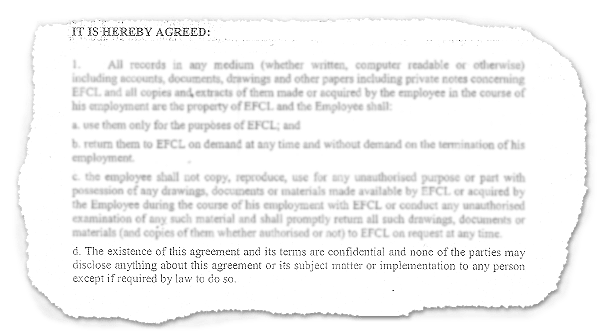
The first sentence of the preamble of the Staff Confidentiality Agreement is –

All new and existing employees will be given a copy of this confidentiality policy and will be required to sign a confidentiality agreement at the time of hiring or during their service to the company.

The emphasis is mine – yes, it reads ‘required to sign’.

But there is more, because the EFCL advertisement also stated that –

Staff who asked for time to get external advice, were allowed to.

However, clause 1 d. of the Confidentiality Agreement states –

The existence of this agreement and its terms are confidential and none of the parties to this agreement may disclose anything about this agreement or its subject matter or implementation to any person except if required by law to do so.

It is clear that the EFCL advertisement and the documents sent to me cannot both be true.

So, which is true?

Why did EFCL not send or publish the documents?

Quite frankly, it appears that EFCL is making a great effort to conceal or obscure its true policy on confidentiality, for whatever reason.

If this is the kind of effort being put into obscuring the elementary policy of this State-owned company, I can scarcely imagine their reaction to queries on particular projects, Directors’ benefits or tender procedure.

The behaviour of the State and its agents must be exemplary.  Public Officials have an obligation, in my view, to behave in a fashion which fosters trust and good order.

It is all starting to resemble a tangled web, sad to say.

Again, I hope that my doubts are misplaced.

SIDEBAR

Five simple questions for EFCL…

  • Is there a new EFCL Confidentiality policy?
  • When did that come into effect?
  • Would you please provide a copy of that policy?
  • Was that policy approved by the Board of Directors?
  • Is the Ministry of Education aware of this new policy?

Property Matters – The EFCL Query part 2

efcl-confidentialDespite the first column in this series, I have had no direct reply or even acknowledgement from any of the EFCL officials to whom my initial queries were directed.

It seems that the people concerned would rather not write, on this matter at least.  A meeting has been indirectly suggested, which of course would have to be properly recorded and minuted – no word on that meeting as I write again.

What could be the delay or difficulty in answering the five simple questions posed last week –

  1. Is there a new EFCL Confidentiality policy?
  2. When did that come into effect?
  3. Would you please provide a copy of that policy?
  4. Was that policy approved by the Board of Directors?
  5. Is the Ministry of Education aware of this new policy?

Four of those questions require basic yes/no responses, while only one requires a date.

I closed Sunday Guardian’s article by reminding readers of the equation

Expenditure of Public money – Accountability – Transparency = CORRUPTION

The elementary accountability of a public company having its policies available for the public to consider seems to be either lacking or of low priority in the case of EFCL.  As we move along, it will be interesting to see how the Transparency part of the equation works out.

In researching this article, it emerged that our country is a signatory to two relevant international conventions.  As I understand it, the effect of our State having become signatory to those agreements is that the country has adopted those standards.

The first one is the Inter-American Convention against corruption, which was signed by our country in April 1998.  At that time, UNC was in power, under PM Basdeo Panday.  At Article III, clause 8, we are obliged to

…consider the applicability of measures to…create, maintain and strengthen…Systems for protecting public servants and private citizens who, in good faith, report acts of corruption, including protection of their identities, in accordance with their Constitutions and the basic principles of their domestic legal systems…

The second convention is the United Nations’ Convention against Corruption, which was signed by our country in December 2003.  At that time, PNM was in power, under PM Patrick Manning.  At Article 8 – Codes of Conduct for Public Officials, clause 4 obliges us to

4. Each State Party shall also consider, in accordance with the fundamental principles of its domestic law, establishing measures and systems to facilitate the reporting by public officials of acts of corruption to appropriate authorities, when such acts come to their notice in the performance of their functions…

So, what is the big secret?

I do understand that staff at companies like this can jeopardize the integrity and effective operations of the organisation by leaking certain confidential information.  That would be a proper concern of management and a confidentiality policy is one of the ways that could be dealt with, just one.

During the Uff Enquiry, UDeCoTT claimed several times that this or that document was confidential and used its lawyers to protest strongly, sometimes even seeking the protection of the High Court.  That was outrageous conduct by a state-owned company, which appeared to be trying to frustrate the Uff Commission, appointed by the State, by seeking to conceal documents.  A case of ‘the tail wagging the dog’.

This situation is one in which it seems that the dangers of leaks in relation to tendering estimates, for example, has been conflated to cover all information in the company.  It appears to be part of a new policy which does not conform to either good labour relations or our country’s international obligations with respect to Whistle-Blowers.

Given the electoral promises made by this government and the importance of the struggle to reduce the menace of corruption in our society, it is very important for us to be attentive to these matters.

UDeCoTT wanted to conceal certain documents and one had to wonder why, given that they are not involved in secret work.  If it was not so serious it would be comical, they are not a spying, military or health institution.  UDeCoTT is just a facilitator for erecting buildings, yet their chiefs were able to pretend to the public that a large part of what they did was confidential. That kind of secrecy could never be in the public interest.  Not ever.

Similarly with EFCL, one has to ask – What is the secret?  That organisation is responsible for the repair and maintenance of schools, using Public Money to do so.

I wonder if that document, which a number of EFCL staff have now been required to sign, is legal and binding?  Could it withstand a challenge in the Courts?  Did EFCL take proper legal advice in this matter?  Was that advice followed?

The legitimate interests of taxpayers require that the management of State Enterprises take proper steps to handle these integrity challenges – Does the EFCL Confidentiality Agreement achieve this?

There is a certain kind of way in which this episode with EFCL is starting to remind me of the early UDeCoTT grappling, before Uff and so on, with tremendous difficulty in getting basic dialogue going, shadow-boxing and bizarre positions being taken.

I really hope that I am wrong, because the correct, encouraging attitude to Whistle-Blowers is essential for the success of the larger Public Procurement agenda.

Colman Commission considerations

This is a rapid look at some of the news coming out of the Colman Commission – the first live evidence was given on Monday 4th July.

That evidence has so far been into the Hindu Credit Union (HCU) and already some peculiar things are emerging.  I do not follow it on TV and just read the newspaper reports –

  • Breach of Trust – It seems clear to me that the depositors had a seriously misplaced faith in HCU and Harry Harnarine, which itself raises certain questions as to who was really fooling who.  It is basic and inescapable that a higher rate of return will mean a higher level of risk, which is why it is important to be more sceptical about high-return investments.  My point being that as a Credit Union, one has to become a member to participate and therefore one has a stake in the success of the organisation – with access to the accounts and attendance at the AGM, one can only wonder what kind of dance existed between the HCU chiefs and its ordinary members.  Yet, we are hearing from people who seem to have deposited their money at these  incredible rates of return and adopted attitudes of complete trust.  The witnesses need to be more seriously probed on what happened at those AGMs and so on – if they HCU conducted its AGMs anything like the CL Financial’s final AGM, it will be quite a story.   We need to get past the various heartbreaking stories, to the nexus of responsibility which is where this entire game is played.  I am sure there is plenty more to come out, plenty more.
  • farid scoon
    Farid Scoon

    Farid Scoon, Attorney-at-Law – Was expected to explain how he could be representing a group of HCU depositors and the former HCU chief, Harry Harnarine, at the same time.

There also seems to be a strange situation on CL Financial, since I am told that none of the affected people are willing to come forward to testify.  I am not very surprised at that and it is yet another indication of the extent of that toxic ‘Code of Silence‘.

What a shame!  25,000 policyholders said to be affected by the failure of CL Financial, yet only one is willing to testify.  Only One!   I wrote before in this space about the probability that a high proportion of those EFPA monies had never been screened by rigorous Anti Money Laundering (AML) procedures.  I suggested to the Minister of Finance that provisions be made in the payout agreements for the applicants for bailout monies to have the source of their funds vetted for compliance with VAT, PAYE, Income and Corporation taxes.  The Minister did not adopt those proposals.

So, what we now have is the spectacle of the Colman Commission set up by the government to examine the causes of the collapse and finding that few want to speak, very few.  I don’t know if it’s dirty money, or ‘keeping it in the family‘ or what…but I do hope that Colman takes a robust approach by using his powers to sub-poena people to appear and testify.

The Colman Commission needs to deploy more resources in getting info up onto its website in a timely fashion.  Just as a simple example, the opening arguments which were heard last week have been posted onto the website in very erratic, delayed fashion.   The session of Monday 27th June was posted on Tuesday 28th June, but the sessions of Wednesday 29th and Thursday 30th June were posted on Tuesday 5th July, no explanation given.  If more resources are required those need to be deployed.  The Colman Commission must not be allowed to become an orphan in our land of grandiose schemes and projects.

Of course we have seen the expected attempts by Lawrence Duprey to remove himself from being enquired into or even being required to answer questions.  At this time those attempts appear to have been thwarted, but we can surely expect more spoiling tactics and not just from Duprey, either.

Property Matters – The EFCL Query

Continuing the series of examinations into the purpose and performance of our State Enterprises, this week I am looking at an important issue which seems to be emerging at the Education Facilities Company Ltd. (EFCL).

EFCL is a state-owned company involved in the building and maintenance of schools.  It consumes public money in the execution of its functions and that is why it is important to put these points now.

efcl excerpt 3

One of the biggest public concerns is the high level of white-collar crime, which means bribery, corruption, fraud, over-billing, ‘back-fitting’, tax-evasion, asset-stripping and so on.  White Collar crime is a growth industry, since the rewards are very high, while the risk of being caught or punished is extremely remote.

Due to the size of the State, a great deal of that white collar crime can be found in State Institutions.  Once Public Money is being spent, we must demand a high standard of accountability and transparency.

In terms of principles, there needs to be an appropriate balance between the long-established ‘Right of privacy‘ in commercial transactions and the growing ‘Right to know‘ which is part of the emerging social order.  There will be different views as to where the correct balance exists and furthermore, the consensus position will shift as time passes.

It seems to me that the default position should be that, in doubtful cases, the right of the public to information should prevail, since we are the ones paying the costs.  Indeed, that position forms part of the Freedom of Information Act, so that is substantial support.

In early 2009 we witnessed an attempt by the then PNM government to amend the Integrity in Public Life Act (IPLA) so that people reporting breaches of that Act would have been forced to give their names and addresses.  That arrangement would have given even greater protection to corrupt officials, since virtually no-one would want to make a report.  Of course people are strongly encouraged to report ‘normal’ crime like rape, robbery, murder and so on – further encouragement is offered by allowing them to make anonymous reports via 800-TIPS, for example.  Those proposals to amend the IPLA would have encouraged corrupt behaviour by reducing the reports.

That Bill was piloted by then Attorney-General, Bridget Annissette-George.  The proposals were strongly opposed in the Parliament and in the wider society, eventually being withdrawn.  One of the strongest protestors in the Parliamentary debate was Dr. Tim Gopeesingh, who was reported to have accused the government of trying to intimidate people into not making reports. [Hansard, 1 May 2009 p.441] On that occasion, the Standing Orders were used by Colm Imbert, to curtail Gopeesingh’s presentation. [Hansard, 1 May 2009 p.455]

The normal good governance provisions for annual accounts, Board Meetings, minutes and so on are very important.  But those provisions must be supplemented by an atmosphere and a series of institutional arrangements which facilitate Whistle-Blowers.  There must be clear channels and protection for Whistle-Blowers if we are to have any chance of reducing corruption in our country.

Without the assistance of Whistle-Blowers, we would not have known of the Piarco Airport or UDeCoTT fiascos and we know for sure that somebody leaked the file on the Heights of Guanapo Church just prior to last year’s election.  We need encouragement for Whistle-Blowers – in some countries they are even given big cash rewards.  The JCC has been active with its partners – TTMA, the Chamber of Commerce and the Transparency Institute – in making Public Procurement proposals to the Joint Select Committee.  An important element of those proposals is the creation of proper channels for Whistle-Blowers.

I recently received a copy of some EFCL documents, which were stated to be their new Confidentiality Policy Statement and a Staff Confidentiality Agreement for the signature of employees.  I was also told, separately, that EFCL staff are being required to sign that Agreement, under threat of dismissal.  What is more, the Agreement contains a specific clause which forbids revelation of either the existence or the terms of the agreement.

efcl excerpt 2

If those documents are genuine, there are serious grounds for concern, so I made a written query via email on Friday 1st July to the EFCL’s CEO, Paul Taylor, and its Chairman, Ronald Phillip.  I outlined what had been reported to me and asked these questions –

From: Afra Raymond <afraraymond@gmail.com>
Date: Fri, Jul 1, 2011 at 1:13 PM
Subject: EFCL Confidentiality Policy
To: paul.taylor@efcl.co.tt
Cc: ronald.phillip@efcl.co.tt

Hello Paul,

I am reliably informed that EFCL staff were recently directed to sign a ‘Confidentiality Agreement’, the rationale being that it is the new Company policy.

Before taking this any further, I am requesting your written response to these questions –

  1. Is there a new EFCL Confidentiality policy?  When did that come into effect?  Would you please provide a copy of that policy?

Assuming a new Confidentiality Policy is in place, these are my queries –

  1. Was that policy approved by the Board of Directors?
  2. Is the Ministry of Education aware of this new policy?

I would appreciate a timely response.

With best wishes.
Afra Raymond

That email was also copied, purely for information, to the Minister of Education.  At the time of writing, there has been no acknowledgment or reply.

efcl excerpt 1

This is a serious development for these reasons –

  1. The Super-Confidentiality provisions mean that staff are forbidden to obtain any advice, which seems to be a breach of good labour relations, at the very least.
  2. The unilateral imposition of this new document does violence to the proper meaning of the word ‘Agreement’.
  3. The ‘Guiding Principles’ at page 2 refer to ‘privileged information‘ and ‘EFCL’s right to privacy‘, both of which seem to me to be leading away from greater transparency and improved procurement procedures – which leads into the final point
  4. This administration promised, both on the campaign trail and post-election, to make new procurement legislation a priority.  The Joint Select Committee on Public Procurement was Chaired by Dr. Tim Gopeesingh, Minister of Education.   EFCL is the principal State Enterprise within the Ministry of Education, so what is Dr. Gopeesingh’s position on all this?  Is this taking place with Dr. Gopeesingh’s knowledge and/or approval?

It is clear to me that this kind of stealthy restriction on the possibility of staff becoming whistle-blowers is incompatible with the high-profile public statements of support for a new, effective public procurement system. Those statements range from the promises at page 18 of the People’s Partnership Manifesto to numerous speeches by the present Prime Minister.

The reality is inescapable –

Expenditure of Public money – Accountability – Transparency = CORRUPTION

I am closing by wondering, aloud, if this is the shape of the new Information policy for our State Enterprises.

SIDEBAR: What is a Super Injunction?

It is possible for a prominent person to obtain a Court Order called an injunction to prevent the publication of material which is likely to be damaging to their reputation.  That is a long-standing legal right and there has been a recent series of decisions in the UK in which super-sensitive, high profile people have been able to obtain ‘Super-injunctions’ from the High Court, which have the effect of prohibiting the publication and further prohibiting revealing the very existence of the injunction itself.  Of course the media have been fighting that in Court and there are two investigations underway into whether the ‘Super-Injunction’ is itself an abusive instrument.  The emerging thinking seems to be that these ‘Super-Injunctions’ are destroying the information balance I outlined earlier.

efcl excerpt 4

This EFCL Confidentiality Policy, if it is so, would seem to be a similar device, doing great violence to the information balance.

The Duprey Letter

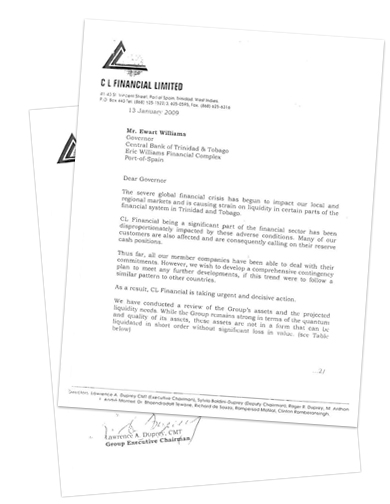
clf-cbtt letterThis is the CL Financial letter of 13th January 2009, signed by their ‘Trinity Chief’ Lawrence Duprey, for readers’ comments. I dub Lawrence Duprey the ‘Trinity Chief’ since he was the majority shareholder, Chairman of the Board and CEO of CL Financial.

I made three applications for this document under the Freedom of Information Act. The first was to the then Minister of Finance, who held over 10,000 shares in CL Financial, Karen Nunez-Tesheira. The reply to that application directed me to the Central Bank, to whom the letter was addressed, which was an obvious ploy to thwart my enquiry, since Central Bank is immune from the Freedom of Information Act. My two subsequent applications (2 & 3) to the current Minister of Finance, Winston Dookeran, have done little better – those were never even acknowledged.

It seems to contain the same text as the one Karen Nunez-Tesheira read into Hansard on 4th February 2009 – see ‘Finding the Assets‘ – except that the table in the copy is titled “CL Financial Group – Assets Available for Restructuring“.

CLF LETTER TO CENTRAL BANK

CL Financial Bailout – The final AGM

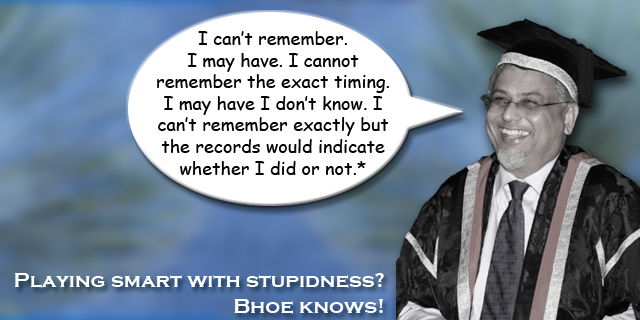
bhoe-knows* In response to a question whether he took part in the reported decision to pay CLF dividends even after the approach to the State in 2009.

CL Financial’s final Annual General Meeting was the most interesting meeting in the saga of its collapse.

That meeting took place at the Trinidad Hilton on Friday 23 January 2009, so consider the timeline –

  • 18 November 2008 – CLF publishes its 2007 Annual Report, including its audited accounts, which showed assets of $100.666Bn and after-tax profits of $1.74Bn.
  • 13 January 2009 – CLF writes, under Lawrence Duprey’s signature, to the Governor of the Central Bank to request urgent financial assistance.  See pg 628 of Hansard of 4 February 2009 for the text of that letter, which specified that CLF’s asset value was $23.9Bn.
  • 16 January 2009 – CLF pays a dividend of $3.00 per share.
  • 23 January 2009 – CLF convenes its final AGM before the ‘official’ collapse.
  • 30 January 2009 – The bailout of CLF is announced at a Press Conference at the Central Bank.  All the speakers at that event stated the CLF asset value at $100Bn.

Given that the normal function of an AGM is to inform a company’s shareholders and stakeholders of its performance and prospects, that timeline raises some intriguing questions.

For whatever reason, there have been no published reports of that final CLF AGM, so I posed these questions to a CLF shareholder in an email exchange –

Q       Did you attend that AGM?
A        Yes
Q       Was it at the Ballroom of the Trinidad Hilton on Friday 23rd January 2009?
A        It was at the Hilton but not in their ballroom. It was in one of the restaurants/meeting rooms that overlooks the Savannah. Can’t remember the name.
Q       About how many shareholders were there in attendance?
A        I would guess about 30-40
Q       Which Directors were present?
A        Clinton Ramberansingh, Rampersad Motilal, Bhoe Tewarie, Gita Sakal and Michael Carballo.
Q       Which Executive Directors were present?
A        Roger Duprey (I think)
Q       What was the ‘tone’ of the meeting?  Was there any clue as to the grave difficulties facing the CLF group?  Was the ‘bailout letter’ mentioned at all?
A        The tone of the meeting was “normal”. There certainly was no indication that CLF  (or the CLF group) was in any imminent danger. The effects of the global downturn was mentioned in light of the reduced dividend (from $5 to $3) and we were told by Carballo that although the group, like everyone else, was feeling the effects of the global recession, it was still performing well and that he expected the performance to improve over the course of the coming year. One interesting “fact” that did emerge (I say “fact” because I have no idea as to the veracity of the claim) had to do with the value of CLF shares. One shareholder had complained about not really being able to derive any value from his CLF shares apart from receiving a dividend. No bank would accept it as security. Carballo advised that CIB would accept the shares as security for a loan………….had I known I’d have taken a big loan and never paid it back!! Certainly the bailout letter was never disclosed to the shareholders.

If true, this account of the events is deeply disturbing.

The question is whether CLF’s Independent Directors were aware of its true position.  Could it be that the Board was unaware of Duprey’s letter and that they were surprised when the bailout was announced?  If that were the case, it would mean that Board of Directors was kept in the dark over this bailout.

If the Board was informed as to the bailout letter, we would be contemplating an even more unacceptable case.  If that is what happened, it would have been fraudulent for the CLF Directors to have carried out that AGM without informing the shareholders of the company’s true position.

Michael Carballo was the CLF Group Financial Director since Andre Monteil’s retirement in early 2008. Given Carballo’s position in the group and the high quality of his professional skills, it is very difficult to accept that he did not himself know CLF’s true position.

Dr Bhoe Tewarie swearing-in

According to this email exchange, neither Lawrence Duprey nor Andre Monteil attended CLF’s final AGM. With only one week to go, they would likely have been attaching more priority to the negotiations for the bailout.

So, Dr. Tewarie – a shareholder and former Director of CLF – is now appointed to Cabinet at the very moment that it is reviewing the bailout of the same CL Financial group.  That man, noted in the field of business education – his last post, before this appointment, being Director of UWI’s Institute of Critical Thinking – when asked about his attendance and participation in the Board meeting which approved those CLF dividends is reported to have said – “I cannot remember, I may have, I cannot remember the exact timing, I may have—I don’t know…The records would indicate whether I did or not...”.

We are being asked to believe that Dr. Tewarie cannot really remember this meeting, probably the final one before CL Financial folded and likely the most eventful in even a high-profile career such as his.  The old people have a saying that you start as you mean to go on.  Dr. Tewarie’s reply can hardly inspire confidence.  It verges on being dismissive and  disrespectful of the public.  We are paying for all the mess created by CL Financial and yes, that is the same public Dr. Tewarie just swore to serve.  It does not augur well.

The essential questions for Dr. Tewarie include his attendance and participation in this final AGM and what he knew about the state of the group at the time.

It seems unacceptable to me for holders of high office in our country to be persons who would be disqualified under the ‘fit and proper’ criteria.  That practice must be revised as part of the New Politics we are being promised.

Given the tremendous stakes and the complete silence by all the responsible people, we need to ensure that this affair does not carry our country any further into peril.

These responsible and silent people must be banished into obscurity, at the very least.

SIDEBAR

PricewaterhouseCoopers
It is a well-established custom that AGMs of large organisations are attended by the responsible partner of the auditor’s firm, who reads the auditor’s letter to the audience.  Did a partner of PriceWaterhouseCoopers attend this meeting?  Which one?  Did a PwC partner read aloud that auditor’s letter?

Real Responsibility
On the one hand, a Cabinet Minister is dismissed over a $100,000 contract and I consider that to be good progress in the correct direction.  The fact that a reasonable suspicion had arisen cost that Minister her job, which is good.  In keeping with the State’s exemplary behaviour, our leaders should not behave in a fashion which causes suspicion or derision.

On the other hand, we are seeing a replacement Cabinet Minister, who at last record was known to be a shareholder of the huge, failed CL Financial group and one of its Board Directors at the time of the colossal crash.  The official version is that CL Financial is a $100Bn group.  There have been recent reports that the Cabinet is about to consider a new approach to the bailout and the public is bound to wonder at the timing of this appointment.

Fit and Proper
The Central Bank’s ‘Fit and Proper’ Guideline (sic) sets out the official position as to the type of person held to be ‘fit and proper’ to be a Director or Officer of a Financial Institution.

It states –

3.1 In accordance with governing legislation a person is considered to be fit and proper if the person essentially is of good character, competent, honest, financially sound, reputable, reliable and discharges and is likely to discharge his/her responsibilities fairly.

State Enterprises and Public Procurement

procurement cycleState Enterprises were created to enhance the pace and quality of Public Procurement, yet they are now the scene of the most bedeviling paradoxes in the entire system of public administration.

Some of the key procurement issues which arise in this arena flow directly from the split character of the governance model.

The basic rationale for the existence of State Enterprises is they can be more effective because they are not bound by the strict rules which control the conventional civil service.  The absence of those rules is supposed to allow more latitude in terms of hiring, borrowing and contracting.  State Enterprises can hire professional staff at market rates, enter complex commercial arrangements and borrow on commercial terms, all of which should amount to significant improvements in public services.

The typical State Enterprise is owned by the State, with the shareholding held by the Corporation Sole, an exceptional legal creature which exists within the Ministry of Finance.  Apart from its owner, the State Enterprise will sometimes have a ‘line Ministry’, which would be its sole or main client.  For example, the Ministry of Housing & the Environment is the sole client of the Housing Development Corporation (HDC) and the Ministry of Education is the sole client of the Education Facilities Company Limited (EFCL).

State Enterprises can operate within the existing Companies Act or be established by a separate Act of Parliament, as is the case with the HDC.  That legal framework ought to ensure that a satisfactory standard of corporate governance and accountability is maintained.

The fact is that many of the Directors and Officers of State Enterprises are political appointees, which puts the entire rationale onto a doubtful footing.  Because the salaries and perks are so attractive, not to mention the commercial opportunities, the State Enterprises are prize targets for political appointments and favours.

Some of the main issues which arise when one is considering this sector are –

  • the number of State Enterprises – there needs to be a reduction in the number of State Enterprises.
  • If the politicians can instruct the State Enterprise, via the Permanent Secretary, on specifics, what is the purpose of the Board?
  • Given the preceding point, do the Board members of State Enterprises have the same duties under the Companies Act as in the case of other registered companies?
  • In terms of our proposed Public Procurement legislation, what is the boundary between the fiduciary responsibility of the Directors and the contracting powers of an ‘authorised officer’ – i.e. someone identified as having the power to enter certain contracts?

Proceeding along the Procurement Cycle and using the International Waterfront Centre (IWC) as an example –

  1. Needs Identification – This is the first stage of the Procurement Cycle and it ought to be an objective assessment of needs.  In this case, the IWC was part of a huge, disastrous boom in building new offices in POS – this is all detailed at ‘Capital Concerns – New Office Buildings’ – here.  Before the boom started in 2005, there was 6.5M sq. ft. of offices in Greater POS, at the start of the boom some 3.2M sq. ft., or an additional 50% of the capital’s office supply was approved for construction.  Please remember that Nicholas Tower, which took 5 years to fill, is only 100,000 sq. ft.  Just under 2.8M sq. ft of new offices was actually built in POS in the last 5 years, with 2.3M sq. ft. of that space (82% of it) actually built by the State.  Every State project identified at the outset was executed, but in stark contrast, virtually half the private sector projects stopped before construction began.  The obvious consequence of that over-building by the State has been a collapse in the office rental levels in the capital, which is detailed in the next point.
  2. Reconcile Needs with Funds – This is the stage at which a developer ought to consider critical questions such as the cost of funds, the cost of the project and the returns from it.  That is sometimes called a feasibility test and this is where the IWC dissolves into utter confusion.  When then PM Manning addressed the Senate on 13May 2008, he emphasized that every UDeCOTT project was approved by Cabinet and had been vetted by a Finance Committee on Financial Implications.  That is the most important address if we are to see the depth of the problem with these State Enterprises – see here.  The break-even point on such projects is the rent at which the project can repay its costs of construction – at minimum, those costs would have to include for land, design, construction and finance.  On that ‘bare-bones’ basis, which makes no allowance for maintenance or periods when spaces are vacant, the break-even rent for the IWC is in the $30 per sq. ft. range.  This is the largest single office building ever built in our capital and the best rents ever achieved for space of comparable quality is about half the break-even figure.  There is no way that the IWC project could ever have satisfied any proper feasibility test.  Every new office project started in our capital only increased the supply of offices, which reduced the market rent, which, in turn, increased the gap with the break-even rent.  Under oath at the Uff Enquiry, Calder Hart tried to rationalize the confusion when he confirmed that only one of UDeCOTT’s projects had been subject to a feasibility test and that one was the IWC.  He was even so bold-faced as to estimate a break-even rent in the $20 range, but, when pressed, had to admit that he had left the cost of the land out of the calculations!  That is the extent of the deformed thinking which typified the best schemes of the leading State Enterprise.  Only one of the State’s many office development projects tested for feasibility and in that case, the cost of the land is omitted, yet that same land is included as a part of UDeCOTT’s Assets at $224M in that very financial year.  Political imperatives were allowed to pervert a process which exists to protect the public interest from this kind of empire-building.  But it is in the next part that the full confusion comes to bear.
  3. The rest of the procurement cycle – This is the stage at which tenders were invited for design-build and the winning bidder selected, the project built and the complex opened.  According to UDeCOTT’s statements, the IWC project is its flagship and an outstanding success, having been built on time and within budget.  Even if one accepts those assertions as being true, the IWC project is an example of the tragic consequences of a limited application of proper procurement processes.

As a result we have a completed project which is said to have been built on time and under budget, yet makes no economic sense and has a break-even point at some uncertain point in the future, if ever.

Some collateral damage needs to be noted, to quote one of the former PM’s notable phrases.  Contrary to his statement to the Senate which is cited here, UDeCOTT did not publish its accounts since 2006, which is a breach of both the Companies Act and the Ministry of Finance guidelines.  A total breach of the elementary norms of good corporate governance, which is the protection the private sector structure was supposed to give us taxpayers as a safeguard.  Because of the political element in the operation, we can see clearly that UDeCOTT was carrying-out the instructions of the Cabinet and those Directors have not been punished or censured in any way, apart from their public dismissal.  The consequence of those breaches being condoned at the largest State Enterprises – UDeCOTT and HDC – how does one get the smaller and less-visible State Enterprises to conform to good governance?

If the priest could play, who is we?

This is why we need a complete review of our procurement controls.

An Overview on the CIVIL SOCIETY submission to the Joint Select Committee on PUBLIC PROCUREMENT

This special publication is dedicated to the important issue of Public Procurement.  It is written by the a private sector group, headed by the Joint Consultative Council for the Construction Industry (JCC).  The JCC consists of:

  1. Association of Professional Engineers of Trinidad & Tobago (APETT)
  2. Trinidad & Tobago Institute of Architects (TTIA)
  3.  Board of Architecture of Trinidad & Tobago (BOATT) – observer status
  4. Trinidad & Tobago Society of Planners (TTSP)
  5. Trinidad & Tobago Contractors’ Association (TTCA)
  6. Institute of Surveyors of Trinidad & Tobago (ISTT) comprising Land Surveyors, Quantity Surveyors and Valuation Surveyors.

The private sector group consisted of –

  • Joint Consultative Council for the Construction Industry
  • Trinidad & Tobago Chamber of Industry & Commerce
  • Trinidad & Tobago Manufacturers’ Association
  • Trinidad & Tobago Transparency Institute.

The members of that Private Sector group were part of the Working Party on the Public Procurement White Paper, which was published in August 2005 and laid in Parliament the following month.

The Peoples’ Partnership’s manifesto, at page 18, commits to –

Procurement

  • Prioritise the passing of procurement legislation and appropriate rules and regulations
  • Establish equitable arrangements for an efficient procurement system ensuring transparency and accountability by all government departments and state enterprises…

In keeping with those campaign promises, the Minister of Finance tabled two legislative proposals in Parliament on 25 June 2010.  Those were a Bill to amend the Central Tenders’ Board Act (originally prepared in 1997, when Ramesh Lawrence Maharaj was Attorney General) and the Public Procurement Bill (originally prepared in 2006, after publication of the White paper).  A Joint Select Committee (JSC) was established on 1 October 2010 to examine those proposals, invite submissions and make recommendations.

The stated target of the PP government is to have the new Public Procurement legislation in place by the first anniversary of their electoral victory – i.e. by 25 May 2011.

Our Private Sector/Civil Society group reconvened last year and made a joint submission to the JSC in December 2010 – it is available here from the JCC‘s website.  Our Private Sector group has had several meetings with the JSC – which was chaired by Education Minister, Dr. Tim Gopeesingh – but the results of those are not featured in this publication.

This special publication is intended to inform readers of the necessity for new Public Procurement legislation in our country and to set out the objectives of our proposals.

The guiding Principles

 These are –

  • Transparency
  • Accountability
  • Value for Money

The broad picture

One of the most serious findings of both the Bernard Enquiry (Piarco Airport Project) and the Uff Report (UDeCOTT and HDC) was the extent to which the largest State projects were being executed outside of any normal system of accountability.  The very purpose of setting up these companies and procurement methods was to bypass the Central Tenders Board.  The natural consequence of that way of proceeding being that if the CTB could be sidelined as a deliberate act of public policy, then other important elements of the regulatory framework are violated as a matter of course.  In the case of both UDeCOTT and NHA/HDC, accounts were not filed for years – since 2006 for the former and 2002 for the latter – in flagrant violation of the rules and laws.

These were the largest State projects – often described as being the flagship or centre-piece of this or that government’s policy – yet they were breaking the main rules and getting away with it.  The ‘getting away with it’ is the cloudy part of the picture, because we never hear of any penalty being sought against those State Enterprise Directors who broke the governance rules.

But that is the very centre of the puzzle and we need to understand it before we can try to unlock it.  So, we are told, time and again, that the only way to really get important and urgent projects done in the correct fashion is to go outside the rules.  The stated reasons are that the old rules are too cumbersome, slow etc… and yet, we end up, time and again, in the same mess.

Some of the features of these fiascos are –

  • Huge cost over-runs on virtually every project.
  • Unfinished projects which virtually no one can make sense of – to date there is no proper rationale for the huge and loss-leading International Waterfront Project, apart from Calder Hart’s bogus explanation to the Uff Enquiry.
  • A gross burden on our Treasury going forward – The continuing delay in completing the accounts for these State Enterprises shows how difficult it is to work out exactly what the State owes and to whom.

What all that tells us is that the existing rule-book seems to be blocking progress and the attempts to bypass it have done little better, if not far worse.

The dismal picture on public procurement is not limited to construction projects and can be found in all the other areas.

A new approach is needed and that is what is at the foundation of these legislative proposals.

What is Public Money?

Central to the new proposals is that any new Public Procurement system must be in full effect whenever Public Money is spent.

Public Money’ is defined at page 5 of our proposals as money which is either due to, or ultimately payable by, the State.

Our proposals are intended to form part of a financial management reform package to include for a National Audit Office and a Financial Management and Accountability Bill.

The intended move is towards a greater transparency and duty of care in terms of how taxpayers’ money is spent.  Our citizens, particularly the unborn ones who will have to pay for some of the wasteful schemes which are littering the landscape, deserve no less.

The new equation confronting us is –

Expenditure of Public Money
minus            Accountability
minus            Transparency
equals         CORRUPTION

We must fix that.

So, what is at stake here?

Our society is beset by large-scale corruption, which sustains wrong-headed decision-making.  The wider social consequences of that toxic culture are now hatching, with a vengeance, in the naked violence and wily crimes which pre-occupy our head-space.

The killing-fields of East POS, the decimation of African urban youths, the URP and CEPEP gangs and the battle for turf are all part of this picture.

As long as our society continues to applaud and reward dishonest, corrupt behaviour, we will continue sliding downhill.

The structure of our economy is that most of the country’s foreign exchange is earned by the State in the form of oil & gas earnings.  The rest of the society relies on the State and its organs to recycle those earnings for the benefit of those of us not directly engaged in the energy sector.

For that reason, the State casts a very long shadow in our country, far more so than in other places.  Virtually every substantial business relies on the State and its organs for a significant part of its earnings.  A healthy connection with the State is essential for good profits.

But that is where the particular problem is, since the conduct of the State and its organs is often found to be lacking in the basic ingredients of fairplay, accountability and transparency.

If the State is the biggest source of funds in the place and the State is not playing straight at all, a serious question arises – How can we hope to uplift our society?

The State has an over-riding duty to behave in an exemplary fashion in its policy and operations.

Due to its tremendous footprint, the State has to behave in that exemplary fashion if we are to move out of this mess.  A positive shift in State conduct will have a salutary effect on the commercial culture and wider society, one that is long overdue.

So, who spends Public Money?

We have a vast, expensive and confusing array of organs, all of which are authorized to spend our money.  For a country of about 1.4M people, we have 26 Ministries.  Just consider that the UK, with a population of about 65 million, has 19 Ministries and the USA, with a population of about 300 million, has 16 Ministries.  For a Caribbean example, Jamaica has twice our population and 16 Ministries.

Quite apart from the number of Ministries, there are two further layers of agencies which also have the power to spend – our country has 73 Government Bodies and 58 State Enterprises.

Given the vast range of operations undertaken by these agencies, any new system would have to be flexible in order to cover all those types of transactions.

The main features of the new system

Three new independent organs will be created –

    1. The Procurement Regulator (PR), with the duty to create overall Guidelines and a common handbook to guide the public procurement process.  The Regulator is appointed by the President in his own discretion and reports only to the Parliament.  Agencies can create their own procurement handbooks, once these conform to the overall Guidelines, as approved by the Procurement Regulator.
    2. The Public Procurement Commission (PPC) will be the investigative arm of the new apparatus to which complaints will be directed.
    3. The National Procurement Advisory Council (NPAC) will be purely advisory and comprises 14 members from a broad range of named private sector/civil society organisations – the JCC, Manufacturers’ Association, Chamber of Commerce, Transparency Institute – as well as the Ministry of Finance and the Tobago House of Assembly.

All expenses are to be drawn on the Consolidated Fund, with the Procurement Regulator and Advisory Council required to report annually to Parliament.

A vital part of our proposals is that Cabinet, Government Ministers or politicians are prohibited from instructing or directing these new agencies in any way.

They are intended to be entirely independent of political influence, which conforms to the proposals in the White Paper.

That freedom from political influence was also specified in both the 1997 and 2006 draft legislation.

A Complaints Procedure

The proposed system will create clear rights to make complaints or report wrongdoing.  Those rights are an important aspect of any modern procurement system and we propose three types of complaints/investigations –

  1. Potential tenderers/suppliers can complain, in the first instance directly to the Agency with which the tendering opportunity resides, then, if that is not dealt with satisfactorily, they can complain to the Public Procurement Commission.  Ultimately, the right to seek the protection of the High Court is preserved, once the established complaints procedure has been followed.
  2. The Whistleblower – We are proposing that whistleblowers be given legislative protection and practical means to bring their complaints direct to the Public Procurement Commission.
  3. The Public Procurement Commission can also, on its own initiative, start an investigation into an area of concern.

There are strict time-limits for acknowledgement and resolution of complaints.

Our proposal is for the Public Procurement Commission to have powers to punish both frivolous complainants as well as parties found to be in breach of the new system.  Those can range from fines to embargoes, during which offending parties can be banned from tendering opportunities.  Offending public officers can be subject to both fines and/or imprisonment.

The concern over the cost of the new apparatus

One of the most frequently expressed criticisms is that as critics of the rationale and operations of significant State Enterprises, we seem to be proposing a new series of state-funded agencies.  Some people have pointed out that these offices are unlikely to be cheap, particularly the PPC, which is to be constituted as a standing Commission of Enquiry under those existing legal provisions.

Yes, there will be new agencies and yes, they will cost money.

Given the recent revelations as to the cost of the Uff Enquiry – already estimated to exceed $50M – there are genuine concerns that we could soon have three new state-funded agencies which could absorb maybe $100M a year.

The challenge here is to move beyond the obvious and factual observations so that we can consider the decisive factors.  Our proposals have the promotion of Value for Money as one of its founding principles and that is good for the public.  So, how can we measure the value for money of these proposals, at this stage?

The scale of public procurement spending

In the case of expenditures direct out of the Ministries, the 2011 Budget has an anticipated capital expenditure for the Ministries of $7.050Bn, as per para 8 at page 4 of the Public Sector Investment Program (PSIP).

Also in that Budget there is an anticipated capital expenditure for the State Enterprises of $6.725Bn, as per the Foreword at page 4 of the Supplementary Public Sector Investment Program (Supplementary PSIP).  The combined figure of $13.775Bn is only for projects, so it excludes the salaries, rents and normal running expenses.  Please note that other elements in public expenditure, beyond just capital projects, will be covered by these proposals.  The guiding principle being that those activities involve the expenditure of Public Money.

There are very limited exemptions from the proposed provisions and those can be viewed at the JCC website.

I am also sure that there are other ways in which Public Money is being expended which are not shown in the national Budget, so the amounts are surely larger than that estimate.

The potential for savings

The scale of the public transactions, involving Public Money, which will come under the control of this new system is huge, at least $14Bn in size.  Even if the new system only saves 5% of that sum every year, we can easily justify an annual running expense in the $100M range, as mentioned earlier. 5% of $14Bn is $700M.

In the next 30 days, we expect our Legislators to make the crucial decisions on this series of proposals and we all need to be vigilant to preserve the key points.

Those key points would include –

  • Heads of Independent organs to be appointed by the President
  • Separation of the Regulator from the Investigator
  • Regulations laid in Parliament for negative resolution, with no Ministerial or Cabinet approval required.
  • Independent Organs funded from the Consolidated Fund, with no requirement to seek a Ministerial approval or Budget vote.
  • Accountability is ensured by the requirement to report annually to Parliament.
  • Private Sector/Civil Society oversight via the National Procurement Advisory Council.
  • Proper provisions for complaints and Whistle-Blowers.

The ultimate question, given what we know now, is – Can we afford not to take this step?

At this unique and challenging moment in what has been a long, twisted journey, the prospects of more corruption and waste are grim.

For these proposals to succeed, the legislators will have to vote in favour of a new law which reduces their power and discretion.  To some, that might be an impossible contradiction and an unreasonable thing to expect, but there will be considerable political credit to the account of those who make this change happen.  Our citizens deserve no less.

CL Financial Bailout – Retirement Planning

When you consider increasing lifespans, inflation and the greater likelihood of major medical expenses as one ages, it is clear that proper retirement planning should be a major factor for most people.

Some extracts from relevant advertisements to start off –

Company A

“Maintain your lifestyle – even after retirement…”

The time passed so fast and now you cannot imagine life without the luxuries you have come to know, the luxuries you deserve. The Company A annuities and pension plans allow you to live the lifestyle that you have become accustomed to – even after you’ve retired – without sacrifices that will affect your current quality of life.

Company B

“I WANT TO RETIRE COMFORTABLY”

It can be daunting to consider how much money it takes to retire in comfort. And government pensions do not provide the guarantees that they once did. But it’s never too late – or too early – to get started.

Company C

“At the rate things change today, long-term financial planning has become a concern for all of us.”

The responsibility for securing a comfortable retirement continues to shift from employers to the individual. Whether your goal is saving for retirement or you’ve already reached that goal and you want to be sure that you will never outlive your savings, an annuity may be just what you’re looking for. In Trinidad & Tobago as in the wider world, life expectancy has lengthened considerably with people living well past their retirement age. This introduces a new risk – outliving your savings.

Company C’s preferred plan features “…guaranteed income for the rest of your life…

Yes, Retirement Planning is an essential part of any good investment planning.

Central to the growth and long-term success of the CL Financial group was its ability to mobilise the retirement savings of the Caribbean people in pursuance of its wider commercial objectives.  I have been writing on how it all went wrong and who is to blame.

In preparing my submissions for the Colman Commission it occurred to me that the financial provisions made for the 3 CL Financial chiefs who departed in the last 12 months before the group collapsed is central to understanding the entire fiasco.  It is rich in irony.

Fiduciary Duty of Directors and Officers

The burning questions are –

  1. When did the Directors and Officers of CL Financial (CLF) know that the group was heading to collapse?
  2. When did the Directors and Officers of the failed subsidiaries know?
  3. What did they know and when did they know it?
  4. How much warning did their management controls give them?

The questions are pertinent and the time-line is instructive –

Timeline to CLICO Bailout

  • 31 March 2008 – Andre Monteil retires as CLF’s Group Finance Director.
  • 6 August 2008 – Anthony Fifi retires as Managing Director of the Home Construction Limited (HCL) group, which is wholly-owned by CLF.  Fifi remained on the board of the parent company, CL Financial.
  • Mid-October 2008 – CLF purchases Jamaica Money Market Brokers’ 45% shareholding in CMMB.  Please note that CLF owns 40% of JMMB.
  • 7 November 2008 – Michael Carballo, CLF’s Group Finance Director gives an interview to the Business Guardian that the group had assets of $100Bn and could weather any storm.
  • 18th November 2008 – CLF 2007 Annual Report is published – its Consolidated Balance Sheet disclosed a Total Asset Value of $100.666Bn.
  • 8 December 2008 – Robert Mayers proceeds on pre-retirement leave from his position as Managing Director of CMMB, pending his scheduled retirement, on 28th February 2009, as Managing Director.
  • 13 January 2009 – Lawrence Duprey, CLF’s Executive Chairman, writes, detailing an asset value of $23.9Bn, to the Governor of the Central Bank to seek urgent financial assistance.  See ‘Finding the Assets‘ published on 23 August 2009 for the text of that letter.
  • 16 January 2009 – CLF pays a dividend of $3.00 per share.
  • 23 January 2009 – CLF has its final and fateful Annual General Meeting at Trinidad Hilton.
  • 30 January 2009 – The bailout is announced at a Press Conference at the Central Bank.

What benefits did the departing Directors and Officers enjoy?  Three of the most important and senior CLF chiefs departed in the 12 months prior to the collapse.  To be fair, Fifi was retiring from HCL, which has not been described as a failed company, despite its challenges.  To understand the picture properly it will be necessary for the Colman Commission to examine the terms of the retirement of these CL Financial chiefs.

Those departures must be examined from the documents if they were to be approached from the compensation aspect.  What I mean is that these chiefs would have been paid upon departure and that would likely have been documented.

The suggested line of enquiry is –

  • How much did Messrs. Monteil/Fifi/Mayers receive upon retirement?  Does anyone believe that these chiefs left without compensation after years of service, at the highest possible level?  The amounts actually received and the bases on which those sums were calculated promises to be very interesting.
  • How were those retirement payments calculated? – Were the amounts arrived at by a ‘set’ formula?  Was that formula specified in their employment contracts?
  • Were those sums reduced to reflect the impending crash? – That alternative is the crux of the issue, coming to the point of what did they know and when.   If the sums were reduced to reflect the poor performance of those failed companies, we need to question the misleading accounts given as to the group’s health right up to the very brink of the collapse.
  • Shifts in asset values – I am also wondering if the sudden drop in asset values from $100Bn + to just under $24Bn, in the space of less than 2 months is part of this aspect of the story.  Only when we have those employment contracts published will we be able to consider whether there was any connection between the chiefs’ compensation formula and the asset values or, to put it another way, their departures and the sudden drop in asset values.
  • Performance-related? – Ultimately, we have to wonder as to the implications of the other alternative.  If we learn that these CL Financial chiefs were able to depart the failing group with no reduction in their retirement payments, that would be very serious indeed.  If that were the case, we would be contemplating employment contracts which divorced pay from performance.  Given contemporary norms that link pay and performance, that would be an appalling vista.  We would be seeing that our region’s largest investment group was saddled with a leadership which had constructed for itself the ultimate high-return, no-risk employment and retirement benefits, all at the expense of everyone else.  The ultimate irony.

I am fully expecting that there will be further legal arguments to silence or shroud any efforts by the Colman Commission to delve into this aspect of things.  Colman must be robust in his probe – he must follow the money.