The Uff Commission – The Final sitting

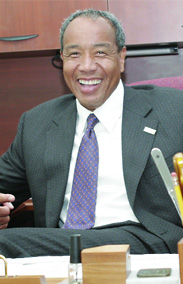
John Uff. Photo courtesy Trinidad Guardian
John Uff
The controversial Uff Commission is to start the final round of its hearings tomorrow. Please click here for the timetable. This Commission of Enquiry was established to examine and report on the Public Sector Construction Industry, with particular reference to UDeCOTT and the HDC’s Cleaver Heights housing project in Arima.

The huge sums of money involved and the egos of the parties all combined with irregular practices in this matter. The combination produced an unflattering and unforgettable picture of our nation’s leading players under the bright lights of the Uff Commission.

The legal challenge against and resulting resignation of Israel Khan as a Commissioner was just one outcome of the bold stance taken by the UDECOTT Board in this matter. The continuing legal challenges mounted by UDeCOTT against the Uff Commission have greatly diluted the credibility of this government, even in the eyes of its most loyal followers.

The failure to gazette the Enquiry was yet another strange aspect of the matter and, although that lapse has now been rectified, we are yet to hear a cogent explanation as to who was responsible and what was the reason for the failure. On this count alone, we are nurturing irresponsible behaviour by allowing this to pass quietly.

The Commission of Enquiry can only make findings based on the evidence which is properly submitted to it and that is where my concern is rooted. We are down to the final few days of hearings and it is my view that the proposed agenda for the final week of hearing is deficient since it leaves some seminal issues outstanding.

These are key points which could be addressed, even at this late stage, by the Commission issuing the necessary legal notices to have these items placed in evidence.

In order of importance, the outstanding issues are:

  1. UDeCOTT’s missing accounts – The main subject of the enquiry is the operation of UDeCOTT and we have not had their audited accounts for 2007 or 2008. The Performance Monitoring Guidelines for State Enterprises, published by the Investment Division of the Ministry of Finance, requires that these should have been published by now. UDeCOTT’s Executive Chairman, Calder Hart, while testifying to the Commission under oath on 28th January, stated that all the outstanding issues with the audit had been resolved and that those accounts would be published in “…a week or two…”. That testimony can be accessed from the CoE website at http://www.constructionenquiry.gov.tt/getattachment/6f957486-f0f4-4aad-b585-d644f3212806/COE-Construction-Industry-20090128-Merged-doc.aspx on page 43. For any Enquiry into the operation of UDeCOTT to make sound findings, those accounts need to be published now. At the least, UDeCOTT should write to explain the breach of the guidelines issued by its shareholder and the undertaking, given under oath by its high-performing Executive Chairman. Again, I ask, “Is UDeCOTT insolvent?”
  2. Bob Lindquist’s missing report – The original concern on the Cleaver Heights housing project arose when the Prime Minister raised concerns as to ‘Where the Money gone?’ and much was made of $10M or $20M which was said to be missing. The PM used the Budget debate in Parliament last year to ask the question of the former Minister of Housing – Dr. Keith Rowley. We were told that the Housing Development Corporation had appointed the respected forensic accountant, Bob Lindquist, to probe the project in question. The Minister of Planning, Housing and the Environment was reported to be silent on details when questioned on the results of that probe by reporters. [See – ‘Not me and the bacchanal’ published in Newsday on August 29th 2009 – http://www.newsday.co.tt/news/0,106338.html That is simply not good enough and the Commission needs to get Mr. Lindquist’s findings into evidence. We cannot have a satisfactory Enquiry if the government is able to control the flow of evidence.
  3. Housing Development Corporation’s output deficit – The Uff Commission’s terms of reference include ‘project delivery’ and the HDC has failed to account for this chronic deficit in satisfying its prime objective – Housing Development. The entire time spent by this Enquiry on housing has been only in respect of the Cleaver Heights project, but the HDC has never produced more than 50% of its target output in terms of the numbers of new homes built each year. The question remains as to whether the HDC is aware of the reasons for this continuing shortfall. This is a flagship state policy and the shortfall in numbers of new homes produced is itself deserving of proper attention from this Enquiry and the responsible State Enterprise. I submitted a series of written questions on this to the Enquiry and one would hope that some written response is forthcoming from the HDC or the Ministry.

The remaining Commissioners can take steps to preserve their reputations and have the key elements of outstanding information put into evidence. We await with interest.

Afra Raymond is Managing Director of Raymond & Pierre Limited and President of the Institute of Surveyors of Trinidad & Tobago. Comments can be sent to afra@raymondandpierre.com.

Freedom of Information request for MOU between CLF and the State

FOI ApplicationThis is my application, under the provisions of the Freedom of Information Act, for publication of the second MoU between CL Financial and the State.  At CMMB’s Budget Breakfast on 10th September, I asked the Minister of Finance when this would be published and she replied that there was no intention to publish it.  I followed up with an email to her on 19th September.  That email was the subject of a telephone call from one of the Minister’s staff to advise that a written reply was being finalised for me in the next few days.  Having had no reply, or any explanation of the delay, I published the Open letter to the Minister of Finance on 5th October in the Trinidad & Tobago Review.  This application is made in the belief that the public deserve to know the details of this arrangement.  The bailout is supposedly being conducted for our benefit and indisputably at our expense, yet there is now an open position that its details are to deemed ‘confidential’.  We, the taxpaying public, need to know who exactly are the beneficiaries of the bailout and what are the terms on which those benefits are being obtained.  Anything less than full and immediate publication is a recipe for utter confusion and corruption.

Nothing but the truth

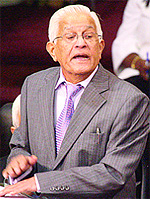
Basdeo Panday
Basdeo Panday, MP

The Leader of the Opposition, Basdeo Panday, recently laid a motion in Parliament seeking for HCU depositors to be granted a ‘bailout’ of the kind given to those who had invested with the failed CL Financial group. On Friday 30th October, the Minister of Finance made a major statement to Parliament, seeking to defend the government’s actions in the cases of these two failed Financial Institutions.

In terms of race, politics and finance, that statement by the Minister deserves our most sober consideration.

Before going further I need to make two things clear – firstly, I am not intervening on behalf of Mr. Harry Harnarine or the HCU. I am not a supporter of that cause. Not at all. Secondly, I do not support the bailout of either group – CL Financial or HCU. The idea that State resources should be deployed to assist investors who have lost money is a dangerous one. As a matter of principle, the concept of moral hazard has real weight in economic behaviour. The idea that investors should be rescued without paying the consequences of their choices is inimical to proper development. That general principle has been done violence by the CL Financial bailout.

As I have stated in my previous articles on this bailout, the record of the government in terms of separating the interests of depositors, policy-holders and shareholders is turbid.

The Minister’s rationale was set out in two limbs – the first being that the HCU dealings were not straightforward – indeed, one newspaper carried the headline ‘Devious HCU’– and secondly, that the CL Financial dealings were marked by “…tangible co-operation…”. This bailout is an extremely serious act being carried out by the government in breach of fundamental principle and we deserve nothing but the truth.

There are deep contradictions on every single point cited by the Minister to support the actions taken.

Here is what the Minister is reported to have said, together with the contradictions –

  1. Ample collateral – The Minister is reported to have said that HCU failed to offer ample collateral to the State. The Central Bank Governor is reported to have said, on 7th April, that all of CL Financial’s assets were otherwise committed – This was reported at http://guardian.co.tt/business/business/2009/04/08/govt-left-empty-handed-cl-financial-bailout.
  2. The Ernst & Young report – The Minister is also quoted as saying that “The auditors’ assessment was that the Hindu Credit Union was facing not a liquidity problem, but a solvency problem and all its assets were overestimated in value and encumbered.” As a rationale for the government’s actions, that is completely at odds with the 7th April statement of the Central Bank Governor. In fact we were told that the CL Financial group and various of its parts were being examined by Ernst & Young, KPMG and Bob Lindquist, the renowned forensic accountants. To date, no results of those accountants’ work have been released. We are being told that the CL Financial chiefs showed “…tangible co-operation…” in their dealings, so where are the audits? Why has the 2008 audit of the CL Financial group by PriceWaterhouseCoopers not been published?
  3. “…What is the Government to do? You dealing with…the major players, and they are not levelling with you…” That was the Minister’s statement about HCU, made in apparent exasperation. As I wrote in my column ‘Who is Who and What is What’ published here on 30th April – “At the beginning of this process we were led to believe that CL Financial was being pro-active and cooperative in their dealings with the State. Indeed the Governor even made this point directly in his prepared remarks at the 30th January press conference “…I would like to acknowledge the high level of cooperation that we have received from Mr. Duprey…” Since then CLF has now been exposed as paying dividends after requesting the State bailout, challenging the injunction obtained by the State over their assets with a powerful legal team and, to top it all, pledging the same assets twice. The Governor spoke on 23rd April – ‘If you ask me whether CL Financial did everything that was honourable and beyond reproach, the answer is no! The answer is no!’”

Obviously, some one of the major players is not levelling with us.

SIDEBAR

So the government bails out policyholders and depositors of the CL Financial group. That is widely welcomed, except for a few objectors, like myself. It seems to me that the interests of the CL Financial shareholders have been promoted in preference to those of the taxpayer. I am subject to correction, but if that is so, it would be a monumental mis-allocation of public funds and a seriously questionable act. The terms of the bailout are now being deliberately concealed from public view, although it is at our expense and supposedly being carried out for the benefit of the public.

That secrecy is toxic to notions of transparency, accountability and modernity. I will return to that secrecy issue.

Suffice to say that the terms of the bailout, the subsequent revelations and the concealment of the second MoU have combined with the Minister’s contradictory statement to yield a very unhealthy series of precedents.

The unspoken question at this moment is ‘Who is next?’. Last week’s BG View editorial highlighted some pertinent concerns as to the health of private pension plans and the strength of the regulatory process.

No one knows if CL Financial is just the first in a chain-reaction or simply a ‘one-off’. The burning question is, if there is another collapse of a large investment house – ‘Will they also be bailed-out?’ and, if yes, ‘On what terms?’

CL Financial subsidary British -American Insurance Company has “gone through.”

GOVERNMENTS OF THE EASTERN CARIBBEAN CURRENCY UNION (ECCU) AGREE ON STRATEGY FOR BRANCHES OF BRITISH AMERICAN INSURANCE COMPANY IN THE EASTERN CARIBBEAN

Introduction
For several months, the Governments of the Eastern Caribbean Currency Union (ECCU) have carefully monitored growing public concern about the financial situation of British American Insurance Company Limited (BAICO) and other subsidiaries of its Trinidadian parent company, C L Financial. BAICO itself is a private, limited liability company incorporated in the Bahamas. Nevertheless, the sheer size of BAICO and the significant exposure of the Eastern Caribbean have made it imperative for the ECCU Governments to adopt a proactive and collective approach to this challenge.

Continue reading “CL Financial subsidary British -American Insurance Company has “gone through.””

Duprey’s Fate

The Business Guardian editorial of 15th October raised the topical question as to ‘Will Lee Chin avoid Duprey’s fate?‘  http://guardian.co.tt/business/business-guardian/2009/10/15/will-lee-chin-avoid-duprey-s-fate

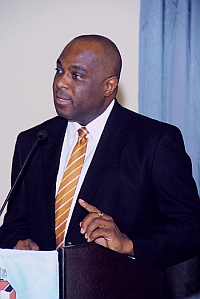
Michael Lee Chin. Photo courtesy Trinidad Guardian
Michael Lee Chin
Of course, one interesting feature of this entire affair is the fact that these two groups were headed by Black Caribbean men.  That is exceptional, as a matter of fact and it required a serious break from our past to develop the required levels of investor confidence.

But the differences are even more interesting than the similarities – for example, it seems that AIC Finance has declared the true position and alerted its stakeholders properly as to its exit strategy.

The characterisation of this situation as being ‘Duprey’s fate’ made me smile.  Quite frankly, that phrase seemed to be a device to create some public sympathy for Duprey when the facts are of another type altogether.

If the terms of the CL Financial bailout are examined, they are truly remarkable, even by our declining national standards.  The principal terms are –

  1. Amount – The amount of public money to be advanced is unspecified. Despite various official statements, this did not form part of the first MoU.  The press release on the second MoU of 12th June 2009 was also silent as to the amount of money to be advanced in this CL Financial bailout.
  2. Collateral – The original MoU specified that certain assets were to be disposed of to repay the funds advanced from the Treasury.  That position was soon overtaken by reality when the Central Bank Governor announced on 7th April that all of CL Financial’s assets were already pledged – http://guardian.co.tt/business/business/2009/04/08/govt-left-empty-handed-cl-financial-bailout. The second MoU and recent statements by Mariano Browne, Minister in the Ministry of Finance, make it clear that no fire sale of assets will be undertaken.  To quote the Minister, speaking on 15th October – “One needs to be judicious in terms of the managing of the assets at CL Financial Group, given the depressed state of the market both here and internationally. There is certainly no intentions (sic) of selling the assets. The position is to manage them and manage them well” http://guardian.co.tt/business/business/2009/10/16/browne-no-plans-govt-increase-shares-rbl.  If we are to believe the Central Bank Governor and the Minister, there being no good reason to doubt either one, it seems that these advances are taking place without security.
  3. Interest rate – The first MoU and the press release on the second MoU are both silent as to the interest rate charged.
  4. Payback period – There is no stated period for repayment of the public funds advanced.  There have been recent announcements as to the government taking over management of the CL Financial group for 3 years.
  5. What fate? – Having arranged an urgent package of rescue financing on those terms, it seems that the shareholders of CL Financial have not had their equity position diluted and further, that Mr. Duprey has been allowed to keep all his personal assets. That is Duprey’s fate.

That summary is the best I can give, based on the limited information available to me.  If it is an accurate one, the CL Financial bailout is tantamount to a huge injection of public funds to bolster the private interests of only 325 shareholders, the main one being Lawrence Duprey.

That is a real shame, given the state of our nation’s finances.   The greater pity is that this is all taking place without proper public accountability or transparency.  So far the Minister of Finance has not replied to my various attempts to get further information on these matters.  But how much blame can we place on our rulers?

Our society is shaped by our collective aspirations, attitudes and actions.  But the notion of collective values is an increasingly doubtful one in this arena.  Insofar as the national economy is concerned, do we actually possess collective values and if so, who can say with certainty what those are?  More and more, it seems that the real question is ‘Whose values will prevail as we go forward’?  The progressive people in the society have a duty to make their voices heard, if we are to have a chance of influencing others.  If we influence others to improve standards, then that is a positive move towards the inescapable future.

This CL Financial fiasco has been marked by the silence of the responsible people in the society.  The nation seems to have been so heavily invested in the CL Financial group that the bailout was greeted with widespread relief.  So much relief, that we seem to have taken our critical eyes ‘off the ball’.  On 19th October I wrote an Open letter to the Institute of Chartered Accountants of Trinidad & Tobago (ICATT) to seek their involvement in calling for greater transparency and accountability in this entire bailout.  That letter can be found at www.afraraymond.com.  The week 19th to 23rd October was Accountants’ Week.  The President of the ICATT, Anthony Pierre, writing to open that Week, stated that ‘We have the opportunity to raise the bar on new standards in corporate governance, accounting, auditing and ethics” and “We do so mindful of our continued responsibility to contribute to the further development of our people, our institutions and our country”.

I also intend to seek the involvement of other civic society organizations in promoting the calls for greater transparency and accountability in this entire bailout process.

Afra Raymond

This series on the CL Financial bailout can be viewed or readers’ comments made at www.afraraymond.com.

Property Matters – Property Taxes 2010

I have included my new series of articles on the proposed property tax here on my website. You can access the articles on it page by clicking the “Property Matters” stub above or by clicking the Title links to retrieve article.

Title Abstract
#1 – An overview The recent proposals for a revision of property taxes have met with a heavy round of criticism. Apart from the government, there have been few supporters for this new tax.


#2 – The Challenge for the TTRA The challenge for the newly-founded Trinidad & Tobago Revenue Authority (TTRA) is considerable, given the depth of criticism against the proposed review of property taxes.


#3 – The proposed 2010 Review This week the actual proposals of the Ministry of Finance are examined. The proposed review is formally set out in the Property Tax Bill 2009, which is to be tabled for debate.


#4 – The Central role of Local Government reform This week I am drawing some conclusions on the property tax proposals, together with a presentation of the corrected data.


Continue reading “Property Matters – Property Taxes 2010”

Open letter to the Institute of Chartered Accountants of Trinidad & Tobago

Anthony Pierre
Anthony Pierre, president of ICATT

From: Afra Raymond <afra@tstt.net.tt>
Date: Sun, Oct 18, 2009 at 4:19 PM
Subject: ICATT and the CL Financial bailout
To:  Anthony Pierre, President

Dear Mr. President,

I am writing to you, as President of the Institute of Chartered Accountants of Trinidad & Tobago, to urge your involvement in the calls for greater transparency and accountability in the bailout process involving the CL Financial group.

Anthony, on the many occasions on which we have interfaced, I developed considerable respect for your integrity and sense of purpose.  Most recently, I took note of your critical intervention on the proposed new regulatory regime for the credit union movement.

I am of the view that we citizens and civil society organisations, such as ICATT, need to be active in promoting higher standards of professional and public conduct.  I know that those are values within which we can find common ground, because in so many respects we can do better.  Yes, we can.

As you know, I have been publishing a critical review of the CL Financial bailout in the pages of the Business Guardian and that now forms the core of my blog at www.afraraymond.com.  The collapse of the CL Financial group is certainly the largest financial crisis to beset our nation and the first MoU of 30th January 2009 was widely welcomed as offering relief to depositors and policyholders.  I expressed doubts on the grounds that we seemed to be ignoring moral hazard.

The second MoU, signed on 12th June 2009, has now apparently been deemed ‘confidential’.  That designation is inimical to vital concepts such as transparency and good governance, both of which form important themes of ICATT’s work generally and in this Accountants’ Week in particular.

I appreciate that your time is very limited, so there are only two articles to which I would invite your attention, both available on my website – ‘Finding the Assets‘ (published on 23rd August) and ‘Open letter to the Minister of Finance‘ (published on 5th October and also in that issue of the Trinidad & Tobago Review).  For ease of reference, I have attached copies of these articles.

My specific questions to the Minister of Finance, on which I am here lobbying for ICATT’s support and involvement are:

  1. CL Financial 2008 Audited Accounts – When are these to be published? What is the reason for the delay in doing so?
  2. The second MoU with CL Financial – The first MoU was published on the Ministry of Finance website on 9th April, 9 weeks after it was signed.  Using even that slow timetable, the new MoU is overdue for publication.  Some 18 weeks have now elapsed.  What is the reason for its omission from the Ministry’s website?  The second MoU creates new and onerous commitments for the country and its publication must no longer be delayed.  I emailed the Minister of Finance on 19th September to request clarification on this, but there has been no reply.
  3. Forensic Audits – We have seen various official reports of forensic audits being carried out at CL Financial and some of its subsidiaries.  Have these been completed?
  4. The interest rate – What is the interest rate being charged to CL Financial for this open-ended financial assistance?
  5. Status Reports – We have had no interim reports as to the disbursement of State funds or the disposal of CL Financial Assets.  When does the Ministry of Finance intend to start providing regular reports on the progress of the bailout to the public?
  6. The equity position – How is the equity position of the shareholders being adjusted in this deal?  Has their shareholding been diluted to reflect the position?  Has the State now taken an equity position in the group?  If not, what is the upside for the State in all this?

For the avoidance of doubt, given the recent confusion amongst our learned friends, please note that this is being published to my website.

Afra Raymond

Open letter to the Minister of Finance on The CL Financial bailout

Honourable Minister,

This government agreed a bailout of the CL Financial group and announced that on 30th January 2009.

It was an historic step and the stated reasons for so doing were to ensure the stability of the national/regional financial system.  The size of the CL Financial group at some $100Bn, as well as the sheer reach of its activities, were cited as part of the rationale for the bailout.  The interests of depositors and policyholders were to be safeguarded by this State intervention.

Since the signing of the Memorandum of Understanding on 30th January 2009, several serious concerns have come to light and those have been highlighted in the press.

This letter is intended to form part of the formal record in this matter.  Its principal concern is the actual size of the bailout commitment.  According to your statement to Parliament on Wednesday 4th February 2009, the Executive Chairman of CL Financial estimated its assets as being worth $23.914Bn.  That statement is taken from page 628 of Hansard and can be accessed at http://www.ttparliament.org/hansards/hh20090204.pdf.  Mr. Duprey’s estimate was stated by you to form part of his letter of 13th January, as Executive Chairman of CL Financial, to the Governor of the Central Bank.

What possible justification could there be for repeatedly stating that the CL Financial group had about $100Bn of assets, if Mr. Duprey estimated the figure to be $23.914Bn?

There are 3 possibilities here –

  1. Firstly, PWC’s Consolidated Balance sheet for the CL Financial group is accurate in disclosing an Asset Value of $100.666Bn.  CL Financial’s Consolidated Balance Sheet is at page 23 of their Annual Report 2007 ‘The Next Wave of Growth’ – http://www.clico.com/pdf/AR07/CL%20Financial%20Annual%20Report%202009.pdf.  Those audited accounts, as at 31st December 2007, were published on 18th November 2008.
  2. Secondly, CL Financial’s letter of 13th January 2009 to the Governor of the Central Bank, signed by its Executive Chairman, Lawrence Duprey, is accurate in disclosing an asset value of $23.914Bn.
  3. Thirdly, if we accept that the first and second statements are both correct, we would have to somehow account for the dramatic decline in the CL Financial Asset values.

In his prepared address to the 30th January press conference to announce the CL Financial bailout, the Central Bank Governor was clear in his appreciation of Mr. Duprey’s stance in the matter “..I would like to acknowledge the high level of cooperation that we have received from Mr. Duprey in our efforts to address what must be a very difficult period for the CL Financial Group.”  It is reasonable to assume that the high level of cooperation referred to by the Governor would have been accompanied by levels of frankness, good faith and full disclosure.  It is therefore all the more puzzling when one considers the Governor’s statement, made in that very address –

“…For the record, ladies and gentlemen, the CL Financial Group has an imposing presence with potentially systemic consequences for the financial sector and the economy of Trinidad and Tobago and the entire region.

For example,

  1. The Group controls over ($100) billion of assets in at least 28 companies located throughout the Region and the world.
  2. The Group’s financial interests cover several industry sectors including banking and financial services, energy, real estate and manufacturing and distribution. The four largest financial institutions in the Group manage assets of over $38 billion, over 25 per cent of the country’s GDP.”

How can one possibly reconcile that official account, made to justify the bailout, with Duprey’s letter, clearly stating that the assets are worth $23.914Bn?

What could have caused such a dramatic decline in CL Financial’s asset values?  The intervening period could either be 12 months and 13 days or 56 days, according to how you count it.  Either way, it is a tremendous decline.  Our Treasury is now committed to restoration of asset values – as per the Angostura Notice to Shareholders of July 2009 – we must understand the reasons for the decline in asset values.

The audited accounts of the CL Financial group for 2008 are now easily overdue and it would be instructive to consider the Balance Sheet as at 31st December 2008.  That would be a mere 13 days before Mr. Duprey wrote to the Central Bank Governor.  Has CL Financial’s audit for 2008 been completed?  If not, why not?  If yes, why the delay in its publication?
This is an aspect of the fiasco which has not been discussed in public, so far.

Your urgent and public response is now needed on these important points –

  1. CL Financial 2008 Audited Accounts – When are these to be published?  What is the reason for the delay in doing so?
  2. The second MoU with CL Financial – The first MoU was published on the Ministry of Finance website on 9th April, 9 weeks after it was signed.  Using even that slow timetable, the new MoU is overdue for publication.  Some 16 weeks have now elapsed.  What is the reason for its omission from the Ministry’s website?  The second MoU creates new and onerous commitments for the country and its publication must no longer be delayed.  I emailed you on 19th September to request your clarification on this, but there has been no reply.
  3. Forensic Audits – We have seen various official reports of forensic audits being carried out at CL Financial and some of its subsidiaries.  Have these been completed?
  4. The interest rate – What is the interest rate being charged to CL Financial for this open-ended financial assistance?
  5. Status Reports – We have had no interim reports as to the disbursement of State funds or the disposal of CL Financial Assets.  When do you intend to start providing regular reports on the progress of the bailout to the public?
  6. The equity position – How is the equity position of the shareholders being adjusted in this deal?  Has their shareholding been diluted to reflect the position?  Has the State now taken an equity position in the group?  If not, what is the upside for the State in all this?

Afra Raymond

The Uff Commission – A Final Fix?

It might seem impossible, but we have been pushed into greater confusion by the events of the fortnight since the last Property Matters appeared.

Despite a fresh round of confusing denials, UDeCOTT are reported to have maintained their legal action to challenge the Uff Commission.   That challenge includes claims as to the alleged bias of the Commissioners.  UDeCOTT continues to deny that the purpose of these legal challenges is to de-rail the Uff Commission.  If those actions were to be sustained and to eventually succeed, the Uff Commission would be de-railed.  Some attorneys have pointed out to me that there have been no studied statements as to whether an Enquiry with a reduced number of Commissioners is still effective under the law.  Even so, justice must not only be done, it must appear to be done.  Point being, even if the Enquiry with a reduced number of Commissioners is lawful, it will hardly be able to command any moral authority.  It is my view that a successful legal challenge from UDeCOTT would have the effect of killing the Uff Commission entirely.

I am reliably informed that the hearings for this UDeCOTT challenge could take at least one year.

Some of the major highlights in the swarm of contradictory comments were –

  • Conrad Enill’s opaque statement on the State paying UDeCOTT’s legal fees.  The PNM Chairman referred the question to the Minister of Planning, Housing and the Environment, Dr. Emily Gaynor-Dick-Forde.
  • Attorney General John Jeremie made strong, stirring statements on his no-nonsense approach to white-collar crime.  Mr. Jeremie was adamant that all the necessary steps would be taken to ensure the proper completion of the Enquiry.
  • Minister Gaynor-Dick-Forde is reported to have given a telephone interview to affirm that ‘UDECOTT is right’ in making its legal challenge.  http://guardian.co.tt/news/politics/2009/09/26/udecott-right That incredible assertion can only dilute the limited authority of this Minister, who took prompt action to dismiss the entire HDC board of Directors earlier this year.  The Minister’s explanation was that there was a ‘governance crisis’ at the HDC.  If this behaviour by UDeCOTT does not count as a ‘governance crisis’ of the first order, we have to wonder about the quality of this Minister’s judgment.  Dr. Gaynor-Dick-Forde went so far as to say that the AG and UDeCOTT were saying ‘one and the same thing’.  This Minister is a highly-lettered scholarship winner and has affirmed herself to be a Christian with a ‘big C’.
  • Independent Senator and UDeCOTT Board member Michael Annisette, gave a strong defence to UDeCOTT in his contribution to the budget debate.  More on this later.

UDeCOTT also made a public statement to compare their legal challenge to Dr. Keith Rowley’s action vs. The Integrity Commission, when he was a member of the Cabinet.  That comparison is baseless and misleading, as are so many other statements in this sorry affair.  Just to list three important differences –

  1. Firstly, Rowley paid his own legal fees while UDeCOTT is using taxpayers’ money to defy the government.
  2. Secondly, Rowley sued in his private capacity – i.e. to preserve his reputation – while it is clear that UDeCOTT is suing as a body corporate.
  3. Thirdly, the Rowley lawsuit was against an independent Constitutional Commission, appointed by the President.  In contrast, UDeCOTT is challenging the acts of an Enquiry whose members have been selected and terms specified by the Cabinet.  The President issued the documents for the appointment of the Commission, but the entire Enquiry is a creature of the government’s creation.  For a State Agency to challenge such an Enquiry is utterly unprecedented and scandalous behaviour.

The original Cleaver Heights allegations have been discredited and the attempt to introduce fresh material on that project was compromised with the surprise appearance of Mr. Carl Khan as a witness on the CH allegations.  The last hearings of the Enquiry had the potential to reveal the extent of the waste and corruption which all citizens know to be a reality.

It is clear for all to see that this important Enquiry is being willfully undermined.  The damage to the credibility of the members of the Cabinet is immense.  Even docile and obedient party members are now asking ‘Who really in charge here?’.

Further legal and reasoned justifications will only deepen the loss of faith.  UDeCOTT Board members are acting in defiance of stated government policy.  Or are they in fact following a policy of concealment?  A Board which was acting in defiance of the PM would have been dismissed already.

Only swift, direct and unambiguous action by the PM can retrieve this fiasco.  The confusing antics by the others are fooling less and less people.

SIDEBAR: Is UDECOTT insolvent?

Amidst all the scandal and name-calling, I am reminding readers that UDeCOTT has filed no accounts for 2007 or 2008.  We are entitled to wonder why.

To continue from last week, I have been involved in a series of email enquiries on this question with Minister in the Ministry of Finance, Mariano Browne.  His replies have advised that all the remaining issues on this audit have been resolved, but that there are non-technical reasons why PWC cannot issue the accounts.  He has not advised what those ‘non-technical issues’ were.

This Property Matters series on UDeCOTT has been running for over 2 years and it is useful to step back from the details and return to first principles.

UDeCOTT is a State Enterprise which lists Value for Money, Professionalism and Accountability among its Core Values.

UDeCOTT has been carrying out a large-scale construction programme and has borrowed most of the funds for that.  While the projects were under construction UDeCOTT’s accountants calculated their value by adding the estimated value of the sites (as if they were vacant) to the cost of the completed works (that is called ‘value’ in the Quantity Surveying/Engineering parts of the construction profession).  That method is an acceptable one.

The problem is that upon completion, those projects have to be put onto the Balance Sheet at Market Value.  That means that the properties have to be valued at the estimated price they would fetch in the open market.  Those are the requirements of International Accounting Standards.  We have repeatedly said that not one of these projects represents value for money.  Not one.  The largely vacant International Waterfront Complex was financed via a 15-year bond which, by my calculations, would now be requiring a monthly payment of the order of $14.0M.  That project is UDeCOTT’s flagship and as such it formed a key part of the Executive Chairman’s report in 2006.  The phrase was – “…project financing on competitive terms without the requirement of a Government Guarantee or Government Letter of Comfort…”  In the absence of either of those, how is UDeCOTT paying the financiers for this project?  More to the point, how is the carrying-cost of the largely vacant complex being shown in the accounts.

The terms of finance secured by UDeCOTT were very competitive – the rental value of the complex, if it were occupied, would barely cover the debt service.  How is the high cost of maintenance to be factored into the property valuation and consequently, the accounts?

One of the recurring themes in this series on UDeCOTT has been the fact that the true ‘break-even’ rent of these projects are in fact unachievable in a market flooded by the very same space.  The plain meaning of that is they are all now liabilities in terms of market value, since their rent is insufficient to cover the real cost of land plus the building.

All these issues are present across the entire portfolio of projects many of which are now completing, post-2006.  If I am right, the accounting effect of all this will be a sudden decline in asset values and a simultaneous leap in debt-servicing/maintenance requirements.

Independent Senator and UDeCOTT board member Michael Annisette made recent comments on the indebtedness and accounts of State Enterprises – http://guardian.co.tt/business/business/2009/09/25/williams-regulate-state-debt

Michael Annisette, president of the Seamen and Waterfront Workers Trade Union, said if regulation is not followed through on a timely basis government must clamp down on those entities.

“I agree that monitoring must be exercised in a timely fashion. There must be oversight and superintending of the accounts in a sustainable and fundamental way, that’s the only way you can have checks and balances on these institutions.

“There are cases where action starts after the fact and not before. The action must be preventative and not reactive,” Annisette said. He said people who are given responsibility are not always accountable. Accountability demands a responsibility if you don’t account you pay the price. There must be a deterrent mechanism in place.” Annisette added. “…The state enterprises are simply ignoring these regulations and no one is following up to ensure compliance…”

Afra Raymond is Managing Director of Raymond & Pierre Limited.  Comments can be sent to afra@raymondandpierre.com

Email to Minister of Finance

From: Afra Raymond <afra@tstt.net.tt>
Date: Sat, Sep 19, 2009 at 2:38 PM
Subject: CL Financial second Mou dated 12th June 2009

To: Nunez-Tesheirak@gov.tt

Honourable Minister,

After your address to the CMMB Budget Breakfast on Thursday 10th September, I asked you when the Ministry of Finance intended to publish the second CL Financial MoU.

You replied that there was no intention to publish that document and you went on to say that the Ministry was seeking legal advice on this. I am relying on my memory here and that is, of course, subject to correction.

For the avoidance of doubt, I am here making a written request for your reply as to when the Ministry of Finance intends to publish this second MoU with CL Financial, signed on 12th June 2009. I would add, for your information, that the original press release on that MoU was emailed to me by the Ministry of Finance upon my request.

Thank you.

Afra Raymond