 Afra Raymond is interviewed by a group of young people on Synergy TV’s pre-election discussion series, “In The Chair”.
The discussions covered the CL Financial bailout, the role of campaign financiers and corruption in our country’s public affairs.
Afra Raymond is interviewed by a group of young people on Synergy TV’s pre-election discussion series, “In The Chair”.
The discussions covered the CL Financial bailout, the role of campaign financiers and corruption in our country’s public affairs.
“…A small State such as Trinidad & Tobago must accord a very high priority to the judicious management and utilization of its land resources or perish. All elements of land policy must be designed to ensure that these finite resources are efficiently utilized and husbanded in such a manner as to serve the long term interests of the national community…”
—Conclusion of “A New Administration and Policy for Land” (19 November, 1992)
The PNM won national elections on 7 September 2015 by 23-18.
Two key themes emerged during the PNM’s successful campaign –
When one considers the various promises, policy changes and actions of the PP in relation to land and property, it seems clear to me that those two campaign commitments made by the PNM are entirely incompatible.
Our country has a very high population density and the previous Minister of Land and Marine Resources estimated that some 63% of our country’s land belongs to the State. It is therefore a cardinal State responsibility to properly manage those critical resources so that short and long term interests can be reconciled in a sustainable manner. The present situation is so serious and damaging to our collective interests that I am calling for a halt to any attempt to keep promises with respect to land and property while a fact-finding and policy review is conducted.
 The opening quotation is from the National Land Policy 1992, which is now a virtually unknown document since its very existence is denied by all the relevant agencies. This Policy provides critical guidance for how this scarce resource should be best managed in the Public Interest.
The severe crisis now evident in relation to our State Lands resembles a ‘Tragedy of the Commons‘ in which this crucial resource which should offer long-term collective benefits is effectively abused by self-seeking individuals. The pattern of abuse is facilitated by gross mismanagement, in profitable partnership with deliberate obscurity in how the State Land system actually operates.
 This remains elusive since in March 2012 the Ministry of Agriculture, Land & Marine Resources published its Food Production Action Plan 2012-2015. The major goal of that Action Plan was to halve the country’s annual $4.0 Billion food import bill. Yet in March 2014, the Food Production Minister, Senator Devant Maharaj, stated that the food import bill had been reduced by only 2% since 2010.
The significant reduction of our food import bill will require a flexible plan, with dedicated implementation and continuous monitoring. The one inescapable requirement is for farmers to have access to land of suitable quantity, quality and location. Without a good supply of land, no food security plan can succeed.
The proposed revisions to the State Lands Act 1998 were approved by the Lower House of Parliament on 3 June 2015 and withdrawn after the JCC raised certain objections. The proposed change in the ‘Land for the Landless’ policy were approved by Cabinet on 19 March 2015 with these main elements –
A policy which was originally intended to alleviate the plight of our poorest citizens has now effectively been extended to offer ‘Land for Everybody’. The existing commitment in respect of 60,000 lots will consume about 8,000 acres of land.
https://vimeo.com/7987617
 The EMBD website states that it is responsible for the development of the former Caroni lands – some 7,500 residential lots are being prepared for ex-Caroni workers as part of their retrenchment package, with a further 8,400 agricultural leases of 2-acre parcels reportedly being processed. That means about 940 acres are to be used for the residential lots, with at further 18,500 additional acres for the agricultural plots. The total land area to be used would be about 19,420 acres, which is about a quarter (26%) of the estimated area of the Caroni lands.
 Caroni Lands were leased to ex–Caroni workers as part of their retrenchment compensation – they were entitled to one residential lot and a two-acre parcel for food-crop farming. The use of those lands for those purposes was intended to be controlled by the restrictive covenants in those leases. For instance, the residential lots were to be developed by a residential building within three years and the agricultural lots were to be held by the ex-workers for food-crop farming. In the 2015 budget, the restriction on sale of those agricultural lands was removed (pg 14). In addition, Cabinet Minute 3093 of 6 November 2014 approved the removal of the restrictive covenants in the leases to ex-Caroni workers – both agricultural and residential. No restriction on sale and no requirement to build on the lots.
This is tantamount to the State entirely gifting the development and transactional rights to these lessees, with no effective means of ensuring the originally desired results.
 The HDC sells new homes at heavily-subsided rates to middle-income families, subject to restrictive covenants which prohibit open-market sale within the first ten years. Under the terms of that clause, the owner of one of these homes is required to offer the property to the HDC at the original price. It now seems that the HDC has relinquished those restrictive covenants. I have seen several letters signed by the HDC which authorise the open-market sale of those homes within the ten-year embargo period. I am not aware of any policy decision which supports that pattern of approvals and none of the vendors I have spoken with have paid any penalties of profit-share to the HDC.
This is yet another example of the State or its agents abandoning its fundamental duty to properly manage the public property rights within its remit.
The proposed Property Tax would require a live, open-access database which would allow anyone to examine the details of any property in the country. Those details would include land area, building area, number of bedrooms/bathrooms and other facilities, transaction history, ownership and assessed taxes. One of the strongest sources of opposition to the Property Tax is persons who would wish to keep the details of their property holdings and dealings as secret as possible.
The new Property Tax system and the modern database is in fact a key element in unearthing the facts of our country’s property ownership and occupation.
Property Tax must therefore be a priority in this arena.
The unrealistic policy of homes with gardens consumes too much land and will jeopardise our country’s sustainable future.
Afra Raymond
#14 Highsquare Condominiums,
1a Dere Street,
Port-of-Spain
868 625 8168
afraraymond@gmail.com
5 May 2015
The Registrar,
Integrity Commission of Trinidad & Tobago,
Level 14, Tower D,
International Waterfront Centre,
1A Wrightson Road,
Port of Spain
Dear Sir,
FORMAL COMPLAINT
Non-compliance of Directors of CL Financial Ltd and its subsidiaries
with the Integrity in Public Life Act (IPLA)
I am once again seeking your update on the Integrity Commission’s handling of my complaint of 10th September 2012 in this matter. Please note that the public statement by the Governor of the Central Bank on Friday March 27th 2015 to provide details of the ‘Resolution’ of the CL Financial bailout, brings this matter of high public importance into prominence.
One of the most instructive lessons from the Wall St/City of London Financial Crash, is the true impact of ‘Regulatory Forbearance’ on allowing the incipient crisis to grow to the devastating extent to which it did.
‘Regulatory Forbearance’ refers to the situation in which the Regulator with responsibility for a particular set of participants in the financial market decides to disregard the clear signs of breaches in the pursuance of some other objectives, usually unspecified. This irregular practice effectively screened reckless participants from the degree of examination and control to which they were supposedly subject. That pattern of erroneous judgment, to use a charitable phrase, wreaked immense damage on the financial system and the many millions of unsophisticated investors who mistakenly relied on the Regulators to safeguard their essential interests. The fact that the affected financial markets were located in advanced jurisdictions should give us pause when we consider that in our minuscule country we seem to be beset by many examples of ‘Regulatory Forbearance’.
For all practical purposes the Integrity Commission is self-governing, in effect outside the purview of any monitoring authority. Redress against it to force prompt and proper action is beyond the resources of all except the wealthy. After repeated attempts I now have to go back to the Integrity Commission itself with the recorded history of this matter (all detailed in this letter) which speaks for itself. This cannot be what the Parliament intended or what the public expects from the operation of the IPLA.
These points are to be considered –
Priority
There are repeated reports, from the most senior Public Officials, that the CL Financial bailout has consumed in excess of $25 Billion of Public Money over the last six years. Those Public Officials include the present Prime Minister, two Ministers of Finance and two Governors of the Central Bank. The Ministry of Finance Press Release of 12th June 2009 declared that the CL Financial group of companies was under State control consequent on signing the CL Financial Shareholders’ Agreement earlier that day. Given that this vast sum of Public Money was expended within this group of companies which remain under State control, there is an irresistible case that this entire matter ought to have been of the utmost priority for the Integrity Commission.
Complaint
My original communication to you in this matter was sent on 10th September 2012 and clearly stated, as its final sentence “…I am therefore requesting, in the public interest, your confirmation that Directors of CL Financial and the companies within its control are required to file declarations or your confirmation that those Directors are not required to file or such other informative response that will satisfy this complaint of apparent non-compliance…”. Yet when, on 22nd May 2014, I questioned the fact that the Commission’s Annual Reports for 2012 and 2013 made no mention of my complaint, you informed me, via email of even date, that my query was not classified as a complaint. For the second time and for the avoidance of any doubt, mine is a formal complaint, so your records should now be rectified accordingly.
Composition of Commission
On 22nd May 2014, in explanation for the delay in handling my complaint, you wrote – “…However the Commission is not properly constituted ( a Commissioner having resigned and not yet replaced by his Excellency the President) at this time and therefore cannot make decisions. As soon as the Commission becomes properly constituted the matter will be placed before the Commission for a decision…”. The appointments of Pete London (Chartered Accountant) as a member of the Integrity Commission on 25th September 2014 and Mr Justice Zainool Hosein as its new Chairman on 21st November 2014 filled the Commission’s vacancies. The Integrity Commission is therefore now properly constituted and capable of making decisions as prescribed under the IPLA.
The request for legal advice
“…Directors of…bodies in which the State has a controlling interest…” is one of the types of ‘Public Officials’ under the remit of the Integrity Commission, according to the ninth item of the Schedule to the IPLA. As noted earlier, the Ministry of Finance Press Release of 12th June 2009 declared that the CL Financial group of companies was under State control consequent on signing the CL Financial Shareholders’ Agreement earlier that day.
Your reply of 22nd May 2014 states “…With respect to your query we have sought and obtained legal advice…”. In light of that statement, I am seeking your clarification as to whether the advice sought ‘with respect to my query‘ was the first advice you sought in this matter. If your reply is in the negative and advice was sought in response to the Press Release of 12th June 2009, that advice could not have relied on the Appeal Court ruling in #30 of 2008, which was not delivered until 27th June 2013.
In addition, I would emphasise that the Integrity Commission’s Public Notice at pg 49 of the Sunday Express of 6th October 2013, states that the IPLA applies to State Enterprises. At the fourth para of that Public Notice, which was intended to clarify published concerns as to the implications of the aforementioned Appeal Court ruling, State Enterprises are defined as companies which are controlled by the State.
In the alternative, if the answer is in the positive and my September 2012 complaint was in fact the first trigger of the Commission seeking legal advice on this point, we would collectively be at a strange and awkward place. A place in which the Integrity Commission, which is vested with the sole legal responsibility to seek declarations from this exact species of Company Director, took no action between 12th June 2009 and 10th September 2012, for whatever reason. We would be contemplating ‘an appalling vista‘ to quote the haunting words of a late, leading jurist.
Please consider these two closing points before moving on from this aspect of this matter –
Firstly, the Integrity Commission is intended to be guided by the provisions of the IPLA, so there could have been no expectation of guidance or instructions from the Executive in relation to the scope of its remit. At least one should hope not.
Secondly, your email of 22nd May 2014 requested from me a copy of the CL Financial Shareholders’ Agreement and the implications of that request are sobering. My original complaint of 10th September 2012 is rooted in the juxtaposition between the provisions of the IPLA and the purpose of the said Agreement (which was embedded in that complaint). In any case, the said Agreement would have been readily available from the Ministry of Finance, which published it on 11th March 2010 in response to my Freedom of Information request of 16th November 2009. It is entirely reasonable to conclude, from your request of 22nd May 2014, that you did not, prior to that request, have the said Agreement in either your possession or contemplation. It seems impossible to rationalise how relevant legal advice on the question of the applicability of the IPLA to the Directors of companies within the CL Financial group could be sought in the absence of the CL Financial Shareholders’ Agreement.
In conclusion, I would again request your urgent, diligent attention to this most important matter. As any reasonable person would appreciate – ‘Justice delayed is justice denied‘ and there has been too much delay in this matter, for one reason or the other. Given the high public importance of this entire matter, I would at this stage request publication of those instructions and legal advices on the issue of the applicability of the IPLA to the Directors of CL Financial and it subsidiaries.
It is impossible to really challenge runaway elites and wayward public officials without dismantling the impunity which these people enjoy due to the failure or refusal of our Regulators and oversight bodies, Law Enforcement officials and the Judiciary to act promptly and properly. In the words of the older generation of teachers and parents – ‘The Upholder is worse than the Offender‘. The thing must not only be done, it must appear to be done.
In the circumstances, I am calling on the Integrity Commission to carry out the necessary investigation to establish the facts according to the Commission’s standards. I am also calling upon the Commission to ensure that, if that investigation establishes the allegations contained in my complaint as being factual, formal Reports will be made under the provisions of S. 31 (1) of the IPLA “…to the appropriate Service Commission, Board or other Authority and to the Director of Public Prosecutions setting out such details and particulars as it thinks fit…”
I await your early, substantive reply.
Yours faithfully,
………………………………..
Afra Raymond
A five-minute clip on the CL Financial bailout, the State and the ‘Code of Silence’ around how $25 Billion of your taxpayers’ Dollars were spent.
At a time when we hear of falling State revenues and we know there is no soap or toilet paper in our public hospitals, this is the story of how $25 Billion of our money was used to bailout the wealthiest man in the Caribbean.
This is the story of the fight by the Ministry of Finance to conceal the details of that massive payout.

These are the official statements as to the actual cost of the bailout since 2012. It really resembles the ‘carefully cultivated confusion‘ which I deplored recently in relation to the Invader’s Bay fiasco.
Para 21 (a) $5.0Bn already provided to CLICO;
         (b) $7.0Bn paid to holders of the EFPA and
Para 22 $12.0Bn estimated as further funding to
be advanced.
Dookeran is saying in April 2012 that $12 Billion had been paid and an estimated $12 Billion remained to be paid, which is a total of $24Bn in public money to be spent to satisfy the creditors of the CLF group.
The first item, Dookeran’s April 2012 affidavit, is the one for which Howai is now being required by the Court to produce the details.
Some of my views on this, from last week –
“…Well, this is the usual practice, in which the public right to know is subordinated to private, undisclosed interests…it seems to me at these moments that the job of the State’s attorneys is to shroud the entire indecent affair in ‘something resembling an important principle’, but ultimately the effort is intended to wear me down and let the issue fade from collective memory…I am continuing to fight this very hard…what we have here is the ultimate collapse of our Republic by Public Officials who are sworn to uphold the Public Interest without fear or favour, but end up exposed as serving the toxic interests of the financial robber barons…I am reminded of Simon Johnson’s ‘The Quiet Coup‘ published in The Atlantic of May 2009…in T&T, we too, had a quiet coup…”
As the Season of Reflection and the impending election flow together, there is a bitter brew now being offered in relation to the CL Financial bailout.
Disdain is an attitude which denotes someone or something as being unworthy of proper consideration. I think that in relation to our collective interests in the CL Financial matter, we are now being subjected to Larry Howai’s ‘studied disdain’ in relation to our collective interests in the CL Financial matter.
On Tuesday 10 August 2015, the State announced its decision to appeal the recent High Court ruling that the details of the CL Financial bailout must be published. That appeal was also filed that day and the State applied to have the stay of execution extended to the end of the appeal process – the latter issue will be heard on 19 October 2015.
The Minister of Finance & the Economy is the main public official with responsibility to account for how Public Money is spent. The Public Money being used to bailout the CL Financial creditors is our money. The Minister of Finance therefore has a fundamental duty to publicly account for how our money has been spent.
Our collective interests in this matter, of exactly how $25 Billion of our dollars were spent, far outweigh the undisclosed interests on whose behalf the Minister is now appealing.
This appeal is against every one of the orders made in the High Court judgment of 22 July 2015 and therefore represents an utter abdication of the fundamental duties of the Minister of Finance and the Economy.
Our collective interests could benefit from the unintended juxtaposition of national elections, the apparent halt of USD sales by the country’s leading bank and the hostility of the Minister of Finance to the truth. These are rare moments in which we might gain insight and regain fundamental rights, but we have to be aware of what is at stake.
The Ministry’s Press Release deserves stern scrutiny, so these are my points. Continue reading “CL Financial Bailout – Studied Disdain”
 Afra Raymond sits with host, Larry Lumsden on the Good Morning T&T television show to discuss his recent High Court victory over the Minister of Finance to get accounting details on the CL Financial bailout. Video courtesy CNMG
Two important laws were partially-proclaimed by the President at the end of July –
Both those laws would be critical in controlling the worst excesses in terms of waste and theft of Public Money as well as the scourge of unplanned development. There is still substantial work to be done to properly implement those new laws, neither of which will actually come into effect before elections on 7 September, so our stern attention will therefore be essential.
The campaigning and committee-work to achieve those new laws has been demanding, so it Is important to re-state our fundamental concern as to the sheer hostility of high-level public officials to the truth. This is a fundamental point since the new laws create modern, transparent and participative processes. If the key public officials maintain their hostility to the truth, we would be entering a period of serious struggles to implement these new laws.
These examples speak to the official hostility to the truth with which we are beset.
Continue reading “Facing the Facts”
JCC President Afra Raymond issues a corrective to the lead story in the Sunday Guardian of 9th August 2015. This ‘Letter to the Editor‘ was published in the T&T Guardian on Tuesday 11th August 2015.
The Editor,
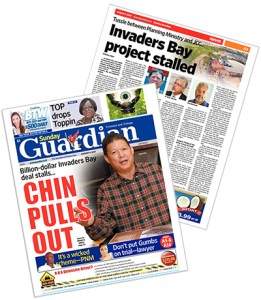 The cover story in Sunday’s Guardian on the Invader’s Bay development requires a response to dispel some of the carefully cultivated confusion around this important set of proposals.
The Public Property known as ‘Invader’s Bay’ comprises 70 acres of reclaimed land at the waterfront in west POS and it is proposed to be the largest development in our capital city in living memory. It is unacceptable that this large-scale development could be proceeding without any public consultation and in the seriously improper manner against which the JCC has protested. It is sobering that the very Ministry of Planning & Sustainable Development (MPSD) has been leading this process for the last four years without seeking to engage in public consultation.
The Request for Proposals (RFP) process used in August 2011 by MPSD was improper and voidable, since, according to Minister Tewarie himself, the Assessment rules were published one month after the closing date. Any reputable organisation running a competition or tender would accept that the rules must be given to all the competitors at the same time and well in advance of the competition itself. That basic and inescapable breach has been pointed-out to MPSD several times by the JCC, but we are yet to see any response on that point.
After JCC specified its concerns that the RFP was in breach of the Central Tenders Board Act, the Minister repeatedly stated that the legal advice was that MPSD was in conformity with the law. Despite our several requests, that advice was never published, so the JCC sued under the Freedom of Information Act. The High Court ruled that the requested information be published and MPSD appealed. One can only wonder at this reluctance by politicians to publish legal advice which supposedly supports their actions. This type of official reticence is a first, so on this count at least, the Invader’s Bay project has a significant element of innovation.
The JCC has enquired as to the cost of the High Court case and the subsequent appeal, but that too has remained undisclosed, for whatever reason.
According to Ms Jearlean John of UDECOTT, a tender has been awarded for design of infrastructure on this 70-acre site, but we also know from MPSD that no planning applications have been made for these developments. That raises the serious question as to how an infrastructure layout can be designed in the absence of either public consultation or relevant approvals.
The carefully cultivated confusion can be seen in three glaring examples – firstly, the question of official responsibility – with Minister Tewarie referring detailed queries to UDECOTT, whose chairman refers those queries back to that Minister. Secondly, according to MPSD, the 10.2 acre parcel allocated to Derek Chin was valued at $204.5M, yet Chin is reported as saying that “…the price is $130M…”. Finally, the entire property is 70 acres and 23.2 acres have been allocated, so it seems that 46.8 acres are to be left undeveloped at this stage. So, how can UDECOTT be responsible for only 51 acres, with Minister Tewarie saying that “…there are about 40 acres of land at Invader’s Bay still open for development…”?
These are a few of the real concerns with this proposed Invaders’ Bay development.
Afra Raymond
JCCPresident
 Afra Raymond is interviewed on the ‘Cruise Control‘ show on Isaac 98.1 FM by Tessa Sampson about the recent judgement in favour of Mr Raymond ordering the publication of the accounts and other material in the CL Financial bailout. 10 August 2015. Audio courtesy Isaac 98.1 FM
 Afra Raymond is interviewed on the ‘The Breakfast Round Table‘ show on Sky 99.5 FM by Eddisson Carr, Jessie May Ventour, Dr Wayne Haywood about the current flare-up by developer Derek Chin regarding his continuation in the controversial and contested Invaders’ Bay project. 10 August 2015. Audio courtesy Sky 99.5 FM

