The previous column outlined the provisions of the current housing policy and some of the implications arising from those. I provided data on housing distribution by tenure and also stated a preliminary view, dismissing the major allegations made against Marlene McDonald – the current Housing & Urban Development Minister.
To understand just how a supposedly-redistributive policy could be used in this fashion, it is necessary to examine how it was changed and how those changes work with the provisions of the Housing Development Corporation Act 2005.
What is the Housing Policy?
 ‘Showing Trinidad & Tobago a new way home‘ was launched on 18th September 2002 by then Housing minister, Senator Danny Montano. At that stage, the policy for allocation of the new homes produced by HDC were –
…How is housing allocated?
All housing that becomes available is allocated in the following way:
- 75% is reserved for public applicants through a random selection system.
- 10% is reserved for the Joint Protective Services – Police, Army, Prisons and Fire Services.
- 15% is assigned to deal with special emergency cases, senior citizens and physically challenged persons…
The rules to qualify for these homes were –
…Do I qualify?
To qualify for a new home, applicants must be:
- A resident citizen of Trinidad and Tobago.
- Twenty-one years of age or over.
- Neither owner nor part owner of a house or land.
- In possession of a Board of Inland Revenue tax file number…
These details are from ‘Applying to Buy a Government House‘ on the TTConnect website, but they are outdated, as they refer to the 2002 position. I was very critical of this ambitious new housing policy, since it was located within this context –
“…The Housing Policy of the Government of Trinidad & Tobago is based on the understanding that every citizen should be able to access adequate and affordable housing regardless of gender, race religion or political affiliation”
Those are important policy guidelines, but they are inadequate to the task, given that they are silent on the single common cause of housing need or homelessness. The point is that all homeless persons, or those with serious housing needs have one thing in common, poverty. Yet the policy is silent on that. That silence was a fatal one since the allocations were being made in accordance with a lottery amongst those who fit the four criteria set out above. I recall attending the 2007 conference of the Caribbean Association of Housing Finance Institutions (CASHFI) and the PS of the Housing Ministry stating that about 95% of the applicants in the system did not qualify for a mortgage.
With no specific allocation numbers for rental units and no weight given to poverty or housing need in the process, the results were predictable. The poorest applicants, the ones who could only afford to rent, were sidelined, as shown in the distribution figures shown.
As I wrote in August 2007 –
“…This is a flawed policy which gives you a ticket in the lottery for a new home, only if you can afford one. But, as the old National Lottery slogan used to say ‘if you haven’t got a ticket, you haven’t got a chance‘…”
In January 2008, the new Housing Minister, Dr Emily Gaynor-Dick-Forde, announced a housing policy review with the specific aim of making housing need a part of the assessment criteria. Despite this encouraging news, it was a case of ‘giving with one hand and taking away with the other’, since the category for ministerial discretion was increased to 25%.
The outcomes are shown in these diagrams, with the greater number of units going to those who could afford to purchase. The perverse policy reached its nadir with the recent revelations that the maximum qualifying monthly income for HDC new homes had been increased to $45,000 at some point in 2014. This was obviously done to cater for persons who were in no housing need whatsoever. I tell you. At least the monthly income limit has now been returned to $25,000 – still way too high for a program which ought to be serving the needy persons in our society, but a step in the right direction.
These charts show just how the housing has been distributed, in terms of tenure.

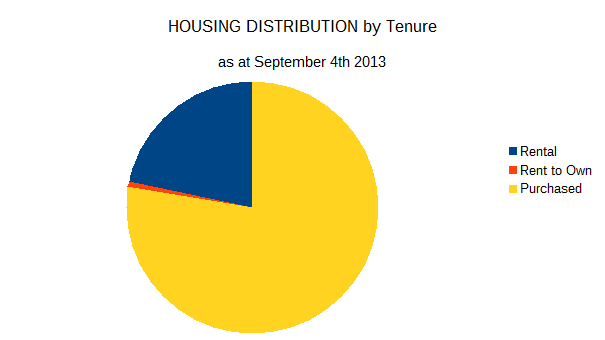
The table of data from which those charts were derived is here –
HDC ALLOCATION of New Homes
| Tenure Type |
August 8th 2011 |
Percentages |
September 4th 2013 |
Percentages |
| Rental |
256 |
3.3% |
1,962 |
21.7% |
| Rent to Own |
111 |
1.4% |
66 |
0.7% |
| Purchased |
7,290 |
95.2% |
7,029 |
77.6% |
| Totals |
7,657 |
100 |
9,057 |
100 |
The Minister’s powers
A Statutory Corporation is a public body established under a special law to perform specified functions. The HDC is a statutory corporation and under the HDC Act – The powers of the Minister are specified at S.12 as –
“…12. The Minister may give to the Board directions in writing of a specific or general nature to be followed in the performance of its functions or the exercise of its powers under this Act, with which the Board shall comply…”
That means that the Minister has the power to order the HDC to perform specific tasks and the HDC has to comply with those directions. As such, the HDC would be required by law to follow a direction from the Housing Minister, as seems to have been the case in the Marlene McDonald episode.
Policy monitoring
SIDEBAR: Secret Policy in Public Bodies
The housing policy is not available online. The allocation policy which is shown online is 14 years out-of-date. The HDC does not issue annual reports as it is required to do by law, but that is for later in the series.
I had enquiries made at HDC last week, but when my staff requested the housing allocation policy, the reply was ‘we don’t know what you are asking us for’. Take that, it is almost like an echo of the widespread official denial of the existence of the 1992 National Land Policy, which became evident in my 2015 ‘Land for Everybody‘ series. I also personally contacted the top person at HDC to request the allocation policy, but got no reply.
All of this points to the question of how well can public policy be monitored in the current situation of a ‘virtual vacuum’ in terms of any details as to actual decisions taken. As demonstrated in the distribution figures shown last week, the outcome can be strikingly different from what one might think from reading the declared policy.In the absence of readily available data, it is possible for applicants who already own property to sign false declarations and obtain houses to which they are not entitled, further depriving the needier citizens. Applicants to the protective services have their names and photos published in the newspapers, as a safety-check against any unsuitable persons being admitted. Despite that safeguard, we all know that unsuitable persons do get admitted to the protective services, so just imagine for a moment what has taken place within the secretive arena of public housing.
Open data is a useful approach which would require all the critical data to be easily available in relation to our public housing program. That approach would enable anyone to get these details –
- Identity of Applicants, together with the details of the category of their applications – i.e. is the person applying as a member of the protective services, a disabled person or a person in housing need.
- Identity of those persons to whom housing has been allocated, together with the category of their applications, as outlined above.
- Numbers of new homes built by HDC.
- Numbers of new homes distributed by HDC.
- Analysis of distribution of new homes by tenure, category of application and development.
The advantages of a system which promoted the routine online release of this information are obvious. Equally obvious are the kinds of strong objections which would be raised by such a proposal, after all, sunlight is the best disinfectant.The key questions which arise on the issue of the Ministerial discretion are –
- Rationale – what is the rationale for allowing a politician to have direct control over such important and scarce resources? Is that an acceptable arrangement?
- Proportion – If one assumes that there is a case for some Ministerial discretion, what part of the output of new homes should be subject to that? Is 25% too high a proportion?
- Monitoring – In the current secretive arrangements, how can we really know just how many new homes have been distributed by Ministerial discretion? Is that complete secrecy an acceptable way to proceed?
Conclusion
Next, the land use implications of the HDC program will be addressed together with the potent estate management issues.

 AFRA RAYMOND, Immediate Past President of the Joint Consultative Council (JCC), comments briefly on the firing of Jearlean John by the new HDC board, after being on administrative leave for a couple of months. He says we should not be too quick to believe the Marlene McDonald dismissal is a sign of greater accountability to come on the part of governments. Mr. Raymond also lauds Government’s proposal to use the housing sector to create opportunities for construction industry, to help pull T&T out of recession.
 This is the ‘On the Couch’ session at the T&T Transparency Institute’s 2016 Anti-Corruption Conference held on Tuesday 8th March 2016. The moderator was Reginald Armour SC, President of the Law Association; Michael Harris, Tapia Member and Express columnist; Mark Regis of Shell Trinidad; and Afra Raymond, managing director of Raymond & Pierre Ltd and Immediate past-President of the JCC
 Although the HDC is the State’s main implementing agency for its housing policy, there are other important elements to be considered. The main one I will examine here is the role of public subsidy in the housing program.

 Afra Raymond is interviewed on Sunday 14th February 2016 by Rennie B on the issues relating to the CL Financial bailout and his ongoing litigation with the Minister of Finance & the Economy to ensure publication of the details of that massive payout of $25Bn + in Public Money.
 AfraRaymond.net